brake AUDI Q5 2015 Repair Manual
[x] Cancel search | Manufacturer: AUDI, Model Year: 2015, Model line: Q5, Model: AUDI Q5 2015Pages: 302, PDF Size: 75.01 MB
Page 224 of 302
Checking and Filling
-Always let the engine cool down. Hot com
ponents will burn skin on contact .
- To reduce the risk of being burned, never
open the hood if you see or hear steam or
coolant escaping from the engine compart
ment . Wait until no steam or coolant can be
seen or heard before carefully opening the
hood.
- Keep children away from the engine com
partment .
- Never spill fluids on hot engine compo
nents . They can cause a fire .
- Never touch the radiator fan. The auxiliary
electric fan is temperature controlled and
can switch on suddenly.
- Never open the coolant reservoir cap when
the engine is still warm. The coolant system
is pressurized and hot coolant could spray
out .
- Protect your face, hands and arm from steam or hot engine coolant by placing a
thick rag over the cap when you open the coolant reservoir .
- Do not remove the engine cover under any
circumstances. This increases the risk of
burns.
- If work on the fuel system or the electrical
system is necessary :
- Always disconnect the battery.
- Never smoke or work near heaters or open
flames . Fluids in the engine compartment
could start a fire.
- Keep an approved fire extinguisher imme
diately available.
- To avoid electrical shock and personal injury
while the engine is running or being started, never touch:
- Ignition cables
- Other components of the high voltage
electronic ignition system.
- If you must perform a check or repair with
the engine running:
- First, fully apply the parking brake , move
selector lever of automatic transmission
to P (Park).
222
- Always use extreme caution to prevent
clothing, jewelry, or long hair from getting
caught in the radiator fan, V-belts or other
moving parts, or from contacting hot
parts . Tie back hair before starting, and do
not wear clothing that will hang or droop
into the engine.
- Minimize exposure to emission and chemi
cal hazards
~ ,&. .
&, WARNING
California Proposition 65 Warning:
- Engine exhaust , some of its constituents,
and certain vehicle components contain or
emit chemicals known to the State of Cali
fornia to cause cancer and birth defects and
reproductive harm. In addition, certain flu
ids contained in vehicles and certain prod
ucts of component wear contain or emit
chemicals known to the State of California
to cause cancer and birth defects or other
reproductive harm.
- Battery posts, terminals and related acces sories contain lead and lead compounds,
chemicals known to the State of California
to cause cancer and reproductive harms .
Wash hands after handling .
('.!) Note
When adding fluids, always make sure that
they are poured into the proper container or
filler opening, otherwise serious damage to
vehicle systems will occur.
@ For the sake of the environment
To detect leaks in time, inspect the vehicle
floor pan from underneath regularly. If you
see spots from oil or other vehicle fluids, have
your vehicle inspected by an authorized Audi dealer.
Page 225 of 302
M N
co ~ co
rl I.O
"' N
"' rl
Checking and Filling
Engine compartment
Engine compartment
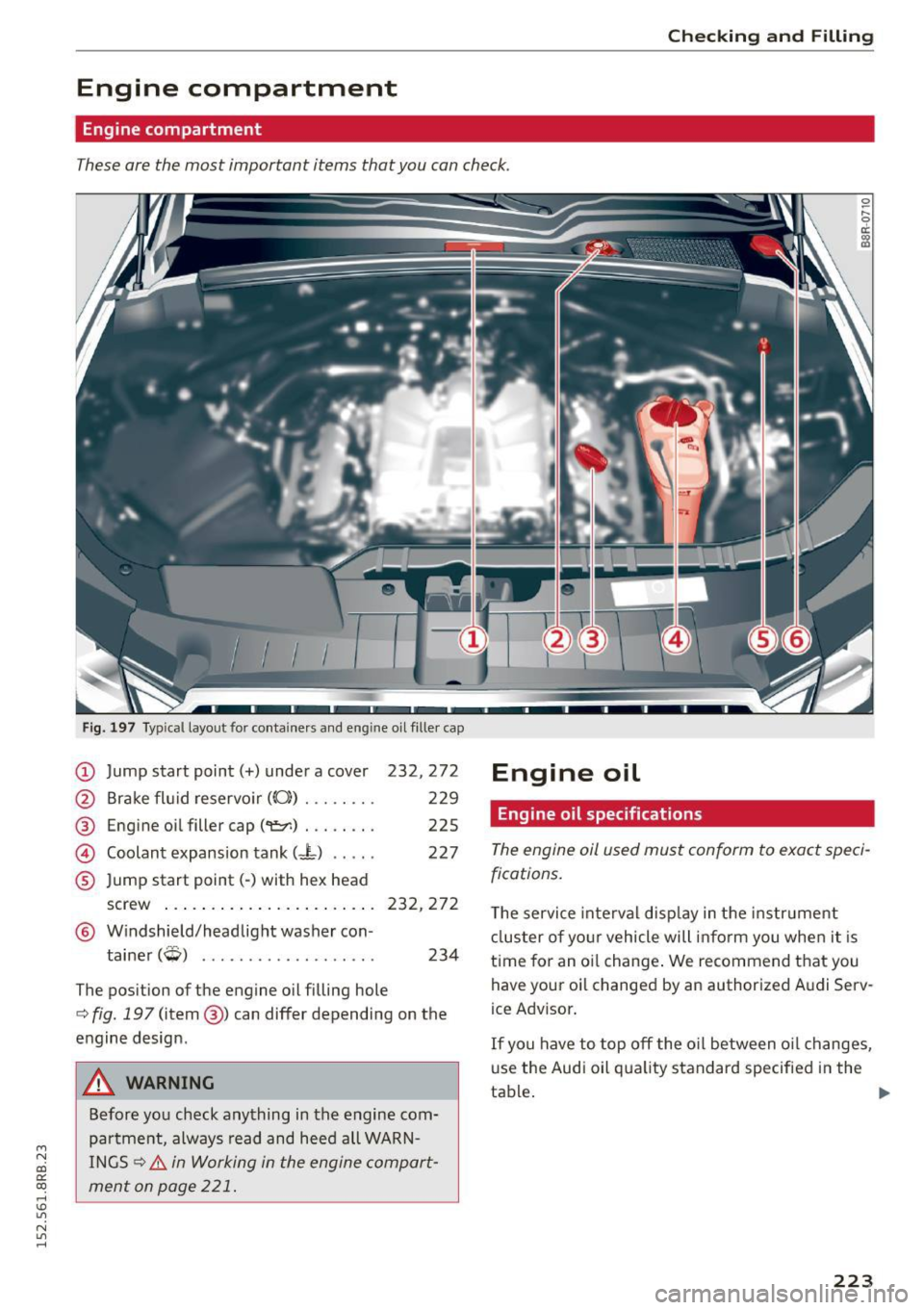
These are the mos t important item s that you can check .
Fig. 197 Typical layou t fo r container s and e ngine oil filler ca p
(D Jump start point(+) under a cover 23 2, 272
@ Brake fluid reservoir (0) . . . . . . . . 229
@ Engine oil filler cap(~) . . . . . . . . 225
@ Coolant expansion tank (- L) . . . . . 227
® Jump start point(-) w ith hex head
s crew . . . . . . . . . . . . . . . . . . . . . . . 232, 272
@ Windshield/headlight washer con -
tainer
(Q) . . . . . . . . . . . . . . . . . . . 234
T he po sit ion of the engine oil filling hole
c:> fig. 197 (item @) can differ depending on the
engine design .
A WARNING
Before you check anything in the engine com
partment, always read and heed all WARN
INGS
c:> &. in Working in the engine compart
ment on page 221.
Engine oil
Engine oil specifications
The engine oil used must conform to exact sp eci
f ications.
T he service interval disp lay in the instrument
cluster of your vehicle will inform you when it is
time for an oi l chang e. We recommend that you
hav e your oil chang ed by an authori zed A udi Serv
ic e Advi sor .
If you have to top off the oil between oil changes,
use the Audi oil qua lity standa rd specified in the
tab~ .
~
223
Page 231 of 302
M N
co ~ co
rl I.O
"' N
"' rl
-To avoid being burned, do not spi ll anti
freeze or coolant on the exhaust system or hot engine parts. Under certain condi
tions, the ethylene glycol in engine cool ant can catch fire.
- Antifreeze is poisonous. Always store anti
freeze in its original conta iner and well out
of the reach of ch ildren .
-If you drain the coolant, it must be caught
and safely stored in a proper container
clearly marked "poison" .
(D Note
-Do not add coolant if the expansion tank is
empty . Air could enter the cooling system
and damage the eng ine .
If this is the case,
do not continue driving. Seek profess ional
ass istance.
- Coolant pollutes the env ironment and could
cause an eng ine fire . Excess coolant will be
fo rced out through the pressure relief valve
i n the cap when the eng ine becomes hot.
- If, i n an emergency , only water can be add
ed, the correct ratio between wa ter and an
tifreeze
~ page 22 7 must be restored as
soon as possib le .
@) For the sake of the environment
Drained coolant should not be reused. Always
dispose o f used coolant while observ ing all
environmental regulations .
Radiator fan
The radiator fan switches on automatically by it
self.
The radiator fan is driven by the engine via the V
be lt . The viscous clu tch regulates the speed of
the fan ac cording to the temperature of the cool
ant.
An auxiliary e lectr ic rad iator fan* switches on and
off depend ing on coolant temperat ure and othe r
veh icle operating conditions.
Afte r you switch the engine off, the auxiliary fan
can continue runn ing for up to 10 minutes -even
Ch eck in g and Fillin g
with the ignition off . It can even switch on again
later by itself¢& , if
- the temperatu re of the engine coo lant rises due
to the heat build- up from the engine in the en
gine compartment, or
- the engine compartment heats up because the
veh icle is parked in intense sun light .
A WARNING
-To reduce the risk of persona l injury never
touch the radiator fan .
- The auxiliary electric fan is temperature con trolled and can switch on suddenly even
when the engine is not running.
- The a uxiliary radiator fan sw itches on auto
matica lly when the engine coolant reaches a
certain temperature and will continue to run
until the coolant temperature drops.
Brake fluid
Checking brake fluid level
The brake fluid level can be checked with a quick
glance .
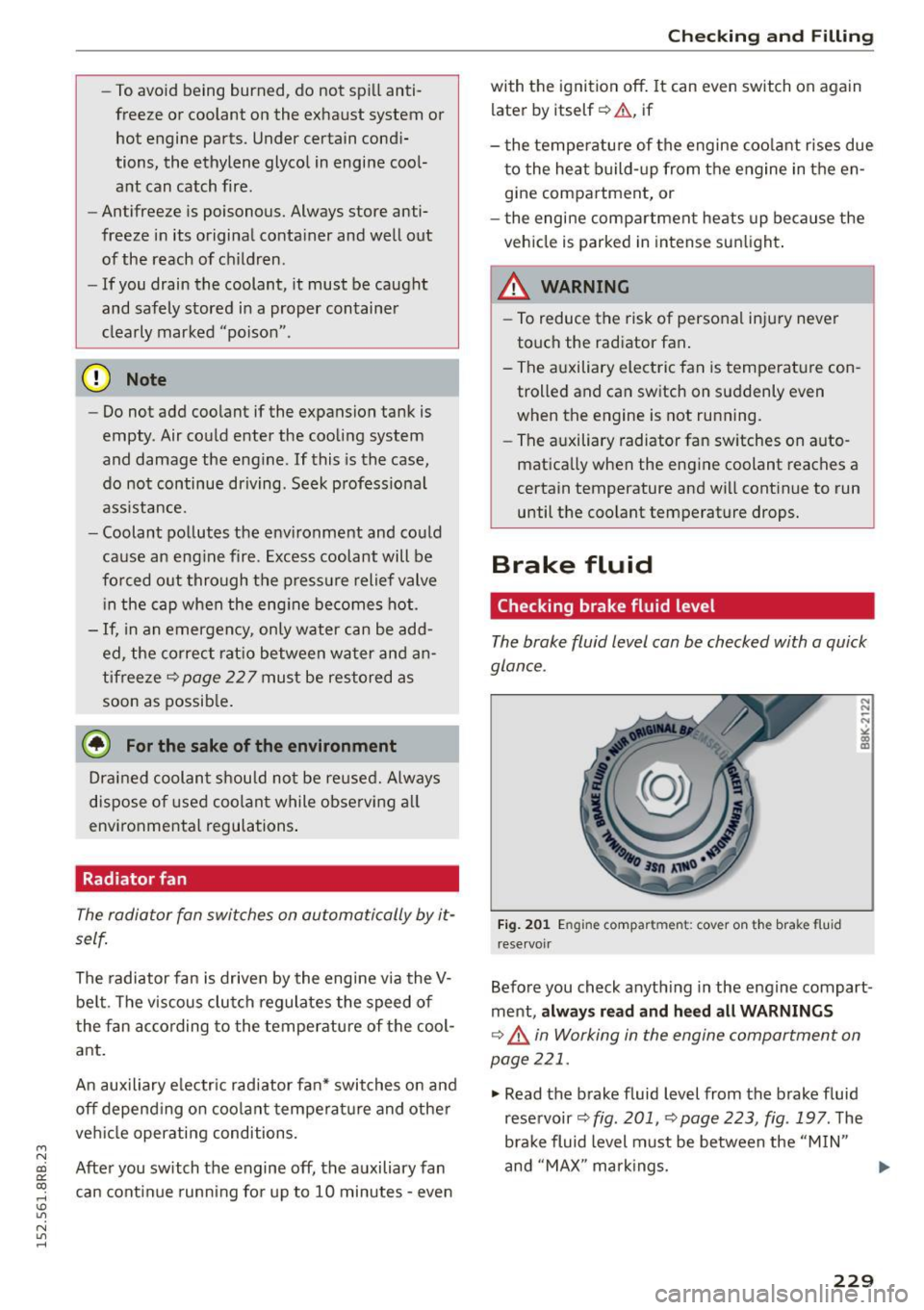
Fig. 201 Engine compar tment : cov er on th e bra ke fluid
r e servoir
Before you check anyth ing in the engine compart
ment,
al way s read and h eed all WARNIN GS
¢ _.& in Working in the engine compartment on
page 221 .
.,. Read the brake fluid level from the b rake fluid
reservoir ¢
fig. 201, ¢ page 223, fig . 197 . The
brake fluid level must be between the
"MIN "
and "MAX " markings.
229
Page 232 of 302
Checking and F ill in g
The brake fluid reservoir is located at the rear
partition of the engine compartment on t he left
side ¢
page 223.
The fl uid level may drop slightly after some time
due to the automatic adjustment of the brake
pads. This is not cause for alarm.
If the b ra ke fluid level fal ls considerably below
the "MIN" mark, the brake warn ing/indicator
light (U.S. models:
1111 , Canadian models: . )
will come on¢
page 18 and ¢ page 28 . Do not
continue to operate the vehicle . The complete
brake system shou ld be thoroughly checked by an
author ized Audi dealer or qualif ied workshop and
the cause corrected. If the brake fluid level is too low, the brake warning/indicator light will illum i
nate. Contact an authorized Aud i dealer
immedi
a tel y.
Changing brake fluid
Have the brake fluid changed by an experienced technician.
Brake flu id abso rbs moisture from the a ir . If the
water content in the brake fluid is too high, cor rosion in the b rake system may result after a pe ri
od of time. The boiling point of the bra ke fluid
will also decrease conside rably and decrease
b ra ki ng per fo rmance .
Therefore, th e brake flu id must be changed
ev ery
tw o years .
Always use new b rake fluid w hich con
forms to Fede ra l Motor Vehicle Standa rd " FMVSS
1 16 DOT 4".
The brake fluid rese rvoir can be difficult to reach,
therefo re, we recommend that yo u have the
b rake fluid changed by your authori zed
Audi
dealer .
Your dealer has the cor rect too ls, the
right brake f luid and the know -how to do t his for
you.
A WARNING
- Brake fluid is po isonous. It must be stored
only in the closed orig inal container out of
the reach of children!
- Brake fai lure can result from old or inappro
pr iate brake fluid . Observe these precau
t ions:
230
- Use only brake fluid that meets SAE spec i
ficat io n
J 1703 and conforms to Federal
Motor Vehicle Sta ndard 116 . Always check
with your aut horized Aud i dea ler to make
su re you are using the correct brake fl uid .
The co rrect type of brake f lu id is also ind i
cated on t he b rake fluid reservoir.
- The brake fl uid must be new. Heavy use of
the b rakes can cause a vapor lock if the
brake fluid is left in t he system too long.
This can se riou sly affec t the efficiency of
the b rakes as well as yo ur sa fety. This
could result in an acc ident .
(D Note
Bra ke fluid will damage the pai nt of you r vehi
cle.
@ For the sake of the environment
B ecause of the prob lem of prope r disposal of
b rake fluid as well as the spe cial tools re
q ui red and the necessary ex pert ise, we rec
ommend that you have the brake f lu id
cha nged by yo ur autho rize d Aud i dea le r.
Battery
General information
U nder normal operat ing conditions , the battery
i n you r Aud i does not need any maintenance.
With
high outside tem pera tures or long d aily
drives we recommend that you have the e lectro
l yte level checked by an a utho rized Audi dea le r or
qualified workshop. The electrolyte leve l should
a lso be checked each time the battery is charged
¢ page 232.
Have the battery checked when yo u take your ve
hicle in for service. You a re well advised to re
place a battery that is older than 5 years.
With cer tain types of airbag deployment, t he bat
tery is disconnected from the vehicle elect rical
system for safety reasons
Q &. in Repair, care
and disposal of the airbags on page 165.
Hybrid drive *: yo u can find important information
abo ut the high voltage battery under ¢
page 98 . ..,.
Page 239 of 302
® Mud and snow capability
"M/S" or "M+S" indicates the tire
has characte ris tics that make it
suitable for driving on mud and snow .
& indica tes a winter tire.
@ Composition of the tire cord
and materials
T he number of plies indicates the
number of rubber ized fabric lay
ers in the tire . In general: the
more layers, the more weight a
tire can carry. Tire manufacturers
must also specify the mater ials
used in the ti re. These include
stee l, nylon, polyester and other
materials.
@ Maximum permitted load
This number indicates the maxi
mum load in kilograms and
pounds that the tire can carry .
@ Uniform tire quality grade
standards for treadwear,
traction and temperature resistance
Treadwear , traction and tempera
ture ranges
c::::> page 251 .
@Running direction
The arrows ind icate the running
direction of unidirect ional tires.
You must always follow the speci- fied running direction
c::::> page 264.
€3) Ma
ximum permitted
inflation pressure
Whe els
This number indicates the maxi
mum pressure to which a tire can
be inflated unde r normal operat
ing conditions .
Glossary of tire and loading
terminology
Accessory weight
means the combined weight (in
excess of those standard items
which may be replaced) of auto matic transmission, power steer
ing, power brakes, power win
dows, power seats, radio, and
heater, to the extent that these
items are available as factory-in
stalled equipment (whether in
stalled or not).
Aspect ratio
means the ratio of the height to
the width of the tire in percent. Numbers of 55 or lower indicate a
low s idewall for improved steer
ing response and better overall
handling on dry pavement . .,.
237
Page 241 of 302
(a) Curb weight
(b) Accessory weight
(c) Vehicle capacity weight, and
(d) Product ion options weight
Maximum (permissible)
inflation pressure
means the max im um cold infla
tion pressu re to which a tire may
be inflated . Also called "ma xi
mum inflation pressure ."
Normal occupant weight
means 150 lbs . (68 kilog rams)
times the number of occupants
seated in the veh ic le up to the to
tal seating capacity of yo ur vehi
c le.
Occupant distribution
means d istr ibution of occupants
in a vehicle.
Outer diameter
means the overall diameter of an
inflated new tire .
Overall width
means the linear dis tance be
tween the exter iors of the side
walls of an inflated tire , including
elevations d ue to labe ling, deco
rations , or protective bands or
ribs .
Whee ls
Ply
means a layer of rubbe r-coated
parallel cords .
Production options weight
means the comb ined weight o f
those installed regular production
options weighing over 5 lbs . (2 .3
kg) in excess o f those s tandard
items which they re place , not pre
viously conside red in c urb weight
or accessory weight, including heavy duty brakes, ride levelers,
roof rac k, heavy d uty batte ry, and
specia l trim .
Radial ply tire
means a pneumat ic t ire in which
the ply cords that ex tend to the
beads are la id at substantially 90
degrees to the centerli ne of the
tread .
Recommended inflation
pressure
see ~ page 2 38, Cold tire infla
tion pressure .
Reinforced tire
means a tire designed to operate
at higher loads and at h igher in
flat ion pressures than the corre
spon ding standard tire . Rein
f orced tires may be identified as
239
Page 245 of 302
M N ai
"' ~
-"' "' N
"' .....
different tire speeds. For this rea
son, in case of emergency, only
use a spare tire* that is the same
circumference as the regular tires.
A WARNING -
-Only use tire/rim combina
tions and suitable wheel bolts
that have been approved by
Audi. Otherwise, damage to
the vehicle and an accident
could result.
-For technical reasons, it is not possible to use tires from oth
er vehicles - in some cases,
you cannot even use tires from
the same vehicle model.
-Make sure that the tires you select have enough clearance
to the vehicle . Replacement
tires should not be chosen
simply based on the nominal
size, because tires with a dif
ferent construction can differ greatly even if they are the
same size. If there is not
enough clearance, the tires or
the vehicle can be damaged
and this can reduce driving
safety and increase the risk of
an accident.
-Only use tires that are more
than 6 years old when abso-
Wheels
lutely necessary and drive
carefully when doing so.
-Do not use run-flat tires on your vehicle . Using them when
not permitted can lead to ve
hicle damage or accidents.
-If you install wheel covers on
the vehicle, make sure they al low enough air circulation to
cool the brake system. If they
do not, this could increase the
risk of an accident.
Tire wear/damage
Fig. 205 Tir e profi le : Treadwear indica
tor
Tire wear
Check the tires regularly for wear.
-Inflation pressure that is too low
or high can increase tire wear
considerably .
-Driving quickly through curves,
rapid acceleration and heavy
braking increase tire wear.
-Have an authorized Audi dealer or authorized repair facility
243
...
Page 250 of 302
Wheels
passengers that the vehicle is in
tended to carry ("seating capaci
ty") with an assumed weight of 150 lbs. (68 kg) for each passen
ger at a designated seating posi
tion and the total weight of any
luggage in the vehicle. If you tow
a trailer, the weight of the trailer
hitch and the tongue weight of
the loaded trailer must be includ
ed as part of the vehicle load.
The
Gross Axle Weight Rating
("GAWR") is the maximum load
that can be applied at each of the
vehicle's two axles.
The fact that there is an upper limit to your vehicle's Gross Vehi
cle Weight Rating means that the
total weight of whatever is being
carried in the vehicle (including
the weight of a trailer hitch and
the tongue weight of the loaded
trailer) is limited. The more pas
sengers in the vehicle or passen
gers who are heavier than the
standard weights assumed mean
that less weight can be carried as
luggage.
The Gross Vehicle Weight Rating
and the Gross Axle Weight Rating
are listed on the safety compli
ance sticker label located on the
248
driver's side B-pillar ~ page 245,
fig. 206.
~ WARNING
Overloading a vehicle can cause
loss of vehicle control, a crash
or other accident, serious per
sonal injury, and even death.
-Carrying more weight than your vehicle was designed to carry will prevent the vehicle
from handling properly and in
crease the risk of the loss of
vehicle control.
-The brakes on a vehicle that
has been overloaded may not
be able to stop the vehicle
within a safe distance.
-Tires on a vehicle that has
been overloaded can fail sud
denly, including a blowout and
sudden deflation, causing loss
of control and a crash.
-A lways make sure that the to
tal load being transported -
including the weight of a trail
er hitch and the tongue
weight of a loaded trailer -
does not make the vehicle
heavier than the vehicle's
Gross Vehicle Weight Rating.
Page 262 of 302
Emerg enc y ass is tance
CJ) Note
Special care is required if you are repairing the
tire on a steep incline.
@ Tips
- Do not operate the compressor for more
than 12 minutes continuously, otherwise it
can overheat . Once the compressor has
cooled, you can continue to use it.
- If sealant has spi lled out, let it dry and then
you can remove it by peeling it away like a
foil.
- Remember to obtain a new bottle of sea lant
from yo ur authorized Aud i dea ler after re
pairing a tire. After this, the functionality of
the tire repa ir set is restored.
- Obey all laws.
Replacing wheels
Before changing a wheel
Observe the following precautions for your own
and your passenger's safety when changing a
wheel.
.. After you experience a tire fa ilure, pull the car
well away from moving traffic and try to reach
l eve l ground before you stop¢_& .
.. All passengers sho uld
le ave t he car and move
to a safe location (for instance, behind the
guardrail)¢ _&.
.. Engage the
parking br ake to prevent your vehi
cle from rolling unintentionally¢_& .
.. Move
select or lever to pos itio n P ¢ &_ .
.. If you are tow ing a trailer: unhitch the trailer
from your vehicle .
.. Block the diagonally opposite wheel with the
folding chocks or other objects.
.. Take the
jack * and the in flat abl e s par e tir e*
out of the luggage compartment¢ page 255.
A WARNING
You or your passengers could be injured while
changing a wheel if you do not follow these
safety precautions:
- If you have a flat tire, move a safe distance
off the road. Turn off the engine, t urn the
260
emergency flashers on and use other warn
ing dev ices to alert other motor ists.
- Make sure that passengers wait in a safe
place away from the vehicle and well away
from the road and traffic.
- To help prevent the vehicle from moving
suddenly and possibly slipping off the jack*,
always fully set the parking brake and block
the wheel diagonally opposite the wheel be
ing changed with the folding chocks or oth
er objects. When one front wheel is lifted
off the ground, placing the Automatic Tra ns
m iss ion in P (Pa rk) w ill
not prevent the veh i
cle from moving.
- Before you change a whee l, be sure the
ground is level and firm.
If necessary, use a
sturdy board under the jack *.
- Always store the vehicle tool kit, the jack*
and the replaced tire in the luggage com
pa rtment
¢ page 140.
Changing a wheel
When you change a wheel, follow the sequence
described below step-by-step and in exactly that
order .
1. Remove the d eco rativ e wheel cover*. For
more details see also¢
page 261, Decora
tive wheel covers
or ¢ page 261, Wheels
with wheel bolt caps .
2. Loosen the wheel bolts¢ page 261 .
3. Locate the proper mounting point for the
jack* and align the jack* be low that point
¢ page 262.
4. Lift the car with the jack*¢ page 262 .
5 . Remove the
wheel with th e flat tire and then
install the
inflatable spa re ti re*
¢ page 263.
6. Tig hte n a ll whee l bolts ligh tly .
7 .
Lo we r the vehicle with the jack* .
8 . Use the wheel bolt wrench and
firml y tighten
all wheel bolts ¢
page 261.
9. Replace the decorative wheel co ve r* . ...
Page 264 of 302
Emergency assistance
... Take tight hold of the end of the wrench handle
and turn the wheel bolts
counter-clockwise
about one single turn in the direction of arrow
c::> fig . 218.
Tightening
" Install the wheel bolt wrench over the wheel
bolt and push it down as far as it will go .
... Take tight hold of the
end of the wrench handle
and turn each wheel bolt
clockwise until it is
seated.
A WARNING
- Do not use force or hurry when changing a
wheel -you can cause the vehicle to slip off
the jack* and cause serious personal inju
ries.
- Do not loosen the wheel bolts more than
one turn
before you raise the vehicle with
the jack*. - You risk an injury.
{D) Tips
If a wheel bolt is very tight, you may find it
easier to loosen by carefully pushing down on
the end of the wheel bolt wrench with
one
foot only.
As you do so, hold on to the car to
keep your balance and take care not to slip.
Raising the vehicle
The vehicle must be li~ed with the jack* first be
fore the wheel can be removed.
Fig. 219 Sill panels: mark in gs
262
Fig. 220 Sill: posi tioning the jack
... Engage the parking brake to prevent your vehi
cle from rolling unintentionally
... Move the
selector lever to position P.
... Find the marking (imprint) on the sill that is
nearest the wheel that will be changed
c::> fig. 219 . Behind the marking, there is a lift
ing point
on the sill for the jack*.
"Turn the
jack* located under the lifting point on
the sill to raise the jack until its arm @
c::> fig. 220 is located under the designated plas
tic mount
c::> &. c::>(j).
... Align the jack* so that its arm @ c::> fig. 220 en
gages in the designated lifting point in the door
sill and the movable base ® lies flat on the
ground. The base ® must be
vertical under the
lifting point @.
"Wind the jack* up further until the flat tire
comes off the ground
c::> ,&. .
Position the jack* only under the designated lift
ing points on the sill
c::> fig. 219. There is exactly
one location for each wheel. The jack* must not
be positioned at any other location
c::> .&. c::>(D.
An unstable surface under the jack* can cause
the vehicle to slip off the jack* . Always provide a
firm base for the jack* on the ground . If necessa
ry place a sturdy board or similar support under
the jack*. On
hard, slippery surfaces (such as
tiles) use a rubber mat or similar to prevent the
jack* from slipping
c::> ,&..
A WARNING -
-You or your passengers could be injured
while changing a wheel if you do not follow
these safety precautions: