sport mode AUDI Q5 2015 Owners Manual
[x] Cancel search | Manufacturer: AUDI, Model Year: 2015, Model line: Q5, Model: AUDI Q5 2015Pages: 302, PDF Size: 75.01 MB
Page 100 of 302
Hybrid
Hybrid
Hybrid drive
Introduction
App lies to veh icles: w ith hybr id drive
Gener al inf orm ation
The hybr id drive is a combined drive concept that
automatically switches between combustion en
g ine and electr ic drive types or combines them.
All work on h igh voltage systems is intended only
for h igh voltage technicians and may only be per
formed by authorized service facilities in accord
ance w ith Aud i regulations.
The high voltage system is composed of the fol lowing h igh voltage components: the h igh volt
age battery, the power electronics, the e lectr ic
motor, the h igh voltage A/C compressor and the
orange h igh vo ltage w iring.
High volta ge battery
The high voltage battery is located in the luggage
compartment underneath the cargo floor . You do
not need to perform any maintenance work on
the high voltage battery. Additional information
about the h igh vo ltage battery can be found un
der
r::!v page 105 .
The high voltage battery service plug is a lso
found underneath an orange cover under the ca r
go floo r. T he service plug is provided on ly for use
by service personne l and must not be removed by
others who are not trained to use it .
A WARNING
The voltage in the high voltage system is life
threatening. Touching a damaged high vo lt
age component can result in a fatal electric
shock. The components in the high voltage
system are marked w ith a warning label wh ich
warns against the h igh voltage.
- Never perform work on orange h igh voltage
cables or on high voltage components. Only
authorized repair facilities that are certified
may perform wo rk on the high voltage sys
tem.
98
- Never open or remove the service plug cover
in the center of the cargo floor.
- Never damage, alter o r remove the orange
high voltage cable or disconnect it from the
high voltage system.
- Aud i regu lations must be followed during
all work performed on the high voltage sys
tem and high voltage components.
A WARNING
While in electric dr ive mode, the veh icle pro
duces considerab ly less id ling, driving and op
erat ing no ise than when the combustion en
g ine is running. This may make it difficult or
impossible fo r othe rs such as pedes trians and
chi ld ren to hear and notice the veh icle when it
is in electrical drive mode . This can lead to
collisions and inj uries, for example in low traf
fic areas, when maneuvering or when driving
in reverse.
A WARNING
Never leave the vehicle unattended whi le in
the drive ready mode. The vehicle could begin moving if the accelerator peda l is pressed,
even if the combustion engine is switched off .
This may cause collisions and severe or fatal injuries. When the vehicle enters dr ive ready
mode, the status message
h• .,rid ii J ap
pears br iefly in the instrumen t cluster display
and the needle in the powe r meter points to
READ Y ¢ page 99.
-When exi ting the vehicle, make sure these
lecto r lever is i n the P position, the ignition
is switched off and the hybrid system is de
activated.
(D Note
- T he h igh voltage system can be damaged if
the vehicle underbody comes into contact
with the ground. Immediate ly drive your ve
hicle to an authorized repair facility and
have it inspected.
- Do not transport fluids in open containers in
the luggage compartment. Spill ed fluids
can seep underneath the cargo floor. This
can damage the high voltage system.
-
Page 105 of 302
M N
co
a:
co
,...., \!) 1.1'1
N 1.1'1 ,....,
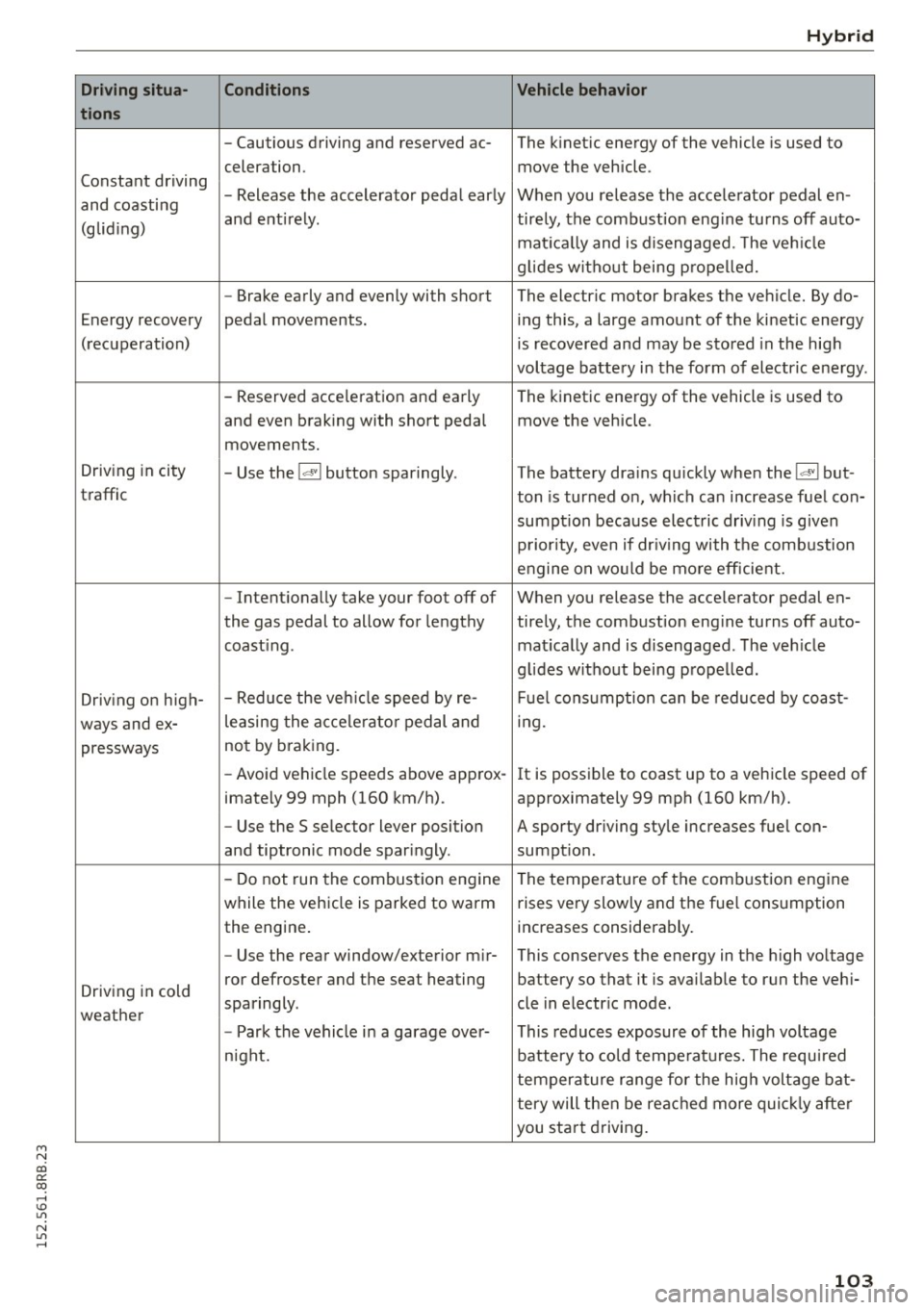
Driving situa-
tions
Constant driving
and coasting
(glid ing)
Energy recovery
(recuperation)
Driving in city
traffic
Driving on high-
ways and ex- pressways
Driving in cold
weather
Conditions
- Cautious driving and reserved ac-
celeration .
- Release the accelerator pedal early
and entirely .
- Brake early and evenly with shor t
pedal movements.
- Reserved acce leration and early
and even braking with short pedal
movements.
- Use the
!<=!VI button sparingly.
- Intentionally take your foot off of
the gas pedal to allow for lengthy
coast ing .
- Reduce the veh icle speed by
re-
leasing the acce lerato r pedal and
not by braking.
- Avoid vehicle speeds above approx-
imately 99 mph (160 km/h).
- Use the S selec tor lever position
and tiptronic mode sparingly .
- Do not run the combustion erngine
while the veh icle is parked to warm
the engine.
- Use the rear window/exterior mir-
ror defroster and the seat heat ing
sparingly .
- Park the vehicle in a garage over-
night. Hybrid
Vehicle behavior
The kinetic energy of the vehicle
is used to
move the vehicle .
When you release the accelerator pedal en-
tirely, the combustion eng ine turns off auto-
matically and is disengaged. The veh icle
g lid es without being propelled.
The electric motor brakes the vehicle. By do- ing this, a large amount of the kinetic energy
is recovered and may be stored in the high
voltage battery in the form of electric energy .
The kinetic energy of the vehicle is used to
move the vehicle .
T he battery drains quickly when the
!<=!VI but-
ton is turned on, which can increase fuel con-
sumpt ion because electric driv ing is given
priority, even if driving with the combustion
engine on wo uld be more efficient.
When you release the accelerator pedal en-
tirely, the combustion engine turns off auto- matically and is disengaged . The vehicle
g lid es without being propelled.
Fu el consumption can be reduced by coast-
ing .
It is possible to coast up to a vehicle speed of
approximately 99 mph (160 km/h).
A sporty dr iving style increases fuel con-
sumpt ion .
The temperature of the combustion engine
rises very slowly and the fue l consumption
increases considerably.
This conserves the energy in the high voltage
bat tery so that it is available to run the veh i-
cle in electr ic mode .
This reduces exposure of the high voltage
battery to cold temperatures. The required
temperature range for the high voltage bat-
tery will then be reached more quickly after
you start driving.
103
Page 122 of 302
Audi drive select
Audi drive select
Driving settings
Introduction
Applies to veh icles: w ith Audi drive select
Drive select provides the possibility to experience
d ifferent types of vehicle settings in one vehicle.
F or instance, using the three
Comfort, Auto and
Dynamic modes, the driver can switch from a
sporty to a comfortable driving mode with the press of a button.
Addit ionally, in vehicles with MM I*, the vehicle
setup for
Individual* mode can be customized by
you. This makes it possible to combine settings
such as a sporty engine tuning with comfortable
steering .
A WARNING
-
Improper use of the drive select can cause
collisions, other accidents and serious person
al injury.
Description
Applies to veh icles: w ith Audi dr ive select
The vehicle setup in each mode depends on the
veh icle's features . However, the engine, automat
ic transmission and steering are always involved.
Engine and automatic transmission
Depending on the mode, the engine and the au
tomatic transmission respond quicker or in a
more balanced manner to accelerator pedal
movements. In the sporty dynamic mode, the au
tomatic transmission shifts at higher RPMs.
Steering
The steering adapts in terms of steering effort and steering ratios. Indirect steer ing that moves
easily, like the steering in comfort mode, is best
suited to long drives on a highway. In contrast,
dynamic mode provides sporty, direct stee ring.
The follow ing applies to vehicles with dynam ic
steer ing*: the steering ratio changes based on ve
h icle speed in order to maintain optimum steer
ing effort for the dr iver at all times. This sets the
s teer ing to be less sensitive at higher speeds in
120
order to provide improved vehicle control. At re
duced speeds, however, steering is more direct in
order to keep the steer ing effort as m inima l as
possib le when the driver is maneuvering the vehi
cle. At low and average speeds, dynamic steering
additionally provides more responsive steering
performance.
Adaptive dampers*
The adaptive dampers* use sensors to record in
formation regarding steering movements, brak ing and acceleration operations by the driver,
road surface, driving speed, and load. This makes
i t possible to adapt damp ing to the driving situa
tion virtually in real t ime . Drive select also makes
i t possible to sat isfy the desire fo r sporty suspen
s ion (Dynamic) and comfortable suspension
(Comfo rt) without giving up ba lanced tuning (Au
to).
Engine sound*
T he sound of the engine is adapted to the select
ed mode and ranges from subtle to sporty.
Adaptive cruise control*
The behavior when accelerating can be adjusted
from comfortable to sporty, depending on the
drive select mode . Adaptive cruise control a lso
r esponds to the driving behavior of the vehicle
ahead in a more conse rvative or sporty manner.
@ Tips
- In some models, the maximum vehicle
speed can only be reached in the
Auto and
Dynamic modes.
- Selecting the
Dynamic mode resu lts in spor
ty shifting characteristics. The 5 gear pos i
tion engages automatical ly.
- In vehicl es that have dynamic stee ring*, op
erating noise is heard when starting or stop
ping the engine. This does not indicate a
problem .
Page 123 of 302
M N
co ~ co
rl I.O
"' N
"' rl
Selecting the driving mode
Applies to vehicles: with Audi drive select
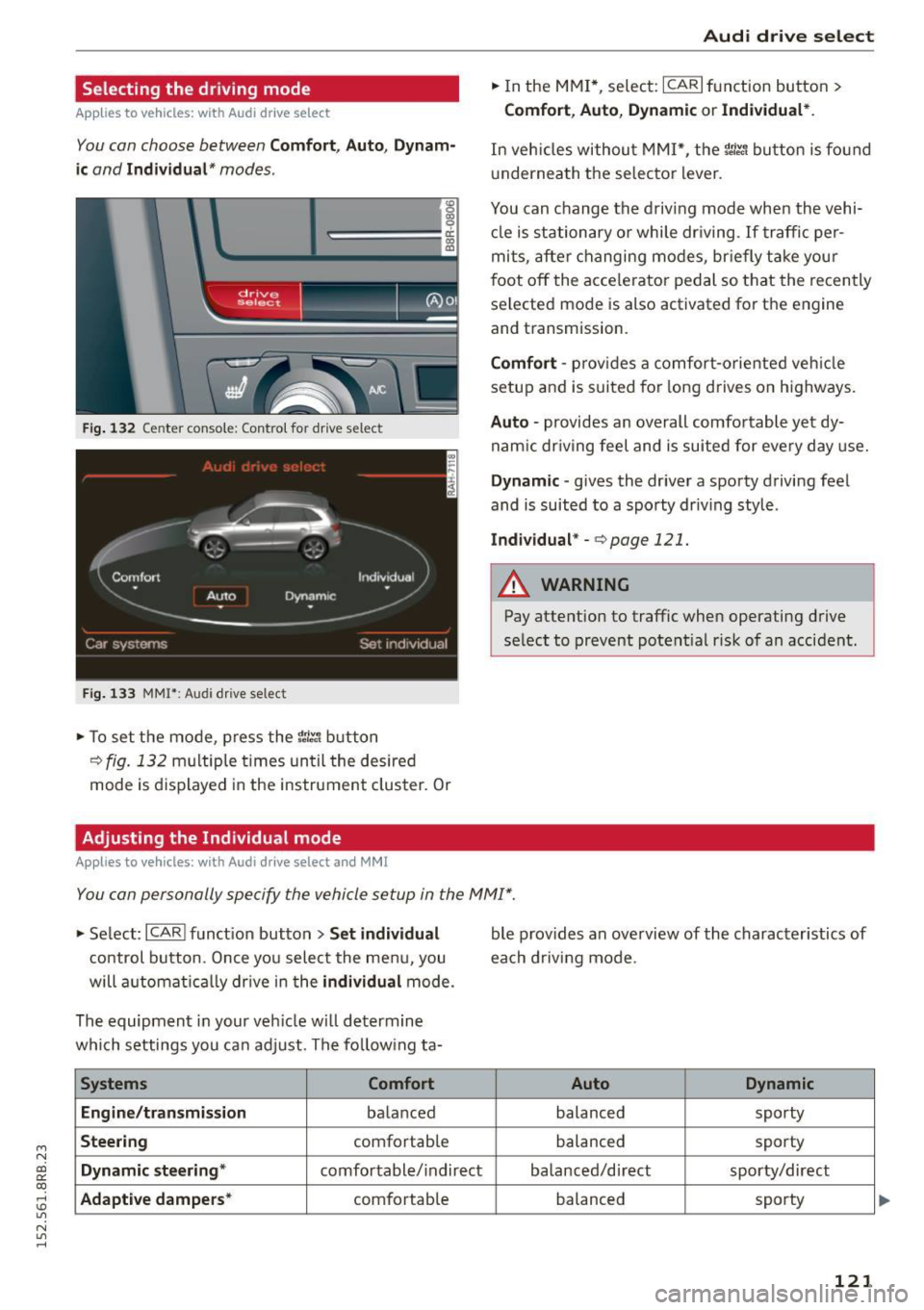
You con choose between Comfort, Auto, Dynam
ic
and Individual* modes .
«>
~ 9
c:=====::::;: ~ a,
drive I I r.,. select _ - ~
Fig. 132 Center console: Contro l for drive select
Fig. 133 MMI": Audi drive select
.. To set the mode, press the r:i.r., button
c>fig. 132 multiple times until the desired
mode is displayed in the instrument cluster. Or
Adjusting the Individual mode
Applies to vehicles: with Audi drive select and M MI
Audi drive select
.. In the MMI*, select: ICARI function button>
Comfort , Auto, Dynamic or Individual* .
In veh ides without M MI*, the r~~, button is found
und ernea th the selector lever .
You can change the driving mode when the vehi cle is stationary or while driving . If traffic per
mits, after changing modes, briefly take your
foot off the accelerator pedal so that the recently
selected mode is also activated for th e engine
and transmission.
Comfort -provides a comfort-oriented vehicle
setup and is suited for long drives on highways.
Auto -provides an overall comfortable yet dy
namic driving feel and is suited for every day use.
Dynamic -gives the driver a sporty driving feel
and is suited to a spo rty driving style .
Individual* -c> page 121.
A WARNING
-Pay attention to traffic when operating drive
select to prevent potential risk of an accident.
You can personally specify the vehicle setup in the MMI" .
.. Select: I CARI function button > Set individual
control button. Once you select the menu, you
will automatically drive in the
individual mode.
The equipment in your vehicle will determine
which settings you can adjust . The following ta-
Systems Comfort
Engine/transmission
balanced
Steering comfortable
Dynamic steering * comfortable/indirect
Adaptive dampers* comfortable ble
provides an overview of the characteristics of
each driving mode.
Auto Dynamic
balanced sporty
balanced sporty
balanced/direct sporty/direct
balanced sporty
121
Page 125 of 302
M N
co
a:
co
,...., \!) ..,.,
N ..,., ,....,
Automatic transmission
tiptronic
Introduction
Th e automat ic transm iss ion is controlled elec
tronically. The transmiss ion ups hifts o r down
shifts aut om atic ally depe nding on which drive
p rogram is se lected. The power is t ransferred by
a to rque conve rter .
W hen a
moderate driving style is used, the
tr an smi ssion se lec ts the mos t econom ica l dr iving
mode.
It will then change up early an d de lay the
downshifts to give better fue l economy.
The t ran smis sion swi tches to a sporty mode a fter
a kick-down o r w he n the dr iver uses a
sporty driv
ing style
cha racte rized by quick acce lerator pedal
movements, heavy acceleration, frequent
changes in speed and traveling at the max imum
speed.
If desired, the drive r can a lso se lect t he gears
manually (tiptronic mode ) ¢page 127.
Selector lever positions
0
~ 9 a: CX) ID
Fig. 1 34 Disp lay in t he instru ment cluste r: selecto r leve r in
pos it io n P
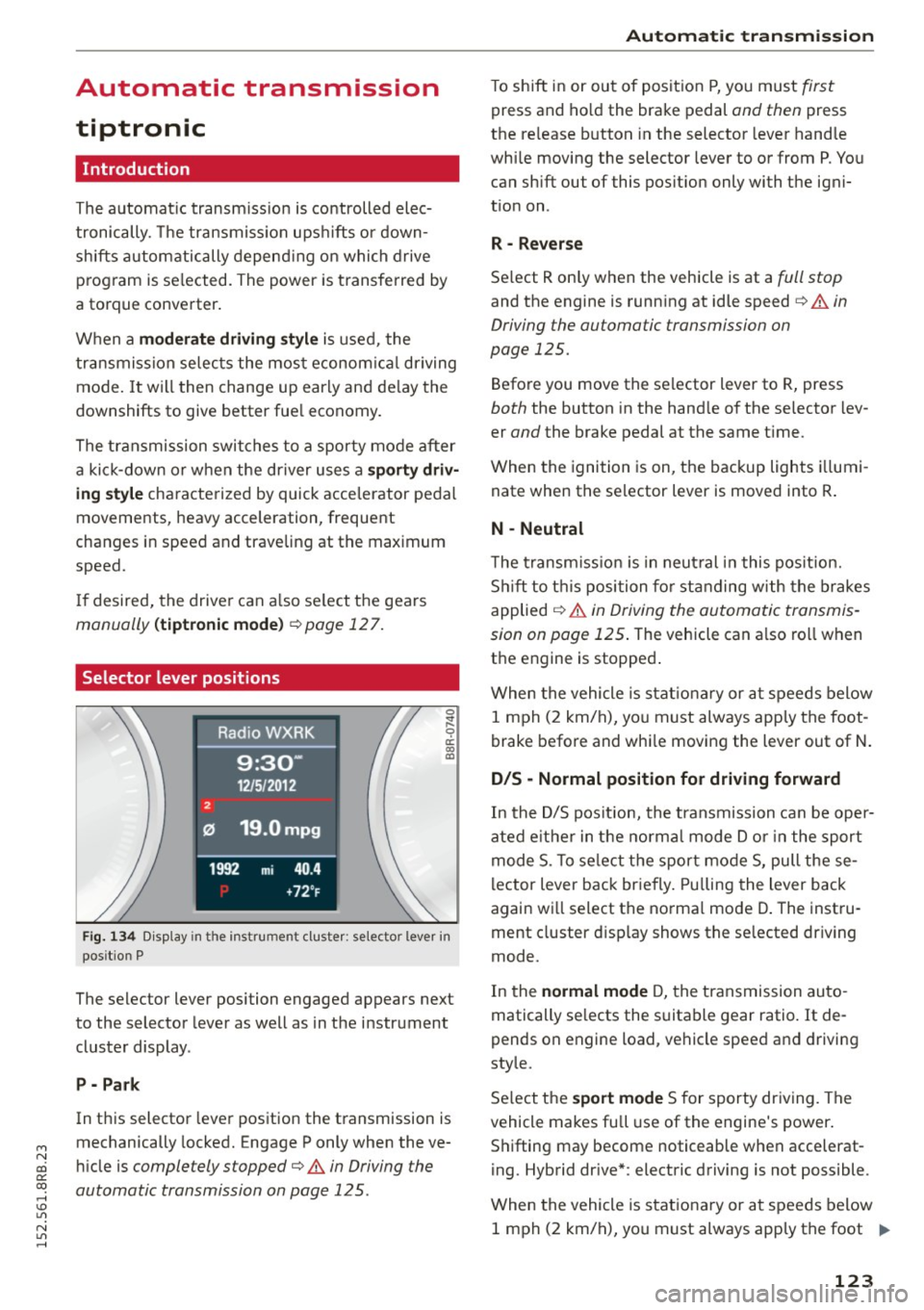
The selector lever position engaged appears next
to the selector leve r as well as in the instrument
cluste r display .
P - Park
In this selector leve r pos ition the t ransmission is
mechanically locked. Engage P only when the ve
hi cle is
completely stopped¢ A in Driving the
automatic transmission on page 125 .
Automatic transmission
T o shift in or ou t of pos it ion P, you must first
press and ho ld the brake pedal and then press
t h e re lease button in the selector leve r hand le
whi le mov ing the selector lever to or from P. Yo u
can sh ift out of this pos it io n only with t he igni
t io n on .
R - Rever se
Se lect R only when the vehicle is at a full stop
and the engine is runn ing at idle speed¢ A in
Driving the automatic transmission on
page 125.
Befo re you move the se lector lever to R, press
both the button in the hand le of the se lecto r lev
er
and the brake pedal at the same t ime.
When the igni tion is on, the backup lights illumi
nate when the se lector lever is moved into R .
N - Neutral
The trans mission is in neu tral in t his pos ition.
Shi ft to t his posi tion for stand ing w ith th e br akes
applied
¢ A in Driving the automa tic transmis
sion on page 125 .
The vehicle can a lso ro ll when
t h e engine is stopped .
W hen the vehicle is stat ionary or a t speeds below
1 m ph ( 2 km/h), yo u m ust always app ly t he foot
brake bef ore and whi le moving the lever out of N.
D/S - Normal position for driving forward
In the D/S pos it ion, the tra nsmission ca n be ope r
ated e it h e r in the normal m ode Dor i n the sport
m ode S . To selec t th e spor t mo de S, pull these
l ector lever bac k br ie fly. Pullin g t he lever back
again w ill select t he no rma l mode D. The inst ru
ment cluster d isp lay shows t he se lected dr iving
mode.
In the
normal mode D , the t ransmission au to
matically se lects the s uita ble gear ratio.
It de
pends on engine load, vehi cle spee d and drivi ng
style.
S e lect t he
sport mode S for sporty dr iv ing. The
vehicle makes full use of the engine's power .
S hi fting may become noticeable when accelerat
i ng. Hybrid dr ive *: electric d riving is not possible .
When the vehicle is s tat iona ry or a t speeds below
1 m ph ( 2 km/ h), yo u m ust always app ly t he foot
IJ>-
123
Page 126 of 302
Automatic transmission
brake before and while moving the lever to D/S
out of N.
A WARNING
Read and follow all WARNINGS c:> &_in Driv
ing the automatic transmission on
page 125.
(D Note
Coasting downhill with the transmission in N
and the engine not running will result in dam
age to the automatic transmission and possi
bly the catalytic converter .
{!) Tips
-On vehicles with Audi drive select*, you can
adjust the sporty shift characteristics in the
Dynamic driving mode.Swill appear in the
instrument cluster display instead of D .
- If you accidentally select N while driving,
take your foot off the accelerator pedal im·
mediately and wa it for the engine to slow
down to idle before select ing D/S .
- Hybrid drive* : if the
1~1 button c:> page 101
is pressed while in sport mode S, the trans
mission switches automatically to the nor·
mal mode D.
- If there is a power failure, the selector lever
will not
move out of the P pos ition. The
emergency release can be used if this hap
pens
c:> page 128.
124
.
Automatic Shift Lock (ASL)
T he Automatic Shift Lock safeguards you against
occidentally shifting into a forward or the re· verse gear and causing the vehicle to move unin
tentionally.
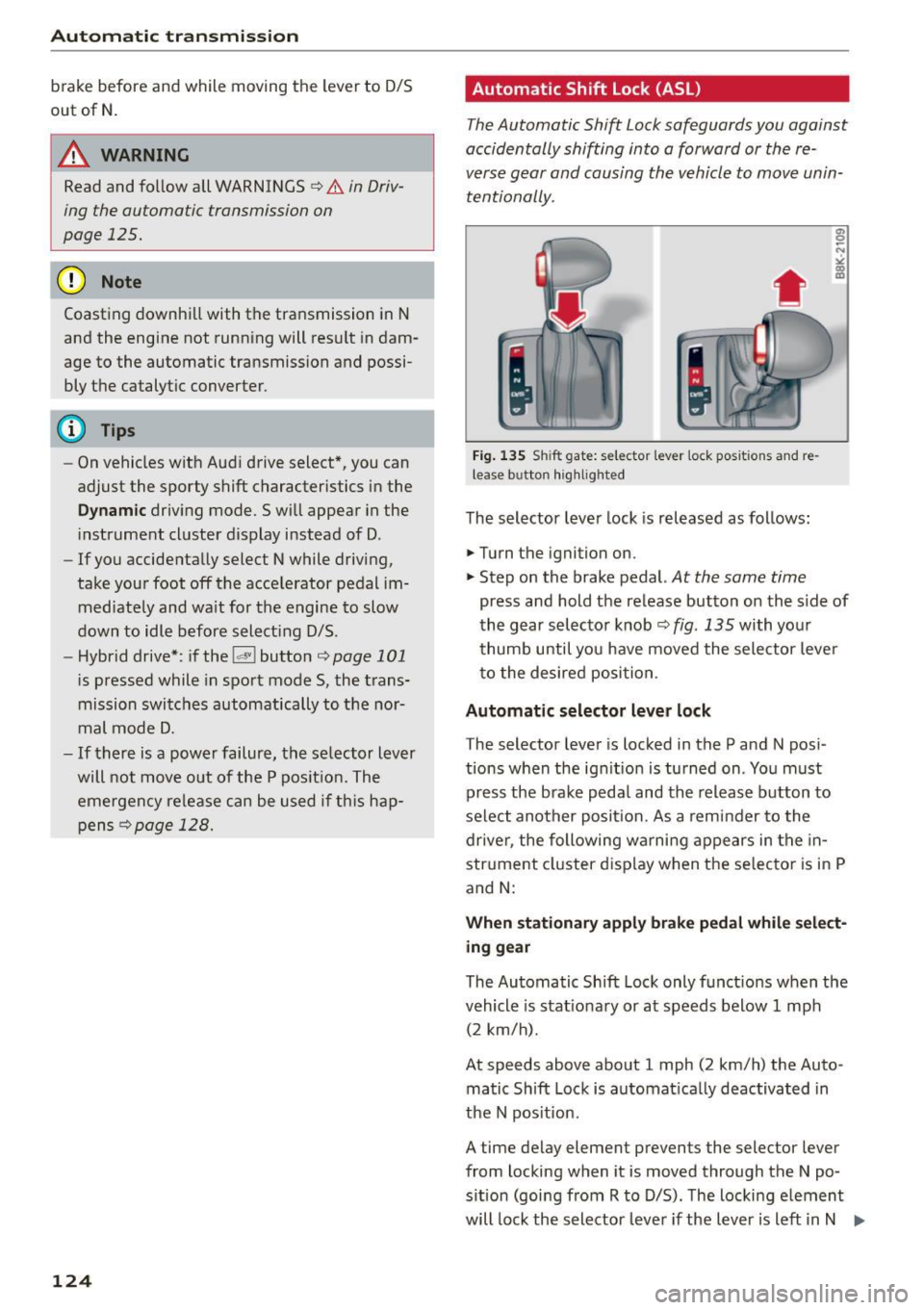
' Fig. 135 S hi ft gate: selector lever lock posit ions and re
lease b utton highlighted
The selector lever lock is released as fol lows:
.,. Turn the ignition on.
.,. Step on the brake pedal.
At the some time
press and hold the release button on the side of
the gear selector knob
c:> fig. 135 with your
thumb until you have moved the selector lever
to the desired position.
Automatic selector lever lock
The selector lever is locked in the P and N pos i
tions when the ignit ion is turned on. You must
press the brake peda l and the release button to
select another position. As a reminder to the
driver, the following warni ng appears in the in
str ument cluster display when the selector is in P
and
N:
When stationary apply brake pedal while select
ing gear
The Automatic Shift Lock only funct ions when the
vehicle is stat ionary or at speeds below 1 mph
(2 km/h).
At speeds
above about 1 mph (2 km/h) the Auto
matic Shift Lock is automat ica lly deactivated in
the N pos ition.
A time delay element prevents the selector lever
from locking when it is
moved through the N po
s ition (going from R to D/S) . The locking e lement
will lock the selector lever if the lever is left in N .,..
Page 130 of 302
Automatic transmission
The transmission temperature has increased sig
nificant ly due to the sporty driving man ner. Drive
in a less sporty manner unti l the temperature re
turns to the normal range and the indicato r light
sw itches of.
[§J Transmi ssion malfunction: You can continue
driving
There is a sys tem ma lf u nction in the tr ansmis
sion . You may continue driving. Drive to your au
thorized A udi dealer or qualified repair facility
soon to have the malf unct io n corrected.
[§J Transmi ssion malfunction: Limited driving
functionality
T here is a sys tem ma lf u nction in the transmis
si on . The tr ansmis sion is sw itch ing t o emergen cy
mode. This mode only shi fts in to cert ain gears o r
will no longer shift a t all. The engine may s tall.
Drive to yo ur aut ho rized Audi dea le r o r qu alified
repair facility immediately to have the ma lf u nc
tion corrected.
[§J Transmission malfunction: Stop vehicle and
shift to park .
Do not contin ue dr ivi ng. Sele ct the P se lec tor lev
e r p osition and see yo ur auth o rize d Aud i de aler
or qualified repair fac ility for assistance .
(D Note
If the tra n sm ission switc hes to e mergency
mo de, you sho uld take the vehicle to an au
t horized A udi d ealershi p as soo n as poss ible
to have the co ndition corrected .
128
Selector lever emergency release
If the vehicle's power supply fails, the selector
lever can be released in an emergency .
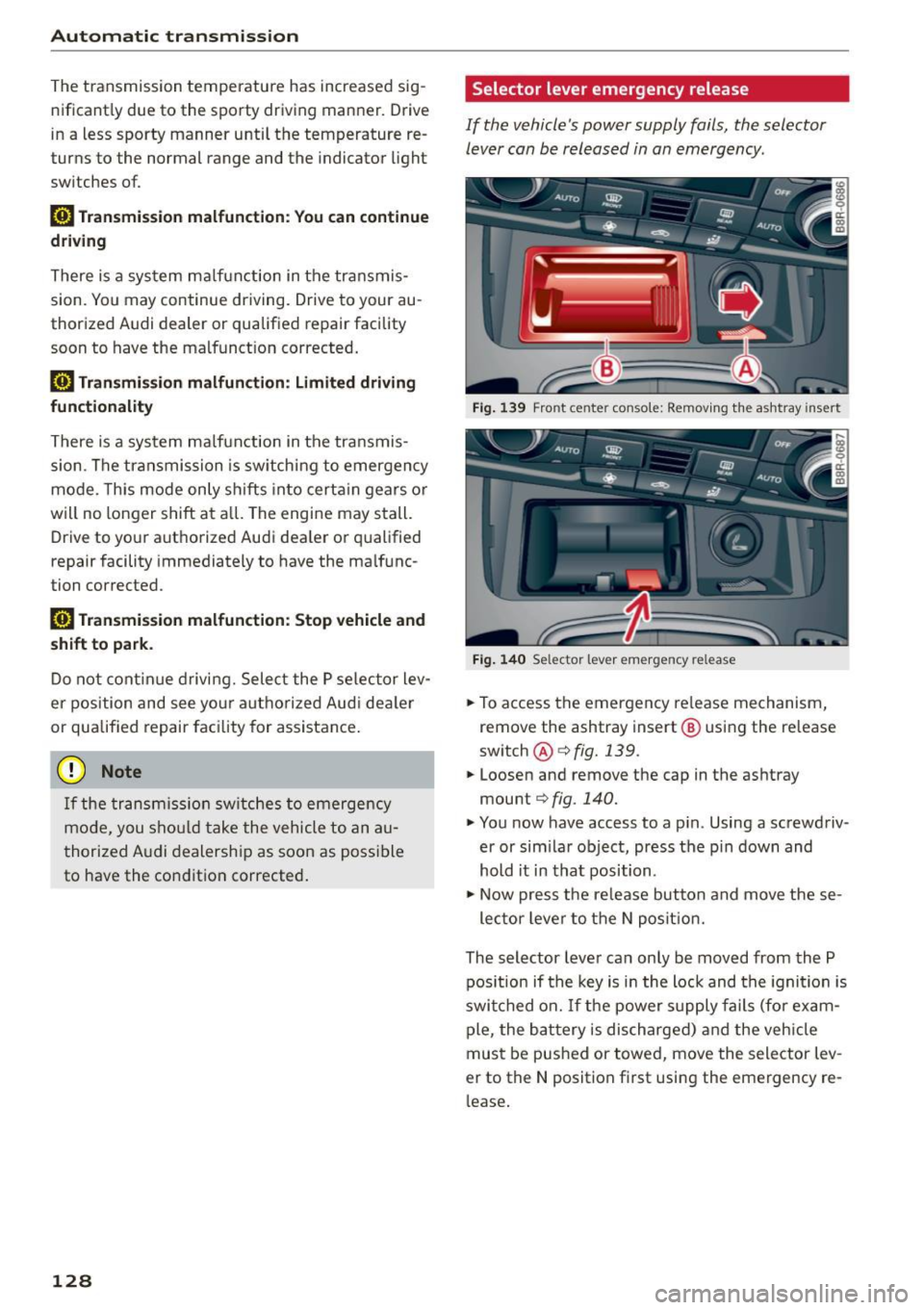
Fig. 139 Fro nt ce nte r co nsole: R emov ing t he ashtray insert
Fig. 140 Selector lev er em erg en cy re le ase
.. To access the emergency re lease mechanism,
remove the ashtray insert @ using the re lease
switch @<:::?
fig. 139 .
.. Loosen and remove the cap in the ashtray
mount
c::? fig. 140.
.. You now have access to a p in . Using a sc rewdriv
er or sim ilar o bject, press the p in down and
hold it in that position .
.. Now press t he re lease but to n and move these-
le cto r leve r to t he N posit ion.
The selector leve r ca n only be mov ed from the P
pos it ion if the key is in the lock and the igni tion is
swi tched on. If th e power supp ly fails (fo r ex am
ple, the bat tery is dis ch arge d) and the veh icle
mus t be pushed or towe d, move the selector lev
er to the N position f irst using the emergency re
l ease .
Page 177 of 302
M N
co
a:
co
,...., \!) 1.1'1
N 1.1'1 ,....,
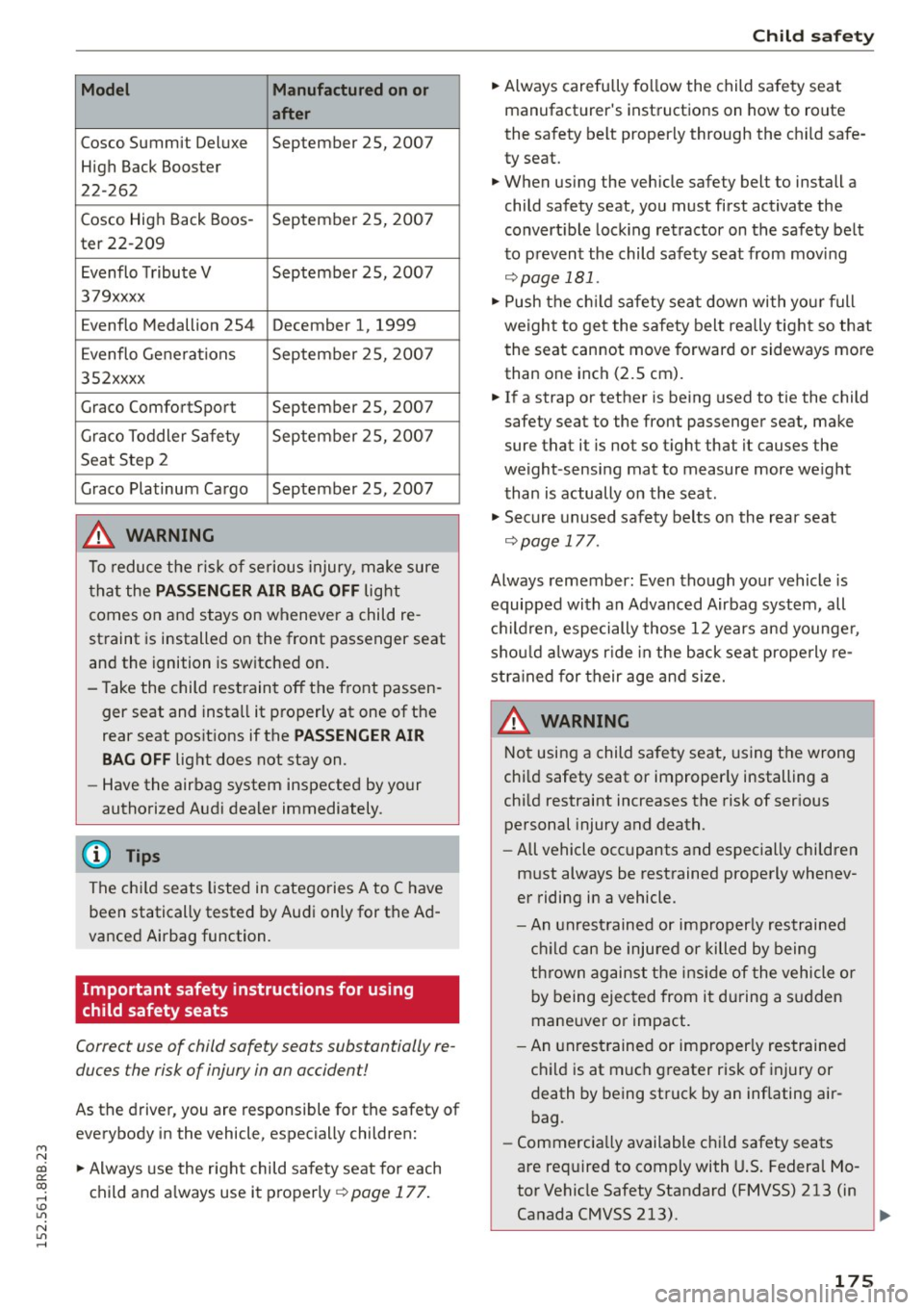
Model Manufactured on or
a fter
Cosco Summit Deluxe September 25, 2007
High Back Booster
22-262
Cosco High Back Boos -September 25, 2007
ter 22-209
Evenflo Tribute V September 25, 2007
379xxxx
Evenflo Medallion 254 December 1, 1999
Evenflo Generations September 25, 2007
3S2xxxx
Graco ComfortSport September 25, 2007
Graco Toddler Safety September 25, 2007
Seat Step 2
Graco Platinum Cargo September 25, 2007
.&, WARNING
To reduce the risk of serious injury, make sure
that the
PASS ENGER AIR BAG OFF light
comes on and stays on whenever a child re
straint is installed on the front passenger seat
and the ignition is switched on.
- Take the child restraint off the front passen ger seat and install it properly at one of the
rear seat positions if the
PASSENGER AIR
BA G OFF
light does not stay on.
- Have the airbag system inspected by your
authorized Audi dealer immediately.
(D Tips
The ch ild seats listed in categories A to C have
been statically tested by Audi on ly for the Ad
vanced Airbag function.
Important safety instructions for using
child safety seats
Correct use of child safety seats substantially re
duces the risk of injury in an accident!
As the driver, you are responsible for the safety of
everybody in the vehicle, especially children:
.,. Always use the right child safe ty seat for each
child and a lways use it properly ¢
page 177.
Child sa fety
.,. Always carefully follow the child safety seat
manufacturer's instructio ns on how to route
the safety belt properly through the child safe
ty seat.
.,. When using the vehicle safety belt to install a
child safety seat, you must first activate the
convert ible lock ing retractor on the safety belt
to prevent the child safety seat from mov ing
r::) page 181 .
.,. Push the ch ild safety sea t down with yo ur full
weight to get the safety belt rea lly tight so that
the seat cannot move forward or sideways more
than one inch (2.5 cm).
.,. If a strap or tether is being used to tie the child
safety seat to the front passenger seat, make
sure that it is not so tight that it causes the
weight -sensing mat to measure more we ight
than is actually on the seat .
.,. Secure unused safety belts on the rear seat
r::) page 177 .
Always remember : Even though your vehicle is
equipped with an Advanced Airbag system, all
c hi ld ren, especially those 12 years and younge r,
shou ld a lways r ide in the back seat prope rly re
stra ined for their age and size.
A WARNING
=
Not using a child sa fety seat, us ing the wrong
chi ld safety seat or improperly installing a
chi ld restraint increases the risk of serious
personal injury and death.
- All vehicle occ upants and especially children
must always be restrained properly whenev
er riding in a vehicle .
- An unrest rained or improperly restrained
ch ild can be injured or killed by being
thrown against the ins ide of the vehicle o r
b y being ejected from it du ring a s udden
maneuver or impact.
- An unrestrained or improperly res trained
child is at much greater risk of injury or
death by being struck by an inflating air
bag.
- Commercia lly available child safety seats
are req uired to comply with U.S. Federa l Mo
tor Vehicle Safety Standard (FMVSS) 213 (in
Canada CMVSS 213). .,_
175
Page 202 of 302
Driving and th e environment
consumption by 10-15 percent. This section will
give you some tips on how you can help the envi ronment and your pocketbook.
(D Tips
The consumption estimates as published by ENVIRONMENTAL PROTECTION AGENCY (EPA)
and Transport Canada may not correspond to
your actual consumption on the road, wh ich
w ill vary depend ing upon vehicle load and
speed, road and weather conditions, trip
length, etc .
Drive smoothly and keep a lookout ahead
Vehicles use the most fuel when they are acceler
ating .
"'Avoid unnecessary accelerating and braking.
Vehicles use the most fuel when they are acceler
ating . If you anticipate what is going to happen
next, you will need to brake less and, thus, accel
erate less. Let the vehicle coast whenever possi
ble -for example when you see that the next traf
fic light is red .
Avoid full throttle
Driving at moderate speeds saves fuel and im
proves your mileage.
"' Try and keep well be low your car's max imum
speed.
Accelerating gently reduces fuel consumption,
engine wear, and does not disturb the environ
ment.
Fue l consumption, exhaust emissions and engine
noise increase disproportionately at high speeds.
If you drive at approximately three quarters of
top speed, fuel consumpt ion w ill be reduced by
one half. Never dr ive faster than the posted
speed lim it and weather conditions permit .
200
· Reducing unnecessary idling
Even when your car is just idling it burns up fuel .
"'Shut the engine off when you are not driving
the vehicle.
"' Do not warm up the vehicle by letting the en-
gine run at idle .
The idling phase is automatically reduced for
vehicles with the Start-Stop-System*. It is effi c ient to sw itch off the eng ine in vehicles w ithout
the Start-Stop-System* when stopped at railroad
crossings and long red lights. Turn ing the engine
off for just 30-40 seconds saves more fuel than is
burned by start ing the eng ine again.
It takes a long t ime for the engine to warm up
fully when it is runn ing at id le . However, wear
and noxious emissions are especia lly high when
the engine is warming up. So you sho uld drive
away as soon as you start the eng ine and avoid
running at high rpms whi le the engine is s till
warming up.
Q) Note
Do not leave engine id ling unattended after
starting. If warning lights should come on to
indicate improper operation, they would go
unheeded. Extended idling also produces
heat, which could result in overheating or oth
er damage to the veh icle or other property.
· Regular maintenance
A badly tuned engine unnecessarily wastes a lot
of fuel.
"' Have your vehicle serviced at regu lar intervals.
By having your veh icle reg ularly serv iced by an
authorized Aud i dea le r helps to ensure that i t
runs proper ly and economica lly. The condition of
your vehicle not on ly affects its safety and ability
to hold its value, it also affects
fuel consump
t ion .
Chec k your oil ea ch t ime y ou fill your tank.
The amount of o il used is re lated to engine load
and speed. .,.
Page 206 of 302
Trailer mode
Trailer mode
Driving with a trailer
General information
Your Audi was designed primarily for passenger
transportation.
If you plan to tow a trai ler, please remember that
the additional load will affect durability, econo my and performance.
Trailer towing not on ly places more stress on the
vehicle, it also calls for more concentration from the driver .
F or this reason, always follow the operating and
driving instructions provided and use common
sense.
Technical requirements
Tr aile r h itch
Use a weight-carrying hitch conforming to the
gross trailer weight. The hitch must be suitable
for your vehicle and trailer and must be mounted
securely on the veh icle's chassis at a technically
sound
location . Use only a trai ler hitch w ith a re
movable bal l mount . Always check with the tra il
er h itch man ufacturer to make sure that you are
using the co rrect hitch.
D o not u se a bump er hit ch.
The hitch must be installed in such a way that it
does not interfere with the impact -absorbing
bumper system. No mod ificat ions should be
made to the vehicle exhaust and brake systems .
From time to time, check that all hitch mounting
bolts remain securely fastened .
When you are not towing a trailer, remove the
trailer h itch ball mount. This prevents the hitch
from causing damage should your vehicle be struck from behind ¢ .&, .
Trailer bra kes
If your trailer is equipped with a braking system,
check to be sure that it conforms to all regula
tions.
204
The trailer hydraulic brake system must not be di
rect ly connected to the vehicle's hydraulic brake
system ¢.&, .
Safet y ch ain s
Always use safety chains betwee n your veh icle
and the trai ler .
Tr aile r lights
Trailer lights must meet all regulations. Be sure
to check w ith your author ized Audi dealer for cor
rect w iring, sw itches, and relays .
Mirro rs
If you are unable to see the traffic behind you us
ing the regular outside mirrors, then you
must in
stall extended mirrors .
It is important that you
always have clear vision to the rear.
&, WARNING
-If a trailer has electrical brakes p lease note
that these brakes are not activated by the
factory -fitted contro l unit -risk of accident!
- After removing the t railer hitch, do not store
it in your vehicle . In case of sudden braking,
the hitch could fly forward and injure you or
your passengers.
- Never install a "weight distributing" or "load equalizing" trailer hitch on your vehi
cle. The vehicle was not designed for these
kinds of tra iler hitches. The hitch attach
ment can fail, causing the tra iler to tear
loose from the veh icle.
- The Gross Vehicle Weight Rating for your ve
hicle, found on the safety compliance label
on the driver's side B-p illar, must never be
exceeded under any circumstances . Exceed
ing the Gross Vehicle We ight Rating of your
veh icle is likely to damage your vehicle, and
such damage will not be covered by your Limited New Vehicle Warranty. Exceeding
the Gross Vehicle Weight Rating will also
change the performance and handling char
acteristics of your vehicle, wh ich could cause
a crash resulting in serious injury or death .