parking brake AUDI Q5 2016 User Guide
[x] Cancel search | Manufacturer: AUDI, Model Year: 2016, Model line: Q5, Model: AUDI Q5 2016Pages: 300, PDF Size: 75.02 MB
Page 126 of 300
Automatic transmissio n
(N eu tra l) for more than approx imately 1 second,
w ithout th e brake peda l being pressed.
Release button
The release button on the se lec to r lever preven ts
the lever from being accidentally sh ifted into cer
tain posit ions . Press ing t his but ton deactivates
the selector lever lock . Depending on the direc
tion of the shift, the selector lever locks at differ
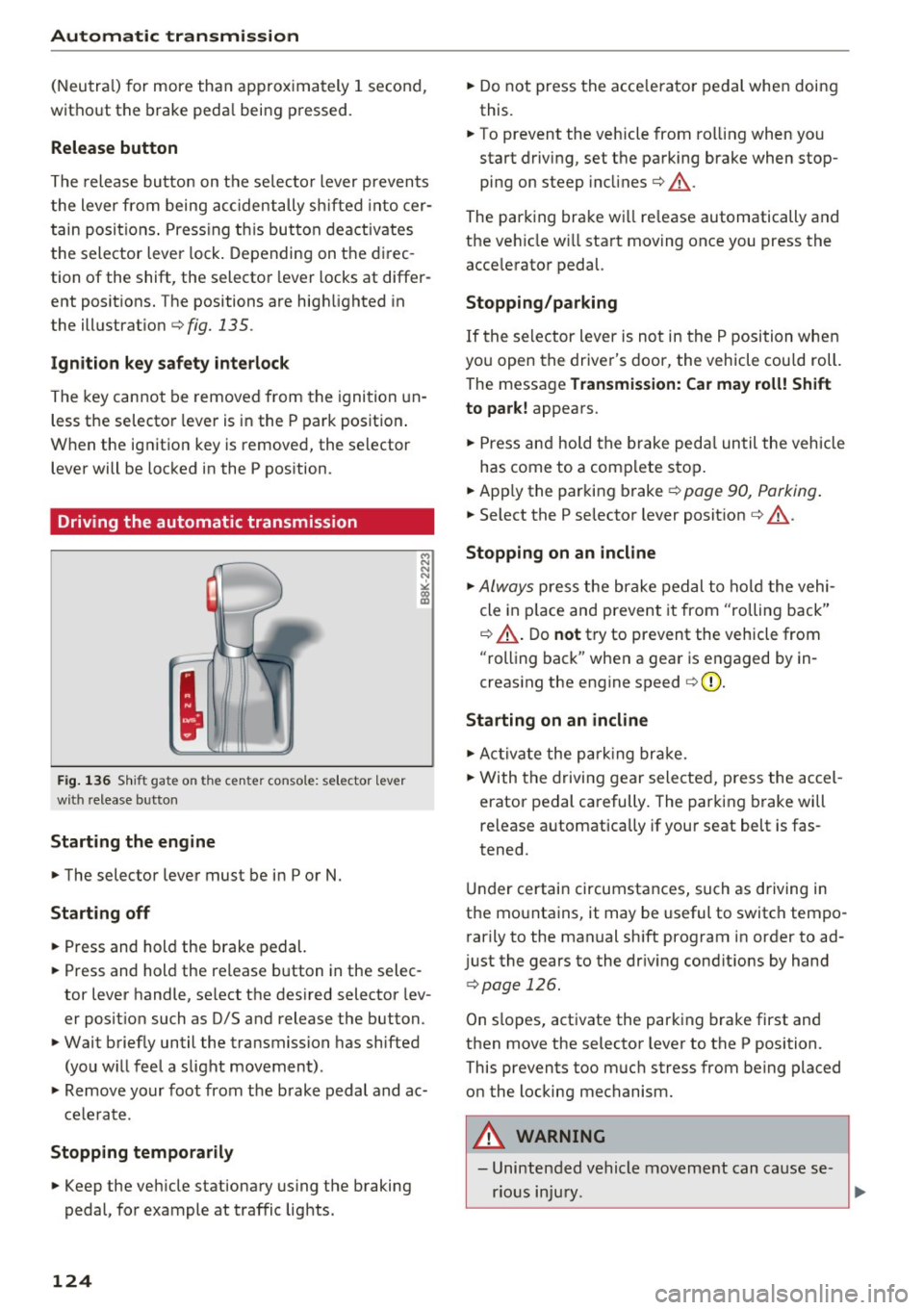
ent positions. The positions are high lighted in
the illustrat ion ¢
fig. 135 .
Ignition key safety int erlock
The key cannot be removed from the igni tion un
less the selector lever is in the P park pos ition .
When the ignition key is removed, the selector lever will be locked in the P pos ition.
Driving the automatic transmission
F ig. 1 36 Shi ft gat e on t he c en te r co nsole : se lecto r lev er
w ith release b utto n
Starting the engine
~ The selector lever must be in P or N.
Starting off
~ Press and hold the brake pedal.
~ Press and hold the release button in the selec
tor lever handle, se lect the des ired selector lev
er posit ion such as D/S and release the button.
~ Wait briefly until the transmission has shifted
(you w ill feel a slight movement) .
~ Remove your foot from the brake pedal and ac
cele rate .
Stopp ing temporarily
~ Keep the veh icle stationary us ing the braking
pedal, for example at traffic lights .
124
~ Do not press the acce lerato r pedal when doing
this.
~ To prevent the veh icle from ro lling when you
start driving, set the parking brake when stop
ping on steep incl ines¢ &_.
The parking brake wi ll re lease automatically and
the ve hicle w ill start moving once you press the
acce lerator pedal.
Stopping /par king
If the se lector lever is not in the P position whe n
you open the driver's door, the vehicle cou ld roll.
The message
Tr ansmis sion: Car may roll! Shift
to park!
appears.
~ Press and hold the brake peda l un til the vehicle
has come to a comp lete stop .
~ Apply the parking brake¢ page 90, Parking .
~ Select the P selector lever posit ion ¢ &_ .
Stopping on an incline
~ Always press the brake pedal to ho ld the vehi
cle in p lace and prevent it from "rolling back"
¢ &_ . D o
not try to prevent the vehicle from
"rolling back" when a gear is engaged by in
creas ing the engine speed ¢(D .
Starting on an incline
~ Ac tivate the pa rk ing br ake.
~ With the d riving gear selected, press the accel
erator pedal carefully. The parking brake will
release a utomatica lly if your seat belt is fas
tened.
Under certain circumstances, such as driving in
the mounta ins, it may be useful to switch tempo
rarily to the manual sh ift program in order to ad
j ust the gears to the dr iv ing cond it ions by hand
¢ page 126.
On slopes, activate the parking b rake first and
then move the selector lever to the P position.
This prevents too m uch stress from being placed
on the locking mechanism.
A WARNING
- Unintended vehicle movement can cause se
rious injury .
Page 127 of 300
,....,
N
co
er::
co
,....,
running while in gear. If you must leave
your vehicle when the engine is running, ac tivate the parking brake and move the selec
tor lever to P.
- Power is still transmitted to the wheels
when the engine is running at idle. To pre
vent the vehicle from "creeping", you must keep your foot on the brake when the en
gine is running and the selector lever is in D/
5 or R or "tiptronic" mode is selected .
- Do not press the accelerator pedal when
changing the selector lever position while
the vehicle is stationary and the engine is running.
- Never shift into R or P while driving.
- Before driving down a steep slope, reduce
your speed and shift into a lower gear with "tiptronic" .
- Do not ride the brakes or press the brake
pedal too often or too long when driving
down a hill. Constant braking causes the
brakes to overheat and substantially re
duces braking performance, increases brak
ing distance or causes complete failure of
the brake system .
- To prevent the vehicle from rolling back
when stopping on inclines, always hold it in
place with the brake pedal or parking brake.
- Never hold the vehicle on an incline with a
slipping clutch. The clutch opens automati
cally when it becomes too hot from the
overload . An indicator lamp
[ijJ illuminates
and a driver message appears
c> page 126
when the clutch is overloaded .
- If the engine must remain running, never
have any driving position engaged when
checking under the hood.
Make sure these
lector lever has securely engaged and is
locked in P with the parking brake set
c> page 220. Otherwise, any increase in en
gine speed may set the vehicle in motion,
even with the parking brake applied.
(D Note
- When stopping on an incline, do not try to
hold the vehicle in place by pressing the ac
celerator pedal while a driving gear is se-
Automatic transmission
lected. This can cause the transmission to
overheat and can damage it. Activate the
parking brake or press the brake pedal to
prevent the vehicle from rolling.
- Allowing the vehicle to roll when the engine
is stopped and the selector lever is in N will
damage the transmission because it is not
lubricated under those circumstances.
(!) Tips
For safety reasons, the parking brake is re
leased automatically only when the driver's
safety belt is engaged in the buckle.
Hill descent control
The hill descent control system assists the driver
when driving down decline s.
Hill descent control is activated when the selec
to r lever is in D/S and you press the brake pedal.
The transmission automatically selects a gear
tha t is suitable for the incline. Hill descent con
trol tries to maintain the speed achieved at the
time of braking, within physical and technical
limitations. It may still be necessary to adjust the
speed with the brakes .
Hill descent control switches off once the decline
levels out or you press the accelerator pedal.
When the speed is set in the cruise control sys
tem
c> page 95 , hill descen t control is also ac ti
vated .
A WARNING
Hill descent control cannot overcome physical
limitations, so it may not be able to maintain
a constant speed under all conditions . Always
be ready to apply the brakes.
125
Page 208 of 300
Trailer mod e
Parking on a slope
Do not park on a slope with a trailer. If it cannot
be avoided, do so only after doing the following:
When parking:
.,. Apply the foot brake .
.,. Have someone place chocks under both the ve
hicle and the trailer wheels .
.,. With chocks in p lace, slowly release the brakes
unt il the wheel chocks absorb the load .
.,. Turn the wheels towards the curb .
.,. Apply the pa rking brake .
.,. Move the selector lever to P .
When resta rting after parking:
.,. Apply the foot brake .
.,. Start the engine .
.,. Move the selector leve r to 0/5 .
.,. Release t he pa rking brake and slow ly pull out
and away from the wheel chocks.
"' Stop and have someone retrieve the wheel
chocks.
(D Tips
If you move the se lector lever of the automat
ic transmission to P before applying the park
ing brake and before blocking the wheels, you may have to use more force later to move the
lever out of the P position .
206
Page 222 of 300
Checking and Filling
Checking and Filling Hood
Releasing the engine hood
The engine hood is released from inside the vehi
cle .
Fig. 195 Driver's side footwell : eng ine hood release lever
.. With the driver's door open, pull the lever un
der the instrument panel in the direction of the
arrow ¢
fig. 195.
The hood pops up slightly under spring pressure.
Opening the engine hood
CJ
Fig. 196 Release lever under t he e ngi ne hood
Before opening the engine hood, make sure that
the windshield wipers are flat against the w ind
shield. Otherwise, they could damage the paint
on the hood.
.,. Pull up on the release under the hood
¢
fig . 196. This releases the catch.
.,. Open the hood all the way ¢.&_ .
,& WARNING
Hot engine coo lant can burn you.
220
-To reduce the r isk of being burned, never
open the hood if you see or hear steam or
coo lant escaping from the engine compart
ment. Wait until no steam or coolant can be
seen or heard before carefully opening the
hood .
Closing the engine hood
.,. Pull the hood down until the pressu re from the
struts is reduced .
.. Let the hood
drop down and latch in place. Do
not try to push it shut;
it may fail to engage
~A -
A WARNING
A hood that is not completely latched could
fly up and block your view while driving.
- When you close the engine hood, check it to
make sure the safety catch has properly en
gaged . The hood should be flush with the
surrounding vehicle body parts .
- If you notice while driv ing that the hood is
not secured properly, stop at once and close
it .
Working in the engine compartment
Be especially careful whenever you work in the
engine compar tment.
-
Whenever you must perform any work in the
engine compartment , for example checking and
filling different fluids, there is a risk of injury,
burns and accidents. To prevent personal injury
always observe the following WARNINGS. The
engine compartment of any vehicle is a hazard
ous area ¢.&, .
A WARNING
To help avoid injury, before you check any
thing und er the hood:
- Turn off the engine.
- Remove the ign ition key .
- Apply the parking brake.
- Move selector lever of automatic transm is-
sion to P (Park).
-
Page 223 of 300
,....,
N
co
er::
co
,....,
ponents will burn skin on contact .
- To reduce the risk of being burned, never
open the hood if you see or hear steam or
coolant escaping from the engine compart
ment. Wait until no steam or coolant can be
seen or heard before carefully opening the
hood.
- Keep children away from the engine com
partment .
- Never spill fluids on hot engine compo
nents. They can cause a fire .
- Never touch the radiator fan. The auxiliary
electric fan is temperature controlled and
can switch on suddenly.
- Never open the coolant reservoir cap when
the engine is still warm. The coolant system
is pressurized and hot coolant could spray
out .
- Protect your face, hands and arm from
steam or hot engine coolant by placing a
thick rag over the cap when you open the
coolant reservoir .
- Do not remove the engine cover under any
circumstances. This increases the risk of
burns.
- If work on the fuel system or the electrical
system is necessary:
- Always disconnect the battery.
- Never smoke or work near heaters or open
flames. Fluids in the engine compartment
could start a fire.
- Keep an approved fire extinguisher imme
diately available.
- To avoid electrical shock and personal injury
while the engine is running or being started, never touch:
- Ignition cables
- Other components of the high voltage
electronic ignition system .
- If you must perform a check or repair with
the engine running:
- First, fully apply the parking brake, move
selector lever of automatic transmission
to P (Park).
Checking and Filling
-Always use extreme caution to prevent
clothing, jewelry, or long hair from get
ting caught in the radiator fan, V-belts or
other moving parts, or from contacting hot parts. Tie back hair before starting,
and do not wear clothing that will hang or
droop into the engine.
- Minimize exposure to emission and chemi
cal hazards
~ .&, .
A WARNING
California Proposition 65 Warning:
- Engine exhaust , some of its constituents,
and certain vehicle components contain or
emit chemicals known to the State of Cali
fornia to cause cancer and birth defects and
reproductive harm. In addition, certain flu
ids contained in vehicles and certain prod
ucts of component wear contain or emit
chemicals known to the State of California
to cause cancer and birth defects or other
reproductive harm.
- Battery posts, terminals and related acces
sories contain lead and lead compounds,
chemicals known to the State of California
to cause cancer and reproductive harms .
Wash hands after handling .
(I) Note
When adding fluids, always make sure that
they are poured into the proper container or
filler opening, otherwise serious damage to
vehicle systems will occur.
@) For the sake of the environment
To detect leaks in time, inspect the vehicle
floor pan from underneath regularly . If you
see spots from oil or other vehicle fluids, have
your vehicle inspected by an authorized Audi dealer.
221
Page 260 of 300
Emergency assistance
Performing the repair
Applies to vehicles: w ith tire repair k it
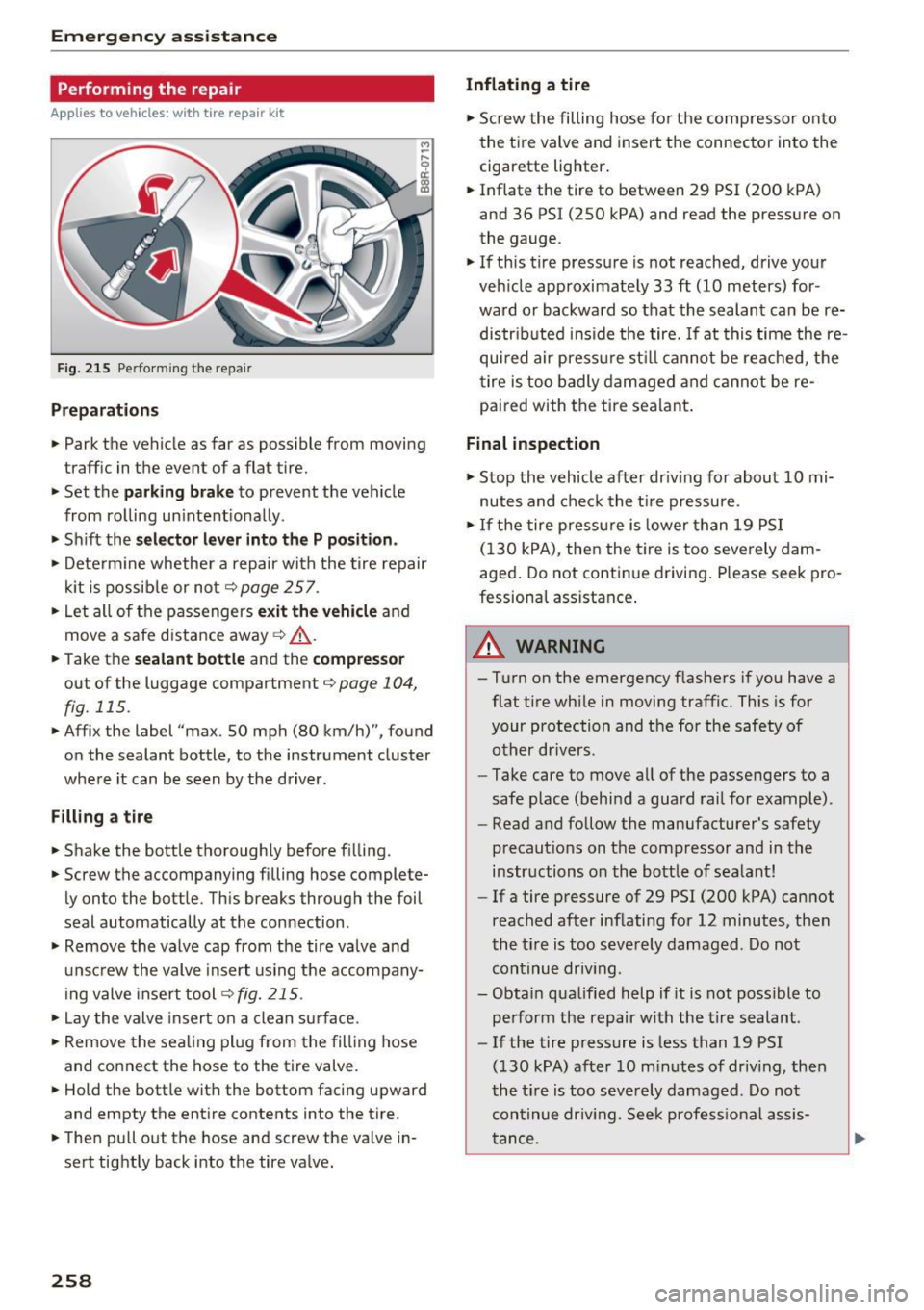
Fig. 215 Performing the repair
Preparations
.,. Park the vehicle as far as possible from moving
traffic in the event of a flat tire.
.,. Set the
parking brake to prevent the vehicle
from rolling unintentionally.
.,. Shift the
selector lever into the P position.
.,. Determine whether a repair with the tire repair
kit is possible or not¢
page 257.
.,. Let all of the passengers
exit the vehicle and
move a safe distance away¢_&. .
.,. Take the
sealant bottle and the compressor
out of the luggage compartment ¢ page 104,
fig. 115.
.,. Affix the label "max. 50 mph (80 km/h)", found
on the sealant bottle, to the instrument cluster
where it can be seen by the driver.
Filling a tire
.,. Shake the bottle thoroughly before filling.
.,. Screw the accompanying filling hose complete
ly onto the bottle. This breaks through the foil
seal automatically at the connection .
.,. Remove the valve cap from the tire valve and
unscrew the valve insert using the accompany
ing valve insert tool
~fig. 215.
.,. Lay the valve insert on a clean surface .
.,. Remove the sealing plug from the filling hose
and connect the hose to the tire valve .
.,. Hold the bottle with the bottom facing upward
and empty the entire contents into the tire .
.,. Then pull out the hose and screw the valve in
sert tightly back into the tire valve.
258 Inflating a tire
.,.
Screw the filling hose for the compressor onto
the tire valve and insert the connector into the
cigarette lighter.
.. Inflate the tire to between 29 PSI (200 kPA)
and 36 PSI (250 kPA) and read the pressure on
the gauge .
.,. If this tire pressure is not reached, drive your
vehicle approximately 33
ft (10 meters) for
ward or backward so that the sealant can be re
distributed inside the tire. If at this time the re
quired air pressure still cannot be reached, the
tire is too badly damaged and cannot be re
paired with the tire sealant.
Final inspection
.,. Stop the vehicle after driving for about 10 mi
nutes and check the tire pressure.
.,. If the tire pressure is lower than 19 PSI
(130 kPA), then the tire is too severely dam
aged. Do not continue driving. Please seek pro
fessional assistance .
&_ WARNING
- Turn on the emergency flashers if you have a
flat tire while in moving traffic. This is for
your protection and the for the safety of
other drivers.
- Take care to move all of the passengers to a
safe place (behind a guard rail for example) .
- Read and follow the manufacturer's safety
precautions on the compressor and in the instructions on the bottle of sealant!
- If a tire pressure of 29 PSI (200 kPA) cannot
reached after inflating for 12 minutes, then
the tire is too severely damaged. Do not
continue driving.
- Obtain qualified help if it is not possible to
perform the repair with the tire sealant .
- If the tire pressure is less than 19 PSI
(130 kPA) after 10 minutes of driving, then
the tire is too severely damaged . Do not
continue driving. Seek professional assis
tance .
Page 261 of 300
,....,
N
co
er::
co
,....,
Special care is required if you are repairing
the tire on a steep incline.
@ Tips
- Do not operate the compressor for more
than 12 minutes continuously, otherwise it
can overheat. Once the compressor has
cooled, you can continue to use it.
- If sealant has spi lled out, let it dry and then
you can remove it by peeling it away like a
foil.
- Remember to obtain a new bott le of sealant
from your authorized Audi dealer after re
pair ing a tire. After this, the functionality of
the tire repair set is restored .
- Obey all laws.
Replacing wheels
Before changing a wheel
Observe the following precautions for your own
and your passenger's safety when changing a
wheel.
""After you experience a tire failure, pull the car
well away from moving traff ic and try to reach
level ground before you stop¢_& .
.. All passengers sho uld
leave the car and move
to a safe location (fo r instance, behind the
guardrai l) ¢ .&_ .
.. Engage the
par king b rake to prevent yo ur vehi
cle from roll ing unintentionally ¢&_ .
.. Move
selecto r le ver to po sitio n P ¢ &_ .
"" If you are towing a trailer: unh itch the trailer
from your veh icle.
"" Block the diagonally opposite wheel with the
folding chocks o r other objects .
""T ake the
jac k* and the inflatable spa re tir e*
out of the luggage compartment ¢ page 254 .
A WARNING
You or your passengers cou ld be inj ured while
changing a wheel if you do not follow these
safety precautions:
- If you have a flat tire, move a safe distance
off the road. Turn off the engine, turn the
Em ergenc y ass is tanc e
emergency flashers on and use other wa rn
ing dev ices to alert other motorists.
- Make sure that passengers wait in a safe
place away from the vehicle and well away
from the road and traff ic.
- To help prevent the veh icle from moving
suddenly and possib ly slipping off the jack*,
always fully set the parking brake and block
the wheel diagonally opposite the wheel be i n g changed with the fold ing c hocks or oth
er objects . When one front whee l is lifted
off the ground, placing the Automatic
Transmission in P (Park) w ill
not prevent the
veh icle from moving.
- Before you change a wheel, be sure the
gro und is leve l and firm.
If necessary, use a
sturdy board under the jack*.
- Always s tore the vehicle too l kit, the jack*
and the replaced tire in the lugg age com
partment
¢ page 139.
Changing a wheel
When you change a wheel, follow the sequence
described below s tep-by -step and in exactly that
order.
1. Remove the de corative wheel cover* . For
more detai ls see also¢
page 260, Decaro-
tive wheel covers
o r¢ page 260, Wheels
with wheel bolt cops .
2. Loosen the w
heel bolt s ¢ page 260.
3 . Locate the proper mounting point for the
jack* and align the jack* below that point
¢ page 261.
4. Li ft the car with the jack*¢ page 261 .
s. Remove the wheel with th e flat tire and then
insta ll the
inflatable spar e tir e *
¢ page 262.
6. Tighte n all whee l bolts lightly.
7 .
Lo wer the vehicle wi th the jack *.
8 . Use the whee
l bolt wrench and
firml y tighten
all wheel bo lts ¢
page 260 .
9. Replace the decorat ive wheel co ver* .
259
...
Page 263 of 300
..... N
co ~ CX)
..... I.Cl U"I
..... I.Cl .....
.. Take t ight hold of the end of the wrench handle
and turn the wheel bolts
c o un ter-cloc kwi se
about one single tu rn in the d irection of arrow
r=> fig . 218.
T igh tening
.. Install the wheel b olt w renc h over the wheel
bolt and push it down as far as it will go .
.. Take tight hold of the
end of the wrench handle
and turn each wheel bolt
cl oc kwise until it is
seated.
_& WARNING
- Do not use force or hurry when changing a
wheel - you can cause the vehicle to slip off
the jack* and cause ser ious personal inju
ries.
- Do not loosen the wheel bolts more than
one turn
before you raise the vehicle with
the jac k*. -Yo u ris k an injury.
@ Tips
If a wheel bolt is very tight, you may find it
easier to loosen by carefu lly pushing down on
the end of the wheel bo lt wrench with
one
foot only.
As you do so, hold on to the car to
keep your balance and take care not to slip.
Raising the vehicle
The vehicle must be li~ed with the jack* first be
fore the wheel can be removed .
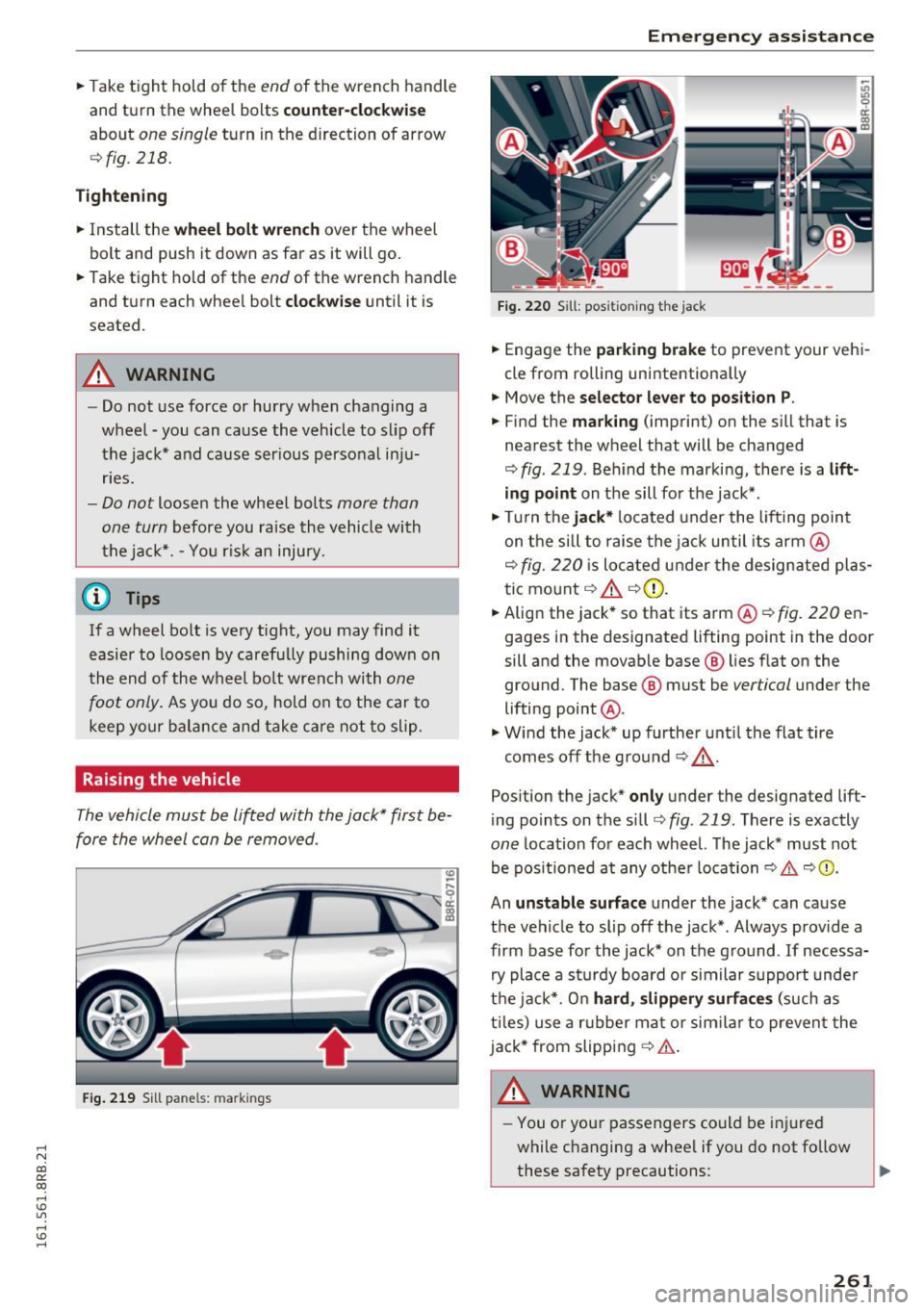
Fig . 219 Sill pane ls: markin gs
Em ergen cy a ssis tanc e
Fig . 220 Sill: pos ition ing the jack
.. Engage the parking brake to prevent your vehi
cle from rolling unintentionally
.. Move the
sel ecto r le ver to po sitio n P.
.. Find the mark ing (imprint) on the sill that is
nearest the wheel that will be changed
r=> fig . 219 . Behind the marking, there is a lift
ing point on t he sill fo r the jack* .
"" Turn the
ja ck * located under the lifting point
on the sill to raise the jack until its arm @
r=> fig. 220 is located under the designated plas
tic mo unt
r=> A r=> (j) .
.. Align the jack* so that its arm @ r=> fig. 220 en
gages in the designated lifting point in the door
sill and the movable base @ lies flat on the
ground. The base @ must be
vertical under the
lifting point @.
"" Wind the jack* up furthe r unt il the flat tire
comes off the g round
r=> _&. .
Pos ition the jack* onl y under the designated lift
ing points on the s ill
r=> fig . 219. There is exactly
one location for each wheel. The jack* must not
be pos itioned at any othe r loca tion
r=> & r=> @.
An un stable surf ace under the jack* can cause
the vehicle to slip off the jack* . Always prov ide a
firm base for the jack* on the ground .
If necessa
r y place a s turdy board or similar support unde r
t h e jack*. O n
hard, slipp ery surfa ce s (such as
t il es) use a r ubber mat or sim ilar to prevent the
jac k* from slipp ing
r=> .&. .
_& WARNING
-
-You or your passengers could be i njured
while changing a wheel if you do not follow these safety precautions :
261
Page 268 of 300
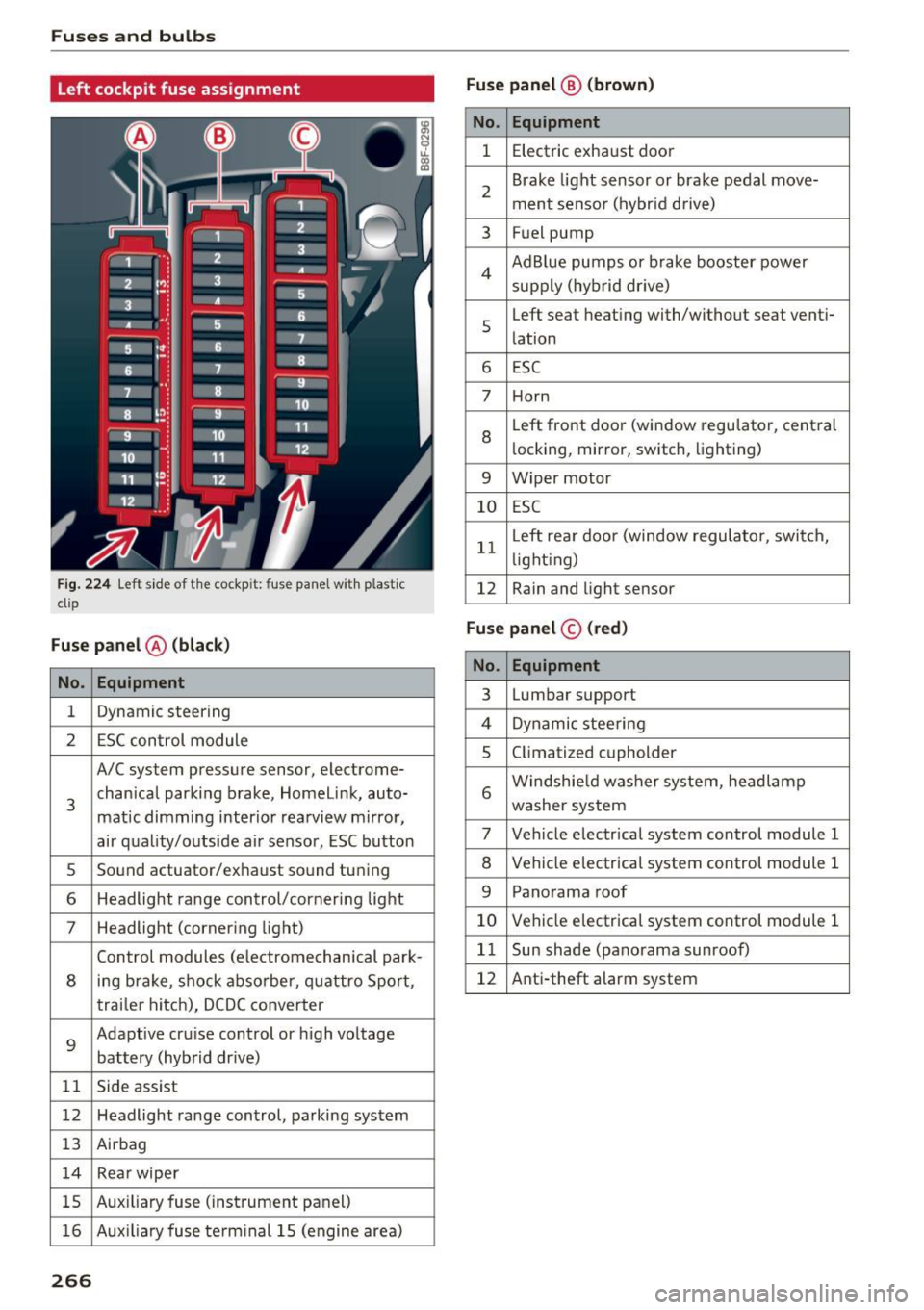
Fuses and bulbs
Left cockpit fuse assignment
Fig. 224 Left side of the cockp it: fuse panel with p lastic
clip
Fuse panel @ (black)
No . Equipment
1 Dynamic steering
2 ESC control module
A/C system pressure sensor, electrome-
3 chanical parking
brake, Homelink, auto-
matic dimming interior rearview mirror,
air quality/outside air sensor, ESC button
s Sound actuator/exhaust sound tuning
6 Headlight range control/corner ing light
7 Headlight (cornering light)
Control modules (electromechanical park-
8 ing brake, shock absorber, quattro Sport,
trailer hitch), DCDC converter
9
Adaptive cruise control or high voltage
battery (hybrid dr ive)
11 Side assist
12 Headlight range control, parking system
13 Airbag
14 Rear wiper
15 Auxiliary
fuse (instrument panel)
16 Auxiliary fuse te rm inal 15 (engine area)
266
Fuse panel ® (brown)
No. Equipment
1 Electric exhaust door
2 Brake
light sensor or brake pedal move-
ment sensor (hybrid drive)
3 Fuel pump
4 Ad
Blue pumps or brake booster power
supply (hybrid dr ive)
s
Left seat heating with/without seat venti-
lation
6 ESC
7 Horn
8
Left front doo r (window regulator, central
locking, mirror, switch, lighting)
9 Wiper motor
10 ESC
11 L
eft rear doo r (window regulator, switch,
li ght ing)
12 Rain and light sensor
Fuse panel
© (red)
No. Equipment
3 Lumbar support
4 Dynamic steering
5 Climatized cupholder
6 Windshie
ld washer system, headlamp
washer system
7 Vehicle electrical system control module 1
8 Vehicle electrical system control module 1
9 Panorama roof
10 Vehicle electrical system control module 1
11 Sun shade (panorama sunroof)
12 Anti-theft alarm system
Page 269 of 300

..... N
co ~ CX)
..... I.Cl U"I
..... I.Cl .....
Right cockpit fuse assignment
Fig. 225 Right side of the cockpit: fuse panel wit h plastic
clip
Fuse panel @ (black)
No . Equipment
5 Steering column switch module
7 Terminal 15 diagnostic connector
8 Gateway (Databus diagnostic interface)
9 Auxil iary heater
Fuse panel @ (brown)
No. Equipment
1 CD /DVD player
2 Wi-Fi
3 MMI/Radio
4 Instrument cluster
5
Gateway (instrument cluster control mod-
ule)
6 Ignition lock
7 Light dial
8 Climate control system blower
9 Steering column lock
1 0 Climate control system
Fuses and bulbs
No . Equipment
11 Diagnostic data
link connector, terminal
30
12 Steering column switch module
Right luggage compartment fuse
assignment
Fig. 226 Right luggage compartment: fuse panel with
pla stic dip
Fuse panel @ (black)
No. Equipment
1 Luggage compartment lid control module
2 Trailer control module
3 Traile r control module
4 Tra iler control module
5 Electromechanical parking brake
6 Electronic damping control
7 Electromechanical parking brake
8 Tail lights
9 quattro Sport
10 Tail lights
11 Central locking system
12 Termina l 30
267