tires AUDI Q5 2016 User Guide
[x] Cancel search | Manufacturer: AUDI, Model Year: 2016, Model line: Q5, Model: AUDI Q5 2016Pages: 300, PDF Size: 75.02 MB
Page 210 of 300
Care and cleaning
& WARNING
-Only wash the vehicle when the ignition is
off and follow the instructions from the car
wash operator to reduce the risk of acci dents.
- To reduce the risk of cuts, protect yourself from sha rp metal components when wash
ing the underbody or the inside of t he wheel
hous ings.
- After was hing the vehicle, the braking effect
may be delayed due to mo isture on the
bra ke rotors o r ice i n the winte r. The bra kes
mus t be d ried first w ith a few care ful brake
applications .
@ Note
-If you wash the ve hicle in an automa tic car
wash, you m ust fold the exte rior m irrors i n
to reduce the risk of damage to the mirrors.
Power folding exterior m irrors * must on ly
be fo lded in and out using the power folding
funct ion.
- To reduce the risk of damage to the rims
and tires, compare the width between the
whee ls on your ve hicle w ith the distance be
tween the gu ide rails in the car wash. -
To red uce the risk of damage, compare the
heig ht and width of your vehicle with the
heig ht and w idth of the inside of the car
wash.
- To prevent paint damage, do not wash the
vehicle in direct sunlight.
- To reduce the risk of damage to the surface,
do not use insect removing sponges, k itchen
sponges or s imilar items.
- Matte finish painted vehicle components:
- To reduce the r isk of damage to the sur-
face, do not use polish ing agents or hard
wax.
- Never use protective wax. It can destroy
the matte finish effect.
- Do not place any stickers or magnetic signs on vehicle parts pain ted with matte
finish paint. The paint could be damaged
when the stickers or magne ts are re
moved.
@ For the sake of the environment
Only wash the veh icle in facilities spe cially de
signed for that pu rpose. This will reduce the
r isk of dirty wate r contamina ted with o il from
entering the sewer system .
Cleaning and care information
When cleaning and caring for individua l vehicle
components, refer to the following tables. The information conta ined there is s imply recom
mendations . Fo r quest ions or for components that are not
listed, consult an authorized Aud i
dealer or authorized Audi Service Fac ility. Also
fo llow the information found in c::> & .
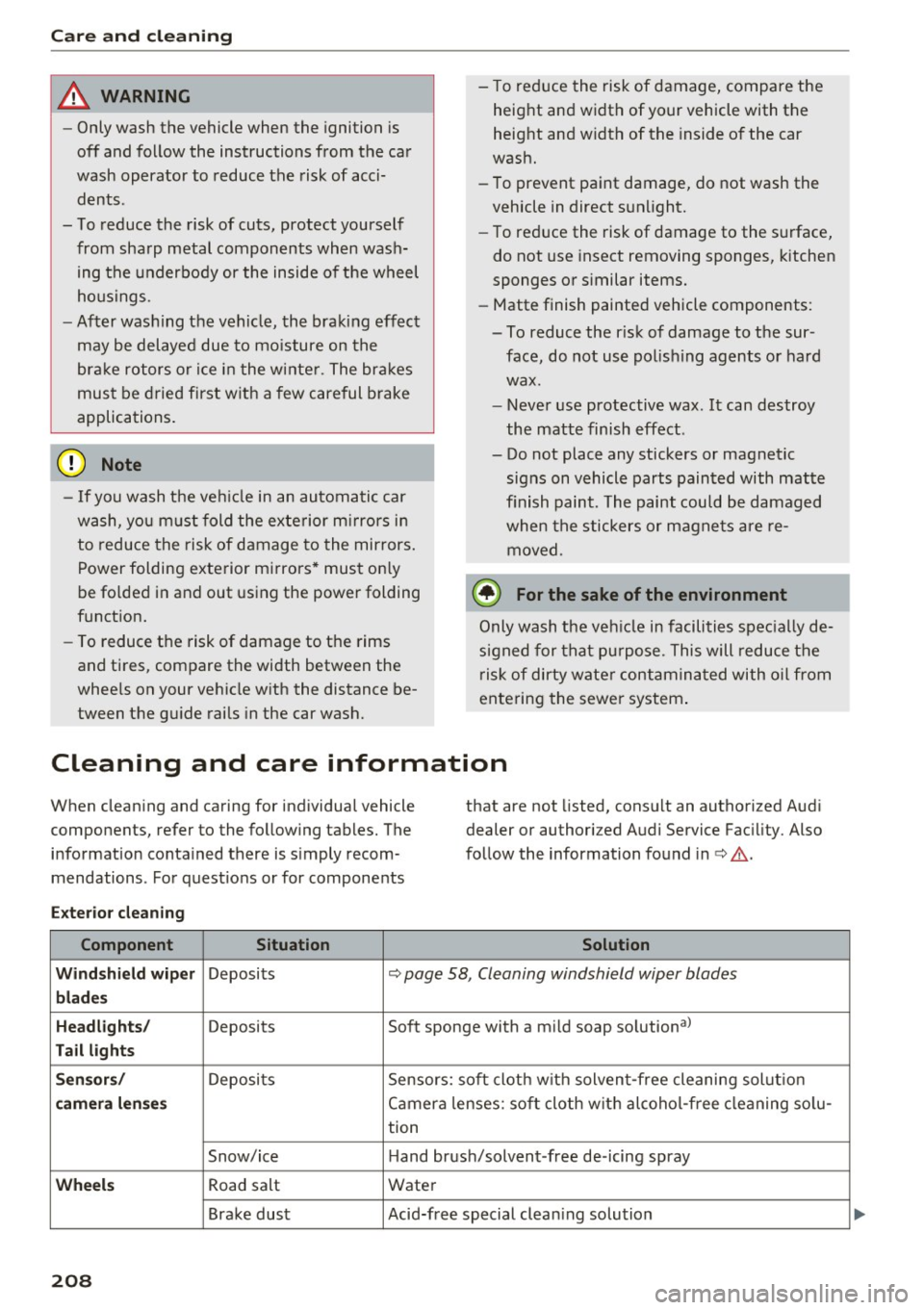
Ex ter io r cleaning
Component S ituation Solution
Wind shield wiper
Deposits c::> page 58, Cleaning windshield wiper blades
blades
Headlights /
Deposits Soft sponge with a mild soap solution a)
Tail lights
Sen sor s/
Deposits Sensors: soft cloth with solvent-free cleaning sol utio n
camera len ses Camera lenses: soft cloth w ith alcoho l-free cleaning so lu-
tion
Snow/ice Hand brush/solvent -free de -icing spray
Wheels Road salt Water
Brake dust Acid-free special cleaning solution
208
Page 236 of 300
Wheels
Wheels
Wheels and Ti res
General information
.,. Check your tires regularly for
damage (punctures, cuts, cracks
and bulges). Remove foreign ob
jects from the tire tread.
.,. If driving over curbs or similar
obstacles, drive slowly and ap proach the curb at an angle.
.,.Have faulty tires or rims re
placed immediately.
.,.Protect your tires from oil,
grease and fuel.
.,.Mark tires before removing
them so that the same running
direction can be maintained if
they are reinstalled .
.,. Lay tires flat when storing and
store them in a cool, dry location
with as little exposure to light as
possible.
(D N ote
-Please note that summer and
winter tires are designed for
the conditions that are typical in those seasons . Audi recom
mends using winter tires dur
ing the winter months . Low
temperatures significantly de crease the elasticity of summ
er tires, which affects traction
23 4
and b raking ability. If summer
tires are used in very cold
temperatures, cracks can form
on the tread bars, resulting in permanent tire damage that
can cause loud driving noise
and unbalanced tires.
-Burnished, polished or chromed rims must not be used in winter driving condi
tions. The surface of the rims
does not have sufficient corro
sion protection for this and
could be permanently dam
aged by road salt or similar
substances.
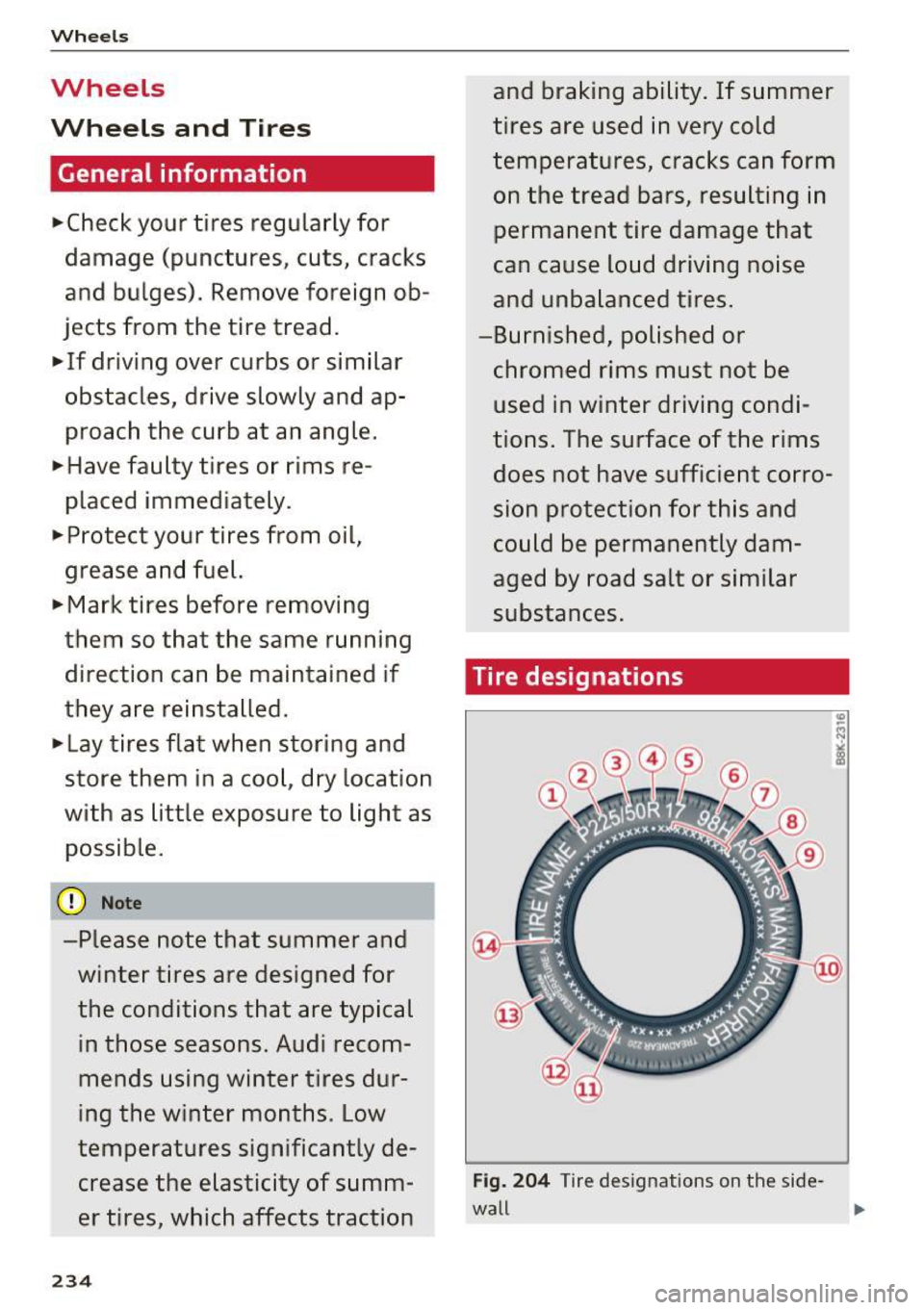
Tire designations
F ig. 20 4 Tire des ignat ions on the side-
wall II>
Page 237 of 300
.... N
co
er::
co
....
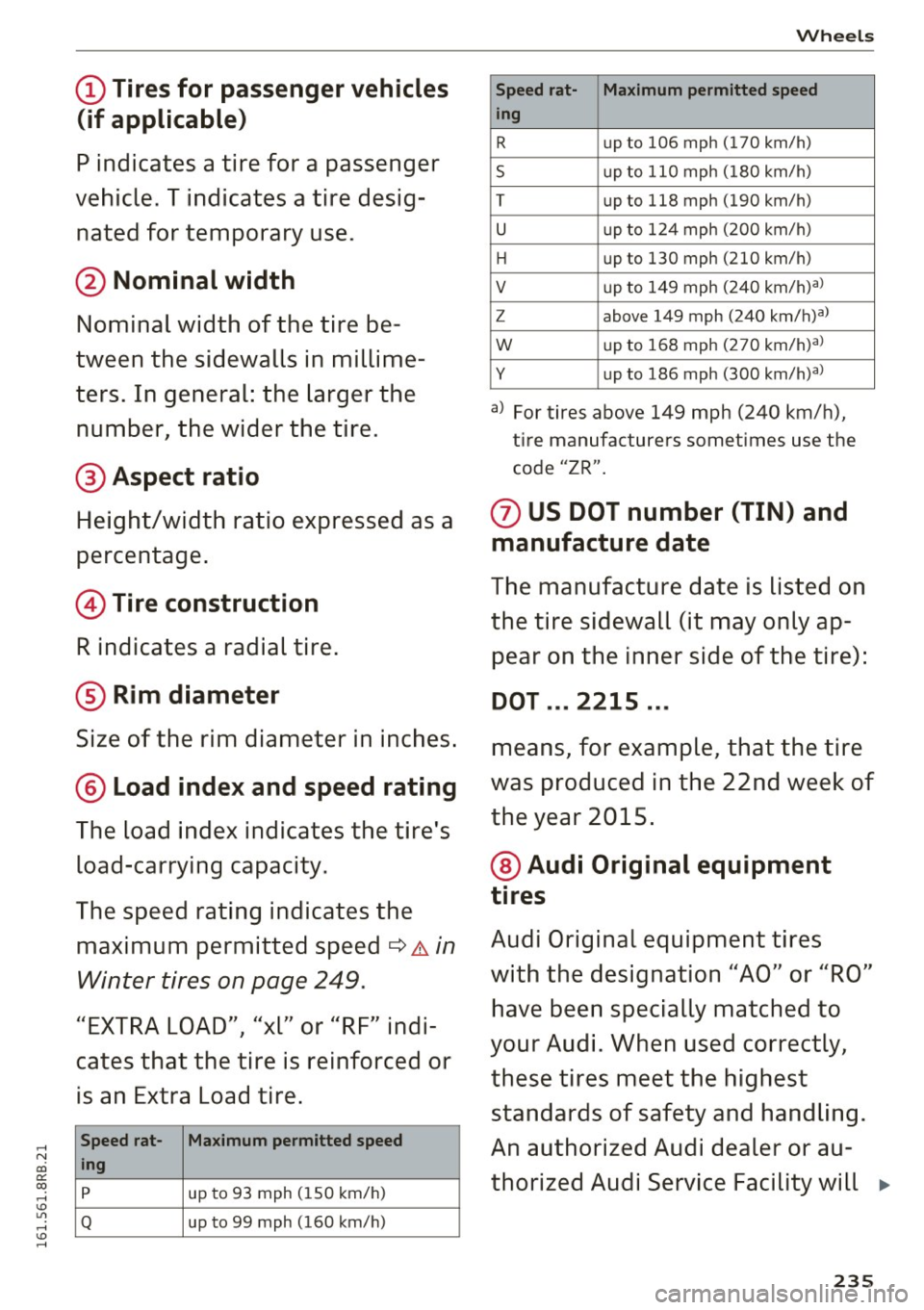
(if applicable)
P indicates a tire for a passenger
vehicle. T indicates a tire desig
nated for temporary use.
@ Nominal width
Nominal width of the tire be
tween the sidewalls in millime
ters. In general: the larger the
number, the wider the tire.
@ Aspect ratio
Height/width ratio expressed as a
percentage.
@ Tire construction
R indicates a radial tire.
® Rim diameter
Size of the rim diameter in inches.
@ Load index and speed rating
The load index indicates the tire's
load-carrying capacity.
The speed rating indicates the
maximum permitted speed¢.&
in
Winter tires on page 249.
"EXTRA LOAD", "xl" or "RF" indi
cates that the tire is reinforced or
is an Extra Load tire.
Speed rat-
Maximum permitted speed
ing
p
up to 93 mph (150 km/h)
Q up to 99 mph (160 km/h)
Wheels
Speed rat- Maximum permitted speed
ing
R up to 106 mph (170 km/h)
s up to 110 mph (180 km/h)
T up to 118 mph (190 km/h)
u up to 124 mph (200 km/h)
H up to 130 mph (210 km/h)
V up to 149 mph (240 km/h) al
z above 149 mph (240 km/h)al
w up to 168 mph (270 km/h)al
y up to 186 mph (300 km/h)al
a) For tires above 149 mph (240 km/h),
tire manufacturers sometimes use the
code "ZR".
(j) US DOT number (TIN) and
manufacture date
The manufacture date is listed on
the tire sidewall (it may only ap
pear on the inner side of the tire):
DOT ... 2215 ...
means, for example, that the tire
was produced in the 22nd week of
the year 2015.
@ Audi Original equipment
tires
Audi Original equipment tires
with the designation "AO" or "RO" have been specially matched to
your Audi. When used correctly,
these tires meet the highest
standards of safety and handling.
An authorized Audi dealer or au
thorized Audi Service Facility will ""
235
Page 238 of 300
Wheels
be happy to provide more infor
mation.
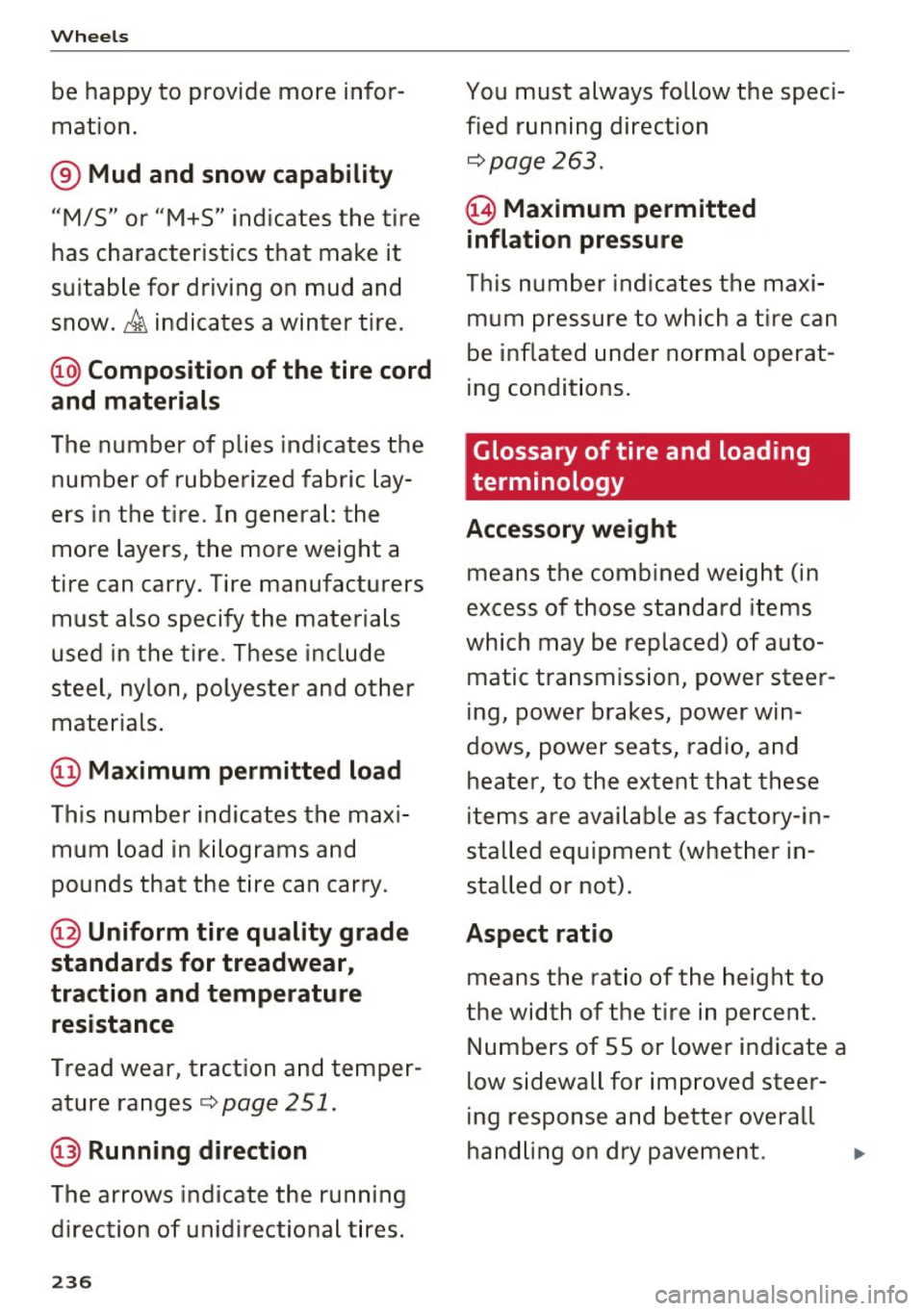
® Mud and snow capability
"M/S" or "M+S" indicates the tire
has characteristics that make it
suitab le for driving on mud and
snow.
& indicates a winter t ire.
@ Compos ition of the tire cord
and materials
The number of plies indicates the
number of rubberized fabric lay
ers in the tire . In general: the
more layers, the more weight a
tire can carry. Tire manufacturers must also specify the materia ls
used in the tire. These include
steel, nylon, polyester and other
materials .
@ Maximum permitted load
This number indicates the maxi
mum load in k ilograms and
pounds that the tire can carry.
@ Uniform tire quality grade
standards for treadwear,
traction and temperature
resistance
Tread wear, t raction and temper
ature ranges
¢ page 251 .
@ Running direction
The arrows indicate the running
direction of unidirec tiona l tires.
23 6
You must a lways follow the speci
fied runn ing direction
¢ page 263.
@ Maximum permitted
inflation pressure
This number indicates the maxi
mum pressure to which a tire can be inflated unde r normal operat
ing condit ions .
Glossary of tire and loading
terminology
Accessory weight
means the comb ined we ight (in
excess of those standard items
which may be replaced) o f auto
matic tra nsmission , power steer
ing , power brakes , power wi n
dows, power seats , radio , and
heater, to the extent that these
items a re available as facto ry-in
stalled equipment (whet her in
stalled or not).
Aspect ratio
means the rat io of the height to
the width o f the tire in pe rcent.
Numbe rs of 55 or lower indicate a
low sidewa ll for imp roved steer
ing response and better overa ll
handling on dry pavement .
...
Page 239 of 300
Bead
means the part of the tire that is
made of steel wires, wrapped or
reinforced by ply cords and that is
shaped to fit the rim.
Bead separation
means a breakdown of the bond
between components in the bead.
Cord
means the strands forming the
plies in the tire.
Cold tire inflation pressure
means the tir e pressure recom
mended by the vehic le manufac
turer for a tire of a designated
size that has not been driven for
more than a couple of miles (kilo
meters) at low speeds in the
three hour period before the tire pressure is measured or adjusted .
Curb weight
means the weight of a motor ve
hicle with standard equipment in
c luding the maximum capacity of
fuel, oi l, and coolant, a ir condi
tioning and add itional weight of
optional equipment.
E xtra load ti re
means a tire designed to operate
at higher loads and at h igher in -
Wheels
flation pressures than the corre
sponding standard tire . Extra load
tires may be identified as "XL",
" xl", "EXTRA LOAD", o r "RF" on
the sidewal l.
Gross Axle Weight Rating
( " GAWR")
means the load -carrying capacity
of a single axle system, measured
at the tire-ground interfaces .
Gross Vehicle Weight Rating
("GVWR ")
means the max imum total loaded
weight of the vehic le.
Groove
means the space between two ad
jacent tr ead ribs .
Load rating (code)
means the max im um load tha t a
tire is rated to carry fo r a g iven in
flat ion pressure . You may not find
this informat ion on all tires be
cause it is not requ ired by law.
Maximum load rating
means the load rating for a tire at
the maximum pe rmissible infla
tion pressure for that tire.
Maximum loaded vehicle
weight
means the sum o f:
23 7
..
Page 240 of 300
Wheels
(a) Curb weight
(b) Accessory weight
(c) Vehicle capacity weight, and
(d) Production options weight
Maximum (permissible )
inflation pressure
means the maximum cold infla
tion pressure to which a tire may be inflated. Also called "maxi
mum inflation pressure ."
Normal occupant weight
means 150 lbs . (68 kilograms)
times the number of occupants
seated in the vehicle up to the to
ta l seating capacity of your vehi
c le .
Occupant distribution
means distribut ion of occupan ts
in a vehic le .
Outer diameter
means the overall diamete r of an
inflated new tire.
Overall width
means the l inear distance be
tween the exter iors of the side
walls of an infla ted tire , including
elevations due to labeling , deco
rations, or protective bands or
r ibs.
23 8
Ply
means a layer of rubber -coated
pa rallel cords.
Production options weight
means t he comb ined we ight of
those insta lled regular production
options weighing over 5 lbs . (2 .3
kg) in excess of those standard
items which they replace , not pre
viously considered in curb weight or accessory weight, inc luding
heavy duty brakes, ride levelers,
roof rack, heavy duty battery, and
special trim.
Radial ply tire
means a pneumatic tire in which
the ply co rds that extend to the
beads are laid at subs tantially 90
deg rees to the centerline o f the
tread .
Recommended inflation
pressure
see~ page 23 7, Cold tire infla
tion pressure.
Reinforced tire
means a tire designed to operate
at highe r loads and at h igher in
flat ion pressures than t he corre
spond ing standa rd tire . R ein
forced tires may be identified as .,.
Page 241 of 300
"XL" "xl" "EXTRA LOAD" or "RF" ' ' '
on the sidewall.
Rim
means a metal support for a tire
or a tire and tube assembly upon
which the tire beads are seated .
Rim diameter
means nominal diameter of the
bead seat. If you change your
wheel size, you will have to pur
chase new tires to match the new
rim d iameter.
Rim size designation
means rim diameter and width.
Rim width
means nominal distance between
r im flanges.
Sidewall
means that portion of a tire be
tween the tread and bead .
Speed rating (letter code )
means the speed at wh ich a tire is
designed to be driven for exten d
ed periods of t ime . The ratings
range from 93 mph (150 km/h)
to 186 mph (298 km/h)
¢ table
on page 235.
Yo u may not find
this information on all tires be
cause it is not required by law.
Wheels
T he speed rating letter code,
where applicable, is molded on
the tire sidewall and indicates the
maximum pe rmissible road
speeds
¢ & in Winter tires on
page 249 .
Tire pressure monitoring
system*
means a system that detects
when one or more of a vehicle's
tires are underin flated and illum i
na tes a low tire pressure wa rning
telltale.
Tread
means that port ion of a tire that
comes into contact with the road.
Tread separation
means pulling away of the tread
from the tire carcass .
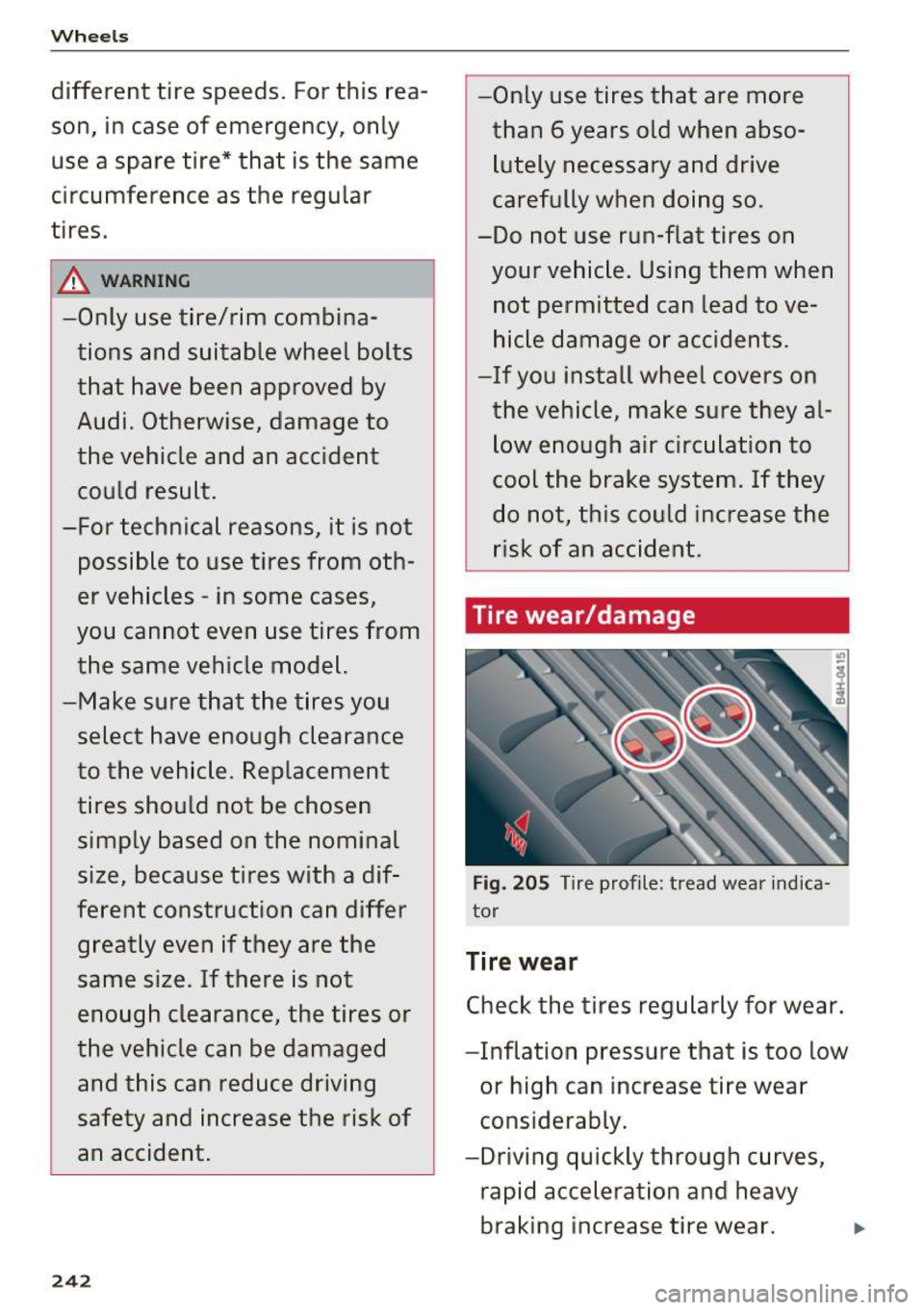
Treadwear indicators (TWI)
means the projections within the
principal grooves designed to give
a visua l indication of t he degrees
of wear of the tread . See
¢ page 243, Treadwear indicator
for mo re info rma tion on measu r-
ing tire wear. .,.
239
Page 242 of 300
Wheels
Uniform Tire Quality Gr ading
is a tire information system devel
oped by the United States Nation
al Highway Traffic Safety Admin
istration (NHTSA) that is designed
to help buyers make relative com parisons among tires. The UTQG
is not a safety rating and not a
guarantee that a tire will last for
a prescr ibed number of miles
(kilometers) or perform in acer
tain way. It simply gives tire buy
ers additional information to
combine with other considera
tions, such as price, brand loya lty
and dealer recommendations. Un
der UTQG, tires are graded by the
tire manufacturers in three areas:
treadwear , traction, and tempera
ture resistance . The UTQG in for
mation on the tires, molded into
the sidewalls.
U.S. DOT Tire Identification
Number (TIN)
This is the tire's "serial number" .
It begins with the letters "DOT"
and indicates that the tire meets
all federal standards. The next
two numbers or letters indicate
the plant where it was manufac
tured, and the last four numbers represent the
week and year of
manufacture . For example,
24 0
DOT ... 2215 ...
means that the tire was produced
in the 22nd week of 201 5. The
other numbers are marketing co
des that may o r may not be used
by the tire manufacturer . This in
formation is used to contact con sumers if a tire defect requires a
recall.
Veh icle capac ity weight
means the rated ca rgo and lug
gage load pl us 150 lbs . (68 k ilo
grams) times the vehicle's desig
nated seating capacity .
Vehicle maximum load on the
tire
means that load on an ind ividual
tire that is determined by distrib
uting to each axle its sha re of the
maximum loaded veh ic le we ight
and dividing by two.
Vehicle normal load on the tire
means that load on an individual
tire that is determi ned by distrib
uting to each axle its share of the
curb weight, accessory weight,
and normal occupan t weight (dis
tributed in accordance with
c::> ta
ble on page 246) and dividing by
two .
~
Page 243 of 300
Occupant loading and distri
but ion for vehicle normal load
for various design ated se ating
c a pa cit ies
Refer to the tire inflation pres
sure label ¢
page 244, fig. 207
for the number of seating posi
tions. Refer to the table ¢
table
on page 246
for the number of
people that correspond to the ve
hicle normal load.
New tires or wheels
Audi recommends having all work
on tires or wheels performed by
an authorized Audi dealer or au
thorized Audi Service Facility .
These facilities have the proper
knowledge and are equ ipped with
the required tools and replace
ment parts .
.,,. New tires do not yet have the
opt imum adhesion properties.
Drive carefully and at moderate
speeds for the first 350 m iles
(500 km) with new tires .
... use tires of the same construc
tion, size (rolling circumference)
and as close to the same tread pattern as possible on all four
wheels.
Wheels
.,,. Do not replace tires individually.
At least replace both tires on the same axle at the same time .
.,,. Audi recommends that you use
Audi Original equipment tires. If
you would like to use different
tires, please note that the tires may perform differently even if
they are the same size¢,&..
.,,. If you would like to equip your
vehicle w ith a tire/r im combina
tion that is different from what
was installed at the factory, con
sult w ith an authorized Audi
dealer or authorized Audi Service
Facility before making a pur
chase ¢
..1,..
The spare t ire* is diffe rent from
the regular tires installed on the
vehicle - for example, if winter
tires or wide tires are installed -
then only use the spare tire* tem
porarily in case of emergency and
drive carefully while it is in use . It
should be replaced with a regular
tire as soon as possible.
On
all wheel d rive vehicles, all
four wheels must be equipped
with tires that are the same brand
and have the same construction
and tread pa ttern so that the
drive system is not damaged by
24 1
Page 244 of 300
Wheels
different tire speeds. For this rea
son, in case of emergency, only
use a spare tire* that is the same
circumference as the regular
tires.
,&. WARNING -
-Only use tire/rim combina tions and suitable wheel bolts
that have been approved by
Audi. Otherwise, damage to
the vehicle and an accident could result.
-For technical reasons, it is not possible to use tires from oth
er vehicles - in some cases,
you cannot even use tires from the same vehicle model.
-Make sure that the tires you select have enough clearance
to the vehicle . Replacement
tires should not be chosen simply based on the nominal
size, because t ires with a dif
ferent construction can differ
greatly even if they are the
same size. If there is not
enough clearance, the tires or
the vehicle can be damaged and this can reduce driving
safety and increase the risk of
an accident.
242
-Only use tires that are more
than 6 years old when abso
lutely necessary and drive
carefully when doing so .
-Do not use run-flat tires on your vehicle. Using them when not permitted can Lead to ve
hicle damage or accidents.
- If you install wheel covers on
the vehicle, make sure they al
low enough air circulation to
cool the brake system. If they
do not, this could increase the
risk of an accident.
Tire wear/damage
Fig. 205 Tire profile: tread wear ind ica
tor
Tire wear
Check the tires regularly for wear.
- Inflation pressure that is too Low
or high can increase tire wear
considerably.
-Driving quickly through curves, rapid acceleration and heavy
braking increase tire wear. ..