brakes AUDI Q5 2016 Owner's Manual
[x] Cancel search | Manufacturer: AUDI, Model Year: 2016, Model line: Q5, Model: AUDI Q5 2016Pages: 300, PDF Size: 75.02 MB
Page 204 of 300
Offroad dri ving
- Ideal conditions do not prevai l offroad . Nev
er utilize the maximum readings to their
fullest, always leave a safety reserve.
Driving tips
On poor rood ond offroad, there is always only
one motto: Plan ahead and drive slowly!
Pl ease observe the following when driv ing away
from paved roads:
.,. Drive only on roads and off road sections which
ma tch the des ign of your vehicle and yo ur abili
ties as a driver . Neve r take risks!
... Drive slowly and p lan ahead!
... Take into consideratio n the
ground clearan ce
of your veh icle.
.,. Activate the
offro ad mode Q page 190 as need
ed .
.,. Use the
hill desc ent a ssis t Q page 192 when
driv ing down steep sections on hills .
Unpaved roads and offroad
Drive s low ly on unfam iliar roads and unknown
offroad sections, and look out for unexpected ob
stacles (e .g. potholes, rocks, tree stumps, etc .) .
To prevent the veh icle from bottoming and avoid
damage to the underbody, you should d rive
stra ight across severe bumps in the ground with
only one side of the vehicle so that only two of
your wheels cross the b umps.
Drive briskly through sandy or marshy offroad
sections and do not stop , if at all possible .
Driving through water
Note the following to avoid vehicle damage when
driving throug h water, fo r example on flooded
roads:
- T he wate r must no t be any higher than the bot-
tom of the vehicle body .
- Do no t drive fas ter than wa lking spee d.
Driving on a slope
If you ever find yo urself not able to cl imb a s lope,
do not try to turn around, d rive back down in
re
verse .
Otherw ise, you run the risk of tipping over.
202 If the vehicle thre
atens to tip o ver when dr iving
across a slope, you must immediately stee r
downhill in the direction of the slope.
Do no t pa rk you r vehi cle on steep s lopes or
grades .
To reduce the risk of tipping over, drive on slopes
i n the d irect io n of the downwa rd slope (fa ll line) -
not cros swi se .
& WARNING
After driving thro ugh water, mud, slush, etc.,
the brakes may be slow to take effect beca use
of wet brake rotors and pads. Dry the brakes
f irst by braking carefu lly to restore the full
braking effect .
(D Note
- Vehicle components such as the engine,
transmiss ion, suspension or electrical sys
tem can be seve rely damaged by driving
throug h water.
-Always switch off the Start-Stop-System *
when driving through water Qpage 93.
(D Tips
-Check the de pth of the water before driving
through it.
- Do not stop the vehicle, drive in reverse or
switch the engine of f whe n driving through
water.
- Keep in mind that oncom ing vehicles may
create waves that raise the water level and
make it too deep fo r your vehicle to drive
t h roug h safe ly.
-Avoid driv ing through salt water beca use it
can cause corrosion.
Page 205 of 300
,....,
N
co
er::
co
,....,
General information
Your Audi was designed primarily for passenger
transportation .
If you plan to tow a trailer, please remember that
the additional load will affect durability, econo my and performance.
T railer towing not only places more stress on the
vehicle, it also calls for more concentration from
the driver.
For this reason, always follow the operating and
driving instructions provided and use common
sense.
Technical requirements
Trailer hitch
Use a weight-carrying hitch conforming to the
gross trailer weight. The hitch must be suitable
for your vehicle and trailer and must be mounted
securely on the vehicle's chassis at a technically
sound
location . Use only a trailer hitch with a re
movable ball mount . Always check with the trail
er hitch manufacturer to make sure that you are
using the correct hitch.
Do not use a bumper hitch.
The hitch must be installed in such a way that it
does not interfere with the impact -absorbing
bumper system . No modifications should be
made to the vehicle exhaust and brake systems .
From time to time, check that all hitch mounting
bo lts remain securely fastened.
When you are not towing a trailer,
remove the
tra iler hitch ball mount . This prevents the hitch
from causing damage should your vehicle be
struck from beh ind ¢
,&. .
Trailer brakes
If your trailer is equipped with a braking system,
check to be sure that it conforms to all regula
tions .
Trailer mode
The trailer hydraulic brake system must not be
directly connected to the vehicle's hydraulic
brake system ¢.&. .
Safety chains
Always use safety chains between your vehicle
and the trailer.
Trailer lights
T ra iler lights must meet all regulations . Be sure
to check with your author ized Audi dealer for cor
rect wiring, switches, and relays.
Mirrors
If you are unable to see the traffic behind you us
ing the regular outside mirrors, then you
must in
stall extended mirrors. It is important that you
always have clear vision to the rear.
,8. WARNING
-If a trailer has electrical brakes please note
that these brakes are not activated by the
factory-fitted control unit -risk of accident!
- After removing the trailer hitch, do not store it in your vehicle. In case of sudden
braking, the hitch could fly forward and in
jure you or your passengers.
- Never install a "weight distributing" or
"load equalizing" trailer hitch on your vehi
cle. The vehicle was not designed for these
kinds of trailer hitches . The hitch attach
ment can fail, causing the trailer to tear
loose from the vehicle.
- The Gross Vehicle Weight Rating for your
vehicle, found on the safety compliance la bel on the driver's side B-pillar, must never
be exceeded under any circumstances. Ex
ceeding the Gross Vehicle Weight Rating of
your vehicle is likely to damage your vehicle,
and such damage will not be covered by
your Limited New Vehicle Warranty. Exceed
ing the Gross Vehicle Weight Rating will al
so change the performance and handling
characteristics of your vehicle, which could
cause a crash resulting in serious injury or
death.
203
Page 206 of 300
Trailer mod e
Operating instructions
6"
~ 2
. 1/2 "
.(. '-I} 1-1/2"
-
F ig. 189 Pe rmi tted ball posit io n of the traile r hi tch
Tr aile r to wing weights
With a f ac tor y-inst all ed or an a ft er ma rket trailer
h itch, the maximum permissib le trailer weight is
4,400 lbs (2,000 kg) . The maximum perm iss ible
unb raked trailer weight is 1,650 lbs (750 kg) .
These spec ificat ions apply when dr iv ing on roads
hav ing an incl ine of less tha n 12%.
Perm is sible tongue load
For best vehicle handling under these changed
conditions, adjust the trailer load so that the
tongue load is at the maxim um allowable or
slightly lower. You can get an approx imation of
the tongue load w ith a bathroom scale or you can
measure the load at a tr ucking company or
weighing station.
W ith a
fa ctor y-installed or an aftermarket trailer
h itch, t he maximum permissib le load on the ball
h itch may not exceed 440 lbs (200 kg).
It is rec
ommended to use the maximum permissible
load.
Trailer load di stribution
B e su re the load in the trailer is held securely in
p lace to prevent it from s hift ing fo rwa rd, back
ward or sideways.
Nev er allo w a p assenge r to ride in a trail er c::> A
in Driving instructions on page 205.
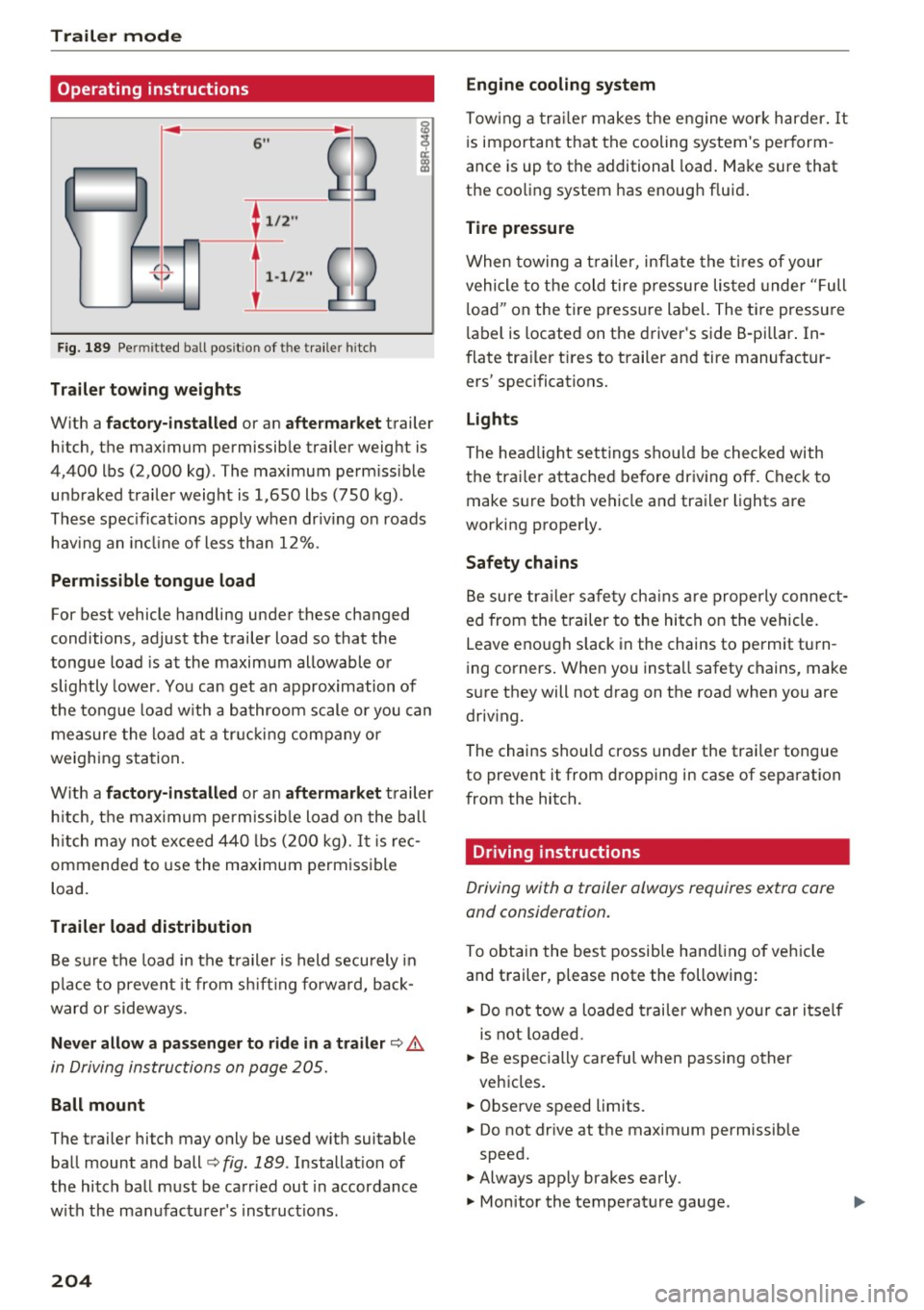
Ball mount
The trailer hitch may only be used w ith suitable
ball mount and ball
c::> fig. 189 . Installat ion of
the hitch ball must be carr ied out in accordance
w ith the manufacturer 's inst ruct ions.
204
Engine cooling system
Towing a tra ile r makes t he engine work harder. It
is important that the cooling system's perform
ance is up to the additional load . Make sure that
the cooling system has enough fluid .
Tire pressure
When towing a t railer, inflate the ti res of your
vehicle to the cold tire pressure listed under "Full
l oad" on the tire press ure label. The tire pressure
l abel is located on the driver 's side B-pillar . In
flate tra iler tires to trailer and tire manufactur
ers' specifications.
Lights
The head light settings shou ld be checked with
the trailer attached before driving off. Check to
make s ure both vehicle and trailer lights are
working properly.
Safety chains
Be sure tra ile r safety cha ins a re properly connect
ed from the trailer to the hitch on the vehicle.
Leave enough slack in the chains to permit tu rn
i ng corners . When you install safety chains, make
s u re they will not drag on the road when you are
driv ing.
The chains should cross under the trai ler tongue
to prevent it from dropping in case of separation
from the hitch.
Driving instructions
Driving with a trailer always requires extra care
and consideration.
To obtain the best possible handling of veh icle
and t railer, p lease note the following:
.., Do not tow a loaded trai ler when your car itself
is not loaded.
.., Be especially care ful when passing other
vehicles .
.., Observe speed limits.
.., Do not drive at the maximum permissible
speed.
.., Always app ly brakes early.
.., Monitor the temperature gauge.
Page 207 of 300
,....,
N
co
er::
co
,....,
Towing a loaded trailer with an empty car res ults
in a high ly unstable distribution of weight. If this
cannot be avoided, drive at very low speeds only
to avoid the risk of losing steering control.
A "balanced" rig is eas ier to operate and control.
This means that the tow vehicle should be loaded
to the extent possible and permissible, while
keeping the trailer as light as possible under the
circumstances. Whenever possible, transfer
some cargo to the luggage compartment of the
tow vehicle while observ ing tongue load require
ments and vehicle loading considerat ions.
Speed
The higher the speed, the more difficult it be
comes for the driver to contro l the rig. Do not
drive at the maximum permiss ible speed . Reduce
your speed even more if load, weather or wind
conditions are unfavorable - part icularly when
going downhill.
Reduce veh icle speed
immediately if the tra iler
shows the slightest sign of swaying .
Do not try
to stop the swaying by accelerating.
Observe speed lim its . In some areas, speeds for
veh icles towing trai lers are lower than for regular
veh icles.
Always apply brakes early. When driving down
h ill , shift into a lower gear to use the engine
braking effect to slow the veh icle. Use of the
brakes alone can cause them to overheat and fa il.
Coolant temperature
The coolant temperature gauge r=;, page 10 must
be observed carefully . If the needle moves close
to the upper end of the scale, reduce speed im mediately and/or turn off the air conditioner.
If the coolant temperature warning light in the
instrument cluster starts flashing., pull off
the road, stop and let the engine
idle for about
two minutes to prevent heat build-up.
A WARNING
Anyone not properly restrained in a moving
vehicle is at a much greater risk in an acci-
-
Trailer mode
dent. Never let anyone ride in your car who is
not properly wear ing the restraints provided
by Aud i.
Trailer mode notes
Important to know
Your vehicle handles differently when towing a
t railer because o f the additional weight and dif
ferent weight distribution. Safety, performance
and economy will greatly depend on how carefu l
ly you load your trai ler and operate your rig.
Before you actually tow your trailer, practice
tu rning, stopping and backing up in an area away
from traffic. Keep practicing until you have be
come comp lete ly familiar w ith the way your vehi
cle-tra iler combination behaves and responds.
Backing up is difficu lt and requires practice.
Backing up with a t railer generally requires steer
ing action opposite to that when backing up your
vehicle without a trailer.
Maintain a greater distance between your vehicle
and the one in front of you . You will need more
room to stop. To compensate for the trailer, you
will need a larger than normal turning radius.
When passing, remember that you cannot accel
erate as fast as you normally would because of
the added load. Make sure you have enough room
to pass. After passing, allow p lenty of room for
your trailer before c hanging lanes again.
Avoid jerky starts, sharp turns or rapid lane
changes.
(D Tips
- Do not tow a trailer during the break-in peri
od of your veh icle.
- If you tow a trailer, your Audi may requ ire
more frequent maintenance due to the ex
tra load
r=;, page 280.
205
Page 208 of 300
Trailer mod e
Parking on a slope
Do not park on a slope with a trailer. If it cannot
be avoided, do so only after doing the following:
When parking:
.,. Apply the foot brake .
.,. Have someone place chocks under both the ve
hicle and the trailer wheels .
.,. With chocks in p lace, slowly release the brakes
unt il the wheel chocks absorb the load .
.,. Turn the wheels towards the curb .
.,. Apply the pa rking brake .
.,. Move the selector lever to P .
When resta rting after parking:
.,. Apply the foot brake .
.,. Start the engine .
.,. Move the selector leve r to 0/5 .
.,. Release t he pa rking brake and slow ly pull out
and away from the wheel chocks.
"' Stop and have someone retrieve the wheel
chocks.
(D Tips
If you move the se lector lever of the automat
ic transmission to P before applying the park
ing brake and before blocking the wheels, you may have to use more force later to move the
lever out of the P position .
206
Page 238 of 300
Wheels
be happy to provide more infor
mation.
® Mud and snow capability
"M/S" or "M+S" indicates the tire
has characteristics that make it
suitab le for driving on mud and
snow.
& indicates a winter t ire.
@ Compos ition of the tire cord
and materials
The number of plies indicates the
number of rubberized fabric lay
ers in the tire . In general: the
more layers, the more weight a
tire can carry. Tire manufacturers must also specify the materia ls
used in the tire. These include
steel, nylon, polyester and other
materials .
@ Maximum permitted load
This number indicates the maxi
mum load in k ilograms and
pounds that the tire can carry.
@ Uniform tire quality grade
standards for treadwear,
traction and temperature
resistance
Tread wear, t raction and temper
ature ranges
¢ page 251 .
@ Running direction
The arrows indicate the running
direction of unidirec tiona l tires.
23 6
You must a lways follow the speci
fied runn ing direction
¢ page 263.
@ Maximum permitted
inflation pressure
This number indicates the maxi
mum pressure to which a tire can be inflated unde r normal operat
ing condit ions .
Glossary of tire and loading
terminology
Accessory weight
means the comb ined we ight (in
excess of those standard items
which may be replaced) o f auto
matic tra nsmission , power steer
ing , power brakes , power wi n
dows, power seats , radio , and
heater, to the extent that these
items a re available as facto ry-in
stalled equipment (whet her in
stalled or not).
Aspect ratio
means the rat io of the height to
the width o f the tire in pe rcent.
Numbe rs of 55 or lower indicate a
low sidewa ll for imp roved steer
ing response and better overa ll
handling on dry pavement .
...
Page 240 of 300
Wheels
(a) Curb weight
(b) Accessory weight
(c) Vehicle capacity weight, and
(d) Production options weight
Maximum (permissible )
inflation pressure
means the maximum cold infla
tion pressure to which a tire may be inflated. Also called "maxi
mum inflation pressure ."
Normal occupant weight
means 150 lbs . (68 kilograms)
times the number of occupants
seated in the vehicle up to the to
ta l seating capacity of your vehi
c le .
Occupant distribution
means distribut ion of occupan ts
in a vehic le .
Outer diameter
means the overall diamete r of an
inflated new tire.
Overall width
means the l inear distance be
tween the exter iors of the side
walls of an infla ted tire , including
elevations due to labeling , deco
rations, or protective bands or
r ibs.
23 8
Ply
means a layer of rubber -coated
pa rallel cords.
Production options weight
means t he comb ined we ight of
those insta lled regular production
options weighing over 5 lbs . (2 .3
kg) in excess of those standard
items which they replace , not pre
viously considered in curb weight or accessory weight, inc luding
heavy duty brakes, ride levelers,
roof rack, heavy duty battery, and
special trim.
Radial ply tire
means a pneumatic tire in which
the ply co rds that extend to the
beads are laid at subs tantially 90
deg rees to the centerline o f the
tread .
Recommended inflation
pressure
see~ page 23 7, Cold tire infla
tion pressure.
Reinforced tire
means a tire designed to operate
at highe r loads and at h igher in
flat ion pressures than t he corre
spond ing standa rd tire . R ein
forced tires may be identified as .,.
Page 249 of 300
plus maximum load. The maxi
mum load includes the number of
passengers that the vehicle is in
tended to carry ("seating capaci
ty") with an assumed weight of
150 lbs. (68 kg) for each passen
ger at a designated seating posi
tion and the total weight of any luggage in the vehicle . If you tow
a trailer, the weight of the trailer
hitch and the tongue weight of
the loaded trailer must be includ
ed as part of the vehicle load .
The
Gross A xle Weight Rating
("GAWR") is the maximum load
that can be appl ied at each of the
vehicle's two axles.
The fact that there is an upper
limit to your vehicle's Gross Vehi
c le Weight Rating means that the
total weight of whatever is being
carried in the vehicle (including
the weight of a tra iler hitch and
the tongue weight of the loaded
trailer) is limited. The more pas
sengers in the vehicle or passen
gers who are heavier than the
standard weights assumed mean
that less weight can be carried as luggage.
The Gross Vehicle We ight Rating
and the Gross Axle Weight Rating
Wheels
are listed on the safety compli
ance sticker label located on the
driver's side B -pillar
¢ page 244,
fig . 206.
_& WAR NING
Overloading a vehicle can cause
loss of vehicle control, a crash
or other accident, serious per
sonal in jury, and even death.
-Carrying more weight than
your vehicle was designed to carry will prevent the vehicle
from handling properly and increase the risk of the loss of
vehicle control.
- The brakes on a vehicle that
has been overloaded may not
be able to stop the vehicle
within a safe distance.
-Tires on a vehicle that has
been overloaded can fail sud
denly, including a blowout and
sudden deflation, causing loss
of control and a crash.
-Always make sure that the to
tal load being transported -
including the weight of a trail
er hitch and the tongue
weight of a loaded trailer - does not make the vehicle
heavier than the vehicle's
Gross Vehicle Weight Rating .
247
Page 287 of 300
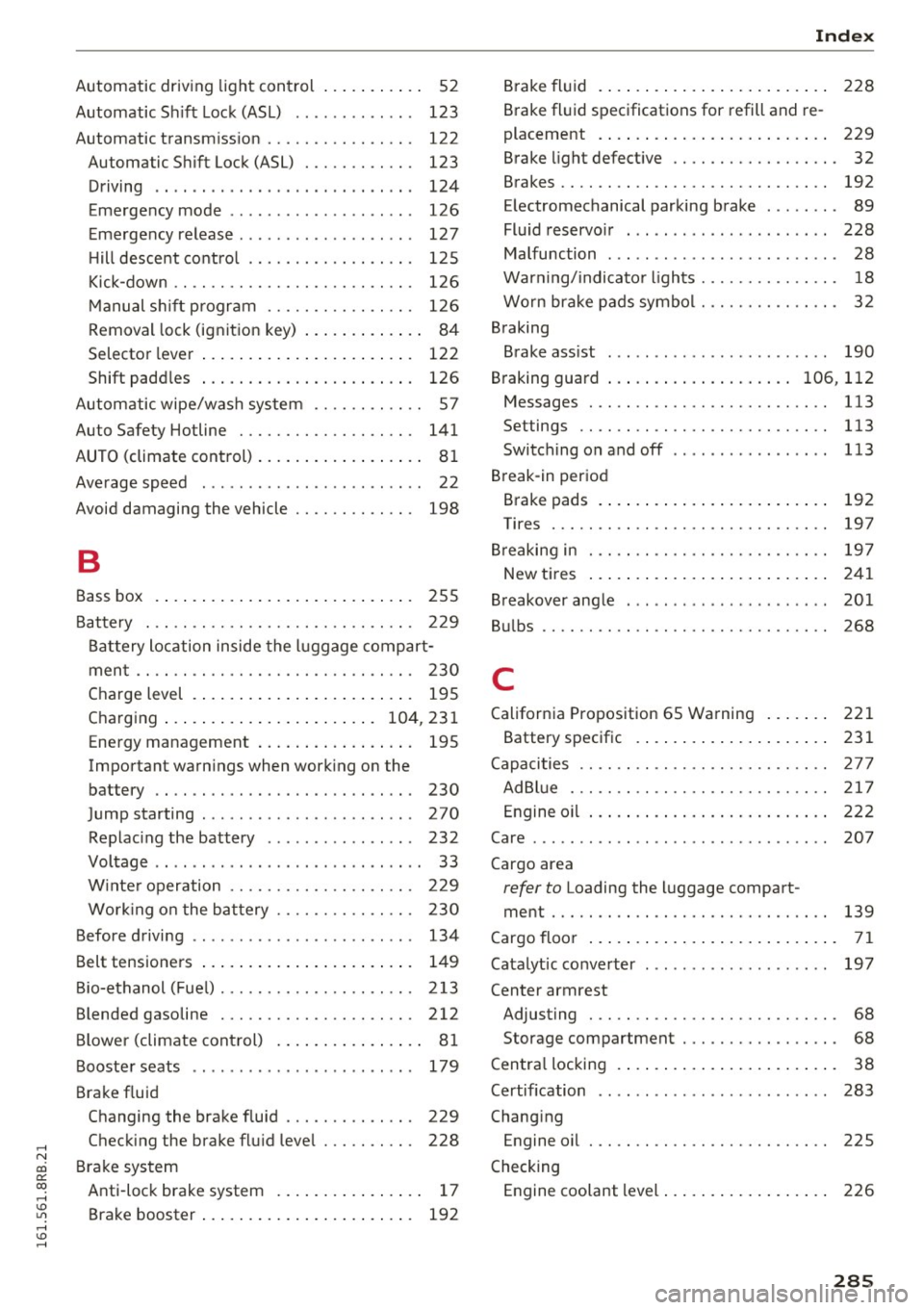
,....,
N
co
er::
co
,....,
Automatic Shift Lock (ASL) . . . . . . . . . . . . . 123
Automatic transmission . . . . . . . . . . . . . . . . 122
Automatic Shift Lock (ASL) . . . . . . . . . . . . 123
Driving .. ... ................... ... . 124
Emergency mode . . . . . . . . . . . . . . . . . . . . 126
Emergency release . . . . . . . . . . . . . . . . . . . 127
Hill descent control . . . . . . . . . . . . . . . . . . 125
Kick-down . . . . . . . . . . . . . . . . . . . . . . . . . . 126
Manual shift program . . . . . . . . . . . . . . . . 126
Removal lock (ignition key) . . . . . . . . . . . . . 84
Selector lever . . . . . . . . . . . . . . . . . . . . . . . 122
Shift padd les . . . . . . . . . . . . . . . . . . . . . . . 126
Automatic wipe/wash system . . . . . . . . . . . . 57
Auto Safety Hotline . . . . . . . . . . . . . . . . . . . 141
AUTO (climate control) . . . . . . . . . . . . . . . . . . 81
Average speed . . . . . . . . . . . . . . . . . . . . . . . . 22
Avoid damaging the vehicle . . . . . . . . . . . . . 198
B
Bass box . . . . . . . . . . . . . . . . . . . . . . . . . . . . 255
Battery . . . . . . . . . . . . . . . . . . . . . . . . . . . . . 229
Battery location inside the luggage compart-
ment .. .. .. .. .. ........... .. .. .. .. . 230
Charge level . . . . . . . . . . . . . . . . . . . . . . . . 195
Charging ... .. .................. 104,231
Ene rgy management . . . . . . . . . . . . . . . . . 195
Important warnings when working on the
battery . . . . . . . . . . . . . . . . . . . . . . . . . . . . 230
Jump starting . . . . . . . . . . . . . . . . . . . . . . . 270
Replacing the battery . . . . . . . . . . . . . . . . 232
Voltage . . . . . . . . . . . . . . . . . . . . . . . . . . . . . 33
W inter operation . . . . . . . . . . . . . . . . . . . . 229
Work ing on the battery . . . . . . . . . . . . . . . 230
Before driving . . . . . . . . . . . . . . . . . . . . . . . . 134
Belt tensioners . . . . . . . . . . . . . . . . . . . . . . . 149
Bio-ethanol (Fuel) .............. .. .. .. . 213
Blended gasoline . . . . . . . . . . . . . . . . . . . . . 212
Blow er (climate control) . . . . . . . . . . . . . . . . 81
Boo ster seats . . . . . . . . . . . . . . . . . . . . . . . . 179
Brake fluid
Changing the brake fluid . . . . . . . . . . . . . . 229
Checking the brake flu id level . . . . . . . . . . 228
B rake system
Anti-lock brake system . . . . . . . . . . . . . . . . 17
Brake booster . . . . . . . . . . . . . . . . . . . . . . . 192
Index
Brake fluid . . . . . . . . . . . . . . . . . . . . . . . . . 228
Brake fluid specifications for refill and re
placement . . . . . . . . . . . . . . . . . . . . . . . . . 229
Brake light defective . . . . . . . . . . . . . . . . . . 32
Brakes . . . . . . . . . . . . . . . . . . . . . . . . . . . . . 192
E le ctromechanical parking brake . . . . . . . . 89
Fluid reservoir . . . . . . . . . . . . . . . . . . . . . . 228
Malfunction . . . . . . . . . . . . . . . . . . . . . . . . . 28
Warning/indicator lights . . . . . . . . . . . . . . . 18
Worn brake pads symbol . . . . . . . . . . . . . . . 32
Braking Brake assist . . . . . . . . . . . . . . . . . . . . . . . . 190
Braking guard ... .. .. ............. 106, 112
Messages . . . . . . . . . . . . . . . . . . . . . . . . . . 113
Settings . . . . . . . . . . . . . . . . . . . . . . . . . . . 113
Switching on and
off . . . . . . . . . . . . . . . . . 113
Break-in period Brake pads . . . . . . . . . . . . . . . . . . . . . . . . . 192
Tires . . . . . . . . . . . . . . . . . . . . . . . . . . . . . . 197
Brea king in . . . . . . . . . . . . . . . . . . . . . . . . . . 197
New tires . . . . . . . . . . . . . . . . . . . . . . . . . . 241
Breakover angle ... .. .... ...... ... .. .. 201
Bu lbs . . . . . . . . . . . . . . . . . . . . . . . . . . . . . . . 268
C
California Proposition 65 Warning . . . . . . . 221
Battery specific . . . . . . . . . . . . . . . . . . . . . 231
Capacities . . . . . . . . . . . . . . . . . . . . . . . . . . . 277
AdBlue ............................ 217
Eng ine oil . . . . . . . . . . . . . . . . . . . . . . . . . . 222
Care . . . . . . . . . . . . . . . . . . . . . . . . . . . . . . . . 207
Cargo area
refer to Loading the luggage compart-
ment..... .... .. .. ............... .. 139
Cargo floor . . . . . . . . . . . . . . . . . . . . . . . . . . . 71
Catalytic converter . . . . . . . . . . . . . . . . . . . . 197
Center armrest Adjusting . . . . . . . . . . . . . . . . . . . . . . . . . . . 68
Storage compartment . . . . . . . . . . . . . . . . . 68
C en tral locking . . . . . . . . . . . . . . . . . . . . . . . . 38
Certification . . . . . . . . . . . . . . . . . . . . . . . . . 283
Changing Engine oil . . . . . . . . . . . . . . . . . . . . . . . . . . 225
Ch ecking
Engine coolant level . . . . . . . . . . . . . . . . . . 226
285