ABS AUDI Q5 2017 Owner's Manual
[x] Cancel search | Manufacturer: AUDI, Model Year: 2017, Model line: Q5, Model: AUDI Q5 2017Pages: 296, PDF Size: 74.43 MB
Page 226 of 296
Checking and Filling
cooling system is not leakin g, a loss can come
from t he coolant boiling through overheat ing
an d be ing pushed out o f the coo ling system .
A WARNING
-
-The cooling system is under pressure. Do
not open t he coolant expansion tank ca p
when the eng ine is hot. This inc reases the
risk of bu rns .
- The coolant add itive and the coolant can be
dangerous to your health. For this reason,
keep the coolant in the o rigina l container
and away from children. There is a risk of
po isoning .
- When working in the eng ine compartmen t,
r emembe r that the rad iator fan ca n switch
on even if the ign ition is swi tc h ed off, which
in creases the risk of in jury.
(D Note
Do not add coolant if the expansion tank is
empty. Air could enter the cooling system and
damage the engine. If this is the case , do no t
cont inue driv ing. See an authorized Audi deal
er or author ized Audi Se rvice Facility for assis
tance .
Brake fluid
Checking brake fluid level
The brake fluid level can be checked with a quick
glance.
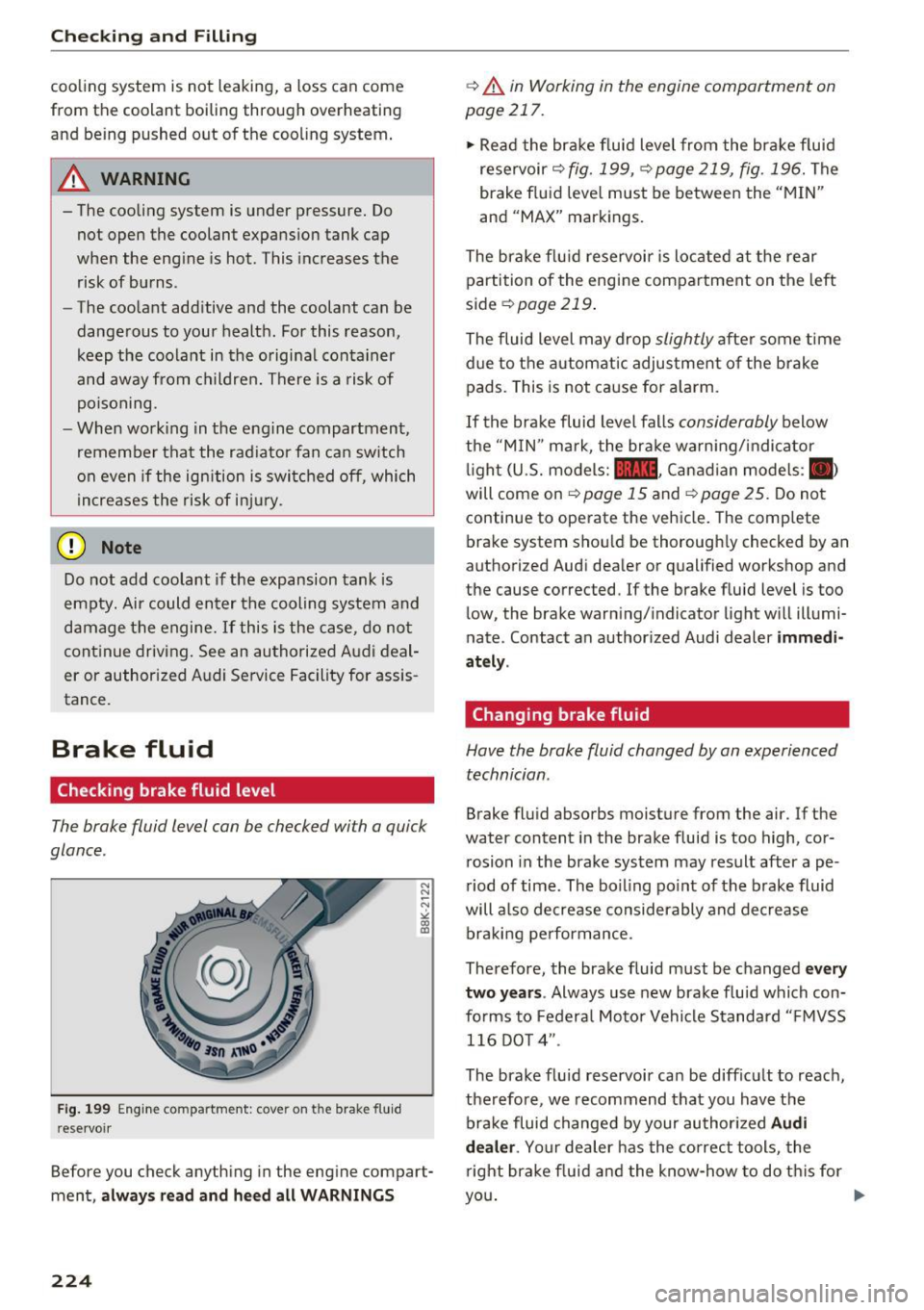
F ig. 19 9 En gi ne co mpa rtme nt: cove r on the brak e fluid
r ese rvoi r
N N
-N
" "' IX)
Before you check anyth ing in the eng ine compart
ment,
a lways read and h eed all WARNING S
224
¢.&. in Working in the engine compartment on
page 217.
.,. Read the bra ke fluid level from the brake f lu id
reservoir ¢
fig. 199, ~ page 219, fig. 196. The
brake fluid leve l must be between the "M IN"
and "MAX" markings.
The brake flu id reservoir is located a t the rear
partition of the engine compartment on the left
side
¢ page 219.
The fluid level may drop slightly afte r some t ime
due to t he automatic adjustme nt of the brake
pads. This is not ca use for a larm.
If the brake fluid level falls considerably below
the
" M IN " mark, the bra ke warn ing/ indica tor
li gh t (U.S. models:
11111 . Canadian models: .
will come on ¢
page 15 and¢ page 25. Do not
continue to ope rate the veh icle. The comp lete
brake system shou ld be thoroughly checked by an
a uthor ized Audi dealer or qualified workshop and
the cause corrected. If the brake fluid level is too l ow, the brake warn ing/ indicator light w ill illumi
nate. Contact a n author ized Audi dealer
immedi
ately .
Chang ing brake fluid
Have the brake fluid changed by an experienced
technician .
Brake fluid absorbs moisture from the air. If the
water content in the brake fluid is too high, cor
rosion in the brake system may result after ape
riod of time . The boiling po int of the brake fluid
will a lso decrease considerably and decrease
bra king pe rformance.
Therefore, the brake fluid must be changed
every
two years .
Always use new brake f lu id which con
fo rms to Federa l Moto r Vehicle S tandard " FMVSS
116 DO T 4".
The brake fluid reservoir can be diff icult to reach,
therefore, we recommend that you have the
brake fluid changed by your author ized
Audi
dealer .
Your dealer has the correct tools, the
right brake fluid a nd the know -how to do t his for
you . ..,.
Page 227 of 296
CD
CD
.... N ,-... N ..... 0 0 C<'. 00
& WARNING
-Brake fluid is poisonous. It must be stored
only in the closed original container out of
the reach of children!
- Brake failure can resu lt from old or inappro
priate brake fluid. Observe these precau
t ions:
- Use only brake flu id that meets SAE speci
fication
J 1 703 and confo rms to Fede ral
Motor Vehicle Standard 116. Always check
with your author ized Audi dealer to make
sure you are using the correct brake fluid.
The correct type of brake fluid is a lso indi
cated on the brake flu id reservoir.
- The brake fluid must be new. Heavy use o f
the brakes can cause a vapor lock if the
brake fl uid is left in the system too long.
This can serious ly affect the efficiency of
the brakes as well as your safety. This
could result in an acc ident.
Brake fluid w ill damage the pa int of yo ur vehi
cle.
@) For the sake of the environment
Because of the prob lem of proper disposal of
brake flu id as we ll as the special tools re
qui red and the necessary expertise, we rec
ommend that you have the brake fluid
changed by your author ized Audi dealer.
Battery
General information
Under normal operating conditions, the battery
in your Audi does not need any maintenance.
W ith
high outside temperatures or long da ily
drives we recommend that you have the electro lyte level checked by an authorized Audi dea ler or
qua lified workshop. The e lectrolyte level should
a lso be checked each t ime the batte ry is charged
¢ page 22 7.
H ave the battery checked when you take your ve
hi cle in for serv ice. You a re well advised to re
p lace a batte ry that is o lde r than 5 years .
Check ing and Filling
Hybrid dr ive *: you can find important in format ion
about the high voltage battery under
¢ page 100.
Disconnecting the battery te rminals
Some vehi cle functions (power window regula
tors, for examp le) are lost if the batte ry te rm i
nals a re disconnected . These functions have to be
re learned after the battery terminals a re con
nected again. To prevent this, the battery should
only be disconnected from the vehicle electrical
system when absolutely necessary for repa irs.
Vehicles not dr iven for long p eriod s
If you do not drive your vehicle over a period of
severa l days or weeks, electrical compone nts are
gradually cut back or switched off. This reduces
energy consumpt ion and maintains starting ca
pability over a longer per iod
¢ page 192.
T ake into consideratio n that when you unlock
your vehicle, some convenience functions, suc h
as the inter ior lights or the power seat adjust
ment, may not be ava ilab le. The conve nience
funct ions will be available again when you turn
on the ignition and sta rt the eng ine.
Winter operation
D uring the winter months, battery capacity tends
to decrease as temperatures drop. This is be
cause more power is also consumed while start
i ng, and the headlights, rear w indow defogger,
etc., are used more ofte n.
Avo id unnecessary power consumption, pa rtic u
larly in city traff ic or when traveling only short
distances . Let your author ized Audi dealer check
the capacity of the veh icle batte ry before winter
sets in
¢ page 22 7. A we ll charged batte ry will
not only p reve nt start ing prob lems when the
wea the r is co ld, but will also last longer.
Working on the battery
Be especially careful when working on or near
the battery.
T he battery is loca ted in t he luggage compart
ment unde r the floo r. B efo re yo u check any thing .,..
225
Page 240 of 296
Wheels
&,. WARNING -
-Only use tire/rim combina
tions and suitable wheel bolts
that have been approved by
Audi. Otherwise, damage to
the vehicle and an accident could result.
-For technical reasons, it is not
possible to use tires from oth
er vehicles -in some cases,
you cannot even use tires from
the same vehicle model.
-Make sure that the tires you
select have enough clearance
to the vehicle. Replacement
tires should not be chosen
simply based on the nominal
size, because tires with a dif
ferent construction can differ
greatly even if they are the
same size. If there is not enough clearance, the tires or
the vehicle can be damaged and this can reduce driving
safety and increase the risk of
an accident.
-Only use tires that are more
than six years old when abso
lutely necessary and drive
carefully when doing so.
-Do not use run-flat tires on
your vehicle. Using them when
238
not permitted can lead to ve
hicle damage or accidents.
-If you install wheel covers on the vehicle, make sure they allow enough air circulation to
cool the brake system. If they do not, this could increase the
risk of an accident.
Tire wear/damage
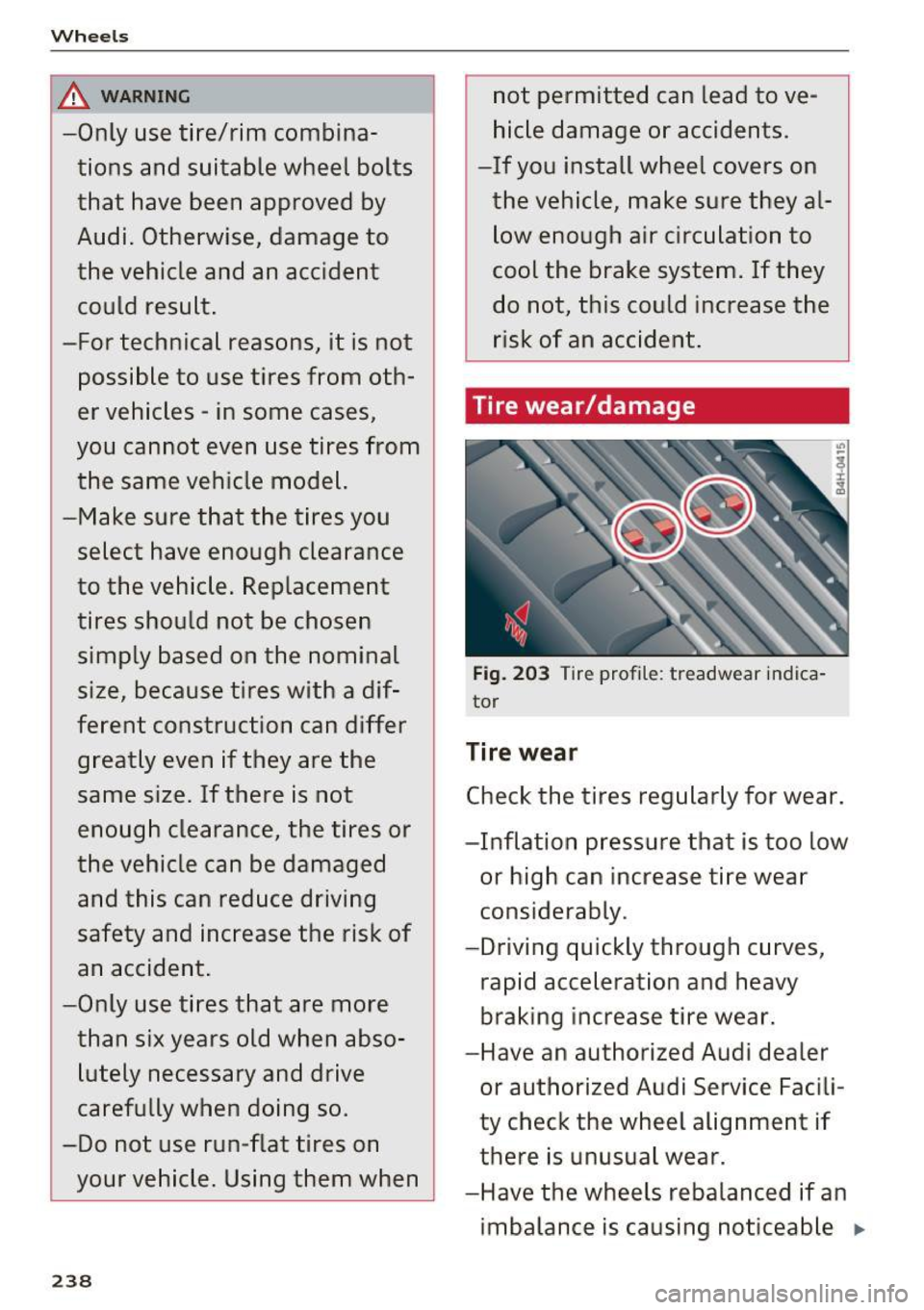
Fig. 203 Tire profile: treadwear indica
tor
Tire wear
Check the tires regularly for wear.
-Inflation pressure that is too low
or high can increase tire wear
considerably.
-Dr iving quickly through curves,
rapid acceleration and heavy
braking increase tire wear.
-Have an authorized Audi dealer
or authorized Audi Service Facili
ty chec k the wheel alignment if
there is unusual wear.
-Have the wheels rebalanced if an imbalance is causing noticeable
i.
Page 250 of 296
Wheels
check your tires as soon as possible, and inflate
them to the proper pressure. Driving on a signifi
cantly under-inflated tire causes the tire to overheat and can lead to tire failure. Under-inflation
also reduces fuel efficiency and tire tread life,
and may affect the vehicle's handling and stop
ping ability.
Please note that the TPMS is not a substitute for
proper tire maintenance, and it is the driver's re
sponsibility to maintain correct tire pressure,
even if under-inflation has not reached the level
to trigger illumination of the TPMS low tire pres
sure telltale.
Your vehicle has also been equipped with a TPMS malfunction indicator to indicate when the sys
tem is not operating properly. The TPMS mal
function indicator is combined with the low tire pressure telltale. When the system detects a
malfunction, the telltale will flash for approxi
mately one minute and then remain continuously
illuminated. This sequence will continue upon
subsequent vehicle start-ups as long as the mal
function exists .
When the malfunction indicator is illuminated,
the system may not be able to detect or signal low tire pressure as intended . TPMS malfunctions
may occur for a variety of reasons, including the
installation of replacement or alternate tires or
wheels on the vehicle that prevent the TPMS from functioning properly . Always check the
TPMS malfunction telltale after replacing one or
more tires or wheels on your vehicle to ensure
that the replacement or alternate tires and
wheels allow the TPMS to continue to function
properly.
248
· If the Tire Pressure Monitoring System
indicator appears
Applies to: vehicles with Tire Pressure Monitoring System
The tire pressure indicator in the instrument
cluster informs you if the tire pressure is too low
or if there is a system malfunction.
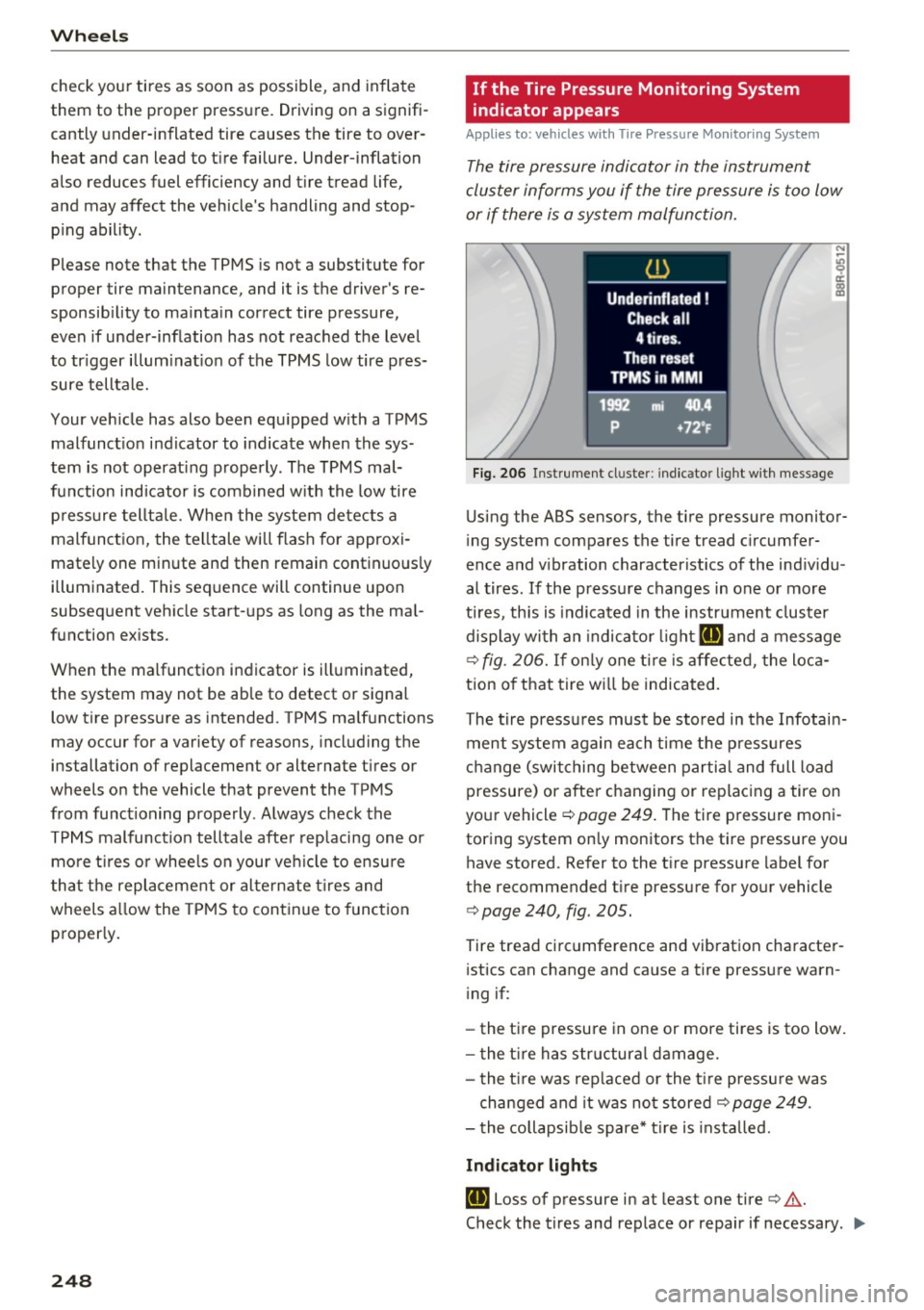
Fig. 206 Instrument cl uster: i ndic ator ligh t with message
Using the ABS sensors, the tire pressure monitor
ing system compares the tire tread circumfer
ence and vibration characteristics of the individu
al tires . If the pressure changes in one or more
tires , this is indicated in the instrument cluster
display with an indicator light
IE and a message
c>fig. 206. If only one tire is affected, the loca
tion of that tire will be indicated.
The tire pressures must be stored in the Infotain
ment system again each time the pressures
change (switching between partial and full load
pressure) or after changing or replacing a tire on
your vehicle
c> page 249. The tire pressure moni
toring system only monitors the tire pressure you have stored. Refer to the tire pressure label for
the recommended tire pressure for your vehicle
c> page 240, fig . 205.
Tire tread circumference and vibration character
istics can change and cause a tire pressure warn
ing if:
- the tire pressure in one or more tires is too low.
- the tire has structural damage.
- the tire was replaced or the tire pressure was
changed and it was not stored
c> page 249 .
-the collapsible spare* tire is installed.
Indicator lights
IE Loss of pressure in at least one tire c> &.
Check the tires and replace or repair if necessary . .,.
Page 252 of 296
Emerg ency assis ta nce
Emergency assistance
Vehicle jack, vehicle tool kit and collapsible spare
tire
Onboard tool kit and vehicle jack
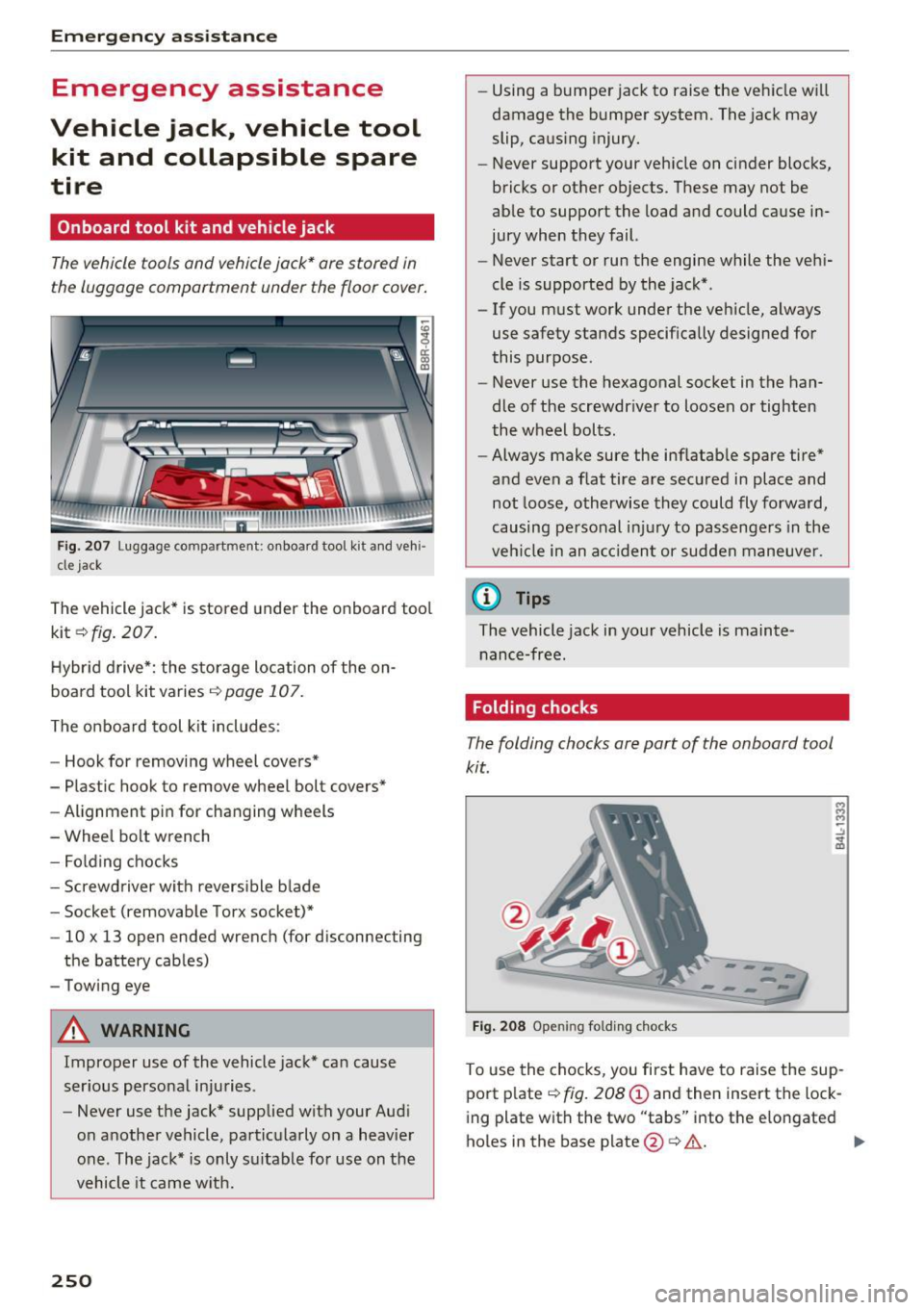
The vehicle tools and vehicle jock* ore stored in
the luggage comportment under the floor cover.
Fig. 207 Luggage compartment: on board tool kit and vehi
cle jack
The vehicle jack* is stored under the onboard tool
kit ¢ fig. 207.
Hybr id d rive*: the storage location of the on
board tool kit varies
r:!) page 107.
The onboard tool k it includes:
- Hook for removing wheel covers*
- Plastic hook to remove wheel bolt covers*
- Alignment pin for changing wheels
- Wheel bolt wrench
- Folding chocks
- Screwdriver with revers ible blade
- Socket (removable Torx socket)*
- 10 x 13 open ended wrench (for disconnecting
the battery cables)
- Towing eye
A WARNING
Improper use of the vehicle jack* can cause
ser ious personal injuries.
- Never use the jack* supplied with your Aud i
on another vehicle, particularly on a heavier
one. The jack* is only su itable for use on the
vehicle it came w ith.
250
- Using a bumper jack to raise the vehicle will
damage the bumper system. The jack may
slip, caus ing injury.
- Never support your vehicle on cinder blocks,
bricks or other objects. These may not be
able to support the load and could cause in
jury when they fail.
- Never start or run the engine while the vehi
cle is supported by the jack* .
- If you must work under the vehicle, always
use safety stands specifically designed for
this purpose.
- Never use the hexagonal socket in the han
dle of the screwdr iver to loosen or tighten
the wheel bolts .
- Always make sure the inflatab le spare tire*
and even a flat tire are secured in place and
not loose, otherwise they could fly forward,
causing personal inj ury to passenge rs in the
vehi cle in an a cc ident or sudden maneuve r.
@ Tips
The vehicle jack in your vehicle is mainte
nance-free.
Folding chocks
The folding chocks ore port of the on board tool
kit .
---
Fig . 208 Open ing fo lding chocks
To use the chocks, you fi rst have to raise the sup
port plate
¢ fig. 208 (D and then insert the lock
ing plate with the two "tabs" into the elongated
holes in the base plate
@ c> &.. .,,_
Page 253 of 296
a,
a,
..... N
" ('I ..... 0 0
0:
co
_& WARNING
-The chock cannot fulfil its function and may
lose its stability if the "tabs" on the support
plate a re not inserted correctly into the
elongated holes in the base plate. If th is
happens, the vehicle may sta rt to move
wh ile a wheel is being changed.
- Never use the fold ing chocks if they are
damaged or if they have not been assem
bled co rrectly.
Removing bass box
Appl ies to: vehicles wit h bass box
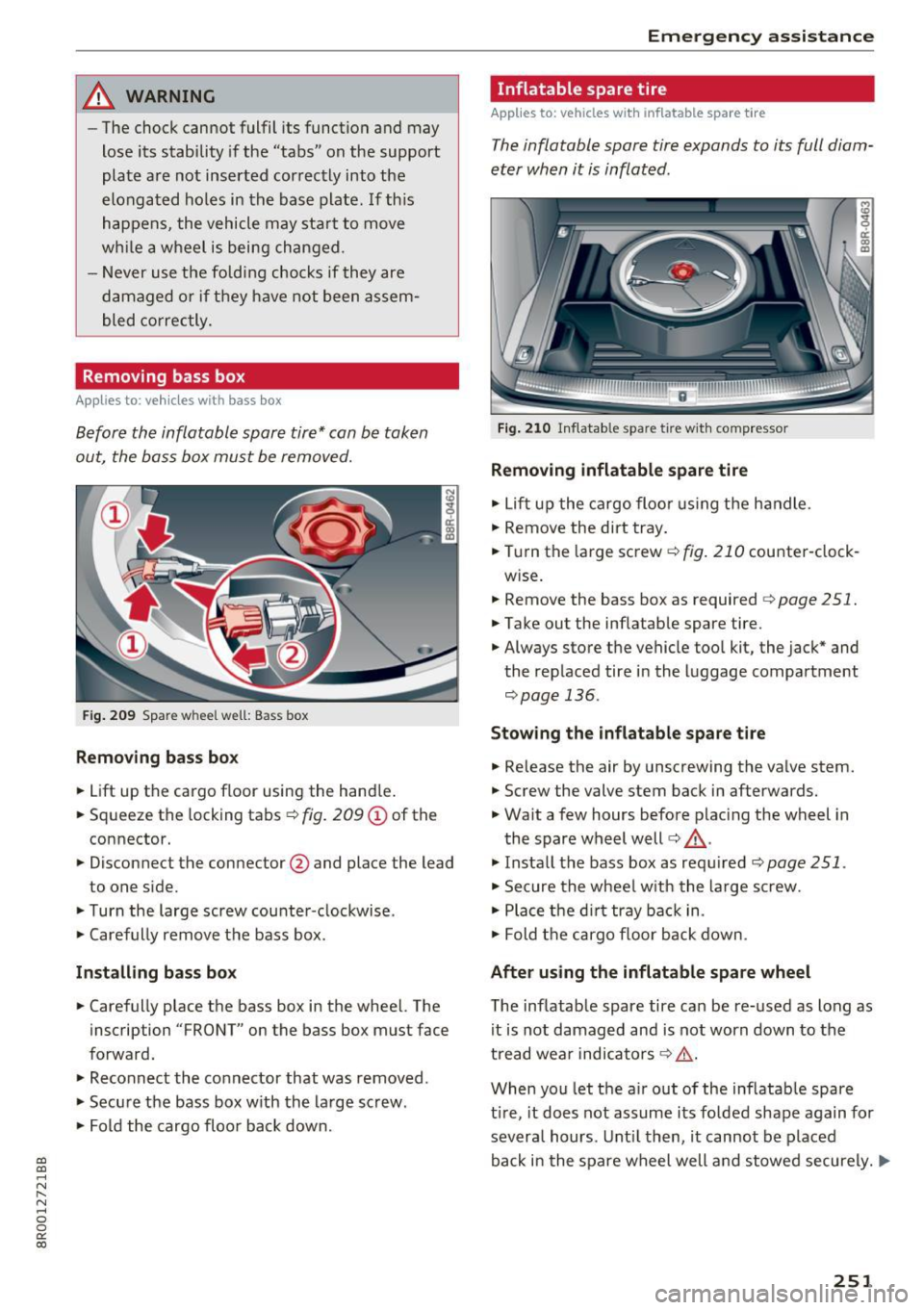
Before the inflatable spare tire* can be token
out, the bass box must be removed.
Fig . 20 9 Spare w heel well: Bass box
Removing ba ss box
"Lift up the cargo floor using the hand le .
" Squeeze the locking tabs¢
fig. 209 © of the
connector.
" Disconnect the connector @and place the lead
to one s ide.
"T urn the large screw counter -clockwise .
" Carefully remove t he bass box .
Installing bas s bo x
"Carefully place the bass box in the whee l. The
inscription "FRONT" on the bass box must face
forward.
" Reconnect the co nnector that was removed.
" Secu re the bass box w ith the la rge screw .
" Fold the cargo floo r bac k down.
Em ergen cy a ssis tanc e
Inflatable spare tire
Applies to: vehicles w ith inflatable spare tire
The inflatable spare tire expands to its full diam
eter when it is inflated .
Fig. 210 In flatable spare tire wit h comp ressor
Removing inflatabl e spare tire
"Lift up the cargo floo r us ing the handle.
" Remove the dirt tr ay .
" Turn the large sc rew ¢ fig .
210 counter -clock-
w ise .
" Remove the bass box as required¢
page 251.
"Take out the inflatab le spare tire.
" Always store the vehicle too l kit, the jack* and
the replaced tire in the luggage compartment
¢ page 136.
Stowing the inflatable spare tire
.. Release the air by unscrewing the valve stem.
" Screw the valve stem back in afterwards.
" Wa it a few hours before plac ing the wheel in
the spare wheel well¢,& .
" Insta ll the bass box as requ ired ¢
page 251 .
" Secure the whee l w ith the la rge sc rew.
" Place t he d irt tray back in .
" Fold t he c argo floor back down .
After using the inflatable spare wheel
The inflatable spare tire can be re-used as long as
it is not damaged and is not worn down to the
tread wea r indicators ¢.&, .
When you let the a ir out of the inf latab le spare
t ir e, it does not assume its folded shape again for
severa l hours . Unt il then, it cannot be placed
back i n the spare wheel well and stowed securely.
IJI>
251
Page 264 of 296
Fuses and bulbs
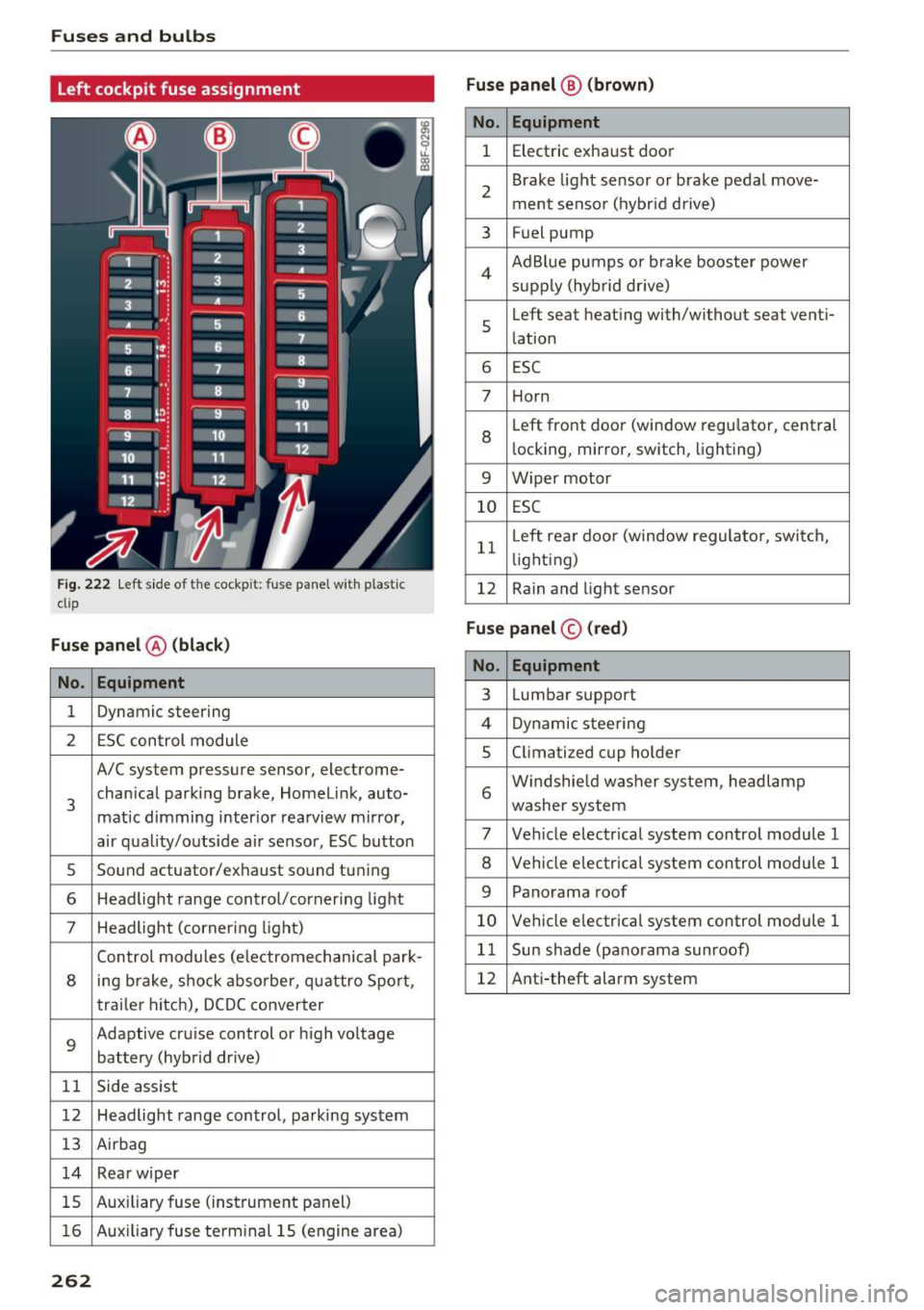
Left cockpit fuse assignment
Fig. 222 Left side of the cockp it: fuse panel with p lastic
clip
Fuse panel @ (black)
No . Equipment
1 Dynamic steering
2 ESC control module
A/C system pressure sensor, electrome-
3 chanical parking
brake, Homelink, auto-
matic dimming interior rearview mirror,
air quality/outside air sensor, ESC button
s Sound actuator/exhaust sound tuning
6 Headlight range control/corner ing light
7 Headlight (cornering light)
Control modules (electromechanical park-
8 ing brake, shock absorber, quattro Sport,
trailer hitch), DCDC converter
9
Adaptive cruise control or high voltage
battery (hybrid dr ive)
11 Side assist
12 Headlight range control, parking system
13 Airbag
14 Rear wiper
15 Auxiliary
fuse (instrument panel)
16 Auxiliary fuse te rm inal 15 (engine area)
262
Fuse panel ® (brown)
No. Equipment
1 Electric exhaust door
2 Brake
light sensor or brake pedal move-
ment sensor (hybrid drive)
3 Fuel pump
4 Ad
Blue pumps or brake booster power
supply (hybrid dr ive)
s
Left seat heating with/without seat venti-
lation
6 ESC
7 Horn
8
Left front doo r (window regulator, central
locking, mirror, switch, lighting)
9 Wiper motor
10 ESC
11 L
eft rear doo r (window regulator, switch,
li ght ing)
12 Rain and light sensor
Fuse panel
© (red)
No. Equipment
3 Lumbar support
4 Dynamic steering
5 Climatized cup holder
6 Windshie
ld washer system, headlamp
washer system
7 Vehicle electrical system control module 1
8 Vehicle electrical system control module 1
9 Panorama roof
10 Vehicle electrical system control module 1
11 Sun shade (panorama sunroof)
12 Anti-theft alarm system
Page 271 of 296
a,
a,
..... N r-N ..... 0 0
0:
co
Front towing loop
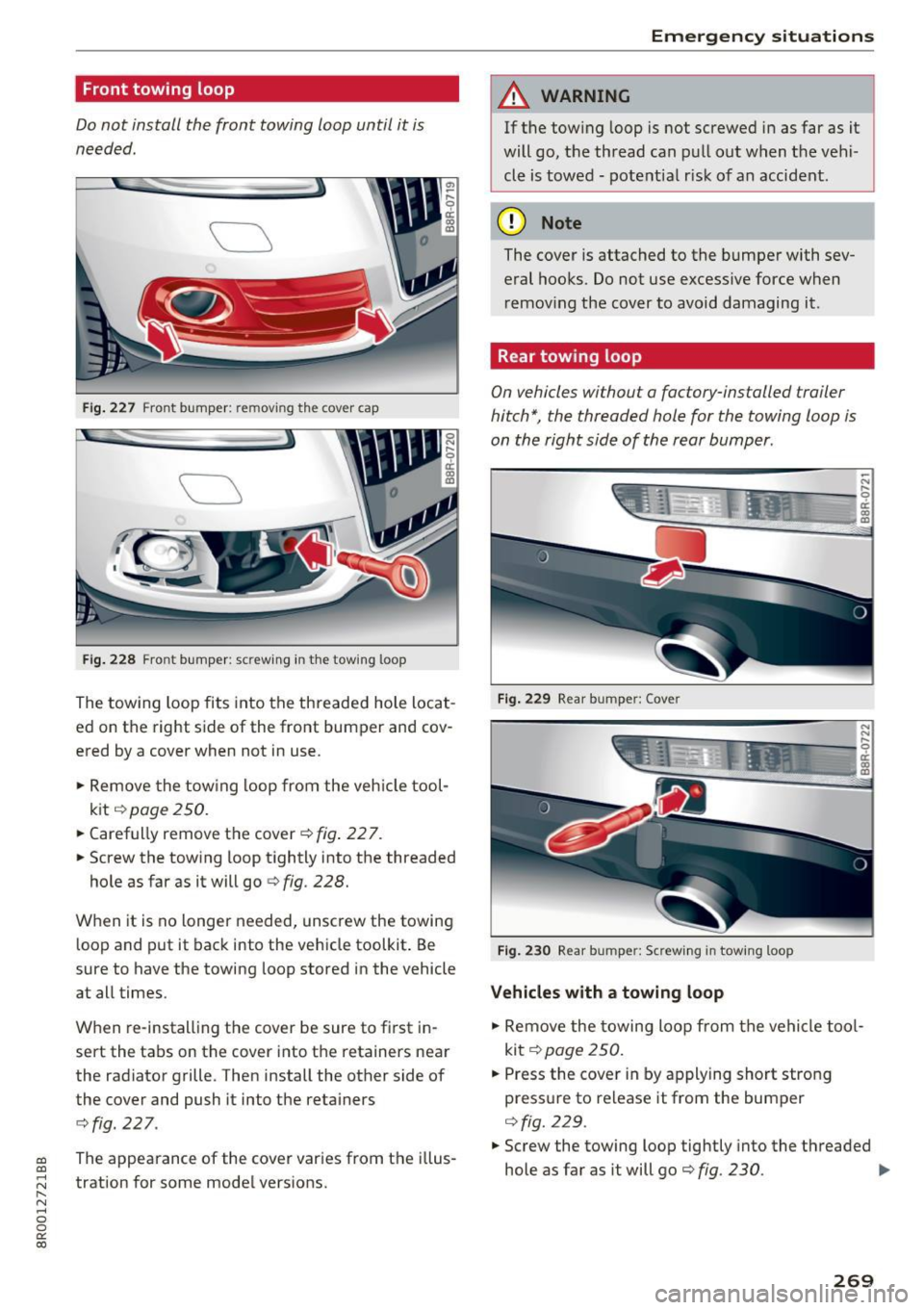
Do not install the front towing loop until it is
needed.
Fig. 227 Fro nt bumper: remov ing the cover cap
:'CT ..,, -
-·
Fig. 228 F ro nt bumper : sc rewing in the towing loop
The towing loop fits into the threaded hole locat
ed on the right side of the front bumper and cov
ered by a cover when not in use .
.,. Remove the towing loop from the vehicle tool
kit ¢
page 250 .
.,. Carefully remove the cover ¢fig . 227 .
.,. Screw the towing loop tightly into the threaded
hole as far as it will go ¢
fig. 228.
When it is no longer needed, unscrew the towing
loop and put it back into the vehicle toolkit . Be
sure to have the towing loop stored in the vehicle
at all times.
When re-installing the cover be sure to first in
sert the tabs on the cover into the retainers near
the radiator grille . Then install the other side of
the cover and push it into the reta iners
¢ fig. 227 .
The appearance of the cover varies from the illus
tration for some model versions.
Emergency situations
A WARNING
-If the towing loop is not screwed in as far as it
will go, the thread can pull out when the vehi
cle is towed -potential risk of an accident.
(D Note
The cover is attached to the bumper with sev
eral hooks. Do not use excessive force when
removing the cover to avoid damaging it .
Rear towing loop
On vehicles without a factory-installed trailer
hit ch*, the threaded hole for the towing loop is
on the right side of the rear bumper .
Fig. 229 Rear bumper: Cove r
Fig. 230 Rear bumper: Sc rewing in towing loop
Vehicles with a towing loop
.,. Remove the towing loop from the vehicle tool
kit
¢ page 250.
.,. Press the cover in by applying short strong
pressure to release it from the bumper
¢ fig. 229 .
.,. Screw the towing loop tightly into the threaded
hole as far as it will go¢
fig. 230 . ..,_
269
Page 293 of 296
CD
CD
.... N ,-... N ..... 0 0 C<'. 00
Treadwear indicato rs . . . . . . . . . . . . . . . . . 238
Unidirectional . . . . . . . . . . . . . . . . . . . . . . . 232
Uniform tire quality grad ing . . . . . . . . . . . 247
Tires and wheels Glossary of tire and load ing terminology . 232
Tire pressure monitoring system . . . . . . . . 13
Tires and vehicle load limits . . . . . . . . . . . 242
Tool kit . . . . . . . . . . . . . . . . . . . . . . . . . . . . . 250
Tools . . . . . . . . . . . . . . . . . . . . . . . . . . . . . . . 107
To rn or frayed safety be lts . . . . . . . . . . . . . . 142
Towing Front eye let . . . . . . . . . . . . . . . . . . . . . . . . 269
Rear eyelet . . . . . . . . . . . . . . . . . . . . . . . . . 269
Tow trucks . . . . . . . . . . . . . . . . . . . . . . . . . 268
Towing a trailer
Parking system . . . . . . . . . . . . . . . . . . . . . . 130
TPM5 (tire pressure monitoring system) . . . 248
Trailer tow ing . . . . . . . . . . . . . . . . . . . . . . . . 200
I nformation . . . . . . . . . . . . . . . . . . . . . . . . 202
Operating instructions . . . . . . . . . . . . . . . . 201
Technical requirements . . . . . . . . . . . 200, 201
Tongue load . . . . . . . . . . . . . . . . . . . . . . . . 201
Trailer turn signal assembly
Warning/indicator lights . . . . . . . . . . . . . . . 14
T ransmission
Malfunction (indicator light) . . . . . . . . . . . . 98
T ransport Canada . . . . . . . . . . . . . . . . . . . . . 139
Travel mode . . . . . . . . . . . . . . . . . . . . . . . . . . 51
Trip computer
Fuel consumption . . . . . . . . . . . . . . . . . . . . 19
Mileage . . . . . . . . . . . . . . . . . . . . . . . . . . . . . 19
Single -trip memory . . . . . . . . . . . . . . . . . . . 20
Total-trip memory . . . . . . . . . . . . . . . . . . . . 20
T rip odometer . . . . . . . . . . . . . . . . . . . . . . . . . 10
Trunk
refer to Rear lid . . . . . . . . . . . . . . . . . . . . . . 41
Turn signals . . . . . . . . . . . . . . . . . . . . . . . . . . 52
Warning/indicator lights . . . . . . . . . . . . . . . 14
u
ULSD No. 2 (D iesel fuel) . . . . . . . . . . . . . . . . 211
Unfastening safety belts . . . . . . . . . . . . . . . 145
Uniform tire quality grading
Unlocking 247
Power locking switch . . . . . . . . . . . . . . . . . . 39
Rear lid/trunk lid . . . . . . . . . . . . . . . . . . . . . 40
Index
Remote control key . . . . . . . . . . . . . . . . . . . 3 7
Using the mechanical key . . . . . . . . . . . . . . 38
Use of jumper cables . . . . . . . . . . . . . . . . . . 267
V
Vanity mirror . . . . . . . . . . . . . . . . . . . . . . . . . . 53
Vehicle Care/cleaning . . . . . . . . . . . . . . . . . . . . . . . 204
Out of service . . . . . . . . . . . . . . . . . . . . . . . 208
Transport . . . . . . . . . . . . . . . . . . . . . . . . . . 108
Vehicle control modules . . . . . . . . . . . . . . . . 188
Vehicle identification label . . . . . . . . . . . . . 272
Vehicle Identification Number (VIN) . . . . . . 272
Vehicle jack . . . . . . . . . . . . . . . . . . . . . . 250, 257
Vehicle tool kit . . . . . . . . . . . . . . . . . . . . . . . 107
Ventilation . . . . . . . . . . . . . . . . . . . . . . . . . . . 77
w
Warning/indicator lights
Airbag system . . . . . . . . . . . . . . . . . . . . . . . 13
Anti-lock brake system (ABS) . . . . . . . . . . . 14
Brake system . . . . . . . . . . . . . . . . . . . . . . . . 15
Cruise control . . . . . . . . . . . . . . . . . . . . . . . . 14
E le ctromechanical parking brake . . . . . . . . 15
Electronic power control . . . . . . . . . . . . . . . 12
E lectron ic Stabilization Contro l (ESC) . . . . . 13
Glow p lug system . . . . . . . . . . . . . . . . . . . . 12
High beam . . . . . . . . . . . . . . . . . . . . . . . . . . 14
Malfunction Indicator Lamp (MIL) . . . . . . . 14
Safety be lt . . . . . . . . . . . . . . . . . . . . . . . . . . 14
Tire pressure monitoring system . . . . . . . . 13
Trailer turn signal assembly . . . . . . . . . . . . 14
Turn signals . . . . . . . . . . . . . . . . . . . . . . . . . 14
Warning/Ind icator lights
Airbag system . . . . . . . . . . . . . . . . . . . . . . 158
Warranty coverages . . . . . . . . . . . . . . . . . . . 276
Washer reservoir . . . . . . . . . . . . . . . . . . . . . 229
Washing matte finish pa int . . . . . . . . . . . . . 204
Weights . . . . . . . . . . . . . . . . . . . . . . . . . . . . . 272
What happens if you wear your safety belt too
l oose? . . . . . . . . . . . . . . . . . . . . . . . . . . . . . . 144
What happens to unbelted occupants? . . . . 141
What impairs driving safety? . . . . . . . . . . . . 132
Wheel bolts . . . . . . . . . . . . . . . . . . . . . . . . . 244
291