air suspension AUDI Q5 2018 Owners Manual
[x] Cancel search | Manufacturer: AUDI, Model Year: 2018, Model line: Q5, Model: AUDI Q5 2018Pages: 392, PDF Size: 60.56 MB
Page 22 of 392
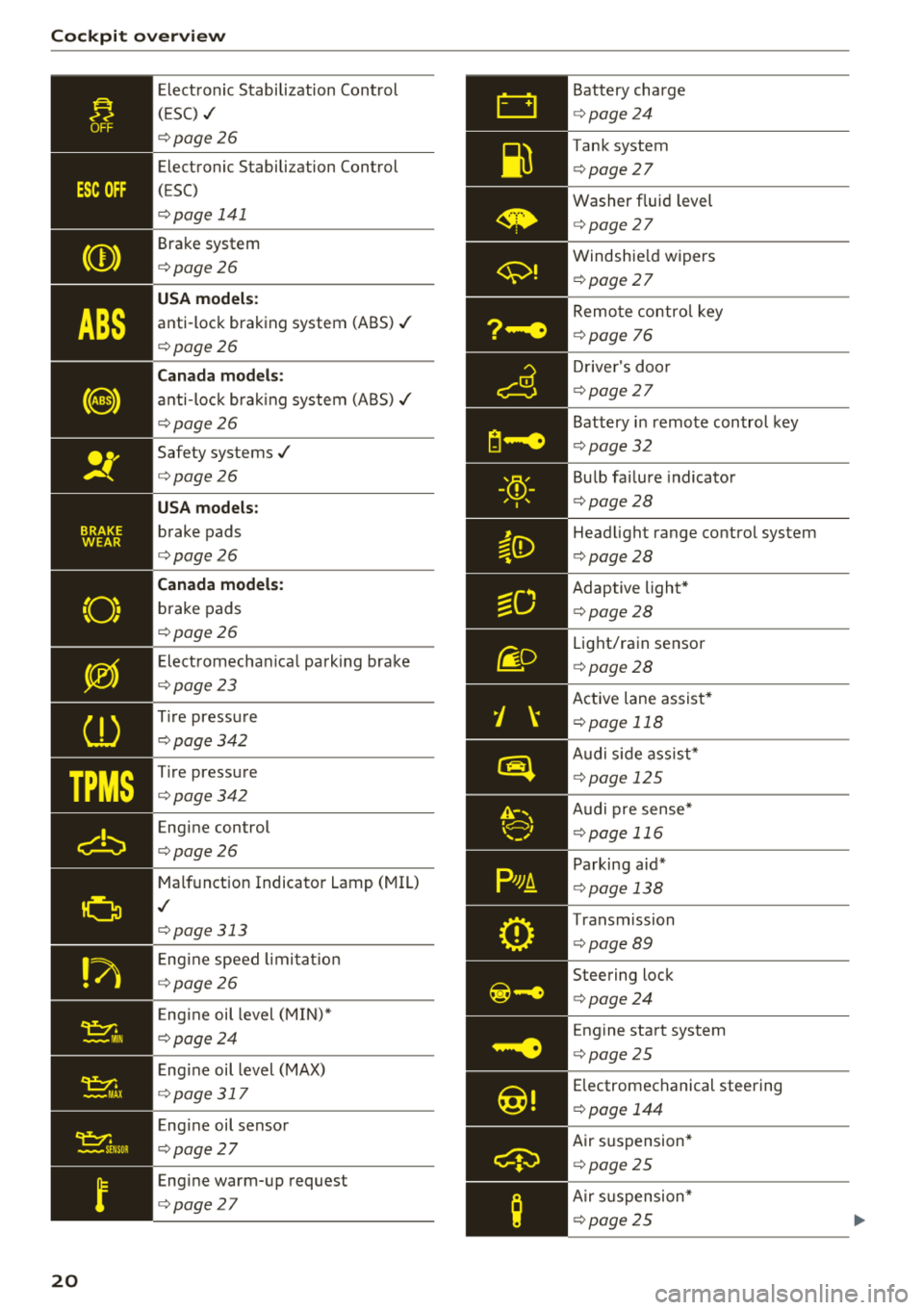
Cockpit overv ie w
.....
,,.I...
TPMS
20
Elect ronic Stabilization Cont rol
( E SC)
./
¢ page 26
Electronic Stabilization Control
( E SC)
¢ page 141
Brake system
¢page26
USA model s:
anti-lock braking system (ABS) ./
¢page26
Canada models :
anti-loc k bra king system (ABS)./
¢ page26
Safety systems./
¢page26
USA models :
brake pads
¢page26
Canada models :
brake pads
¢page26
Elect romechan ica l parking brake
¢ page23
Tire pressure
¢ page342
Tire pressure
¢ page342
Engine control
¢page26
Malfunction Indicator Lamp (MIL)
./
¢page313
Eng ine speed limi ta ti on
¢ page26
Eng ine oil level (MIN)*
¢ page24
Eng ine oil level (MAX)
¢ page 317
Eng ine oil sensor
¢ page27
Engine warm-up request
¢page27
Battery charge
¢page24
Tank system
¢ page 27
Washer fluid level
¢page 27
Windshie ld wipers
¢ page 27
Remo te control key
¢ page 76
Drive r's doo r
¢page 27
Battery i n remote control key
¢ page 32
Bu lb fai lure indicator
¢ page28
Head light range control system
¢ page 28
Adaptive light*
¢page28
Light/rain sensor
¢page 28
Active lane assist*
¢page 118
Audi s ide ass ist*
¢ page 12 5
Audi pre sense *
¢page 11 6
Parking aid*
¢page 138
Transmission
¢ page 89
Steering lock
¢page 24
Engine start system
¢ page 25
Electromechanical steering
¢ page 144
Air suspension*
¢page 25
Air s uspension*
¢ page 25
Page 23 of 392
u co ..... N r--N ..... 0 <( 0 00
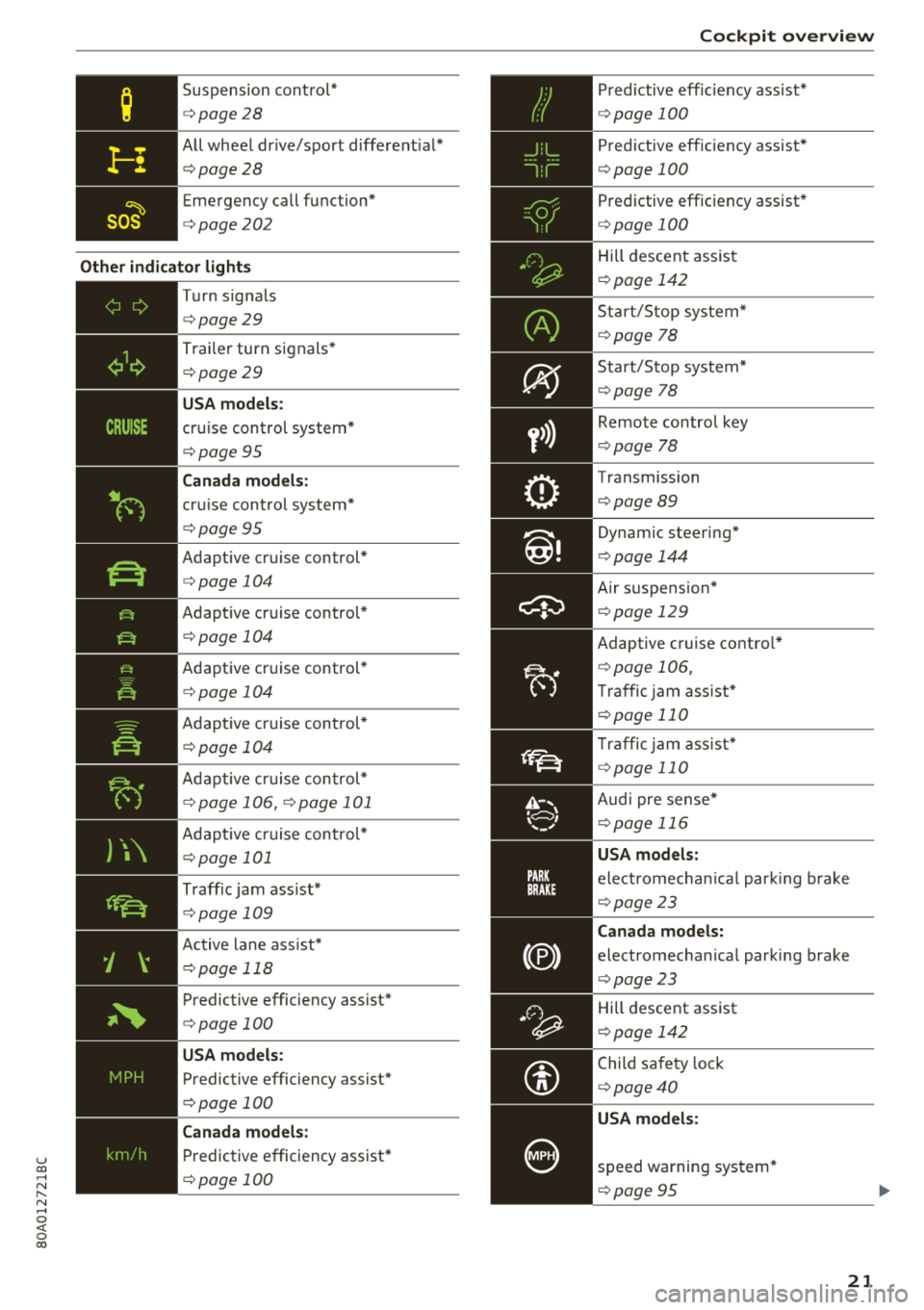
Suspension cont rol*
c:> page 28
All wheel dr ive/sport different ial*
c:> page28
Emergency call function*
c:>page202
Other indic ato r ligh ts
-
~
--------------
Turn signa ls
c:> page 29
Trai ler turn signals *
c:>page 29
USA model s:
cruise control system *
c:>page 95
Canada models :
cruise control system*
c:> page 95
Adapt ive cruise control*
c:> page 104
Adapt ive cruise control*
c:> page 104
Adaptive cruise control*
c:> page 104
Adapt ive cr uise control*
c:> page 104
Adapt ive cr uise con trol*
c:> page 106, c:> page 101
Adapt ive cr uise control*
c:> page 101
Traff ic jam ass ist*
c:> page 109
Active lane ass ist*
c:> page 118
Predictive efficiency assist*
c:> page 100
USA models :
Predictive efficiency assist*
c:> page 100
Canada models :
Predictive efficiency assist*
c:> page 100
Coc kpit o ver view
P red ictive eff ic iency assist*
c:> page 100
Pred ictive eff ic iency assist*
c:> page 100
Predictive efficiency assist*
c:> page 100
Hill descent assis t
c:>page 142
Start/Stop system*
c:>page 78
Start/Stop system*
c:>page 78
Remote control key
c:>page 78
Transmission
c:>page 89
Dynam ic steering*
c:> page 144
Air suspension*
c:> page 129
Adaptive cruise contro l*
c:> page 106,
Traffic jam assist*
c:> page 110
Traffic jam assist*
c:> page 110
Audi pre sense *
c:>page 116
USA models:
electromechan ica l par king b rake
c:> page 23
Canada models:
electromechan ica l park ing brake
c:> page 23
Hill descent assist
c:>page 142
Child sa fety lo ck
c:> page 40
USA models :
speed warning system*
c:>page 95
21
Page 27 of 392

u co ..... N r--N ..... 0 <( 0 00
1!11 Steering lock: malfunction! Please contact
Service
There is a malfunction in the elect ronic stee ring
l o ck.
Dri ve to an authorized Aud i dea ler or authorized
Audi Service Fac ility imm ediately to have the
malfunction corrected.
A WARNING
Do not tow your vehicle when there is a mal
function in the electronic steering lock
-this
increases the risk of an accident .
~ Engine start system
• Engine start system: malfunction! Please
contact Service
Do not switch the ignition off because you may
not be able to switch it on again.
Drive to an authorized Aud i dea le r or authorized
Aud i Service Facility im media tely to have the
mal function corrected.
-
l::J Engine start system: malfunction! Please
contact Service
There is a malfunction in the engine starting sys
tem .
Drive to an authori zed Aud i dea ler or authori zed
Aud i Service Facility immediately to have the
malfunction corrected.
c;:::::,Hood
• Warning! Hood is not locked. Stop vehicle
and check the lock
If the indicator light turns on and the message
appears, the hood locking mechanism is not en
gaged correctly.
Stop immediately and close the hood
c>page 315.
0/Q Air suspension
Applies to: vehicles with air suspension
• Air suspension: malfunction. Safely stop ve
hicle . Steering and ground clearance limited
Cockpit overview
Due to a system ma lf u nction, your vehicle's
ground clearance is very low at the front or rear
axle* (in veh icles with all -whee l steering) . Be
cause of this, the wheels no longer have enough
clearance to steer correctly.
See an authorized Audi dealer or authorized Audi
Service Facility for assistance.
• Air suspension: malfunction! You can con
tinue driving slowly. Speed limited to max.
3S mph (60 km/h )
The re is a malfunction that can result in restrict
ed driving stability. T he speed is limit ed to a
maximum of 35 mph (60 km/h).
Drive to an authorized Audi dealer or authorized
A udi Service Facility immediately to have the
malfunction corrected.
• Air suspension: malfunction! You may con
tinue driving slowly at max. 35 mph (60 km/h)
There is a malfunction that can result in restrict
ed driv ing stab ility .
Drive to an authorized Audi dealer or authorized
Audi Service Facility immed iate ly at a maximum
speed of 35 mph (60 km/h) to have the malfunc
t ion corrected .
• Air suspension: service mode! Vehicle can be
moved but handling may be impaired
Carefully drive to an authorized Audi dea ler or
authorized Audi Service Facility immediately to
have the service mode deactivated .
II Air suspension: malfunction! Please contact
Service
T he re is a system malfunction that can result in
restricted driving stability or red uced ground
clearance.
Drive to an authorized Audi dealer or autho rized
A udi Service Facility immediately to have the
malfunction corrected.
II Air suspension: vehicle too low. Limited
ground clearance
The ground clearance is very low due to a system
malfunction . Wait until the a ir suspension sys-
tem has restored normal ground clearance .
.,.
25
Page 95 of 392
u co ..... N r--N ..... 0 <( 0 00
Tongue weight
The maximum permitt ed tongue weight of the
trailer drawbar on the trailer hitch ball head may
not be exceeded .
I f the tongue we ight is too low, th is affects t he
trailer's handling. For driv ing safety, we recom
mend to always utilize the maximum permitted
tongue weight, but not exceed it. You can reach
it, for example, by distributing the cargo in the
trailer correctly.
You can determine the tongue weight, for exam
p le, with a bathroom scale or a public weigh sta
tion .
The permitted tongue we ight of your veh icle can
be found in the vehicle documentation or in
¢page 370.
Load distribution
Poor cargo load and distribution can negatively
i mpact ve hicle handl ing .
-Store objects preferably in the vehicle luggage
compartment. The vehicle shou ld always carry
the heaviest possible load and the trailer
shou ld have the lightest possible load.
-Distribute the load in the tra iler so that the
heavy objects are as close to the axle as possi
ble.
-Secure objects from slid ing out of p lace.
-Utilize the maximum permitted tongue weight
if possible .
Tires
Set the tire pressure on your vehicle for a "full
load"; see the t ire pressure
sticker¢ page 335 .
If necessary, also adjust the tire pressure on the
trailer according to the manufacturer's recom
mendation .
W inter tires should be mounted on the vehicle
and on the trailer during winter temperatures .
Outside mirrors
If you cannot see the traffic behind the trailer
with the standard exterior mirrors, then you must attach addit ional exterior m irrors. Adjust
them so you have a sufficient visibility behind
you .
Trailer towing
Exterior lighting
Follow the legal regu lations rega rding the light
ing equipment on your trailer. Contact an author
ized Audi dea ler or authorized Audi Service Facili
ty for more information.
Before starting to drive , check all lighting eq uip
ment on the hitched trailer.
T he headlight range cont rol adjusts automat ica l
ly to the light range of the headlights .
Safety chains
Make sure the safety chains are correctly applied
when pulling a trailer . The cha ins should hang
enough so that the trailer can drive around
curves . Howeve r, th ey must not touch the
ground.
Air suspension
Applies to: vehicles with air suspension
The air suspens ion must be at the standard vehi
cle height before you set the tongue weight on
the tra iler and hitch the
trailer ¢@ , ¢page 128,
Raising/lowering the vehicle.
For vehicles with a factory-installed trailer hitch,
the a ir suspension trailer mode w ill automatically
switch on if you connect the trailer cable to the
socket.
For vehicles with a retrofitted trailer hitch, you
must sw itch on the a ir suspension trailer mode
manua lly . Select in the Infotainment system:
IMENU I button> Vehicle> left cont rol button>
Vehicle settings > Air suspension: trailer. Switch
i t off again after towing a tra iler .
You can also sw itch off trailer mode manually
wh ile dr iving, for example, whe n using a bicycle
rack system.
If you have to dr ive through d ifficult road cond i
tions, you can ra ise the vehicle again after hitch
i ng the tra iler o r after adjusting the tongue
we ight.
(UJ} Note
Applies to: vehicles with air suspension
-Changes in temperature or load can affect
the height of the vehicle .
93
Page 128 of 392
Assistance systems
Engine and automatic transmission
Depending on the mode , the engine and auto
matic transmission respond more quickly or in a
more balanced manner to accelerator peda l
movements. In the sporty
Dynamic mode, the
transmission shifts at higher speed ranges.
Air suspension*
The air suspension* is an electronically-control
led air suspension and damping system. The
ad
justment depends on the driving mode selected,
steering movements, the driver's braking and
ac
celeration, and as the road surface, vehicle speed
and load. The veh icle ground clearance depends
on the mode selected and the speed .
The ground clearance increases significantly
when the vehicle is in the
Allroad mode . At
speeds from approximate ly SO mph (80 km/h) to
75 mph (120 km/h), the ground clearance
re
duces in stages . When the speed decreases, the
ground clearance increases aga in automat ically .
The ground clearance is the lowest in
Dynamic
mode.
Suspension control*
The suspension control* uses sensors to record
information regard ing steering movements,
braking and acceleration operations by the driv
er, road surface, dr iv in g speed, and load. This
makes it possible to adapt damping to the driv
ing situation near ly in rea l time. With drive
se
lect, you can adjust the suspension contro l to be
sporty
( Dynamic ), comfortab le (C omfort ) or bal
anced
(A uto ).
Steering
The power steering adapts. Ind irect steer ing that
moves easi ly as in
Comfort mode is especia lly
suited to long drives on highways. The
Dynamic
mode provides sporty, direct steering.
The following applies to vehicles with dynamic
steering* : the steering ratio changes based on
vehicle speed in order to maintain optimum
steering effort for the driver at all times . This
sets the steering to be less sensitive at higher
speeds in order to prov ide improved vehicle con
trol. At reduced speeds, steering is more direct in
126
order to keep the steering effort as minima l as
possible when the driver is maneuvering the ve hi
cle. At low and average speeds, dynamic steer
i ng* addit iona lly prov ides more respons ive steer
i ng performance.
Sport differential*
As a component of the all whee l drive system
(quattro)
r=!> page 144, the sport differentia l dis
tributes the driving power to the rear axle
de
pending on the s ituation. The distr ibut ion of
power varies depending on the selected mode
from moderate
(C omfort ) to sporty (Dynamic ).
The goal is a high level of ag ility and ability to ac
celer ate on curves. The vehicle is very respons ive
to stee ring.
Adaptive cruise control (ACC)*
The behavior whe n accelerating can be adjusted
from comfortable to sporty, depending on the drive select mode . Adaptive cruise control also
r esponds to the driv in g behavior of the vehicle
ahead in a more conservative or sporty manner.
Engine sound*
The engine sound adapts to the current mode
and can be subtle to sporty .
@ Note
Applies to: vehicles with a ir suspension
- Make sure there is enough clearance above
and below the vehicle when pa rking. Th e
height of the vehicle (ground clearance) can
change once it is parked due to temperature
fluctuations, changes to the load conditions
and changes to the driving modes.
- When transporting the vehicle on a car
car
rier, train, ship or by other means, only tie
the vehicle down at the running sur face of
the tires, which is the outer c ircumference.
Securing the vehicle at the axle compo
nents, suspension struts or tow ing eyes is
not perm itted because the pressure in the
air suspens ion struts can change during
transport. The vehicle may not be secured
sufficiently if this happens .
Page 129 of 392
u co ..... N r--N ..... 0 <( 0 00
(D Tips
The "S" selector lever position automatically
engages when the
Dynamic mode is se lected .
Selecting the driving mode
Applies to: ve hicles with Audi drive select
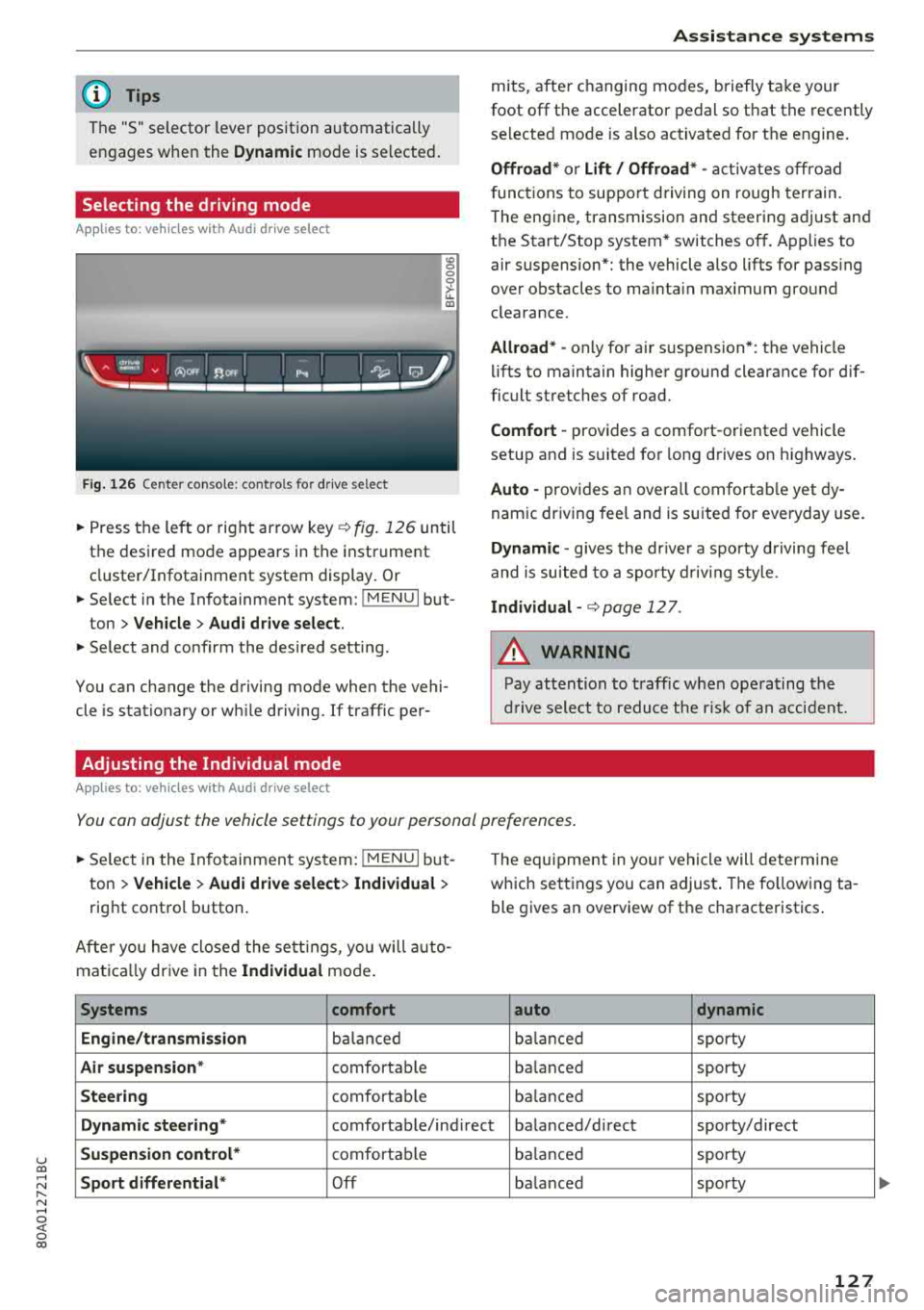
Fig. 126 Center conso le: controls for drive select
0 >'-LL ID
~ Press the left o r right arrow key¢ fig. 126 until
the desired mode appears in the instrument
cluster/Infotainment system display . Or
~ Se lect in the Infotainment system: !MENUI but-
ton
> Vehicle > Audi drive select.
~ Select and confirm the desired setting.
You can change the driving mode when the vehi
cle is stationary or wh ile driving. If traffic per-
Adjusting the Individual mode
Applies to: ve hicles with Audi drive select
Assistance systems
mits, after changing modes, briefly take your
foot
off the accelerator pedal so that the recently
selected mode is also activated for the engine.
Offroad* or Lift/ Offroad* -activates off road
f unct ions to support driving on rough terrain.
T he engine, transmission and steering adjust and
the Start/Stop system* switches
off. Applies to
air suspension*: the vehicle also lifts for pass ing
over obstacles to mainta in maximum ground
clearance.
Allroad * -only for ai r suspension *: the vehicle
lifts to maintain higher ground clearance for dif
ficult stretches of road.
Comfort -provides a comfort -oriented vehicle
setup and is suited fo r long d rives on h ighways .
Auto -provides an overall comfortable yet dy
namic driving feel and is suited for everyday use.
Dynamic -gives the drive r a sporty driving feel
and is suited to a sporty driving style .
Individual -¢ page 12 7.
A WARNING
-
Pay attention to traffic when operating the
drive select to reduce the risk of an accident.
You can adjust the vehicle settings to your personal preferences .
~ Select in the Infotainment system: !MENUI but
ton
> Vehicle > Audi drive select> Individual >
right contro l button.
Afte r you have closed the settings, you will auto
mat ica lly dr ive in the
Individual mode.
Systems comfort
Engine/transmission
balanced
Air suspension * comfortable
Steering comfortable Th
e equipment in yo ur vehicle will determine
which settings you can adjust . The fo llowing ta
ble gives an overview of the characteristics .
auto dynamic
balanced
sporty
ba lanced sporty
balanced sporty
Dynamic
steering* comfortable/ind irect ba lanced/direct sporty/direct
Suspension control* comfortab le balanced sporty
Sport differential* Off balanced sporty
127
...
Page 131 of 392
u co ..... N r--N ..... 0 <( 0 00
(D Tips
-The vehicle will not lower if one of the vehi
cle doors is open or when the ignit ion is
switched off and the compressed air reser
voir is empty. The button LED blinks three
times .
- If the compressed air reservoir is empty, it
i s refilled while dr iving at speeds above
25 mph (40 km/h) .
Messages
Applies to: vehicles with air suspension
II Air suspension : vehicle currently too high .
Controlling level. . .
II Air suspension: vehicle currently too low .
Controlling le vel. . .
The message turns off when the level contro l
process is complete.
A ss istance systems
129
Page 137 of 392
u co ..... N r-N .....
~ 0 co
~ Now you can position your vehicle in front of
the trailer ¢
A in General information on
page 135,
¢ (Din General information on
page 135.
The orange orientation line indi
cates the expected path toward the trailer
hitch . Use the blue lines to help you estimate
the d ista nce to the trailer h itch.
Peripheral cameras
Introduction
Applies to: vehicles with peripheral cameras
With this equipment, the parking system plus*
¢
page 131 is supplemented w ith various periph
eral cameras. The four cameras give you the fol
lowing views : area around the vehicle, front cor
ner v iew and rear corner v iew, view in front of the
veh icle and beh ind the veh icle .
General information
App lies to: veh icles with peripheral cameras
i
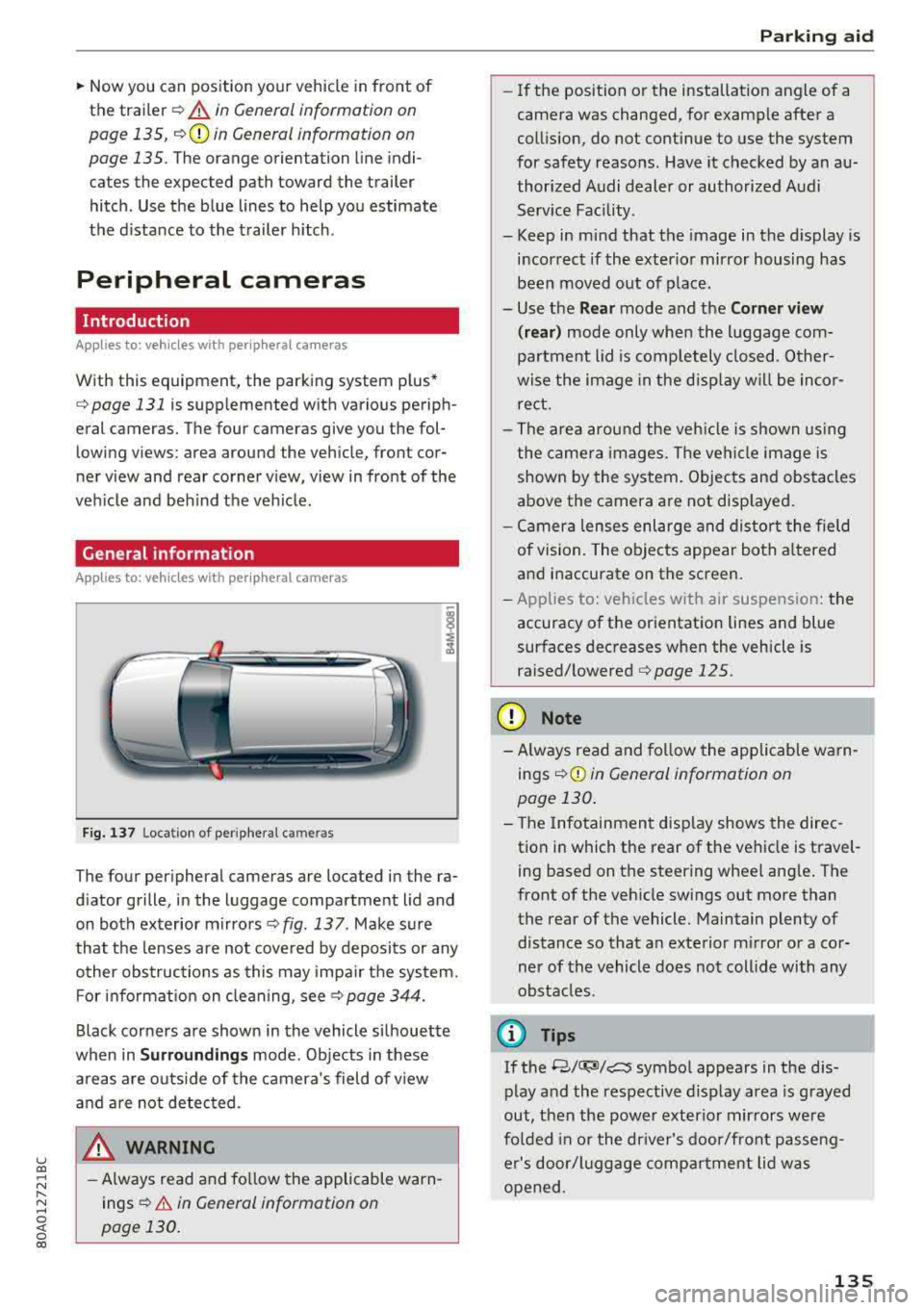
Fig. 137 Locat ion of periphera l ca mera s
The four per ipheral cameras are located in the ra
d iator grille, in the luggage compartment lid and
on both exterior mirrors ¢
fig. 13 7 . Make sure
that the lenses are not covered by deposits or any
other obstructions as this may impa ir the system.
F or info rmat io n on cleaning, see
c::> page 344.
Black corners are shown in the vehicle si lhouette
when in
Surroundings mode. Objects in these
a reas a re outside of the camera 's field of v iew
and a re not detec ted .
_& WARNING
-Always read and follow the applicable warn
ings ¢
A in General information on
page 130.
P ark ing aid
- If the position or the installation angle of a
camera was changed, for example after a
coll is ion, do not cont inue to use the system
for safety reasons. Have it checked by a n au
thorized A udi dealer or authorized Audi
Serv ice Facility.
- Keep in mind that the image in the display is
i n correct if the exterior mirror housing has
been
moved out of p la ce.
- Use the
Rear mode and the Corner view
( rear )
mode only when the luggage com
pa rtment lid is comp letely closed. Other
wise the image in the disp lay w ill be inco r
re ct.
- The area around the veh icle is shown using
the camera images. The vehi cle image is
shown by the system. Objects and obs tacles
above the camera are not disp layed .
- Ca mera lenses enl arge and distort the field
of vision. The o bjects appear both a ltered
a nd inaccurate on the screen.
- Applies to: vehicle s with air suspension: the
accuracy of the orientation lines and blue
surfaces dec reases whe n the vehicle is
raised/lowered <=>
page 125.
(D Note
-Always read and fo llow the applicable wa rn
ings
c::> (D in General information on
page 130 .
- The Info tainmen t display shows the direc
tion i n which the rear of the vehicle is travel
ing based on t he steering wheel ang le . The
front of the veh icle swings out mo re than
the rear of the vehicle. Maintain plenty of
distance so that a n exterior m irror or a cor
ner of the vehicle does not coll ide with any
obstacles.
(0 Tips
If the 8/0";JJ/c:5 symbo l appears in the d is
play a nd the res pect ive d isplay area is grayed
out, then the power exter ior mir rors we re
fo lded in or the dr iver's door/front passeng
e r's door/luggage comp artme nt lid w as
opened .
135
Page 287 of 392
u co ..... N r-N .....
~ 0 co
-For safety reasons in severe accidents, the
alternator and starter are separated from
the vehicle battery with a pyrotechnic circuit
interrupter.
- Work on the pyrotechnic circuit interrupt
er must only be performed by a qualified
technicians who have the experience, in
formation and special tools necessary to
perform the work safely.
- If the vehicle or the circuit interrupter is
scrapped, all applicable safety precautions
must be followed .
@ For the sake of the environment
Undeployed airbag modules and pretension
ers might be classified as Perchlorate Materi
al
-special handling may apply, see
www.dtsc.ca.gov/hazardouswaste/perchlo rate. When the vehicle or parts of the re
straint system including airbag modules and
safety belts with pretensioners are scrapped,
all applicable laws and regulations must be
observed. Your authorized Audi dealer is fa
miliar with these requirements and we recom
mend that you have your dealer perform this
service for you.
Other things that can affect Advanced
Airbag performance
Changing the vehicle's suspension system can
change the way that the Advanced Airbag System performs in a crash . For example, using tire-rim
combinations not approved by Audi, lowering the
veh icle, chang ing the stiffness of the suspens ion,
including the springs, suspension struts, shock
absorbers etc. can change the forces that are
measured by the airbag sensors and sent to the
electronic contro l unit. Some suspension changes
can, for example, increase the force levels meas
ured by the sensors and make the airbag system
deploy in crashes in which it would not deploy if
the changes had not been made. Other kinds of changes may reduce the force levels measured by
the sensors and prevent the airbag from deploy
ing when it should .
Airbag system
A WARNING
Changing the vehicle's suspension including
use of unapproved tire-rim combinations can
change Advanced Airbag performance and in
crease the risk of serious personal injury in a
crash.
- Never install suspension components that
do not have the same performance charac
teristics as the components originally instal
led on your vehicle.
- Never use tire-rim combinations that have
not been approved by Audi.
Side airbags
· Description of side airbags
The airbag system can provide supplemental
protection to properly restrained occupants.
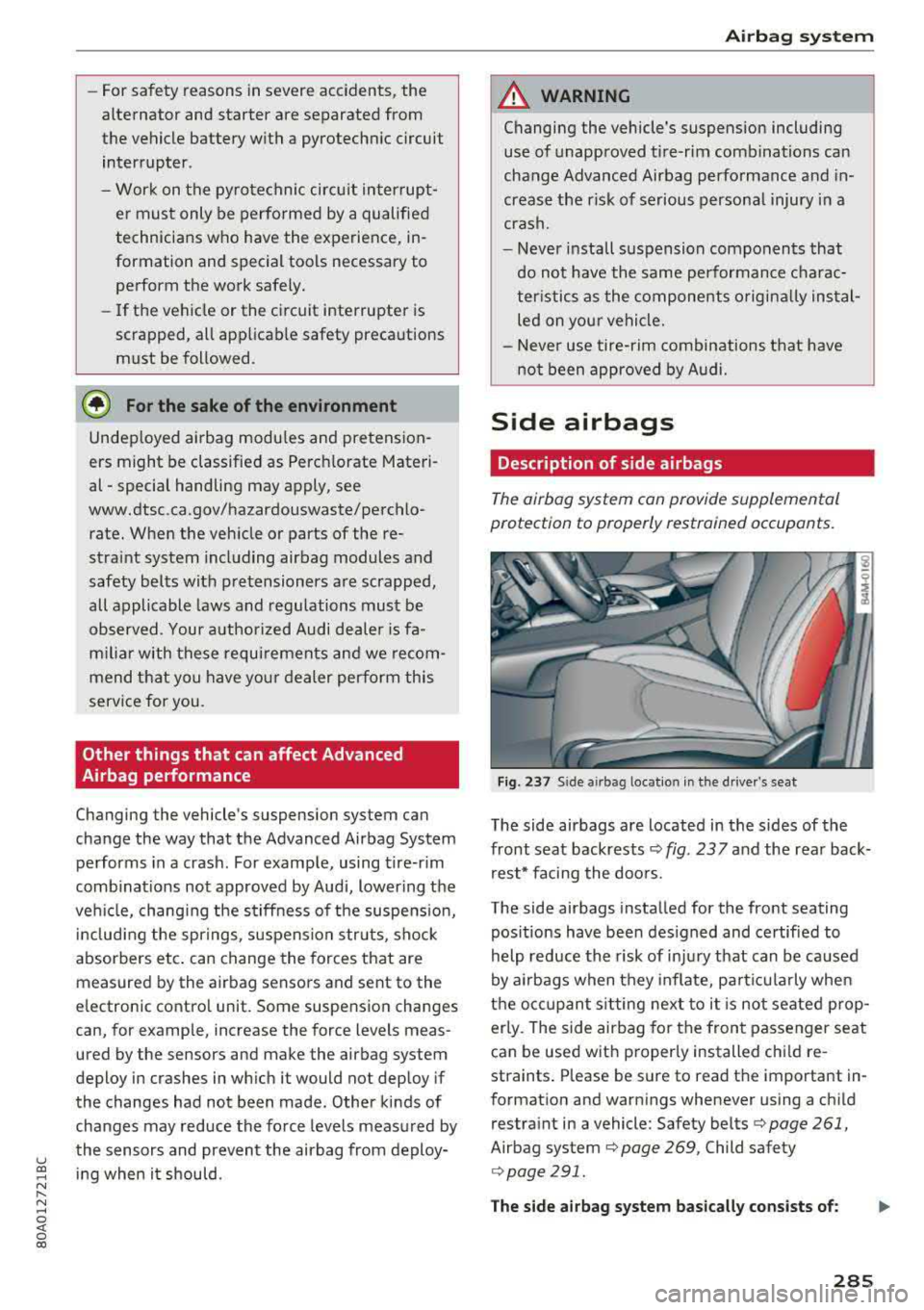
Fig. 237 Side a irbag locatio n in the driver's seat
The side airbags are located in the sides of the
front seat backrests
¢ fig . 23 7 and the rear back
rest* facing the doors.
The side airbags installed for the front seating
pos itions have been des igned and certified to
help reduce the risk of injury that can be caused
by airbags when they inflate, particularly when
the occupant s itting next to it is not seated prop
erly. The side airbag for the front passenger seat
can be used w ith proper ly installed chi ld re
straints . Please be sure to read the important in
formation and warnings whenever using a child
restraint in a vehicle: Safety belts¢
page 261,
Airbag system ¢ page 269, Child safety
r:=> page 291.
The side airbag system basically consists of:
.,..
285
Page 343 of 392
u co ..... N r--N ..... 0 <( 0 00
control, which increases the risk of an
accident.
@ Note
-Snow chains can damage the rims/wheel
covers* if the chains come into direct con
tact with them . Remove the wheel covers*
first. Use coated snow chains.
-Do not install and use snow chains if there is
a malfunction in the air suspension*, be
cause the vehicle height will be very low. If
you drive with snow chains anyway, the
wheel housings and other vehicle compo
nents can be severely damaged.
(D Tips
When using snow chains, it may be useful to
switch the offroad mode on <=>
page 141.
Low-profile tires
App lies to: ve hicles with low -profile tires
Compared to other tire/rim combinat ions, low
profile tires offer a wider tread surface and a
l arger r im diameter with shorter tire sidewalls.
This results in an agile dr iv ing style. However, it
may reduce the leve l of comfort and increase
road noise when driving on roads in poor condi
tion .
L ow -profile tires can become damaged more
quickly than standard tires when driving over
l arge bumps, potholes, manhole covers, and
curbs . Therefore, it is particular ly important to
maintain the correct tire pressure<=>
page 335 .
To reduce the risk of damage to the tires and
rims, drive very carefu lly on poor roads.
Check your wheels regularly every 2,000 mi
(3,000 km) for damage. Fo r example, check for
bulges/cracks on the tires or deformations/
cracks on the rims.
After a heavy impact or damage, have the tires
and rims inspected or replaced immediate ly by
an authorized Audi dealer or authorized Audi
Service Facility .
Lo w-profile tires can wear out faster than stand
ard tires.
Wheels
Uniform tire quality grading
-Tread wear
-Traction AA ABC
-Temperature ABC
Quality grades can be found where applicable on
the tire side wall between tread shoulder and
maximum section width <=>
page 326, fig. 266.
For example: Tread wear 200 , Traction AA, Tem
perature A.
All passenger car tires must conform to Federal
Safety Requirements in addition to these grades.
Tread wear
The tread wear grade is a comparative rating
based on the wear rate of the tire when tested
under controlled cond it ions on a specified gov
ernment test course.
For example, a tire graded 150 would wear one
and one half (1 1/2) times as we ll on the govern
ment course as a tire graded 100.
The relative performance of tires depends upon
the actual cond it ions of the ir use, however, and
may depa rt significantly from the norm due to
variations in driv ing habits, service practices and
differences in road characteristics and climate.
Traction
The traction grades, from highest to lowest, are
AA , A, Band
C. Those grades represent the tire's
ability to stop o n wet pavement as measured un
der controlled conditions on specified govern
ment test surfaces of asphalt and concrete. A tire
marked C may have poor traction performance
c:>,& .
Temperature
The temperature grades are A (the highest), B,
and C, representing the tire's resistance to the
generation of heat and its ability to dissipate
heat when tested under controlled conditions on
a specified indoor laboratory test wheel.
Sustained high temperature can cause the mate
rial of the tire to degenerate and reduce tire life,
and excessive temperature can lead to sudden
tire failure
c:> ,& . ..,.
341