brake fluid AUDI Q7 2009 Owner´s Manual
[x] Cancel search | Manufacturer: AUDI, Model Year: 2009, Model line: Q7, Model: AUDI Q7 2009Pages: 426, PDF Size: 97.13 MB
Page 343 of 426
_____________________________________________ C_h_ e_ c _ k_in -= g_a _ n_d _ f_il _li _n ..;::g =-- ____.•
& WA RNING ! continued )
• The auxiliary ele ctric fan is temperature controlled and can
s w itch on suddenly even wh en t he engine is not runn ing .
• The auxiliary radiator fan swit ches on automatic ally when the
engin e coolant rea che s a cer tain temperature and will con tinue to
run until the coolant temperature drop s. •
Brake f luid
Checking brake fluid level
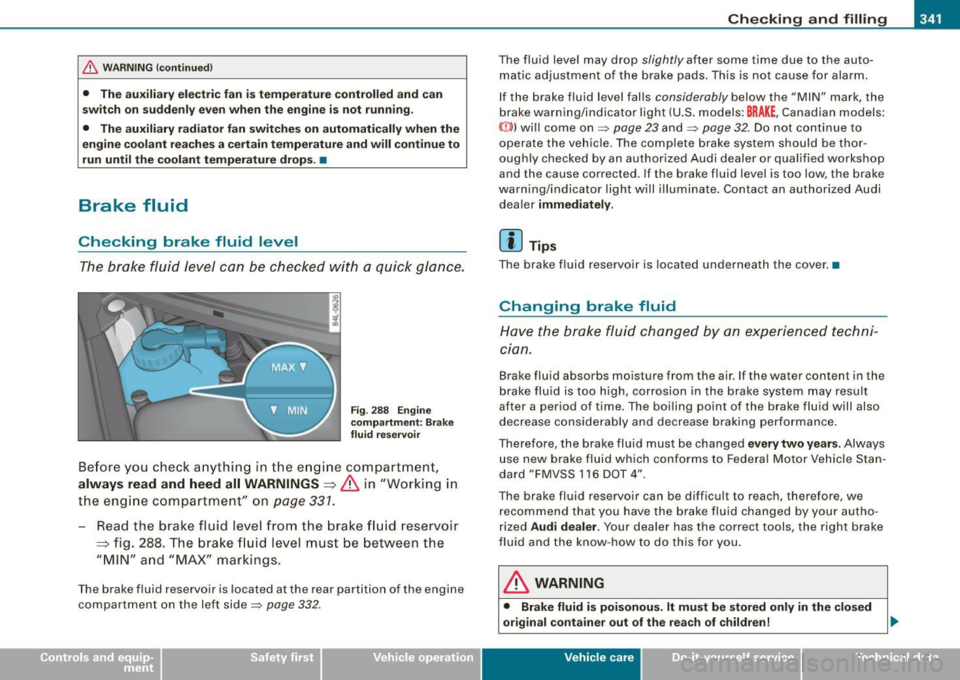
The brake fluid level c an be checke d with a quick gl ance .
Fig. 288 E ngine
comp artm ent: B ra ke
flui d rese rvoir
Be fore you check a nything in th e en g in e co mpart ment,
always read and heed all WARNINGS=> & in "Working in
t h e eng ine compartment" on
page 331.
- Read the brake fluid l eve l from the brake fluid reservoir
=> fig. 288. The brake flu id level mus t be between the
"MIN" and "MAX" markings.
The brake fluid reservoir is locate d at the rear partition of the engine
compartment on the left side=>
page 332.
The fluid level may drop slightly after some time due to the auto
ma tic adjustment of the brake pads. This is not cause for alarm .
If the brake fluid leve l falls
considerably below the "MIN" mark , the
brake warning/indicator light (U.S. models:
BRAKE , Canadian models:
«D> l will come on=>
page 23 and=> page 32 . Do not continue to
operate the vehicle. The complete brake system should be thor
oughly checked
by an author ized Audi dealer or qua lif ied workshop
and the cause corrected . If th e brake fluid level is too low, the brake
warning/indicator light w ill illumi nate. Contact an authorized Audi
dea ler
immedi ately .
[ i ] Tips
The brake fluid reservoir is located underneath the cover .•
Changing brake fluid
Have the brake fluid changed by an experience d techni
cian.
Brak e fluid absorbs mois ture from the air. If the wate r conten t in the
brake fluid is too high, corrosion in the brake sys tem may res ult
after a period of time . The boiling point of the brake fluid will also
decrease conside rably and decrease braking performance .
Therefore , the brake fluid mus t be changed
every two year s. Always
use new brake fluid which conforms to Federal Motor Vehicle S tan
da rd "FMVSS 116 DOT 4".
The brake fluid reservoir can be difficul t to reach, therefore , we
recommend that y ou have the brake fluid changed by your autho
rized
Audi deal er. Your dealer has the correct tools, the right brake
fluid and the know -how to do this for you .
& WARNING
• Brak e fluid is poi sonou s. It mu st be stored only in the clo sed
o riginal conta iner out of the rea ch of children! ..,.
Vehicle care I I irechnical data
Page 344 of 426
-~_C_ h_e _c _ k_ i_n ...:::g::;...._ a_n_ d_ f_ i_ll _in -'g:::;.._ ___________________________________________ _
& WARN ING (c o ntinued )
• Brake failure can re sult from old or inappr opriate brake fluid .
Ob serve the se precautio ns:
- Use only brake fluid that meets SAE specific ation J 1703 and
c onform s to Fed era l Moto r Vehi cle St anda rd 116. Al ways c heck
with your authori zed Audi dealer to make sure you are u sin g
the corre ct brake fluid. The correct typ e of brake fluid i s also
indicated o n the brake fluid reser vo ir .
- The br ake flu id mu st be ne w. Heavy u se of the brake s can
c au se a vapor lock if the brake fluid i s left in the s ystem too
long. Thi s can seriou sly affect the effi cien cy of the brake s as
w ell a s your safet y. Thi s could re sult in an acci dent .
0 Note
Brake fluid will damage the paint of your vehicle .
For the sake of the environment
Because of the problem of proper disposal of brake fluid as well as
the special too ls required and the necessa ry expertise, we recom
mend that you have the brake fluid changed by your authorized Audi
dea ler .•
Battery
General information
Under normal operating condi tions, the battery in your Audi does
not need any maintenance. With
high outside temperatures or long
daily drives we recommend that you have the e lectrolyte level
checked by an au thorized Audi dealer or qualified workshop . The
e lectrolyte level should also be ch ecked each time the battery is
charged ~
page 344.
Have the battery checked when you take your vehicle in for service .
Yo u are well advised to replace a battery that is o lder than 5 years .
With certain types of airbag dep loyment, the battery is discon
nected from the vehicle electrical system for safety reasons~
& in
"Repair, care and disposal of the airbags" on
page 255.
Disconnecti ng th e batt ery termin als
Some vehicle functions (power window regulators , for example) are
lost if the battery termina ls are disconnected. These functions have
to be relearned after the battery terminals are connected again . To
prevent this, the battery should only be disconnected from the
vehic le electrical sys tem when abso lutely necessary for repairs .
Vehicles not driven for long per iods
If you do not drive your vehicle ove r a period of several days or
weeks, electrical components are gradually cut back or switched off .
T his reduces energy consumption and maintains starting capab ility
over a longer period
~ page 295 .
Take i nto consideration that whe n you u nlock your vehicle, some
convenience functions, such as the master key remote function or
powe r seat adjustme nt, may not be ava ilable. The convenience
functions will be available again when you turn on the ignition and
start the engine .
Wint er op erati on
Duri ng the winter mont hs, batte ry capacity tends to decrease as
temperatures drop . This is because more power is also consumed
whi le star tin g, and the headlights, rear window defogger, etc ., are
used more often.
Avoid unnecessary power consumption, particular ly in city traffic or
when trave li n g o nly short dis tances . Let your authorized Audi dea ler
check the capacity of the vehicle battery before winter sets in
~ page 344. A we ll cha rged battery w ill not only preven t starting
problems when the weather is cold, but will also last longer . ..,_
Page 360 of 426
-~_T_ ir_e_ s_ a_ n_d _ w_ h_ e_e _l_s _________________________________________________ _
make, there will be six to eight of them evenly placed around the
tire. Marks on the tire sidewall (for example "TWI" or other symbols)
indicate the positions of the tread wear indicators. Worn tires must
be replaced. Different figures may apply in other countries=>& .
Tire pressure
Incorrect tire pressure causes premature wear and can cause
sudden tire blow-out. For this reason, tire pressure must be checked
at least once a month =>
page 353.
Driving style
Driving fast around curves, heavy acceleration and hard braking
increase tire wear.
Rotating tires for more even wear
For all four tires on your vehicle to have the same service life, we
recommend that the front and rear tires are rotated according to the
tire manufacturer's suggested tire rotation intervals. Please
remember the following:
• Tire rotation intervals may differ from the vehicle service inter
vals outlined in your Warranty
& Maintenance booklet.
• The longer one tire is used in one location on the vehicle , the
more it wears at certain points; therefore, we recommend that you
follow the tire manufacturer's suggested tire rotation intervals .
• Vehicles with front-wheel drive experience more tread wear on
the front wheels compared to all-wheel drive (quattro ®l.
• Please rotate tires as shown =>
page 357, fig. 294.
• Extra care must be taken when rotating direction-specific tires
=>
page 379.
Wheel balancing
The wheels on new vehicles are balanced. However, various situa
tions during everyday driving can cause them to become unbal
anced, resulting in vibrations you can usually feel through the
steering wheel. Unbalanced
wheels must be rebalanced to avoid excessive wear on
steering, suspension and tires. A wheel must also be rebalanced
when a new tire is installed.
Incorrect wheel alignment
Incorrect wheel alignment can cause excessive tire wear , impairing
the safety of the vehicle. If tires show excessive wear, have the
wheel alignment checked by an authorized Audi dealer or qualified
workshop.
All Wheel Drive
Vehicles with quattro® must always have tires of the same size,
construction and tread type. For details see=>
page 294.
& WARNING
Sudden tire failure can lead to loss of control, a crash and serious
personal injury!
• Never drive a vehicle when the tread on any tire is worn down
to the wear indicators.
• Worn tires are a safety hazard, they do not grip well on wet
roads and increase your risk of "hydroplaning" and loss of control.
• Always keep chemicals that can cause tire damage, such as
grease, oil, gasoline and brake fluid away from tires .
• Tires age even if they are not being used and can fail suddenly,
especially at high speeds. Tires that are more than 6 years old can
only be used in an emergency and then with special care and at
lower speeds .
• Never mount used tires on your vehicle if you are not sure of
their "previous history." Old used tires may have been damaged
even though the damage cannot be seen that can lead to sudden
tire failure and loss of vehicle control. •
Page 405 of 426
__________________________________________________ C_o_ n _ s_u_ m_ e ___ r_l_ n _f_ o_ r _m...:....:.. a:.;..:. ti .... o:.. n ........ _llll
& WA RNIN G (continu ed )
• The engine compartment of any motor vehi cle i s a potentially
h az ardou s area. N ev er re ach into the are a arou nd or to uch the
r a di ator fan . It is temperature co ntrolled and can swi tc h o n
s uddenly -even wh en the engine i s off and the ignition key h as
been removed . The r adiator f an switches on autom atic all y w hen
the coolant reache s a certain temperature and will continue to run
until the coo lant t emper ature drop s.
• Alway s remov e th e ignition key befo re anyone get s under the
v ehi cle .
• Alway s s upport your vehi cle with safety sta nd s if it i s ne ces
sa ry to wor k unde rne ath the veh icle . The ja ck suppl ied with the
v ehic le i s not adequ ate for thi s purpo se and could coll ap se
c au sin g s eriou s per son al in jury .
• If you m ust w ork under neath the vehi cle with the wheel s on
the ground , alwa ys m ake sure the veh icle i s on l eve l ground , that
the wheels ar e always securely blocked and that the engine
ca nn ot be sta rted .
• Alway s mak e sure the tran sm iss ion selecto r leve r (automatic
tr ansmi ssion ) is in "P " (P a rk po sition ) and the park brake is firml y
applied .
c£> For the sake of the environment
• Changing the engine settings w ill adverse ly affect emission
levels . This is detrimenta l to the environment and increases fuel
consumption.
• Always observe environmenta l regu lations when disposing of
old engine oil, used brake fluid, dirty engine coolant, spent batteries
or worn out tires.
• Undeployed airbag modules and pretens ioners might be classi
fied as Perchlorate Material -specia l handling may apply, see
www .dtsc .ca .gov/hazardouswaste/perchlorate. When the vehicle or
parts of the restraint system including airbag modules safety belts
with pretens ioners are scrapped, all applicable laws and regu la-
Controls and equip
ment Safety first Vehicle operation
tions must be observed. Your authorized Audi dealer is familiar with
these requirements and we rec
ommend that you have your dea ler
perform this service for you .•
Additional accessories ,
modifications and parts replacement
Addition al a ccessori es and parts
replacement
Always c onsul t an authorized Audi dealer before
purchasing accessories.
Your vehicle incorporates the latest safety design features ensuring a high standard of act ive and passive safe ty .
This safety could be compromised by non -approved changes to the
vehic le . F or this reason, if par ts have to be replaced, please observe
the following points when insta lling additiona l accessories:
Approved Audi accessories and genuine Audi parts are avai lable
from authorized Audi dealers.
These dealers also have the necessary facilities, tools and trained specialis ts to install the parts and accessories prope rly.
& WARNING
Using the wrong spare part s or u sing non-approved acce ssorie s
can c ause seri ous persona l injur y.
• Use onl y acc essorie s ex pres sly approved by Audi and g enuine
Audi spare p art s
• The se p art s and acce ssorie s have been spe cia lly de signed to
be used on you r vehi cle .
• Nev er in stall acc ess orie s s uch a s telep hone cra d le s or
be ver age holder s on airb ag cover s or within th e airbag deploy-
Vehicle care Do-it-yourself service Tec hn ica l da ta
Page 412 of 426
___ A_l.:,. p _h_ a_ b_e _t _ic _ a_l _in _ d_e _x ____________________________________________ _
Brake fluid
Changing the brake fluid ... ... ... .
341
Checking the brake fluid level . . . . . . 341
Reservoir ...... .. .... .... ....... 341
What is the correct brake f luid level? 341
What should I do if the brake fluid warning
light comes on? ........ .... ....
341
Brake light
Defective . . . . . . . . . . . . . . . . . . . . . . . .
27
Brake system ....................... 341
Anti-lock brake system . . . . . . . . . . . . . 22
Brake fluid . . . . . . . . . . . . . . . . . . . . . . 341
Brake f luid specifications for refill and
replacement ...... ...... ...... .
341
Brake pads ..................... . 298
General information . . . . . . . . . . . . . . 291
How does moisture or road salt affect the
brakes? ..... .... ....... .... ...
291
Malfunction ........ ... .. .... .... . 32
Park ing brake . . . . . . . . . . . . . . . . . . . . 147
Warning/indicator lights ... ...... .. 23
Worn brake pads symbol . . . . . . . . . . . 37
Braking guard
See Audi braking guard ... ... .... . 168
Break-in period . . . . . . . . . . . . . . . . . . . . . 297
Brake pads .... .................. 298
Tires .... ... .. .... .... ......... . 297
Breakover angle . . . . . . . . . . . . . . . . . . . . 302
Bulbs ..... ....... .. .... .... ...... . 385
Bumper cover
Caution when parking near a parking bar -
rier or curb .. ... ..... ........ ..
147
C
Ca lifornia Proposition 65 Warning 332
Battery specific .... .... .... .... .. 344
Capac,t,es ... .............. ...... .. 399
Car -Systems
Background lighting . ...... .... ....
79
Lighting profiles . . . . . . . . . . . . . . . . . . 79
Car care ........................... 312
Interior .... .... .... .... ....... .. 319
Plastic and vinyl ........... ... ... 316
Weatherstrips ... .. .... .... ...... 317
Care of exterior ..................... 312
Cargo area
See Loading the luggage compartment . .
227
Cargo floor ......... .... ........ ... 109
Cargo net . . . . . . . . . . . . . . . . . . . . . . . . . .
107
Catalytic converter .. ....... ........ . 298
Center conso le in rear
Central locking 103
Emergency locking ............ .... 57
Panoramic s liding sunroof ...... .... 69
Certification . . . . . . . . . . . . . . . . . . . . . . . . 404
Changing a flat tire .... .... ....... ... 373
Changing a wheel ................... 373
Changing engine oil ... ........ ...... 336
Chassis
Undercoating ... .. .... .... .... ...
318
See also Adaptive Air Suspension . .. 206
CHECK button . . . . . . . . . . . . . . . . . . . . . . . 16
Checking
Engine coolant level
338
Checking tire pressure ............. .. 353
Child restraints
Danger of using ch ild restra ints in the
front seat . . . . . . . . . . . . . . . . . . . . . .
243
What types of child restraint anchors are
available? ... ......... ......... .
276
Where can I get additional information
about child restraints? .... .... .. .
277
Child safety .................... 263, 268
Additional information .. ... .... ... 282
Booster seats . . . . . . . . . . . . . . . . . . . . 271
Convertible child safety seats ... ... 269
Convertible locking retractor .... ... 273
Guidance fixtures for lower anchorages ..
279
Important safety instructions for using
chi ld safety seats ...............
266
Important things to know when driving
with children .. .... ... ..... .....
263
Infant seats ......... ........ .... 268
Install ing a child restraint using the
LATCH system .. ...... ....... ...
281
Lower anchorages ... .. .... .... ... 278
Mounting and releasing the anchorage
hook ..... ........ .... ....... ..
282
Older children and safety belts 272
Safety belts and older children ..... 272
Tether anchors .. ...... .... ...... 282
Tether strap ... .... .... ...... .... 283
Which restraint system should my older
chi ld wear? ... ....... .... .... ..
272
Page 415 of 426

______________________________________________ A_ l_,_ p _h_ a_ b_e _t_ic _ a _ l _in _ d_e _ x __ lllll
Starting with jumper cables ... .... . 387
Stopp ing . . . . . . . . . . . . . . . . . . . . . . . . 144
Engine compartment Safety instructions . ...... ..... .. . 331
Working the engine compartment .. 331
Engine coolant system ...... .... .... . 337
Adding coolant ....... .... .... ... 339
Checking coolant level .. .... .. .... 338
Checking the engine coolant level . .. 338
Malfunction ..... .... .... ......... 33
Radiator fan ........ ............ . 340
Engine coolant temperature Temperature gauge ...... .... ...... 13
Engine data ............... ......... 399
Engine hood
Closing ..................... .... 331
How to rel ease the hood .... .... ... 330
Engine oil . ... .. ..... ........... .... 333
Adding .............. .... .... ... 336
Additives ... .. .... .... .... .... ... 336
Changing .... .... .... ........... 336
Checking the engine oil level ... .... 335
Indications and condit ions r equiring ext ra
checking .... .... .... ... .... .... 335
Oil consumption . .... ... .... ..... 334
Oil grades .. ...... .... ........... 333
Recommended oil check intervals .. . 335
Specification and viscosity .. ....... 333
Engine oil level .. .... .... .... .... .... 37
Engine oi l pressur e
Mal func tion ....... ..... .... ... ... 33
Engine oil sensor defective . .......... . 37
Engine speed limitation ............ ... 37
Controls and equip
ment Safety first
Entry assist
Rear seats .... ...... ........ ... .. . 99
Environment Break -in period ...... ...... .... ... 297
Catalytic conv erter .... .... .... .... 298
Disposing o f your v ehicle battery ... 346
Driving a t high speeds ............ 299
Driving to minimi ze pollution and noise .
299
Fuel . .... ........ .... .... ... .... 327
Fuel economy .... ..... .. .... .... . 299
L e aks under your v ehicle .. ........ 331
L etting th e ve hicle stand and warm up ..
300
Proper disposal of drained brake fluid
341
P roper disposal of drained engine
coolant .. ...... .. .. .... .... .... 339
Proper disposal of drained engine o il 336
Recycl ing us ed engine o il .... ...... 336
Unl eaded fuel ... .. ...... ..... ... . 325
What should I do with an old battery? 346
EPC
See Electronic power control .. .. .... 19
ESP
S ee Electronic stabilization program
(ESP) .. .... ... .................. 19
Event Data Recorder (EDR) ... ....... .. 288
Expansion tank ........... ...... .... 338
Explanation of some technical terms .. . 302
Ext erior lighting in the mirror hous ing . .. 76
Eyeglasses compartment ............. 121
F
Fall line ... .. .... .... ...... .... ... .. 302
Fan Four -zone automatic comfort a ir
conditioning ... .. .... ........... 133
Radiator ..... .. ... ....... ... ..... 340
Flat tire Changing . .... .... .... .... ...... . 373
Floor mats . ... ...... .... ........ ... 226
Fog lights ........... ... .... .... ..... 75
Fo lding chocks .. ... ... .. .... .... .... 370
Fo ldin g master key with remote control .. 48
Foot pedals . ...... .. .... .... .... .... 226
For the sake of the environment Gasoline fumes and th e environment 327
L et ting your eng ine warm up ... ....
143
Reducing engine noise by early
upshifting . ...... ....... .... .. . .. 13
Refueling ..... .... .... .. .. ... .. .. 327
Saving fuel by early upshifting .... . .. 13
Using the rear window defogg er ... . 129
Fording depth ........... .. . ........ 302
Four -zone automa tic comfort a ir
conditioning ... .. .... ........... 131
Automatic mode in rear . ........ .. 132
Heated rear seats ...... .... ....... 137
Rear air distribution ... .... .... .... 133
Rear con trols .... .... .... .... ... . 131
Rear fan . .... ... .... ... .. .... .... 133
Rear operation .... ...... .... .... . 135
Rear temperatu re ............ ... .. 133
Vehicle operation Vehicle care Do-it-yourself service Technical data
Page 423 of 426
_____________________________________________ ..:..A ..:: l:.!: p :.:h..:.: a::..:: b:.::e :.: t:.:.ic ::..:: a~l ..::in :...:.::: d:.::e ::: x:__ _IJIII
u
Undercoating .... ... ........ .... ... . 318
Unfastening safety belts ... .... ...... 238
Unidirectiona l tires ...... .... ........ 347
Uniform tire quality grading .. ... .... . 363
Unlocking Power locking switch .... .... .... .. 55
Rear lid/trunk lid ........ ......... . 57
Remote control key .......... .... .. 53
Using the key .... .... .... ..... .. .. 54
V
Valet key function
Activating and deactivating .... .... . 51
Vanity mirror .. ... ... ... .... ...... ... 80
Vehicle Identification Number (VIN) .... 396
Vehic le jack .................... 370, 376
Veh ic le literature .... .... .... ... .... ... 5
Vehicle-care products ..... .... .... ... 312
Venti lation
Climate controls ...... ....... .... . 123
w
Warning lights ...... .... .... .... ..... 17
Warning/indicator lights .... .... .... .. 13
Adaptive Air Suspension ......... .. 21
Adaptive Cruise Control .. ...... ... 161
Airbag system . ....... ......... ... 19
Anti -lo ck brake system (ABS) . ...... . 22
Brake system .. ...... .... .... .... . 23
Controls and equip
ment Safety first
Cruise contro
l .... .. . .. .. .... ... .. . 22
Electronic power con trol .. .... .... .. 19
Electronic stabilization program (ESP) 19
High beam ... ... .... .... .... .... . 22
Malfunction Indica tor Lamp (MIU .... 20
Parking brake .. ....... .. .... .... .. 23
Safety belt .......... .............. 21
Tire pressure monitoring system .... . 20
Trailer turn signal assembly .. ..... .. 20
Turn signals ....... ....... ... .... . 20
Warranty coverages ...... ... .... .... 401
Washer reservoir .... .... ... .... .... . 346
Washing .. ......................... 312
Automatic car wash ....... ........ 313
by hand ......................... 313
General information .............. 312
with a power washer ... .... ... .... 314
Waxing ................ ............ 315
Wear indicator ...... ........ .... ... . 357
Weatherstrips ...... .... ......... ... 317
Weights .... .... .... .... .... .... ... 397
What happens if you wear your safety belt too
loose? ...... .... .... ........... 236
What happens to unbelted occupants? . 233
What impairs driving safety? ...... .... 221
What should I do after changing a wheel? ..
354
What should I do after replacing wheels?
354
Wheel bolts
Torque .. .... ... .. .... .... .... ... 365 Wheels
...... .... .. .. ... .. .. ..... .. 347
Cast alloy ... .. .... .... .... .... ... 318
Checking tire pressure . .... .... ... 353
Co ld tire inflat ion pressure ... ..... . 351
General notes ...... ... .... ..... .. 347
Glossary of tire and loading terminology
348
New tires and whee ls .. .... ... ... . 359
Tires and vehicle load limits . ...... . 355
When must a safety belt be replaced? .. 234
When must the airbag system be inspected?
252
When should I adjust the tire pressures? ...
354
When should I check the tire pressures? 354
Where can I find the tire pressures for my
car? . ............... .... ... .. .. 353
Why safety belts? ......... ..... .. 231,232
Windows Cleaning ......... ... .... ........ 317
Convenience close/open feature ..... 66
Defogging .... .... .... ... .... .... 127
Defrosting ..... .... ... .... .... ... 127
Rapid defrosting/defogg ing ........ 130
Windshield washer fluid Low level . ....... ... .. ...... .... .. 36
Windshield wipers Chang ing the rear wiper blade ..... .. 86
Faulty ... .. ........... ........ .... 38
Intermittent wiping .... .... ...... .. 81
One -tap wiping .... .... ... .... ... .. 81
Rain sensor .. .. ... .... ... .... .... . 81
Rear window wiper .... ............ 83
Vehicle operation Vehicle care Do-it-yourself service Technical data