change wheel AUDI Q7 2009 Owner´s Manual
[x] Cancel search | Manufacturer: AUDI, Model Year: 2009, Model line: Q7, Model: AUDI Q7 2009Pages: 426, PDF Size: 97.13 MB
Page 257 of 426

Airbag system -----------------=~-
& WARNING (continued )
• Always install forward or rear-facing child safety seats on the
rear seat -even with an Advanced Airbag Sy stem.
• If you must install a rearward -facing child safety seat on the
front passenger seat because of exceptional circumstances and
the PASSENGER AIR BAG OFF light does not appear and stay on,
immediately inst all the rear -facing child safety seat in a rear
seating position and have the airbag system inspected by your
authorized Audi dealer.
• A tight tether or other strap on a rearward-facing child restraint
attached to the front pas senger seat can put too much pressure
on the weight-sensing mat in the se at and reg ister more weight
than is actually on the seat. The heavier weight registered can make the system work as though an adult were on the seat and
deploy the Advanced Airbag when it must be suppressed causing
serious or even fatal injury to the ch ild .
• If, in exceptional circumstance s, you must install a forward
facing child restraint on the front passenger seat, always move the
seat into its rearmost position in the seat's fore and aft adjust
ment range , as far away from the airbag as possible . The backrest
must be adjusted to an upright position . Make sure that the
PASSENGER AIR BAG OFF light comes on and stays on all the time
whenever the ignition is switched on .
& WARNING
• If the PASSENGER AIR BAG OFF light does not go out when an
adult is sitting on the front passenger seat after taking the steps
described above, make sure the adult is properly seated and
restrained at one of the rear seating positions .
• Have the airbag sy stem inspected by your authorized Audi
dealer before transporting anyone on the front passenger seat .
Controls and equip ment Safety first
Vehicle operation
[ i ] Tips
If th e we ight-se nsing mat in t he front passenger seat detects an
e m pty seat, the front airbag on the passenger si de wil l be turned
o ff , a nd t he
PASSENGER AIR BAG OFF lig ht will stay on. a
Repair, care and disposal of the airbags
Pa rts o f the airba g syste m are in sta lled a t many d ifferent places on
your Audi. Insta lling, removing, servicing or repa ir ing a part in an
ar ea of the ve hicle ca n dama ge a par t of a n airbag sys te m and
prevent that system from wor king properly in a co llision.
There are so me i mpor ta nt thi ngs you have to know to make sure
that the effectiveness of the system w ill not be impaired and that
d iscarded components do no t cause inju ry o r po llute the e nvir on
m ent.
& WARNING
Improper care , servicing and repair pro cedures can increase the
risk of personal injury and death by preventing an airbag from
deploying when needed or deploying an airbag unexpectedly :
• Never cover, obstruct, or change the steering wheel horn pad
or airbag cover or the instrument panel or modify them in any way .
• Never attach any objects such as cupholders or telephone
mountings to the surfaces covering the airbag units .
• For cleaning the horn pad or instrument panel , use only a soft ,
dry cloth or one moistened with pla in water . Solvents or cleaners
could damage the airbag cover or change the stiffness or strength
of the material so that the airbag cannot deploy and protect prop
erly .
• Never repair , adjust , or change any parts of the airbag system .
• All work on the steering wheel , instrument panel, front seats or
electrical system (including the installation of audio equipment ,
~
Vehicle care Do-it-yourself service Technical data
Page 310 of 426
ll'I __ T_ r _a_ il_e _r_ t_ o_ vv_ in__... g,_ __________________________________________________ _
& WARNING
Anyone not properly restrained in a moving vehicle is at a much
greater risk
in an accident. Never let anyone ride in your car who
is not properly wearing the restraints provided by Audi .
c:
Trailer towing tips
Important to know
Your vehicle handles differently when towing a trailer because of
the additional weight and different weight distribution. Safety,
performance and economy will greatly depend on how carefully you
load your trailer and operate your rig.
Before you actually tow your trailer, practice turning, stopping and
backing up in an area away from traffic. Keep practicing until you
have become completely familiar with the way your vehicle -trailer
combination behaves and responds.
Backing up is difficult and requires practice. Backing up with a
trailer generally requires steering action opposite to that when
backing up your vehicle without a trailer.
Maintain a greater distance between your vehicle and the one in
front of you. You will need more room to stop. To compensate for
the trailer, you will need a larger than normal turning radius.
When passing, remember that you cannot accelerate as fast as you normally would because of the added load. Make sure you have
enough room to pass. After passing, allow plenty of room for your
trailer before changing lanes again.
Avoid jerky starts, sharp turns or rapid lane changes.
[ i] Tips
• Do not tow a trailer during the break-in period of your vehicle. • If you tow
a trailer, your Audi may require more frequent mainte
nance due to the extra load~
page 401. •
Parking on a s1ope
Do not park on a slope with a trailer. If it cannot be
avoided , do so only after doing the following:
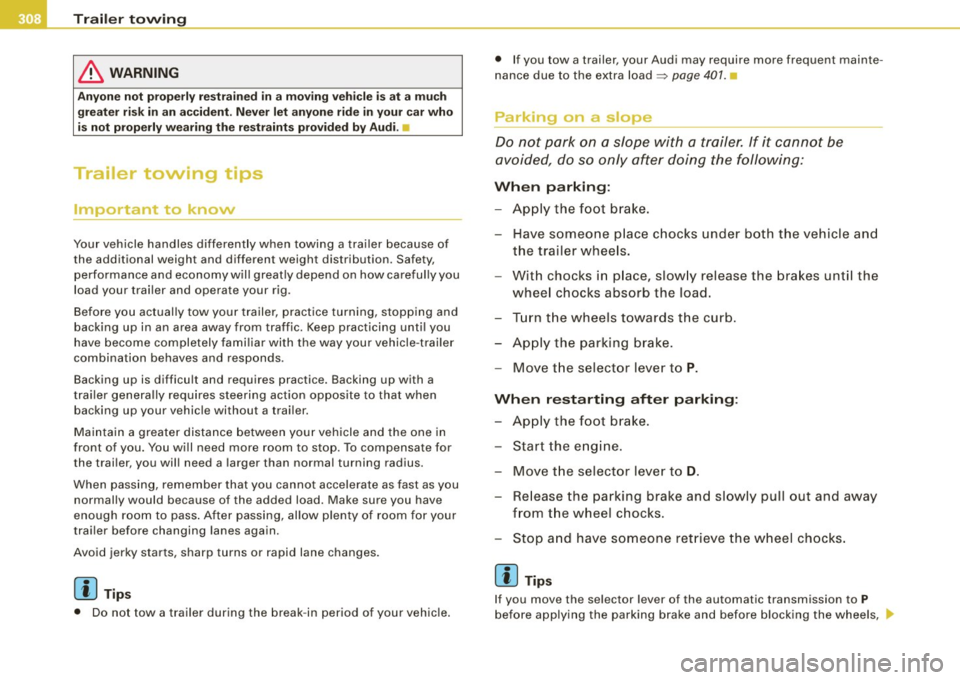
When parking:
-Apply the foot brake.
- Have someone place chocks under both the vehicle and
the trailer wheels.
- With chocks in place, slowly release the brakes until the
wheel chocks absorb the load.
- Turn the wheels towards the curb.
- Apply the parking brake.
- Move the selector lever to
P.
When restarting after parking:
- Apply the foot brake.
- Start the engine.
- Move the selector lever to
D.
-Release the parking brake and slowly pull out and away
from the wheel chocks.
- Stop and have someone retrieve the wheel chocks.
[ i] Tips
I f you move the selector lever of the automatic transmission to P
before applying the parking brake and before blocking the wheels, II-
Page 354 of 426
-Tires a nd wh eels rm __________________ _
for the vehicle at its maximum capacity weight and tires that were
on your veh ic le at the time it was manufactured.
If you w is h t o improve co mfort w hen opera ting the vehicle a t
n ormal lo ad (up t o 3 o ccupant s), you can a djust ti re pre ss ure s to
tho se s pecified for norm al v ehi cle load . B efore operating the vehi cle
at m aximum lo ad , y ou must i ncreas e the t ire p re ss ure s to tho se
s pe cifi ed for m axim um vehicle lo ad
=> & .
Bear in mind that the tire pressure monitoring system can only
monitor the tire pressures you have stored. The system does not
recognize the load condition of your vehic le.
The effectiveness of the tire pressure monitoring system will be impaired if you store normal load pressures but then operate the
vehic le at its maximum load=>&. See the
illustration=>
page 351, fig. 291 for the location of the label
either on driver's side B -p illar or inside the fuel fi ller flap (color of
the actual label and exact location on the vehicle will vary slight ly).
Note that the fol lowing tab le is accurate at the time of going to
press and is subject to change . In the event of discrepanc ies, the tire
pressure label (On USA vehic les, the tire pressure label is located on
the driver's s ide B-pillar . On Canada vehicles, the tire pressure label
is located either on the driver's side B-pillar or inside the fue l fi ller
fl ap) always takes precedence.
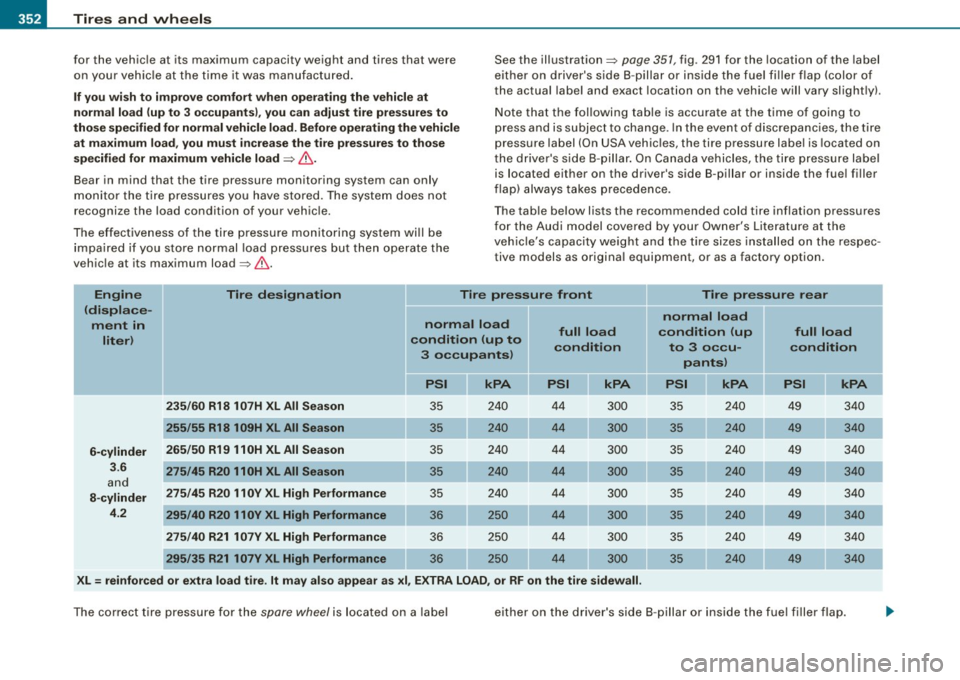
T he table below lists the recommended cold tire inflation pressures
for the Audi model covered by your Owner's Literature at the
vehic le's capacity weight and the tire sizes installed on the respec
tive models as origina l equipment, or as a factory option.
En gin e
( displ ac e
m ent in
liter) Tir
e desi gnatio n Tire pressure fr ont Tire pressur e re ar
normal load norm
al lo ad
full l oad conditi
on (up
full load
condition (up to c ondit ion t o 3 o ccu- co nditi on 3 occupants)
pant s)
II
PSI II kPA PSI kPA PSI II kPA PSI kPA
235/6 0 R18 10 7H XL All Sea son 35 240 44 300 35 240 49 340
255/55 R18 109H XL All S easo n 35 2
40 44
300 35 240 49 3
40
6 -cy lind er 2
65 /50 R19 11 OH XL All Seas on 35 240 44 300 35 240
49 340
3.6
275 /45 R20 11 OH XL All Se ason 35 240 44 300 35 240 49 340
and
8- cy linder 2
75/ 45 R20 11 0 Y XL Hig h Pe rfo rman ce
35 240 44
300 35 240 49 340
4
.2 295 /40 R20 11 0Y XL Hi gh P erform ance 36 44 300 35 240 49
340
2 75/40 R21 10 7V XL High Perf ormanc e 36 250 44 300 35 240 49 340
295 /3 5 R21 107 V XL High P erforman ce 36 250 4
4
300 35 240 49 340
X
L = re infor ced or extr a load tire . It ma y als o app ear as x i, EXTRA LOAD , or RF on the tire side wa ll.
The correct tire pressure for the spare wheel is located on a label either on the driver's side B -pillar or inside the fue l filler flap.
Page 357 of 426
Tires and wheels -_____________ .:.....::...=..____:__:_:_:_=-=----
•
& WARNING (continu ed )
• Incorrect tire pressure and /or under inflation can cause
in creased tire wear and can affect the handling of the vehicle and
stopping ability .
• Incorrect t ire pressures and /o r underinflat ion can also lead to
sudden tire failure, including a blowout and sudden deflation,
causing lo ss of vehicle control .
• The driver is respon sible for the correct tire pressures for all
tires on the vehicle. The applicable pre ssure values are located on
a sticker on the driver 's side 8-pillar or on the inside of the fuel
filler flap .
• Only when all tires on the vehicle are filled to the correct pres
sure , the tire pressure monitoring sy stem can work correctly .
• The use of incorrect tire pressure values can lead to accidents
or other damage . Therefore it is essential that the driver observe
the specified tire pressure value s for the tires and the correct pres
sures for the function of the tire pressure monitoring system.
• Always inflate tires to the re commended and correct tire pres
sure before driving off .
• Driving with underinflated tires bend more , letting them get
too hot resulting in tread separation , sudden tire failure and loss
of control.
• Ex cessive speed and /overloading can cause heat build-up ,
s udden tire failure and lo ss of control .
• If the tire pres sure is too low or too high , the t ires will wear
prematurely and the vehicle will not handle well .
• If the tire is not flat and you do not have to change a wheel
immediately , drive at reduced speed to the nearest service station
to check the t ire pressure and add air as required.
0 Note
Dr iving wi thout valve stem caps ca n cause damage to t he tire
valves. To prevent this, always make sure that factory instal led va lve
stem caps o n all wheels are sec urely mou nted on the va lve .
c£> For the sake of the environment
Underi nflate d tir es w ill a lso inc rease the fue l consu mptio n.•
Tires and vehicle load limits
There are li m its to the a mou nt o f load or weig ht th at any ve hic le and
any tire can carry . A vehicle that is overloaded wil l not handle wel l
and is more diff icu lt to stop . Overload ing ca n no t only lead to loss
of vehic le control, but can also damage important parts of the
ve hicle a nd can lead to sud den tire failu re, i nclu di ng a bl owou t and
sudden deflat ion that can cause the vehic le to crash.
Your safety an d that of your passengers also depends on ma kin g
su re tha t load l imits are not exceeded . Vehicle load includes eve ry
body and everything in and on the vehic le. These load limits are
t echnica lly re ferred to as the ve hicle's
Gross Vehicle Weight Rating
("GVWR"l.
The "GVWR" in clu de s th e we ig ht of t he basi c ve hicle, all fac tory
insta lled accessories, a ful l tank of fuel, oil, coolant and other fluids
plus m aximu m load. The maxi mum l oad inc lude s the n umber of
passen gers that the vehicle is intended to carry !"seating capacity")
with an assumed weight of 150 lbs (68 kg) fo r each passenger at a
designated seating position and the total weight of any lugga ge in
the vehicle. If you tow a trailer, the weight of the trailer hitch and the
to ngue we ig ht of th e loaded tra iler must b e included as par t of th e
vehic le load.
The
Gross Axle Weight Rating ("GAWR") is the m aximum loa d th at
can be applied at each of the vehicle's two ax les. _,,,
Vehicle care I t •
Page 372 of 426
lllffll.___W_ h_ a_t _d_ o_ l _d _o_ n_ o_ vv_ ? ______________________________________________ _
What do I do now?
Jack, tools and inflatable spare tire
Jack and folding chocks
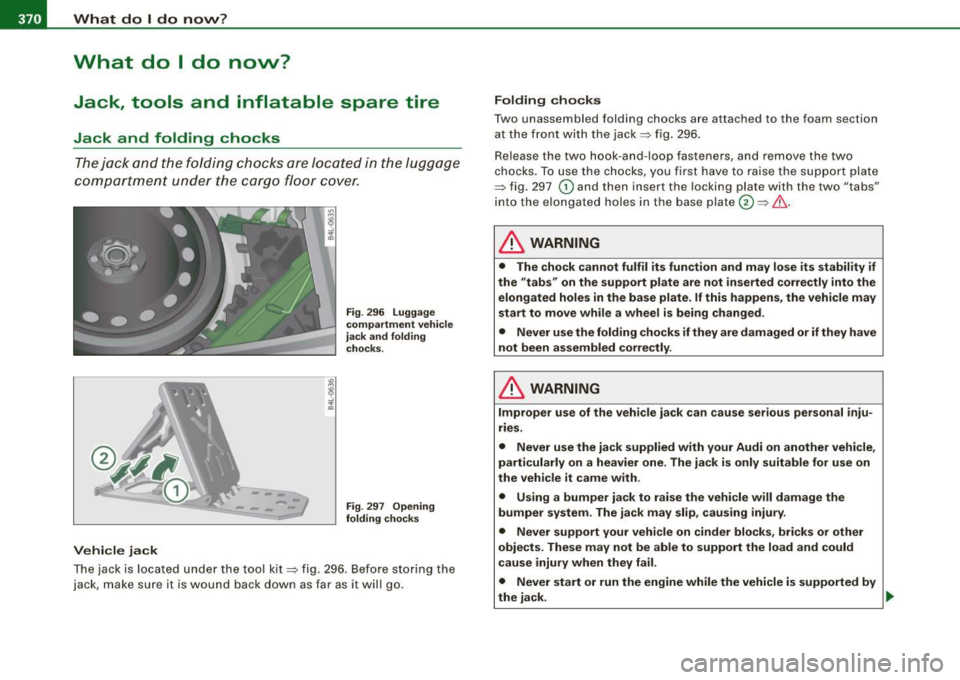
The jack and the folding chocks are located in the lug gage
comp artmen t under t he ca rgo floor co ver.
Vehicle jack
Fig . 296 Luggage
comp artment v ehi cle
jack and fold ing
c ho ck s.
Fig . 2 97 Opening
fold ing ch ocks
The jac k is located under the too l kit:::;, fig. 296 . B efore sto ring the
jack, ma ke su re it is wo und back down as fa r as it w il l go.
Folding chocks
Two unassembled fold ing chocks a re attached to the foam section
at the fron t w ith th e jack :::;, fig. 296 .
Release the two hook -and -loop fasteners, and remove the two
chocks . To use the chock s, you fi rst ha ve to raise the sup port pla te
:::;, fig. 297
G) and then insert the locking plate with the two "tabs"
into the e longated holes in the base plate@:::;,& .
& WARNING
• The chock cannot fulfil its fun ction and may lose its stability if
the "tabs " on the support plate are not inserted corre ctly into the
elongated holes in the base plate. If this happens , the vehicle may
sta rt to move while a wheel is being changed .
• Never u se the folding chocks if they are damaged or if they have
not been assembled co rre ctly .
& WARNING
Improper use of the vehi cle jack can cause serious pe rsonal inju
rie s.
• Never use the jack supplied with your Audi on another vehicle,
particularly on a heavier one. The jack is only suitable for use on
the veh icle it came with .
• Using a bumper jack to raise the veh icle will damage the
bumper system . The jack may slip , caus ing injury .
• Never support your vehicle on cinder blocks , bricks or other
objects. These may not be able to support the load and could
cause injury when they fail.
• Never start or run the engine while the vehicle is supported by
the jack .
~
Page 375 of 426
What do I do now? -
---------------~.;______
•
& WARNING (continued)
• Loose items in the passenger compartment can cause serious
personal injury during hard braking or in an accident .
- Never store the inflatable spare tire or jack and tools in the
passenger compartment.
- Always store all jacking equipment, tools, and the inflatable
spare tire in the luggage compartment.
- Tighten the knurled retaining screw for the inflatable spare
tire securely.
0 Note
• Th e inflatable spare tire has been developed specifically for this
vehicle model. It must not be exchanged or used for other vehicle
models. Similarly, inflatable tires from other vehicle models must
not be used.
• Normal summer or winter tires must not be installed on the
inflatable tire rim.•
Changing a wheel
Before changing a wheel
Observe the following precautions for your own and your
passenger's safety when changing a wheel.
-After you experience a tire failure, pull the car well away
from moving traffic and try to reach
level ground before
you stop => & .
- All passengers should
leave the car and move to a safe
location (for instance, behind the guardrail)=> &.
- Engage the
parking brake to prevent your vehicle from
rolling unintentionally=> &. -
Move
selector lever to position P =:> & .
- If you are towing a trailer: unhitch the trailer from your
vehicle.
- Block the diagonally opposite wheel with the folding
chocks or other objects.
- Take the
jack and the inflatable spare tire out of the
luggage compartment=>
page 370.
& WARNING
You or your passengers could be injured while changing a wheel if
you do not follow these safety precautions:
• If you have a flat tire, move a safe distance off the road. Turn off
the engine, turn the emergency flashers on and use other warning
devices to alert other motorists.
• Make sure that passengers wait in a safe place away from the
vehicle and well away from the road and traffic.
• To help prevent the vehicle from moving suddenly and possibly
slipping off the jack , always fully set the parking brake and block
the wheel diagonally opposite the wheel being changed with the
folding chocks or other objects. When one front wheel is lifted off
the ground, placing the Automatic Transmission in "P" (Park) will
not prevent the vehicle from moving.
• Before you change a wheel, be sure the ground is level and firm .
If necessary, use a sturdy board under the jack.
• After installing the inflatable spare tire, make sure that you
replace the flat tire/wheel in its storage area properly and tighten
the knurled retaining screw securely. •
Do-it -yourself service
Page 376 of 426
lll'Jl,___W_ h_ a_ t_ d_o_ l_ d_ o _ n_ o_w _ ? ____________________________________________ _
Changing a wheel
When you change a wheel, follow the sequence described
below step-by-step and in exactly that order.
1. Activate the vehicle jack mode (only vehicles with Adap
tive Air Suspension) ~
page 210.
2. Remove the decorative wheel cover*. For more details
see also~
page 375, "Decorative wheel covers" or
~ page 375, "Wheels with wheel bolt caps".
3. Loosen the wheel bolts ~ page 376.
4. Locate the proper mounting point for the jack and align
the jack below that point~
page 376.
5. Lift the car with the jack~ page 376.
6. Remove the wheel with the flat tire and then install the
inflatable spare tire =>
page 378.
7. Tighten all wheel bolts lightly.
8.
Lower the vehicle with the jack.
9. Use the wheel bolt wrench and
firmly tighten all wheel
bolts
~ page 376.
10. Replace the decorative wheel cover*.
11. Deactivate the vehicle jack mode (only vehicles with
Adaptive Air Suspension)=>
page 210.
& WARNING
Always read and follow all WARNINGS and information => & in
"Raising the vehicle" on
page 376 and => page 379. •
After changing a wheel
A wheel change is not complete without the doing the
following.
- Store and secure the wheel you replaced in the spare
wheel well.
- Replace the tools and the jack in their proper location.
- As soon as possible, have the
tightening torques on all
wheel bolts checked with a torque wrench. The correct
tightening torque is 120 ft lb (160 Nm).
- Have t he flat tire
replaced as soon as possible.
[ i] Tips
• I f you notice that the wheel bolts are corroded and difficult to
turn while changing a tire, they should be replaced before you check
the tightening torque .
• Drive at reduced speed until you have the tightening torques
checked .•
Page 381 of 426
_______________________________________________ W_ h_ a_t _ d_ o_ l _d _o_ n_ o _ w_ ? __ IIIII
•
- Let the compressor run until it has reached 50 PSI (3.5
bar). Switch the compressor off after running for 8
minutes at the most -danger of overheating!
& WARNING
The compressor and the tire filler hose can become extremely hot
while they are running -danger of burns!
0 Note
Switch the compressor off after running for 8 minutes at the most -
danger of overheating! Allow the compressor to cool down for a few
minutes before you use it again.
[ i] Tips
The compressor must not be connected to the cigarette lighter
socket, as this socket does not provide the required power .•
Tires with unidirectional tread design
Tires with unidirectional tread design must be mounted
with their tread pattern pointed in the right direction.
Using a spare tire with a tread pattern intended for use
in a specific direction
When using a spare tire with a tread pattern intended for use in a
specific direction, please note the following:
• The direction of rotation is marked by an arrow on the side of the
tire.
• If the spare tire has to be installed in the incorrect direction, use
the spare tire only temporarily since the tire will not be able to
achieve its optimum performance characteristics with regard to
aquaplaning, noise and wear. •
We recommend that you pay particular attention to this fact
during wet weather and that you adjust your speed to match road
conditions.
• Replace the flat tire with a new one and have it installed on your
vehicle as soon as possible to restore the handling advantages of a
unidirectional tire. •
Notes on wheel changing
Please read the information => page 359, "New tires and replacing
tires and wheels " if you are going to use a spare tire which is
different from the tires on your vehicle.
After you change a tire :
• Check the tire pressure on the spare immediately after installa
tion.
• Have the wheel bolt tightening torque checked with a torque
wrench as soon as possible by your authorized Audi dealer or a
qualified workshop.
• With steel and alloy wheel rims, the wheel bolts are correctly
tightened at a torque of 120 ft lb (160 Nm).
• If you notice that the wheel bolts are corroded and difficult to
turn while changing a tire, they should be replaced before you check
the tightening torque.
• Replace the flat tire with a new one and have it installed on your
vehicle as soon as possible. Remount the wheel cover.
Until then, drive with extra care and at reduced speeds .
& WARNING
• If you are going to equip your vehicle with tires or rims which
differ from those which were factory installed, then be sure to read
the information
=> page 359, "New tires and replacing tires and
wheels". ..
Do-it -yourself service
Page 401 of 426
_____________________________________________________ D_a_ t_ a __ lffllll
Data
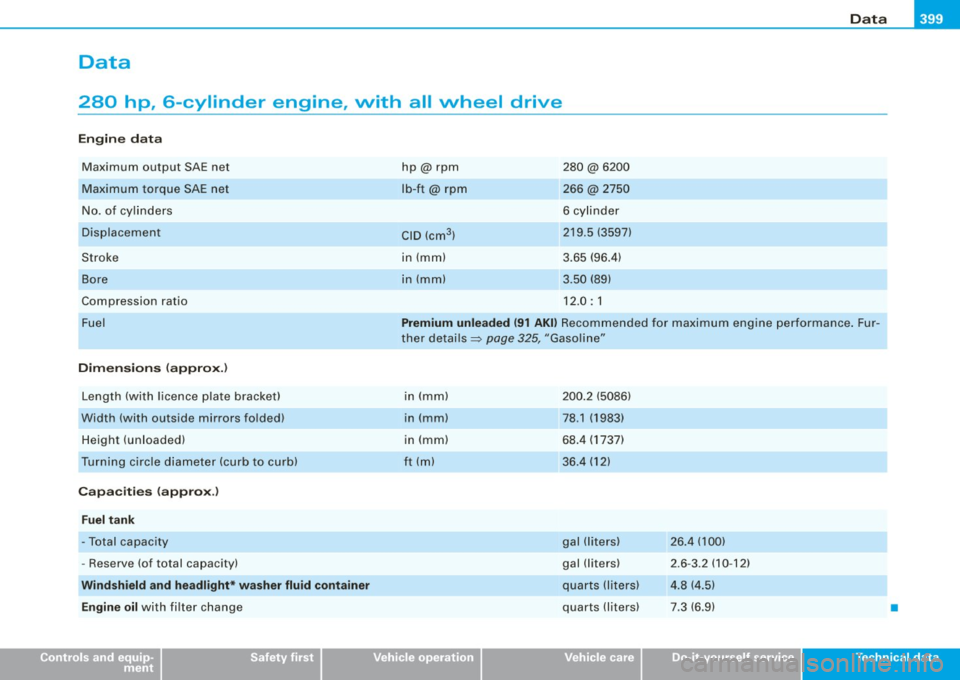
280 hp, 6 -cylinder engine, with all wheel drive
Engine data
Maximum output SAE net
Maximum torque SAE net
No. o f cy li n ders
Displacement
Stroke Bore
Compression ratio
Fuel
Dimensions (approx .)
Length (with lice nce plate bracket)
Width (with outside mirrors fo lded)
Height (unloaded)
Turning circle d iameter (curb to curb)
Capacities (approx .)
Fuel tank
- Total capacity
- Reserve (of total capacity)
Wind shield and headlight * wa sher fluid container
Engine oil
with fi lter change
Controls and equip
ment Safety first
hp@rpm
lb
-ft@ rpm
C ID (cm
3
)
in (mm)
in (mm) 280@ 6200
266@2750
6 cy
lind er
219 .5 (3597)
3 .65 (96 .4)
3.50 (89)
12 .0 : 1
Premium unleaded (91 AKO Recommended for maximum engine pe rformance . Fur
ther details~
page 325, "Gasoline"
i n ( mm)
i n (mm)
in (mm)
ft ( ml 200
.2 (5086)
78 .1 (1983)
68 .4 (1 737)
36.4 (12)
gal ( liters)
gal !liters)
quarts (liters)
quarts !liters) 26
.4 (100)
2 .6 -3 .2 (10 -12)
4.8 (4.5)
7 .3 (6 .9)
•
Vehicle operation Vehicle care Do-it-yourself service Tec hn ica l da ta
Page 402 of 426
____ D_ a_t _a ________________________________________________________ _
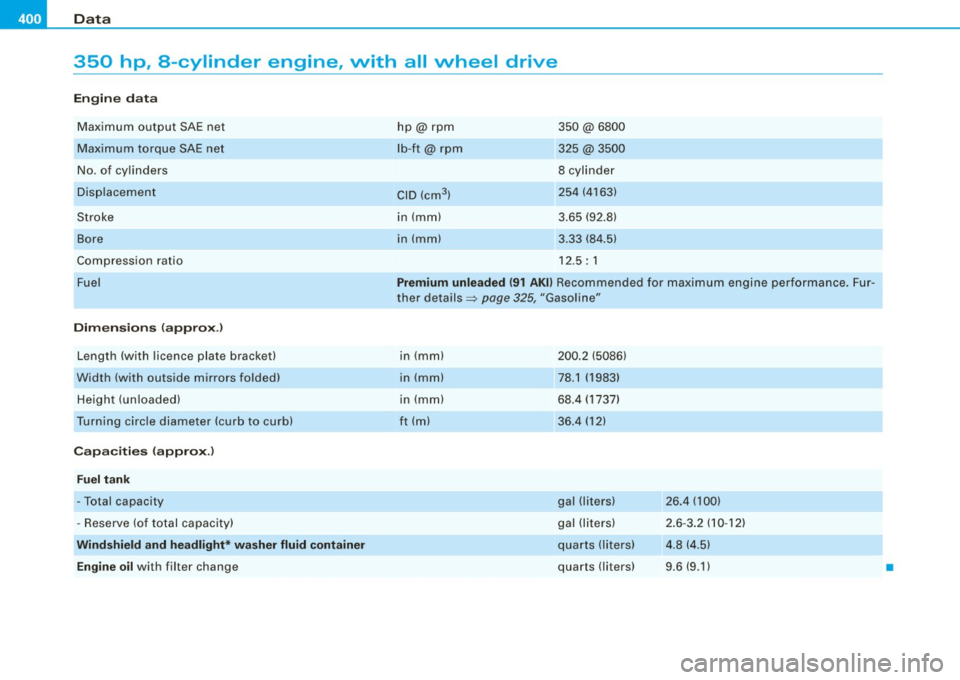
350 hp, 8-cylinder engine, with all wheel drive
Engine data
Maximum output SAE net
Maximum torque SAE net
No . of cy linders
Disp lacement
Stroke
Bore
Compression ratio
Fuel
Dimensions {approx .)
Length (with licence plate bracket)
Width (with outside mirrors folded)
He igh t (un loa ded)
Turning circle diameter (curb to curb)
C apa cities {approx .)
Fuel tank
-Total capacity
- Reserve (of total capacity)
Wind shi eld and headlight* wa sher fluid cont ain er
Engine oil
with filter change hp@ rpm
lb
-ft@ rpm
CID (cm
3 )
in (mm)
in (mm)
350@ 6800
325@3500
8 cylinder
254(4163)
3.65 (92 .8)
3.33 (84.5) 12.5: 1
Pr emium unleaded (91 AKI)
Recommended for maximum engine per formance. Fur
ther details~
page 325, "Gasoline"
in (mm)
in (mm)
in (mm)
ft (ml
200.2 (5086)
78.1 (1983)
68 .4 ( 1737)
36.4 (12)
gal Oitersl
gal (lite rs)
quarts (liters)
quarts Oitersl 26.4 (100)
2.6-3.2 (10 -12)
4.8 (4.5)
9.6(9. 1)
•