cooling AUDI Q7 2009 Owner´s Manual
[x] Cancel search | Manufacturer: AUDI, Model Year: 2009, Model line: Q7, Model: AUDI Q7 2009Pages: 426, PDF Size: 97.13 MB
Page 133 of 426

Warm and cold -
-------------------'
- To adjust the direction o f the airflow from the o utlet,
move the tab in the cen ter of the o utlet in the desired
direction . The direction of the air delivered from the
vents can be adjusted hor izontally and vertically .
The air outlets are actuated either automatically or manually
depending on the operating mode selected . Heated or unheated
fresh air, or cooled air flows from the vents .
The air outlets to heat the rear footwell are located under the front seats.
[ i ) Tip s
If the climate control system is operating in cooling mode, air flows
primarily from the outlets in the center console and in the door
pillars . To achieve adequate cooling, you should never close the
out lets completely .•
Using climate control economically
Using the climate controls prudently can help save fuel.
When you use the a ir conditioner, engine power is reduced
and fuel consumption increases. To save fuel, you should
use the air conditioner only when necessary . A lso please
note the follow ing po ints:
- If you want to save fuel, activate ECON.
- If yo u are g oing to dr ive wit h the w indows or Panorami c
sliding sunroof* open, use ECON .
- If the ve hicle is e xtremely ho t due to the heat of t he s un,
br iefly open doors and windows .
Contro ls and eq uip
ment
ffi For the sake of th e environm ent
By reducing the amount of fue l you use, you also reduce the amount
of pollutants emitted into the air. •
Rear Air Conditioning
Applies to vehicles: w ith four- zone aut oma tic com fort air co ndit ionin g
Rear air conditioning -controls
This overview is to assist you in familiarizing yourself with
the rear air conditioning controls.
Fi g. 14 0 Rear air
c ond ition in g co ntro ls
The left disp lay indicates the temperature selected for the rear left
passenger, the right display indicates the temperature se lected for
the rear right passenger. If the sett ings for seat heating*, air distri
bution or the air conditioning fan are changed, the relevant indi
cator will appear briefly on the MMI Display.
Each function is turned on or off by briefly p ressing the corre
sponding button. T he indicator light in the button illuminates when
t he function is active. .,
Vehicle care I I Technical data
Page 134 of 426
![AUDI Q7 2009 Owner´s Manual -W
arm and cold --------------------
Butt on(s ) Function Pa g e
Turning rear air condition -
ION /OFF] ing on and off => page 132
[AUTO] => page 132
Control knob G) Temperature selec](/img/6/40274/w960_40274-133.png "AUDI Q7 2009 Owner´s Manual -W
arm and cold --------------------
Butt on(s ) Function Pa g e
Turning rear air condition -
ION /OFF] ing on and off => page 132
[AUTO] => page 132
Control knob G) Temperature selec")
-W
arm and cold --------------------
Butt on(s ) Function Pa g e
Turning rear air condition -
ION /OFF] ing on and off => page 132
[AUTO] => page 132
Control knob G) Temperature select ion => page 133
Q) Seat heating* => page 136or
=> page 137
00 Air distribution => page 133
00 Blower => page 133
S yn chr oniz ing rear a ir conditi oning : By pressing and holding the
control knob on the rear left side, the t emperature setting of the rear
left side can be switched to the rear right side and vice versa. The new t emp eratur e is shown in th e disp lay .•
Ap plies to vehicles: with four-zone automatic comfort air condition in g
Turning rear air conditioning on and off
[ON /OFF ]
Turning on r ear air conditioning
- Press [ ON/OFF] briefly, or
- Press [AUTO ].
Turning off re ar air conditioning
-Press t he I ON /OFF ] button for at least 2 seconds to switc h
the rear air conditi oning of f.
OFF appears in the display.
Turning th e cooling syst em on /off
- Turn ing the cool ing sys tem on/off is done when the air
condit ioning is on. -
Press the
(ON /OFF] b utton jus t briefly.
The air conditioner turns bac k on if you press one of the control
buttons o r th e con tro l knob.
[ i ] T ip s
If the e le ctron ic ch ild safety syst em is on , th e re ar air conditioning
control element will not operate. In this case, dashes"---" wi ll
appear in the air conditioning control element display .•
App lies to veh ic les: with four-zone automatic comfo rt a ir condition in g
Automatic mode in rear [AUTO )
The automatic mode is the standard setting for all
seasons .
Turning on AUTO
-Select temperature between 60 °F (+ 16 °C) and 84 °F
(+28 °C) .
Press [AUTO] ~ page 131.
Automatic opera tion ensures cons tant temperatures in the interior
and dehumidifies the air inside the vehicle. Air temperature, vo lume
and distribution are contro lled automatically to reach or maintain
the desired in terior temperature as quickly as possible . Fluctuat ions
in exterior temperature and the effects of temperature from the
position of the sun are compensated for automatically.
This operating mode works only in the adjustable tempera ture
range, from 60 °F ( + 16 °C) to 84 °F ( +28 °C) . If a temperatu re below
60 °F
(+ 1 6 °C) is selected, LO appears in the disp lay. At temperatures
above 84 °F ( +28 °Cl,
HI is displayed. At both ext reme settings,
climate control runs continuously at maximum cooling or heating
power . There is no temperature regu lation. •
Page 308 of 426
llffl!I Trailer towing
------=---------------------------------
& W ARN ING (continued )
• The Gros s Vehicle Weight Rating for your Audi 07 vehicle ,
found on the safety compliance l abel on the driver's side B -pillar ,
must never be ex ceeded under any cir cumstances . E xceeding the
Gross Vehi cle Weight Rating of your vehicle is likely to damage
your vehicle , and such damage w ill not be covered by your Limited
New Vehicle Warranty. Exceeding the Gro ss Vehicle Weight Rating
will also change the performan ce and handling characteristics of
your vehicle , which could cause a crash resulting in serious injury
or death .
• The Gros s Vehicle Weight Rating for your Audi 0 7 would be
e xc eeded if your veh icle is simultaneously equipped with
Panoramic sliding sunroof ; third -row seating ; trailer towing equip
ment (factory or dealer -installed) , and running boards (dealer
installedl. UNDER NO CIRCUMSTANCES MAY ALL SUCH ITEMS BE
INSTALLED ON THE SAME VEHICLE .
a
Operating instructions
---------~--~-------
MAX 6.9"
MAX 175mm
Trailer towing weights
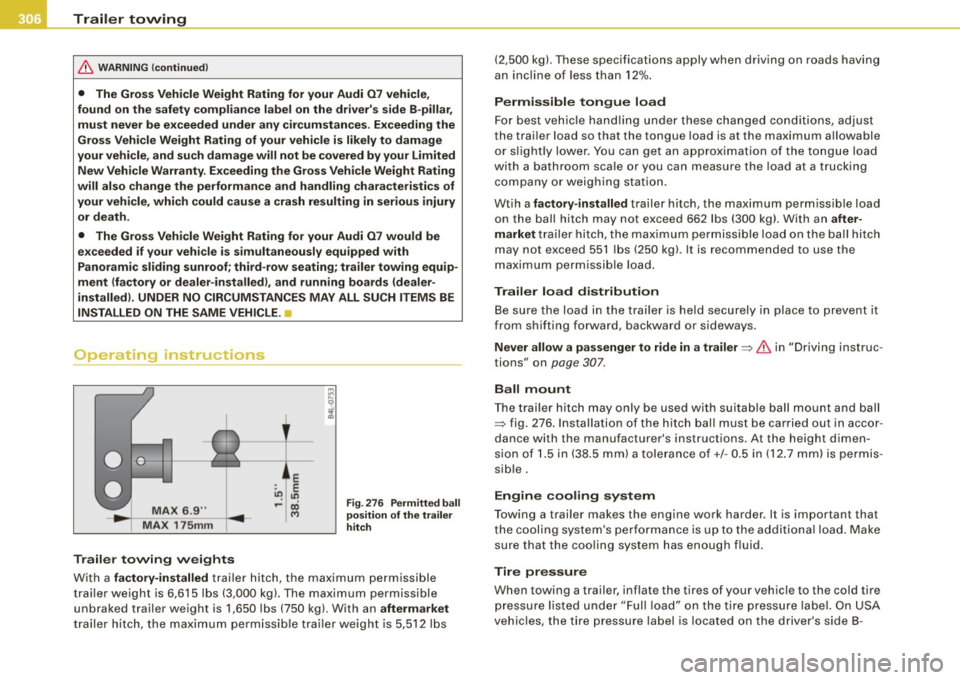
Fi g. 2 76 P erm itted ball
po sition of the trailer
hitch
With a factory-installed trai ler hitch, the maximum permissible
trai ler weight is 6,615 lbs (3,000 kg). The maximum permissible
unbraked trailer weight is 1,650 lbs (750 kgl. With an
aftermarket
tr ailer h itch , the maxi mum pe rm iss ib le tra iler weigh t is 5,51 2 lb s (2,500
kg). These specifications apply when driv ing on roads having
an in cli ne of less t han 12% .
Permissible tongue load
Fo r best v ehicle ha ndling under th es e changed con ditio ns, a dju st
the trai ler load so that the tongue load is at the maximum allowable
or s lightly lower. Y ou ca n ge t an ap proxi mati on of the tong ue load
with a bathroom sca le or you can measure the load at a trucking
company or weig hing s tati on.
Wtih a
factory -installed trailer hi tch, the max imum perm issib le load
on the ball hitch may not exceed 66 2 lbs (300 kg) . With an
after
market
t ra iler hitc h, the max imum pe rmi ssible loa d on the ball h itch
may not exceed 55 1 lbs (250 kg). It is recommended to use the
m aximum p ermi ssi ble l oad.
Trailer load distribution B e sure the load in the trai ler is he ld securel y in place to prevent it
from shifting forward, backward or sideways.
Never allow a passenger to ride in a trailer=> & in "D riving ins truc
tions" on page 307.
Ball mount
T he trai ler hitch may only be used with suitab le ball mount and ball
=> fig. 276 . In sta llati on of t he hitch ball must be ca rr ie d o ut i n a ccor
dance with the manufacturer's instructions. At the height dimen
s io n of 1 .5 in (38 .5 mm) a tole ran ce o f+/- 0 .5 in (12 .7 mm) is pe rmis
sib le.
Engine cooling system
T owing a trai ler makes the engine work harder. It is important that
th e c ooli ng system 's per forman ce is u p to the a ddi tiona l loa d. Ma ke
sure that the coo ling s ystem has enough f luid.
Tire pressure
When towing a trailer, inflate the tires of your vehic le to the cold tire
p re ssure l is ted unde r "Full load" on th e tire press ure l abe l. On USA
vehic les, the tire pressure label is located on the driver's side 8 -
Page 339 of 426
___________________________________________ C_ h_e _c_ k_ i_n _g _ a_n _d_ f_il _li _n _g __ lll
•
T he engine oil must be changed according to the intervals specified
in your Warranty
& Maintenance book le t. This is very important
because the lubricating properties of oi l diminish gradually during
normal vehicle use .
Under some circumstances the engine oil should be changed more
frequently. Change oil more often if you drive most ly short
distances, opera te the vehic le in dusty areas or under predomi
nant ly stop-and-go traffic conditions, or have your vehicle where
t emperatures remain below free zing for extended periods.
Detergent additives in the oil wil l make fresh oi l look dark after the
engine has been running for a sh ort time . This is normal and is not
a reason to chan ge the oi l more often than recommended.
Because of the problem of proper disposal, along with the specia l
t ools and necessary expertise requ ired, we strongly recommend
that you have your oi l changed by an authorized
Audi de aler or a
qualified se rvice statio n.
If you choo se to change your oil yourself , please note the following
important information:
& WARNING
To reduce the risk of per sonal injury if you mu st ch ange the engine
o il in you r veh icle your self :
• Wear eye protection.
• To reduce the ri sk of burns from hot engine oil , let the eng ine
c ool down to the touch.
• Wh en remo ving the oil dra in plug with your fingers , stay a s far
aw ay as po ssible. Alway s keep your forearm parallel to the ground
to help prevent hot oil from ru nning do wn your arm .
• Drain t he o il into a container designed for thi s purpo se , one
large enough to hold at lea st the total amount of oil in your eng ine.
• Engine oil i s poi sonous . K eep it well out of the rea ch of children .
& WAR N IN G ( continued )
• Continuous contact with used engine oil i s harmful to your
sk in. Al way s prote ct your skin b y was hing oil off thorough ly w ith
soap and water .
0 Note
Never mix oil additives with your engine oil. These additives can
damage your engine and adversely affect your Aud i Limited New
Vehicle Warranty.
can properly dispose of the used oil.
• Always dispose of used engine oil properly. Do not dump it on
garden soil, wooded areas, into ope n strea ms or down sewage
drains .
• Recycle used engine oil by taking it to a used engine oil collec
tion facility in your area, or contact a service station. •
Engine cooling system
Coolant
The engine coolan t per for ms two functions: i t kee ps the
engine from ove rhe ating and it prot ects the e ngine from
freezing in the winter.
The cooling system is sea led and general ly requires litt le attention.
The coo ling system has been fi lled at the fac tory with a per manent
coolant which does not need to be changed. The coo lant consists of
a m ixture of water and the manufacturer's glycol -b asedco olant
additive G 12++ antifreeze with anti corrosion additives (50% for USA .-,
Vehicle care I t •
Page 340 of 426
___ C_h_ e_ c_k _in --== g'-- a_n _d_ f_il _li _n ..:::g:::..- ___________________________________________ _
models; 60% for Canadian models). This mixture both assures the
necessary frost protection and protects metal components in the
engine's cooling system from corrosion and scaling. It also raises
the boiling point of the coolant.
Do not reduce the concentration of the coolant in the summer by
adding plain water.
Th e pro port io n of coo la nt additi ve mu st be at
lea st 50 % but n ot mor e th an 60 %
to maintai n ant ifreeze protection
and cooling efficiency. If the coolant frost protection is too low , the
coolant could free ze and damage the veh icle heating and engine
cooling system .
For year-round driving , antifreeze is added at the factory for temper
atures down to:
• -31 °F ( -35 °c1 usA
• - 40 °F ( - 40 °C) Canada.
You can mix the
Gl 2+ + coolant additive with other additives (G12+
or G12). Always check w ith your authorized Audi dealer.
& WARNING
B efo re you che ck anyt hing in th e eng ine compartmen t, alway s
re ad a nd he ed all WARN ING S~
& in " Working in the engine
c ompar tm ent " on
page 33 1.
0 Not e
• Before winter sets in, have the coolant checked to see if the
coo lant additive in your vehicle is sufficient to meet the climate
conditions. This is especia lly important if you live in a region where
the winter is extremely cold . If necessary, increase the proportion of
coolant additive to 60%.
• When adding coolan t additive to your coo ling system,
remember:
-We recommend using only coolant additive
G12+ + (check the
label) for your vehicle. This coolant additive is avai lable at autho
riz ed Audi dealers. Other types of antifreeze can significantly reduce corrosion protection. The resulting corrosion can cause a
loss of coolant and serious engine damage.
• Do not add any type of radiator leak sealant to your vehicle's
engine coolan t. Adding radiator repair fluid may adversely affect the
function and performance of your cooling system and could result
in damage not covered by your New Vehicle Limited Warranty. •
Checking the engine coolant level
The engine coolant level can be checked with a quick
glance.
F ig . 287 E ngine
com partm ent : Cool ant
ex pans io n tank
Before you check anything in the engine compartment,
alw ays read and h eed all WARNINGS ~
& in "Working in
the eng ine compartment" on page 331.
- Turn off the ignition.
- Let the engine coo l dow n.
Place a thick rag over the coola nt expansio n tank
~ fig . 287 and carefully twist the cap counter-c lockwise
~ & - .,
Page 341 of 426
___________________________________________ C_ h_e _c_ k_ i_n _g _ a_n _d_ f_il _li _n _g __ lR
•
- Read the engine coolant level in the open coolant expan
sion tank :::::>
page 338, fig. 287. With a cold engine, the
coolant level should be between the "min" and "max"
markings. When the engine is warm, the level may be
slightly above the "max" marking.
The location of the coolant expansion tank can be seen in the
engine compartment illustration~
page 332.
To obtain an accurate reading, the engine must be switched off.
The expansion tank in your vehicle is equipped with an electric
coolant level sensor.
When the coolant level is too low, the warning light in the Auto
Check System~
page 33will blink until you add coolant and the
level has been restored to normal. Even though there is an electric
coolant level sensor, we still recommend you check the coolant level
from time to time .
Coolant loss
Coolant loss may indicate a leak in the cooling system . In the event
of coolant loss, the cooling system should be inspected immedi
ately by your authorized Audi dealer . It is not enough merely to add
coolant.
In a
sealed system, losses can occur only if the boiling point of the
coolant is exceeded as a result of overheating.
& WARNING
The cooling system is under pressure and can get very hot. Reduce
the risk of scalding from hot coolant by following these steps.
• Turn off the engine and allow it to cool down.
• Protect your face, hands and arms from escaping fluid and
steam by covering the cap with a large, thick rag.
& WARNING (continued)
• Turn the cap slowly and very carefully in a counter-clockwise
direction while applying light, downward pressure on the top of
the cap .
• To avoid being burned, do not spill antifreeze or coolant on the
exhaust system or hot engine parts. Under certain conditions, the
ethylene glycol in engine coolant can catch fire.
0 Note
Do not add any type of radiator leak sealant to your vehicle's engine
coolant. Adding radiator repair fluid may adversely affect the func
tion and performance of your cooling system and could result in
damage not covered by your New Vehicle Limited Warranty. •
Adding coolant
Be very careful when adding engine coolant.
Before you check anything in the engine compartment,
always read and heed all WARNINGS:::::> & in "Working in
the engine compartment" on
page 331.
- Turn off the engine.
Let the engine cool down.
Place a thick rag over the coolant expansion tank
=:> page 338, fig. 287 and carefully twist the cap counter
clockwise :::::>& .
Add coolant.
- Twist the cap on again
tightly.
Replacement engine coolant must conform to exact specifications
~ page 337, "Coolant". Even in an emergency, if coolant additive .,,
Vehicle care I t •
Page 342 of 426
-~_C_ h_e _c _ k_ i_n ...:::g::;...._ a_n_ d_ f_ i_ll _in -'g:::;.._ ___________________________________________ _
G12+ +, G12 + or G12 is not available, do not use a different addit ive .
Use p lain water ins tead until you ca n get the c orrec t additive and
can restore the correct ratio . This should be done as soon as
poss ible.
If you have los t a considerable amount o f coo lant, then you s hould
add co ld antifreeze and cold water only when the engine is cold .
A lways us e
new en gi ne c oolant when refi llin g .
Do not fi ll coo lant above the "MAX" mark. Excess coolant wil l be
forced out through the pressure relief valve in the cap when the
engine beco mes hot.
& WARNING
• The cooling sy stem is under pressure and can get very hot .
Reduce the risk of s calding from hot coolant by following these
steps .
- Turn off the engine and allow it to cool down.
- Protect your face, hands and arms from escaping fluid and
steam by covering the cap with a large, thick rag .
- Turn the cap slowly and very carefully in a counter -clockwise
dire ction while applying light , downward pressure on the top
of the cap .
- To avoid being burned , do not spill antifreeze or coolant on
the exhaust system or hot engine parts . Under certain condi
tions , the ethylene glycol in engine coolant can catch fire.
• Antifreeze is po isonous . Always store antifreeze in its original
container and well out of the reach of children.
• If you drain the coolant , it must be caught and safely stored in
a proper container clearly marked "poison ".
0 Note
• Coo lant po llutes t he e nviro nment and cou ld cause a n en gin e
fire. Excess coolant wi ll be forced out through the pressure re lief
va lve in the cap when the eng ine becomes hot.
• I f, in an emergency, on ly wate r can be added, the correct ratio
between wate r and ant ifree ze::::>
page 337 must be restored as soon
as possib le .
W For the sake of the environment
Drained coolant should not be reused. Always dispose of used
coo la nt whi le observ ing all env iro nmen tal reg ulat io n s. •
Radiator fan
The radiato r fan switches on au toma tic ally by i tself.
The radiator fa n is dr iven by the eng ine via th e V -belt. The visco us
clutch regulates the speed of the fan according to the temperature
o f t he coo la nt.
An auxiliary electric radiator fan * sw itches on and off depending on
coo la nt t empe rat ure a nd othe r vehic le operating c ondi tio ns.
A ft er you sw itch the e ngine o ff, the au xiliary fa n ca n conti nue
running for up to 10 m inutes- even with the ignition off. It can even
switch o n again lat er by itsel f::::> & , if
• the temperature of the eng ine coo lant rises due to the heat
bu ild -up from the eng ine in the eng ine compartment, or
• the engine compartment heats up because the vehic le is parked
in i ntense sun ligh t.
& WARNING
• To reduce the ri sk of personal injury never touch the radiator
fan .
~
Page 413 of 426

______________________________________________ A_ l_,_ p _h_ a_ b_e _t_ic _ a _ l _in _ d_e _ x __ _
Child safety lock
rear doors (powe r) .. ... .. ... ... .... 61
Child safety seats . ................. . 268
Convertible locking retractor .... ... 273
Danger of using child restraints in the front seat ...... .... .... ...... .. 243
How do I properly install a child safety
s e at in my vehicle? .. .... ... .... . 266
Installing .. .. .... ... ..... ...... .. 273
LATCH system ...... .. ... .. .. ... . 281
Safety instructions .. ... ....... ... 266
Cigar ette light er ... ... ... .. ... .... .. 117
Cleaning Alcantara (synthetic suede) ... .. ... 323
Engine compartment .. ...... .... . 324
Fabrics and fabric coverings ....... 319
Ins trument pane l ...... ........... 320
Int erior ... ....... .... .... ... .... 319
L eather .... .... ......... ........ 322
MMI display ..... .. ... ... .... .... 319
MMI terminal ...... ....... .... ... 319
Plastic and vinyl ......... .... ..... 316
Plas tic parts .. .. .... .... ... .. ... . 320
Safety belts .. .... ....... .... .... 323
Trim strips ... .... .... ... .... .... 315
trim strips .. ...... .... ..... ...... 316
Cleaning and pro tection .. .... ... ... .. 312
Climate control ..... .... .... ....... . 123
Synchronizing .. ...... ...... ..... 125
Warm and cold .. .... .... .... .... . 123
Climate controls Air distribution ... .... .... .... .... 127
Air outlets .... ... .... .... .... .... 130
Air outlets (rear) .... ........... ... 130
Controls and equip
ment Safety first
Air recirculation
...... .... .... .... 128 Starting engine ....... .. .. ... .... 144
AUTO (standard set ting) .. .... ..... 126 STOP button .. .. ... ... .... ..... .. 145
Basic settings .... .... ... .... ..... 134 Switching engine off ... ... ... ... .. 145
Blower ...... ... .... .... .... ..... 128 Switching on ignition ... .. .... .... 144
Controls . .... .... .... .... ... .... 125 Unlocking vehicle ...... ... .... .... . 62
Defrosting/defogging ...... ....... 127
Convertible child seats
Description .. ...... ... .... .... ... 123
How do I properly install a convertib le
ECON mode .... . .. .. ..... ... .... 126 child seat in my vehic le? ...... ... 269
ECON operation ........... ....... 134 Safety instructions ........ ........ 269
Energy manageme int .. .... .... .... 123
Convertible locking retractor
Heated seats, fron t .... ... ..... ... 136
Activating ........ .... ... .... .... 275
Key coded setting ........ ........ 123
Deactivating ... ... .... .... .... ... 276
Recirculation mode (automatic) ... .. 134
Using to secure a chi ld safety seat . 273,
Recommended settings .. ... .... .. 123 275
Residual heat ................... . 126
Coolant system ....... ... ........... 337
Setting the temper .ature .. ... ... .. . 127
Cooling box in glove compartment .... . 120
SETUP ...... ... .. .... .... .... ... 134
Synchronization ... .... .... .... ... 135 Cooling System
Expansion tank ... ..... .. .... .... . 338
Turning on and off ......... ... .... 126
Using climate control economically . 131 Cornering
light ....................... 76
Cruise control
Clock ......... .... . ...... ........ ... 14
Changing speed ............ .. .... 150
Closing Presetting your speed ........ ..... 150
Panoramic sliding sunroof .......... 68
Switching off ..... ... .... .... .... 150
Coat hooks ... .. .... .... ........ .... 121
Switching on ... .... ... ..... ... ... 149
Cold tire inflation pressur e ..... ... ... 351
Warning/indicator lights ........ .... 22
Compass mirror ........... ......... .. 89
See also Adaptive Cruise Control . ... 152
Compliance ......... ...... ... .. .... 404 Cruising range ......... ....... .. ..... 40
Consumer Information ........... 229, 401 Cupholder ........... ....... 103,114,115
Contacting NHTSA ... .... ... .... .... 229
Convenience key ..... ...... .... ... ... 61
D
Driver messages ... ... .... .. .. ... 146
Locking vehicle ... .... .... .... ..... 63
START button .................... 144 Damping
See Adaptive Air
Suspension .... ... 206
Vehicle operation Vehicle care Do-it-yourself service Technical data
Page 416 of 426

-Alphabetical index
-----=-------------------------------------
Synchronization . ...... ... .. .. ... 135
Turning on/off .... .... ....... .... 132
Front airbags Description . ...... .... .......... 245
How they work . . . . . . . . . . . . . . . . . . . 250
Front arm rest Cup holder .. ...... .... ..... .. ... 103
Storage compar tmen t .... .... ... . 103
Front ashtray . . . . . . . . . . . . . . . . . . . . . . . 116
Front fog lights . . . . . . . . . . . . . . . . . . . . . . 75
Front seats . . . . . . . . . . . . . . . . . . . . . . . . . 92
Adjusting ....................... 223
Child restraints in the front seat .... 243
Frontal collisions and the laws of physics ...
232
Fuel Additives . . . . . . . . . . . . . . . . . . . . . . . 325
Blended gasoline ... .. .... ...... . 325
Consumption . . . . . . . . . . . . . . . . . . . . . 40
Fi ller neck ... .. .... .... .... .... .. 326
Fuel gauge . . . . . . . . . . . . . . . . . . . . . . . 15
Gasoline .. .... .... ....... .... ... 325
Gasoline additives .. ....... .... ... 326
Low fuel level . . . . . . . . . . . . . . . . . . 15, 36
Octane rating . ...... ......... .... 325
Recommendation . . . . . . . . . . . . . . . . 325
Refuel ling . .... .... .... ... .... ... 327
Reserve ... ....... .... .... .... .... 15
Tank capacity . . . . . . . . . . . . . . . . . . . . 399
Un locking the fue l filler flap by hand 329
Fuse arrangement . . . . . . . . . . . . . . . . . . 38 1 G
Garage door opener (HomeLink®l . .... 214
Gas discharge lamps ................ 385
Gauges Engine coolant temperature . ...... . 13
Fuel gauge . . . . . . . . . . . . . . . . . . . . . . . 15
Speedometer . . . . . . . . . . . . . . . . . . . . . 15
Tachometer ...................... 14
Trip odometer ....... ...... ..... .. 15
General illustration Instruments and controls . . . . . . . . . . . 11
General rules and driving tips ... ... ... 302
Before driving offro.ad . ...... .... . 302
Driving offroad .... .... .... .... .. 302
G lossary of tire and loading terminology .. .
348
Glove compartment .. .... .... .... ... 119
Cooling box . . . . . . . . . . . . . . . . . . . . . 120
Valet key function ... .. ...... .... .. 51
G love compartment -emergency unlocking .
120
Gradient angle ... ... .... .... .... ... 302
Gross Vehic le Weight Rating (GVWR) . .. 397
Ground clearance .... ... ... .. .... ... 302
H
Head restraints ..... .. .... .... .... .. 225
Adjusting ..... .. . ... ... ... .. . ... 225
Front seats . . . . . . . . . . . . . . . . . . . . . . 101
Rear seats .... ..... .. ..... .. 101, 102
Headlight washer reservoir . .... .... .. 346 Headlights
... ..... .. .... ........ .. . . 73
Adaptive Light ..... ... .... .... ... . 76
Defective . . . . . . . . . . . . . . . . . . . . . . . . . 27
Front fog lights .... ... .... .... .... 75
Headlight range control defective .... 37
Switching off ... .. .... .... .... .... 73
Switching on ...... .... ........... 73
Washer system . . . . . . . . . . . . . . . . . . . 83
Xenon headlights ..... .... .... .... 73
Heated outside mirrors ... .... .... .... 88
Heated seats Front ......... .... .... ... .... ... 136
Rear .. ..... ... .... .... ... .... ... 137
Rear seats (four -zone automatic comfort
air conditioning) ....... .. .... ... 137
Heated steering wheel . .... ... .... ... 138
Heated washer jets
Wiper and washer system .. .... .... 8 1
Heating Climate controls ...... .... .... ... 123
Heavy clothing and safety belts ....... 234
High beam ... .... .... .... ... .... . 73, 77
Warning/indicator lights .... ... .... . 22
High voltage warning label .. ...... ... 396
Hi ll descent control .... ... ...... .... 288
Hill hold assist
Starting on hills ... .... .... .... ... 148
HomeLink® universal remote control 214
Hood Opening ... .... .... ... .... .... .. 330
Release lever ..... ....... .. ...... 330
Horn ............................... 11