engine oil AUDI Q7 2009 Owner´s Manual
[x] Cancel search | Manufacturer: AUDI, Model Year: 2009, Model line: Q7, Model: AUDI Q7 2009Pages: 426, PDF Size: 97.13 MB
Page 294 of 426
___ ln_ t _e_ ll-'"ig ...,_ e_ n_t _t_ e_ c_ h _ n_o _ l_o _,.g= y,_ __________________________________________ _
& WARNING
• You should perform braking maneu vers for the purpose of
cleaning the brake system only if road conditions permit . Other
road u sers mu st not be put at r isk -you may cause an a ccident!
• Before des cending a steep grade, reduce speed and shift trans
mission into a lower gear or lower dr iving range . Do not ride the
brakes or hold the pedal down too long or too often. This could
cause the brake s to get hot and diminish braking effi ciency .
• Do not "ride the brakes " by resting your foot on the pedal when
you do not intend to b rake. This may cause the br ake s to ove rheat ,
premature wear and increased stopping distance.
• Under ce rtain climat ic and operating condit ions such as
passing through water , driving in heavy rain or after washing the
vehi cle , the effectiveness of the brakes can be reduced . In winter ,
ice can a ccumulate on the brake pads , linings , discs and drums .
Carefully apply bra kes fo r a test . Brakes will dry and ice coatings
will be cleaned off after a few careful brake appli cations .
• Driving for an extended period of time on salt -co vered roads
without using your brakes can also affect braking effic iency. Clean
off accumulated salt coating from brake dis cs and pads with a few
c areful brake applications .
• If you damage the front spoile r, or if you install a different
spoiler, be sure the air flow to the front brakes is not ob structed.
Otherw ise the brake sy stem could overheat reducing the effective
ness of the entire brake system .
• Failure of one bra ke cir cuit will impair the braking capability
resulting in an increased stopping distance. Avoid driving the
vehicle and ha ve it towed to the nearest authorized Audi dealer or
qualified workshop . •
Brake booster
T he b rake boost er ad ds extra b ra kin g powe r.
The brake booster works with vacuum pressure which is created
o nly w he n t he e ngine is ru nnin g=> & .
& WARNING
• Never let the vehicle roll to a stop with the engine shut off.
• If the brake booster is not working, for example when towing
your vehicle, or because the brake boo ster has somehow been
damaged , the brake pedal must be pressed considerably harder to
make up for the lack of booster assistance . •
Functioning of A!"lt"-Lock Brake System (ABS)
ABS p revents the wheels from locking up unde r brakin g.
Th e ABS co ntribu tes effect ively to vehicle cont ro l since it preve nts
the whee ls from
locking when the brakes are app lied. This means
t h at the ve hicle rema ins steerable and is less l ikely to s kid.
With ABS you do not need to pump the brake . Just hold the brake
pedal down .
However, do not expec t the A BS to s hor ten bra king d istance u nder
all circumstances. When driving o n grave l or on newly fallen snow
o n t op o f icy sur faces, brak ing d istance may be ev en lon ger, the re
fore, under these c ircumstances, it is especially important that you
driv e slow ly an d with gre at ca re.
How the ABS system works
An a utomatic c heck is m ade w hen a speed of about 1 2 mph (2 0
km/h) is reached. When this happens, a pumping noise can be
h ea rd.
Page 300 of 426
___ D_ r_iv _ in_... g"'- a_ n_ d_ e_ n_ v_i_r _o _n_ m_ e_n_ t _______________________________________________ _
New brake pads
--
Remember that new brake pads do not have a full braking
effect during the first 250 miles (400 kilometers) after they
are installed .
New brake pads have to be "burnished in" before they have optimal
grab =>& .
During the break -in period, you should avoid putting severe loads
on the brakes . Severe loads include, for examp le, sudden hard
braking, in particular at very high speeds or, for example, on moun
tain passes.
& WARNING
New brake pads don't have the best stopping power and must be
"broken-in" during the initial 100 to 150 miles (150 to 200 kilome
ters) of normal city driving. You can compensate for this by
pressing the brake pedal more firmly . This also applies later when
new pads are installed.
:J
Catalytic converter
It is very important that your emission control system
(catalytic converter) is functioning properly to ensure that
your vehicle is running in an environmentally sound
manner.
- Always use lead-free gasoline:=> page 325, "Fuel supply".
- Never run the tank down all the way to empty.
- Never put too much motor oil in your engine ==>
page 336,
"Adding engine oil 't=:;r\11
•
Never try to push- or tow-start your vehicle.
The catalytic converter is an efficient "clean-up" device built into the
exhaust system of the vehicle. The catalytic converter burns many
of the po llutants in the exhaust gas before they are released into the
atmosphere.
The exclusive use of unleaded fuel is critically important for the life
of the catalytic converter and proper functioning of the engine.
& WARNING
• Do not park or operate the vehicle in areas where the hot
exhaust system may come in contact with dry grass, brush, fuel
spill or other material which can cause a fire .
• Do not apply additional undercoating or rustproofing on or
near the exhaust manifold, exhaust pipes, catalytic converter or
heat shields. During driving, the substance used for undercoating
could overheat and cause a fire .
0 Note
• Be aware that just one tank filling with leaded fuel will alr eady
seriously degrade the performance of the catalytic converter.
• Do not exceed the correct engine oil level=>
page 336.
• Do not drive until the fuel tank becomes completely empty. The
engine could misfire. Unburned fuel could also get into the exhaust
system and this could cause the catalytic converter to overheat.
• Do not turn off the ignition while the vehicle is moving.
• Do not continue to operate your vehicle under these conditions,
as otherwise fuel can reach the catalytic converter. This could result
in overheating of the converter, requiring its replacement .
• To assure efficient operation of the Emission Control System:
- Have your vehicle maintained properly and in accordance with
the service recommendations in your Warranty
& Maintenance
booklet. •
Page 302 of 426
___ D_ r_i v_ in_... g"'- a_ n_ d_ e_ n_ v_i_r _ o _n_ m __ e_n _ t _______________________________________________ _
one half. Never drive faster than the posted speed limit and weather
conditions permit. •
Reducing unnecessary =citing
Even when your car is just idling it burns up fuel.
- Shut the eng ine off when you are not driving the vehicle .
- Do not warm up the vehicle by letting the engine run at
idle.
It makes sense to shut off the engine in traffic jams, when waiting
for trains to pass at rai lroad crossings , or at traffic lights that have
long waits on red. Turning the engine off for just 30 -40 seconds
saves more fuel than is burned starting the engine again .
It takes a long time for the engine to warm up fu lly when it is
running at idle. However, wear and noxious emissions are especially
high when the engine is warming up. So you should drive away as
soon as you start the engine and avoid running at high rpms while
the engine is still warming up.
0 Note
Do not leave engine idling unattended after starting . If warning
lights should come on to indicate improper operation, they would
go unheeded. Extended idling also produces heat, which could result in overheating or other damage to the vehicle or other
property .•
Regu1ar ma1--.tenance
A badly tuned engine unnecessarily wastes a lot of fuel.
- Have your vehic le serviced at regular intervals . By having your vehicle regularly serviced by an authori
zed Audi
dea ler helps to ensure that it runs properly and economica lly. The
condition of your vehicle not only affects its safety and ability to
hold its value, it a lso affects
fu el con sumpti on.
C he ck your oil each time you fill your t ank .
The amount of oil used is related to engine load and speed.
It is norma l for the oil consumption of a new engine to reach its
lowest va lue after a certain mileage has been driven.
You must drive your vehicle about 3,000 miles (5,000 kilometers) before you can properly assess oil consumption .
T his also applies to fuel consumption and engine output .
0 Note
• Have your vehicle maintained properly and in accordance with
the service recommendations in your Warranty
& Maintenance
booklet. Lack of proper ma intenance as well as improper use of the
vehic le wi ll impair the function of the emission control system and
cou ld lead to damage.
• Do not alter or remove any component of the Emiss ion Control
System unless approved by the manufacturer.
• Do not alter or remove any device, such as heat shields,
switches, ignition wires, valves, which are designed to protect your
vehicle 's Em ission Control System and other important vehicle
components .•
Fewer short tr ips
Fuel consumption will always be relatively high on short
trips.
- Try to avoid driving short dista nces wi th a cold engine. _,
Page 304 of 426

llffl!I Driving off road __ _...,______;, _____________________________ _
Driving off road
Driving in difficult road conditions
and offroad
General information
The operat ion o f the Elect ronic Stab ilizat ion Prog ram ( ESP) is
e x panded for operation away from paved roads . In situations where
s lip o r a di fferential lockin g function is required, the ESP o ffroad
mode can be activated~
page 288. Hill descent contro l is also avai l
able in the ESP off road m ode, w hich a utomat ical ly bra kes t he
vehicle and thereby keeps speed constant when different whee l
speeds are de tected whe n descend ing a hill ~
page 289 . You r Audi
a lso has permanent all -wheel drive in add ition .
Howeve r, your Audi is not a pure offroad vehicle . It was n ot bu ilt fo r
dr ivin g und er ex tre me cond itions, e.g . for tr ips t hat ar e in t he n atu re
of an expedition.
Drive only on roads and offroad sections which match the design of
your vehicle and your abilitie s as a driver . Never take r isks!
Before driving offr oad
• Check the engine oil level, tire pressure, coolant level, and the
fl uid level in t he windshie ld wash er r eservo ir.
• Stow luggage items and other objects in the luggage compart
ment, and secure the m aga inst sl iding around .
After driving offroad • After trips offroad, remove any twigs and other forei gn ob jects
from the gri ll, the underbody and the whee ls. Pay special attention
t o foreig n objects (stones) which have become lodged in t he tire
tread.
• Clean the body and the vehicle underside, and inspect the
veh ic le for possible damage. •
Clean dirty windows, headlamp lenses, rea r lights, and license
plates.
• Perform a bra ke check (particularly af ter travel ling through
wa ter).
& WARNING
• Drive especially attentively and plan ahead in difficult road
c onditions and when offroad . Excessive speed or in correct maneu
vers can cause injuries and damage to the vehicle.
• Alway s adapt your speed and d riv ing style to road , offroad,
traffic, and weather conditions. Drive especially slowly offroad
when your v iew is restri cted .
• Please be aware that in ESP offroad mode , particularly on a
smooth and slippery road , the wheels may have an in creased
tendency to spin and the vehicle may break away -danger of skid
ding !
• Stability is limited in the ESP offroad mode.
[ i ] Tips
On ly dr ive where it is perm itted and s tay on marked roads a nd
paths.
Explanation of some technical terms
T he fol lowing data refer to idea l conditions. Depending on vehic le
lo ad and g round cond itions and the environ ment, t he num ber s may ...
Page 334 of 426
-Checking and filling PW---=---------------
& WARNING (continued )
-Always u se extreme caution to prevent cloth ing , jewelry, or
long hair from getting caught in the radiator fan , V-belt s or
other moving parts , or from contacting hot parts . Tie back hair
before starting , and do not wear clothing that will hang or
droop into the engine .
• Minimize exposure to emis sion and chemical hazards
::::> & .
& WARNING
California Proposition 65 W arn ing :
• Engine exhaust , some of its constituents , and certain vehicle
c omponents cont ain or emit chemicals known to the State of Cali
fornia to cause cancer and birth defects and reproductive harm. In addition , certain fluids contained in vehi cles and certa in products
of component wear contain or emit chemicals known to the State
of California to cause cancer and birth defect s or other reprodu c
tive harm.
• Battery posts , terminals and related ac cessories conta in lead
and lead compounds , chemicals known to the State of California
to cause cancer and reproductive harms. Wash hands after
handling.
0 Note
When adding f luids, always make sure that they are poured into the
proper container or filler ope ning, otherwise serious damage to
vehic le systems wi ll occur.
ci> For the sake of the environment
To detect leaks in time, inspect the vehicle floor pan from under
n eath regu larly. If you see spots fro m oil o r o th e r v eh icle flu ids, hav e
your vehicle inspected by an author ized Audi dea ler. •
Engine compartment
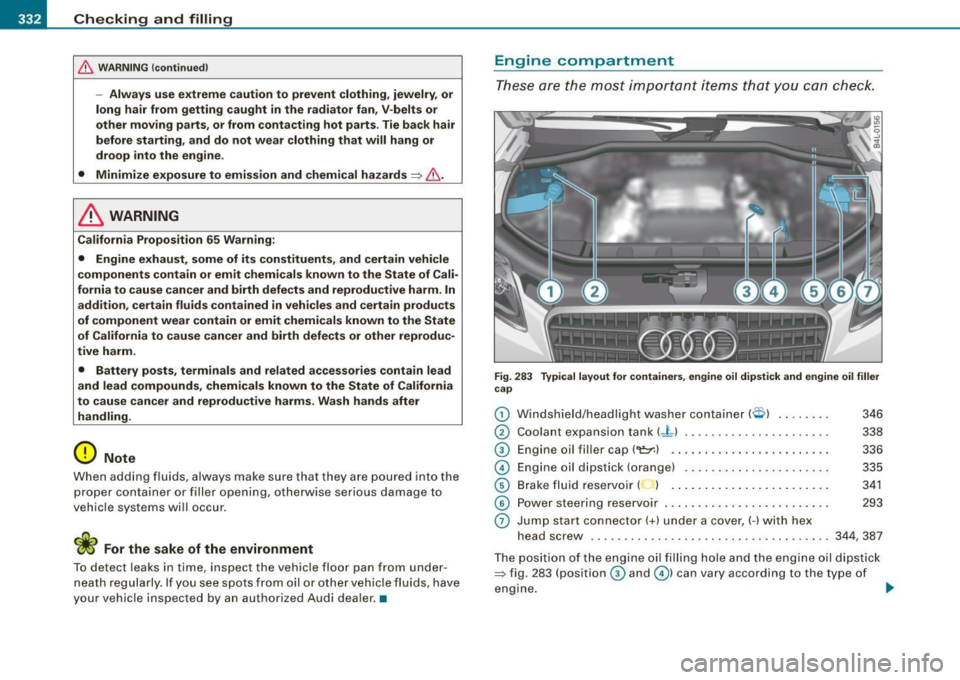
These are th e m ost im porta nt items th at you can ch ec k.
Fig. 283 Typical layout for containe rs, engine oi l d ipstick and engine oil filler
cap
0 W indsh ield/headligh t was her conta iner ( 9 ) . . . . . . . . 346
0 Coolant e xpansion tank (- L l . . . . . . . . . . . . . . . . . . . . . . 338
G) Engin e oil fi ller cap ("l::r.) . . . . • . . . . . . • • • • . . . • . . • . . 336
© Engine oil d ips tick (orange) . . . . . . . . . . . . . . . . . . . . . . 335
© Brake fluid reservo ir ( ) . . . . . . . . . . . . . . . . . . . . . . . . 341
© Pow er steer ing r eser voir . . . . . . . . . . . . . . . . . . . . . . . . . 2 93
0 Jump sta rt connector( +) u nder a cover,( -) w ith hex
head screw .... ... ..... .... ... .... ... ..... .... . 344 , 387
The positi on of t he e ngin e oil fi lling hole and t he engine oil dipstick
=> fig . 283 (position G) and ©l can vary according to the type of
eng ine. .,_
Page 335 of 426
Checkin g and fillin g -
-----------------=---------
•
& WARNING
Befo re you c heck anythin g in th e engine comp artme nt, a lways
r e ad and heed all WARNING S
~ & in "Workin g in the en gine
co mp art m ent " o n page 331 . •
Engine oil
Engine oil specifications
The engine oil used in your Audi needs the right kind of
oil.
The engine in your Audi is a sophisticated powerplant that was built
to exacting specifications. This engine needs the right kind of
engine oil that meets specifications regarding quality and viscosity
so that it can run smoothly and reliably . Choos ing the right oil and
changing oil within the time and mileage intervals printed in your
vehic le's Warranty
& Maintenance booklet matters a lot more today
than it did years ago. Audi has developed a special quality standard for engine oil that will help assure that your vehicle's engine will get
t he lubr ication it needs for proper operation .
Modern engine lubrication has taken a quantum leap in the last few
years . Many synthetic oi ls availab le today provide better engine
lubrication that can outlast traditional petroleum-based oils,
making them a smart choice for use throughout the life of your Audi.
Whether you use synthetic or petroleum -based engine oi l, the oi l
that you use must conform to Audi's oi l quality standard VW 502 00
t o help keep your vehic le's engine running smoo th ly and help
prevent the formation of harmful deposits, sometimes called
"s ludge," that over time can lead to expensive repairs.
At the time of printing, engine oi ls avai lable in the U.S. and Canada
that meet the exacting specifications of Audi oil standard VW 502 00
are synthetic engine oils . This does not mean, however, that every synthetic engine oil will meet Audi oil standard VW 502 00
. So
a lways be sure tha t you use an approved o il.
To help prevent the formation of harmful deposits use only oil with
the fo llowing specifications printed on the oil container:
Audi oil standard VW 50 2 00
Oil container labels may carry the specification singly or in combi
nation with other designa tions and oil quality standards .
Viscosity
Engine oils are graded according to their viscosity. The proper
viscosity grade oi l for your engine depends on c limactic or seasona l
conditions where you drive. You can use oil with a viscosity grade of
SAE 5W40 across all temperature ranges for normal driving condi
tions .
However, if engine oil viscosity grade SAE 5W40 is not available, you
can a lso use viscos ity grade SAE 5W-30 or SAE 0W -40 as long as it
meets Audi oil qua lity standard VW 502 00 specifications .
Because engine o il that meets the Audi o il standard may not be
avai lable everywhere when you need it, we strongly recommend
that you a lways carry with you an extra quart (l iter) of oil that
express ly conforms to the VW 502 00 specification, in case you have
to top off the oil while on the road .
Only if the level of the o il is at or be low the minimum mark on the
oi l dipstick - and no oil that expressly conforms to Audi oi l standard
VW 502 00 specifica tions is avai lable -may you top off wit h a high
quality engine oi l, preferably synthetic-based, that meets ACEA A3,
ACEA A5 or ACEA 85, AP I SL or ILSAC GF -3 spec ifications, but even
then, only in viscosity grades SAE 5W-40 , SAE 5W -30, or SAE 0W -40 .
However, during the enti re time between oi l cha nge interva ls, never
top off with more than a total of 0.5 qt/ liter engine oi l that does not
conform to Audi oil specification VW 502 00.
For more information about engine oi l that has bee n approved for
your vehicle, p lease contact either your authorized Audi dea ler or
Audi C ustomer Relations at 1 (800) 822 -2834 or visit our web site at
www.audiusa.com or www.audicanada.ca . Here you will a lso find a .._
Vehicle care I t •
Page 336 of 426
-~_C_ h_e _c _ k_ i_n ...:::g::;...._ a_n_ d_ f_ i_ll _in -'g:::;.._ ___________________________________________ _
current list of oils (manufacturers, brand names etc.) that conform
t o Audi oi l standard VW 502 00 .
Changin g the engine oil
The engine oil and oil filter must be changed according to the
mi leage (ki lometers) and time intervals specified in your vehicle's
Warranty
& Maintenance booklet. Do not exceed these interva ls -
harmful deposits from old engine oil can reduce engine perfor
mance and can lead to expensive engine repairs.
Changing the oi l at the recommended intervals is so very important
because the lubricating prope rties of oi l decrease gradual ly during
normal vehicle use . If you are not sure when you have your oil
changed, ask your author ized Audi Serv ice Advisor.
Under some circumstances the engine oil should even be changed
more frequently. Change oil more often if you dr ive mostly short
distances, operate the vehicle in dusty areas or mostly under stop
and -go t raffic conditions, or when you use your vehicle where
temperatures stay be low freezing point for long per iods.
Detergent additives in the oil will make fresh oil look dark after the
engine has been running for a short time . This is normal and is not
a reason to change the oil more often than recommended.
Damag e or malfunctions due to lack o f mainten anc e
It is essentia l that you change your oi l at the recommended interva ls
using on ly engine oil that complies with Audi oil standard
VW 502 00. Your Limited New Vehicle Warranty does not cover damage or ma lfunctions due to failure to follow recommended
main tenance and use requirements as set forth in the Aud i Owner's
Manual and Warranty
& Maintenance booklet. Your dealer wi ll have
t o deny warranty cove rage unless you present to the dealer p ro o f in
the form of Service or Repair Orders that all schedu led maintenance
was pe rformed in a timely manner. •
Engine oil consumption
The engine in your vehicle depends on an adeq uate
amount of oil t o lubric ate and c ool all of its m oving parts.
In order to provide effective lubrication and coo ling of interna l
engine components, al l interna l combustio n eng ines consume a
certain amount of oil. Oil consumption varies from engine to engine
and may change significant ly over the life of the engine . Typ ically,
engines with a specified break-in period (see=>
page 2971 consume
more oil du ring the break-in period than they consume after oil
consumption has stabi lized .
Unde r normal conditions, the rate of oil consumption depends on
the quality and v iscosity of the oil, the RPM (revolutions per minute)
at which the engine is operated, the ambient temperature and road
cond itions. Fur ther factors are the amount of oil di lu tion from wate r
condensation or fue l residue and the oxidation leve l of the oi l. As
any engine is subject to wear as mileage bu ilds up, t he oil consump
tion may increase over time until replacement of worn components
may become necessa ry .
With all these variables coming into play, no standard rate o f oi l
consumption can be established or specified . There is no alternative
t o regula r and frequent checking of the oil level, see
Note .
If the yel low engine oil level warning symbo l in the instrument
clus ter lights up, yo u should check the oil level as soon as
possible
with the oil dipstick=> page 335. Top off the oil at your
ea rliest convenience =>
page 336.
& WARNING
Before you check anything in the engine compartment , always
read and heed all WARNING S
=> & in "Working in the engine
compartment " on
page 331.
Page 337 of 426
![AUDI Q7 2009 Owner´s Manual Checking and filling -
---------------------=----"=---------
0 Note
Driving with an insufficient oil level is likely to cause severe damage
to the engine.
[ i] Tips
• The oil pre](/img/6/40274/w960_40274-336.png "AUDI Q7 2009 Owner´s Manual Checking and filling -
---------------------=----\"=---------
0 Note
Driving with an insufficient oil level is likely to cause severe damage
to the engine.
[ i] Tips
• The oil pre")
Checking and filling -
---------------------=----"=---------
0 Note
Driving with an insufficient oil level is likely to cause severe damage
to the engine.
[ i] Tips
• The oil pressure warning display~ is not an indicator of the oil
level. Do not rely on it. Instead, check the oil level in your engine at
regular intervals, preferably each time you refuel, and always before
going on a long trip.
• If you have the impression your engine consumes excessive
amounts of oil, we recommend that you consult your Audi dealer to
have the cause of your concern properly diagnosed. Keep in mind
that the accurate measurement of oil consumption requires great
care and may take some time . Your Audi dealer has instructions
about how to measure oil consumption accurately. •
Checking the engine oil level
Fig. 284 Illustration of
principle 1: Markers on
oil dipstick Fig
. 285 Illustration of
principle 2: Markers on
oil dipstick
Before you check anything in the engine compartment,
always read and heed all WARNINGS=> & in "Working in
the engine compartment" on
page 331.
Determining oil level
-Park your vehicle so that it is horizontally level.
- While at operating state temperature, briefly let the
engine run at idle and then shut it off.
- Wait approx. two minutes.
- Pull out the oil dipstick. Wipe off the oil dipstick with a
clean cloth, and slide it back in as far as it will go.
Pull it back out and read off the oil level=> fig. 284 or
=> fig. 285. Top off the engine oil, if applicable
=>
page 336.
Oil level within range @
- Do not add oil.
Oil level within range @
-You can add oil. Afterwards, the oil level should be within
range @. _,,,
Vehicle care I I irechnical data
Page 338 of 426
___ C_h_ e_ c_k _in --== g'-- a_n _d_ f_il _li _n ..:::g:::..- ___________________________________________ _
Oil l ev el within r ange
©
- You must add oil. Afterwards, the oil level should be
within range @.
The oil level needs to be checked at regular intervals. The best times
to do this are whenever you refuel and prior to long tr ips.
Depending on the way the vehicle is driven and the operating condi
tions, oil consumption can be up to 1 quart per 1.200 miles (1 liter
per 2.000 km). Consumption may be higher within the first
3.000 miles (5.000 km) .•
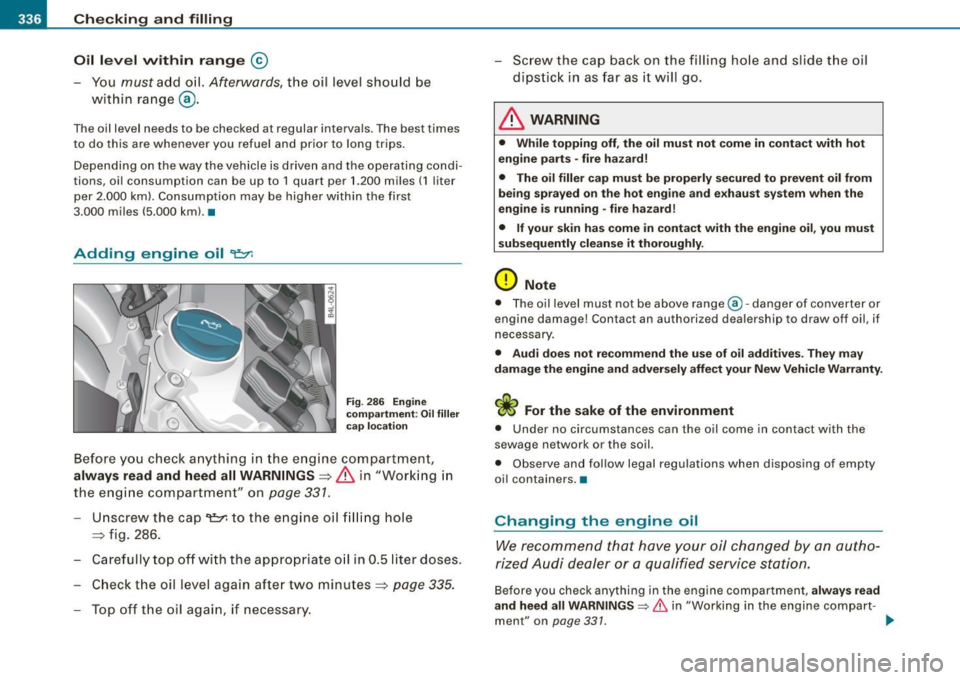
Adding engine oil "l=:7:
Fig . 28 6 Engine
co mp artm ent: Oil filler
ca p loc ation
Before you check anything in the engine compartment,
alw ay s read and h eed all WARNINGS ==> & in "Work ing in
the engi ne compartment" on
page 331.
- Unscrew the cap
Carefully top off with the approp riate o il in 0.5 liter doses .
- Check the oil level again after two minutes
==> page 335.
- Top off the oil again, if necessary . - Sc
rew the cap back on the filling hole and slide the oil
dipstick in as far as it will go .
& WARNING
• Whil e topping o ff, the oil mu st not come in cont act with h ot
eng ine p arts -fire haza rd!
• The oil filler cap mu st be properly se cured to pr eve nt oil from
b ei ng spr ayed on th e hot engi ne and e xhau st sy stem when the
engine i s running · fire ha zard !
• If you r skin has com e in contac t wit h th e eng ine oil, you mu st
s ub sequently clean se it thoroughly.
0 Not e
• The oil level must not be above range @- danger of converter or
engine damage! Contact an authori zed dealership to draw off oi l, if
necessary.
• Audi do es not re comm end the use of oil add it ives. They may
d a mage the engi ne and advers ely affe ct y ou r Ne w V ehicle W arra nty.
cj? For the sake of the environment
• Under no circumstances can the oil come in co ntact with the
sewage network or the soil.
• Observe and follow legal regulations when disposing of empty
oi l containers. •
Changing th e engin e oil
We recommend that have your oil changed by an autho
rized Audi dealer or a qualified service station.
Before you check anything in the engine compartment, a lways r ead
a nd h eed all W ARNIN GS=:>
& in "Working in the engine compart-
ment" on
page 331 . .,_
Page 339 of 426
___________________________________________ C_ h_e _c_ k_ i_n _g _ a_n _d_ f_il _li _n _g __ lll
•
T he engine oil must be changed according to the intervals specified
in your Warranty
& Maintenance book le t. This is very important
because the lubricating properties of oi l diminish gradually during
normal vehicle use .
Under some circumstances the engine oil should be changed more
frequently. Change oil more often if you drive most ly short
distances, opera te the vehic le in dusty areas or under predomi
nant ly stop-and-go traffic conditions, or have your vehicle where
t emperatures remain below free zing for extended periods.
Detergent additives in the oil wil l make fresh oi l look dark after the
engine has been running for a sh ort time . This is normal and is not
a reason to chan ge the oi l more often than recommended.
Because of the problem of proper disposal, along with the specia l
t ools and necessary expertise requ ired, we strongly recommend
that you have your oi l changed by an authorized
Audi de aler or a
qualified se rvice statio n.
If you choo se to change your oil yourself , please note the following
important information:
& WARNING
To reduce the risk of per sonal injury if you mu st ch ange the engine
o il in you r veh icle your self :
• Wear eye protection.
• To reduce the ri sk of burns from hot engine oil , let the eng ine
c ool down to the touch.
• Wh en remo ving the oil dra in plug with your fingers , stay a s far
aw ay as po ssible. Alway s keep your forearm parallel to the ground
to help prevent hot oil from ru nning do wn your arm .
• Drain t he o il into a container designed for thi s purpo se , one
large enough to hold at lea st the total amount of oil in your eng ine.
• Engine oil i s poi sonous . K eep it well out of the rea ch of children .
& WAR N IN G ( continued )
• Continuous contact with used engine oil i s harmful to your
sk in. Al way s prote ct your skin b y was hing oil off thorough ly w ith
soap and water .
0 Note
Never mix oil additives with your engine oil. These additives can
damage your engine and adversely affect your Aud i Limited New
Vehicle Warranty.
can properly dispose of the used oil.
• Always dispose of used engine oil properly. Do not dump it on
garden soil, wooded areas, into ope n strea ms or down sewage
drains .
• Recycle used engine oil by taking it to a used engine oil collec
tion facility in your area, or contact a service station. •
Engine cooling system
Coolant
The engine coolan t per for ms two functions: i t kee ps the
engine from ove rhe ating and it prot ects the e ngine from
freezing in the winter.
The cooling system is sea led and general ly requires litt le attention.
The coo ling system has been fi lled at the fac tory with a per manent
coolant which does not need to be changed. The coo lant consists of
a m ixture of water and the manufacturer's glycol -b asedco olant
additive G 12++ antifreeze with anti corrosion additives (50% for USA .-,
Vehicle care I t •