ABS AUDI Q7 2009 Owner´s Manual
[x] Cancel search | Manufacturer: AUDI, Model Year: 2009, Model line: Q7, Model: AUDI Q7 2009Pages: 426, PDF Size: 97.13 MB
Page 307 of 426

Trailer towing
Driving with a trailer
Genera l information
Your Audi was designed primarily for passenger transpor
ta tion.
If you plan to tow a trailer, please remember that the add itional load
wi ll affect durability, economy and performance.
Trai ler towing no t only places more s tress on the vehicle, it a lso ca lls
for more concentration from the driver.
F or this reaso n, always fol low the operating and driving instructions
prov ided and use common sense.
(D Note
If you are going to tow a tra iler, you must activate the trailer opera
tion mode =>
page 211, "Towing a trailer".
Technical requirements
Trailer hitch
Use a we ight-carry ing hitch conforming to the gross tra iler weig ht.
T he hitch must be suitable for your vehic le and trailer and must be
m ounted secure ly on the veh icle's chassis at a
technically sound
location. Use only a trailer hitch with a removable ball mount.
Always check with the trai ler hitch ma nufacturer to make sure that
you are using the correct hitch .
Do not use a bumper hitch.
The hitch must be instal led in such a way that it does not in terfere
with the impact-absorbing bumper system. No modifications shou ld be made to the vehicle exhaust and b rake systems . Fro m
Controls and equip
ment Safety first Vehicle operation
Tr
aile r t owing
time to time, check that all hitch mounting bolts remain securely
fastened .
When you are not towing a trai ler, rem ove the t railer hi tch bal l
mount. This prevents the hitch from causing damage should your
vehicle be struck from behind =>
&.
Trailer bra kes
If your trai ler is equipped with a b raking system, check to be sure
that it conforms to all regulations.
The tra iler hydraul ic bra ke system must not be directly co nnecte d to
the veh icle's hydrau lic brake system=> &.
Safety chains
Always use safety chains between your vehicle and the trailer.
Trail er lights
Trai ler lights must meet a ll regulations. Be sure to check with your
au thorized Audi dea ler for correct wiring, switches, an d relays.
Mirrors
If you are unab le to see the traff ic behind you using the regular
outside mirrors, then you
must instal l extended mirrors. It is impor
t ant that you
always have clear v isi on to the rear.
& WARNING
• If a trailer has electrical brake s please note that the se brakes
are not act ivated by the fa ctory-fitted control unit -ris k of acci
dent!
• After removing the trailer hitch , do not store it in your vehicle.
In case of sudden braking , the hitch could fly forward and injure
you or your passengers .
Vehicle care Do-it-yourself service Technical data
Page 310 of 426
ll'I __ T_ r _a_ il_e _r_ t_ o_ vv_ in__... g,_ __________________________________________________ _
& WARNING
Anyone not properly restrained in a moving vehicle is at a much
greater risk
in an accident. Never let anyone ride in your car who
is not properly wearing the restraints provided by Audi .
c:
Trailer towing tips
Important to know
Your vehicle handles differently when towing a trailer because of
the additional weight and different weight distribution. Safety,
performance and economy will greatly depend on how carefully you
load your trailer and operate your rig.
Before you actually tow your trailer, practice turning, stopping and
backing up in an area away from traffic. Keep practicing until you
have become completely familiar with the way your vehicle -trailer
combination behaves and responds.
Backing up is difficult and requires practice. Backing up with a
trailer generally requires steering action opposite to that when
backing up your vehicle without a trailer.
Maintain a greater distance between your vehicle and the one in
front of you. You will need more room to stop. To compensate for
the trailer, you will need a larger than normal turning radius.
When passing, remember that you cannot accelerate as fast as you normally would because of the added load. Make sure you have
enough room to pass. After passing, allow plenty of room for your
trailer before changing lanes again.
Avoid jerky starts, sharp turns or rapid lane changes.
[ i] Tips
• Do not tow a trailer during the break-in period of your vehicle. • If you tow
a trailer, your Audi may require more frequent mainte
nance due to the extra load~
page 401. •
Parking on a s1ope
Do not park on a slope with a trailer. If it cannot be
avoided , do so only after doing the following:
When parking:
-Apply the foot brake.
- Have someone place chocks under both the vehicle and
the trailer wheels.
- With chocks in place, slowly release the brakes until the
wheel chocks absorb the load.
- Turn the wheels towards the curb.
- Apply the parking brake.
- Move the selector lever to
P.
When restarting after parking:
- Apply the foot brake.
- Start the engine.
- Move the selector lever to
D.
-Release the parking brake and slowly pull out and away
from the wheel chocks.
- Stop and have someone retrieve the wheel chocks.
[ i] Tips
I f you move the selector lever of the automatic transmission to P
before applying the parking brake and before blocking the wheels, II-
Page 322 of 426
___ C_ le_ a _ n_i_n ~g _ a_ n_ d __ p_r _o _t _e _c_ t_ i_o _n ___________________________________________ _
Normal c lea ning
Genera lly, we recommend using a sof t sponge or a lint -free
microfiber cloth to the c lean fabric. Brushes should only be used for
carpets and floor mats, since other fabric surfaces cou ld be harmed
by brushes .
Normal surface stains can be cleaned using a commercially avail
able foam cleaner . Spread the foam on the surface of the fabric with
a soft sponge and work it in g ent ly. Do not saturat e the fabric. Then
pat the foam d ry using abs orbent, dry cl oths (e .g . micro fiber c loth)
and vacuum it after it has dried completely .
Cleaning stains
Stains caused by beverages (e.g. coffee , fruit juice, etc.) can be
treated w ith a mild detergent so luti on. Apply the detergent so lu tion
with a sponge . In the case of stubborn stains , a d etergent paste can
be applied di rectly t o the sta in and worked into the fabric . After
wards , use copious amounts of clean water to remove the
remaining detergen t. Apply the wa ter w ith a damp cloth or sponge
and pat the fabric dry with an absorbent, dry c loth.
Stains from chocolate or makeup should have detergent paste (e .g.
ox -ga ll soap) rubbed into them . Afterwards, remove the soap w ith
water (damp sponge).
A lcohol can be used to treat stains from grease, oil, lipstick o r a ba ll
point pen. Melted grease or dye must be patted off using absorbent material. It may be necessary to retreat the areas with detergent
paste and water.
In the case of genera l soiling of the upholstery and cover material,
we recommend hiring a specialist that has the eq uipment to c lean
the seat covers and other fabric surfaces by shampooing and spray
extraction .
& WARNING
Always read and heed all WARNINGS and th e information
=> page 31 2.
[ i ] T ips
Open Ve lcro fasteners on your clothing can damage the seat cover.
Please make su re that Ve lcro fasteners are c losed .•
Plastic parts and instrument panel
Always use a clean cloth moistened in clea r water to clean these
areas . For persistent dir t use an Audi approved
solvent -free plastic
cleaner/protecta nt.
& WARNING
Solvent s can change the propertie s of some plastics and make it
ha rder for the airbag to deploy .
• Never clean the instrument panel or the surface of airbag
module s with cleaning pr oduct s that contain so lvents .
• Product s containing solvent s w ill make the surface of this part
porou s.
• Seriou s injuries can result if pla stic parts come loo se when the
ai rbag is deployed .
• Alway s read and heed all WARNING S and other info rm ation
=> page 312 .
0 Note
Cleaning agents containing solvents wil l attack the material and can
change the way it behaves .•
Page 324 of 426
-Cleaning and prot ection
Pt'l:I-~--------------
Applies to vehicles : with na tura l leather
Cleaning and caring for leather upholstery
and trim
N atural leather requires special care and attention.
Normal cleaning
C lean s oiled areas wi th a s lig htly mo istened cotton o r
w oole n cloth.
Mor e stubborn dirt
- More stubborn dirt can be removed using a cloth satu
rated with a mild soap solution (2 tablespoons m ild
liquid soap) .
- Neve r allow the soap solution to saturate the leathe r, and
make certain that no water soaks into the seams.
Wipe off the soap solution with a soft, dry clot h.
Cleaning spots
-Remove fresh water-based spots (su ch as coffee, tea,
juices, b lo od) with an a bsorbent c loth or paper towel.
- Remove fresh grease or oil-based spots (such as butter,
mayonnaise, choco late) with an absorbent c loth o r paper
towel, or use the cleaner from the leather care k it if t he
spot has not yet penetrated into the su rface of the
l eather.
- Use an oil/grease dissolving spray, if oil/grease spots
have dried on .
- Remove specific kinds of spots (ballpoint pen , fe lt
marker, fingernai l po lish, water -based paint, shoe polish ,
etc.) with a spot remover specifically formulated for lea ther .
Leather car e
-Every half year use a n approved leather care product
(availa ble from your author ized Audi deale r) to care for
t h e lea ther.
- Apply the produc t very spar ingly.
- Wipe i t off wit h a damp cloth.
If you have any questions about c leaning and caring fo r the lea ther
in your vehicle, i t is best to contact your authorized Audi dealer , who
wi ll be glad to help you a nd tell you about our ful l range of leather
care products, such as:
• Le ather cle aning and care kit
• Creams to care for co lored leather
• Spot r emovers for ba llpoint pens, shoe polish, etc .
• Oil/grease disso lving spray
• New and upcoming products .
& WARNING
Always read and heed all WARNINGS and other info rmation
~ page 312 .
0 Note
• Never use ch em ical solvents (e .g . lighter flu id, turpentine),
waxes, shoe po lish or simi lar products on the leather surfaces in
your Aud i.
• To avoid damage , have s tubbo rn stains removed by a commer
cia l cleaning spec ial ist .•
Page 343 of 426
_____________________________________________ C_h_ e_ c _ k_in -= g_a _ n_d _ f_il _li _n ..;::g =-- ____.•
& WA RNING ! continued )
• The auxiliary ele ctric fan is temperature controlled and can
s w itch on suddenly even wh en t he engine is not runn ing .
• The auxiliary radiator fan swit ches on automatic ally when the
engin e coolant rea che s a cer tain temperature and will con tinue to
run until the coolant temperature drop s. •
Brake f luid
Checking brake fluid level
The brake fluid level c an be checke d with a quick gl ance .
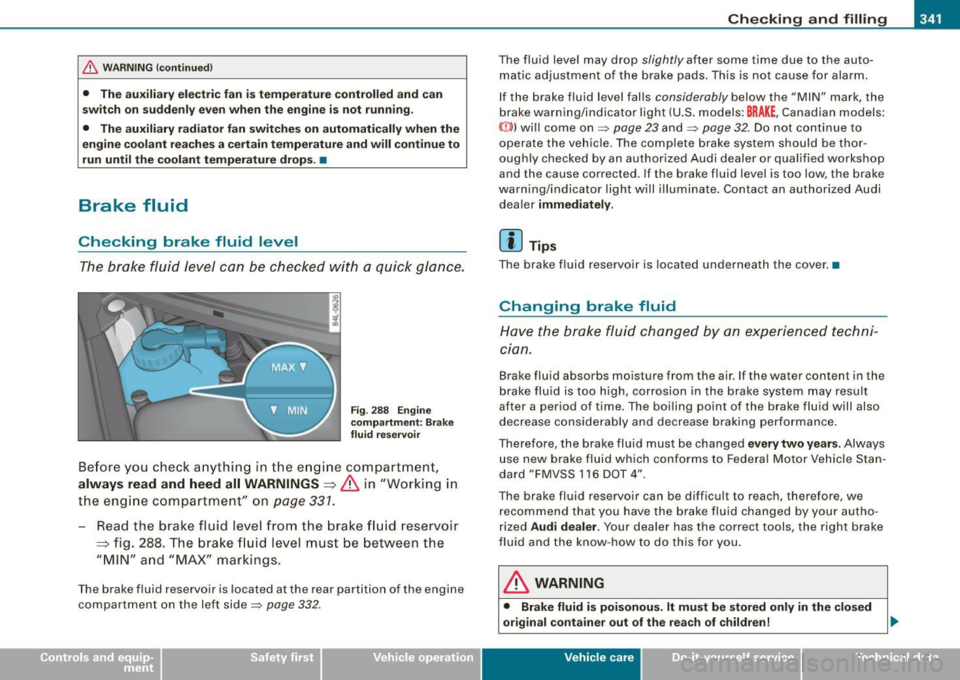
Fig. 288 E ngine
comp artm ent: B ra ke
flui d rese rvoir
Be fore you check a nything in th e en g in e co mpart ment,
always read and heed all WARNINGS=> & in "Working in
t h e eng ine compartment" on
page 331.
- Read the brake fluid l eve l from the brake fluid reservoir
=> fig. 288. The brake flu id level mus t be between the
"MIN" and "MAX" markings.
The brake fluid reservoir is locate d at the rear partition of the engine
compartment on the left side=>
page 332.
The fluid level may drop slightly after some time due to the auto
ma tic adjustment of the brake pads. This is not cause for alarm .
If the brake fluid leve l falls
considerably below the "MIN" mark , the
brake warning/indicator light (U.S. models:
BRAKE , Canadian models:
«D> l will come on=>
page 23 and=> page 32 . Do not continue to
operate the vehicle. The complete brake system should be thor
oughly checked
by an author ized Audi dealer or qua lif ied workshop
and the cause corrected . If th e brake fluid level is too low, the brake
warning/indicator light w ill illumi nate. Contact an authorized Audi
dea ler
immedi ately .
[ i ] Tips
The brake fluid reservoir is located underneath the cover .•
Changing brake fluid
Have the brake fluid changed by an experience d techni
cian.
Brak e fluid absorbs mois ture from the air. If the wate r conten t in the
brake fluid is too high, corrosion in the brake sys tem may res ult
after a period of time . The boiling point of the brake fluid will also
decrease conside rably and decrease braking performance .
Therefore , the brake fluid mus t be changed
every two year s. Always
use new brake fluid which conforms to Federal Motor Vehicle S tan
da rd "FMVSS 116 DOT 4".
The brake fluid reservoir can be difficul t to reach, therefore , we
recommend that y ou have the brake fluid changed by your autho
rized
Audi deal er. Your dealer has the correct tools, the right brake
fluid and the know -how to do this for you .
& WARNING
• Brak e fluid is poi sonou s. It mu st be stored only in the clo sed
o riginal conta iner out of the rea ch of children! ..,.
Vehicle care I I irechnical data
Page 344 of 426
-~_C_ h_e _c _ k_ i_n ...:::g::;...._ a_n_ d_ f_ i_ll _in -'g:::;.._ ___________________________________________ _
& WARN ING (c o ntinued )
• Brake failure can re sult from old or inappr opriate brake fluid .
Ob serve the se precautio ns:
- Use only brake fluid that meets SAE specific ation J 1703 and
c onform s to Fed era l Moto r Vehi cle St anda rd 116. Al ways c heck
with your authori zed Audi dealer to make sure you are u sin g
the corre ct brake fluid. The correct typ e of brake fluid i s also
indicated o n the brake fluid reser vo ir .
- The br ake flu id mu st be ne w. Heavy u se of the brake s can
c au se a vapor lock if the brake fluid i s left in the s ystem too
long. Thi s can seriou sly affect the effi cien cy of the brake s as
w ell a s your safet y. Thi s could re sult in an acci dent .
0 Note
Brake fluid will damage the paint of your vehicle .
For the sake of the environment
Because of the problem of proper disposal of brake fluid as well as
the special too ls required and the necessa ry expertise, we recom
mend that you have the brake fluid changed by your authorized Audi
dea ler .•
Battery
General information
Under normal operating condi tions, the battery in your Audi does
not need any maintenance. With
high outside temperatures or long
daily drives we recommend that you have the e lectrolyte level
checked by an au thorized Audi dealer or qualified workshop . The
e lectrolyte level should also be ch ecked each time the battery is
charged ~
page 344.
Have the battery checked when you take your vehicle in for service .
Yo u are well advised to replace a battery that is o lder than 5 years .
With certain types of airbag dep loyment, the battery is discon
nected from the vehicle electrical system for safety reasons~
& in
"Repair, care and disposal of the airbags" on
page 255.
Disconnecti ng th e batt ery termin als
Some vehicle functions (power window regulators , for example) are
lost if the battery termina ls are disconnected. These functions have
to be relearned after the battery terminals are connected again . To
prevent this, the battery should only be disconnected from the
vehic le electrical sys tem when abso lutely necessary for repairs .
Vehicles not driven for long per iods
If you do not drive your vehicle ove r a period of several days or
weeks, electrical components are gradually cut back or switched off .
T his reduces energy consumption and maintains starting capab ility
over a longer period
~ page 295 .
Take i nto consideration that whe n you u nlock your vehicle, some
convenience functions, such as the master key remote function or
powe r seat adjustme nt, may not be ava ilable. The convenience
functions will be available again when you turn on the ignition and
start the engine .
Wint er op erati on
Duri ng the winter mont hs, batte ry capacity tends to decrease as
temperatures drop . This is because more power is also consumed
whi le star tin g, and the headlights, rear window defogger, etc ., are
used more often.
Avoid unnecessary power consumption, particular ly in city traffic or
when trave li n g o nly short dis tances . Let your authorized Audi dea ler
check the capacity of the vehicle battery before winter sets in
~ page 344. A we ll cha rged battery w ill not only preven t starting
problems when the weather is cold, but will also last longer . ..,_
Page 372 of 426
lllffll.___W_ h_ a_t _d_ o_ l _d _o_ n_ o_ vv_ ? ______________________________________________ _
What do I do now?
Jack, tools and inflatable spare tire
Jack and folding chocks
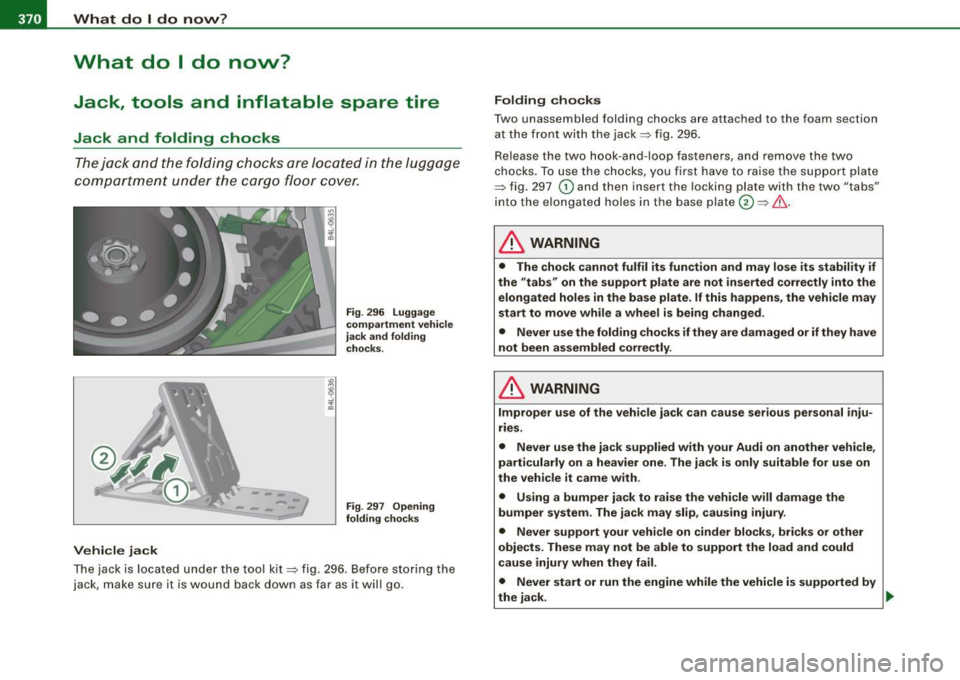
The jack and the folding chocks are located in the lug gage
comp artmen t under t he ca rgo floor co ver.
Vehicle jack
Fig . 296 Luggage
comp artment v ehi cle
jack and fold ing
c ho ck s.
Fig . 2 97 Opening
fold ing ch ocks
The jac k is located under the too l kit:::;, fig. 296 . B efore sto ring the
jack, ma ke su re it is wo und back down as fa r as it w il l go.
Folding chocks
Two unassembled fold ing chocks a re attached to the foam section
at the fron t w ith th e jack :::;, fig. 296 .
Release the two hook -and -loop fasteners, and remove the two
chocks . To use the chock s, you fi rst ha ve to raise the sup port pla te
:::;, fig. 297
G) and then insert the locking plate with the two "tabs"
into the e longated holes in the base plate@:::;,& .
& WARNING
• The chock cannot fulfil its fun ction and may lose its stability if
the "tabs " on the support plate are not inserted corre ctly into the
elongated holes in the base plate. If this happens , the vehicle may
sta rt to move while a wheel is being changed .
• Never u se the folding chocks if they are damaged or if they have
not been assembled co rre ctly .
& WARNING
Improper use of the vehi cle jack can cause serious pe rsonal inju
rie s.
• Never use the jack supplied with your Audi on another vehicle,
particularly on a heavier one. The jack is only suitable for use on
the veh icle it came with .
• Using a bumper jack to raise the veh icle will damage the
bumper system . The jack may slip , caus ing injury .
• Never support your vehicle on cinder blocks , bricks or other
objects. These may not be able to support the load and could
cause injury when they fail.
• Never start or run the engine while the vehicle is supported by
the jack .
~
Page 373 of 426
_____________________________________________ W.:..:..; h:..:.= a:.:t ..:.d=-= o:....:... I .::d :.:o :....:.. n:.:o::.. w.:...:.. ?:...___J -
& WARNING !continued)
• If you must work under the vehicle, always use safety stands
specifically designed for this purpose.
• Always make sure the inflatable spare tire and even a flat tire
are secured in place and not loose, otherwise they could fly
forward, causing personal injury to passengers in the vehicle in an
accident or sudden maneuver . •
Tools
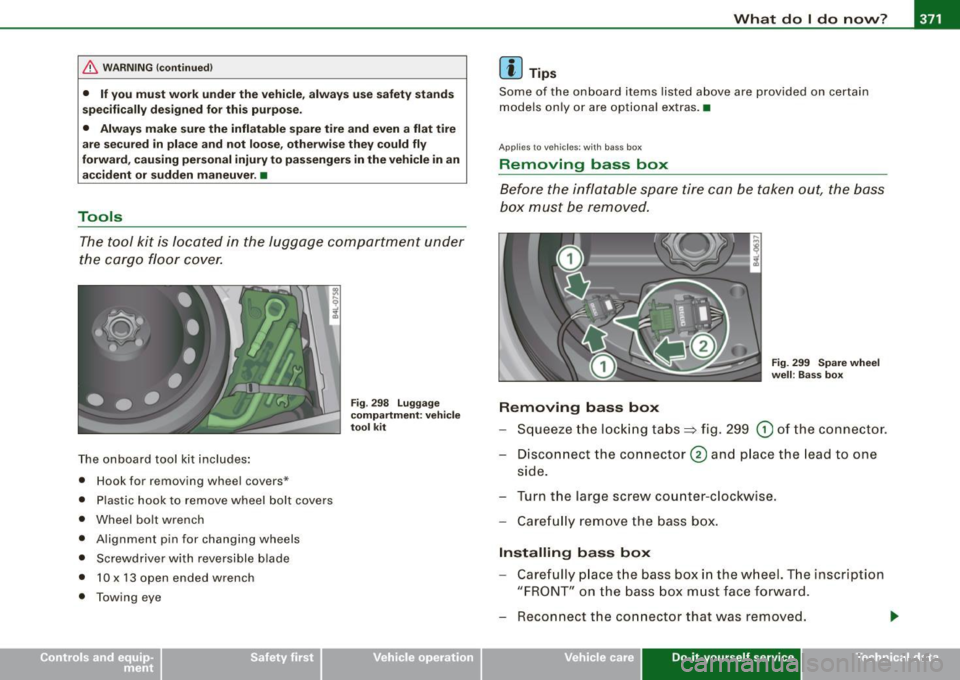
The tool kit is located in the luggage compartment under
the cargo floor cover.
The onboard tool kit includes:
• Hook for removing wheel covers *
• Plastic hook to remove wheel bolt covers
• Wheel bolt wr ench
• Alignment p in for changing wheels
• Screwdriver with reversible blade
• 10
x 13 open ended wrench
• Towing eye
Fig . 298 Luggage
compartment : vehicle
tool kit
[ i] Tips
Some of the on board items listed above are provided on certain
models only or are optional extras .•
A pp lies to ve hicles: w ith bass box
R emoving bass box
Before the inflatable spare tire can be taken out, the bass
box must be removed.
Fig . 299 Spare wheel
well : Bass box
Removing bass box
- Squeeze the locking tabs~ fig. 299 G) of the connector.
- Disconnect the connector @ and place the lead to one
side.
- Turn the large screw counter-clockwise.
- Carefully remove the bass box.
Installing bass box
-Carefully place the bass box in the wheel. The inscription
" FRONT " on the bass box must face forward.
- Reconnect the connector that was removed.
Vehicle care Do-it-yourself service irechnical data
Page 393 of 426
________________________________________________ E_ m ___ e_r .::g :...e_ n _ c_,!y:._ s_ i_t _u _a_ t_ i_o _n_ s _--J_
- Screw the towing loop t ightly into the threaded hole as
far as it will go::::>
page 390, fig. 315.
When it is no longer needed, unscrew the towing loop and put it
back into the vehicle toolkit. Be sure to have the towing loop stored
in the vehicle at all times.
When installing the grill for the air duct, be sure that the tabs on the
gril l are first inserted into their guides on the vehicle above the
fog lamp. Then position the opposite side of the grill
=> page 390,
fig. 314 ® and push it firmly into its guide.
& WARNING
If the towing loop is not screwed in as far as it will go, the thread
can pull out when the vehicle is towed -potential risk of an
accident. •
Rear towing loop
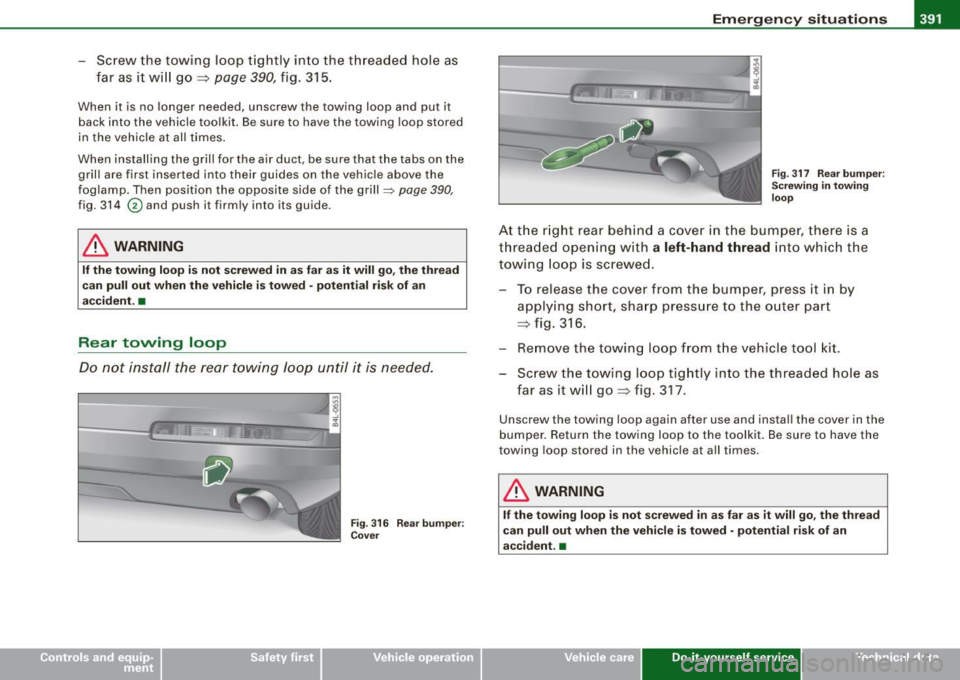
Do not install the rear towing loop until it is needed.
Fig. 316 Rear bumper:
Cover Fig
. 317 Rear bumper:
Screwing in towing
loop
At the right rear behind a cover in the bumper, there is a
threaded opening with
a left-hand thread into which the
towing loop is screwed.
- To release the cover from the bumper, press it in by
applying short, sharp pressure to the outer part
==> fig. 316.
- Remove the towing loop from th e vehicle tool kit.
- Screw the towing loop tightly into the threaded hole as
far as it will go ::::> fig. 317.
Unscrew the towing loop again after use and instal l the cover in the
bumper. Return the towing loop to the toolkit. Be sure to have the
towing loop stored in the vehicle at all times .
& WARNING
If the towing loop is not screwed in as far as it will go, the thread
can pull out when the vehicle is towed -potential risk of an
accident. •
Vehicle care Do-it-yourself service irechnical data
Page 411 of 426

______________________________________________ A_ l_,_ p _h_ a_ b_e _t_ic _ a _ l _in _ d_e _ x __ lll
Important things to know . ... .. .... 241
Indi cator light ...... .. .... ... ..... 252
Monitoring ... .... .... ..... .. .... 252
PASSENGER AIR BAG OFF light ... .. 253
Repairs .. .... .... .... ... .... .... 255
Safety instructions ... .... ..... .. . 254
Side airbags ... .. .... .... ...... .. 257
Side curtain airbags ... .. .... .... . 260
Weight -sensing mat .... ........ .. 264
When must the system be inspected? ..
252
All Wheel Drive .. .... ....... ...... .. 294
Alloy wheels ... .. .... .... ..... .. .... 318
All-whee l drive
Winter tires .... .. .... ...... ... .. . 363
Alternator Malfunction . .... .... ........ ..... 32
Anti-freeze
See Engine coo lant system .. ...... . 337
Anti-glare inside day-night mirror .... 86, 87
Anti -lock brake system
How the ABS system works . .... ... 292
Warning/indicator lights .. .... .... .. 22
Anti-Slip Regulation System (ASR)
How the system works ........ .... 290
Anti-theft systems
Anti-theft alarm system ... ......... 63
Elec tronic immobilizer .. ... .... .... 51
Approach/departure angle ............ 302
Ashtray Front .. .... ... .. .... .... ...... .. 116
R ear .... ... .. .... .... ........... 116
Controls and equip
ment Safety first
ASR
How the Anti-Slip Regulation System
works ...... ............. ...... 290
Asterisk What does it mean when something is
marked with an asterisk? .. ....... .. 6
Audi braking guard ....... .... ... .... 168
Error messages ....... .... ... .... 170
Settings ........... ... .... .... ... 169
Status messages .......... .... ... 170
Switching on and off .. .... .... .... 169
Audi Service Repair Manuals and Literature
401
AUTO mode AC climate contro ls ..... ...... .... 126
Auto Safety Hotline ..... ... ... .. .... . 229
Auto -Check Control ...... ..... ... .... . 30
Automatic belt retractor ... .. .... .... . 235
Automatic car wash
See Washing ............... .... .. 313
Au tomatic mode
Four -zone automatic comfort air
conditioning .... ...... ...... ... 132
Automatic Shif t Lock (ASU ...... ... ... 186
Automatic transmission
6 -speed automatic transmission .... 184
Automatic Shift Lock (ASU ...... .. . 186
Driving ...... ....... ...... .... ... 1 84
Dynamic shift program .... ........ 187
Emergency release for selector lever 189
F ail-safe mode ...... ... .. .... ... . 189
Ignition key safety lock ..... .. .... . 143 Manua
l sh ift program .. .. ....... .. 188
Selector lever .................... 185
Shift buttons ...... .... .... ...... . 189
Steering wheel with tiptronic® ..... 189
Average speed ....................... 40
Avo id damaging the vehicle ... .... .... 299
B
Background lighting
Lighting profiles . ......... ......... 79
Bass box ........... ... .. .... ...... . 371
Battery ...... .... ... .... .... .... ... 342
Battery location .......... .... .... 343
Charging ........................ 344
Important warnings when working on the
battery ...... ....... .... ...... . 343
Jump starting ................ .... 387
Low ...... ........... ....... .. .. 295
Replacing the battery ............ . 346
State of charge ................... 295
Voltage ........... ...... .... .... . 36
Winter operation ............ ... .. 342
Working on the battery ... ....... .. 343
Before driving ... .... .... ...... .... . 221
Blended gasoline .................... 325
Body cavity sealing .. .... .... .... ... . 318
Booster seats ...... ... .. .... .... .... 271
How do I properly insta ll a booster seat in
my vehic le? . .... .... .... ... .... 271
Safety instructions .... .......... .. 271
Brake assistant .......... .... .... ... 293
K ick -down .... .... ...... ...... ... 187 Brake booster ....................... 292
Vehicle operation Vehicle care Do-it-yourself service Technical data