height AUDI Q7 2009 Owner´s Manual
[x] Cancel search | Manufacturer: AUDI, Model Year: 2009, Model line: Q7, Model: AUDI Q7 2009Pages: 426, PDF Size: 97.13 MB
Page 308 of 426
llffl!I Trailer towing
------=---------------------------------
& W ARN ING (continued )
• The Gros s Vehicle Weight Rating for your Audi 07 vehicle ,
found on the safety compliance l abel on the driver's side B -pillar ,
must never be ex ceeded under any cir cumstances . E xceeding the
Gross Vehi cle Weight Rating of your vehicle is likely to damage
your vehicle , and such damage w ill not be covered by your Limited
New Vehicle Warranty. Exceeding the Gro ss Vehicle Weight Rating
will also change the performan ce and handling characteristics of
your vehicle , which could cause a crash resulting in serious injury
or death .
• The Gros s Vehicle Weight Rating for your Audi 0 7 would be
e xc eeded if your veh icle is simultaneously equipped with
Panoramic sliding sunroof ; third -row seating ; trailer towing equip
ment (factory or dealer -installed) , and running boards (dealer
installedl. UNDER NO CIRCUMSTANCES MAY ALL SUCH ITEMS BE
INSTALLED ON THE SAME VEHICLE .
a
Operating instructions
---------~--~-------
MAX 6.9"
MAX 175mm
Trailer towing weights
Fi g. 2 76 P erm itted ball
po sition of the trailer
hitch
With a factory-installed trai ler hitch, the maximum permissible
trai ler weight is 6,615 lbs (3,000 kg). The maximum permissible
unbraked trailer weight is 1,650 lbs (750 kgl. With an
aftermarket
tr ailer h itch , the maxi mum pe rm iss ib le tra iler weigh t is 5,51 2 lb s (2,500
kg). These specifications apply when driv ing on roads having
an in cli ne of less t han 12% .
Permissible tongue load
Fo r best v ehicle ha ndling under th es e changed con ditio ns, a dju st
the trai ler load so that the tongue load is at the maximum allowable
or s lightly lower. Y ou ca n ge t an ap proxi mati on of the tong ue load
with a bathroom sca le or you can measure the load at a trucking
company or weig hing s tati on.
Wtih a
factory -installed trailer hi tch, the max imum perm issib le load
on the ball hitch may not exceed 66 2 lbs (300 kg) . With an
after
market
t ra iler hitc h, the max imum pe rmi ssible loa d on the ball h itch
may not exceed 55 1 lbs (250 kg). It is recommended to use the
m aximum p ermi ssi ble l oad.
Trailer load distribution B e sure the load in the trai ler is he ld securel y in place to prevent it
from shifting forward, backward or sideways.
Never allow a passenger to ride in a trailer=> & in "D riving ins truc
tions" on page 307.
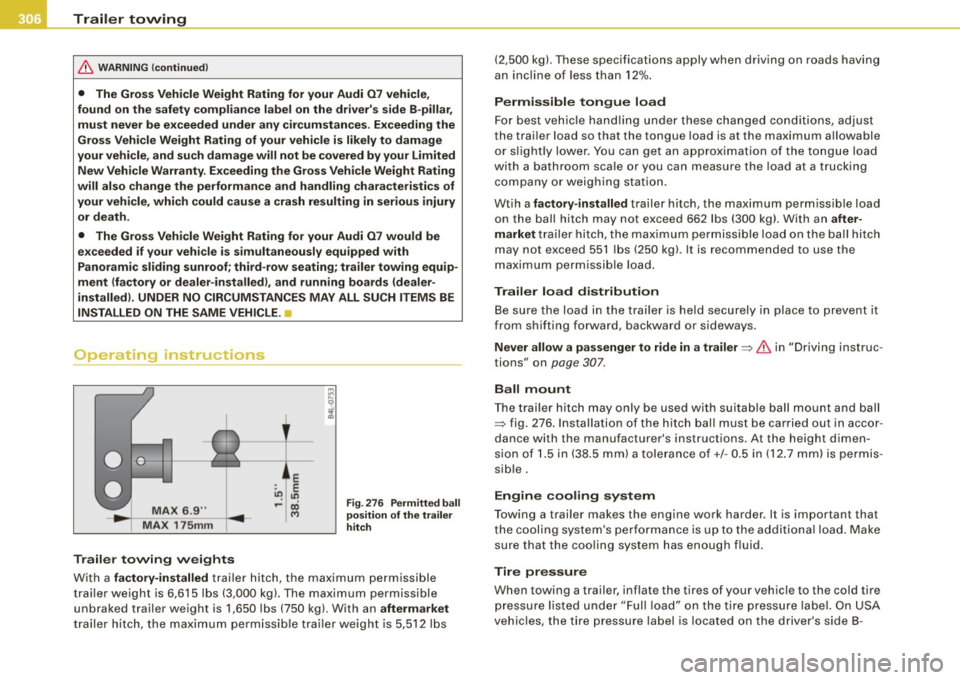
Ball mount
T he trai ler hitch may only be used with suitab le ball mount and ball
=> fig. 276 . In sta llati on of t he hitch ball must be ca rr ie d o ut i n a ccor
dance with the manufacturer's instructions. At the height dimen
s io n of 1 .5 in (38 .5 mm) a tole ran ce o f+/- 0 .5 in (12 .7 mm) is pe rmis
sib le.
Engine cooling system
T owing a trai ler makes the engine work harder. It is important that
th e c ooli ng system 's per forman ce is u p to the a ddi tiona l loa d. Ma ke
sure that the coo ling s ystem has enough f luid.
Tire pressure
When towing a trailer, inflate the tires of your vehic le to the cold tire
p re ssure l is ted unde r "Full load" on th e tire press ure l abe l. On USA
vehic les, the tire pressure label is located on the driver's side 8 -
Page 315 of 426
Cleaning and protection -
----------------
•
Under certain circumstances, weekly washing may be necessary.
Under other conditions , a monthly washing and waxing may be
adequate .
After the winter, the
underside of the vehicle should be thoroughly
washed, preferably in a professional car wash.
& WARNING
Always read and heed all WARNINGS and other information
~ page 312. •
Automatic car wash
The vehicle can be washed in almost any modern auto
matic car wash.
The vehicle paint is so durable that the vehicle can normally be
washed without problems in an automatic car wash . However, the
effect on the paint depends to a large extent on the design of the
facility, the filtering of the wash water , the type of wash and care
material, etc. If the paint has a dull appearance after going through
the car wash or is scratched , bring this to the attention of the oper
ator immediately . If necessary, use a different car wash .
Before going through a car wash, be sure to take the usual precau
tions such as closing the windows and the Panoramic sliding
sunroof. Factory installed antennas must not be removed.
If you have installed additional accessories on the vehicle - such as
spoilers, roof rack, etc. -it is best to ask the car wash operator if
these should be removed .
& WARNING
Please take note of the following points before going through an
automatic car wash with your vehicle, so that you can avoid
damage to your vehicle.
& WARNING (continued)
• Compare the track of your vehicle with the distance between
the guide rails of the facility -there is a risk of damage to the
wheels and tires .
• Compare the height and width of your vehicle with the height
and width of the tunnel at the facility.
• Fold the exterior mirrors flat -there is a risk of damaging the
exterior mirrors. Power folding exterior mirrors* must not be
folded in or out by hand. Use the power function!
• Do not allow the wiper blade to fall onto the windshield after
the vehicle is dried -there is a risk of damaging the paint on the
hood.
• Always read and heed all WARNINGS and other information
~ page312. •
Washing the vehicle by hand
A lot of water is needed when washing a vehicle by hand.
Before you start washing, make sure you have read and
understood the WARNINGS ::::>
& in "General informa
tion" on page 312.
- First soak all dried dirt until it is soft, then rinse it off.
- As you clean your vehicle, start with the roof and work
your way down to the bottom, using a sponge, a sponge
glove or a clean brush.
Rinse the sponge or the sponge glove often, flushing it
clean each time.
- Use special car shampoo only for very persistent dirt.
Rinse the car thoroughly with water.
Use a chamois leather to gently wipe the exterior dry.
Vehicle care I t •
Page 350 of 426
-~_T_ ir_e_ s_ a_ n_d _ w_ h_ e_e _l_s _________________________________________________ _
& WARNING (continued)
crashes and serious personal injuries . Have worn or damaged tires
replaced immediately.
• Tires age even if they are not being used and can fail suddenly,
especially at high speeds. Tires that are more than 6 years old can
only be used in an emergency and then with special care and at
low speed.
Glossary of tire and loading terminology
Accessory weight
means the combined weight (in excess of those standard items
which may be replaced) of automatic transmission, power steering,
power brakes, power windows, power seats, radio, and heater, to
the extent that these items are available as factory-installed equip
ment (whether installed or not).
Aspect ratio means the ratio of the height to the width of the tire in percent.
Numb ers of 55 or lower indicate a low sidewall for improved
steering response and better overall handling on dry pavement.
Bead
means the part of the tire that is made of steel wires, wrapped or reinforced by ply cords and that is shaped to fit the rim.
Bead separation means a breakdown of the bond between components in the bead.
Cord
means the strands forming the plies in the tire.
& WARNING (continued)
• Never mount used tires on your vehicle if you are not sure of
their "previous history." Old used tires may have been damaged
even though the damage cannot be seen that can lead to sudden
tire failure and loss of vehicle control.
• If you notice unusual vibration or if the vehicle pulls to one side
when driving, always stop as soon as it is safe to do so and check
the wheels and tires for damage . •
Cold tire inflation pressure
means the tire pressure recommended by the vehicle manufacturer
for a tire of a designated size that has not been driven for more than
a couple of miles (kilometers) at low speeds in the three hour period
before the tire pressure is measured or adjusted.
Curb weight means the weight of a motor vehicle with standard equipment
including the maximum capacity of fuel, oil, and coolant, air condi
tioning and additional weight of optional equipment.
Extra load tire
means a tire design to operate at higher loads and at higher infla
tion pressures than the corresponding standard tire. Extra load tires
may be identified as "XL",
"xi", "EXTRA LOAD", or "RF" on the side
wall.
Gross Axle Weight Rating ("GAWR")
means the load-carrying capacity of a single axle system, measured
at the tire -ground interfaces.
Gross Vehicle Weight Rating ("GVWR"l
means the maximum total loaded weight of the vehicle.
Page 361 of 426
__________________________________________________ T_ ir_e _ s_ a_ n _ d_ w_ h_ e_ e_ls _ ____.11111
New tires and replacing tires and wheels
New tires and wheels have to be broken in.
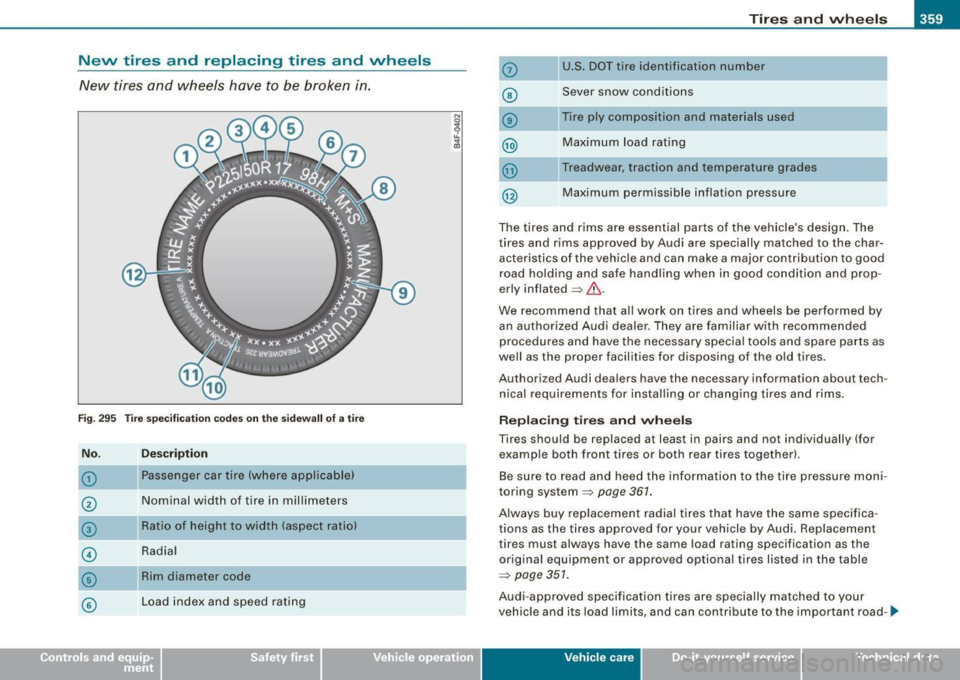
Fig. 295 Tire specification codes on the sidewall of a tire
No.
G)
@
©
©
©
©
Description
Passenger car tire (where appl icable)
Nominal width of tire in millimeters
Ratio of height to width (aspect ratio)
Radial
Rim diameter code
Load index and speed rating
0
©
U.S. DOT tire identificat ion number
Sever snow conditions
Tire ply composition and materials used
Maximum load rating
@ Treadwear, traction and temperature grades
@ Maximum permissible inflation pressure
The tires and rims are essential parts of the vehicle's design. The
tires and rims approved by Audi are specially matched to the char acteristics of the vehicle and can make a major contribution to good
road holding and safe handling when in good condition and prop
erly inflated =>& .
We recommend that all work on tires and wheels be performed by
an authorized Audi dealer. They are familiar with recommended
procedures and have the necessary special tools and spare parts as
well as the proper facilities for disposing of the old tires.
Authorized Audi dealers have the necessary information about tech
nical requirements for installing or changing tires and rims.
Replacing tires and wheels
Tires should be replaced at least in pairs and not individually (for
example both front tires or both rear tires together).
Be sure to read and heed the information to the tire pressure moni
toring system =>
page 361.
Always buy replacement radial tires that have the same specifica
tions as the tires approved for your vehicle by Audi. Replacement
tires must always have the same load rating specification as the original equipment or approved optional tires listed in the table
=> page 351.
Audi -approved specification tires are specially matched to your
vehicle and its load limits, and can contribute to the important road-.,_
Vehic le care I I irechnical data
Page 362 of 426
-~_T_ ir_e_ s_ a_ n_d _ w_ h_ e_e _l_s _________________________________________________ _
holding, driving characteristics, and safety of the vehicle. The table
(~ page 357) lists specifications of the tires approved for the Audi
models covered by your Owner's Literature .
The tire pressure label (On USA vehicles, the tire pressure label is
located on the driver 's side 8 -pillar . On Canada vehicles, the tire
pressure label is located either on the driver's side 8 -pillar or inside
the fue l fi ller flap)( ~
page 351, fig. 292) lists the specifications of
the original equipment tires instal led on your vehic le at the time i t
was manufactured.
Federal law requires tire manufacturers to place standardized infor
mation on the sidewa ll of all tires~
page 359, fig. 295 . This informa
tion identifies and describes the fundamental characteristics, the quality grade of the tire and also provides a tire identification
number for safety standard certificat ion and in case of a recall.
Ti re sp ec ifica tio ns
Knowledge of tire specifications makes it easier to choose the
correct tires . Radial tires have the tire specifications marked on the
sidewa ll, for example:
P 235 / 6 0 R 18 107 H XL
This contains the fo llowing information :
P Indicates the tire is for passenger cars (where applicable)
235 Nominal tire width in mm of the tire from sidewall edge to side -
wall edge. In general, the larger the number, the wider the tire
60 Height/width ratio in percent (aspect ratio)
R T ire construction: Radial
18 Rim diameter code (in inches)
10 7 Load rat ing code
H Speed rat ing letter code
X L (or "xi" , "EXTRA LOAD", or "RF" Indicates that the tire is a"Rein
forced" or an "Extra Load" tire
M+ S (or "M/S"l Indicates that the tire has some mud and snow capa
bility T
he tires could also have the information of direction of rotation
~ page 347.
Ti re manuf acturing d ate
The manufacturing date is a lso indicated on the tire sidewa ll
(possibly only on the
inner side of the wheel) :
"DOT ... 2208 ... " means, for example, that the tire was produced in
the 22th week of 2008 .
Speed rating
permissible road speeds~
& in "Winter tires" on page 363.
p
up to 93 mph ( 150 km/h)
Q up to 99 mph (158 km/h)
R upto 106mph(170km/hl
s upto 110 mph (180 km/h)
T up to 118 mph (190 km/h)
u up to 124 mph (200 km/h)
H up to 130 mph (210 km/h)
V up to 149 mph (240
km/h)4
l
z over 149 mph (240 km/h)4
l
w up to 168 mph (270 km/h)41
y up to 186 mph (298 km/h)41
Your vehic le is norma lly factory equipped with tires, which possess
exce llent driving characteristics and give your Audi optimum
driving comfort . An e lectronic speed limiter ~
page 29will normal ly
prevent your vehicle from going faster than the tire speed rating
~ & - ..
41 For tires w ith a maximum speed capab ility over 149 mph (240 km /h ), tire
manufacture rs som etim es us e th e lette rs "ZR."
Page 368 of 426
-~_T_ ir_e_ s_ a_ n_d _ w_ h_ e_e _l_s _________________________________________________ _
0 Note
The specified torque for the wheel bolts is 120 ft lb (160 Nm) with a
tolerance of± 7,4 ft lb(± 10 Nm). Torque wheel bolts diagonally.
After changing a wheel, the torque must be checked as soon as
possible with a torque wrench -preferably by an authorized Audi
dealer or qualified workshop. •
Low aspect ratio tires
Your Audi is factory-equipped with low aspect ratio tires. These tires
have been thoroughly tested and been selected specifically for your
model for their superb performance, road feel and handling under
a variety of driving conditions . Ask your authorized Audi dealer for
more details.
The low aspect ratio of these tires is indicated by a numeral of
55 or
less
in the tire's size designation. The numeral represents the ratio
of the tire's sidewall height in relation to its tread width expressed
in percentage. Conventional tires have a height/width ratio of 60 or
more.
The performance of low-aspect-ratio tires is particularly sensitive to
improper inflation pressure. It is therefore important that low
aspect ratio tires are inflated to the specified pressure and that the
inflation pressure is regularly checked and maintained. Tire pres
sures should be checked at least once a month and always before a
long trip~
page 353, "Checking tire pressure".
What you can do to avoid tire and rim damage
Low aspect ratio tires can be damaged more easily by impact with
potholes, curbs, gullies or ridges on the road, particularly if the tire
is underinflated.
In order to minimize the occurrence of impact damage to the tires
of your vehicle, we recommend that you observe the following precautions: •
Always maintain recommended inflation pressures. Check your
tire pressure every 2,000 miles (3,000 km) and add air if necessary.
• Drive carefully on roads with potholes, deep gullies or ridges.
The impact from driving through or over such obstacles can
damage your tires. Impact with a curb may also cause damage to
your tires.
• After any impact, immediately inspect your tires or have them
inspected by the nearest authorized Audi dealer. Replace a
damaged tire as soon as possible.
• Inspect your tires every 2,000 miles (3,000 km) for damage and
wear. Damage is not always easy to see. Damage can lead to loss of
air and underinflation, which could eventually cause tire failure. If
you believe that a tire may have been damaged, replace the tire as
soon as possible.
• Th ese tires may wear more quickly than others.
• Please also remember that. while these tires deliver responsive
handling, they may ride less comfortably and make more noise than
other choices.
Reduced performance in winter/cold season
conditions
All tires are designed for certain purposes. The low aspect ratio,
ultra high performance tires originally installed on your vehicle are
intended for maximum dry and wet road performance and handling.
They are not suitable for cold, snowy or icy weather conditions. If
you drive under those circumstances, you should equip your vehicle
with all -season or winter tires, which offer better traction under
those conditions. We suggest you use the recommended snow or all -season tires specified for your vehicle, or their equivalent.
Refer to~
page 363for more detailed information regarding winter
tires. •
Page 385 of 426
Fuses and bul bs 11111 ________________________________ ..:....:,:_=-.::..:....:.;.:_.:..:..,_,;__,;____,J
....
No.
1
-
2
3
4
5
6
Eq uipm ent
Headlight electronic system (left side of vehi -
cle)
Adaptive Cruise Control
Not used
Audi lane assis t
Not used
Terminal 15 (interior)
Oil level sensor
8 Diagnostic connector
9 Automatic dipping interior mirror
10 Homelink
1 1 Control module Gateway
12 Headlight range adjustment
Amps
10
5
10
5
5
5
5
5
5
5
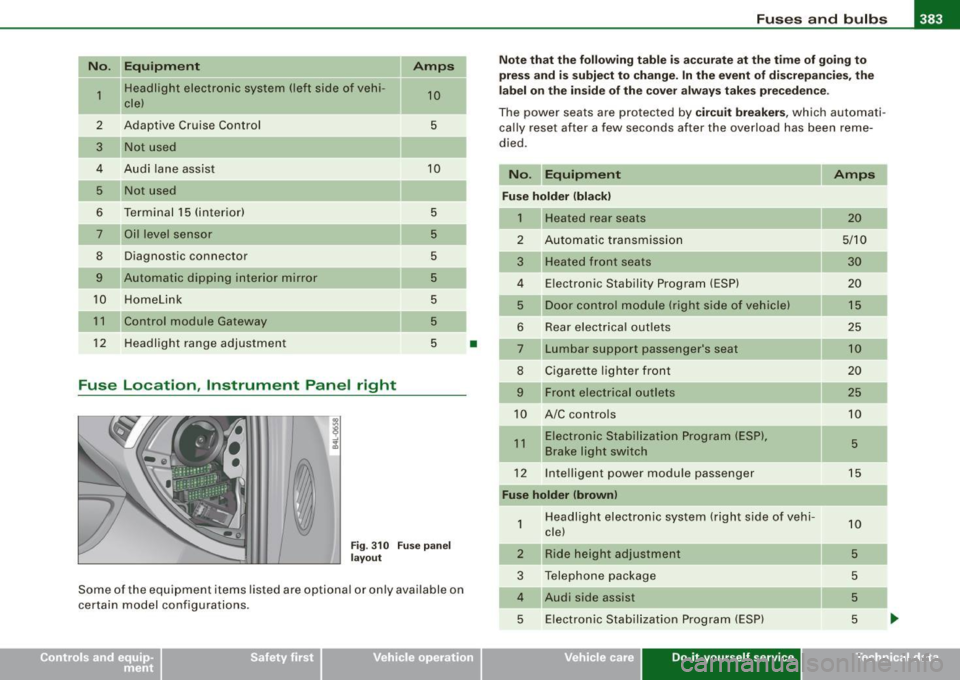
Fuse Location , Instrument Panel right
Fi g. 310 F use pane l
l ayo ut
Some of the equipment items listed are optional or only avai lable on
certain model configurations .
•
Note that th e fo llo wi ng ta ble is acc urate a t the time of goi ng to
pre ss and is subject to change. In th e event of di screpan cies, t he
l a b el on the ins ide o f th e cover a lw ays ta ke s prec eden ce.
The power seats are protected by circ uit breakers , which automati
ca lly reset af ter a few seconds after the overload has been reme
died .
No. Equipm ent
Fu se holder (bla ck )
1 Heated rear seats
2 Automatic transmission
3 Heated front seats
4 E lectronic Stability Program (ESP)
5 Door control module (right side of vehicle)
6 Rear electrical out
lets
7 Lumbar support passenger's seat
8 Cigarette lighter front
9 Front electrical outlets
10 A/C controls
1 1 Electronic Stabilization Prog ram (ESP),
Brake light switch
12 Inte lligent power modu le passenger
Fuse holder (brown )
1
2
3
Headlight electronic system (right side of vehi
cle)
Ride height adjustment
Telephone package
4 Audi side assist 5 E lectronic Stab ilizat ion Program (ESP)
Vehicle care Do-it-yourself service
Amps
20
5/10
30 20
15
25
10
20
25
10
5
15
1 0
5
5
5
5
-
irechnical data
Page 386 of 426
11111 Fuses and bulbs ..._ ____ .;__...;_;,;_ _______________________________ _
No. Equipment Amps
6 Automatic transmission
5/20
7 Electronic Stabilization Program (ESP) 5
8 Shift gate automatic transmission
5
9 Advanced Parking System 5
10 Airbag 5
1 1 Heated rear seats 5
12 Air-conditioning
5
Fuse holder (red)
1 Not used
2 Not used
3 Not used
4 MMI Display 5
5 Telephone, telematics, cell phone package
5
6 MMI, antenna amplifier
15
front light unit 5/7,5
7 Panoramic sliding sunroof segment 1 20
8 Panoramic sliding sunroof segment 2 20
9 Panoramic sliding sunroof sunblind 20
10 CD player, DVD drive
5
11 Window regulators (right side of vehicle) 35
12 Rear air-conditioning controls 10
•
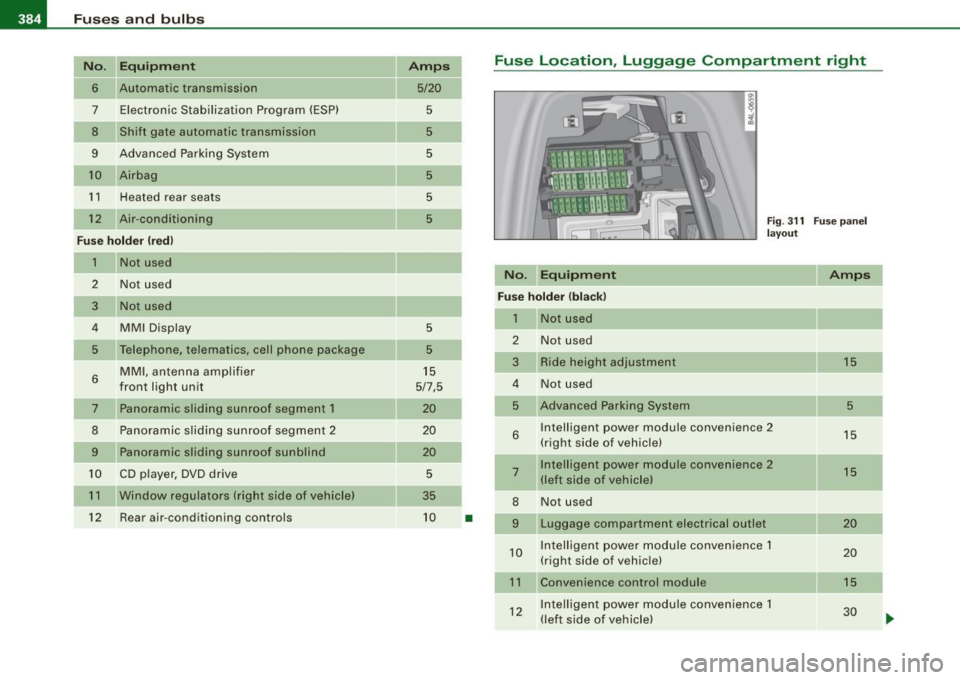
Fuse Location, Luggage Compartment right
No. Equipment
Fig. 311 Fuse panel
layout
Amps
Fuse holder (black)
1 Not used
2 Not used
3 Ride height adjustment
15
4 Not used
5 Advanced Parking System 5
6 Intelligent power module convenience 2
15
(right side of vehicle)
7 Intelligent power module convenience 2
15
(left side of vehicle)
8 Not used
9 Luggage compartment electrical outlet 20
10 Intelligent
power module convenience 1
20
(right side of vehicle)
11 Convenience control module 15
12 Intelligent power module convenience 1
30
(left side of vehicle)
Page 401 of 426
_____________________________________________________ D_a_ t_ a __ lffllll
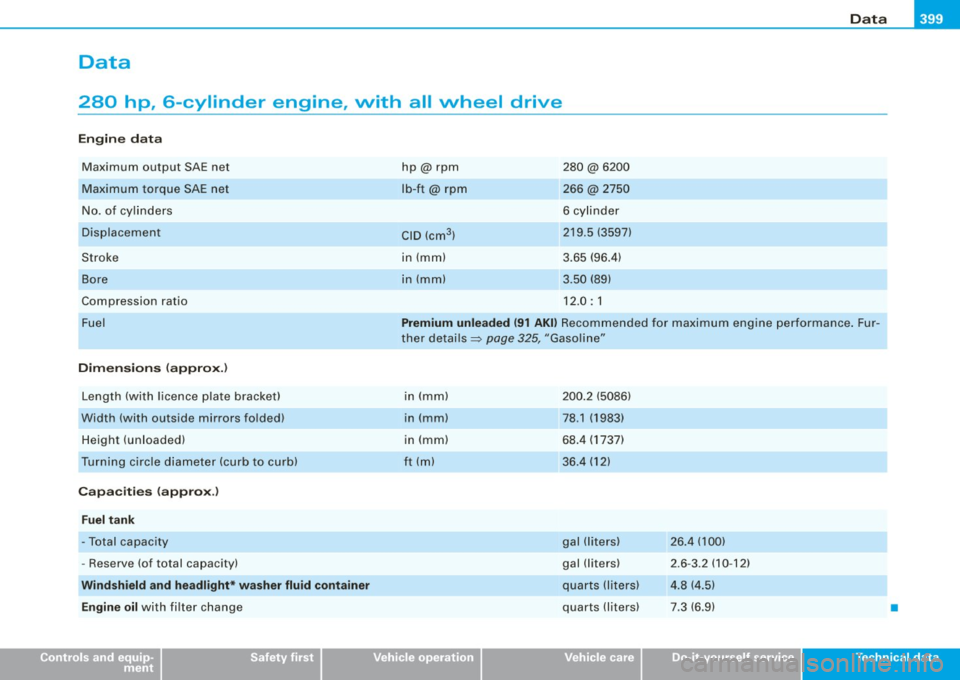
Data
280 hp, 6 -cylinder engine, with all wheel drive
Engine data
Maximum output SAE net
Maximum torque SAE net
No. o f cy li n ders
Displacement
Stroke Bore
Compression ratio
Fuel
Dimensions (approx .)
Length (with lice nce plate bracket)
Width (with outside mirrors fo lded)
Height (unloaded)
Turning circle d iameter (curb to curb)
Capacities (approx .)
Fuel tank
- Total capacity
- Reserve (of total capacity)
Wind shield and headlight * wa sher fluid container
Engine oil
with fi lter change
Controls and equip
ment Safety first
hp@rpm
lb
-ft@ rpm
C ID (cm
3
)
in (mm)
in (mm) 280@ 6200
266@2750
6 cy
lind er
219 .5 (3597)
3 .65 (96 .4)
3.50 (89)
12 .0 : 1
Premium unleaded (91 AKO Recommended for maximum engine pe rformance . Fur
ther details~
page 325, "Gasoline"
i n ( mm)
i n (mm)
in (mm)
ft ( ml 200
.2 (5086)
78 .1 (1983)
68 .4 (1 737)
36.4 (12)
gal ( liters)
gal !liters)
quarts (liters)
quarts !liters) 26
.4 (100)
2 .6 -3 .2 (10 -12)
4.8 (4.5)
7 .3 (6 .9)
•
Vehicle operation Vehicle care Do-it-yourself service Tec hn ica l da ta
Page 420 of 426
llffl Alphabetical index
-----=-------------------------------------
Refuelling . .... ... .... .. ...... . .. .. 327
Release lever for hood . . . . . . . . . . . . . . . 330
Remote control garage door opener
(Homelink®) . . . . . . . . . . . . . . . . . . .
214
Remote control key . . . . . . . . . . . . . . . . . . 49
Un locking and locking .... .... .... . 53
Remote rear lid release ............. .. 57
Repair manuals . . . . . . . . . . . . . . . . . . . . . 401
Repairs
Airbag system . . . . . . . . . . . . . . . . . . .
255
Replacing
Wheel rims ......................
361
Replacing a fuse . . . . . . . . . . . . . . . . . . . . 381
Replacing light bulbs ................ 385
Replacing tires and wheels .... ....... 359
Reporting Safety Defects . . . . . . . . . 229, 230
Reset button . . . . . . . . . . . . . . . . . . . . . . . . 1 5
Residual heat . . . . . . . . . . . . . . . . . . . . . .
125
Retractor . . . . . . . . . . . . . . . . . . . . . . . . . . 235
Rims
Cast alloy .. ... .... ....... .......
318
Replacing ....................... 361
Roof rack . . . . . . . . . . . . . . . . . . . . . . . . . . 112
Loading . . . . . . . . . . . . . . . . . . . . . . . . 113
Mounting locations .............. .
Roof weight ............. ... .... ... .
Rule of behavior offroad
s
113
113
302
SAFE ............................... 15
Safe driving habits . ...... .... ....... 220
Safety belt height adjustment ... .. .... 238
Safety be lt position . . . . . . . . . . . . . . . . . 236
Safety belt height adjustment ...... 238
Safety belts worn by pregnant women ..
237
Safety belt pretensioner . . . . . . . . . . . . . 239
Service and disposal .... .... .... .. 240
Safety belt warning light .... .... .. 21,231
Safety belts . . . . . . . . . . . . . . . . . . . . . . . . 235
cleaning .. .... ........ ... ....... 323
Danger to passengers who do not wear a
safety belt . . . . . . . . . . . . . . . . . . . . .
233
Fastening ........ .......... .. ... 235
Improperly worn ................. 239
Not worn . . . . . . . . . . . . . . . . . . . . . . . 233
Safety belt position . . . . . . . . . . . . . . . 236
Safety instructions .... ...... ..... 234
Securing child safety seats ........ 273
Special considerations for pregnant
women ........................
237
Unfastening . . . . . . . . . . . . . . . . . . . . . 238
Warning/indicator light ........... 231
Why YOU MUST wear them ........ 231
Worn properly ..... .... .......... 234
Safety comp liance sticker ..... .... ... 396
Safety equipment .. ........ ....... .. 220
Safety features for occupant restraint and
protection . . . . . . . . . . . . . . . . . . . . .
220
Safety guide lines
Seat adjustment .. .... .... ... .... .
92
Safety instructions
Engine compartment .............
331
for booster seats ............... .. 271 f
'd
. . b or s1 e curtain air ags .... .... .. .
for using child safety seats . .... .. .
for using convertible child seats ... . 262
266
269
for using infant seats ...... .... ... 268
for using safety belts ...... .... ... 234
Monitoring the Advanced Airbag System
254
Safety lock
Ignition key, automatic transmission
143
Seat adjustment
Adjusting the seat height manually ..
96
Adjusting the seatback .. ........... 94
Adjusting the seatback manually .. .. 96
Driver's seat . . . . . . . . . . . . . . . . . . . . . . 92
Driver's seat memory . ...... .... ... 97
Front passenger's seat ......... .... 93
Front seats . . . . . . . . . . . . . . . . . . . . . . . 92
Head restraints . .... ......... 101, 225
Lumbar support ........... .... ... . 95
Manual controls ... .... ..... ... ... . 96
Moving the seat forward or backward
manually .... .... .... ... .... ....
96
Seat belts
See Safety belts .................. 231
Seat memory . . . . . . . . . . . . . . . . . . . . . . . . 97
Seating capacity ... .. .... .... .... ... 231
Seating position
Driver .... .... .... .... ...... ... .
222
Front passenger ................. 223
How to adjust the front seats ... ... 223
Incorrect seat position ... .... ... .. 225
Occupants .. ...... .... ... .... ... 222
Rear passengers ....... ... .... ... 224