instrument panel AUDI Q7 2009 Owner´s Manual
[x] Cancel search | Manufacturer: AUDI, Model Year: 2009, Model line: Q7, Model: AUDI Q7 2009Pages: 426, PDF Size: 97.13 MB
Page 249 of 426

__________________________________________________ A_ i_ r _b _a...; g::- s_ y=--- s_t _e _m __ l!ftlll
Whe n a person is detected on the front passenger seat, weighing
more than the to tal weight of a child t hat is about 1 year old
restrained in one of the rear-facing or forward -facing infant
restraints (listed in Federa l Motor Vehicle Safety Standard 208 with
which the Advanced Airbag System in your vehicle was certified), the front airbag on the passenger side may or may not deploy .
The
PA SSENGER AIR BAG OFF light comes on when the e lectronic
control unit detects a total weight on the front passenger seat that
requires the front a irbag to be turned off . If the
PA SSENGER AIR BAG
O FF
light does not come on, the front airbag on the passenger side
has not been tu rned off by the contro l u nit and can dep loy if the
control unit senses an impact that meets the conditions stored in its
memory .
I f the total weight on the front passenger seat is more than that o f
a typical
1 year -old, but less than the we ight of a small adult, the
front airbag on the passenger side may dep loy (the
PA SS ENGER AIR
BAG OFF
l ight does not come on).
For example , the airbag may deploy if :
• a small ch ild that is heavier than a typ ical 1 year-o ld child is on
the front passenger seat (regardless of whether the child is in one
of the child sa fety seats listed ~ page 265),
• a child who has outgrown child res traints is on the front
passenger seat.
I f the front passenger airbag is turned off, the
PASSENGER AIR BAG
O FF
light in the cen ter of the instrument panel wi ll co me on and stay
on .
T he front airbag on the passenge r side may
not deploy (the
PASS ENGER AIR BAG OFF light does not illuminate and stay lit) if:
• a small adult or teenager is on the front passenger seat
• a passenger who is not sitting upright with their back against a
non -reclined backrest with their feet on the vehicle floor in front of
the seat is on the front passenger seat.
I f the front passenger airbag dep loys, the Federal Standard requires
the airbag t o meet the "low risk" deployment criteria to help reduce
Controls and equip ment Safety first Vehicle operation the risk of injury through interaction with the airbag
. "Low risk"
dep loyment occurs in those crashes that ta ke place at l ower decel
erations as defined in the electronic contro l unit .~ page 252
Al way s remembe r: Even though your vehicle is equipped with
Advanced Airbags, the safes t place for chi ldren is properly
restrained on the back seat. Please be sure to read the important
informat ion in t he sections tha t follow a nd be sure to heed a ll of the
WARNINGS.
& WARNING
To reduce the risk of injury when an airbag inflates , always wear
s afety belts prope rly.
• If you are unrestrained , leaning forward , sitt ing s ideways or out
of position in any w ay, your risk of injury i s mu ch higher .
• You will al so receive se riou s injurie s and could even be killed if
you are up against the airbag or too clo se t o it when it inflate s -
even with an Advanced Airbag=> page 241 .
& WARNING
A child in a rearward -facing child safety seat in stalled on the front
pa ssenge r seat will be ser iou sly injured and can be killed if the
front airb ag inflate s -even with an Advanced Airbag System .
• Although the Advan ced Airbag S ystem in your vehicle is
de signed to turn off the front airbag when a rearward -fa cing child
restraint h as been in stalled on the front pa ssenger seat , nobod y
c an ab solutely guarantee that deployment i s impo ssible in all
c onceivable situations that may happen during the useful life of
your vehicle .
• The inflating airbag will hit the ch ild s afety seat or inf ant
c arrier with great force and will smash the chi ld safety seat and
c hild ag ain st the ba ckre st, center a rm re st, door , or roof .
• Always in stall rearward -fa cing child restraints on the rear seat ....
Vehicle care Do-it-yourself service Technical data
Page 250 of 426
___ A_ ir_ b_ a-g _ s_y _s_ t_ e_ m _________________________________________________ _
& WARNING (continued)
• If you must install a rearward facing child safety seat on the
front passenger seat because of exceptional circumstances and
the PASSENGER AIR BAG OFF light does not come on and stay on,
immediately install the rear-facing child safety seat in a rear
seating position and have the airbag system inspected by your
authorized Audi dealer.
& WARNING
If, in exceptional circumstances, you must install a forward-facing
child restraint on the front passenger's seat:
• Always make sure the forward -facing seat has been designed
and certified by its manufacturer for use on a front seat with a
passenger front and side airbag.
• Never put the forward-facing child restraint up against or very
near the instrument panel.
• Always move the passenger seat into its rearmost position in
the seat's fore and aft adjustment range, as far away from the
airbag as possible, before installing the forward-facing child
restraint . The backrest must be adjusted to an upright position.
• Make sure that the PASSENGER AIR BAG OFF light comes on
and stays on all the time whenever the ignition is switched on. •
Advanced Airbag System components
The front passenger seat in your vehicle has a lot of very important
parts of the Advanced Airbag System in it. These parts include the
weight-sensing mat, sensors, wiring, brackets, and more. The func
tion of the system in the front passenger seat is checked by the elec
tronic control unit when the ignition is on. The control unit monitors
the Advanced Airbag System and turns the airbag indicator light on
when a malfunction in the system components is detected. The
function of the airbag indicator light is described in greater detail below
. Because the front passenger seat contains important parts
of the Advanced Airbag System, you must take care to prevent it
from being damaged. Damage to the seat may prevent the
Advanced Airbag for the front passenger seat from doing its job in
a crash .
The front Advanced Airbag System consists of the
following:
• Crash sensors in the front of the vehicle that measure vehicle
acceleration/deceleration to provide information to the Advanced
Airbag System about the severity of the crash.
• An electronic control unit, with integrated crash sensors for front
and side impacts. The control unit "decides" whether to fire the
front airbags based on the information received from the crash
sensors. The control unit also "decides" whether the safety belt
pretensioners should be activated.
• An Advanced Airbag with gas generator for the driver inside the
steering wheel hub .
• An Advanced Airbag with gas generator inside the instrument
panel for the front passenger.
• A weight-sensing mat under the upholstery padding of the front
passenger seat cushion that measures the total weight on the seat.
The information registered is sent continuously to the electronic
control unit to regulate deployment of the front Advanced Airbag on
the passenger side.
• An airbag monitoring system and indicator light in the instru
ment cluster ~
page 252.
• The PASSENGER AIR BAG OFF light comes on and stays on in the
center of the instrument panel~
page 253, fig. 253 and tells you
when the front Advanced Airbag on the passenger side has been
turned off.
• A sensor below the safety belt latch for the front seat passenger
to measure the tension on the safety belt. The tension on the safety
belt and the weight registered by the weight -sensing mat help the
control unit "decide" whether the front airbag for the front ..
Page 253 of 426
Airbag system -----------------=---=---
or the lower parts of the body. Front airbags suppl em ent the three
poi nt s afet y be lts o nly in s ome fro ntal c oll isi ons i n whi ch the v ehicl e
deceleration is hi gh enough to d eploy the airbags .
Front airbags will not deploy:
• if the ignition is switched off when a crash occurs
• i n sid e collisi ons
• i n rea r- e nd collisi ons
• in ro llovers
• when the cras h de celer ation me asured b y th e a ir bag sy ste m i s
less than the minimum threshold nee ded for airbag dep loyment as
r egi stere d by t he ele ctronic control un it
The front passenger airbag also will not deploy :
• when the front p assenger s eat i s not o cc up ied
• whe n the weig ht on th e front pass enger seat as se nsed by t he
Adva nced A irb ag System indi cate s that the fr ont airba g on the
p as se n ge r side h as to be turned off b y the e lectronic cont rol unit
(the PASSENGER AIR BAG OFF l ig ht co me s on and stays on )
& WARNING
Sitting in the wrong position can increase the risk of serious injury
in crashes .
• To reduce the risk of injury when the airbags inflate , the driver
and passengers must always sit in an upright position , must not
lean against or place any part of their body too close to the area
where the airbags are located .
• Occupants who are unbelted , out of position or too close to the
airbag can be seriously injured by an airbag as it unfolds with
great force in the blink of an eye
~ page 243.
Controls and equip ment Safety first
Vehicle operation
& WARNING
A child in a rearward-facing child safety seat installed on the front
passenger seat will be seriously injured and can be killed if the
front airbag inflates - even with an Advanced Airbag System .
• The inflating airbag will hit the child safety seat or infant
carrier with great force and will smash the child safety seat and
child against the backrest , center arm rest , door or roof.
• Always install rear-facing child safety seats on the rear seat .
• If you must install a rearward -facing child safety seat on the
front passenger seat because of exceptional circumstances and
the PASSENGER AIR BAG OFF light does not come on and stay on, immediately install the rear-facing child safety seat in a rear
seating position and have the airbag system inspected by your
authorized Audi dealer .
& WARNING
Objects between you and the airbag will in crease the risk of injury
in a crash by interfering with the way the airbag unfolds or by
being pushed into you as the airbag inflates .
• Never hold things in your hands or on your lap when the vehicle
is in use.
• Never transport items on or in the area of the front passenger
seat. Objects could move into the area of the front airbags during
braking or other sudden maneuvers and become dangerous
projectiles that can cause serious personal injury if the airbags
inflate .
• Never place or attach accessories or other objects (such as
cupholders , telephone brackets, large, heavy or bulky objects) on
the doors, over or near the area marked "AIRBAG" on the steering
wheel , instrument panel , seat backrests or between those areas
and yourself . These objects could cause injury in a crash , espe-
cially when the airbags inflate . ...
Vehicle care Do-it-yourself service Technical data
Page 257 of 426

Airbag system -----------------=~-
& WARNING (continued )
• Always install forward or rear-facing child safety seats on the
rear seat -even with an Advanced Airbag Sy stem.
• If you must install a rearward -facing child safety seat on the
front passenger seat because of exceptional circumstances and
the PASSENGER AIR BAG OFF light does not appear and stay on,
immediately inst all the rear -facing child safety seat in a rear
seating position and have the airbag system inspected by your
authorized Audi dealer.
• A tight tether or other strap on a rearward-facing child restraint
attached to the front pas senger seat can put too much pressure
on the weight-sensing mat in the se at and reg ister more weight
than is actually on the seat. The heavier weight registered can make the system work as though an adult were on the seat and
deploy the Advanced Airbag when it must be suppressed causing
serious or even fatal injury to the ch ild .
• If, in exceptional circumstance s, you must install a forward
facing child restraint on the front passenger seat, always move the
seat into its rearmost position in the seat's fore and aft adjust
ment range , as far away from the airbag as possible . The backrest
must be adjusted to an upright position . Make sure that the
PASSENGER AIR BAG OFF light comes on and stays on all the time
whenever the ignition is switched on .
& WARNING
• If the PASSENGER AIR BAG OFF light does not go out when an
adult is sitting on the front passenger seat after taking the steps
described above, make sure the adult is properly seated and
restrained at one of the rear seating positions .
• Have the airbag sy stem inspected by your authorized Audi
dealer before transporting anyone on the front passenger seat .
Controls and equip ment Safety first
Vehicle operation
[ i ] Tips
If th e we ight-se nsing mat in t he front passenger seat detects an
e m pty seat, the front airbag on the passenger si de wil l be turned
o ff , a nd t he
PASSENGER AIR BAG OFF lig ht will stay on. a
Repair, care and disposal of the airbags
Pa rts o f the airba g syste m are in sta lled a t many d ifferent places on
your Audi. Insta lling, removing, servicing or repa ir ing a part in an
ar ea of the ve hicle ca n dama ge a par t of a n airbag sys te m and
prevent that system from wor king properly in a co llision.
There are so me i mpor ta nt thi ngs you have to know to make sure
that the effectiveness of the system w ill not be impaired and that
d iscarded components do no t cause inju ry o r po llute the e nvir on
m ent.
& WARNING
Improper care , servicing and repair pro cedures can increase the
risk of personal injury and death by preventing an airbag from
deploying when needed or deploying an airbag unexpectedly :
• Never cover, obstruct, or change the steering wheel horn pad
or airbag cover or the instrument panel or modify them in any way .
• Never attach any objects such as cupholders or telephone
mountings to the surfaces covering the airbag units .
• For cleaning the horn pad or instrument panel , use only a soft ,
dry cloth or one moistened with pla in water . Solvents or cleaners
could damage the airbag cover or change the stiffness or strength
of the material so that the airbag cannot deploy and protect prop
erly .
• Never repair , adjust , or change any parts of the airbag system .
• All work on the steering wheel , instrument panel, front seats or
electrical system (including the installation of audio equipment ,
~
Vehicle care Do-it-yourself service Technical data
Page 263 of 426
angle of impact, s inc e the ci rcumstanc es w ill vary considerably
bet ween one collisi on and another. Important factors include, for
example, the na ture (hard or soft) of the impacting object, the ang le
of impact, vehicle speed, etc.~
page 267, "How side curtain ai rbags
work".
Aside from their norma l safety function, safety be lts work to help
keep the driver or front passenger in position in the event of a col li
sion so tha t the side curtain airbags can provide protection .
The airbag system is not a substitute for your safety belt. Rather, it
is part of the overa ll occupant restraint system in your vehicle .
Always remembe r that the airbag sy stem can only help to protect
you if you are wea ring your safety belt and wearing it proper ly. This
is another reason why you should a lways wear your safety belts, not
just because the law requires you to do so~
page 231, "General
notes".
I t is important to remember tha t while the side curtain airbag
system is designed to help reduce the likelihood of serious injuries,
other in jur ies, for examp le, swelling, bruising, and minor abrasions
can a lso be associated with these airbags upon dep loyment.
Remember too, these airbags will dep loy only once and only in
certa in kinds o f accidents -your safety belts are always there to
offer protection.
T he side curtain airbag s ystem basi cally consists of :
• T he electronic control module and external side impac t sensors
• T he side curtain airbags above the front and rear side windows
• The airbag indicator light in the instrument panel
T he airbag system is monitored electronically to make certain i t is
functioning prope rly at a ll times. Each time you turn on the ignition,
the airbag system indicator light will come on for a few seconds
(self diagnos tics).
The side curtain airbag is not a cti vated :
• if the ignition is tur ned off
Safety first
Airb ag sy ste m
• in side collisions when the acceleration measured by the sensor
is too low
• in front -end collisions
• in rear -end co llisions.
& WARNING
• Safety belt s and the airbag sy stem will only p rov ide protect ion
when o ccupants are in the proper seating po sition
=> page 92 ,
"General recommendation s".
• If the airbag indicator light come s on when the vehicle i s being
used , ha ve the system inspected immediatel y by your aut horized
Audi dealer . The side curtain airbag may not work properly even
when the vehicle acceleration in a side colli sion i s high enoug h to
act ivate the a irbag. •
How side curtain airbags work
Side curtain air bags can work together with side airbags
to help reduce the risk of head and upper torso injuries for
occ upants who are pro perly res trained.
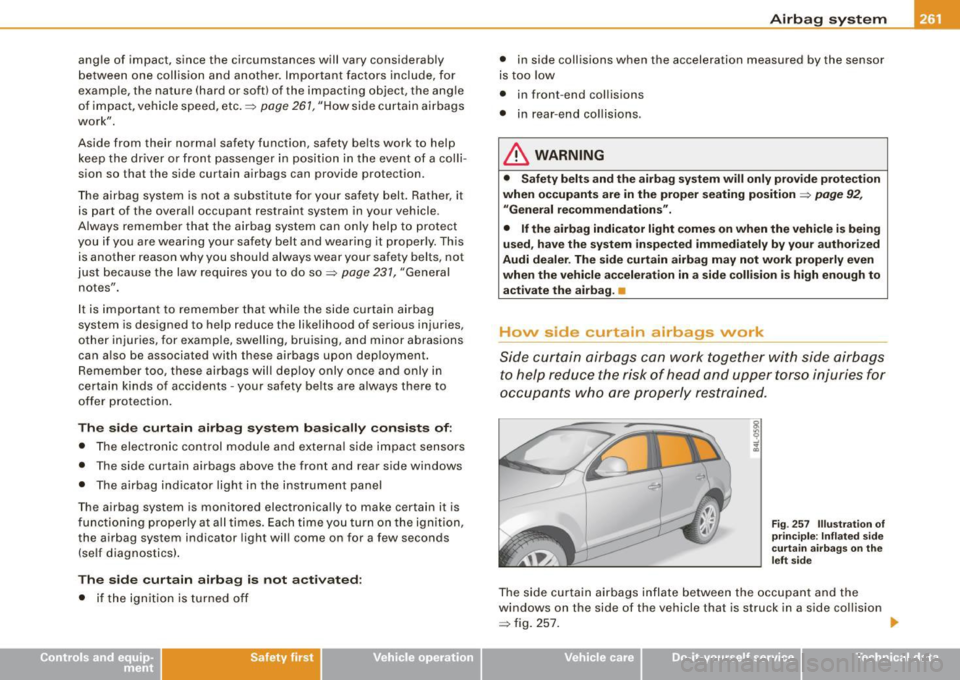
F ig . 2 57 Illus trat ion of
p rinc iple : In fl ate d side
c urt ain a irb ag s on the
left side
The side cu rta in airbags inflate between the occupant and the
windows on the side of the vehicle that is struck in a side collision
~ fig. 257. tt
Vehicle care I I irechnical data
Page 276 of 426
___ C_h_ i_ ld _ S_ a_ f_ e_ t_y ____________________________________________ _
& WARNING (continued)
• If the backrest is not securely latched, the child and the child
restraint will be thrown forward together with the backrest and
will strike parts of the vehicle interior . The child can be seriously
injured or killed.
• Never install rear-facing child safety seats or infant carriers on
the front passenger seat. A child will be seriously injured and can be killed when the passenger airbag inflates .
• The inflating airbag will hit the child safety seat or infant
carrier with great force and will smash the child safety seat and
child against the backrest, center arm rest, door or roof.
• Always install rear-facing child safety seats or infant carriers on
the rear seat.
• Forward-facing child safety seats or infant carriers installed on
the front passenger's seat may interfere with the deployment of
the airbag and cause serious injury to the child.
• It is safer to install a forward-facing child safety seat on the rear
seat. • Always read and heed all WARNINGS whenever using a child
restrained in a vehicle is being used
~ page 263. Special precau
tions apply when installing a child safety seat on the front
passenger seat
~ page 243, "Child restraints on the front seat -
some important things to know ".
L1}. WARNING
Always take special precautions if you must install a forward or
rearward -facing child restraint on the front passenger's seat in
exceptional situations:
• Whenever a forward or rearward -facing child restraint is
installed on the front passenger seat, the PASSENGER AIR BAG
OFF light must come on and stay on whenever the ignition is
switched on .
& WARNING (continued)
• If the PASSENGER AIR BAG OFF light does not come on and stay
on, perform the checks described
~ page 252, "Monitoring the
Advanced Airbag System" .
• Take the child restraint off the front passenger seat and install
it properly at one of the rear seat positions if the PASSENGER AIR
BAG OFF light does not stay on whenever the ignition is switched
on .
• Improper installation of child restraints can reduce their effec
tiveness or even prevent them from providing any protection.
• An improperly installed child restraint can interfere with the
airbag as it deploys and seriously injure or even kill the child.
• Always carefully follow the manufacturer's instructions
provided with the child safety seat or carrier.
• Never place additional items on the seat that can increase the
total weight registered by the weight-sensing mat and can cause injury in a crash.
L1}. WARNING
Forward-facing child restraints:
• Always make sure the forward -facing seat has been designed
and certified by its manufacturer for use on a front seat with a
passenger front and side airbag.
• Never put the forward-facing child restraint up , against or very
near the instrument panel .
• Always move the passenger seat into its rearmost position in
the seat's fore and aft adjustment range, as far away from the airbag as possible before installing the forward-facing child
restraint . The backrest must be adjusted to an upright position.
• Make sure that the PASSENGER AIR BAG OFF light comes on
and stays on all the time whenever the ignition is switched on . _.
Page 322 of 426
___ C_ le_ a _ n_i_n ~g _ a_ n_ d __ p_r _o _t _e _c_ t_ i_o _n ___________________________________________ _
Normal c lea ning
Genera lly, we recommend using a sof t sponge or a lint -free
microfiber cloth to the c lean fabric. Brushes should only be used for
carpets and floor mats, since other fabric surfaces cou ld be harmed
by brushes .
Normal surface stains can be cleaned using a commercially avail
able foam cleaner . Spread the foam on the surface of the fabric with
a soft sponge and work it in g ent ly. Do not saturat e the fabric. Then
pat the foam d ry using abs orbent, dry cl oths (e .g . micro fiber c loth)
and vacuum it after it has dried completely .
Cleaning stains
Stains caused by beverages (e.g. coffee , fruit juice, etc.) can be
treated w ith a mild detergent so luti on. Apply the detergent so lu tion
with a sponge . In the case of stubborn stains , a d etergent paste can
be applied di rectly t o the sta in and worked into the fabric . After
wards , use copious amounts of clean water to remove the
remaining detergen t. Apply the wa ter w ith a damp cloth or sponge
and pat the fabric dry with an absorbent, dry c loth.
Stains from chocolate or makeup should have detergent paste (e .g.
ox -ga ll soap) rubbed into them . Afterwards, remove the soap w ith
water (damp sponge).
A lcohol can be used to treat stains from grease, oil, lipstick o r a ba ll
point pen. Melted grease or dye must be patted off using absorbent material. It may be necessary to retreat the areas with detergent
paste and water.
In the case of genera l soiling of the upholstery and cover material,
we recommend hiring a specialist that has the eq uipment to c lean
the seat covers and other fabric surfaces by shampooing and spray
extraction .
& WARNING
Always read and heed all WARNINGS and th e information
=> page 31 2.
[ i ] T ips
Open Ve lcro fasteners on your clothing can damage the seat cover.
Please make su re that Ve lcro fasteners are c losed .•
Plastic parts and instrument panel
Always use a clean cloth moistened in clea r water to clean these
areas . For persistent dir t use an Audi approved
solvent -free plastic
cleaner/protecta nt.
& WARNING
Solvent s can change the propertie s of some plastics and make it
ha rder for the airbag to deploy .
• Never clean the instrument panel or the surface of airbag
module s with cleaning pr oduct s that contain so lvents .
• Product s containing solvent s w ill make the surface of this part
porou s.
• Seriou s injuries can result if pla stic parts come loo se when the
ai rbag is deployed .
• Alway s read and heed all WARNING S and other info rm ation
=> page 312 .
0 Note
Cleaning agents containing solvents wil l attack the material and can
change the way it behaves .•
Page 332 of 426
___ C_h_ e_ c_k _in --== g'-- a_n _d_ f_il _li _n ..:::g:::..- ___________________________________________ _
Checking and filling
Engine hood
Releasing the engine hood
The engine hood is released from inside the vehicle.
-Open the driver's door.
Fig . 281 Driver's side
footwell: engine hood
release lever
-Pull the release lever on the left under the instrument
panel
=> fig. 281 in the direction of the arrow.
The hood pops up slightly under spring pressure. •
Opening the engine hood
Fig. 282 Release lever
under the engine hood
Before opening the engine hood, make sure that the wind
shield wipers are flat against the windshield. Otherwise,
they could damage the paint on the hood.
Lift the hood slightly =>&, .
- Pull up on the release under the hood => fig. 282. This
releases the catch.
- Open the hood all the way.
The hood is kept in the open position by two gas struts.
& WARNING
Hot engine coolant can burn you.
• To reduce the risk of being burned, never open the hood if you
see or hear steam or coolant escaping from the engine compart
ment. Wait until no steam or coolant can be seen or heard before
carefully opening the hood. •
Page 383 of 426

_________________________________________________ F_ u_ s_ e_s _ a_n _d_ b_ u _ lb_ s _ __._
Fuses and bulbs
Fuses
Replacing a fuse
A problem in the electrical system may be caused by a
blown fuse.
Fig . 307 Ins trument
pa nel left: Face c over
F ig . 308 I nst rume nt
pa nel left: Co ntent
F ac e cover
- Locate the fuse which belongs to the component which
failed.
- Switch off the ignition and the e lectr ica l component
affected. - Carefully p
ry t he face cover off the instr umen t pane l
using the ignition key or a screwdriver~ fig. 307.
- Rem ove the plastic clip @ from i ts retainer in the face
cove r~ fig. 308, p lace i t over the questionable fuse and
remove the fuse.
- Replace a blown fuse (recognizable by the melted metal
str ip inside) wi th a f use of the
same amperage.
The individual circuits are protected by fuses. T he fuse panels with
the fuses are located on the left and right front faces of the instru
ment pane l behind a cover and in the right storage area in the
luggage compartment.
There is a plastic clip @ in the cover on the lef t side of the instru
ment pane l, which can be used to remove the fuses . The crank © is
used for emergency operation of the Panoramic sliding sun roof *.
You w ill also find a label on both covers in the instrument panel with
the fuse layout © for the corresponding fuse panel.
& WARNING
Nev er replac e a fuse with one that ha s a high er amperag e rati ng.
• A fu se w ith a to o high ampe rage could damage the ele ctr ical
pa rt a nd cause a fire .
0 Note
• On no account should fuses be repaired (e .g. patched up wi th tin
foil or wire) as this may cause serious damage elsewhere in the e lec
trica l circuit o r cause fire.
• If a fuse blows repeatedly, do not keep replacing it. Instead , have
the cause of the repea ted short circuit or overload located and fixed.
ti>
Vehicle care Do-it-yourself service Technical data
Page 384 of 426
lllftl.,___F_ u_ s_ e_s _ a_n _ d_ b_ u_lb _ s _______________________________________________ _
[ i J Tips
You are well advised to keep a supply of spare fuses in your vehicle .
Fuses with the proper ampere ratings are available at your autho
rized Audi dealer. •
Fuse Location, Instrument Panel left
Fig . 309 Fuse panel
layout
Some of the equipment items listed are optional or only available on
certain model configurations .
Note that the following table is accurate at the time of going to
press and is subject to change. In the event of discrepancies, the
label on the inside of the cover always takes precedence.
The power seats are protected by circuit breakers, which automati
cally reset after a few seconds after the overload has been reme
died.
No.
Equipment
Fuse holder (red)
1
2
3
Not used
Not used
Not used
Amps
No. Equipment
4 Tire pressure monitoring system
5 Not used
6 Lumbar support driver's seat
7 Window regulators (left side of vehicle)
8 Door control module (left side of vehicle)
9 Battery energy management
10 Electronic ignition lock,
power steering column adjustment
11 Switch module steering column
12 Intelligent
power module convenience
Fuse holder (brown)
1
2
Not used
Not used
3 Not used
4 Wiper system
5 Rain sensor
6 Horn
7
8
9
Intelligent power module driver
Intelligent power module driver
(lights left side of vehicle)
Intelligent power module driver
(lights right side of vehicle)
10 Instrument cluster
11 Headlight washer system
12 Diagnostic connector
Fuse holder (black) Amps
5
10
35 15
5
30
10 5
30
5
25
30
25 25
10
30
10
-