child seat AUDI Q7 2009 Owner´s Manual
[x] Cancel search | Manufacturer: AUDI, Model Year: 2009, Model line: Q7, Model: AUDI Q7 2009Pages: 426, PDF Size: 97.13 MB
Page 281 of 426
Lower a nch orages
The lower anchorage attachment po ints are located between the
rear seatback and rear seat cushion~
page 278, fig. 263 or
~ page 278, fig. 264 .
Lower anchorages secure the child restraint in the seat without
using the vehicle's safety be lts. Anchorages provide a secure and
easy -to -use attachment and minimize the possibility of improper
child restraint installation.
All child restraints manufactured after September 1, 2002, must have lower anchorage attachments for the LATCH system .
Please remember that the lower anchorage points are only intended
for installation and attachment of child restraints specifical ly certi
fied for use with LATCH lower anchorages. Child restraints that are
not equipped with the lower anchorage a ttachments can sti ll be
insta lled in compliance with the child restraint manufacturer's
instructions on using vehicle safety be lts .
& WARNING
Improper in sta llation of child re stra in ts will in crea se the ri sk of
inj ury i n a c ras h.
• Alway s care fully follow th e child re str ain ts m anuf acture r's
i n stru ctio ns for proper inst allati on of the child restraint and
pr oper us e of th e lo wer anchorage s or safet y be lt s i n y our vehi cle.
• Never sec ure or att ach a ny lugg age or othe r item s to th e
LATCH
low er an chor ages.
• Alwa ys read and heed the important information ab out child
r estra ints in thi s chapt er a nd WA RNIN GS
~ page 263, "Child
S afet y". •
Safety first
Child Safety
Ap plie s to vehi cles: with th ird row s eat ing
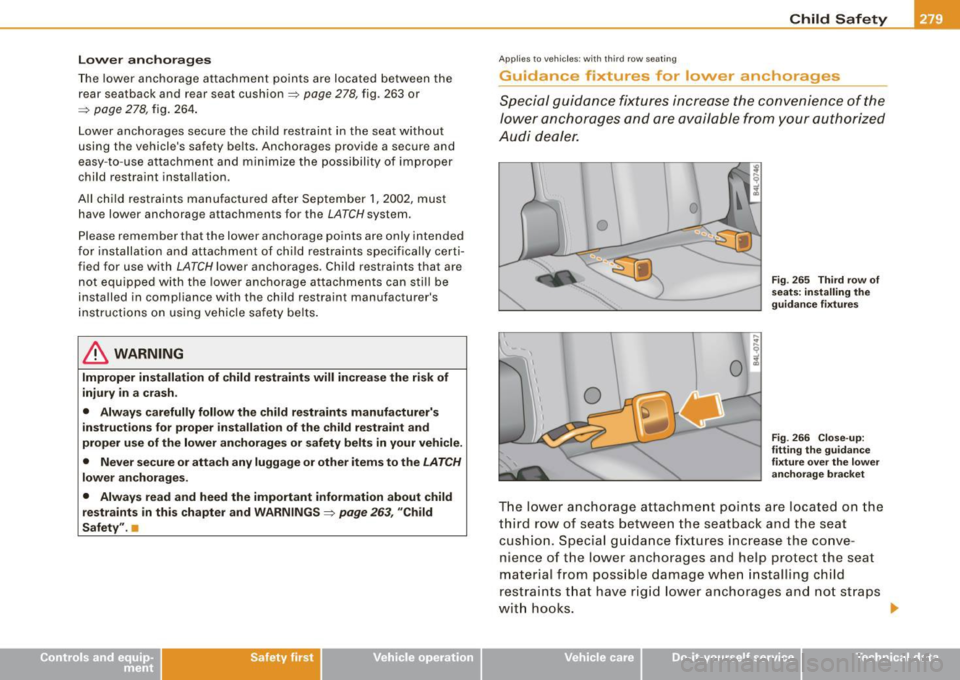
Guidance fixtures for lower anchorages
Special guidance fixtures increase the convenience of the
lower anchorages and are available from your auth orized
Audi dealer.
I
I I
I 0
F ig . 265 Thi rd row of
seats: insta lling th e
g uid ance fixt ure s
Fig . 2 66 Close- up:
f it ting th e gu idan ce
fi xt ure over the lower
a n cho rage brac ket
The lower anchorage attachment points are located on the
third row of seats between the seatback and the seat
cushion. Special gu idance fixtures increase the conve
nience of the lower anchorages and help protect the seat
mate rial from poss ible damage when i nstalling child
restraints t hat have rigid lower anchorages and no t straps
wit h hooks . .,.
Vehicle care I I irechnical data
Page 282 of 426
-L~C~ h~ il~ d ~S~ a~f e ~ ty!._ _____________________________________________ _
In stalling th e guidan ce fixtures
- Push down on the seat cushion so that the lower ancho r
ages are vis ible.
- Hold the guidance fixture with t he part number facing
downward and push it in the direction of the arrow onto
the anchorage =>
page 279, fig. 266.
- Make sure that each of the two guidance fixtures per seat snaps into place.
Removing the guidan ce fixtures
- Re move the child restrain t according the child res tra int
ma nufactur er's instr uct ions.
- Push down on the seat cushion so that the lower anchor
ages are visib le.
- Pu ll off the guidance fixtures from the lower a nch orages.
- Always remove the gu idance fixtures and keep them in a
safe p lace when not in use .
You may find it easier to insta ll child restraints equipped with hooks
attached to straps without the guidance fixtures in place . If this is
the case, remove the guidance fixtures by pu lling them off the
anchorages. However, the guidance fixtures can he lp you to locate
the LATCH anchorages.
& WARNING
Improp er use of tether anchorage s or lower anchorages can cau se
s erio us persona l inj ury i n a cra sh .
• Alway s carefully foll ow the child restraint manuf acturer's
in stru ction s fo r prope r inst allati on and use of child re str aint
sy stems .
& WARN ING (continued )
• Never use the LATCH or tether anchor ages to attach safety
belt s or ot her kinds of occupant re st raint s.
• Child restra int tether attachments and lower attachment s are
only de signed to se cure a child re straint that ha s been equipped
to use the se anchor ages .
• Tether a nchorages and lower anchorage s are desig ned t o with
s tand only those load s imposed by correctly fitted child re straint s.
Under no cir cum sta nce s ca n they be used safel y for adu lt or ch ild
s afety belts or harne sse s.
• Never mount more than one child r estraint to a single tether o r
to a lower an chorage point. Att aching two child restraints to a
s ingle anchorage point can ca use the ancho rag e to fail and cau se
s eri ous per sonal injury in a c rash .
0 Note
• Remove the guidance fixtures before fo lding the rear seatback to
prevent damaging the seat cushion.
• If you leave the guidance fixtures installed for several days, they
cou ld leave a mark on the upholstery on the seat cushion and back
rest in the area that the guidance fixtures were installed. The uphol
stery would also be permanent ly stretched around the guidance
fixtures . This applies especial ly to leather seats .
[ i ] Tip s
• Always remove the guidance fixtures when not in use.
• Please keep the guidance fixtures in a safe place with the vehicle
when not in use. •
Page 283 of 426
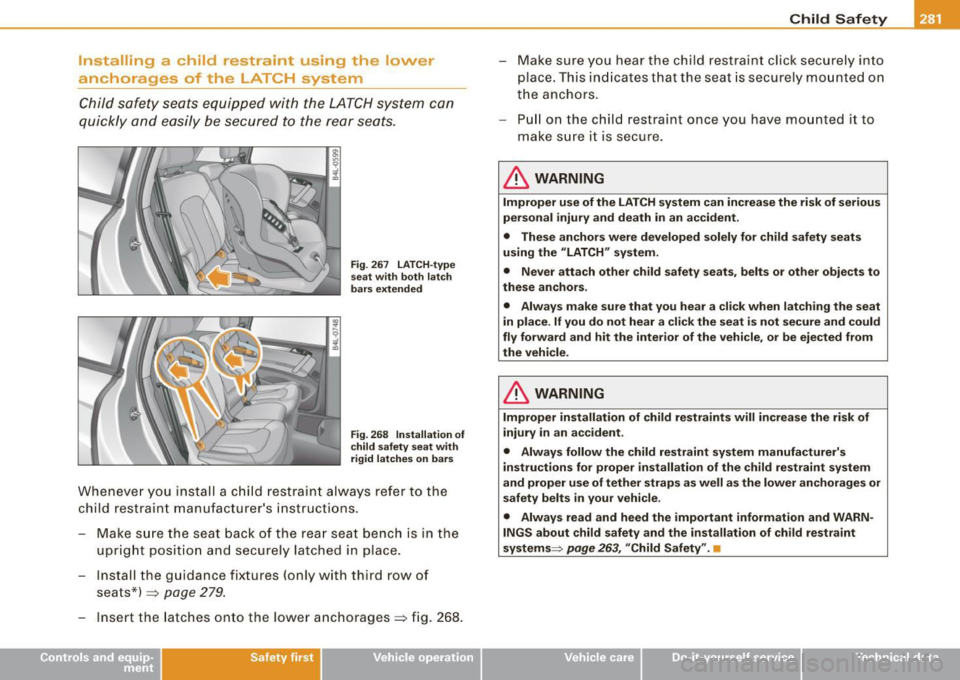
Installing a child restraint using the lower
anchorages of the LATC H system
Child safety seats equipped with the LATCH system can
quickly and easily be secured to the rear
seats.
Fig . 267 LATCH-type
seat with both latch
bars extended
Fig. 268 Installation of
child safety seat with
rigid latches on bars
Whenever you install a child restraint always refer to the
child restraint manufacturer's instructions.
- Make sure the seat back of the rear seat bench is in the
upright position and securely latched in place.
- Install the guidance fixtures (only with third row of seats*) =>
page 279.
- Insert the latches onto the lower anchorages=> fig. 268.
Safety first
Child Safety
- Make sure you hear the child restraint click securely into
place. This indicates that the seat is securely mounted on
the anchors.
- Pull on the child restraint once you have mounted it to
make sure it is secure.
& WARNING
Improper use of the LATCH system can increase the risk of serious
personal injury and death in an accident.
• These anchors were developed solely for child safety seats
using the "LATCH" system.
• Never attach other child safety seats, belts or other objects to
these anchors.
• Always make sure that you hear a click when latching the seat
in place. If you do not hear a click the seat is not secure and could
fly forward and hit the interior of the vehicle, or be ejected from
the vehicle.
& WARNING
Improper installation of child restraints will increase the risk of
injury in an accident .
• Always follow the child restraint system manufacturer's
instructions for proper installation of the child restraint system
and proper use of tether straps as well as the lower anchorages or
safety belts in your vehicle.
• Always read and heed the important information and WARN
INGS about child safety and the installation of child restraint
systems ~
page 263, "Child Safety". •
Vehicle care
I I irechnical data
Page 284 of 426
___ C_h_ i_ld _ S_ a_ f_ e_ t-= y'------------------------------------------------
Mounting and releasing the anchorage hook
If you use a child restraint system with hooks or other
latches attached to adjustable strops.
Mounting
- Press the anchorage hook with the spring catch release
onto the lower anchorage so that the anchorage hook
locks into place.
Pull on the anchorage hook to make sure that it has
securely engaged the lower anchorage.
- Tighten the strap following the child restraint manufac
turer's instructions.
Releasing
Loosen the tension on the strap following the child
restraint manufacturer's instructions.
- Depress the spring catch on the hook.
- Hold the spring catch in depressed position.
- Move the hook in the direction of the vehicle floor so that
there is enough space to release the anchorage hook
from the lower anchorage.
& WARNING
• Improper installation of child restraints will increase the risk of
injuries in a crash.
• Always refer to the child restraints manufacturer's instructions
for proper installation of the child restraint and proper use of the
lower anchorages or safety belts in your vehicle. •
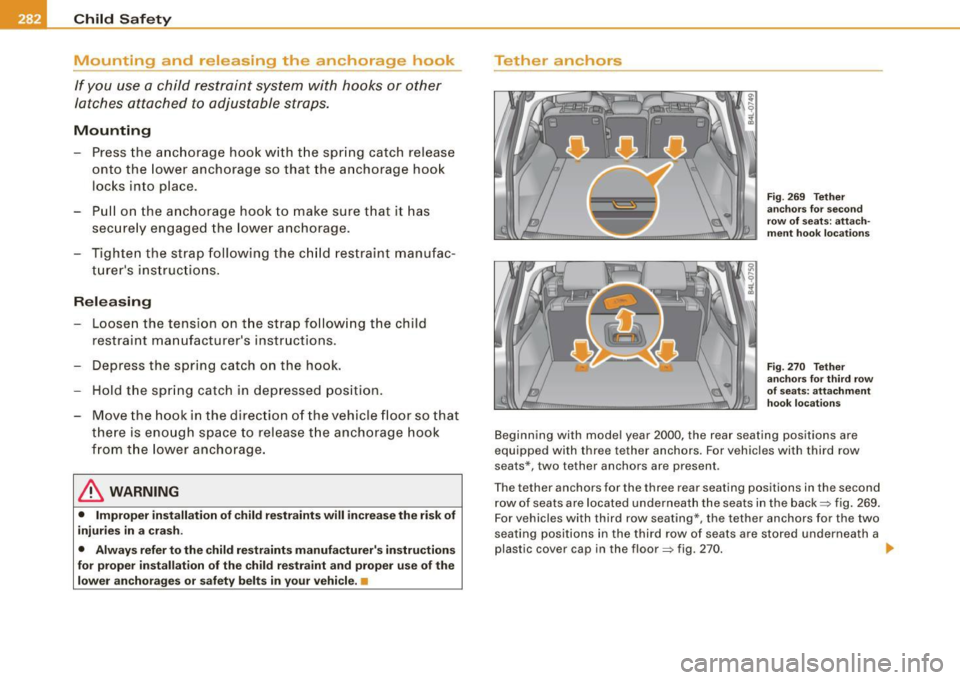
Tether anchors
Fig. 269 Tether
anchors for second
row of seats: attach
ment hook locations
Fig. 270 Tether
anchors for third row
of seats: attachment
hook locations
Beginning with model year 2000, the rear seating positions are
equipped with three tether anchors. For vehicles with third row
seats*, two tether anchors are present.
The tether anchors for the three rear seating positions in the second
row of seats are located underneath the seats in the back=> fig. 269.
For vehicles with third row seating*, the tether anchors for the two
seating positions in the third row of seats are stored underneath a
plastic cover cap in the floor=> fig. 270. .._
Page 285 of 426
& WARNING
Improper installation of child restraints will increase the risk of
injury and death in a crash.
• Improper use of child restraint anchors (tether anchors) could
lead to injury in a collision. The anchors are designed to withstand
only those loads imposed by correctly fitted child restraints .
• Never mount two child restraint systems on one LATCH lower
anchor point .
• Never attach two child restraint systems to one tether strap or
tether anchorage .
• Always follow the instructions provided by the manufacturer of
the child restraint you intend to install in your Audi .
• Never use child restraint tether anchorages to secure safety
belts or other kinds of occupant restraints.
• Never attach a tether strap to a tie-down hook in the luggage
compartment.
• Never secure or attach any luggage or other items to the LATCH
lower anchorages or to the tether anchors.
• If a tether or other strap is used to attach a child restraint to the
front passenger seat, make sure that it is not so tight, that it causes the weight-sensing mat to measure more weight than is
actually on the seat.
• The heavier weight registered can make the system work as
though an adult were on the seat and deploy the Advanced Airbag
when it must be suppressed causing serious or even fatal injury to
the child. •
Safety first
Child Safety
Tether strap
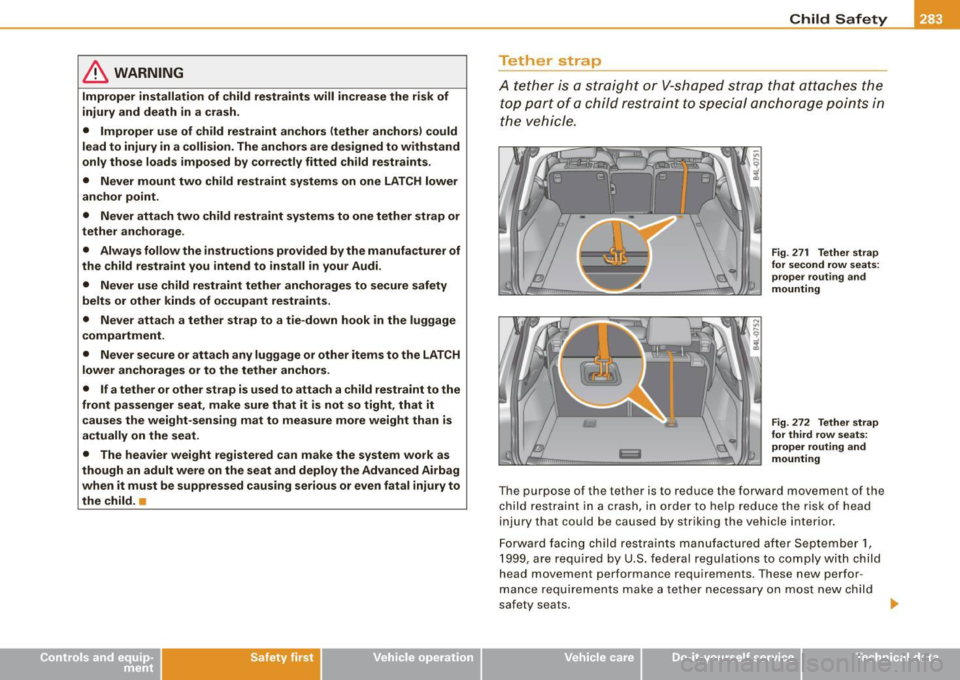
A tether is a straight or V-shaped strap that attaches the
top part of a child restraint to special anchorage points in
the vehicle.
Fig . 271 Tether strap
for second row seats:
proper routing and
mounting
Fig . 272 Tether strap
for third row seats:
proper routing and
mounting
Th e purpose of the tether is to reduce the forward movement of the
child restraint in a crash, in order to help reduce the risk of head
injury that could be caused by striking the vehicle interior.
Forward facing child restraints manufactured after September 1,
1999 , are required by U.S. federal regulations to comply with child
head movement performance requirements. These new perfor
mance requirements make a tether necessary on most new child
safety seats.
~
Vehicle care I I irechnical data
Page 286 of 426
__ _:::C:..:..h ::.i:..:: ld :...:: S:..::a :.:f .:::e :.::t .Ly ____________________________________________ _
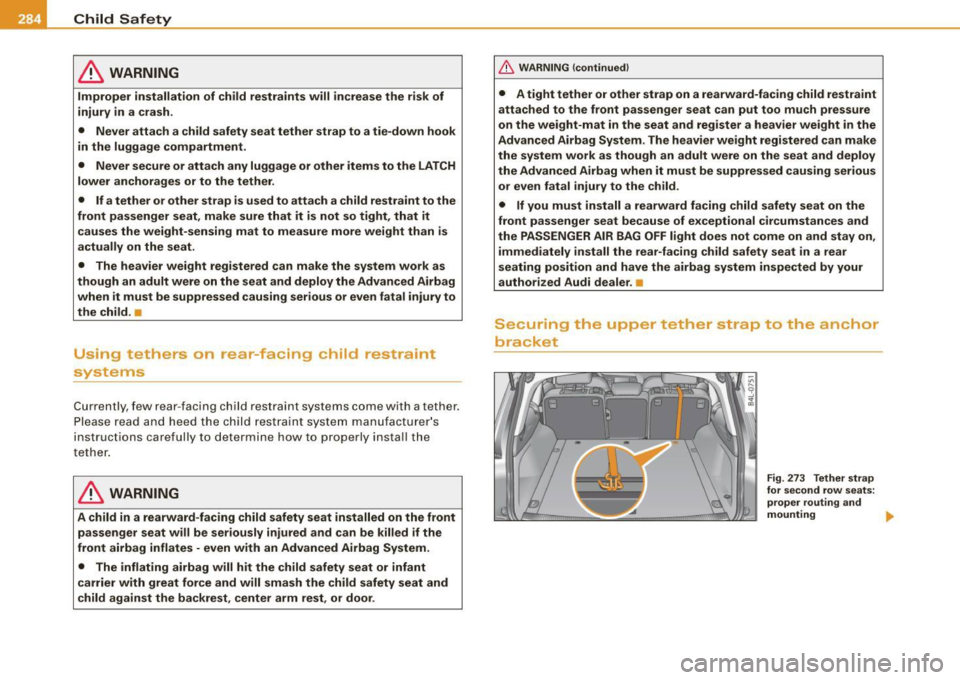
& WARNING
Improper installation of child restraints will increase the risk of
injury in a crash .
• Never atta ch a child safety seat tether strap to a tie-down hook
in the luggage compartment.
• Never se cure or attach any luggage or other items to the LATCH
lower anchorages or to the tether.
• If a tether or other str ap is used to attach a child restraint to the
front passenger seat, make sure that it is not so tight , that it
causes the weight-sensing mat to measure more weight than is
actually on the seat.
• The heavier weight registered can make the system work as
though an adult were on the seat and deploy the Advanced Ai rbag
when it must be suppressed causing serious or even fatal injury to
the child .•
Using tethers on rear-facing c hild restraint
sys tems
Currently, few rear -facing child restraint systems come with a tether .
Please read and heed the child rest raint system manufacturer's
instructions careful ly to determine how to properly insta ll the
tether .
& WARNING
A child in a rearward -facing child safety seat installed on the front
passenger seat will be ser iously injured and can be killed if the
front airbag inflates - even with an Advanced Airbag System .
• The inflating airbag will hit the child safety seat or infant
carrier with great force and will smash the child safety seat and
child against the backrest , center arm rest , or door .
& WARNING (continued )
• A tight tether or other strap on a rearward-facing child restraint
attached to the front passenger seat can put too much pressure
on the weight-m at in the seat and register a heavier weight in the
Advan ced Airbag System . The heavier weight regi stered can m ake
the system wo rk as though an adult were on the seat and deploy
the Advanced Airbag when it must be suppressed causing serious or even fatal inju ry to the child .
• If you must install a rearward facing child safety seat on the
front passenger seat because of exceptional circumstances and
the PASSENGER AIR BAG OFF light does not come on and stay on ,
immed iately install the rear-facing child safety seat in a rear
seating position and have the airbag sy stem inspected by your
authorized Audi dealer . •
Securing the upper tether strap to the anchor
bracket
F ig . 2 73 Tether strap
for second row seat s:
proper r outing and
m ounting ..
Page 287 of 426
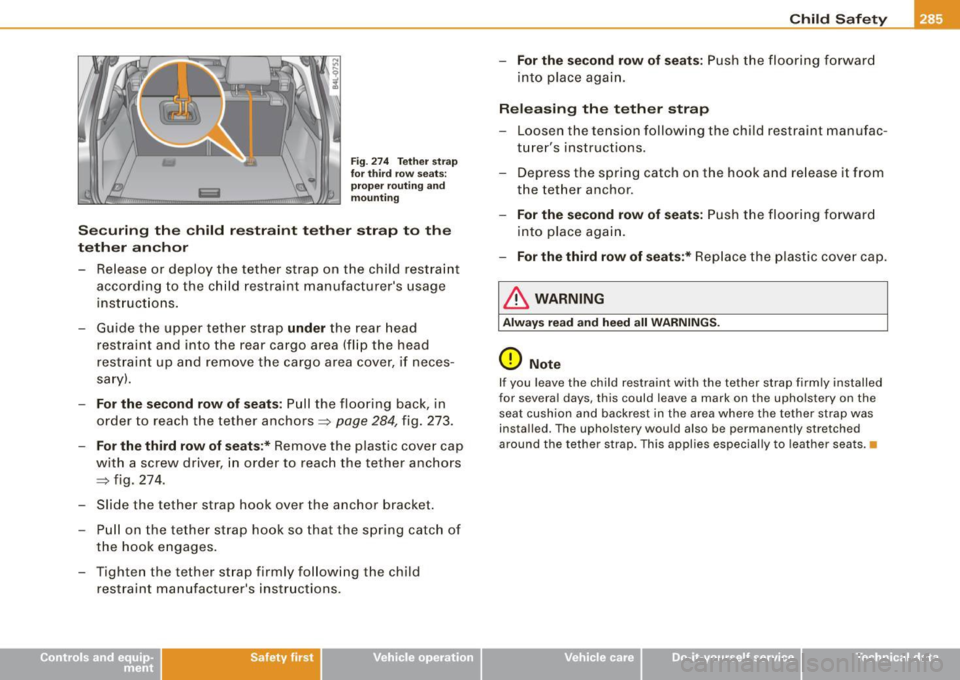
Fig. 274 Tether strap
for third row seats:
proper routing and
mounting
Securing the child restraint tether strap to the
tether anchor
- Release or deploy the tether strap on the child restraint
according to the child restraint manufacturer's usage
instructions.
- Guide the upper tether strap
under the rear head
restraint and into the rear cargo area (flip the head
restraint up and remove the cargo area cover, if neces
sary).
- For the second row of seats: Pull the flooring back, in
order to reach the tether anchors~
page 284, fig. 273.
-For the third row of seats:* Remove the plast ic cover cap
with a screw driver, in order to reach the tether anchors
~ fig. 274 .
- Slide the tether strap hook over the anchor bracket.
- Pull on the tether strap hook so that the spring catch of
the hook engages.
- Tighten the tether strap firmly following the child
restraint manufacturer's instructions.
Safety first
Child Safety
-For the second row of seats: Push the flooring forward
into place again.
Releasing the tether strap
- Loosen the tension following the ch ild restra int manufac
turer 's instructions.
- Dep ress the spring catch on the hook and release it from
the tether anchor.
- For the second row of seats: Push the flooring forward
into place again.
- For the third row of seats:* Replace the plastic cover cap.
& WARNING
Always read and heed all WARNINGS.
0 Note
If you leave the child restraint with the tether strap firmly installed
for several days, this could leave a mark on the uphols tery on the
seat cushion and backrest in the area where the tether strap was
ins talled . The uphols tery would also be permanen tly st ret ched
around the tether strap. This applies especially to leather seats.•
Vehicle care
I I irechnical data
Page 323 of 426
Cleaning and protection IJI
----------------=-----=------
•
Applie s to vehicles: with natural leather
Natural leather
Audi makes great efforts to maintain the properties,
natural look and feel of interior leather.
General
We offer many different types of leather on our vehicles. Most are
different types of nappa leather, which has a smooth surface and
comes in various colors.
The intensity of the color determines the visua l characteristics and
appearance. If the surface of the leather has a typica l natural look,
then the leather is a nappa leather that has been left in a re latively
natural condition. This leather offers particular ly good comfort and
breathes well. Fine veins, closed grains, insect bites, skin folds, and
subtle variations in color remain visible. These characteristics
demonstrate that the material is natural.
Natura l nappa leather is not covered by a color finish. It is therefore
more sensitive to soiling and wear, which is something you need to
consider if children, animals or other factors might prove to be
particularly hard on the leather .
By contrast, leather types that are covered by a colored finish layer
are more durable. This has a positive effect on the leather's resis
tance to wear and soiling in daily use . On the other hand, the typical
characteristics of natural leather are barely or not apparent.
However, this does not mean that the leather itself is of inferior
quality.
Care and handling
Because of the exclusive nature of the types of leather that Audi
uses and their unique properties (such as sensitivity to oils, grease,
soiling, etc.l, you will need to be somewhat careful with these
leathers, and a certain type of care is required. For example, dark
clothing materials can discolor leather seats (especial ly if such
clothing is damp and was not dyed correctly) . Dust and dirt particles in pores, folds, and seams can have an abrasive effect and can
damage the leather surface as well as weaken seams
.
The leather should be cleaned regularly as needed . After having
been used for a relatively long time, your leather seats will acquire
a rich aged finish. This is a characteristic of natural leather and a
sign of true quality.
In order to maintain the value of this natural product over the life of
your vehicle, you should follow the recommendations below:
0 Note
• To keep your leather from bleaching out, do not allow it to be
exposed to bright sun light for long periods of time. If you have to
leave the vehicle parked outside for long periods, cover the leather
to protect it from direct exposure to sunlight.
• Sharp objects on clothing, such as zippers, rivets or sharp pieces
on belts can leave permanent scratches or scrape marks on the
surface of the leather.
[ i ] Tips
• After each time you clean the leather and at regular intervals, use
a leather preservative creme that contains UV -blockers and that
works into the leather . This creme wil l nourish and moisturize the
leather, helping it to breathe and stay supple. It also helps to build
up a protective coating on the surface .
• Clean the leather every 2 -3 months, and clean any areas that get
soiled.
• Remove fresh marks made by ballpoint pens, ink, lipstick, shoe
polish, etc. as soon as possible .
• Preserve the color of the leather as needed by using a special
colored leather care creme to touch up areas of uneven color. •
Vehicle care I t •
Page 410 of 426
lffll __ A_ l..:,. p _ h_ a_ b_e _t_ic_ a_l _in_ d_e_ x ____________________________________________ _
A
Accessories . . . . . . . . . . . . . . . . . . . . . . . . 403
Adaptive Air Suspension .... ... .. .... 206
Cargo mode in the MMI ....... .... 212
Controls . . . . . . . . . . . . . . . . . . . . . . . . 207
Description ... ...... ............ 206
High level . . . . . . . . . . . . . . . . . . . . . . . 207
Highway level . . . . . . . . . . . . . . . . . . . 207
Instrument cluster display .. .... ... 209
Jacking mode when changing a flat tire . 210
Low level ... ... ... .... ..... .. ... 207
Normal level . . . . . . . . . . . . . . . . . . . . 207
Segment display . . . . . . . . . . . . . . . . . 208
Setting the driving modes ......... 208
Trailer towing mode ... .... .... ... 211
Using sw itch for cargo mode .. .... 212
Warning/indicator lights . .......... 21
Adaptive Cruise Control .. .... ..... ... 152
Changing speed ................. 156
Driver information ............... 160
Driver intervention prompt ........ 164
Driving in traffic 154
Driving program .. .... .... .... ... 165
Error messages . . . . . . . . . . . . . . . . . . 163
Open road . . . . . . . . . . . . . . . . . . . . . . 154
Override . . . . . . . . . . . . . . . . . . . . . . . . 154
Request for driver to assume control 154
Save speed . . . . . . . . . . . . . . . . . . . . . . 156
Setting distance . . . . . . . . . . . . . . . . . 158
Setting time interval .............. 158
Settings ........................ 165
Specia l driving situations ......... 165 Status
messages . ....... ... .. ... . 163
Switching on and off .. ........... 155
System limits .. .................. 165
Temporarily turning off ......... .. 157
warn ing/indicator lights ........... 161
Adaptive Light .... ...... ...... ... ... . 76
defective ......................... 37
Adding Engine coolant ... ....... .... .... . 339
Engine oil ... .. .. . ... ....... .... . 336
Windshield washer fluid ...... .... . 346
Additiona l accessories .......... .... . 403
Additives Engine oil ....................... 336
Adjusting Instrument cluster i llumination . .... . 17
Steering column electrically ....... 141
Steering column manually ......... 140
Adjusting front seats .... .... .... . ... . 92
Advanced Parking System with rear view
camera
Adjusting the chimes -option 1 . ... 201
Adjusting the chimes -option 2 .... 202
front and back with visual display and
rear -view camera . . . . . . . . . . . . . . . 191
General information ......... ..... 191
Notes on distance information ... .. 200
Parking next to obstac les . . . . . . . . . . 199
Rear-view camera -parking mode 1 196
Rear -view camera -parking mode 2 . 198
Rear -view camera (Rear View) ... ... 194
Rear -view camera coverage area . . . . 195
Rear -view camera tips ............ 204 Special parking
situations ... .. .. .. 199
Switching the rear-view camera on and
off .... . ... .... .... ... .. .... ... 203
switching the visua l display on and off ..
203
System error message ............ 204
Towing hitch ...... .... ...... .... 201
Air conditioning
See Climate controls 123
Air distribution Climate controls ... ....... .... ... 127
Four -zone automatic comfort air
conditioning ................... 133
Air pol lutants fi lter
Climate controls ................. 123
Airbag Warning/indicator lights . ...... .... . 19
Airbag system .... .... .... ... ... 241, 258
Advanced Airbag System ...... .... 245
Advanced Airbag System components . ..
248
Care ........................ .... 255
Child restraints .................. 265
Children ... .... .... ... ...... ... . 264
Components (front airbags) . ....... 248
Danger of fitting a chi ld safety seat on the
front passenger seat . . . . . . . . . . . . 243
Disposal ............. ....... .... 255
Front airbags .. ........ ...... 245, 246
How do the front airbags work? . ... 250
How many airbags does my vehicle have? 248
How the Advanced Airbag System compo -
nents work together . ........ .... 249
Page 412 of 426
___ A_l.:,. p _h_ a_ b_e _t _ic _ a_l _in _ d_e _x ____________________________________________ _
Brake fluid
Changing the brake fluid ... ... ... .
341
Checking the brake fluid level . . . . . . 341
Reservoir ...... .. .... .... ....... 341
What is the correct brake f luid level? 341
What should I do if the brake fluid warning
light comes on? ........ .... ....
341
Brake light
Defective . . . . . . . . . . . . . . . . . . . . . . . .
27
Brake system ....................... 341
Anti-lock brake system . . . . . . . . . . . . . 22
Brake fluid . . . . . . . . . . . . . . . . . . . . . . 341
Brake f luid specifications for refill and
replacement ...... ...... ...... .
341
Brake pads ..................... . 298
General information . . . . . . . . . . . . . . 291
How does moisture or road salt affect the
brakes? ..... .... ....... .... ...
291
Malfunction ........ ... .. .... .... . 32
Park ing brake . . . . . . . . . . . . . . . . . . . . 147
Warning/indicator lights ... ...... .. 23
Worn brake pads symbol . . . . . . . . . . . 37
Braking guard
See Audi braking guard ... ... .... . 168
Break-in period . . . . . . . . . . . . . . . . . . . . . 297
Brake pads .... .................. 298
Tires .... ... .. .... .... ......... . 297
Breakover angle . . . . . . . . . . . . . . . . . . . . 302
Bulbs ..... ....... .. .... .... ...... . 385
Bumper cover
Caution when parking near a parking bar -
rier or curb .. ... ..... ........ ..
147
C
Ca lifornia Proposition 65 Warning 332
Battery specific .... .... .... .... .. 344
Capac,t,es ... .............. ...... .. 399
Car -Systems
Background lighting . ...... .... ....
79
Lighting profiles . . . . . . . . . . . . . . . . . . 79
Car care ........................... 312
Interior .... .... .... .... ....... .. 319
Plastic and vinyl ........... ... ... 316
Weatherstrips ... .. .... .... ...... 317
Care of exterior ..................... 312
Cargo area
See Loading the luggage compartment . .
227
Cargo floor ......... .... ........ ... 109
Cargo net . . . . . . . . . . . . . . . . . . . . . . . . . .
107
Catalytic converter .. ....... ........ . 298
Center conso le in rear
Central locking 103
Emergency locking ............ .... 57
Panoramic s liding sunroof ...... .... 69
Certification . . . . . . . . . . . . . . . . . . . . . . . . 404
Changing a flat tire .... .... ....... ... 373
Changing a wheel ................... 373
Changing engine oil ... ........ ...... 336
Chassis
Undercoating ... .. .... .... .... ...
318
See also Adaptive Air Suspension . .. 206
CHECK button . . . . . . . . . . . . . . . . . . . . . . . 16
Checking
Engine coolant level
338
Checking tire pressure ............. .. 353
Child restraints
Danger of using ch ild restra ints in the
front seat . . . . . . . . . . . . . . . . . . . . . .
243
What types of child restraint anchors are
available? ... ......... ......... .
276
Where can I get additional information
about child restraints? .... .... .. .
277
Child safety .................... 263, 268
Additional information .. ... .... ... 282
Booster seats . . . . . . . . . . . . . . . . . . . . 271
Convertible child safety seats ... ... 269
Convertible locking retractor .... ... 273
Guidance fixtures for lower anchorages ..
279
Important safety instructions for using
chi ld safety seats ...............
266
Important things to know when driving
with children .. .... ... ..... .....
263
Infant seats ......... ........ .... 268
Install ing a child restraint using the
LATCH system .. ...... ....... ...
281
Lower anchorages ... .. .... .... ... 278
Mounting and releasing the anchorage
hook ..... ........ .... ....... ..
282
Older children and safety belts 272
Safety belts and older children ..... 272
Tether anchors .. ...... .... ...... 282
Tether strap ... .... .... ...... .... 283
Which restraint system should my older
chi ld wear? ... ....... .... .... ..
272