radiator AUDI Q7 2009 Owner´s Manual
[x] Cancel search | Manufacturer: AUDI, Model Year: 2009, Model line: Q7, Model: AUDI Q7 2009Pages: 426, PDF Size: 97.13 MB
Page 16 of 426

Instruments and warning/indicator lights
Warning light in the instrument cluster -t
When the _L warning light in the instrument cluster starts to flash,
this can mean one of two things: either the coolant
temperature is
too high, or the coolant
level is too low~ page 33.
If the needle is well in the upper area of the gauge, the coolant
temperature is too high.
Stop the vehicle, switch the engine off and
allow the engine to cool.
If the warning light comes on again after
driving a short distance, contact an authorized dealer.
& WARNING
• Always observe the warning in ~ page 324, "Engine compart
ment", before opening the hood and checking the engine coolant
level.
• Never open the engine hood if you see or hear steam, or if you
see engine coolant dripping from the engine compartment . You
could burn yourself. Let the engine cool off first so that you cannot
hear or see any steam or engine coolant.
0 Note
• Mounting additional lights or accessories in front of the air inlets
reduces the cooling effect of the radiator. At high outside tempera
tures or high engine load, the engine could overheat.
• The front spoiler has been designed to properly distribute the
cooling air when the vehicle is moving. If the spoiler is damaged,
this could reduce the cooling effect and the engine could then
over
heat. Ask your authorized Audi dealer for assistance. •
Tachometer (engine rev counter)
The tachometer indicates the engine RPM (revolutions per
minutes).
The tachometer 0 ~ page 13, fig. 2 is the left of the two large clock
type displays. The
engine turns at a speed
1,000 times the single digit in the
display, e.g. if the needle is pointing at the "2" the engine is turning
at 2,000 RPM.
If engine RPM drops below 1,500, you should downshift to the next
lower gear. The red area at the end of the scale indicates maximum
permissible engine RPM after the break -in period. Before reaching
this area, move the selector lever to position "D (Drive)" or ease your
foot off the accelerator pedal.
0 Note
The tachometer needle should not move into the red range. If it
does, then only for a
very short period of time. You could damage
your engine by driving at high RPM .
'£> For the sake of the environment
Upshifting early saves fuel and reduces engine noise.•
Digital clock with date display
Date and time of day can be set in the MM/.
Fig . 3 Instrument
cluster with digital
clock
The date, time of day, and time and date format can be set in the
MMI. You can find out more in the MMI manual. .,_
Page 35 of 426
& WARNING (continued)
vehicle control and an accident. Have your vehicle repaired immediately by your authorized Audi dealer or a qualified workshop.
Drive slowly and avoid sudden, hard brake applications. •
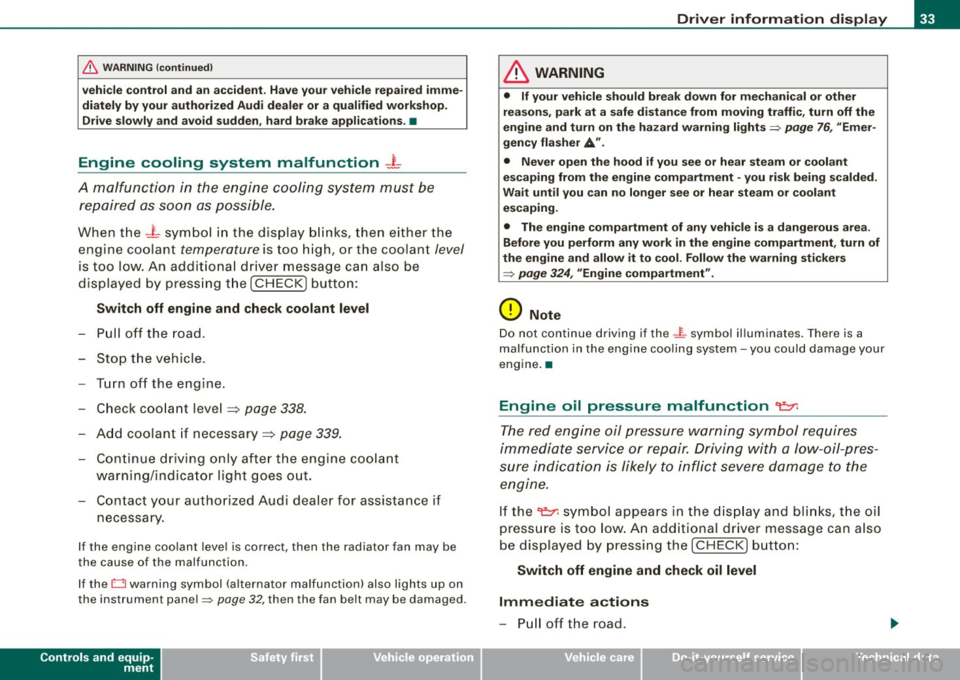
Engine cooling system malfunction -L
A mo/function in the engine cooling system must be
repaired as soon as possible.
When the _ t symbol in the display blinks, then either the
engine coolant temperature is too high, or the coolant level
is too low. An additional driver message can also be
displayed by pressing the [ CHECK] button:
Switch off engine and check coolant level
- Pull off the road .
- Stop the vehicle.
- Turn off the engine.
- Check coolant level => page 338.
- Add coolant if necessary => page 339.
- Continue driving only after the engine coolant
warning/indicator light goes out.
- Contact your authorized Audi dealer for assistance if
necessary.
If the engine coolant level is correct, then the radiator fan may be
the cause of the malfunction.
If the O warning symbol (alternator malfunction) also lights up on
the instrument panel~
page 32, then the fan belt may be damaged .
Controls and equip
ment
Driver information display
& WARNING
• If your vehicle should break down for mechanical or other
reasons, park at a safe distance from moving traffic, turn off the
engine and turn on the hazard warning lights
~ page 76, "Emer
gency flasher
A".
• Never open the hood if you see or hear steam or coolant
escaping from the engine compartment -you risk being scalded.
Wait until you can no longer see or hear steam or coolant
escaping.
• The engine compartment of any vehicle is a dangerous area.
Before you perform any work in the engine compartment, turn of
the engine and allow it to cool. Follow the warning stickers
~ page 324, "Engine compartment".
0 Note
Do not continue driving if the _f_ symbol illuminates. There is a
malfunction in the engine cooling system -you could damage your
engine. •
Engine oil pressure malfunction "l::;r.
The red engine oil pressure warning symbol requires
immediate service or repair. Driving with a low-oil -pres
sure indication is likely to inflict severe damage to the
engine.
If the 'l::::11 symbol appears in the display and blinks, the oil
pressure is too low. An additional driver message can also
be displayed by pressing the [CHECK] button:
Switch off engine and check oil level
Immediate actions
- Pull off the road.
I • •
Page 146 of 426

• ..__O_ n_ t_h _e _ r_o _a _ d __________________________________________________ _
& WARNING
Never start or let the engine run in a confined or enc losed area .
Exhaust fumes from the engine contain carbon monoxide , a color
le ss and odorless gas . Carbon monoxide can be fatal if inhaled .
• Never leave the engine idling unattended . An unattended
vehi cle with a runn ing engine poses a danger of personal injury or
theft.
0 Note
• Avoi d high engine speed s, fa st a ccele rati on or heavy eng ine
loads while the engi ne is sti ll cold. This cou ld damage the engine.
• The e ngi ne canno t be sta rt e d by pushing o r to w ing the vehicle.
~ For the sake of the environment
To avoid unnecessary engine wear and to re duce ex hau st emis
sions, do not let your vehicle stand and warm up. Be ready to drive
off immed iate ly afte r start ing y our veh icle. Maintain modera te
sp eed unt il the engine is completely warm. Remembe r, th e engine
performs best a t operati ng tempe ra ture .•
Stopping the engine
- Turn t he ignit ion key to position ©~ page 1 43, fig. 153 .
& WARNING
• Never turn off the engine until the vehicle has come to a
complete stop.
• The brake booster and servotroni c only work when the engine
is running . With the ignition turned off , you have to apply more
force when steering or braking . Since you cannot steer and stop
normally, this can lead to accidents and serious injuries .
& WARNING (continued )
• The radiator fan can continue to run for up to 10 minutes even
after you have turned off the engine and removed the ignition key .
The radiator fan can also turn on again if the engine coolant heats
up because of inten se sunlight or heat build -up in the engine
compartment .
0 Note
Do not stop the engine immediatel y after hard or extended driving.
Keep the eng ine runn ing f or ap proximate ly t wo minu tes to preven t
excessive heat build -up. •
Starting and stopping the engine
with Convenience key
Ap plies to vehicles: wit h C onvenien ce key
Starting the engine with th e [ START) button
This button s witches on the i gnition and starts the en gine.
Fig. 154 C onvenienc e
key ; EN GINE START
button
T he [ S TA RT ] b utto n is prov ided with two-stage operation
~ fig . 15 4. .,,_
Page 148 of 426

• .___O_ n_ t_h _e _ r_o _a_ d __________________________________________________ _
& WARNING
• Never turn off the engine until the vehicle has come to a
complete stop.
• The brake booster and servotronic only work when the engine
is running. With the ignition turned off, you have to apply more
force when steering or braking. Since you cannot steer and stop
normally, this can lead to accidents and serious injuries.
• For safety reasons, you should always park your vehicle with
the selector lever in P. Otherwise, the vehicle could inadvertently roll away.
• After the engine has been switched off, the radiator fan can
continue to run for up to 10 minutes -even with the ignition
switched off. It can also switch on again after some time if the
coolant temperature rises as the result of a heat buildup or if the
engine is hot and the engine compartment is additionally heated
by the sun's rays.
0 Note
If the engine has been under heavy load for an extended period,
heat builds up in the engine compartment after the engine is
switched off -there is a risk of damaging the engine. Allow the
engine to run at idle for about 2 minutes before switching it off. •
Applies to vehicles: w ith Conven ience key
Driver messages in the instrument cluster
display
If a function is not present, a driver message appears.
No key identified
This message appears when the [STAR T) button is pressed if there
is no master key inside the vehicle or if the system does not recog
nize it . For example, the master key cannot be recognized if it is
covered by an object (e.g. aluminum brief case) which
screens the radio signal. Electronic devices such as cell phones can also inter
fere with the radio signal.
Press brake pedal to start engine
This message appears if you press the [ START) button to start the
engine and do not depress the brake pedal. The engine can only be
started if the brake pedal is depressed.
Engage N or P to start engine
This message appears when the engine is started if the selector
lever for the automatic transmission is not in the P or N position.
The engine can only be started with the selector in these positions.
? Key not in vehicle
This message appears along with the symbol if the master key is
removed from the vehicle with the engine running. It is intended to
remind you (e.g. when changing drivers) not to continue the journey
without the master key.
If the master key is no longer in the vehicle, you cannot switch off
the ignition after stopping the engine and you also cannot start the engine again. Moreover, you cannot lock the vehicle from the
outside with the key.
Shift to P, otherwise vehicle can roll away. Doors do not lock if lever
is not in
P.
This message appears for safety reasons along with a warning
buzzer if the selector lever for the automatic transmission is not in
the P position when the ignition is switched off with the
[STOP)
button and the driver's door is opened. Move the selector lever to
the P position, otherwise the vehicle is not secured against rolling
away. You also cannot lock the vehicle using the locking button on
the door handle or using the remote key.
To engage steering lock, press and hold STOP button
This message appears for safety reasons if the engine and the igni
tion have been switched off by pressing the [
STOP) button once, .,,_
Page 326 of 426
lll'ft __ C_ le_ a _ n_i_n ~g _ a_ n_ d __ p_r _o _t _e _c_ t_ i_o _n ___________________________________________ _
Engine compartment
Be especially careful when cle aning the engine compart
ment.
Alw ays sw itch off the ignition before cle aning the en gine ~ &.
Ple num p anel
Remove leaves from the p lenum pane l in front of the windshield
under the engine hood. This prevents the water drain ho les from
becoming blocked, and it prevents debris from entering the vehicle
inter ior through the hea ting and ventilation ducts .
Corrosion protection
The engine compartment and transmission have been corrosion
protected at the factory .
Good anti-corros ion treatment is very important, particularly in the
winter. If the vehicle is frequently driven on salt treated roads, the
en tire engine compartment and plenum pa nel sh ould be tho r
oughly c leaned at the end of winter and retreated to prevent salt
damage. A t the same time, the underside o f the vehicle shou ld be
washed as well.
If the engine compartment is cleaned at any t ime with grease
removin g solutions
3
l, or if you have the eng ine washed, the anti
corrosion treatment is almost a lways removed as well. It is therefore
essential to have a long -lasting corrosion protection reapplied to all
surfaces, seams, joints and components in the engine compart
ment .
& WARNING
Be awa re: The engi ne compa rtment of any moto r vehicle i s a
potenti ally ha zardou s area .
• Before workin g in the eng ine compartment , be sure to read the
inform ation
~ page 324 .
31 Use on ly the correct cleaning solutions. Never use gasoline or diesel fuel.
& WARN ING (continued )
• Before reaching into the front plenum panel , always remove the
ignition key . Otherw ise, the windshield wiper system could unin
tentionally be swit ched on , po ssibl y causing personal injury from
the moving wiper link age .
• Never re ach into the are a a round or touch the radiator fan . The
au xilia ry fan i s temper ature cont rolled and can swit ch on suddenly
- even when the ignition is off .
• Do not w ash, w ax or dry the engine with the engine run ning.
Moving or hot parts could injure you .
• Do not clean the underside of the cha ssis , fenders , wheel
cover s, or other hard to rea ch parts without protecting your hands
and arm s. You ma y cut your self on sh a rp -edged metal part s.
• Always read and heed all WARNINGS and other inform ation
~ poge312. •
Page 333 of 426
_____________________________________________ C_ h_ e .=....= c..:..k :..:.in :....:..:= g:.....= a..:..n .:....:d::......:. f.:..:il .:..:li ..:..n ::.:g:!....- __
•
Closing the engine hood
- Pull the hood down until the pressure from the struts is
reduced .
- Let the hood
drop down and latch in place. Do not try to
push it shut;
it may fail to engage => &.
& WARNING
A hood that is not completely latched could fly up and block your
view while driving.
• When you close the engine hood, check it to make sure the
safety catch has properly engaged. The hood should be flush with
the surrounding vehicle body parts.
• If you notice while driving that the hood is not secured prop
erly, stop at once and close it. •
Working in the engine compartment
Be especially careful whenever you work in the engine
compartment.
Whenever you must perform any work in the engine compartment,
for example checking and filling different fluids, there is a risk of injury, burns and accidents. To prevent personal injury always
observe the following WARNINGS. The engine compartment of any
vehicle is a hazardous area
~ & .
& WARNING
To help avoid injury, before you check anything under the hood :
• Turn off the engine.
• Remove the ignition key.
• Apply the parking brake .
& WARNING (continued)
• Move selector lever to "P" (Park).
• Always let the engine cool down. Hot components will burn
skin on contact.
• To reduce the risk of being burned, never open the hood if you
see or hear steam or coolant escaping from the engine compart
ment. Wait until no steam or coolant can be seen or heard before
carefully opening the hood.
• Keep children away from the engine compartment .
• Never spill fluids on hot engine components. They can cause a
fire.
• Never touch the radiator fan. The auxiliary electric fan is
temperature controlled and can switch on suddenly.
• Never open the coolant reservoir cap when the engine is still
warm . The coolant system is pressurized and hot coolant could
spray out.
• Protect your face, hands and arm from steam or hot engine
coolant by placing a thick rag over the cap when you open the
coolant reservoir.
• If work on the fuel system or the electrical system is necessary :
- Always disconnect the battery.
- Never smoke or work near heaters or open flames . Fluids in
the engine compartment could start a fire.
- Keep an approved fire extinguisher immediately available.
• To avoid electrical shock and personal injury while the engine
is running or being started, never touch:
- Ignition cables
- Other components of the high voltage electronic ignition system.
• If you must perform a check or repair with the engine running: -First, fully apply the parking brake, move selector lever to "P"
(Park). .,
Vehicle care
I t •
Page 334 of 426
-Checking and filling PW---=---------------
& WARNING (continued )
-Always u se extreme caution to prevent cloth ing , jewelry, or
long hair from getting caught in the radiator fan , V-belt s or
other moving parts , or from contacting hot parts . Tie back hair
before starting , and do not wear clothing that will hang or
droop into the engine .
• Minimize exposure to emis sion and chemical hazards
::::> & .
& WARNING
California Proposition 65 W arn ing :
• Engine exhaust , some of its constituents , and certain vehicle
c omponents cont ain or emit chemicals known to the State of Cali
fornia to cause cancer and birth defects and reproductive harm. In addition , certain fluids contained in vehi cles and certa in products
of component wear contain or emit chemicals known to the State
of California to cause cancer and birth defect s or other reprodu c
tive harm.
• Battery posts , terminals and related ac cessories conta in lead
and lead compounds , chemicals known to the State of California
to cause cancer and reproductive harms. Wash hands after
handling.
0 Note
When adding f luids, always make sure that they are poured into the
proper container or filler ope ning, otherwise serious damage to
vehic le systems wi ll occur.
ci> For the sake of the environment
To detect leaks in time, inspect the vehicle floor pan from under
n eath regu larly. If you see spots fro m oil o r o th e r v eh icle flu ids, hav e
your vehicle inspected by an author ized Audi dea ler. •
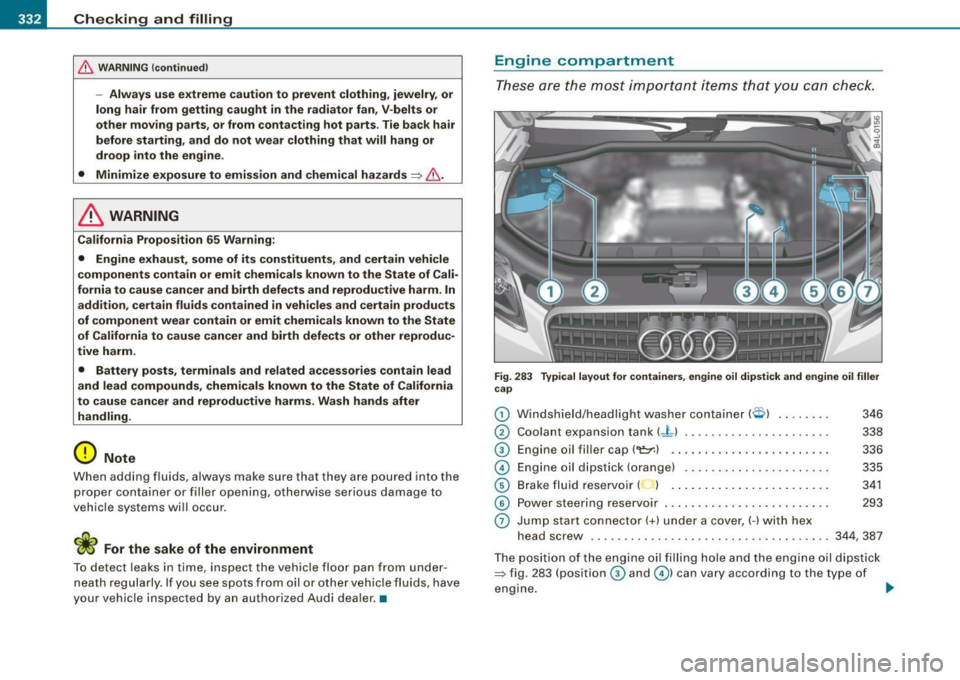
Engine compartment
These are th e m ost im porta nt items th at you can ch ec k.
Fig. 283 Typical layout for containe rs, engine oi l d ipstick and engine oil filler
cap
0 W indsh ield/headligh t was her conta iner ( 9 ) . . . . . . . . 346
0 Coolant e xpansion tank (- L l . . . . . . . . . . . . . . . . . . . . . . 338
G) Engin e oil fi ller cap ("l::r.) . . . . • . . . . . . • • • • . . . • . . • . . 336
© Engine oil d ips tick (orange) . . . . . . . . . . . . . . . . . . . . . . 335
© Brake fluid reservo ir ( ) . . . . . . . . . . . . . . . . . . . . . . . . 341
© Pow er steer ing r eser voir . . . . . . . . . . . . . . . . . . . . . . . . . 2 93
0 Jump sta rt connector( +) u nder a cover,( -) w ith hex
head screw .... ... ..... .... ... .... ... ..... .... . 344 , 387
The positi on of t he e ngin e oil fi lling hole and t he engine oil dipstick
=> fig . 283 (position G) and ©l can vary according to the type of
eng ine. .,_
Page 340 of 426
___ C_h_ e_ c_k _in --== g'-- a_n _d_ f_il _li _n ..:::g:::..- ___________________________________________ _
models; 60% for Canadian models). This mixture both assures the
necessary frost protection and protects metal components in the
engine's cooling system from corrosion and scaling. It also raises
the boiling point of the coolant.
Do not reduce the concentration of the coolant in the summer by
adding plain water.
Th e pro port io n of coo la nt additi ve mu st be at
lea st 50 % but n ot mor e th an 60 %
to maintai n ant ifreeze protection
and cooling efficiency. If the coolant frost protection is too low , the
coolant could free ze and damage the veh icle heating and engine
cooling system .
For year-round driving , antifreeze is added at the factory for temper
atures down to:
• -31 °F ( -35 °c1 usA
• - 40 °F ( - 40 °C) Canada.
You can mix the
Gl 2+ + coolant additive with other additives (G12+
or G12). Always check w ith your authorized Audi dealer.
& WARNING
B efo re you che ck anyt hing in th e eng ine compartmen t, alway s
re ad a nd he ed all WARN ING S~
& in " Working in the engine
c ompar tm ent " on
page 33 1.
0 Not e
• Before winter sets in, have the coolant checked to see if the
coo lant additive in your vehicle is sufficient to meet the climate
conditions. This is especia lly important if you live in a region where
the winter is extremely cold . If necessary, increase the proportion of
coolant additive to 60%.
• When adding coolan t additive to your coo ling system,
remember:
-We recommend using only coolant additive
G12+ + (check the
label) for your vehicle. This coolant additive is avai lable at autho
riz ed Audi dealers. Other types of antifreeze can significantly reduce corrosion protection. The resulting corrosion can cause a
loss of coolant and serious engine damage.
• Do not add any type of radiator leak sealant to your vehicle's
engine coolan t. Adding radiator repair fluid may adversely affect the
function and performance of your cooling system and could result
in damage not covered by your New Vehicle Limited Warranty. •
Checking the engine coolant level
The engine coolant level can be checked with a quick
glance.
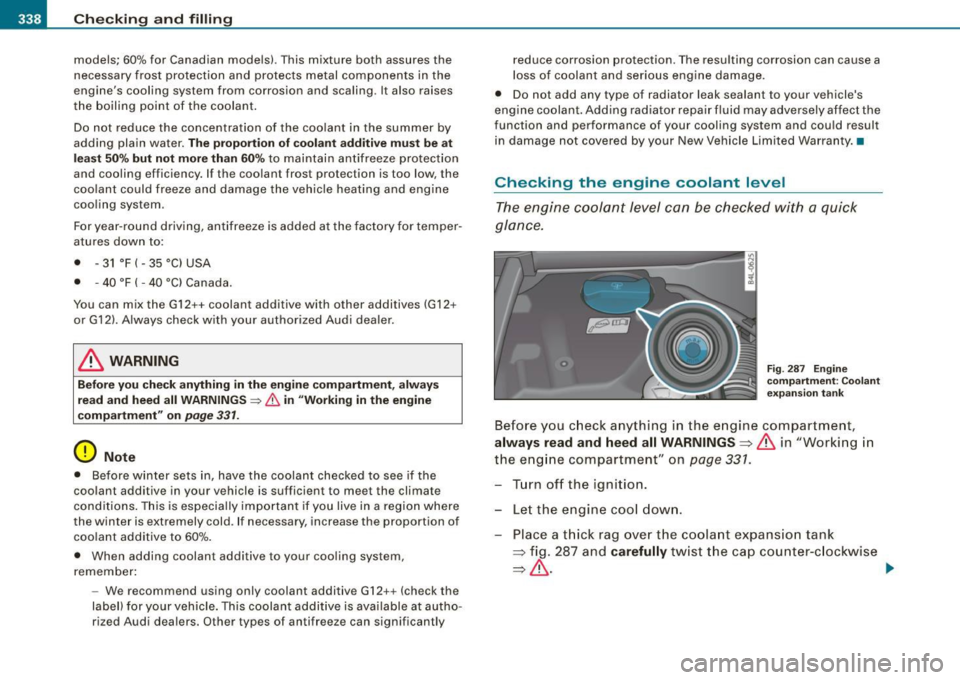
F ig . 287 E ngine
com partm ent : Cool ant
ex pans io n tank
Before you check anything in the engine compartment,
alw ays read and h eed all WARNINGS ~
& in "Working in
the eng ine compartment" on page 331.
- Turn off the ignition.
- Let the engine coo l dow n.
Place a thick rag over the coola nt expansio n tank
~ fig . 287 and carefully twist the cap counter-c lockwise
~ & - .,
Page 341 of 426
___________________________________________ C_ h_e _c_ k_ i_n _g _ a_n _d_ f_il _li _n _g __ lR
•
- Read the engine coolant level in the open coolant expan
sion tank :::::>
page 338, fig. 287. With a cold engine, the
coolant level should be between the "min" and "max"
markings. When the engine is warm, the level may be
slightly above the "max" marking.
The location of the coolant expansion tank can be seen in the
engine compartment illustration~
page 332.
To obtain an accurate reading, the engine must be switched off.
The expansion tank in your vehicle is equipped with an electric
coolant level sensor.
When the coolant level is too low, the warning light in the Auto
Check System~
page 33will blink until you add coolant and the
level has been restored to normal. Even though there is an electric
coolant level sensor, we still recommend you check the coolant level
from time to time .
Coolant loss
Coolant loss may indicate a leak in the cooling system . In the event
of coolant loss, the cooling system should be inspected immedi
ately by your authorized Audi dealer . It is not enough merely to add
coolant.
In a
sealed system, losses can occur only if the boiling point of the
coolant is exceeded as a result of overheating.
& WARNING
The cooling system is under pressure and can get very hot. Reduce
the risk of scalding from hot coolant by following these steps.
• Turn off the engine and allow it to cool down.
• Protect your face, hands and arms from escaping fluid and
steam by covering the cap with a large, thick rag.
& WARNING (continued)
• Turn the cap slowly and very carefully in a counter-clockwise
direction while applying light, downward pressure on the top of
the cap .
• To avoid being burned, do not spill antifreeze or coolant on the
exhaust system or hot engine parts. Under certain conditions, the
ethylene glycol in engine coolant can catch fire.
0 Note
Do not add any type of radiator leak sealant to your vehicle's engine
coolant. Adding radiator repair fluid may adversely affect the func
tion and performance of your cooling system and could result in
damage not covered by your New Vehicle Limited Warranty. •
Adding coolant
Be very careful when adding engine coolant.
Before you check anything in the engine compartment,
always read and heed all WARNINGS:::::> & in "Working in
the engine compartment" on
page 331.
- Turn off the engine.
Let the engine cool down.
Place a thick rag over the coolant expansion tank
=:> page 338, fig. 287 and carefully twist the cap counter
clockwise :::::>& .
Add coolant.
- Twist the cap on again
tightly.
Replacement engine coolant must conform to exact specifications
~ page 337, "Coolant". Even in an emergency, if coolant additive .,,
Vehicle care I t •
Page 342 of 426
-~_C_ h_e _c _ k_ i_n ...:::g::;...._ a_n_ d_ f_ i_ll _in -'g:::;.._ ___________________________________________ _
G12+ +, G12 + or G12 is not available, do not use a different addit ive .
Use p lain water ins tead until you ca n get the c orrec t additive and
can restore the correct ratio . This should be done as soon as
poss ible.
If you have los t a considerable amount o f coo lant, then you s hould
add co ld antifreeze and cold water only when the engine is cold .
A lways us e
new en gi ne c oolant when refi llin g .
Do not fi ll coo lant above the "MAX" mark. Excess coolant wil l be
forced out through the pressure relief valve in the cap when the
engine beco mes hot.
& WARNING
• The cooling sy stem is under pressure and can get very hot .
Reduce the risk of s calding from hot coolant by following these
steps .
- Turn off the engine and allow it to cool down.
- Protect your face, hands and arms from escaping fluid and
steam by covering the cap with a large, thick rag .
- Turn the cap slowly and very carefully in a counter -clockwise
dire ction while applying light , downward pressure on the top
of the cap .
- To avoid being burned , do not spill antifreeze or coolant on
the exhaust system or hot engine parts . Under certain condi
tions , the ethylene glycol in engine coolant can catch fire.
• Antifreeze is po isonous . Always store antifreeze in its original
container and well out of the reach of children.
• If you drain the coolant , it must be caught and safely stored in
a proper container clearly marked "poison ".
0 Note
• Coo lant po llutes t he e nviro nment and cou ld cause a n en gin e
fire. Excess coolant wi ll be forced out through the pressure re lief
va lve in the cap when the eng ine becomes hot.
• I f, in an emergency, on ly wate r can be added, the correct ratio
between wate r and ant ifree ze::::>
page 337 must be restored as soon
as possib le .
W For the sake of the environment
Drained coolant should not be reused. Always dispose of used
coo la nt whi le observ ing all env iro nmen tal reg ulat io n s. •
Radiator fan
The radiato r fan switches on au toma tic ally by i tself.
The radiator fa n is dr iven by the eng ine via th e V -belt. The visco us
clutch regulates the speed of the fan according to the temperature
o f t he coo la nt.
An auxiliary electric radiator fan * sw itches on and off depending on
coo la nt t empe rat ure a nd othe r vehic le operating c ondi tio ns.
A ft er you sw itch the e ngine o ff, the au xiliary fa n ca n conti nue
running for up to 10 m inutes- even with the ignition off. It can even
switch o n again lat er by itsel f::::> & , if
• the temperature of the eng ine coo lant rises due to the heat
bu ild -up from the eng ine in the eng ine compartment, or
• the engine compartment heats up because the vehic le is parked
in i ntense sun ligh t.
& WARNING
• To reduce the ri sk of personal injury never touch the radiator
fan .
~