lock AUDI Q7 2010 Owner´s Manual
[x] Cancel search | Manufacturer: AUDI, Model Year: 2010, Model line: Q7, Model: AUDI Q7 2010Pages: 390, PDF Size: 93.04 MB
Page 323 of 390
Tires and wheels Ill _____________ --=-=--=.:..:......:..::....:.=----
gauge and keep chec king the press ure until you reach t he press ure
th at i s cor rect fo r t he lo ad ( pass en ge rs and l uggage) and kind of
dr iving you plan to do .
If the press ure i n any t ire is too low, note the difference betwee n th e
pressu re in t he cold tire a nd the pressure you need and add the air
that you need to reach the correct pressure for t he ve hicle load
( pass enge rs and lugg age) f or th e tires on yo ur vehicle as l ist ed on t he
on your vehicle and in this manua l and the kind of driving you p lan to
do.
Never exceed the maximum inflation pressure listed on the tire
sidewall for any reason.
Remember that the ve hicle m anufac tur er, no t the tire manufa cture r,
determines t he correct tire press ure for the t ires on your veh icle.
It is important to check the tire pressure when the t ires a re co ld .
• Read the requ ired t ire pr essure from t he t ire pr essure lab el. T he
tire pressure labe l is locate d on t he driver's side 8- pillar. Th e tire pres
s u re labe l lists t he re com men ded col d tire inflat io n pr essures fo r the
vehicle at its maxim um capac ity we ight and the t ires t hat were on
yo ur vehicle at the t ime it was ma nufact ured. For r ecom mende d tire
pressures fo r norma l load cond it ions, please see chapter
=> page 318.
• Turn the valve stem cap co unter -clockw ise to remove it from the
t ire v alve.
• Place the air press ure gauge on the valve.
• The tire p ressures sho uld on ly be checked and adjusted wh en the
tires are cold. The slightly raised press ures of wa rm tires must not be
re du ced.
• Adjust the tire p ress ure to the loa d you are ca rry ing.
• Reinstall the valve stem cap o n the valve .
When should I check the tire pressure?
The correct tire press ure is especially important at high speeds. The
pressu re shoul d there fore be c hec ke d at least once a mo nth a nd
Safety first
always before start ing a journey . Do not forget to check t he t ire pres
s u re for the spare w heel.
When should I adjust the tire pressures?
Adju st the tir e pre ssure to the load y ou ar e carry ing. A fter ch anging a
wheel
or replac ing wheels you have to adjust t he t ire p ressures on all
w heels. I n addition , you m ust th en s tore the new tire press ures i n the
t ir e pressu re monitoring system=>
page 335.
& WARNING
Incorrect tire pressures and/or underinflation can lead sudden tire
failure, loss of control, collision, serious pers onal injury or even
death.
• When the warning symbol appears in the instrument
cluster, stop and inspect the tires.
• Incorrect tire pressure and/or underinflation can cause
increased tire wear and can affect the handling of the vehicle and
stopping ability.
• Incorrect tire pressure s and/or underinflation can also lead to
sudden tire failure, including a blowout and sudden deflation,
causing loss of vehicle control.
• The driver is responsible for the correct tire pressures for all
tires on the vehicle. The applicable pressure values are located on a sticker on the driver's side B-pillar.
• Only when all tires on the vehicle are filled to the correct pres
sure, the tire pressure monitoring system can work correctly.
• The use of incorrect tire pressure values can lead to accidents or
other damage. Therefore it is essential that the driver observe the
specified tire pressure values for the tire s and the correct pres
sures for the function of the tire pressure monitoring system.
• Always inflate tires to the recommended and correct tire pres-
sure before driving off. .,_
Vehicle care Technical data
Page 330 of 390

-~_T_ ir_e_ s_ a_ n_ d_ w_ h_e_ e_ ls _______________________________________________ _
the 22nd week of 2009. The other numbers are marketing codes that
may or may not be use d b y the ti re manu facture r. T his in format ion is
used to contact consumers if a tire de fect requires a recall.
Audi Original tire
T ires with the ident ificat ion "AO" or "RO" have been specially
m atche d w ith your Audi. We recommend using on ly these t ire s
because t hey meet the hig hest standards regard ing safety a nd
dr iving charac teris tics when used corre ctly. Your aut horize d Aud i
dea ler w ill glad ly provide you wi th mor e informatio n.
Tire ply composition and materials used
T he number of p lies indicates the number of layers of rubber-coated
f abr ic in the tire. In ge ne ral, the greate r the numbe r of p lies, the
more weig ht a tire ca n support. Tire manufac turers also mus t indi
c ate the materials in the t ire, which incl ude stee l, nylon, polyes ter,
and others .
Maximum Load Rating
This number ind icates the maximum load in k ilograms and pounds
t ha t can be carried by the tire .
Tire quality grading for treadwear, traction, and
temperature resistance
Tread wear, traction and temperat ure grades~ page 329.
Maximum Permissible Inflation Pressure
Th is number is the greatest amount o f air press ure t hat should eve r
be pu t in the tire under no rm al driv in g c ond ition s.
& WARNING
• Using incorrect or unmatched tires and/ or wheels or improper
tire and wheel combinations can lead to loss of control , collis ion
and seriou s personal injury.
& WARNING (co ntinued )
• Always use tires, rims and wheel bolts that meet the specifica
tions of original factory-installed tires or other combinations that have been specifically app roved by the vehicle manufacturer.
• Tires age even if they are not being used and can fail suddenly,
especially at high speeds . Tires that a re more than 6 years old can
only be used in an emergency and then with special care and at
lower speeds.
• Never mount used tires on your vehicle if you are not sure of
their "previous history ." Old used tires may have been damaged
eventhoughthedamagecannotbeseenthatcanleadtosudden
tire failure and loss of vehicle control.
• All four wheels must be fitted with radial tires of the same
type , size (rolling circumference) and the same tread pattern.
Driving with different tires reduces vehicle handling and can lead
to a loss of control.
• If the spare tire is not the same as the tires that are mounted
on the vehicle - for example with winter tires - only use the spare
tire for a short period of time and drive with extra care . Refit the
no rmal road wheel as soon as safely possible .
• Never drive faster than the maximum speed for which the tires
on your vehicle are rated because tires that are driven faster than
their rated speed can fail suddenly .
• Ove rloading tire s cause heat build-up, sudden tire failure,
including a blowout and sudden deflation and loss of control.
• Temperature grades apply to tires that are properly inflated
and not over or underinflated.
• For technical rea sons it is not always possible to use wheels
from other vehicles- in some cases not even wheels from the same
vehicle model.
• If you install wheel trim discs on the veh icle wheels, make sure
that the air flow to the brakes is not blocked . Reduced airflow to
the brakes can them to overheat , increasing stopp ing distances
and causing a colli sion.
~
Page 333 of 390

Tires and wheels Ill
----------------
& WARNING
Always adjust your driving to the road and traffic condit ions.
Never let the good a cceleration of the winter tires and all-wheel
drive t empt you into tak ing e xtra ri sks. Always rememb er:
• When braking , an all-wheel drive vehicle handle s in the same
way as a front drive vehicl e.
• Drive carefully and reduce your speed on icy and slippery road s,
even winter tires cannot help under black ice condit ions.
c£> For the sake of the environment
Use summer tires when weather co ndit ions permit. They are qu ieter,
do not wea r as qu ickly and r educe fuel consumpt ion. •
Snow chains
Snow c hains m ay be fi tted on ly to the rear w heels, and only to cer tain
tire sizes . Ask your authorized Audi dea ler on wh ich tire sizes snow
c hains can be used .
Th e snow chains must have low-profile links and m ust not be thicker
than 0.53 inch ( 13 .S mm), including the lock .
Remove wheel ce nter covers and trim discs before put ting snow
chains on your vehicle~
0. For safety reasons cover caps must then
be fi tted over t he wheel bolts . T hese a re av ail able fro m auth o rized
Audi dealers.
& WARNING
Using the wrong snow chains for your vehicle or installing them
in correctly can increa se the risk of loss of control leading to
serious personal injury.
Safety first
& WARNING (co ntinued )
• Snow chains are available in different sizes . Always make sure
to follow the instruction s provided by the snow chain manufac
turer.
• When driving with snow cha ins never drive fa ster than the
speed permitted for your specific snow chains .
• Always observe local regulat ions.
0 Note
• Remove snow chains before driving on roads not covered wit h
snow to avoid damaging t ires and wear ing the snow chains down
unnecessar i Ly .
• Snow chains, whi ch come into direc t contac t wi th the w heel rim,
can scratch o r damage it. Therefore, make s ure that the snow chai ns
are sui tably covered. Chec k the pos ition of the snow chains after
dr iv ing a few yards and correct if necessary . Follow the instruct ions
from the snow chain ma nufact urer when do ing so.
• If the Adaptive Air Suspension* should malfunct io n, do not mount
or use snow chai ns because the ve hicle w ill be extreme ly low. If you
do d rive with snow chains on while the vehicle is at this level, the
snow c hains m ight severe ly damage the whee lhouse and other parts
of t he ve hicle .
[ i ] Tips
Whe re snow c ha in s are mandatory on ce rtain roads, t his norm ally
also app lies to vehicles with All Whee l Dr ive. •
Vehicle care Technical data
Page 339 of 390
_____________________________________________ W __ h_a _ t_ d_o_ I_ d _ o_ n_o_ w_ ? _ ___.11111
Release the two hook-and-loop fasteners, and remove the two
chocks . To use the chocks, you first have to raise the support plate
=>
page 336, fig . 248 (D and then insert the locking plate with the
two "tabs" into the elongated holes in the base plate @=>& .
& WARNING
• The chock cannot fulfil its function and may lose its stability if
the "tabs" on the support plate are not inserted correctly into the
elo ngated holes in the base plate. If this happens, the vehicle may
start to move while a wheel is being changed.
• Never use the folding chocks if they are damaged or if they
have not been assembled correctly.
& WARNING
Improper use of the vehicle jack can cause serious personal inju
ries.
• Never use the jack supplied with your Audi on another vehicle,
particularly on a heavier one. The jack is only suitable for use on
the vehicle it came with.
• Using a bumper jack to raise the vehicle will damage the
bumper system. The jack may slip, causing injury.
• Never support your vehicle on cinder blocks, bricks or other
objects . These may not be able to support the load and could cause
injury when they fail.
• Never start or run the engine while the vehicle is supported by
the jack.
• If you must work under the vehicle, always use safety stands
specifically designed for this purpose.
• Always make sure the inflatable spare tire and even a flat tire
are secured in place and not loose, otherwise they could fly
forward, causing personal injury to passengers in the vehicle in an
accident or sudden maneuver. •
Vehicle OP-eration
Applies to vehicles : with bass box
Removing bass box
Before the inflatable spare tire can be taken out, the bass
box must be removed.
Fig. 249 Spare wheel
well: Bass box
Removing bass box
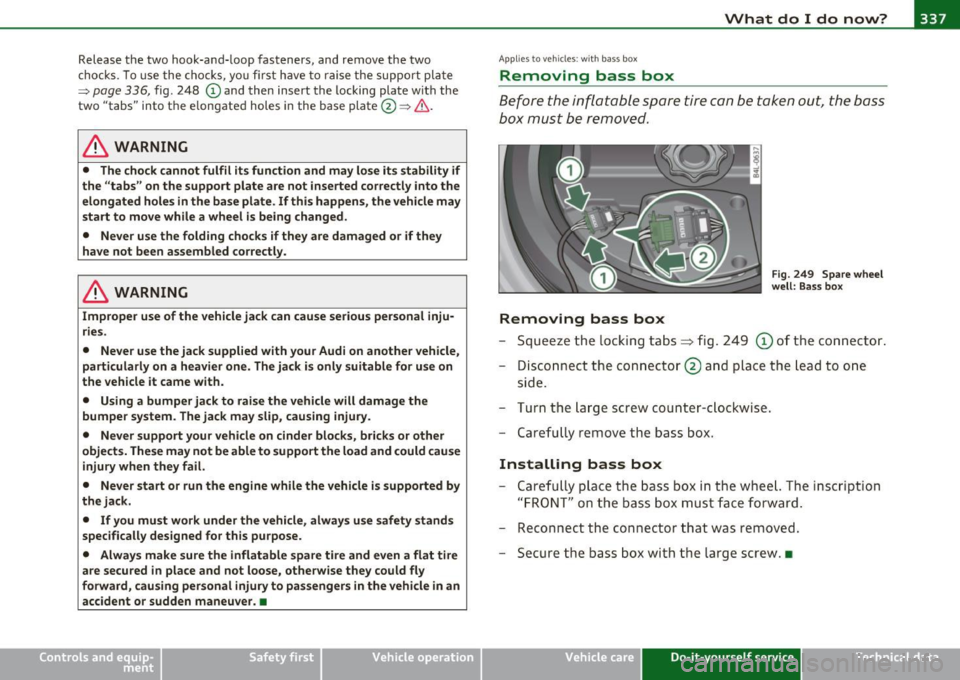
-Squeeze the locking tabs=> fig. 249 (D of the connector.
- Disconnect the connector @ and place the lead to one
side.
- Turn the large screw counter-clockwise.
- Carefully remove the bass box.
Installing bass box
-Carefully place the bass box in the wheel. The inscription
"FRONT" on the bass box must face forward.
- Reconnect the connector that was removed.
- Secure the bass box with the large screw. •
Vehicle care Do-it-yourself service iTechnical data
Page 340 of 390

111...__W_ h_ a_t _ d_ o_ I_d_ o_ n_o _w_ ? ___________________________________________ _
Inflatable spare tire
The inflatable spare tire expands to its full diameter
when it is infl ated.
Removing inflatable spare tire
Fig. 250 I nfl ata ble
sp are tir e wi th
c ompr essor
- Lift up the cargo floor using the handle.
- Turn the large screw=> fig. 250 counter -clockwise .
- Remove the bass box as required==>
page 337.
Take out the in flatab le spare tire .
Stowing the inflatable spare tire
- Release the air by unscrewing the valve stem .
- Screw the valve stem back in afterwards.
- Wa it a few hou rs before placing the w hee l in the spare
wheel well=>
&-
- Install the bass box as required=> page 33 7.
- Secure the whee l with the large screw .
- Fold the cargo floor bac k down .
After using the inflatable spare wheel
The inflatable spare t ire can be re -used as long as it is not damaged
and is not worn down to the tread wear indica tors=>
& -
When you let the air out of the inflatab le spare tire, it does not
assume its folded shape again for severa l hours. Until then, it cannot
be placed back in t he spare wheel well and stowed secure ly.
& WARNING
• Never use the spare tire if it is d amaged or if it is worn down to
the tread wear indicators.
• If the infl atable spare tire is more than 6 years old , use it only
in an emergency and with extreme caution and careful driving.
• The inflatable spa re tire is intended only for temporary and
short-term use. It should be replaced a s soon as possible with the
n o rmal wheel and tire .
• Ma ximum inflation pressure for the inflatable spare tire is
50 PSI (3.5 bar ).
• Ma ximum permiss ible speed is 50 mph (80 km /h ).
• Avo id full-throttle a cceleration, heavy braking, and fast
corne ring .
• When the air is let out of the infl atable spare wheel, it d oes not
assume its folded shape for se veral hours . Until then , it cannot be
pla ced back in the spare wheel w ell and stowed securel y.
• Never drive with more than one inflatable spare tire.
• For technical r easons , the use of tir e chains on the inflatabl e
spare tire i s not permitted. If it i s necessary to dri ve with tire
c ha in s, the inflatabl e spare whe el must be mounted on the front
axle in the event of a flat in a rea r tire. The newly a vailable front
whee l mu st then be installed in place of the re ar wheel with the
flat tire. Ins talling the tire chain before mounting the wheel and
tir e is recomm ended.
• Loo se items in the passenger compartment can cause serious
per sonal injury during hard braking or in an accident . .,,.
Page 342 of 390
111.___W_ h_ a_t _ d_ o_ I_d_ o_ n_o _w_ ? ____________________________________________ _
-Block the diagonally opposite wheel with the folding
chocks or other objects.
- Take the
jack and the inflatable spare tire out of the
luggage compartment =>
page 336.
& WARNING
You or your passengers could be injured while changing a wheel if
you do not follow these safety precautions:
• If you have a flat tire, move a safe distance off the road. Turn
off the engine, turn the emergency flashers on and use other
warning devices to alert other motorists.
• Make sure that passengers wait
in a safe place away from the
vehicle and well away from the road and traffic.
• To help prevent the vehicle from moving suddenly and possibly
slipping off the jack, always fully set the parking brake and block
the wheel diagonally opposite the wheel being changed with the
folding chocks or other objects. When one front wheel is lifted off
the ground, placing the Automatic Transmission in "P" (Park) will
not prevent the vehicle from moving.
• Before you change a wheel, be sure the ground is level and
firm. If necessary, use a sturdy board under the jack.
• After installing the inflatable spare tire, make sure that you
replace the flat tire/wheel in its storage area properly and tighten
the knurled retaining screw securely. •
Changing a wheel
When you change a wheel, follow the sequence described
below step-by-step and in exactly that order .
1. Activate the vehicle jack mode (only vehicles with Adaptive
Air Suspension) =>
page 180.
2. Remove the decorative wheel cover*. For more details see
also =>
page 341, "Decorative wheel covers" or
=>
page 341, "Wheels with wheel bolt caps".
3. Loosen the
wheel bolts=> page 342.
4. Locate the proper mounting point for the jack and align
the jack below that point=>
page 342.
5. Lift the car with the jack=> page 342.
6. Remove the wheel with the flat tire and then install the
inflatable spare tire=> page 344.
7. Tighten all wheel bolts lightly.
8.
Lower the veh icle with the jack .
9. Use the wheel bolt wrench and
firmly tighten all wheel
bolts =>
page 342.
10. Replace the decorative wheel cover*.
11. Deactivate the vehicle jack mode (only vehicles with
Adaptive Air Suspension)=>
page 180.
& WARNING
Always read and follow all WARNINGS and information:::::, & in
"Raising the vehicle" on
page 342 and=> page 345. •
After changing a wheel
A wheel change is not complete without the doing the
following.
- Store and secure the wh eel you replaced in the spare
wheel well.
- Replace the tools and the jack in their proper location .
Page 344 of 390

lffll.,___W_ h_ a_t _ d_ o_ I_d_ o_ n_o _w_ ? ___________________________________________ _
Loosening and tightening the wheel bolts
The wheel bolts must be loosened before raising the
vehicle.
Loosening
Fig . 253 Changing a
wheel: loosening the wheel bolts
-Install the wheel bolt wrench over the wheel bolt and
push it down as far as it will go.
- Take tight hold of the
end of the wrench handle and turn
the wheel bolts
counter-clockwise about one single turn
in the direction of arrow:::::, fig. 253 .
Tightening
-Install the wheel bolt wrench over the wheel bolt and
push it down as far as it will go.
- Take tight hold of the
end of the wrench handle and turn
each wheel bolt
clockwise until it is seated.
& WARNING
• Do not use force or hurry when changing a wheel -you can
cause the vehicle to slip off the jack and cause serious personal
injuries.
& WARNING (continued)
• Do not loosen the wheel bolts more than one turn before you
raise the vehicle with the jack. -You risk an injury.
(I] Tips
If a wheel bolt is very tight, you may find it easier to loosen by care
fully pushing down on the end of the wheel bolt wrench with
one foot
only. As you do so, hold on to the car to keep your balance and take
care not to slip. •
Raising the vehicle
The vehicle must be lifted with the jack first before the
wheel can be removed.
Fig. 254 Changing a
wheel: mounting
points for the jack ..
Page 346 of 390

lffll.___W_ h_ a_t _ d _ o_ I_ d_ o_ n_o _w_ ? ___________________________________________ _
Taking the wheel off/installing the
inflatable spare tire
Follow these instructi ons step-by-step for changing the
wheel
Fig. 256 Ch an ging a
wh eel: alig nm ent pi n
i n si de the to p h ole
After you have loosened all wheel bolts and raised the vehic le
off the gro und, remove and replace the wheel as follows:
Removing the wheel
- Remove the topmost wheel bolt complete ly and set it
aside on a
clean surface.
- Screw the threaded end of the
alignment p in from the
tool kit hand-tight into t he empty bolt ho le~
page 344,
fig . 256.
-Then r emove the other whee l bol ts as describe d above .
- Take off the wheel leaving the a lignm ent pin in the bo lt
hole .
Putting on the inflatable spare tire
-Inflate the inflatable spare tire~ page 339 and push the
wheel over t he alignment pin. -
Screw in and tighten all wheel bolts
slightly .
- Remove the alignment pin and insert and t ighten the
remaining w hee l bolt slightly like the rest .
- Turn the jack handle counter -c lockwise to lower the
vehicle u ntil the jac k is fully released .
Use t he wheel bolt wrenc h to t ighten all w hee l bolts f irmly
~ page 342. Tighten t hem crosswise, from one bolt to
the (approx imately) opposite one, to keep the wheel
cente red .
[I] Tips
• When mounting tires with unid irectional tr ead design make sure
the tread pattern is po inted the r ight way ~
page 344.
• The wheel bolts should be clean and easy to turn. Check for dirt
and corrosion on the mating surfaces of both the whee l and the h ub.
Remove all dirt from these surfaces before remounting the w heel. •
Tires with unidirectional tread design
Tires with unidirectional tread design must be mounted
with their tread pattern pointed in the righ t direction .
Using a spare tire w ith a t read pattern intended for
u se in a specific direction
When usi ng a spare tire w ith a t read pa ttern intended fo r use in a
specific direction, please note the following:
• T he di rec tion of rotation is ma rked by an ar row on the s ide of the
tire.
• If the spare tire has to be installed in the incor rect d irect io n, use
the spare tire only temporar ily since the tire will not be ab le to
a chieve its optim um pe rfo rma nce characteristics with rega rd to
aquaplaning, no ise and wear. _,.
Page 349 of 390
![AUDI Q7 2010 Owner´s Manual ______________________________________________ F _u_s _e_ s_ a_ n_ d _ b _u_l_b _ s _ ___.1111
(]] Tips
You a re well adv ised to keep a supply of spare fuses in your veh icle .
Fuses wit](/img/6/40275/w960_40275-348.png "AUDI Q7 2010 Owner´s Manual ______________________________________________ F _u_s _e_ s_ a_ n_ d _ b _u_l_b _ s _ ___.1111
(]] Tips
You a re well adv ised to keep a supply of spare fuses in your veh icle .
Fuses wit")
______________________________________________ F _u_s _e_ s_ a_ n_ d _ b _u_l_b _ s _ ___.1111
(]] Tips
You a re well adv ised to keep a supply of spare fuses in your veh icle .
Fuses with the proper ampere ratings are available at your authorized
Audi dealer. •
Fuse Location, Instrument Panel left
Fig. 2 59 Fuse pa nel
layou t
Some of the eq uipment items listed a re opt io na l o r only availab le on
certain model configurations.
Note that the following table i s accurate at the time of going to
pre ss and is subject to change . In the event of di scr epancie s, th e
label on the in side of the cover always takes precedence.
Th e power seats are p rotected by circuit breaker s, which a utomat i
cally reset after a few seconds after the overload has been remedied.
No. Equipment
Fuse holder (red)
1
2
Not used
Not used
N ot used
4 T ire pressure monitor ing system
Amps
5
Vehicle OP-eration
No ... Equipment
5 Not used
6 L umbar supp ort dr iver's sea t
7 Window regulators (left side of veh icle)
8 Door control module (left side of vehicle)
9 Not used
1 0 E
lect ronic igni tion lock,
power steering col umn adjustment
1 1 Switch module stee ring column
12 Intell igen t power modu le convenience
Fuse holder (brown)
1 N ot used
2 Not used
3 Seat ventilatio n (left)
4 Wi per system
5 Ra in sensor
6 Horn
7 I ntell igen t po wer mo du le dr ive r
9
10 Intell
igent power module driver
(lights left side of vehicle)
I ntel ligen t power modu le dr iver
(lig hts rig ht side of vehicle)
Instrument cluster
11 Headlight washer system
12 Diagnostic connector
Fu se holder (black)
1 Headlight electronic syst em (left sid e of vehicle)
Vehicle care Do-it-yourself service
Amps
10
35
15
30
10
5
15
30
5
25
30
25
2 5
10
30
10
10
iTechnical data
Page 356 of 390

llft.___E_ m_ e_r -=g =- e_ n_c -=y ;..._ s_i_t _u _a _ t_ i_ o _ n_ s ____________________________________________ _
Connect POSITIVE(+) to POSITIVE(+) (red)
- Open the red cover on the positive pole=> page 353,
fig. 262.
1. Connect one end of the positive cable (red) on the
jump
start bolt=>
page 353, fig. 263 (D (Bolts under red cover
= "positive") of the vehicle to be started @.
2. Connect the other end to the positive terminal @ of the
booster battery @.
Connect NEGATIVE(-) to NEGATIVE(-)
(black)
3. Connect one end to the negative terminal@ of the
booster battery @.
4. Connect the other end of the negative cable (black) to the
jump start bolt© (Bolts with hex head= "negative ") of
the vehicle to be started
@.
Starting the engine
- Start the engine of the vehicle with the booster battery.
Run the engine at a moderate speed.
- Start engine with discharged vehicle battery in the usual
manner.
- If the engine fails to start: do not keep the starter
cranking for longer than 10 seconds. Wait for about
30 seconds and then try again.
- With engine running, remove jumper cables from both
vehicles in the exact
reverse order.
- Close the red cover on the positive pole.
The battery is vented to the outside to prevent gases from entering
the vehicle interior. Make sure that the jumper clamps are well
connected with their
metal parts in full contact with the battery
terminals.
& WARNING
To avoid serious personal injury and damage to the vehicle, heed all warnings and instructions of the jumper cable manufacturer. If
in doubt, call for road service.
• Jumper cables must be long enough so that the vehicles do not
touch.
• When connecting jumper cables, make sure that they cannot
get caught in any moving parts in the engine compartment.
• Before you check anything in the engine compartment, always
read and heed all WARNINGS~
page 286, "Engine compart
ment".
0 Note
Improper hook-up of jumper cables can ruin the generator.
• Always connect POSITIVE(+) to POSITIVE( +), and NEGATIVE( -)
to NEGATIVE(-) ground post of the battery manager control unit.
• Check that all screw plugs on the battery cells are screwed in
firmly . If not, tighten plugs prior to connecting clamp on negative
battery terminal.
• Please note that the procedure for connecting a jumper cable as
described
above applies specifically to the case of your vehicle being
jump started. When you are giving a jump start to another vehicle, do
not connect the negative(-) cable to the negative(-) terminal on the
discharged battery©~
page 353, fig. 263. Instead, securely
connect the negative(-) cable to either a solid metal component that
is firmly bolted to the engine block or to the engine block itself.
If the
battery that is being charged does not
vent to the outside, escaping
battery gas could ignite and explode! •