change time AUDI Q7 2010 Owner´s Manual
[x] Cancel search | Manufacturer: AUDI, Model Year: 2010, Model line: Q7, Model: AUDI Q7 2010Pages: 390, PDF Size: 93.04 MB
Page 302 of 390
___ C_ h_e _c_ k_ i_ n _ g_ a_ n _ d_ f_il _l _in ____ g ___________________________________________ _
Applies to vehicles with diesel engine only : Only if the level of t he
oil is a t or be low the m inimum m ark o n the o il d ipstick -and no o il
that express ly conforms to A udi o il standard VW 507 00 spec ifica
tions is available -may you top off with a high q ua lity engine oil , that
meets ACEA C3 o r API CF spec ifications, but even then, on ly in
viscosity gra des SAE 5W- 40, SAE SW -30, or SAE OW -40 . However,
dur ing t he e ntire time between o il change i nte rvals, neve r top off
w ith more than a tota l of 0.5 qt/liter engine oil that does not
c onfor m to Audi o il specification VW 5 07 00.
For more information about eng ine oi l th at has been approved for
your vehicle, please con tact either your au thorized A udi dea le r or
Aud i Customer Relations at 1 (800) 822 -2834 or vis it our web site at
www.aud iusa .com or www .aud icanada.ca . He re yo u w ill also find a
cu rrent list of oils (manufactu rers, brand names e tc.) that co nform to
Audi oil standard VW 502 00 (vehicles with gaso line e ngine) or VW
507 00 (vehicles w it h die sel eng ine).
Changing the engine oil
The eng ine oil and oil fi lter mus t be changed according to the mileage
(kilome ters) and t ime intervals specified i n your vehicle 's Warranty &
Ma intenance booklet . Do not exceed these interva ls - harmful
deposi ts from o ld engi ne oil can reduce engine pe rfo rmance and ca n
lead to expensive engine repa irs.
C hangi ng the oil at the recommende d interva ls is so very imp ortant
because the lubricating properties of o il decrease gradually during
normal ve hicl e use. If yo u ar e not sure w hen you have yo ur oil
changed, ask your author ized Audi Service Adv isor .
Under some circumstances the eng ine o il should even be changed
more fr eq uent ly. Chang e oil mor e of ten if you d rive mostly short
distances, operate the veh icle in d usty areas or mostly under stop
and -go t raff ic condi tion s, or when you use yo ur vehicle where tempe r
atures stay be low free zing po int for long periods.
De tergen t ad dit ives in the o il wi ll m ake fres h oil look dark a fter the
eng ine has bee n ru nning for a short t ime . This is normal and is not a
reason to ch ang e the oil mo re of ten t han re commended.
Damage or malfunctions due to lack of maintenance
It is essentia l that you change your o il at the recommended intervals
using only en gine oil th at com plies wi th A udi o il st and ard VW 502 0 0
(vehicles w ith gasoline eng ine) o r VW 507 00 (vehicles with d iesel
eng ine) . Your Limited New Vehicle Wa rranty does not cover damage
or ma lfunct ions due to fa ilure to follow recomm ended maintena nce
and use requirements as set forth in t he Au di Owner's Man ua l and
W arranty
& M aintenance boo klet. Y ou r deale r will have to deny
wa rranty coverage unless yo u present to the dealer proof i n th e form
of Se rvice o r Rep air O rders tha t al l sche dul ed main tena nce was
performed in a time ly ma nner. •
Engine oil consumption
To provide effective lubr ication a nd cooling for interna l eng ine parts,
a ll in ter na l c omb ustion e ngines use some oil. Oil cons umption v aries
from engine to engine and may change over the life of the eng ine .
E ngines te nd to use m ore oi l dur ing the b re a k-i n period t han t hey do
after ward, when oil consumption has stab ilized. Depending on t he
way the vehicle is driven and the operatin g cond itions, oi l cons ump
tion ca n be up to a 1 quart per 1,200 miles
(I lite r per 2,000 km) .
Consumptio n may be higher withi n th e first 3,000 m iles (5, 000 km) .
Under nor mal co ndi tions, the rate o f oi l consu mptio n depe nds o n oil
quality as well as viscosity, engine speed ( rpm), o utside tempe rature,
roa d condi tion s, the amou nt of o il d ilution caused by co nde nsed
water or fu el residue, and oxidation of the oil. O il cons umption may
increase wi th en gine we ar ove r time, un til repl aceme nt of worn
eng ine pa rts may become necessa ry.
Because of all these var ia bles, there is no standa rd o r "norma l" rate
of oil consumption .
We urge you to check the engine oil level at
regular intervals, preferably every time you fill the fuel tank, and
always before a long trip .
The oil pressure warning light
~ is not an indicator of low eng ine
oil level. If the warning light does not go out after starting, or
flashes while driving (above 1500 rpm), a buzzer will sound . It
indicates that the oil pressure is too low. Stop the engine immedi- _.,,
Page 305 of 390
___________________________________________ C_ h_e _c _k_ i_n ~g_ a_n_ d_ f_ i_ll _i_n _g __ _
& WARNING
Spilled oil is a fire hazard .
• The oil filler cap must be properly sec ured to prevent oil from
being sprayed on the hot eng ine and e xhaust system when the
engine i s running.
0 Note
• The oil leve l mus t not be above range @-danger of converte r o r
eng ine damage! Contact an author ized dealership to draw off oil, if
necessary .
• Audi does not recommend the use of oil addit ives . The y may
damage the engine and adver sely affect your New Vehicle
Warranty .
For the sake of the environment
• Under no c ircumstances can the o il come in contact with the
sewage netwo rk or the soil.
• Observe and fo llow legal regu lations when d isposing o f empty o il
containers. •
Changing the engine oil
Engine oil must be chang ed at int ervals listed in th e
W arranty
& Maintenance booklet.
Th e eng ine oil an d oi l filter mus t be c hanged accor ding to the mile age
and time interva ls spec ified in your vehicle's Warranty
& Maintena nce
book let. Do not ex ceed these interv als - ha rmfu l sl ud ge and de posi ts
from o ld eng ine oi l can reduce engine performance and can lead to
expensive engine repairs.
Chang ing o il at r egular intervals is so very important because the
L u br icating pro perties of o il decrease gradually d u ring normal veh icle
Safety first
use . If you a re not sure whe n to have the oil changed, as k your autho
r iz ed A udi Serv ice Adv isor.
Under some circumstances t he e ng ine oi l should even be changed
more often than specified for no rma l use . Change oi l more often if
you often drive s ho rt dista nce s, ope ra te the vehicle in d usty a reas or
mostly unde r stop -and-go traffic cond itions, or when you use your
vehicle whe re te mper atures s tay be low free zing po int f or long
per iods.
Detergent addit ives i n the o il w ill make fresh oil look dark after the
engine has bee n running for a short time . This is normal and is not a
reason to chan ge the oil mo re often t han recommended.
& WARNING
Stop! Before working in the engine compartment, always read and
heed all WARNINGS =>
& in "Working in the engine compart
ment" on
page 297. The engine compartment of any motor
vehicle is a potentially dangerous area and can cause serious
personal injury .
& WARNING
If you must change the engine oil in your vehicle:
• Always wear eye protection .
• To reduce the risk of burns from hot engine oil let the eng ine
cool down to the touch.
• When removing the oil drain plug w ith your fingers, stay as far
away as possible. Always keep your forearm parallel to the ground
to help prevent hot oil from running down your arm .
• Drain the oil into a container designed for this purpose, one
large enough to hold at least the total amount of oil in your
engine .
• To reduce the risk of poisoning, never use empty food or
beverage containers that might mislead someone into drinking
from them .
Vehicle care Technical data
Page 310 of 390
![AUDI Q7 2010 Owner´s Manual -Checking and filling
-------=------=---------------------------------------------------
warning/ind icator light will illum inate . Contac t an authorized Aud i
de aler
immediately .
[ i ]](/img/6/40275/w960_40275-309.png "AUDI Q7 2010 Owner´s Manual -Checking and filling
-------=------=---------------------------------------------------
warning/ind icator light will illum inate . Contac t an authorized Aud i
de aler
immediately .
[ i ]")
-Checking and filling
-------=------=---------------------------------------------------
warning/ind icator light will illum inate . Contac t an authorized Aud i
de aler
immediately .
[ i ] Tips
T he b rake fl uid reservoir is located unde rneath t he cover. •
Changing brake fluid
Have the b rake fluid chan ged by an exp eri enc ed t echni
cian.
B ra ke flui d absorbs mois ture fro m th e air . If the w ater con ten t in the
brake fl uid is too high, corros io n in th e brake system may result afte r
a p eriod of time. The boil ing po int of the br ake fl uid will also de cre as e
cons iderab ly and decr ease brak ing performa nce.
Th erefo re, the brake fl uid m ust be changed
every two years. Always
use new br ake fluid w hich conforms to Federal Motor Veh icle Stan
dard "FMVSS 1 16 DOT
4" .
The b rake fl uid reservo ir can be diffi cult to rea ch, there fore, we
recommend that you have the brake fluid c hanged by your author ized
Audi dealer. Your dea ler has the correct tools, the rig ht b rake f luid
and the k now-how to do t his for you .
& WARNING
• Brake fluid is poisonous. It must be stored only in the closed
original container out of the rea ch of children!
• Brake failure can result from old or inappropriate brake fluid.
Observe these precautions:
-Use only brake fluid that meets SAE specification
J 1703 and
conforms to Federal Motor Vehicle Standard 116. Alway s check
with your authorized Audi dealer to make sure you are using
the correct brake fluid. The correct type of brake fluid is also indicated on the brake fluid reservoir .
& WARNING (co ntinued )
-The brake fluid must be new. Heavy use of the brakes can
cause a vapor lock if the brake fluid is left in the system too
long . This can seriously affect the efficiency of the brakes as
well as your safety . This could result in an accident.
0 Note
B rak e fluid will dam age the pai nt of yo u r ve hicl e.
<£> For the sake of the environment
Beca u se of the pr oblem of pro per dispo sal o f b rak e fl uid as we ll a s
the spec ia l too ls req uired and the necessary expertise, we recom
me nd that you h ave t he brake f luid chan ged b y yo ur a uth oriz e d Audi
dea ler. •
Battery
General information
Under normal operat ing co ndit io ns, the battery in your Aud i does not
need any maintenance. With high outs ide temperatures or long daily
dr iv es we re comme nd that yo u have th e ele ct rolyte level checked by
an a uth orized Audi dealer o r qualified wor kshop. The electro lyte leve l
s ho uld a ls o be che cked e ach time the batte ry is ch arge d=>
page 311.
Have the batte ry chec ked when yo u take yo ur vehicle in for serv ice.
Yo u ar e well advised to rep lace a batte ry that is older th an 5 years .
W ith certa in types of airbag deployme nt, the ba ttery is disconnected
from the vehicle e lectrica l system for safety reasons=>
& in "Repair,
c are and dis posa l o f the air bag s" on
page 223. ~
Page 312 of 390
llft!I __ C_ h_ e_c _k _i _ n _g ~ a_n _d_ f_il _l_in _ g _________________________________________ _
& WARNING (conti nu ed )
• Always wear eye protection. Do not let battery acid or any lead
particles get on your skin or clothing. Shield your eyes. Explo sive
gases can cause blindness or other injury.
• Battery acid contains sulfuric acid. Sulfuric acid can cause
blindnes s and severe burns .
- Always wear gloves and eye protect ion. Do not tilt the
battery because acid could leak out of the ventilation open
ings.
- If you get battery acid in your eyes or on your skin , immedi
atel y rinse with cold water for several minutes and get medical
attention.
- If you should ingest any battery acid, seek medical attention
immediately.
• Do not expose the battery to an open flame, elect ric sparks or
an open light .
• Do not smoke.
• Do not int erchange the positive and negative cab les .
• When working on the battery, be sure not to short-cir cuit the
terminals with tools or other metal obje cts. This would cause the
battery to heat up very quickly, which could lead to damage or
explosion and per sonal injury .
• When a battery is charged , it produces hydrogen gas which i s
e xplosive and could cause personal injury.
• Always keep the battery well out of the reach of children .
• Before work is done on the electrical system, disconnect the
negative ground cable.
• Befo re performing any work on the electrical system , swit ch
off the engine and ignition as well as any electrical equipment .
The negative cable on the battery must be disconnected. If you are
ju st going to replace a light bulb, then it is enough to switch off
the l ights.
& W ARNING (continued )
• Before di sconnecting the battery , switch off the anti-theft
alarm system! Otherwise you w ill set off the alarm .
• When disconnecting the battery, first disconnect the negative
cable and then the po sitive cable .
• Before reconnecting the battery , make su re all electri cal
consumers are sw itched off . Reconnect the positive cable first and
then the negative cable. Never interchange the cables - this could start a fire!
• Never charge a frozen or a thawed-out battery. It could
e x plode! If a battery has frozen, then it must be replaced. A
di scharged battery can freeze o ver at 32 °F (0 °C ).
• Make sure the vent hose is always attached to the open ing on
the side of the battery .
• Never use batte ries which are damaged . There is the danger of
an explosion! Alway s repla ce a damaged battery .
& WARNING
California Proposition 65 Warning:
• Battery posts , terminals and related accessorie s contain lead
and lead compounds, chemicals known to the State of California
to cause cancer and reproductive problems. Wash hands after
handling.
0 Note
• Do not disco nne ct the vehi cle battery when t he ign it ion is
switched on o r when the engine is running, otherwise, you wi ll
da mage e le ctronic compone nts in t he e lec trica l system .
• If your ve hicle is go ing to stan d for a long period of time witho ut
bei ng d rive n, protect the ba tte ry from "freezing", ot herwis e it w ill be
damaged and will then have to be replaced.•
Page 314 of 390
-Checking and filling .,,,, _ _..::::.__-=-----------------
& WARNING (continued)
• To reduce the danger of explosion, never connect or disconnect
charger cables while the charger is operating.
• Fast charging a battery is dangerous and should only be
attempted by a competent technician with the proper equipment.
• Battery acid that may spill during charging should be washed
off with a solution of warm water and baking soda to neutralize
the acid.
0 Note
Never use a fast charger as a booster to start the engine. This will seri
ously damage sens it ive electronic components, such as control units,
relays, radio, etc ., as well as the battery charger.•
Battery replacement
The new battery must have the same specifications and
dimensions as the original equipment battery.
Intelligent energy management in your veh icle is responsible for
distributing the electrical energy throughout your vehicle
~ page 259. T he intelligent energy management system will keep
the engine battery charged better then vehicles without this system .
To make sure the additional electrical energy is available once again
after you have changed the battery, we recommend that you install
batteries of the same type and manufacture only (the same as those
installed at the time your vehicle was delivered). Specifications are
listed on the battery housing. Your authorized Audi dealer will then
code the battery management control unit.
If it is not poss ible to use a battery of this type, the new battery must
have the same capacity, vo ltage (12 volts), amperage, construction
and plug sea ling .
When installing the battery, make sure the ignition and all electrica l
consumers are turned off.
0 Note
Make sure the vent ilation hose on the side of the battery is
connected, otherwise fumes or battery acid can leak out.
mend your authorized Audi dealer change the battery for you.
Batteries contain sulfuric acid and lead and must always be disposed
of properly in compliance with all environmental regulat ions.
Disposing of vehicle batteries improperly is very dangerous to the
environment. •
Windshield/headlight washer
container
Fig. 238 Engine
com partm ent : Wind·
shield and headlight"
wash er fluid container
The washer fluid container is marked with the symbol~ on
its cap.
- Before you check anything in the engine compartment,
always read and heed all WARNINGS~ & in "Working
in the engine compartment" on page
297. ..,_
Page 318 of 390
-~_T_ ir_e_ s_ a_ n_ d_ w_ h_e_ e_ ls _______________________________________________ _
Groove
means the space between two adjacent tread ribs.
Load rating (code)
means the maximum load that a tire is rated to carry for a given infla
tion pressure. You may not find this information on all tires because
it is not required by law.
Maximum load rating
means the load rating fo r a tir e at the maximum permissible inflation
pressure for that tire.
Maximum loaded vehicle weight
means the sum of:
(a) Curb weight
(b) Accessory weight
(c) Vehicle capacity weight, and
(d) Production options weight
Maximum (permissible) inflation pressure
means the maximum cold inflation pressure to which a tire may be
inflated. Also called "maximum inflation pressure."
Normal occupant weight
means 150 lbs. (68 kilograms) times the number of occupants seated
in the vehicle up to the total seating capacity of your vehicle.
Occupant distribution
means distr ibution of occupants in a vehicle .
Outer diameter
means the overall diameter of an inflated new tire.
Overall width
means the linear distance between the exteriors of the sidewalls of
an inflated tire, including elevations due to labeling, decorations, or
protective bands or ribs.
Ply
means a layer of rubber -coated paralle l cords.
Production options weight
means the combined weight of those installed regular production
options weigh ing over 5 lbs. (2.3 kg) in excess of those standard
items which they replace, not previously considered in curb weight or
accessory weight, including heavy duty brakes, ride levelers, roof
rack, heavy duty battery, and special trim.
Radial ply tire
means a pneumatic tire in which the ply cords that extend to the
beads are laid at substantially 90 degrees to the centerline of the
tread .
Recommended inflation pressure
see=> page 315, "Cold tire inflation pressure".
Reinforced tire
means a tire design to operate at higher loads and at higher inflation
pressures than the corresponding standard tire. Reinforced t ires may
be identified as "XL ", "x l", "EXTRA LOAD", or "RF" on the sidewall.
Rim
means a metal support for a tire or a tire and tube assembly upon
wh ich the tire beads are seated .
Rim diameter
means nominal diameter of the bead seat . If you change your wheel
size, you w ill have to purchase new tires to match the new rim diam
eter .
Rim size designation
means rim diameter and width.
Rim width
means nom inal distance between rim flanges.
Page 321 of 390
________________________________________________ T_i_re _ s_ a _ n_d_ w_ h_ e_ e_l_s __ _
If you wish to improve comfort when operating the vehicle at
normal load (up to 3 o ccupant s), you can adjust tire pres sures to
those specified for normal vehicle load . Before operating the
vehicle at maximum lo ad, you must increase the tire p res sures to
those specified for maximum vehicle load=>& .
Bear in mind that the tire press ure monitor ing system can only
mon itor the t ire pressu re s you h ave sto red . T he sys tem does no t
recogn ize the load cond it ion of your vehicle.
Th e effectiveness of t he tire pressu re monitoring system will be
impa ired if you store normal load pressu res but then operate the
vehicle at its maxim um loa d=> & . See the
illustration=> fig. 239 for the location of the label on driver's
side B- pillar (colo r of the act ual la bel and ex act l ocation on the
vehicle will vary slig htly).
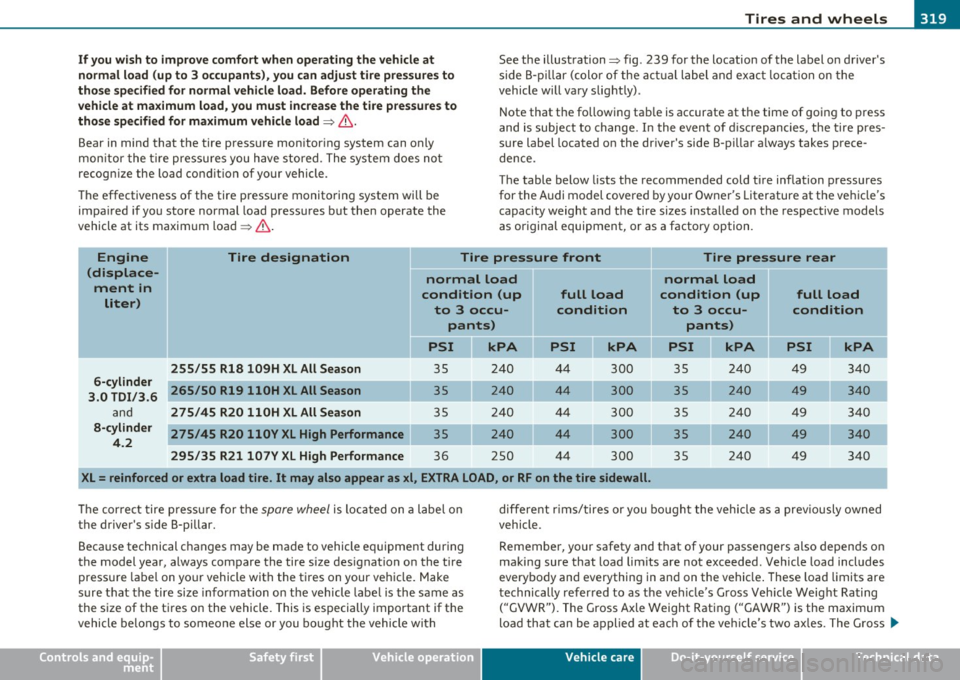
N ote that the fo llow ing tab le is accurate at the time of going to press
and is subjec t to change. I n the even t of discrepancies , the tire pres
sure label located on the dr iver's side B-pi llar a lways takes prece
dence .
T he table below lists the recommended cold t ire inflation pressures
for the Audi model covered by your Owne r's Literature at t he ve hicle's
capac ity weight and the tire sizes insta lled on the respective models
as original equipment, or as a factory option .
Engine Tire designation Tire pressure front Tire pressure rear
(displace- normal load normal load
ment in
liter) condition
(up
full load condition (up
full load
to
3 occu- condition to 3 occu- condition
pants) pants)
PSI kPA PSI PSI kPA PSI kPA
255/55 R18 109H XL All Season 35 240 44 300
35 240 49 340
6-cylinder
265/50 R19 110H XL All Season
35 240 44 300 35 240 49 340 3.0 TDI/3
.6
and 275/45 R20 110H XL All Season 3 5 24 0 44 3 00 35 240 4 9 340
a-cylinder
275/45 R20 llOY XL High Performance 35 240
44 300
35 240 49 340 4
.2
295/35 R2110 7Y XL High Performance
36 250 44
300 35 240 49 340
XL= reinforced or extra load tire
. It may also appear as xi , EXTRA LOAD, or RF on the tire sidewall .
The correct tire p ress ure for t he spare wheel is loca ted on a labe l o n
the driver 's s ide B-pillar.
Beca use technical c hanges may be made to vehicle equipment dur ing
the model year, always compare the tire size des ignation on the t ire
pressu re labe l on yo ur vehicle with the t ires on your vehicle. Make
sure that the tire size informat ion on t he v ehicle labe l is the same as
the size of the t ires o n the vehicle. This is especially important if the
vehicle belongs to so meone else or you bo ug ht the vehicle with
Safety first
differe nt r im s/ tires or you bo ugh t the vehicle as a prev iously owned
vehicle.
Remember, yo ur safety and t hat of your passengers also depends o n
making sure that load limits are not exceeded. Vehicle load includes
everybody and everything in an d on the vehicle . These load limits are
t e chnically refer red to as the veh icle's G ross Veh icle Weig ht Rating
("GVW R"). The Gross Axle Weight Rati ng ("GAWR") is the maximum
load tha t can be applied at ea ch of the ve hicle's two ax les . T he G ross ..
Vehicle care Technical data
Page 336 of 390

lffll __ T_ i_ r_e _s_ a_ n_ d _ w _h _e_e_ l_ s _______________________________________________ _
Tire pressure indicator appears
The tire pressure indicator in the instrument cluster
informs you if the ti re pressure is too low or if there is a
system malfunction.
Fig. 2 44 D ispla y:
u nd erinfl ation
warni ng
Fi g. 2 45 Display:
Syst em m alf un ction
Us ing the ABS sensors, the tire pressure monitoring system compares
t he t ire tread c ircumference and vibrat ion characte rist ics o f the indi
vidual tires. If the pressure decreases in one or more tires, this is indi
cated in the ins trument cl uste r wi th a warning symbol
1 and a
message=> fig. 244 . The dr iver message in the display goes o ut after
5 seconds . T he driver message can be disp layed again by p ressing the
[ CHECK ] button. If only one t ire is affected , the display will ind icate
its position . The tire press
ure monitoring must be reset via MMI each time the
pressu res are adju sted (e.g. when sw itching between partial and full
load pressure) or after chang ing or replacing a t ire on your veh icle
=>
page 335. You can find the recommended tire pressures fo r your
vehicle on the label o n the dr iver's door pillar=>
page 318.
Ti re tread circumference and v ibration characterist ics can change and
c ause a tire p ress ure warning if:
• the tire pressure in one or more tires is too low,
• t he ti re has s tructur al damage,
• the t ire pressure was changed, wheels rotated or rep laced but the
T PM S w as no t rese t=>
page 335.
Warning symbols
' ' Loss of press ure in at least one tir e=> .&. Chec k the t ire or t ires
and rep lace or repair if necessary. The indicator light in the instru-
me nt cluster a lso illumina tes=>
page 14. C heck/co rrect t he p res
sures of all four ti res and reset TPMS via MMI.
( T ire Pressure Monitor ing System)
Tire pre ssure! System
malfunction .
If appears afte r sw itch ing the ignition o n or while
dr iv ing =>
page 334, fig. 24 5 and the indicator ligh t in the ins tru
me nt clus ter blinks for approx imately one minu te and then s tays on,
there is a system ma lfunction . See your a uthorized Audi dealer as
soon as poss ible.
& WARNING
• If the tire pressure indicator appear s in the instrument cluster
display, one or more of your tires is significantly under-inflated.
Reduce your speed imm ediately and avoid any hard steering or
brak ing maneuvers . Stop as soon as possible and check the tires
and their pres sures. Inflate the tire pre ssure to the proper pres
s u re as indicated on the vehicle 's tire pressure label=>
page 318.
Driving on a significantly under-inflated tire cau ses the tire to
overheat and can lead to tire failure . Under-inflat ion also is l ikely
to impair the vehicle 's handling and stopping ability .
~
Page 349 of 390
![AUDI Q7 2010 Owner´s Manual ______________________________________________ F _u_s _e_ s_ a_ n_ d _ b _u_l_b _ s _ ___.1111
(]] Tips
You a re well adv ised to keep a supply of spare fuses in your veh icle .
Fuses wit](/img/6/40275/w960_40275-348.png "AUDI Q7 2010 Owner´s Manual ______________________________________________ F _u_s _e_ s_ a_ n_ d _ b _u_l_b _ s _ ___.1111
(]] Tips
You a re well adv ised to keep a supply of spare fuses in your veh icle .
Fuses wit")
______________________________________________ F _u_s _e_ s_ a_ n_ d _ b _u_l_b _ s _ ___.1111
(]] Tips
You a re well adv ised to keep a supply of spare fuses in your veh icle .
Fuses with the proper ampere ratings are available at your authorized
Audi dealer. •
Fuse Location, Instrument Panel left
Fig. 2 59 Fuse pa nel
layou t
Some of the eq uipment items listed a re opt io na l o r only availab le on
certain model configurations.
Note that the following table i s accurate at the time of going to
pre ss and is subject to change . In the event of di scr epancie s, th e
label on the in side of the cover always takes precedence.
Th e power seats are p rotected by circuit breaker s, which a utomat i
cally reset after a few seconds after the overload has been remedied.
No. Equipment
Fuse holder (red)
1
2
Not used
Not used
N ot used
4 T ire pressure monitor ing system
Amps
5
Vehicle OP-eration
No ... Equipment
5 Not used
6 L umbar supp ort dr iver's sea t
7 Window regulators (left side of veh icle)
8 Door control module (left side of vehicle)
9 Not used
1 0 E
lect ronic igni tion lock,
power steering col umn adjustment
1 1 Switch module stee ring column
12 Intell igen t power modu le convenience
Fuse holder (brown)
1 N ot used
2 Not used
3 Seat ventilatio n (left)
4 Wi per system
5 Ra in sensor
6 Horn
7 I ntell igen t po wer mo du le dr ive r
9
10 Intell
igent power module driver
(lights left side of vehicle)
I ntel ligen t power modu le dr iver
(lig hts rig ht side of vehicle)
Instrument cluster
11 Headlight washer system
12 Diagnostic connector
Fu se holder (black)
1 Headlight electronic syst em (left sid e of vehicle)
Vehicle care Do-it-yourself service
Amps
10
35
15
30
10
5
15
30
5
25
30
25
2 5
10
30
10
10
iTechnical data
Page 350 of 390

-Fuses and bulbs ..._ __________________________________________ _
No.
2
3
4
5
6
7
8
9
10
11
1 2
Equipment
Adaptive Cruise Control
N ot used
N ot used
Not used
T erminal
15 (interior)
O il level sensor
D iagnostic connector
Automatic dipping interior mirror H omelink
Control module Gateway
H eadlight range adj ustment
Amps
5
5
5
5
5
5
5
5
Fuse Location, Instrument Panel right
Fig . 260 Fuse pa nel
la yo ut
Some of the equipment i tems listed a re optiona l or only avai lab le on
certain model configu rations .
Note that the following table i s accurate at the time of going to
pre ss and is subject to change . In the ev ent of di screpancie s, the
label on the inside of the co ver always takes preceden ce.
•
The power seats are protected by circuit break ers , which automat i
cally reset aft e r a few seconds af ter the overload has been remed ied.
No . Equipment
Fuse holder (black)
1 Heated rear seats
2 Automat ic transm issio n
3 Front seat hating/seat ventilation (right)
4 Elect ronic Stability Program (ESP)
5 Door con trol module (right side of vehicle)
6 Rear electrical outlets
7 Lumbar support passenger's seat
8 C igarette ligh ter front
9 Front e lectrical outlets
Amps
20
2 0
1 5
25
10
20
25 __________ .__
10 A/C contro ls
11 Not used
12 Intelligent power module passenger
Fuse holder (brown )
1
2
Headlig ht ele ctronic s ystem (r ight side of vehi
cle)
Ride height adjustment
3 Telephone package
4 Audi side assist
5 Elect ronic Stabilization Prog ram (ES P)
6 Automatic transmission
7 Electronic Stabilization Program (ESP)
8 Shift gate automatic transmission
9 Pa rk ing system
10
15
1 0
5
5
5
5
5/20
5
5
5