steering wheel AUDI Q7 2010 Owner´s Manual
[x] Cancel search | Manufacturer: AUDI, Model Year: 2010, Model line: Q7, Model: AUDI Q7 2010Pages: 390, PDF Size: 93.04 MB
Page 216 of 390
........ _A_ ir_ b_ a-=g :..- s.:o.y _s _t _e_ m _______________________________________________ _
& WARNING (conti nued)
• Airbag work mo st effectivel y when us ed with p roperly worn
safety belts .
• Therefore, always wear your safety belts and make sure that
everybody in your veh icle is properly restrained .
& WARNING
A person on the front passenger seat , especially infants and small
c hildren, will receive seriou s injuries and can even be killed by
being too close to the a irbag when it inflates.
• Although the Advanced Airbag System in your vehicle is
designed to turn off the front passenger a irbag if an infant or a
small child is on the front passenger seat, nobody can absolutely
guarantee that deployment under these special conditions is
impossible in all conceivable situations that may happen during
the useful life of your vehicle.
• The Advanced Airbag System can deploy in a ccordance with the
" low risk" option under the U.S. Federal Standard if a child that is
hea vier than the t ypical one-year old child is on the front
passeng er seat and the other condition s for airbag deployment
are met.
• Accident statistics have shown that children are generally safer
in the rear seat area than in the front seating position .
• For their own safety, all children , especially 12 years and
younger, should always ride in the back properly res trained for
their age and size. •
Advanced front airbag system
Your vehicle is equipped with a front Advanced Airbag System in
compliance wit h Unit ed St ates Fe d er al Motor Vehi cle Safe ty Standar d
208 as applicab le at the time your vehicle was manufactured . The front Advanced A
irbag System supplements the safety belts to
prov ide ad ditional prote ct ion for th e d river's and front passenger's
heads and uppe r bodies in fro nta l crashes. The ai rbags i nflate only in
fronta l impacts when the vehicle dece leration is high enoug h.
Th e front Adva nced A irbag Sys tem for the fron t seat oc cupan ts is not
a s ubstitute for your safety be lts. Rathe r, it is part o f the overall occu
p an t restr aint sy stem in y our ve hicl e. Always remembe r that the
airbag system ca n only help to protect you, if you are sitting upr ight,
we aring your sa fe ty be lt and we aring it prope rly. T his is why you and
your passengers must always be properly restra ined, not just because
t he law requires you to be.
Th e A dvan ced A irbag Syst em in your veh icle has been c ertified to
meet the "low r isk" req uir ements fo r 3 an d 6 year-old c hildren on the
pas senge r side and ve ry small ad ults o n the dr ive r side. T he low r is k
dep loyment cr iteria a re intended to help reduce the risk of injury
t hroug h in teraction wi th the front a irbag tha t can oc cur, fo r ex am ple,
by being too close to the steering wheel and instrument panel whe n
t he air bag i nflates .
In add it ion , the system has been cert ified to comply with t he
"supp ression" requirements of the Safety Standa rd, to t urn off the
front airbag for infants 12 mont hs old and young er w ho are
restrained on the front passenger seat in child restra ints that are
listed in the Standard=>
pag e 233, "Child restra ints and A dvan ced
Airbags".
"Su pp ression" req uires t he front a irbag on the passenger side to be
t ur ned off if:
• a child up to about one year of age is restra ined on the front
passenge r seat in one of t he rear-faci ng or forwa rd-facing infant
restraints listed in Federa l Motor Vehicle Safety Standard 208 w it h
w hich the Adv anced Airbag Sys tem in yo ur vehicle w as ce rt ified. Fo r a
list ing of the child restra ints that were used to certify your vehicle's
c omp li a nce with the US Safety Stand ard =>
page 233,
• weight less than a thresho ld level stored in the contro l unit is
detec ted on t he fro nt p assenger se at.
Page 225 of 390
Airbag system -----------------=--=---
& WARNING (co ntinued )
• Always install forward or rear-facing child safety seats on the
rear seat - even with an Advanced Airbag System .
• If you must install a rearward-facing child safety seat on the
front passenger seat because of exceptional circum stances and
the PASSENGER AIR BAG OFF light does not appear and stay on ,
immediately install the rear-facing child safety seat in a rear
seating pos ition and have the airbag system inspected by your
authorized Audi dealer.
• A tight tether or other strap on a rearward-facing child
restraint attached to the front passenger seat can put too much
pressure on the weight-sensing mat in the seat and register more
weight than is actually on the seat. The heavier weight registered can make the system work as though an adult were on the seat
and deploy the Advan ced Airbag when it must be suppres sed
caus ing serious or e ven fatal injury to the child.
• If, in exceptional circumstances, you must install a forward
facing child restraint on the front passenger seat, always move
the seat into its rearmost position in the seat' s fore and aft adju st
ment range , as far away from the airbag as possible . The backrest
must be adjusted to an upright position. Make sure that the PASSENGER AIR BAG OFF light comes on and stays on all the time
whenever the ignition is switched on.
& WARNING
• If the PASSENGER AIR BAG OFF light doe s not go out when an
adult is sitting on the front passenger seat after taking the steps
described above, make sure the adult is properly seated and
restrained at one of the rear seating posit ions.
• Have the airbag system inspected by your authorized Audi
dealer before transporting anyone on the front passenger seat.
Controls and equip ment Safety first Vehicle operation
(I] Tips
If the we
ight-se nsin g mat in the fro nt passenge r seat detec ts a n
empty seat , the front airbag on the passenger s ide will be t urned off,
a nd the PASSENGER AIR BAG OFF light will sta y on .
a
Repair, care and disposal of the airbags
Parts of the ai rbag syste m are inst alled a t many diffe re nt pla ces on
your Audi. Installing, removing, serv ic ing o r repairing a part in a n
area of t he vehicle c an damage a par t of an a irbag sys tem and preve nt
that system from working proper ly in a coll is ion.
Th ere are some importa nt things you have to know to ma ke sure t hat
t he effectiv eness of the system will not be impai red and that
discarde d components do not cause injury or pollute t he env iron
m en t.
& WARNING
Improper care , servicing and repair procedures can increase the
risk of personal injury and death by preventing an airbag from
deploying when needed or deploying an airbag unexpectedly:
• Never cover, obstru ct, or change the steering wheel horn pad or
a irbag cover or the instrument panel or modify them in any way .
• Never atta ch any objects such as cupholders or telephone
mountings to the surfaces covering the airbag units .
• For cleaning the horn pad or instrument panel, use only a soft,
dry cloth or one moistened with plain wate r. Solvents or cleaners
c ould damage the airbag cover or change the stiffne ss or strength
of the mater ial so that the airbag cannot deploy and protect prop
erly.
• Never repair, adjust , or change any parts of the airbag system .
• All work on the steering wheel, instrument panel, front seats
or electrical system (including the installation of audio equip -
~
Vehicle care Do-it-yourself service Technical data
Page 255 of 390

_________________________________________ I_ n_ t_ e_ ll_,igent technology ,__E~-
fore-and-aft and lateral directions, the brake pressure and the
steering angle are all measured.
The direction in which the driver wishes to travel is determined with
the aid of the steering angle and vehicle speed and is continually
compared with the actual behavior of the vehicle. If the two do not
match, for example, when the vehicle starts hydroplaning on a wet
road, ESP will automatically brake the appropriate whee l to correct
the problem.
The vehicle is then stabi lized by the forces acting on the whee l during
braking. If the vehicle is
oversteering (rear tends to skid out of the
turn), the brakes are main ly applied on the wheel that is on the
outs ide of the curve. In the case of a vehicle that is
understeering
(tendency to slide out of the curve), the brakes are applied as needed
on the wheel that is on the inside of the curve or additionally on the
other wheels. An acoustic s ignal indicates when ESP brake application
cuts in=> &.
The system operates across the entire speed range in combination
with the ABS system ~
page 256 . If the Anti -Lock Brake System
(ABS) ma lfunctions, the ESP wi ll be out of action as well.
Activating
When you turn on the engine, ESP will automatically be activated and
will perform a self-test. As soon as the test is comp leted, the system
is in normal operating mode .
Offroad mode
ESP should normally be operated in normal mode because this
ensures maximum vehicle stability. If necessary, you can activate the
ESP offroad mode by pressing the button=>
page 252, fig. 220 to
obtain maximum traction and braking ability when driving off paved
roads at low speeds. In ESP offroad mode, the ESP indicator light
=> page 16 illuminates and the message ESP Offroad Caution!
Limited driving stability
appears briefly in the disp lay.
The ESP offroad mode can be useful in the following exceptiona l situ
ations when slip or a highly effe ctive different ial loc king funct ion is
desirable. Examples:
Controls and equip ment Safety first Vehicle operation
•
when driving w ith tire chains,
• when driving in deep snow or on loose ground,
• when driving on uneven surfaces with the wheels severely
unloaded (articulation), and
• when rocking the vehicle loose a fter it has become stuck.
When the unusual situation is past, you should sh ift back to the
normal ESP operating mode by pushing the button again. The
message
ESP/ ASR on then appears briefly in the display.
Hill descent control
The hill descent control is switched on in ESP offroad mode. When
slowly descending steep gradients on loose ground or when the axles
are art iculated, hill descent control provides assistance by automati
cally applying the brakes to keep vehicle speed constant. The vehicle
is also rende red easier to steer by select ive distribution of braking
force. Hill descent control intervenes when:
• the accelerator pedal is not pressed,
• the vehicle is travelling less than 12 mph (20 km/h),
• a steep gradient is detected,
• wheel behavior indicates loose ground or conditions with poor
adhesion (e.g. also axle articulat ion).
Hill descent control operates both dr iving forward and in reverse.
Active hi ll descent control is deactivated by pressing the accelerator
pedal until the conditions for activation already listed are met aga in .
& WARNING
• The Electronic Stabilization Program is nevertheless subject to
the laws of physics . It is particularly important to pay attention to
this fact on wet and slippery roads. It is therefore important that
you always adapt your driving to the condition of the road and
traffic conditions. Do not allow the increased safety provided by
the Electronic Stabilization Program system to lull you into
accepting additional safety risks. ..
Vehicle care Do-it-yourself service Technical data
Page 259 of 390
_________________________________________ I_ n_ t_ e_ ll_,igent technology ,__E~-
If an individual wheel begins to rotate too slowly in relation to vehicle
speed and tends to lock, the ABS automatically reduces brake pres
sure to prevent that wheel from locking .
Thi s automatic adjustment process wi ll cause a
slight vibration of
the brake pedal and some noises to alert you that vehicle speed must
be adapted to existing road and traffic conditions.
_& WARNING
Although the ABS is very effective, always remember that braking
capability is limited by tire traction. Always adjust your driving
speed according to the road and traffic conditions. Do not let the
extra safety afforded by the ABS tempt you into taking extra risks.
The ABS cannot overcome the laws of physics .
(I) Tips
• If ABS is not funct ioning properly, a warning light will come on .
See ~
page 19.
• If a fault occurs in the ABS, the EDL is also not functioning. This is
ind icat ed by the ABS warning light. •
Brake assistant
The brake assistant is designed to achieve the optimum
braking effect.
The brake assistant helps to increase the effective braking power and
thus to achieve a shorter stopping distance.
If the driver presses the
brake peda l very qu ickly , the brake assistant automatically boosts the
braking force to the maximum level, up to the point where the anti
lock brake function (ABS) intervenes to stop the whee ls from locking.
You should then keep the brake pedal pressed until the vehicle has
braked to the required speed. The brake assistant switches itself off
as soon as you release the brake pedal.
Controls and equip ment Safety first Vehicle operation
Automatic full braking
assist
This function allows full braking in spite of high brake pedal forces
(e .g . when the brakes are severely stressed because the veh icle is fully
loaded). The driver notices this function through a reduction of pedal
force and increased pedal travel. When the brake pedal is released,
full braking assist switches off again automatically.
If there is an ABS failure, the brak e assistant and automatic full
braking assist are not available.
Th e brake assistant will not be operative if there is a ma lfunction in
the ABS .
_& WARNING
Please remember that the accident risk always increases if you
drive too fast, especially in corners or on a slippery road, or if you
follow the vehicle ahead of you too closely. Increased risk of an
accident cannot be compensated for even by the brake assistant ,
so always maintain a safe speed.•
Servotronic® -advanced power
steering system
The power steering systems uses the power of the
running engine to allow precise steering with little effort.
The advanced Servotronic ® power steering system senses the road
speed and electronically adjusts power assistance to provide
comfortable and safe steering response exactly matched to the
vehicle speed .
Power steering will not work if the engine is off. As a result , the
steering wheel will be hard to turn .
Th e power steering fluid level is checked during the scheduled main
tenance services.
Vehicle care Do-it-yourself service Technical data
Page 260 of 390
Intelligent technology
'-----------------------------------------------
0
Note
If t he re is an elect ro n ic malfunc tion, servotroni c will still funct io n
like a conventional power steering system, provid ing a constant
steer ing suppo rt force tha t is no longer proportiona te to the vehi cle
speed. This is most noticeable when t urning the steer ing wheel at low
speeds (for ex ample when p arki ng) , - m ore effo rt will be req uire d
than usua l.
• Be aw are of the d iffe ren t than usual steeri ng respo nse and adjust
your steering force accord ingly.
• Have t he pr oblem chec ked and set r igh t by a n Audi dea ler as soo n
as possib le .
[I) Tips
• When the engine is runni ng, neve r hold t he steering wheel turned
a ll the way to the r ig ht o r to t he left fo r longe r th an 1 5 seco nd s. The
powe r steering pump will over heat the hydraulic fluid if yo u keep
holding t he s teering w heel turne d all the w ay . This is likely to damage
the power steer ing system.
• If the powe r stee ring sys tem s ho uld fail entire ly, or if the engine
is not running (for examp le, while be ing towed), you will still be able
t o steer the vehicle. Howeve r,
considerably more effo rt will be
required to do so.
• If the powe r stee ring sys tem s ho uld have a leak, or is not func
tioning properly, contact your author ized Audi dealer immediately.
• Th e power s teeri ng system re quir es a specially fo rm ulated
hydraulic fluid. The power stee ring reservoir is the one located
f ar the st to the rea r on t he left side of the eng ine compa rtment
=> page 298 . The correct fluid level in the reservo ir is important for
pr op er f unctio ning o f the power steer ing.•
Dr"v ing witr your quattro®
--------
Wit h All Wheel Drive, all four wheels are d riven .
General information
With All Wheel Drive, power is dist ribu ted to all fo ur wheels. This
hap pens a utomat ically depending o n your dr iv ing style and t he road
conditions at the time. See also =>
page 254, "Electronic different ia l
lock (EDL)" .
Winter tires
When d riving in the win ter, your vehicle with A ll Whee l Dr ive has an
advantage, even w ith regula r tir es. In w inter road con ditions i t may
be advisable to mou nt wi nte r ti res (or all-seaso n tires) for improve d
dr iveability and b raking: these tires m ust be mounted on
all four
wheels .
See also=:> page 330, "W inter tires".
Tire chains
Whe re tire chains are ma nda to ry on certa in roa ds, th is no rma lly a lso
ap plies to vehicles with A ll Whee l Drive =:>
page 331, "Snow chains" .
Replacing wheels/tires
Vehicles wit h All W heel Dr ive must a lways have t ires of the same si ze .
Also avoid tires with different tread depths. For details see page
=> pa ge 32 6, "N ew tires and rep lacing tires and wheels".
& WARNING
Always adjust your driving to road and traffic conditions . Do not
let the extra safety afforded by All Wheel Drive tempt you into
taking extra risks.
• Although the All Wheel Drive is very effective, always
remember that braking capacity is limited by tire traction. You
should therefore not drive at excessive speeds on icy or slippery
road surfaces.
• On wet road surfaces, be careful not to drive too fast because
the front wheel s could begin to slide on top of the water (aqua- ...
Page 336 of 390

lffll __ T_ i_ r_e _s_ a_ n_ d _ w _h _e_e_ l_ s _______________________________________________ _
Tire pressure indicator appears
The tire pressure indicator in the instrument cluster
informs you if the ti re pressure is too low or if there is a
system malfunction.
Fig. 2 44 D ispla y:
u nd erinfl ation
warni ng
Fi g. 2 45 Display:
Syst em m alf un ction
Us ing the ABS sensors, the tire pressure monitoring system compares
t he t ire tread c ircumference and vibrat ion characte rist ics o f the indi
vidual tires. If the pressure decreases in one or more tires, this is indi
cated in the ins trument cl uste r wi th a warning symbol
1 and a
message=> fig. 244 . The dr iver message in the display goes o ut after
5 seconds . T he driver message can be disp layed again by p ressing the
[ CHECK ] button. If only one t ire is affected , the display will ind icate
its position . The tire press
ure monitoring must be reset via MMI each time the
pressu res are adju sted (e.g. when sw itching between partial and full
load pressure) or after chang ing or replacing a t ire on your veh icle
=>
page 335. You can find the recommended tire pressures fo r your
vehicle on the label o n the dr iver's door pillar=>
page 318.
Ti re tread circumference and v ibration characterist ics can change and
c ause a tire p ress ure warning if:
• the tire pressure in one or more tires is too low,
• t he ti re has s tructur al damage,
• the t ire pressure was changed, wheels rotated or rep laced but the
T PM S w as no t rese t=>
page 335.
Warning symbols
' ' Loss of press ure in at least one tir e=> .&. Chec k the t ire or t ires
and rep lace or repair if necessary. The indicator light in the instru-
me nt cluster a lso illumina tes=>
page 14. C heck/co rrect t he p res
sures of all four ti res and reset TPMS via MMI.
( T ire Pressure Monitor ing System)
Tire pre ssure! System
malfunction .
If appears afte r sw itch ing the ignition o n or while
dr iv ing =>
page 334, fig. 24 5 and the indicator ligh t in the ins tru
me nt clus ter blinks for approx imately one minu te and then s tays on,
there is a system ma lfunction . See your a uthorized Audi dealer as
soon as poss ible.
& WARNING
• If the tire pressure indicator appear s in the instrument cluster
display, one or more of your tires is significantly under-inflated.
Reduce your speed imm ediately and avoid any hard steering or
brak ing maneuvers . Stop as soon as possible and check the tires
and their pres sures. Inflate the tire pre ssure to the proper pres
s u re as indicated on the vehicle 's tire pressure label=>
page 318.
Driving on a significantly under-inflated tire cau ses the tire to
overheat and can lead to tire failure . Under-inflat ion also is l ikely
to impair the vehicle 's handling and stopping ability .
~
Page 374 of 390
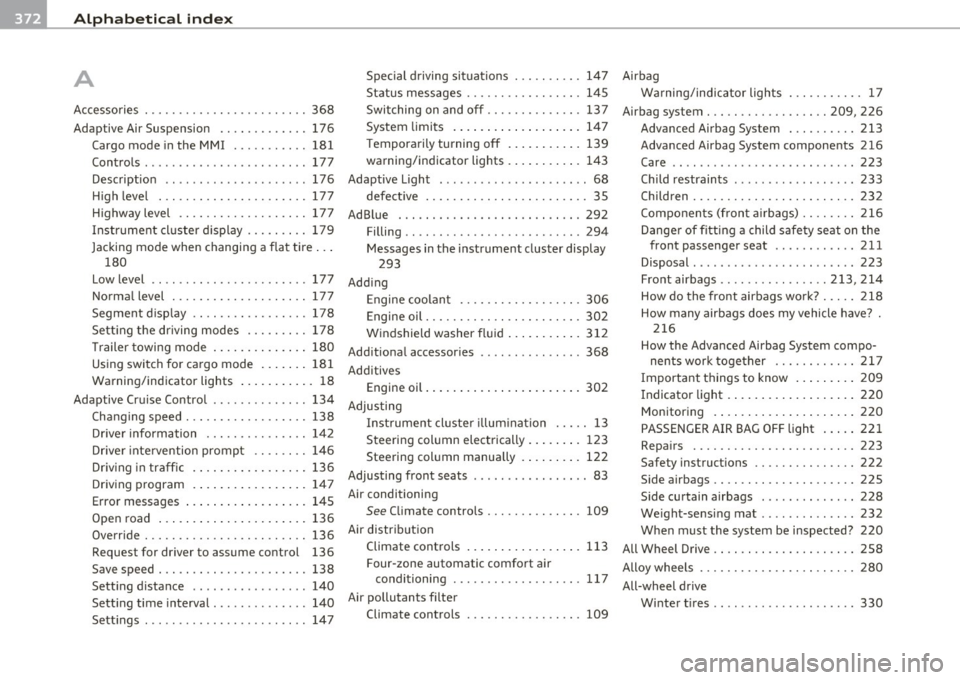
-Alphabetical inde x Plff ___,__ ______________ _
A
Accessories . .. .. ..... .... ... ..... .. 368
Adap tive Ai r Suspension ....... ...... 176
Cargo mode in the MM I ........ ... 181
Controls . . . . . . . . . . . . . . . . . . . . . . . . 177
Description .. .. .. .. .. .. .. .... ... 1 76
H igh leve l ... .. .. .. .. .. .... ..... 177
H ighway level .. ...... ..... .. .. .. 17 7
Inst rume nt cl uste r d isplay ....... .. 179
Jacking mode when changing a flat tire ...
180 Spe
cial d riving si tua tions ... .. .. ... 147
Status messages . . . . . . . . . . . . . . . . . 145
Switching on and of f ....... .. .. .. . 13 7
System limi ts . ... .. .. .... .. .. .. . 147
T emporarily tu rning off ... .. .... .. 139
warning/indicator lights . .. .. ... .. . 143
Adaptive Light ..... ... ... ... .. .. .. .. 68
defect ive ...... ...... .... .. .. .... 35
AdBlue . .. .. ...... ....... .... .. .. . 292
Filling .. .. ... .... .... ..... .... .. 294
Messages in the instrument cluster display
293
Low level .. .. .. .. .. .. ..... ..... . 177 Add ing
No rma l level ............ .. .... . .
Segmen t disp lay .. .. .. .. .... .... .
Sett ing t he driving modes ....... . . 17
7
178
17 8
Tr ailer towi ng mode ....... ... .. .. 1 80
Us ing switch fo r ca rgo mode .... .. . 18 1
Wa rning/indicator lights ... .. ... ... 18
Adaptive Cr uise Co ntro l .. ..... ... .. .. 1 34
Cha ng ing speed . .. .... .. ......... 138
Dr ive r information ....... ...... . .
Drive r inte rvention prompt .. .... . . 1
4 2
14 6 E
ngine coolant ........... ...... . 30 6
E ngine oil ...... ...... .... .. .. ... 302
W indshield washer fl uid ... .. .. .. .. 312
Additiona l accessories ... ... . ... .. .. . 368
Additives Engine oil ....... ..... .. .. .. .. .. . 302
Adjusting Inst rument cl uste r illum ination .. .. . 13
Steeri ng col umn elect rically .. ... .. . 123
Steering col umn manually . ... .. .. . 122
Dr iv ing in tra ffic . ... ... ... .... .. .
Dr iv ing p rogram . ... .. .. ... .... . . 1
36
1 47 Adjusting front seats
............. .. .. 83
Error messages . . . . . . . . . . . . . . . . . . 145
Open road ..... .. .. .. .. ... .... .. 136
Override ............ .... .... .. .. 136 Ai
r conditioning
See C limate contro ls ....... .. .. .. . 109
Air d istr ib ution
Request for driver to assume control Climate controls
...... ..... .... .. 113 Airbag
Warning/ind icator lights . .......... 1 7
Airbag system . .. ...... ....... .. 209, 226
Advanced Airbag System . .. ...... . 213
Adva nced Airbag System compone nts 216
Care .. .. .............. ......... 223
Child restraints .... ....... ... .. .. 233
Chi ld ren ........ .. .. .. .. .. .... .. 232
Compo nents (fron t airbags) .. .. .. .. 216
D ange r of fitting a child safe ty se at on the
front passenge r seat ....... .... . 211
Disposal . ................ ... .. .. 223
Fro nt airbags .. .. ... .. . .. ... . 2 13,21 4
How do the fro nt airbags wo rk? ... .. 218
How many airb ags does my vehicle have? .
216
How the Advanced Airbag System compo- nent s work toge ther ............ 217
Importa nt things to know ... .. .. .. 20 9
Indicator light . ... .. ...... ... . ... 22 0
M onitoring . ... .. .. ...... ... . ... 220
PASSENGER AIR BAG OFF light .. ... 22 1
Repa irs ............ .. .. .. .... .. 223
Safety instruct ions .. ............. 222
Side airbags .. .. .. .. ............. 225
Side curtain airbags ............. .
We ight-sens ing mat ....... ... .. . .
W hen m ust the system be inspected?
All Wheel Drive .. .. . ... ......... .. . . 228
232
220
258
Save speed . .. .. .. .. .. .. ........ .
Sett ing d istance ...... .. ........ . 136
138
140
1
40
14 7 Four-zone automatic comfort air
conditioning ............... ... . Alloy wheels . . . . . . . . . . .
. . . . . . . . . . . . 28 0
1 17
All-wheeldrive
Sett ing t ime interval ... ....... ... .
Sett ings .... ............. .... .. . Ai
r pollutants filter
Climate controls ................ . W
inte r tir es .. .. ... ... ... ... .... . 330
109
Page 375 of 390
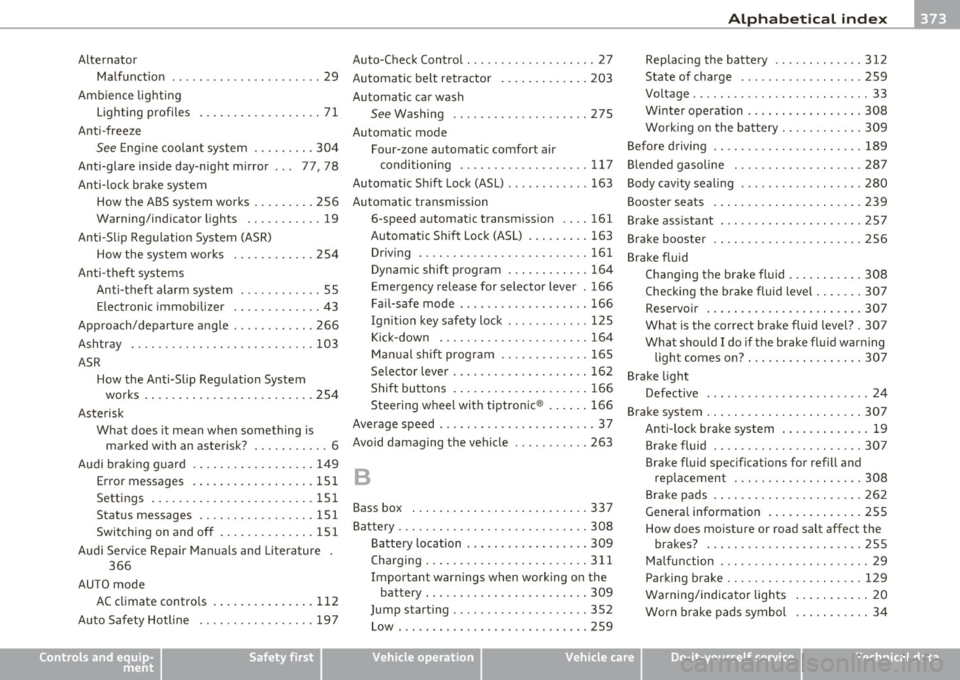
Alphabetical index -________________ fWI
Alternator Auto-Check Control ..... .. .. .... ...... 27 Replacing the battery .. .... .. .. .. . 312
Malfunction ............. ........ . 29 Automatic belt retractor ............. 203 State of charge
.................. 259
Ambience lighting Lighting profiles ................. . 71
Anti -freeze
See Engine coolant system ......... 304
Anti-glare inside day-night mirror ... 77, 78
Anti -lock brake system
How the ABS system works ......... 256
Warning/indicator lights ... .. .... .. 19
Anti-S lip Regulation System (ASR)
How the system works ... .... .. .. . 254
Anti-theft systems
Anti-theft alarm system ........ .. .. 55
Electronic immobilizer ............. 43
Approach/departure angle ............ 266
Ashtray . ............. .. .. .. .. .... . 103
ASR How the Anti-Slip Regulation System works . ..... ... ... .. .. ......... 254
Asterisk What does it mean when something is
marked with an asterisk? ........... 6
Audi braking guard .................. 149
Error messages ............... ... 151
Settings ................ ..... ... 15 1
Status messages ................. 151
Switching on and off .............. 151
Audi Service Repair Manuals and Literature
366
AU TO mode
AC climate contro ls ...... .... .. .. . 112
Auto Safety Hotline .... ... ... ....... 197
Controls and equip
ment Safety first
Automatic car wash
See Washing
.................... 275
Automatic mode Four-zone automatic comfort air
conditioning ........... ...... .. 117
Automatic Sh ift Lock (ASL) ............ 163
Automatic transmission
6-speed automatic transmiss ion .. .. 161
Automatic Shift Lock (ASL) ......... 163
Driving ......................... 161
Dynamic shift program ............ 164
Emergency release for selector lever . 166
Fail-safe mode ................ ... 166
Ignition key safety lock .... ... .. .. . 125
Kick-down . ...... .. .. .. .. ....... 164
Manual shift program .. .. .. .. .. .. . 165
Selector lever ............ ........ 162
Shift buttons .................... 166
Steering wheel with tiptronic ® .... .. 166
Average speed ....................... 3 7
Avoid damaging the vehicle ........... 263
B
Bass box ... .. .. ................. .. 337
Battery . .. .. .. .. .. ........ ......... 308
Battery location .. ... ............. 309
Charging ................ .. ... ... 311
Important warnings when working on the battery . .. .... ....... ..... .. ... 309
Jump start ing ................. ... 352
Low . .. .... .. .. .... ... ...... .... 259 Voltage
............. .... ... ...... 33
Winter operation ............... .. 308
Work ing on the battery ............ 309
Before driving .. .... .. ...... ....... . 189
Blended gasoline . .. .. ...... ....... . 287
Body cavity sealing .................. 280
Booster seats .................... .. 239
Brake ass istant . .. .... .............. 257
Brake booster ..................... . 256
Brake fluid Changing the brake fluid ........... 308
Checking the brake fluid level ....... 307
Reservoir ...................... . 307
What is the correct brake fluid level? . 307
What should I do if the brake fl uid wa rning
light comes on? ... .. .. .. ........ 307
Brake light
Defective .... .................... 24
Brake system ..... .......... ...... .. 307
Anti -lock brake system ............. 19
Brake fluid .. ...... ...... ....... . 307
Brake fluid specificat ions for refill and
replacement ................. .. 308
Brake pads .. .. ................ .. 262
General information ............ .. 255
How does moisture or road salt affect the
brakes? . ...................... 255
Malfunction ........ ...... ...... .. 29
Parking b rake .................... 129
Warning/indicator lights ..... .. .. .. 20
Worn brake pads symbol ........... 34
Vehicle operation Vehicle care Do-it-yourself service Technical data
Page 380 of 390
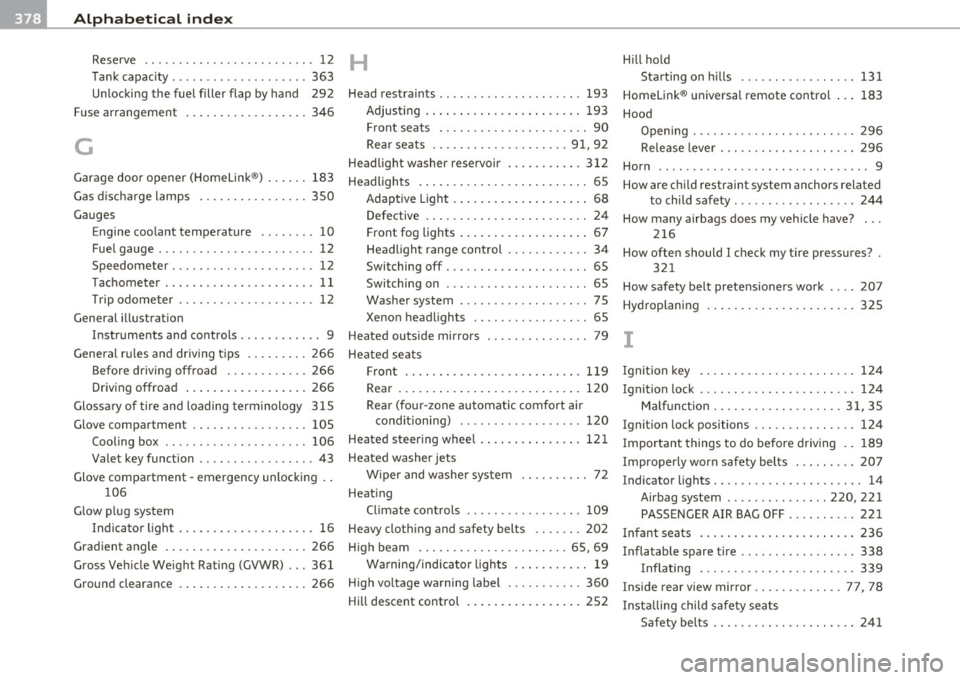
__ _:._A..:. l:.! p:.. h ::....:..:: a:.:b:.. e=-= t.:..:ic :.:a:.. l:.....:..: in~ d:...:e :..: x.:...._ ___________________________________________ _
Reserve ..... .... ........ .... ... . 12
Tank capacity . .. .. .. ...... ... .. .. 363
Unlocking the fuel filler flap by hand 292
Fuse arrangement ... ............... 346
G
Garage door opener (Homelink®) ...... 183
Gas d ischarge lamps ........ .. .... .. 350
Gauges Engine coolant temperature . ... .... 10
Fuel gauge . .... .. .... .. .. .. .. .... 12
Speedometer ... .. .. ........ .. . ... 12
T achometer ...................... 11
Tr ip odometer ............. .... .. . 12
General illustration Instruments and controls ............ 9
General rules and driving tips ......... 266
Before driving offroad ........ .... 266
Driving offroad .................. 266
Glossa ry of tire and loading terminology 315
Glove compartment ........ ......... 105
Cooling box ..... ........ .... .. .. 106
Valet key function ......... ... .. .. . 43
Glove compartment -emergency unlocking ..
106
Glow plug system
Indicator light ............. .... .. . 16
Gradient angle .................. ... 266
Gross Vehicle We ight Rating (GVWR) ... 361
Ground clearance .. .. ............ ... 266
H
Head restraints ............... .... .. 193
Adjusting .. .. .... .. .... .. .. .. ... 193
Front seats . . . . . . . . . . . . . . . . . . . . . . 90
Rear seats .. .. ........... ..... 91, 92
Headlight washer reservoir ........... 312
Headlights ............ ... .. .. ... ... 65
Adaptive Light ............. .... .. . 68
Defective . . . . . . . . . . . . . . . . . . . . . . . . 24
Front fog lights ............ ... .. .. 67
Headlight range control . ........... 34
Switching
off ......... .. .. .. .. .. .. 65
Switching on ......... .... .. ...... 65
Washer system . ..... ... . ... .. .. .. 75
Xenon headlights .... ............. 65
Heated outside mirrors
79
Heated seats Front ................... .. .... . 119
Rear ............... ..... .. .. .. . 120
Rear (four-zone automatic comfort air
conditioning) ..... ...... .. .. .. . 120
Heated steering wheel ... ..... ....... 121
Heated washer jets
Wiper and washer system .... .. .. .. 72
Heating Climate controls ............... .. 109
Heavy clothing and safety belts ....... 202
H igh beam ......... .... .... .. .. . 65 , 69
Warning/indicator lights ..... .. .. .. 19
High voltage warning label .... .... ... 360
Hi ll descent control ..... ............ 252 Hill hold
Starting on hills 131
Homelink ® universal remote control ... 183
Hood Opening ............ .... .... .. .. 296
Release lever ... .. .. ..... .. .. .. .. 296
Horn .................. .... ... ... ... 9
How are child restraint system anchors related to child safety .... ....... ... .. .. 244
How many airbags does my vehicle have? ...
216
How often should I check my tire pressures? . 321
How safety belt pretensioners work .... 207
Hydroplaning ......... ............. 325
I
Ignition key ................ ..... .. 124
Ignition lock .. .. ............. .. .. .. 124
Ma lfunct ion .... .. .. .... ....... 31, 35
Ignition lock positions ... .. .. .. .... .. 124
Important things to do before driving .. 189
Improperly worn safety belts ... .. .. .. 207
Indicator lights . . . . . . . . . . . . . . . . . . . . . . 14
Airbag system ....... .. .. .. .. 220,221
PASSENGER AIR BAG OFF .... .... .. 221
Infant seats ................ ... .. .. 236
Inflatable spare tire .. .. .. .. .. .... ... 338
Inflating ........... .. .... .... .. 339
Inside rear view mirror .. ........... 77, 78
Installing child safety seats Safety belts ............... .. .. .. 241
Page 385 of 390
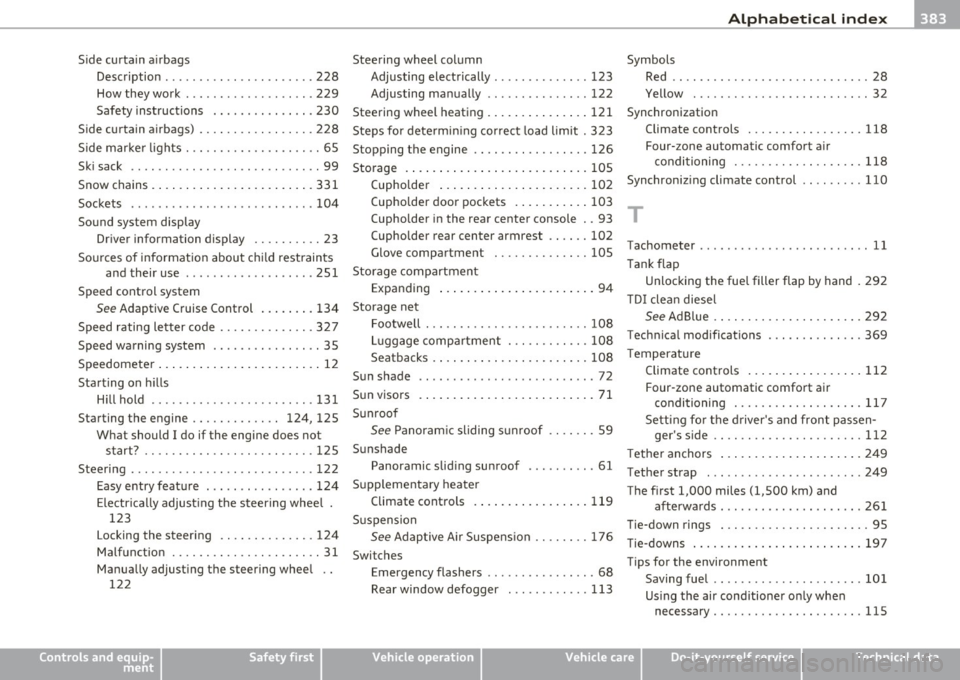
_____________________________________________ A_ L .... p_ h _ a_b_ e_ t_ ic_a_ l_ in_ d_e _ x __ _
Side curtain airbags
Description ............ ... ... .... 228
How they work ............... .... 229
Safety instructions .. .......... .. . 230
Side curtain airbags) .......... ... ... . 228
Side marke r lights ................ ... . 65
Sk i sack ......... ... ... ... .. .. ... ... 99
Snow chains .... ................ ... . 331
Sockets ..................... ... ... 104
Sound sys tem display
Driver information display .......... 23
Sources of information about child restraints
and their use ........... ... .. .. . 251
Speed control system
See Adaptive Cruise Control ........ 134
Speed rating letter code ........... .. . 327
Speed warning system ........... ... .. 35
Speedometer ... ... ............. ..... 12
Starting on hills
H ill hold ...... ...... ... ... ..... . 131
Starting the engine ........... .. 124, 125
What should I do if the engine does not start? ...... .. .... .. .... .. .... . 125
Steering . ............ .... ... ... .... 122
Easy entry feature . .. .. ........... 124
Electrically adjusting the steering whee l .
123
Locking the steering .... .. ... ..... 124
Malfunction .............. .. .. .. .. 31
Manually adjusting the steering wheel
122
Controls and equip ment Safety first
Steering wheel colum
n Symbols
Adjusting electrically ............ .. 123 Red ..... ........................ 28
Adjusting manually ............... 122 Yellow ................... .... ... 32
Steering wheel heating ........ ..... .. 121 Synchronization
Steps for determining correct load limit . 323 Climate controls ...
.............. 118
Stopping the engine .... .. .. .. .. .. .. . 126
Storage ...... .. ... ... ... .......... 105
(upholder .. . .. .... ... .......... 102 Four-
zone automatic comfort air
conditioning ............ .... .. . 118
Synchronizing climate control . ... .. .. . 110
(upholder door pockets ........... 103
(upholder in the rear center console . . 93
T
(upholder rear center armrest .... .. 102
Glove compartment ...... ...... .. 105
Storage compartment
Expanding ... ..... ............... 94
TOI clean diesel
See Ad Blue .. .. .. .. ............. . 292
Storage net
Footwell . .. .. .... ............... 108 Tachometer
.................. .... ... 11
T ank flap
Unlocking the fuel filler flap by hand . 292
Luggage compartment . .. .. .. ..... 108 Technical modifications
, , , .. , ..... ... 369
Seatbacks .... .. .... ............. 108 T
emperature
Sun shade .. ................ ... .. ... 72 Climate controls
................. 112
Sun visors . ................ .. .... ... 71
Sunroof
See Panoramic sliding sunroof .. .. .. . 59 Four-zone automatic comfort air
conditioning ............ .. .. .. . 117
Setting fo r the driver's and front passen-
ger's side .. .. .. .. .............. 112
Sunshade Tethe r anchors ... ................ .. 249
Panoramic sliding sunroof ......... . 61
Supplementary heater
Climate controls . ..... ........... 119 Tether strap
... .. ... ... ........ .... 249
The first
1,000 miles (1,500 km) and
afterwards ... ......... .. ... ... . 261
Suspension
See Adaptive A ir Suspension ...... .. 176 Tie-down rings
... .. .. .... ........... 95
T ie-downs ......................... 197
Switches
Emergency flashers ... ......... ... . 68
Rear window defogger . ...... ..... 113 Tips for the environment
Saving fuel .. .. .. ................
101
Using the air conditioner on ly when
necessary ............... ...... .
115
Vehicle operation Vehicle care Do-it-yourself service Technical data