warning AUDI Q7 2010 Owner´s Manual
[x] Cancel search | Manufacturer: AUDI, Model Year: 2010, Model line: Q7, Model: AUDI Q7 2010Pages: 390, PDF Size: 93.04 MB
Page 80 of 390
Clear vision
Applies to veh icles : w ith automat ically dimm ing inside mirror
Automatically dimming inside mirror
The automatic dimming function can be turned on and
off if required .
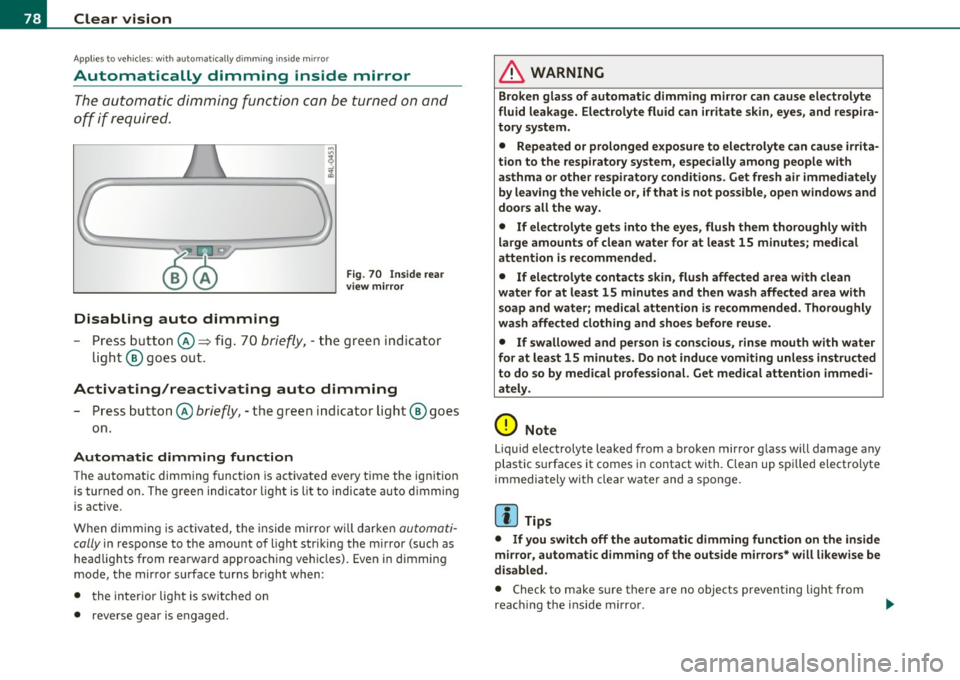
Disabling auto dimming
Fig . 7 0 I nside rea r
v ie w mirror
- Press butt on @ ~ fig . 70 brie fly, -the green indic ator
light ® goes out.
Activating/reactivating auto dimming
- Press button @ briefly, -the green indicator ligh t® goes
on.
Automat ic dimming function
The automatic dimming function is activated every time the ignition
is turned on. The g ree n indicator light is lit to indica te auto d imming
is active.
W hen dimm ing is act ivated, the inside mir ror w ill darke n
automati
cally
in response to the amou nt of light striking the mirror (such as
head lights from rearward approaching vehicles). Even in d imming
mode, the mirror surface turns br ight when:
• the interior light is switched on
• reverse gear is engaged.
& WARNING
Broken glass of automatic dimming mirror can cause electrolyte
fluid leakage . Electrolyte fluid can irritate skin , eyes, and respira
tory system .
• Repeated or p rolonged expo sur e to electrolyte can cau se irrita
tion to the resp iratory system, esp ecially among people with
asthma or other r espiratory conditions. Get fre sh air immediately
by le aving the vehicl e or, if that is not po ssible , open window s and
doors all the wa y.
• If ele ctrolyte gets into the eye s, flush them thoroughly with
large am ount s of clean water f or at lea st 15 minute s; medical
attention is re commended .
• If electrolyte contacts skin , flush affected area with clean
water for at l east 15 minutes and then wash aff ected area with
s oap and water; medical attention is rec ommended . Thoroughly
wash affected clothing and shoe s before reu se.
• If swallowed and person i s con sciou s, rinse mouth with water
for at least 15 minutes. Do not induce vomit ing unle ss instru cted
to do so by medical profe ssional. Get medical attenti on immedi
ate ly .
0 Note
Liquid e lectrolyte leaked from a broken mir ror g lass will damage any
plastic surfaces it comes in contact with. Clean up spi lled electrolyte
immediately with clear wate r and a sponge.
[I) Tips
• If you switch off the automatic dimming function on th e inside
mir ror, automatic dimming of the outside mi rro rs* will l ikew ise be
di sabled .
• Check to make s ure there are no objects preventing light from
reac hing t he i nside m irro r.
Page 82 of 390
Clear vision
0 Note
• Curved ( i.e. co nvex) mir ror s urfaces increase your field of view.
Remember that vehicles or other objects will ap pear smaller and
f art her away th an whe n seen in a fla t mi rror. If you use th is mi rro r to
estimate distances of follow ing ve hicles when chang ing lanes, you
could estimate i nco rre ct ly and ca u se an a cci dent .
• If the mir ror ho using is moved un inte ntionally (for examp le, whi le
par king yo ur veh icle), then you m ust fir st f old the mir ror ele ctrically.
Do not read just the mirro r hous ing manually. You could damage the
mot or w hic h con trols the mi rror .
• If you take the vehicle to an automatic car wash, yo u m ust fo ld the
exterior mirrors flat to preven t dam aging the m. Powe r fol ding ex te
r ior mirrors" m ust not be folded in or out by hand. Use the powe r
f unc tion!
[ i ) Tips
If th ere should be a malfu nction in the ele ct rical sys tem , you can still
adjust the outs ide mirrors by pressing the edge of the m irror. •
App lies to ve hicles : w ith auto mat ic dim mi ng fo r outs ide m ir ro rs
Automatic dimming for outside mirrors
Th e ou tside mir rors are d immed toge ther w it h t he a utoma tic
dimming of the ins ide mirror . When the ignition is switched on, t he
m irrors da rken a utomat ically depe nd ing on the light s trik ing t hem
(e .g . headlights from the r ea r) .
W hen the interio r light ing is switched on and when reverse gear is
engaged , the m irrors are sw itche d back to their or ig inal bright ness
(not d immed).
& WARNING
Broken glass of automatic dimming mirror can cause electrolyte
fluid leakage. Electrolyte fluid can irritate skin, eyes, and respira
tory system.
• Repeated or prolonged exposure to electrolyte can cause irrita
tion to the respiratory system, especially among people with
asthma or other respiratory conditions. Get fresh air immediately
by leaving the vehicle or, if that is not possible, open windows and
doors all the way.
• If electrolyte gets into the eyes, flush them thoroughly with
large amounts of clean water for at least 15 minutes; medical
attention is recommended.
• If electrolyte contacts skin, flush affected area with clean
water for at least 15 minutes and then wash affected area with
soap and water; medical attention is recommended. Thoroughly
wash affected clothing and shoes before reuse.
• If swallowed and person is conscious, rinse mouth with water
for at least 15 minutes. Do not induce vomiting unless instructed
to do so by medical professional. Get medical attention immedi
ately.
0 Note
Electro lyte lea king from a broke n m irror g lass a ttacks the vehicle
paint and plastic surfaces . Clean up spilled electrolyte imme diate ly
w ith clear water and a sponge .
(I) Tips
• If automatic dimming for the inside mirror i s switched off, the
outside mirrors are also not dimmed automatically .
• Automatic d imm ing fo r the mir ro r only op erates p roperly if the
s u nshade* fo r th e rear w indow is ret racted, o r the light strik ing t he
inside m irror is not h indere d by ot her objec ts. •
Page 84 of 390
Clear vision
Applies to veh icles : w ith d ig ita l compass
Calibrating the compass
The compass has to be recalibrated if the display is wrong
or inaccurate .
-Hold the@ button down until the letter C is displayed on
the interior rear view mirror .
- Drive in a circle at a speed of about 5 mph (10 km/h) until
a direction is shown on the interior rear view mirror.
& WARNING
The digital compass is to be used as a directional aid only. Even
though you may want to look at it while you are driving, you must
still pay attention to traffic, road and weather conditions as well
as other possible hazards. •
Page 85 of 390
Seats and storage
General recommendations
Why is your seat adjustment so important?
The safety belts and the airbag system can only provide
maximum protection if the front seats are correctly
adju sted.
Th ere a re various ways of adjusting t he front seats to provide safe and
comfortable support for the driver and the front passenger . Ad just
your seat properly so that :
• you can easily and quickly reach a ll the switc hes and contro ls in the
ins trumen t pa nel
• your body is properly supported thus reducing phys ica l stress and
fatigue
• the safety be lts and airbag system can offer maximum protection
=>
page 209 .
In the following sections, you w ill see exact ly how you can best ad just
your sea ts .
Th ere are special regulations a nd instr uctions for install ing a child
safety seat on the front passenger's sea t. Always follow the informa
tion regarding child safety p rovided in=>
page 231, "Child Safety ".
& WARNING
Incorrect seating posit ion of the dri ver and all other passengers
can result in seriou s personal injury.
• Always keep your feet on the floor when the vehicle is in
motion -never put your feet on top of the instrument panel, out
of the window o r on top of the seat cush ion. This applies especially
to the passengers.
If your seating po sition is incorrect, you
increase the ri sk of injury in the case of sudden braking or an acci-
Controls and equip
ment Safety first
Seats and storage
& WARNING
(con tinu ed)
dent . If the airbag inflates and the seating position is incorrect ,
this could result in per sonal injury or even death .
• It is important for both the dri ver and front passenger to keep
a distan ce of at least 10 inche s (25 cm) between themselves and
the steering wheel and /or instrument panel. If you 're sitting any
closer than this , the airbag system cannot protect you properly. In
addition, the front seats and head restraints must be adjusted to
your body height so that they can give you maximum protection .
• Always try to keep as much distance as possible between your
self and the steering wheel or instrument panel.
• Do not adjust the driver's or front passenger 's seat while the
vehicle is moving. You r seat may move unexpectedly , causing
sudden loss of vehicle control and personal injury . If you adjust
your seat while the vehicle is moving , you are out of position. •
Driver's seat
The correct seat position is important for saf e and
re lax ed driving.
W e recomme nd that you a djust the drive r's sea t in the
f ollowing man ner :
- Ad just the seat in fore and aft direction so that you can
easily pus h the pedals to the floor w hile keeping your
knees slightly bent=>
& in "Why is yo ur seat a djus tme nt
so importa nt?" .
- Adjust the seatback so that when yo u sit with yo ur back
agai nst t he seatback , you can st ill grasp t he top of the
steering w heel. ..,
Vehicle care Technical data
Page 86 of 390
Seats and storage
-Position the head restraint according to the occupant's
height=>
page 90. For maximum protection, the top of
the head restraint should be at least at eye level, prefer
ably higher and ideally level with the top of the head
=>
page 193, fig. 185.
& WARNING
Never place any objects in the driver's footwell. An object could
get into the pedal area and interfere with pedal function. In case
of sudden braking or an accident, you would not be able to brake
or accelerate. •
Front passenger's seat
Always move the front passenger seat into the rearmost
position.
To avoid contact with the airbag while it is deploying, do not
sit any closer to the instrument panel than necessary and
always wear the three-point safety belt provided adjusted
correctly. We recommend that you adjust the passenger's
seat in the following manner:
- Move the front passenger seat into the rearmost position
of the fore and aft adjustment range=>
& in "Why is your
seat adjustment so important?" on
page 83.
- Bring the backrest up to an (almost) upright position. Do
not ride with the seat reclined.
- The ideal position for the head restraint is with the upper
edge of the restraint level with the top of your head
=>
page 90. You should not lower the top of the restraint
below the level of your eyes. -
Place your feet on the floor in front of the passenger's
seat. •
Power front seat adjustment
Seat adjustment controls
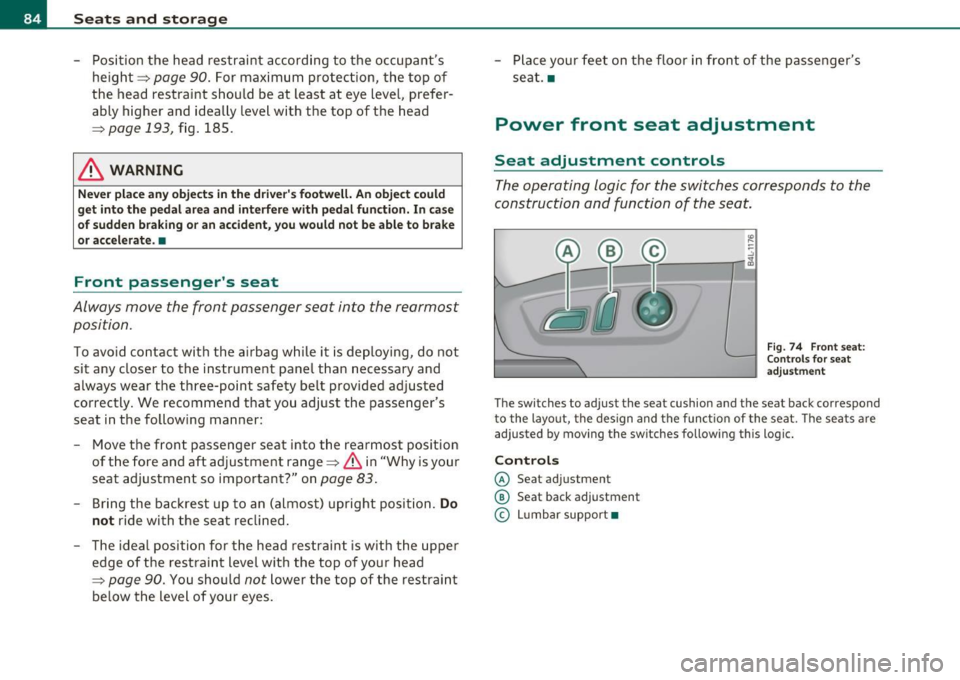
The operating logic for the switches corresponds to the
construction and function of the seat.
ie ~ ~ ..!J
-----r -aal
Fig. 74 Front seat:
Controls for seat
adjustment
The switches to adjust the seat cushion and the seat back correspond
to the layout, the design and the function of the seat. The seats are
adjusted by moving the switches following this logic.
Controls
© Seat adjustment
@ Seat back adjustment
© Lumbar support •
Page 87 of 390
Adjusting the seat
Position, angle and shape of the seat can be adjusted
electrically to ensure safe and comfortable seating.
Read and follow the warning notices=> & before you adjust
your seat .
Fore-and-aft adjustment
- Push the switch@ forward or backward=> page 84,
fig. 74.
Adjusting seat height
-Pull or push the switch@ up or down.
Front seat cushion up/ down
-Press the switch@ at the front up or down.
Rear seat cushion up/ down
-Press the switch@ at the rear up or down.
Adjusting seat back angle
-Push the switch @forward or backward .
Adjusting the curvature of the lumbar
support
- Push the switch plate © forward or backward to increase
or reduce the curvature.
Adjusting the height of the lumbar support
- Push the switch plate © up or down to position the curva
ture higher or lower.
Controls and equip
ment Safety first
Seats and storage
& WARNING
•
Adjust the driver's seat only when the vehicle is stationary. You
risk an accident otherwise.
• The power adjustment for the front seats also works with the
ignition switched off or with the ignition key removed. For this reason, children should never be left unattended in the vehicle -
they could be injured!
• Exercise caution when adjusting the seat height. Unsupervised
or careless seat adjustment can pinch fingers or hands causing
injuries.
• While the vehicle is moving, the seat backs of the front seats
must not be inclined too far to the rear because the effectiveness
of the safety belts and the airbag system is severely compromised
- there is a risk of injury.
• To reduce the risk of injury
in the case of sudden braking or
accident, front passengers must never ride in a moving vehicle
with the seatback reclined. Safety belts and the airbag system
only offer maximum protection when the seatback is upright and
the safety belts are properly positioned on the body. The more the
seatback is reclined, the greater the risk of personal injury from an
incorrect seating position and improperly positioned safety
belts. •
Vehicle care Technical data
Page 88 of 390
Seats and storage
Adjusting front passenger's seat manually
Applies to vehicl es: with manua lly adjustab le passenger seat
Adjustment controls
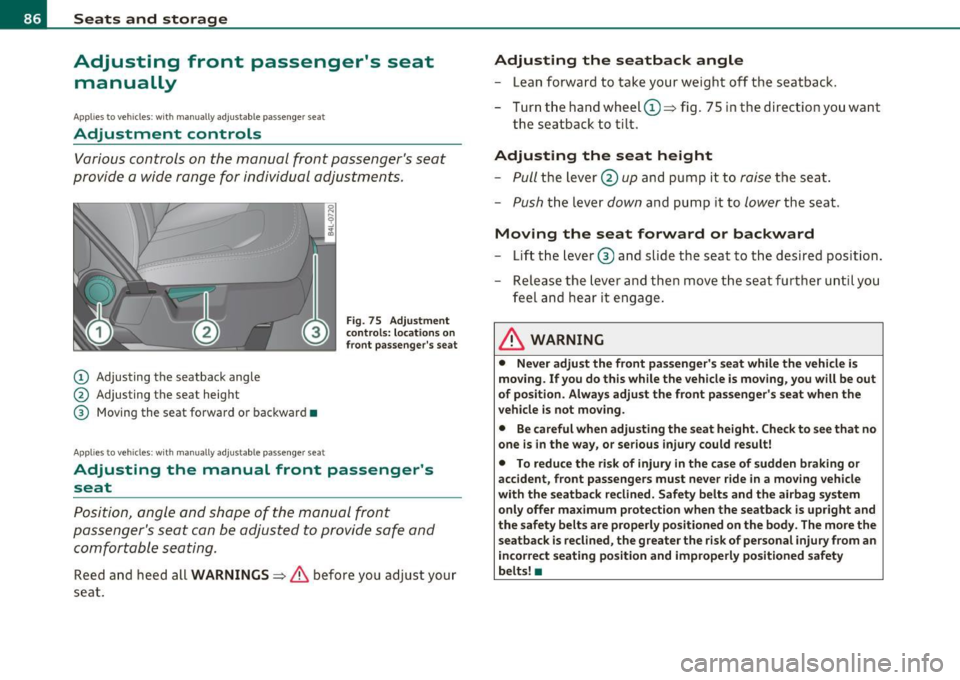
Various controls on the manual front passenger's seat
provide a wide range for individual adjustments.
(D Adjusting the seatback angle
@ Adjusting the seat height
® Moving the seat forward or backward •
Applies to veh icles : w ith manually adjustable passenger seat
Fig . 75 Adjustment
controls: locations on
front passenger's seat
Adjusting the manual front passenger's
seat
Position, angle and shape of the manual front
passenger's seat can be adjusted to provide safe and
comfortable seating.
Reed and heed all WARNINGS :::;, & before you adjust your
seat.
Adjusting the seatback angle
- Lean forward to take your weight off the seatback.
- Turn the hand wheel(D:::;, fig . 75 in the direction you want
the seatback to tilt .
Adjusting the seat height
-Pull the lever @up and pump it to raise the seat.
-Push the lever down and pump it to lower the seat.
Moving the seat forward or backward
- Lift the lever® and slide the seat to the desired position.
- Release the lever and then move the seat further until you
feel and hear it engage.
& WARNING
• Never adjust the front passenger's seat while the vehicle is
moving. If you do this while the vehicle is moving, you will be out
of position. Always adjust the front passenger's seat when the
vehicle is not moving.
• Be careful when adjusting the seat height. Check to see that no
one is in the way, or serious injury could result!
• To reduce the risk of injury in the case of sudden braking or
accident, front passengers must never ride in a moving vehicle
with the seatback reclined. Safety belts and the airbag system
only offer maximum protection when the seatback is upright and
the safety belts are properly positioned on the body. The more the
seatback is reclined, the greater the risk of personal injury from an
incorrect seating position and improperly positioned safety
belts! •
Page 90 of 390

Seats and storage
time. When the vehicle is unlocked , the settings stored on the
remote con trol key are res to red .
If your veh icle is d riven by other persons using yo ur remote cont rol
key, you should save your individua l seat position on one of the
memo ry buttons. Yo u can rec all you r settings ag ain sim ply and
conveniently by press ing the corresponding memory button. When
t he vehi cle i s loc ked , the se se ttings a re a utomat ic a lly re-assig ned to
the remote control key and stored .
& WARNING
• For safety reasons , the seat setting can only be recalled when
the vehicle is stationary -otherwi se you risk having an accident .
• In an emergency , the recall operation can be stopped by
pressing the [
ON/OFF] button or by briefly pre ssing any given
memory button. •
Applie s to v ehicle s: w it h sea t m em ory
Activating remote control key memory
To be able to re ca ll the store d settings with the rem ote
c ontrol key, the func tion has to be activat ed in th e MMI.
- S elect : Fu nct ion button I C AR] > Systems*> Seat
adjustment
> Driver's seat > Key mem. profile > On. •
Rear seats
General information
Safe tran sportatio n of p asse nge rs on the re ar sea ts
r e q uir es pr op er safe ty pre caution s.
All passengers on the rear seats must be seated in compliance with
t he s afety gui deli nes e xplained in=>
page 199 and => page 209. The correct seating position is crit
ica l for the safety of front
and rear seat
p assenge rs alik e=>
page 192.
& WARNING
• Occupants in the front and rear seat s must always be properly
restrained .
• Do not let anyone ride in the vehicle without the head
restraints provided . Head rest raints help to reduce injuries .
• Loose items inside the passenger compartment, can fly
fo rwa rd in a crash or sudden maneuver and injure occupants.
Always store articles in the luggage compartment and use the
fastening eyes, especially when the rear seat backs have been
folded down.
• Read and heed all WARNINGS =>
page 192, "Proper seating
positions for passengers in rear seats ".•
Adjusting seat (second row seating)
Th e fo re-and-aft adjustment * of the seat cushion and the
sea t ba ck an gle can be adjusted .
Fig. 77 Adju sting seat
back ang le ..,.
Page 91 of 390
....
~....-'""-~_3-:>--.....,__~~ :
······--... __ ;::::.:_ :::--~
Adjusting seat back angle
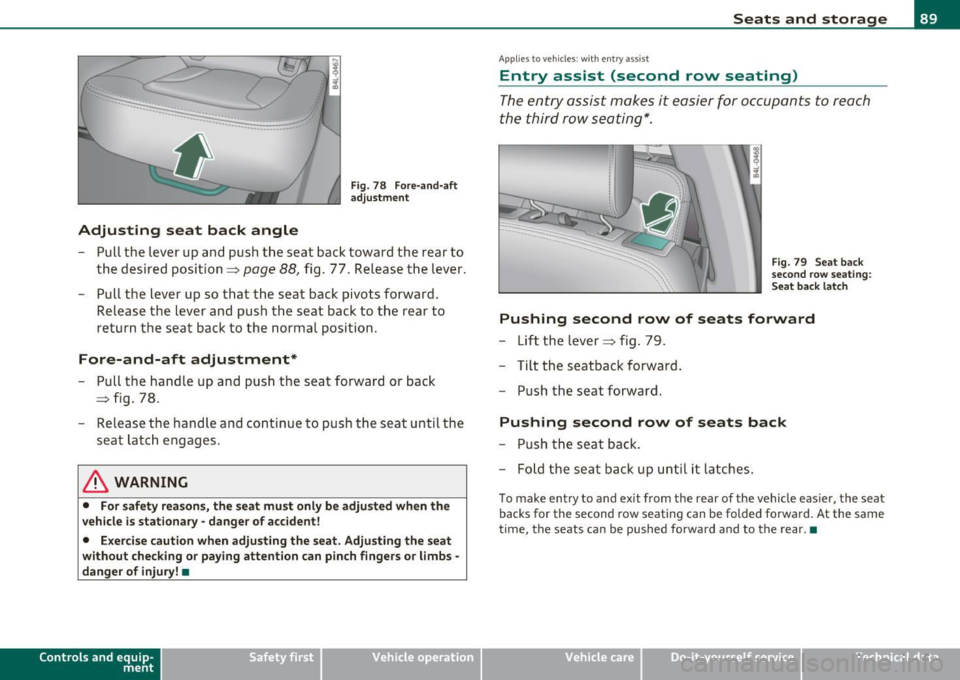
Fig . 78 Fore -and -af t
adju stme nt
- Pull the lever up an d push the seat bac k toward t he rear to
t h e desi red position ==>
page 88, fig. 77. Release the lever.
- Pull t he lever up so that the seat back pivots forward.
Release t he lever and pus h the seat back to the rear to
retu rn t he sea t bac k to the norma l position.
Fore-and-aft adjustment*
- Pull t he ha ndle up and push the seat forward or back
==> fig. 78.
- Releas e the handle a nd cont inue to p ush th e seat u ntil the
sea t latc h engages.
& WARNING
• For safety rea son s, the seat mu st only be adjusted when the
vehicle is stationary · danger of accident!
• Exerci se caution when adjusting the seat . Adju sting the seat
without checking or paying attention c an pinch finge rs or limbs·
danger of injury! •
Con trol s and equ ip
m ent Vehicle
OP-eration
Seats and storage
Applies to ve hicles : with e ntry assist
Entry assist (second row seating)
The entry assist makes it easier for occupants to reach
the third row seating*.
Fig. 79 Seat back
s e co nd r ow sea ting :
S eat back lat ch
Pushing second row of seats forward
- Lift the lever==> fig . 79.
- Tilt the s eatback forwa rd .
- Pu sh the seat forward.
Pushing second row of seats back
-Push the seat back.
- Fo ld the seat back u p un til it latches.
T o make en try to and ex it from the rear of the vehi cle eas ie r, the seat
backs for th e se cond row seating can be folded fo rwa rd. At the sam e
time, the seats ca n be pushed forwa rd and to the rear. •
Vehicle care Do-it-yourselt service iTechnical data
Page 92 of 390
Seats and storage
Applies to veh icles : w ith third row seat ing
Folding seat back up and down (th ird row
seating)
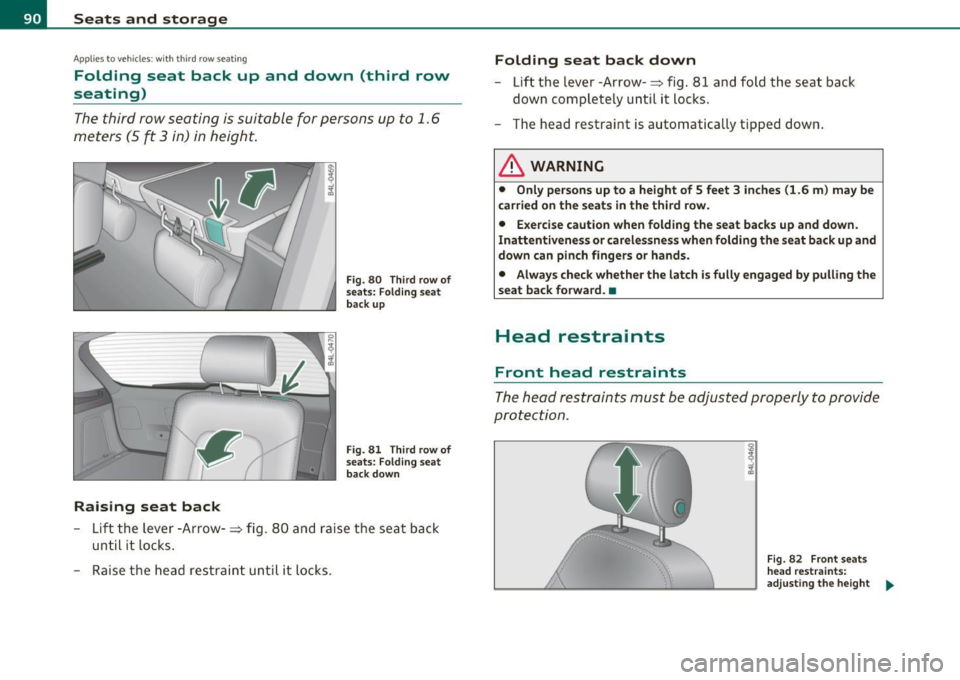
The third row seating is suitable for persons up to 1. 6
meters (5 ft 3 in) in height.
•
Raising seat back
Fig . 80 Third row of
seats: Folding seat
back up
Fig . 81 Third row of
seats: Folding seat
back down
-Lift the Lever -Arrow- ~ fig. 80 and raise the seat back
until it Locks.
- Raise the head restraint until it locks.
Folding seat back down
-Lift the Lever -Arrow- ~ fig. 81 and fold the seat back
down completely until it locks .
- The head restraint is automatically tipped down.
& WARNING
• Only persons up to a height of 5 feet 3 inches (1.6 m) may be
carried on the seats in the third row.
• Exercise caution when folding the seat backs up and down .
Inattentiveness or carelessness when folding the seat back up and
down can pinch fingers or hands.
• Always check whether the latch is fully engaged by pulling the
seat back forward. •
Head restraints
Front head restraints
The head restraints must be adjusted properly to provide
protection .
Fig. 82 Front seats
head restraints:
adjusting the height .,_