belt AUDI Q7 2010 Owner´s Manual
[x] Cancel search | Manufacturer: AUDI, Model Year: 2010, Model line: Q7, Model: AUDI Q7 2010Pages: 390, PDF Size: 93.04 MB
Page 250 of 390
• .___C_ h_ il_d _ S_a _ f_ e _ t--= y '------------------------------------------------
in the area that the guidance fixtures were installed . The upholstery
would also be permanently stretched around the guidance fixtures.
This applies especially to leather seats .•
Installing a child restraint with LATCH
lower anchorages
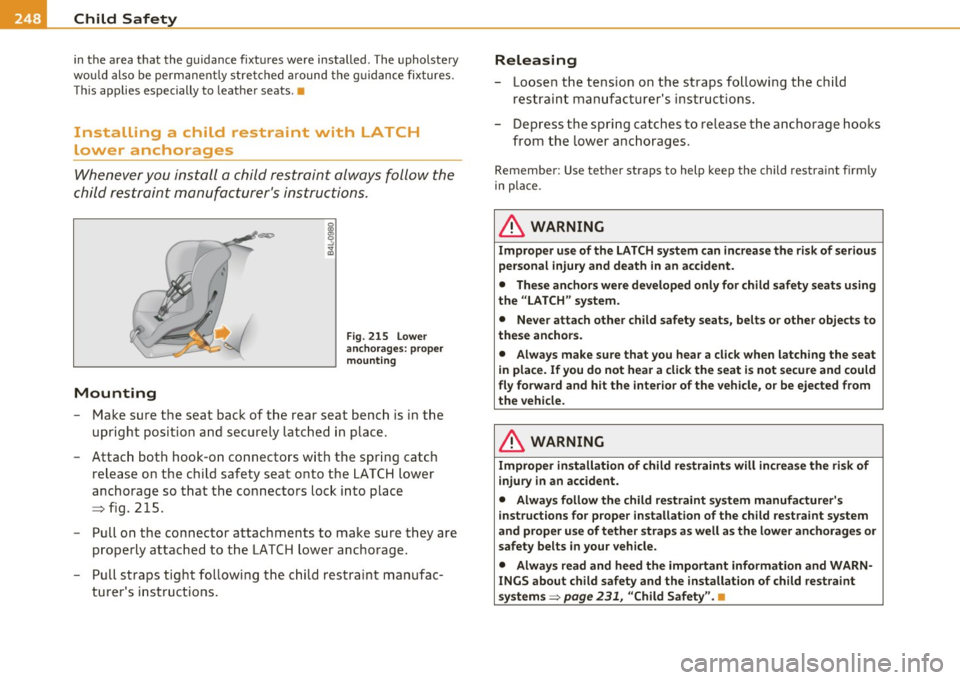
Whenever you install a child restraint always follow the
child restraint manufacturer's instructions.
Mounting
Fig. 215 Lower
anchorages: proper
mounting
- Make sure the seat back of the rear seat bench is in the
upright position and securely latched in place.
- Attach both hook-on connectors with the spring catch
release on the child safety seat onto the LATCH lower
anchorage so that the connectors lock into place
~ fig. 215.
- Pull on the connector attachments to make sure they are
properly attached to the LATCH lower anchorage.
- Pull straps tight following the child restraint manufac
turer's instructions.
Releasing
- Loosen the tension on the straps following the child
restraint manufacturer's instructions.
- Depress the spring catches to release the anchorage hooks
from the lower anchorages.
Remember: Use tether straps to help keep the child restraint firmly
in place.
& WARNING
Improper use of the LATCH system can increase the risk of serious
personal injury and death in an accident.
• These anchors were developed only for child safety seats using
the "LATCH" system.
• Never attach other child safety seats, belts or other objects to
these anchors.
• Always make sure that you hear a click when latching the seat
in place. If you do not hear a click the seat is not secure and could
fly forward and hit the interior of the vehicle, or be ejected from
the vehicle.
& WARNING
Improper installation of child restraints will increase the risk of
injury in an accident.
• Always follow the child restraint system manufacturer's
instructions for proper installation of the child restraint system
and proper use of tether straps as well as the lower anchorages or
safety belts in your vehicle.
• Always read and heed the important information and WARN
INGS about child safety and the installation of child restraint
systems ~
page 231, "Child Safety". •
Page 251 of 390
Tether anchors and tether straps
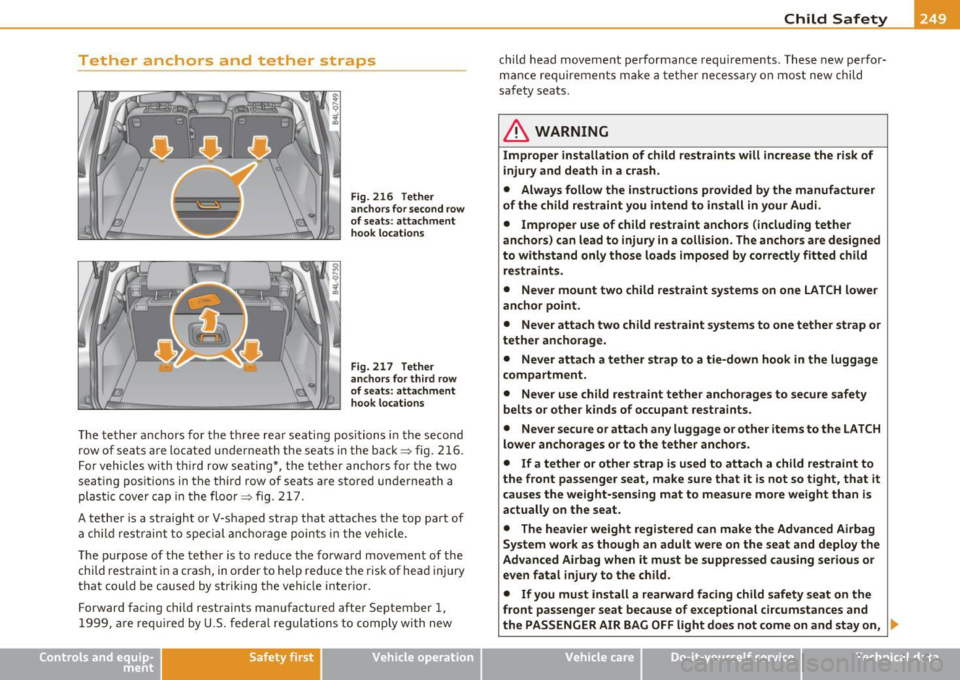
Fig. 216 Tether
anc hors fo r second row
of seats: attachment
h ook location s
Fig . 217 T ether
anch ors for third row
of seats: a tt ac hment
h ook location s
The tether anchors for the three rea r seating positions i n the s econd
row of seats are located u nderneath the seats in the back~ fig. 216.
For vehicles wi th t hir d row seating *, th e tet her anchors for the two
seating pos it io ns in th e third row of seats are stored un derneath a
p lastic co ve r cap in th e floor~ fig. 217 .
A tethe r is a straight o r V-shaped strap that attaches the top part of
a child restra int to special anch o rage points in t he vehicle .
Th e purpose of the te the r is to reduc e the fo rwa rd movemen t of t he
child rest raint in a cras h, in order to help reduce the risk of head injury
th at could be c au se d by striki ng the ve hicle in ter ior.
Forward facing child restraints man ufactured after September 1,
1 99 9, ar e re quir ed b y U.S. feder al regulat ions to co mply wi th new
Safety first Vehicle OP-eration
Child Safety
child head movem ent performance requ ireme nts . These new per for
ma nce re quiremen ts mak e a t eth er nece ssary on m ost new child
sa fety s eats .
& WARNING
Improper installation of child restraints will increase the risk of
injury and death in a crash.
• Always follow the instructions provided by the manufactu rer
of the child restraint you intend to install in your Audi.
• Improper use of child restraint anchors (including tether
anchors) can lead to injury in a collision . The anchors are designed
to withstand only those loads imposed by correctly fitted child
restraints.
• Never mount two child restraint systems on one LATCH lower
anchor point.
• Never attach two child restraint systems to one tether strap or
tether anchorage .
• Never attach a tether strap to a tie-down hook
in the luggage
compartment.
• Never use child restraint tether anchorages to secure safety
belts or other kinds of occupant restraints .
• Never secure or attach any luggage or other items to the LATCH
lower anchorages or to the tether anchors.
• If a tether or other strap is used to attach a child restraint to
the front passenger seat, make sure that it is not so tight, that it
causes the weight-sensing mat to measure more weight than is
actually on the seat.
• The heavier weight regi stered can make the Advanced Airbag
System work as though an adult were on the seat and deploy the
Advanced Airbag when it must be suppressed causing serious or
even fatal injury to the child.
• If you must install a rearward facing child safety seat on the
front passenger seat because of exceptional circumstances and
the PASSENGER AIR BAG
OFF light does not come on and stay on, ..
Vehicle care Do-it-yourselt service iTechnical data
Page 253 of 390
Child Safety -
-------------------"'---
The up ho lstery wou ld also be perma ne ntly stre tc h ed a round t he
t e th er strap . T his app lies esp eci ally to l eath er s eats .•
Using tether straps on rearward-facing
child restraints
Cu rren tly, few re a r-f acing child restra int s yste ms come w ith a t eth er.
Please read and hee d the c hild restraint system manufac turer's
i nst ructions car efu lly to d ete rm in e ho w to prop erl y i nsta ll the te the r.
& WARNING
A child in a rearward-facing child safety seat installed on the front
passenger seat will be seriously injured and can be killed if the
front airbag inflates· even with an Advanced Airbag System .
• The inflating airbag will hit the child safety seat or infant
carrier with great force and will smash the child safety seat and
child against the backrest, center armrest, or door.
• A tight tether or other strap on a rearward-facing child
restraint attached to the front passenger seat can put too much
pressure on the weight-mat in the seat and register a heavier
weight in the Advanced Airbag System. The heavier weight regis
tered can make the system work as though an adult were on the seat and deploy the Advanced Airbag when it must be suppressed
causing serious or even fatal injury to the child.
• If you must install a rearward facing child safety seat on the
front passenger seat because of exceptional circumstances and
the PASSENGER AIR BAG OFF light does not come on and stay on ,
immediately install the rear-facing child safety seat in a rear
seating pos ition and have the airbag system inspected by your
Audi dealer. •
Controls and equip ment Safety first Vehicle operation
Additional Information
Sources of information about child
restraints and their use
T he re are a numbe r of sources of additional inf ormat ion abo ut child
re straint s ele ction , insta llation an d use:
N HTSA adv ises t hat t he b est ch ild saf ety s eat is th e on e that f its your
child and fits in yo ur vehicle, a nd that yo u will use cor rectly an d
c o nsis ten tly.
Try before you b uy!
U.S National Highway Traffic Safety Administration
T el. : 1-8 88- 327-42 36 (TTY : 1-80 0-4 24 -9153)
www .nhtsa .gov
National SAFE KIDS Campaign
Te l.: (202) 662-0600
www. safe kids .o rg
Safety BeltSafe U .S.A
T el. : (800) 745-SAFE ( Eng lish)
Te l.: (800) 747-SA NO (Spa nish )
www .c ars eat .org
Transport Canada Information Centre
Te l.: 1 (800) 333-0371 or call 1 (613) 998 -8616 if you are i n the
Ott awa are a
www .t c.gc.ca/ roadsaf ety
Audi Customer CARE
Te l.: (800) 822-2834 •
Vehicle care Do-it-yourself service Technical data
Page 254 of 390
Intelligent technology
'-----------------------------------------------
Intelligent technology
Notice about data recorded by
vehicle control modules
Your vehicle is not equipped with an Event Data Recorder (EDR),
installed by some manufacturers for the express purpose of
capturing data for retrieval after an accident or crash event. ED Rs are
sometimes called "crash recorders".
Some state laws restrict the retrieval or downloading of data stored
by ED Rs that were installed in a vehicle for the express purpose of
retrieving data after an accident or crash event without the owner's
consent.
Although your vehicle is not equipped with an EDR, it is equipped w ith
a number of electronic control modu les for various vehicle systems
such as, for example, engine function, emission control, as well as for
the airbags and safety belts.
T hese electronic contro l modules also record vehicle-re lated data
during normal vehicle operation for diagnostic and repair purposes .
Th e recording capacity of the e lectronic control modu les is limited to
data (no sound is recorded) and only a sma ll amount of data is actu
ally recorded over a very limited period of time and stored when a
system fault or other condition is sensed by a control unit. Some of
the data then stored may relate to vehicle speed, direction, braking
as well as restraint system use and performance in the event of a
crash or other condition. Stored data can only be read and down
loaded with special equipment.
Electronic Stabilization Program
(ESP)
General information
The ESP improves the vehicle stability.
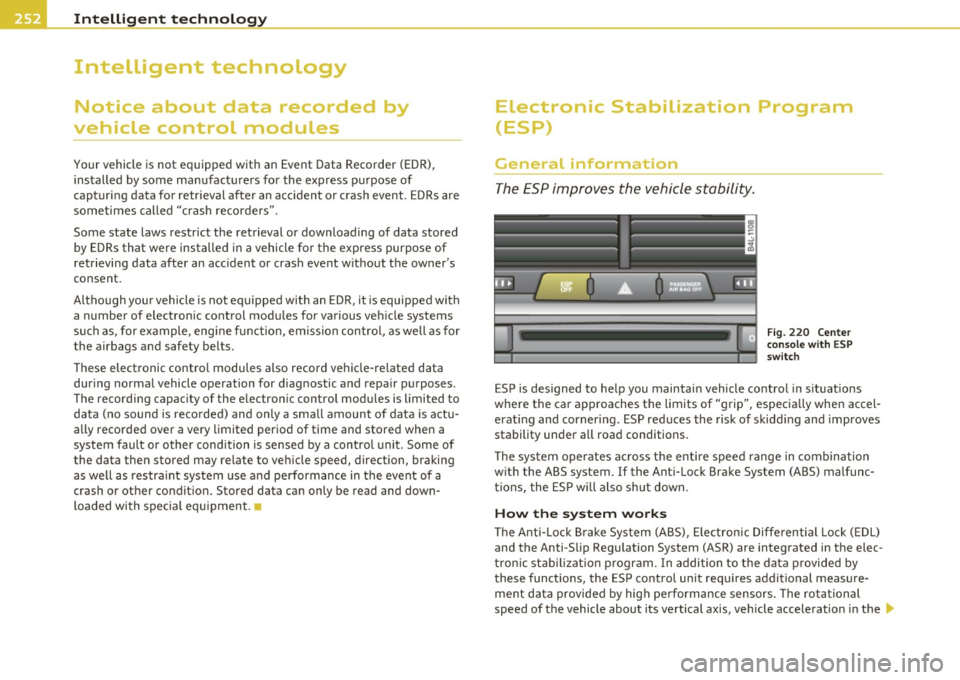
Fig. 220 Center
console with ESP
switch
ESP is des igned to help you maintain vehicle control in situations
where the car approaches the limits of "grip", especia lly when accel
erat ing and cornering. ESP reduces the risk of skidd ing and imp roves
stability under all road conditions.
Th e system operates across the entire speed range in combination
with the ABS system. If the Anti-Lock Brake System (ABS) malfunc
tions, the ESP will also shut down.
How the system works
The Anti-Lock Brake System (ABS), Electronic Differential Lock (EDL)
and the Anti-Slip Regulation System (ASR) are integrated in the elec
tronic stabilization p rogram. In addition to the data provided by
these funct ions, the ESP control unit requires additional measure
ment data provided by high performance sensors. The rotational
speed of the vehicle about its vertical axis, veh icle acceleration in the ...
Page 285 of 390
____________________________________________ C_l_e _a_ n_ i n--= g=--- a_n_ d----' p,__ r_o _t_ e_ c_ t_ i _o_ n __ _
Appli es to veh icles : with n atural leathe r
Natural leather
Audi makes great efforts to maintain the properties,
na tural look and feel of interior leather .
General
We offer many different types of leather on our vehicles . Most are
different types of nappa leather, which has a smooth s urface and
comes in various colors.
Th e intensity of the color determines the visual cha racter istics and
appearance .
If the surface of the leat her has a typical natural look,
then the leather is a nappa leather that has been left in a relatively
natura l condition. This leathe r offers pa rticu la rly good comfo rt and
breathes wel l. Fine veins, closed gra ins, insect b ites, sk in fo lds, and
s u btl e var iations in co lor remai n visible . These c harac ter istics demon
strate that the mater ial is natural.
N atural nappa leather is not covered by a color fin ish . It is the refore
more sensitive to soiling and wea r, which is something you need to
consider if children, animals or other factors might prove to be partic
ular ly hard on the leather .
By contrast, leather types that are covered by a colored fin ish layer
are more dur able. This h as a pos it ive e ffect on t he leather 's resist ance
to wear and so iling in daily use . On the other hand, the typical charac
t eris tics of na tura l leather are ba rely o r not app aren t. H oweve r, this
does not mean that the leather itself is of inferior quality.
Care and handling
Because of the exclusive nature of the types of leather that Audi uses
and the ir un ique properties (such as sensitivi ty to oils, gre ase, soiling,
etc.), you will need to be somewhat careful with these leathe rs, a nd
a ce rtain type of care is req uired. For example, dark clo thing mate
r ials can discolor leather seats (especially if such clothing is damp and
was not dyed cor rect ly). Dust and dirt particles in pores, folds, and
seams can have a n ab rasive effect and ca n damage the leathe r
surface as well as weaken seams.
Safety first
The leather should be cleaned regularly as needed . After having been
used for a rela tively long time, yo ur leat her seats w ill acq uire a rich
aged fi nish. This is a characteristic of natural leather and a s ign of
true quality .
I n orde r to maintain the va lue of this nat ural p rodu ct over t he life of
your vehicle, you should fo llow the recommendations be low:
0 Note
• To keep your leather from b leach ing out, do not allow it to be
exposed to b right s unl igh t fo r long pe riod s of time. If yo u have to
leave t he veh icle parked outside for long periods, cover the leather to
protect it from direct exposure to sunlight.
• Sharp objects on cloth ing, such as zippers, rivets or sharp pieces
on belts can le ave pe rm an ent sc ratches o r scrape mar ks on the
surface of the leather.
[I] Tips
• After each t ime you clean the leather and at regular intervals, use
a leathe r preservat ive creme that con tains UV -bloc ke rs and that
works into the leather. This creme will nourish and mo istur ize the
leather, helping it to b reathe and s tay supp le . It also he lps to build up
a p rotect ive coa ting on the surface .
• C lean the leather every 2 -3 months, a nd clean any areas that get
soiled .
• Remove fresh marks made by ballpoint pens, ink, lipstick, shoe
polish, etc . as soon as poss ible.
• P reserve t he colo r of t he lea ther as needed by us ing a specia l
co lored leather care creme to touch up areas of uneven color. •
Vehicle care Technical data
Page 287 of 390
-----------------------------------------~C~le~a~n~i~n~g~a!..!n..!:d~pEr~o~t~e~c~t:.!i~o~n:!..._ __
App lies to vehicles : with Alcantara up hols tery
Cleaning Alcantara ® (synthetic suede)
Removing dust and dirt
- Mois t en a c loth, squee ze out excess water a nd wip e down
the seat su rfaces .
Removing stains
- Moisten a cloth with lukewarm water or wi th diluted ethyl
(rubbing) alcohol.
- Dab at t he s tai n. Start a t the ou tside and work inwards.
- O nce the stain is no longer v isibl e, use a soft dry clot h or
tissue to soak up the moist ure .
Do not use leathe r clean ing p roduc ts on Alcanta ra.
You may us e a suitable shampoo for r emoving dus t and d irt.
Dust and grit in the pores and seams can sc ratch and damage the
s u rface . If the car is left s tanding in the su n fo r long pe riods, the
Alcantara should be protected against direc t su nlight to prevent it
from fading . Slight co lor var iat ions will develop in norma l use and are
not a n indic a tion of mater ial deter io ration .
0 Note
• Never use chem ical solven ts (e .g . lighte r fluid, turpen tine), waxes ,
shoe po lish or simi lar p roducts on A lcantara ® sur faces .
• T o avo id damage , have st ubbor n sta ins removed by a commerc ia l
cl eaning s pecialist .
• Do no t use brushes, s tiff sponges o r sim ilarly abrasive clea ning
aids .•
Safety first
Safety belts
On ly well -m aintai ned saf ety belts wor k relia bly when
n ee ded.
K ee p be lts cl ean .
- F or cleani ng, use a mi ld soap a nd water sol ution. Let bel ts
dry t ho ro ug hly a nd away fro m direct s unligh t.
- Do not a llow i nertia ree l safety belts to retract befo re th ey
a re co mpletely dry.
- Check t he cond it io n of yo ur safety belts
regularly.
Heav ily so iled s afety be lts may not retra ct properly .
& WARNING
Damaged safety belts can break in a crash.
• Anything that might damage your safety belts could mean
that you and your passengers would not be adequately protected
in an accident.
• Safety belt performance depends on correct installation . Never
remove belts from the vehicle to clean them .
• Do not use chemical cleaning agents, bleach or dyes. They have
corrosive properties which weaken the webbing.
• When cleaning your safety belts, inspect them for damage. If
you di scover damage , see your authorized Audi dealer .
• Always read and heed all WARNINGS and other information
~page 274 . •
Vehicle care Technical data
Page 300 of 390

___ C_h_ e_c _k _i_n -=g :a,__ a_n_ d_ f_ i_ l _li _n _,g;._ __________________________________________ _
& WARNING (continued)
-Always use extreme caution to prevent clothing, jewelry, or
long hair from getting caught in the radiator fan, V-belts or
other moving parts, or from contacting hot parts. Tie back hair
before starting, and do not wear clothing that will hang or
droop into the engine.
• Minimize exposure to emission and chemical hazards=:>
/1::..
& WARNING
California Proposition 65 Warning:
• Engine exhaust, some of its constituents, and certain vehicle
components contain or emit chemicals known to the State of Cali
fornia to cause cancer and birth defects and reproductive harm. In
addition, certain fluids contained in vehicles and certain products
of component wear contain or emit chemicals known to the State
of California to cause cancer and birth defects or other reproduc
tive harm.
• Battery posts, terminals and related accessories contain lead
and lead compounds, chemicals known to the State of California
to cause cancer and reproductive harms. Wash hands after
handling.
0 Note
When adding fluids, a lways make sure that they are poured into the
proper container or filler open ing , otherwise serious damage to
vehicle systems wi ll occur.
ci> For the sake of the environment
To detect leaks in time, inspect the vehicle floor pan from underneath
reg ular ly. If yo u see spots from oil or other vehicle fl uids, have your
vehicle inspected by an authorized Audi dea ler .•
Engine compartment
These are the most important items that you can check.
Fig. 231 Typical layout for containers, engine oil dipstick and engine oil filler
cap
© Windshield/headlight washer container ( q ) . . . . . . . . 312
@ Coolant expansion tank (- L ) . . . . . . . . . . . . . . . . . . . . . 305
® Engine oil f iller cap
("l!::r.) . . . . . . . . . . . . . . . . . . . . . . . . 302
© Engine oil dipstick (orange) . . . . . . . . . . . . . . . . . . . . . . 301
® Brake fluid reservoir ( ) . . . . . . . . . . . . . . . . . . . . . . . . 307
© Power steering reservoir . . . . . . . . . . . . . . . . . . . . . . . . 257
0 Jump start connector( +) u nder a cover,(-) with hex head
screw .. ... ... ...... ........ ......... .... .. .. 311,352
The position of the engine oil filling hole and the engine oil dipstick
=:> fig. 231 (position ® and ©> can vary according to the type of
eng ine. .,_
Page 309 of 390

___________________________________________ C_ h _ e_c _k _ i_n -=g .._ a_n _ d_ f_i _ll _i _ n -=g '-- ....... JIII
<£> For the sake of the environment
Dra ined coolant sho uld not be reused. A lways dispose of used coolan t
w hile observing a ll enviro nmental regulations .•
Radiator fan
T he radia tor fa n switc hes on a utoma tically by itself
The radiator fan is driven by the engine via the V-belt. The v iscous
cl utch reg ulates the spee d of t he fan accord ing to t he tem pera ture o f
the coolant.
An aux ili ar y e lec tric r adi ator fan* sw itches on and o ff depend ing o n
coo la nt temperat ure and other vehicle operating conditions.
After you switch the engine off, the auxiliary fan can continue r unning
for up to 10 minutes -eve n w it h t he igni tion o ff.
It can even swit ch on
again later by itse lf => & , if
• t he tem pera ture of the e ngi ne coola nt rises due to the hea t build
up from the eng ine in the engine compa rtment, o r
• th e engine compar tmen t heats up because the ve hicl e is parked in
intense s unlight.
& WARNING
• To reduce the risk of personal injury never touch the radiator
fan .
• The auxiliary electric fan is temperature cont rolled and can
switch on suddenly even when the engine i s not running.
• The auxiliary radiator fan switche s on automatically when the
engine coolant reaches a certain temperatu re and will continue to
run until the coolant temperature drops. •
~ehicle OP-eration
Brake fluid
Checking brake fluid level
The brake flu id l eve l can be checke d with a quick gl ance .
Fig . 236 Engine
compa rtment : Brake
fluid rese rvoir
Before you check a nyt hin g i n th e eng ine compa rtment ,
always read and heed all WARNINGS~ & in " Working in
the e ng ine co mpartmen t" on
page 297.
- Read the brake fluid level f rom t he bra ke flu id reservoir
~ fig. 2 36 . The bra ke fluid leve l must be between the
" MIN " and "MAX" markings.
Th e brake fl uid rese rvoir is located at the rear partition of t he engine
compartment on the left side=>
page 298.
The fluid level may drop slightly after some time due to the auto
m atic adjus tmen t of th e br ake pads. This is no t ca use for alarm .
If the brake fluid level falls
considerably below the "MIN" mark, t he
brake warn ing/i nd icator lig ht ( U.S. models :
BRAKE, Canadian mode ls:
ill ) will come on=> page 20 and=> page 29 . Do not continue to
operate the vehicle . The complete brake system s hould be thorough ly
che cked by an au thori zed Aud i dea le r o r q ua lified wor kshop a nd the
cause corrected.
If t h e brake fl uid leve l is too low, the brake .,,_
Vehicle care Do-it-yourselt service iTechnical data
Page 324 of 390
-Tires and wheels Pffl,.____ ______________ _
& WARNING (conti nu ed )
• Driv ing with underinflated tire s bend more , letting them get
too hot re sulting in tread separation , sudden tire failure and lo ss
of control.
• Exce ssive speed and /overloading can cause heat build-up,
s udden tire failure and loss of control.
• If the tire pressure is too low or too high , the tires will wear
prematurely and the vehicle will not handle well.
• If the tire is not flat and you do not have to change a wheel
immediately, drive at reduced speed to the nearest service station
to check the tire pressure and add air as required .
0 Note
Driving without valve s tem caps can cause damage to the tire valves .
T o prevent this, a lways make sure that factory ins talled valve stem
caps on al l wheels are secure ly mounted on the valve .
<£> For the sake of the environment
Underinflated t ires will also inc rease t he f uel consumption .•
Tires and vehicle load limits
T here are lim its to the amo unt of load or weight that any veh icle and
any tire can carry . A veh icle that is overloade d will not handle well and
is more difficult to stop . Overload ing can not on ly lead to loss of
vehicle contro l, but can also damage important parts of the vehicle
and can le ad t o su dden t ire failure, including a b lowo ut and s udden
def lation that can ca use the vehicle to c rash .
Yo ur safety a nd t hat of your passengers also de pends o n mak ing s ure
that load limits are not exceeded . Vehicle load incl udes everybody
and everything in and on the vehicle . These loa d limits are technically
referred to as the ve hicle's
Gross Vehicle Weight Rating ("GVWR") . The
"GVWR" includes the weight o f the basic vehicle, all factory
ins talled accessories, a f ull tank of f uel, oil, coolan t and other fl uids
plus maxim um load . The max imum load i ncludes the numbe r of
passenge rs that the vehicle is intended to carry ("seating capacity")
w ith an ass umed we ight of 150 lbs (68 kg) for each passenger at a
designate d seati ng position and the total weig ht of any luggage in
the vehicle. If yo u tow a trai le r, the weight of t he t railer hitch and the
tongue weight of the loaded trailer must be included as part of the
veh icle loa d.
The
Gross Axle We ight Rating ("GAWR") is the max imum load that
can be a pplied at each o f the ve hicle 's two axles .
Th e Gross Vehicle Weight Rat ing and the Gross Axle Weight Rat ing
are listed on the safety compliance sticker label located on the
dr iver 's side B-pillar. Your A udi has 5 seat ing pos it ions, 2 in the front
and 3 in the rear for tota l seat ing capacity of 5. On vehicles with six
sea ts*, yo ur vehicl e has two fron t seat s, two se a ts i n the se co nd row
seating and two seats in the t hird row seating. On ve hicles with seven
sea ts*, yo ur veh icle has two fron t se ats , th ree seats in the se cond row
seat ing and two seats in the third row seating. Eac h seating posit io n
has a seat belt=>
page 199, "Safety bel ts" .
Th e fact that there is an upper lim it to your veh icle 's Gross Vehicle
We ight Rating means that the total weight of whatever is being
c arried in t he veh icle ( inclu ding t he weight of a tra ile r hi tch and the
tongue weight of the loaded tra iler) is limited . The more passengers
in the vehi cle or passenge rs who are heavier th an the stan dard
we ights assumed mean that less we ight can be carried as luggage.
Th e tire pressure labe l on yo ur Audi a lso lis ts the max imum combined
we igh t of all of the occupants and luggage or o ther cargo that the
vehicle ca n carry. For t he locat ion of the label=>
page 318, fig. 239.
& WARNING
Overloading a vehicle can cause loss of vehicle control, a crash or
other accident, serious personal injury, and even death. ._
Page 370 of 390
___ C_ o_n_ s _ u_m_ e_ r_ I_ n_ f_o _r_ m_ a_ t_io _ n _____________________________________________ _
& WARNING (conti nu ed )
• The engine compartment of any motor veh icle is a potentially
hazardous area . Never reach into th e area around or touch the
radiator fa n. It is temperature controlled and can switch on
s uddenly -even when the engine is off and the ignition key has
been remo ved. The radiator fan switches on autom atically when
the coolant rea ches a certain temperature and will continue to run
until the coolant tempe rature drops.
• Always remove the ignition key before anyone gets under the
vehicle.
• Always support your vehicle with safety stands if it i s neces sary
to work unde rne ath the vehicle. The jac k supplied with the vehicle
is not adequate for thi s purpose and could collap se cau sing
serious personal injury.
• If you must work underneath the vehicle w ith the wheels on
the ground , always ma ke sure the vehicle is on level ground , th at
the whe els are alway s securely blocked and that the engine cannot
be started .
• Always make sure the transmi ssion selector l ever (automatic
tran smission) is in "P" (Park position ) and the par k brake is firmly
applied.
W For the sake of the environment
• Changing the engine settings will adversely affect e miss io n levels.
Th is is detrimenta l to the environment and increases fuel consump
ti on.
• Always observe enviro nmental regulations when disposing of old
eng ine o il, use d brake fl uid, dirt y engine coo lant, s pent ba tt er ies or
worn out t ires.
• Undep loyed a irbag modules and pretens ioners migh t be classified
as Perchlorate Mater ia l -spec ial handling may apply, see
www.dts c.ca .g ov/h azar douswas te/pe rchlo ra te . When the veh icle or
parts of the rest raint system including a irbag modu les sa fety belts
w ith pretens ioners are sc rapped, all applicable laws and regulat io ns must be observed
. Your authorized Aud i dealer is familiar with these
re qui remen ts and we recomme nd that you have your dealer perfo rm
this serv ice for you .•
Additional accessories,
modifications and parts
replacement
Additional accessories and parts
replacement
A lway s con sul t an autho rized Audi dealer before
purchasi ng a ccess ories.
Your vehicle incorporates the latest safety design feat ures ens uring a
hig h stand ard of active and passive s afe ty.
T hi s safety co uld be compromised by no n-app roved changes to the
vehicle. Fo r this reason, if parts have to be replace d, p lease observe
the following points when installing addit ional accessories :
Approved Audi accessories and genuine Aud i parts are available from
a u thor ized Aud i deal ers.
T hese dea lers a lso have the necessary fac ilities, tools and tra ined
speci alists to inst all the parts and ac cessor ies p ro p er ly.
& WARNING
Using the wrong spar e parts or u sing non-approved ac ce ss ories
can cause damage to the vehicle and serious personal injury .
• Use only acces sories expressly approved by Audi and genuine
Audi spare parts
• The se parts and acces sorie s have been specially designed to be
used on your vehicle . _,.