maintenance AUDI Q7 2010 Owner´s Manual
[x] Cancel search | Manufacturer: AUDI, Model Year: 2010, Model line: Q7, Model: AUDI Q7 2010Pages: 390, PDF Size: 93.04 MB
Page 7 of 390
Vehicle literature
In addit io n to this Owner 's Manua l, your Aud i comes w ith the
• MMI Operat ing Instructions
• Warra nty
& Ma intenance booklet .
If yo u are m issing one of these pub lications, or if you believe that the
i n fo rm ation is not complete, co ntact your a uth o rized A udi de aler fo r
assistance.
MMI Operating Instructions
contain detailed desc ription of the A udi Mu lti Media Interface (MMI)
including the nav igat ion system, the sound system and the handheld
phone.
The Warranty & Maintenance booklet
exp la ins how you ca n keep your A udi in top d riving condition by having
it serviced regularly and conta ins deta iled informat io n about the
warran ties covering your Audi. Always have the booklet with you
when you take your veh icle to an author ized Aud i deale r for serv ice.
Your Audi Service Adviser will record each scheduled serv ice and can
answe r any questions yo u may have reg arding how to m ainta in your
vehicle.
In Canada,
the vehicle literature is also ava ilab le in French. To obtain a copy,
contact yo ur dealer or wri te to :
Au Canada, on peut se procurer un exemplaire en frani;:ais de ce docu
ment aupres du concessionna ire o u de:
Volkswagen Canada, Inc. Client Assistance
Assistance a la Clie ntele
7 77 Bayly St reet, West,
Ajax, Ontario LlS 7G7
Controls and equip ment Safety first Vehicle operation
Vehicle Literature
If you sell your Audi
all literature should be left in the vehicle to make the Warranty terms
as well as all operating, safety and maintenance information avail
able to the next owner.
If you change your address or if you bought
this Audi used
be sure to se nd in a "Notice of Address C hange "/ "Notice of Used Car
Purchase" post card. This card can be found in the Warranty
& Ma in
t enance boo klet o r obta ined from your authorized Audi dealer.
It is in your own int ere st that we are able to contact you should the
need ari se .•
Vehicle care Do-it-yourself service Technical data
Page 42 of 390
Opening and closing
Opening and closing
Keys
Key set
C !
Fig. 23 Key set
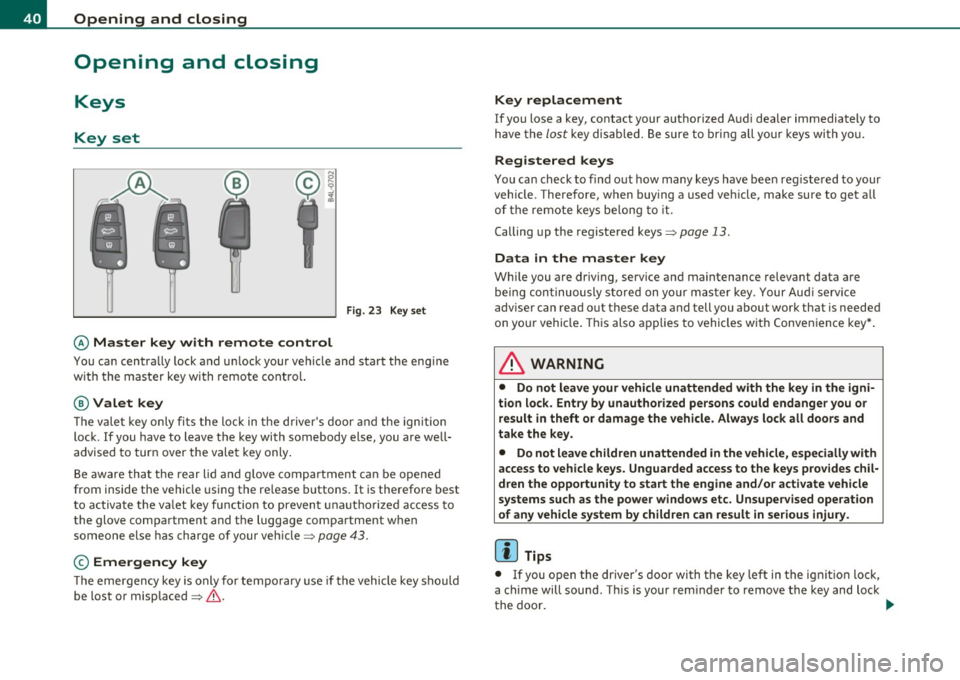
© Ma ster key with remote control
You can centrally lock and u nlock your vehicle and start the eng ine
with the master key with remote cont ro l.
@ Valet key
The v alet key only fi ts the loc k in t he d river's doo r and the ignition
lock. If you have to leave the key with somebody else, you are well
advised to tur n over the vale t key only .
Be aware tha t the rear lid a nd g love compa rtment ca n be opened
from inside the vehicle using the release b uttons . It is therefore best
t o activ ate t he va let key fu nction to preven t unauth oriz e d ac cess to
the glove compartment and the luggage compartment when
someone else has charge of your vehicle=>
page 4 3.
© Emergency key
Th e emergency key is only for tempo rary use if the vehicle key should
be lost or misp laced =>
&.
Key replacement
If you lose a key, contact your authorized Aud i dealer immediately to
h ave the
lost key disab le d . B e sure to bri ng all you r keys wi th yo u.
Registered keys
You can check to find out how many keys have been reg iste red to your
vehicle. Therefore, when b uying a used veh icle, make sure to get all
of the remote keys be long to it.
Calling up the registered keys=>
page 13.
Data in the master key
Wh ile you are driv ing, service and maintenance relevant data are
be in g con tinuously s tored on yo ur mast er key. Your Aud i serv ice
adviser can read out these data and tell you about work that is needed
on yo ur vehi cle. T hi s also app lies to vehi cles w it h Conve nience key* .
& WARNING
• Do not leave your vehicle unattended with the key in the igni
tion lock. Entry by unauthor ized persons could endanger you or
result in theft or damage the vehicle. Alway s lock all doors and
take the key.
• Do not leave children unattended in the vehicle, especially with
access to vehicle keys. Unguarded access to the keys prov ides chil
dren the opportunity to start the engine and /or a ctivate vehicle
systems such as the power windows etc. Unsupervised operation
of any vehicle system by children can result in serious injury .
[ i ] Tips
• If you open t he dr iver's doo r wi th t he key left in the igni tion lock ,
a ch ime will sound. Thi s is your reminder to remove the key and lock
the doo r. _.,,
Page 111 of 390

_______________________________________________ w __ a _r _m _ a_ n_d _ c_o _ l_ d __ _
Warm and cold
Climate control
Description
The air conditioner is fully automatic and is designed to
maintain a comfortable and uniform climate inside the
vehicle.
We recommend the following settings:
- Set the temperature to 72
°F (+22 °C).
- Press the
[AUTO] button.
With this setting, you attain maximum comfort in the least amount
of time. Change this setting , as desired , to meet your personal needs.
The climate controls are a combination of heating, ventilation and cooling systems, which automatically reduce humidity and cool the
air inside your vehicle .
The air temperature, air flow and air distribution are automatically regulated to achieve and maintain the desired passenger compart
ment temperature as quickly as possible.
The system automatically compensates for changes in outside
temperature and for the intensity of the sunlight entering the
vehicle. We recommend you use the
Automatic mode ~ page 112
for year-round comfort .
Please note the following:
Turn on the air conditioner to reduce humidity in the vehicle. This also
prevents the windows from fogging up.
When the outside temperature is high and the air is very humid,
condensation from the evaporator may drip under the vehicle . This is
normal and does not indicate a leak.
Controls and equip
ment Safety first
If the outside temperature is
low, the fan normally only switches to a
higher speed once the engine coolant has warmed up sufficiently .
The air conditioner temporarily switches off when you drive off from
a standstill using full throttle to save engine power.
The compressor also switches off if the coolant temperature is too
high, so that the engine can be adequately cooled under extreme
loads.
Air pollutants filter
The air pollutants filter (a combined particle filter and activated char
coal filter) reduces or prevents outside air pollution (dust, or pollen)
from entering the vehicle. The air is also filtered in air recirculation
mode.
The air pollutants filter must be changed at the intervals specified in
your Warranty
& Maintenance booklet, so that the air conditioner can
properly work.
If you drive your vehicle in an area with high air pollution, the filter
may need to be changed more frequently than specified in your Audi
Warranty
& Maintenance booklet. If in doubt, ask your authorized
Audi Service Advisor for advice .
Key coded settings
The air conditioner settings selected are automatically stored and
assigned to the key being used. When the vehicle is started, the air
conditioner automatically selects the settings assigned to that key.
This way every driver will maintain his/her own personal settings and
does not have to reset them manually.
If a different driver uses your key and changes the air conditioner
settings, the latest adjustments will erase and replace the settings
you have stored. _.,
Vehicle care Technical data
Page 226 of 390
-L___!_A~ ir~b~ a ~ g!..-= s~y :_:s ~t ~e ~ m~ -----------------------------------------------
& WA RNING (conti nued)
ment, cellular telephones and CB radios, etc. ) must be performed
by a qualified technician who h as the training and special equip
ment necessary .
• For any work on the airbag system, we strongly recommend
that you see your authorized Audi dealer or qualified wo rkshop.
• Never modify the front bumper or parts of the vehicle body .
• Always make sure that the side airbag can inflate without
interference :
- Never in stall seat cover s or replacement upholstery over the
front seatbacks that have not been specifically approved by
Audi.
- Never use addit ional seat cushions that cover the areas
where the side airbags inflate.
- Damage to the or iginal seat covers or to the seam in the area
of the side airbag module mu st always be repaired immedi
ately by an authorized Audi dealer.
• The airbag sy stem can be activated only once . After an airbag
has inflated, it must be replaced by an authorized Audi dealer or
qualified technician who has the techni cal information, training
and special equipment necessary.
• The airbag sy stem can be deployed only once . After an airbag
has been deployed, it must be replaced w ith new replacement
parts designed and approved e specially for your Audi model
version. Replacement of complete airbag systems or a irbag
c omponents must be performed by qualified workshops onl y.
Make sure that any airbag service action is entered in you r Audi
Warranty
& Maintenance booklet under AIRBAG REPLACEMENT
RECORD .
• For safety reasons in severe accidents, the alternator and
starter are separated from the vehicle battery with a pyrotechnic
circuit interrupter.
-Work on the pyrotechnic circuit interrupter must only be
performed by a qualified dealer -risk of an accident!
& WARNING (c on tinued )
-If the vehicle or the circuit interrupter is scrapped , all appli
cable safety precautions must be followed.
c£' For the sake of the environment
Undep loyed a irbag mod ules and pretensione rs might be class ified as
Perch lorate Mate rial -special handling may apply, see
www.dt sc.ca.gov/ha zardou sw ast e/perc hlor ate. When the vehicle or
parts o f the restraint system including ai rbag modu les and sa fety
be lts with p rete nsioner s are sc rappe d, all app lic able laws and r egu la
tions m ust be observed. Yo ur authorized Aud i dealer is familiar w ith
t hese requi reme nts and we recommend th at you have yo ur dealer
per form t his service for you .•
Other things that can affect Advanced
Airbag performance
Chang ing the vehicle's suspension system can change the way that
th e Adva nced Airbag System pe rforms i n a cr ash. Fo r examp le, us in g
t ire-rim combinations not approved by Audi, lowering the vehicle,
c hang ing the stiffn e ss o f th e suspension, incl uding t he sp rings,
suspension struts , shock absorbers etc. can change t he forces that
are meas ured by the a irbag sensors an d sent to the elect ronic contro l
unit . Some suspension c hanges can, fo r example, increase the force
levels meas ure d by the senso rs and make the airbag system deploy in
crashes in which i t would not deploy if the changes had not been
ma de. Other ki nds of changes may reduce the force levels meas ure d
by th e sensors a nd p rev ent the airbag from dep loying when it should.
T he sensors in the safety belt b uckle for the drive r and front
p assenge r se at tell the e lec tron ic co ntrol mo dule if the safety bel t i s
latched or not. If the safety belt is being used, the front a irbag w ill
dep loy at a sligh tly higher rate o f vehicle deceler ation t han if t he
sa fety belt is not be ing used . Therefo re, in a pa rt icu lar collis io n, it is
possible that an a irbag w ill not dep loy at a seating posi tion where the .,_
Page 266 of 390
Driving and environment
Drive smoothly and keep a lookout ahead
Vehicles use the most fuel when they are accelerating.
- Avo id unnecessary acce lerating and braking .
Vehicles use the most fuel when they are accelerati ng. If you antici
pate what is going to happen next, you will need to brake less and,
thus , accelerate less. Let the vehicle coast whenever possible - for
example when you see that the next traffic light is red. •
Avoid full throttle
Driving at moderate speeds saves fuel and improves your
mileage.
- Try and keep well below your car's maximum speed.
Accelerating gently reduces fuel consumption, engine wear, and does
not disturb the environment.
Fuel consumption , exhaust emiss ions and eng ine no ise increase
disproportionately at high speeds. If you drive at approximately three
quarters of top speed, fuel consumption w ill be reduced by one ha lf.
Never drive faster than the posted speed limit and weather condi
tions pe rm it. •
Reducing unnecessary idling
Even when your car is just idling it burns up fuel.
- Shut the eng ine off when you are not driving the vehicle.
- Do not warm up the vehicle by letting the eng ine run at
idle .
It makes sense to shu t off t he eng ine in traffic jams, when wa it ing for
tra ins to pass at railroad crossings, or at traffic lights that have long waits on red
. Turning the eng ine off for just 30-40 seconds saves
more f uel than is burned start ing the engine aga in.
It takes a long t ime for the engine to warm up fully when it is ru nning
at idle . However, wear and noxious emissions are especia lly high
when the eng ine is wa rming up. So you shou ld drive away as soon as
you start the engine and avoid running at high rpms while the engine
is still warming up .
0 Note
Do not leave engine idling unattended afte r start ing. If warning
lights should come on to indicate improper operation, they would go
unheeded. Extended idling also produces heat, which cou ld result in
overhea ting or other damage to the vehicle or other property. •
Regular maintenance
A badly tuned engine unnecessarily wastes a lot of fuel.
- Have your vehicle serviced at regular intervals.
By having your vehicle regularly serv iced by an authorized Aud i dealer
helps to ensure that it runs properly and economically. The condition
of your vehicle not only affects its safe ty and ability to hold its value,
it a lso affects fuel con sumption .
Che ck your o il e ach time you fill your t ank.
T he amo unt of oil used is related to engine load and speed.
It is normal for the o il consumption of a new engine to reach its
lowest val ue afte r a certa in m ileage has been d riven.
You must drive your veh icle about 3,000 m iles (5,000 kilometers)
before you can properly assess oi l consumption .
T his also app lies to f uel consumption and engine ou tput. ._
Page 267 of 390
Driving and environment
---------------------------------------------------'
0
Note
• Have you r vehicle ma intained properly and in acco rdance w ith t he
service recommendations in your Warranty
& Maintenance booklet .
Lac k of p roper ma inte nan ce as well as imprope r use of the vehicle wi ll
impair the funct ion of the em ission control system and cou ld lead to
damage.
• Do not alter o r remove any component of the Emission Control
System u nless approved by the manufa ct ur er.
• Do not a lter or remove any device, such as heat shie lds, switches,
ign ition w ires , va lves, which are desig ned to protec t your ve hicle's
Emission Contro l System and other important veh icle components .•
Fewer short trips
F uel consumptio n will always be relatively high on short
trips .
-Try to avoi d drivi ng s ho rt dis tances wit h a cold engine .
The engine and catalytic converter have to reach their optima l oper
ating temperature
t o reduce f uel consum ptio n a nd noxio us em is
sions effectively.
Just after starting, a cold engine in a mid -s ize car on ly achieves a fuel
economy of 6-8 m iles per gallon (30- 40 l/l00km) . After about a ha lf
a mile, fuel economy climbs to 12 mpg (20 l/100 km). After abo ut
2 .5 m iles ( 4 km), t he engine i s at its p rop er operat ing temper ature
and fue l economy has reached a normal level. So yo u can see that you
sho uld avoi d short t rips whenever possible.
T he
out side temperature is a lso c ritical in this regard. Your car
cons umes mo re fue l in the winter than in the summer. •
Controls and equip·
ment Safety first Vehicle operation
Vehicle care Do-it-yourself service Technical data
Page 294 of 390
Fuel supply and filling your fuel tank
(I) Tips
• Runn ing your eng ine while refuelling may cause vapors to escape
or even cause fuel to spill out of the tank. This would then shut off the
fuel nozzle before the tank is full.
• Do not refuel your vehicle with the ignition turned on. The fuel
gauge may otherwise not ind icate the correct fuel level after refuel
ling.
• Diesel vehicles* are equipped w ith a mechanism to prevent incor
rect fueling. They can only be fueled with diesel pump nozzles. A
worn, damaged, or improperly specified nozz le may not allow this
mechanism to open, thereby preventing refueling. If you cannot
insert the pump nozzle, rotate it in the tank opening. This should
open the mechanism and allow refueling. •
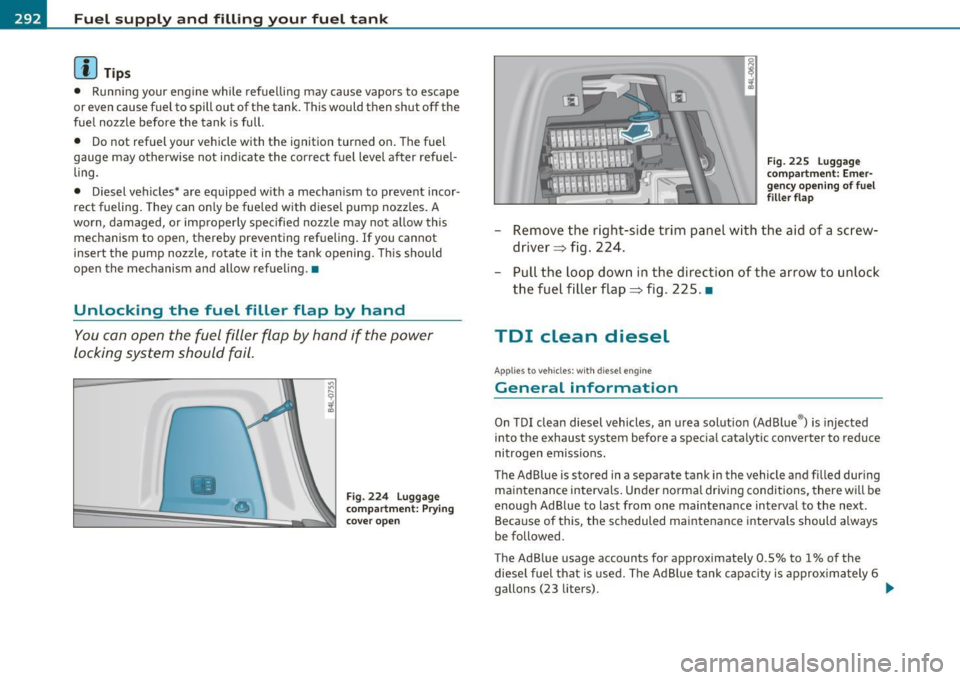
Unlocking the fuel filler flap by hand
You can open the fuel filler flap by hand if the power
locking system should fail.
•
Fig. 224 Luggage
compartment: Prying
cover open Fig. 225
Luggage
compartment: Emer
gency opening of fuel
fille r flap
- Remove the right -s id e trim panel with the aid of a screw
driver => fig. 224.
- Pull the loop down in the direc tion of the arro w to unlock
the fuel filler flap=> fig . 225. •
TDI clean diesel
App lies to veh icles: w ith diese l eng ine
General information
On TOI clean diesel vehicles, an urea solution (AdBlue®) is injected
into the exhaust system before a specia l catalytic converter to reduce
nitrogen emissions.
The Ad Blue is stored in a separate tank in the vehicle and f illed during
maintenance intervals. Under norma l driving conditions, there will be
enough Ad Blue to last from one maintenance interval to the next.
Because of this, the scheduled maintenance intervals should always
be followed.
The Ad Blue usage accounts for approximately 0.5% to 1 % of the
diesel fuel that is us ed. The Ad Blue tank capacity is approximately 6
gallons (23 liters). ..,_
Page 295 of 390
If Ad Blue usage increases due to individual driving style, the driver
must add AdBlue between scheduled maintenance intervals
=>page 294 .
& WARNING
Failure to heed Ad Blue refill information in the instrument cluster
can prevent the vehicle from being started and driven . If the
vehicle cannot be driven and an emergency arises, personal injury
can occur.
• Always have the Ad Blue tank refilled well before the tank runs
dry.
[ i J Tips
• If the Ad Blue tank is completely empty, the engine w ill not start
agai n after the igni tion is sw itched off. The instrument cluster display
indicates the distance remaining that can be driven=>
page 293.
• Ad Blue is required by law to operate this vehicle.
• AdBlue ® is a registered trademark of the Registered Automob ile
Association (Verband der Automobilindustrie e . V. -VOA). •
Safety first
Fuel supply and filling your fuel tank
App lies to ve hicles : w ith d iese l eng ine
Indicator in the instrument cluster display
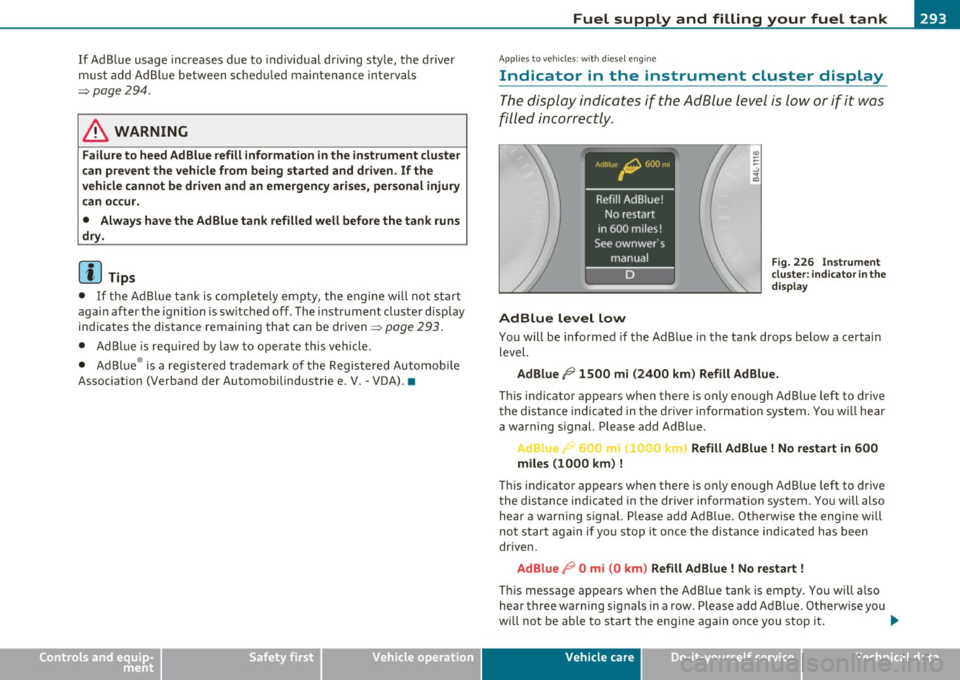
The display indicates if the Ad Blue level is low or if it was
filled incorrectly .
AdBlue level low
Fig. 226 Instrument
cluster: indicator in the
display
You will be informed if the Ad Blue in the tank drops below a certain
level.
Ad Blue /9 1500 mi (2400 km) Refill AdBlue.
This indicator appears when there is only enough Ad Blue left to drive
the distance indicated in the driver information system. You will hear
a warning s ignal. Please add Ad Blue.
... 0C_ .c Refill Ad Blue ! No restart in 600
miles (1000 km)
!
Th is indicator appears when there is only enough Ad Blue left to drive
the distance indicated in the driver informat ion system . You will also
hear a warning signal. Please add Ad Blue . Otherw ise the engine w ill
not start again if you stop it once the distance indicated has been
dr iven .
AdBlue 19 0 mi (0 km) Refill Ad Blue ! No restart !
Thi s message appears when the Ad Blue tank is empty. You will also
hear three warning signals in a row. Please add Ad Blue. Otherwise you
wi ll not be able to start the engine again once you stop it . ._
Vehicle care Technical data
Page 302 of 390
___ C_ h_e _c_ k_ i_ n _ g_ a_ n _ d_ f_il _l _in ____ g ___________________________________________ _
Applies to vehicles with diesel engine only : Only if the level of t he
oil is a t or be low the m inimum m ark o n the o il d ipstick -and no o il
that express ly conforms to A udi o il standard VW 507 00 spec ifica
tions is available -may you top off with a high q ua lity engine oil , that
meets ACEA C3 o r API CF spec ifications, but even then, on ly in
viscosity gra des SAE 5W- 40, SAE SW -30, or SAE OW -40 . However,
dur ing t he e ntire time between o il change i nte rvals, neve r top off
w ith more than a tota l of 0.5 qt/liter engine oil that does not
c onfor m to Audi o il specification VW 5 07 00.
For more information about eng ine oi l th at has been approved for
your vehicle, please con tact either your au thorized A udi dea le r or
Aud i Customer Relations at 1 (800) 822 -2834 or vis it our web site at
www.aud iusa .com or www .aud icanada.ca . He re yo u w ill also find a
cu rrent list of oils (manufactu rers, brand names e tc.) that co nform to
Audi oil standard VW 502 00 (vehicles with gaso line e ngine) or VW
507 00 (vehicles w it h die sel eng ine).
Changing the engine oil
The eng ine oil and oil fi lter mus t be changed according to the mileage
(kilome ters) and t ime intervals specified i n your vehicle 's Warranty &
Ma intenance booklet . Do not exceed these interva ls - harmful
deposi ts from o ld engi ne oil can reduce engine pe rfo rmance and ca n
lead to expensive engine repa irs.
C hangi ng the oil at the recommende d interva ls is so very imp ortant
because the lubricating properties of o il decrease gradually during
normal ve hicl e use. If yo u ar e not sure w hen you have yo ur oil
changed, ask your author ized Audi Service Adv isor .
Under some circumstances the eng ine o il should even be changed
more fr eq uent ly. Chang e oil mor e of ten if you d rive mostly short
distances, operate the veh icle in d usty areas or mostly under stop
and -go t raff ic condi tion s, or when you use yo ur vehicle where tempe r
atures stay be low free zing po int for long periods.
De tergen t ad dit ives in the o il wi ll m ake fres h oil look dark a fter the
eng ine has bee n ru nning for a short t ime . This is normal and is not a
reason to ch ang e the oil mo re of ten t han re commended.
Damage or malfunctions due to lack of maintenance
It is essentia l that you change your o il at the recommended intervals
using only en gine oil th at com plies wi th A udi o il st and ard VW 502 0 0
(vehicles w ith gasoline eng ine) o r VW 507 00 (vehicles with d iesel
eng ine) . Your Limited New Vehicle Wa rranty does not cover damage
or ma lfunct ions due to fa ilure to follow recomm ended maintena nce
and use requirements as set forth in t he Au di Owner's Man ua l and
W arranty
& M aintenance boo klet. Y ou r deale r will have to deny
wa rranty coverage unless yo u present to the dealer proof i n th e form
of Se rvice o r Rep air O rders tha t al l sche dul ed main tena nce was
performed in a time ly ma nner. •
Engine oil consumption
To provide effective lubr ication a nd cooling for interna l eng ine parts,
a ll in ter na l c omb ustion e ngines use some oil. Oil cons umption v aries
from engine to engine and may change over the life of the eng ine .
E ngines te nd to use m ore oi l dur ing the b re a k-i n period t han t hey do
after ward, when oil consumption has stab ilized. Depending on t he
way the vehicle is driven and the operatin g cond itions, oi l cons ump
tion ca n be up to a 1 quart per 1,200 miles
(I lite r per 2,000 km) .
Consumptio n may be higher withi n th e first 3,000 m iles (5, 000 km) .
Under nor mal co ndi tions, the rate o f oi l consu mptio n depe nds o n oil
quality as well as viscosity, engine speed ( rpm), o utside tempe rature,
roa d condi tion s, the amou nt of o il d ilution caused by co nde nsed
water or fu el residue, and oxidation of the oil. O il cons umption may
increase wi th en gine we ar ove r time, un til repl aceme nt of worn
eng ine pa rts may become necessa ry.
Because of all these var ia bles, there is no standa rd o r "norma l" rate
of oil consumption .
We urge you to check the engine oil level at
regular intervals, preferably every time you fill the fuel tank, and
always before a long trip .
The oil pressure warning light
~ is not an indicator of low eng ine
oil level. If the warning light does not go out after starting, or
flashes while driving (above 1500 rpm), a buzzer will sound . It
indicates that the oil pressure is too low. Stop the engine immedi- _.,,
Page 305 of 390
___________________________________________ C_ h_e _c _k_ i_n ~g_ a_n_ d_ f_ i_ll _i_n _g __ _
& WARNING
Spilled oil is a fire hazard .
• The oil filler cap must be properly sec ured to prevent oil from
being sprayed on the hot eng ine and e xhaust system when the
engine i s running.
0 Note
• The oil leve l mus t not be above range @-danger of converte r o r
eng ine damage! Contact an author ized dealership to draw off oil, if
necessary .
• Audi does not recommend the use of oil addit ives . The y may
damage the engine and adver sely affect your New Vehicle
Warranty .
For the sake of the environment
• Under no c ircumstances can the o il come in contact with the
sewage netwo rk or the soil.
• Observe and fo llow legal regu lations when d isposing o f empty o il
containers. •
Changing the engine oil
Engine oil must be chang ed at int ervals listed in th e
W arranty
& Maintenance booklet.
Th e eng ine oil an d oi l filter mus t be c hanged accor ding to the mile age
and time interva ls spec ified in your vehicle's Warranty
& Maintena nce
book let. Do not ex ceed these interv als - ha rmfu l sl ud ge and de posi ts
from o ld eng ine oi l can reduce engine performance and can lead to
expensive engine repairs.
Chang ing o il at r egular intervals is so very important because the
L u br icating pro perties of o il decrease gradually d u ring normal veh icle
Safety first
use . If you a re not sure whe n to have the oil changed, as k your autho
r iz ed A udi Serv ice Adv isor.
Under some circumstances t he e ng ine oi l should even be changed
more often than specified for no rma l use . Change oi l more often if
you often drive s ho rt dista nce s, ope ra te the vehicle in d usty a reas or
mostly unde r stop -and-go traffic cond itions, or when you use your
vehicle whe re te mper atures s tay be low free zing po int f or long
per iods.
Detergent addit ives i n the o il w ill make fresh oil look dark after the
engine has bee n running for a short time . This is normal and is not a
reason to chan ge the oil mo re often t han recommended.
& WARNING
Stop! Before working in the engine compartment, always read and
heed all WARNINGS =>
& in "Working in the engine compart
ment" on
page 297. The engine compartment of any motor
vehicle is a potentially dangerous area and can cause serious
personal injury .
& WARNING
If you must change the engine oil in your vehicle:
• Always wear eye protection .
• To reduce the risk of burns from hot engine oil let the eng ine
cool down to the touch.
• When removing the oil drain plug w ith your fingers, stay as far
away as possible. Always keep your forearm parallel to the ground
to help prevent hot oil from running down your arm .
• Drain the oil into a container designed for this purpose, one
large enough to hold at least the total amount of oil in your
engine .
• To reduce the risk of poisoning, never use empty food or
beverage containers that might mislead someone into drinking
from them .
Vehicle care Technical data