weight AUDI Q7 2011 Owner´s Manual
[x] Cancel search | Manufacturer: AUDI, Model Year: 2011, Model line: Q7, Model: AUDI Q7 2011Pages: 392, PDF Size: 93.29 MB
Page 242 of 392
___ C_h_ i_ l _ d _S_ a_f _e _t ,,.,Y _____________________________________________ _
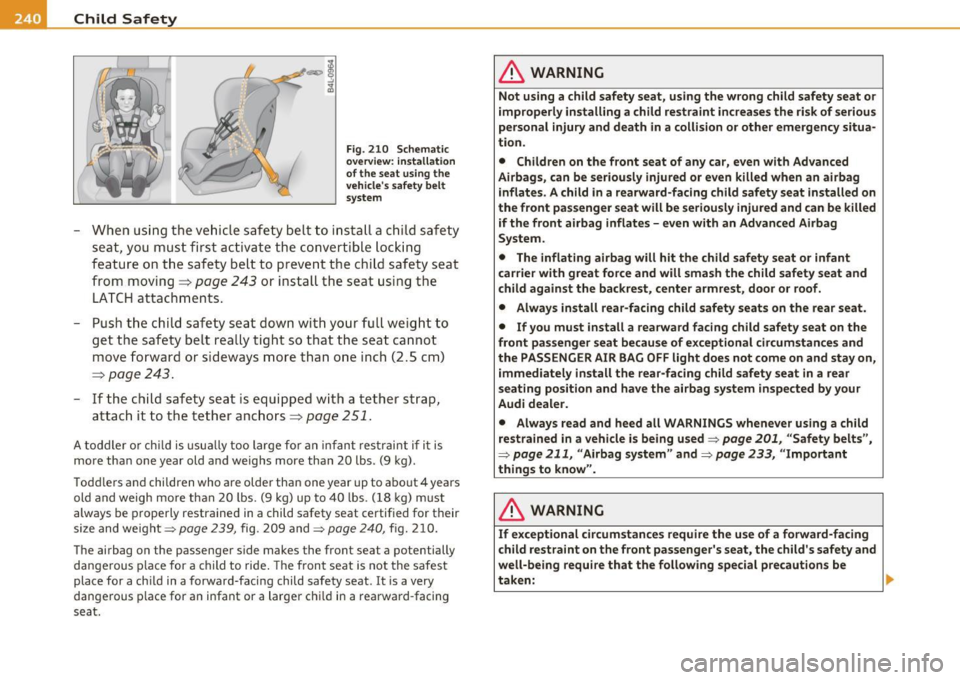
Fig. 210 Schematic
overview: installation
of the seat using the
vehicle's safety belt
system
- When using the vehicle safety belt to install a child safety
seat, you must first activate the convertible locking
feature on the safety belt to prevent the child safety seat
from moving~
page 243 or install the seat using the
LATCH attachments.
- Push the child safety seat down with your full weight to get the safety belt really tight so that the seat cannot
move forward or sideways more than one inch
(2.5 cm)
=>
page 243.
- If the child safety seat is equipped with a tether strap, attach it to the tether anchors=>
page 251.
A toddler or child is usually too large for an infant restraint if it is
more than one year old and weighs more than 20 lbs . (9 kg) .
Toddlers and children who are older than one year up to about 4 years old and weigh more than 20 lbs. (9 kg) up to 40 lbs. (18 kg) must
always be properly restrained in a child safety seat certified for their
size and weight~
page 239, fig. 209 and~ page 240 , fig. 210.
The airbag on the passenger side makes the front seat a poten tially
dangerous place for a child to ride. The front seat is not the safest
place for a child in a forward-facing child safety seat . It is a very
dangerous place for an infant or a larger child in a rearward-facing
seat .
& WARNING
Not using a child safety seat, using the wrong child safety seat or
improperly installing a child restraint increases the risk of serious
personal injury and death in a collision or other emergency situa
tion.
• Children on the front seat of any car, even with Advanced
Airbags, can be seriously injured or even killed when an airbag
inflates. A child in a rearward-facing child safety seat installed on
the front passenger seat will be seriously injured and can be killed
if the front airbag inflates -even with an Advanced Airbag
System.
• The inflating airbag will hit the child safety seat or infant
carrier with great force and will smash the child safety seat and
child against the backrest, center armrest, door or roof.
• Always install rear-facing child safety seats on the rear seat.
• If you must install a rearward facing child safety seat on the
front passenger seat because of exceptional circumstances and
the PASSENGER AIR BAG OFF light does not come on and stay on,
immediately install the rear-facing child safety seat in a rear
seating position and have the airbag system inspected by your
Audi dealer.
• Always read and heed all WARNINGS whenever using a child
restrained
in a vehicle is being used ~ page 201, "Safety belts",
~ page 211, "Airbag system" and~ page 233, "Important
things to know".
& WARNING
If exceptional circumstances require the use of a forward-facing
child restraint on the front passenger's seat, the child's safety and
well-being require that the following special precautions be
taken:
11'-
Page 246 of 392
lffll.___C_ h_ il_d _ S_a _ f_ e _ t--= y '------------------------------------------------
& WARNING (cont inued)
• If the backrest is not securely latched, the child and the child
restraint will be thrown forward together with the backrest and
will strike parts of the vehicle interior. The child can be seriously
injured or killed.
• Never install rear-facing child safety seats or infant carriers on
the front passenger seat. A child will be seriously injured and can be killed when the passenger airbag inflates.
• The inflating airbag will hit the child safety seat or infant
carrier with great force and will smash the child safety seat and
child against the backrest, center armrest, door or roof .
• Always install rear-facing child safety seats or infant carriers
on the rear seat.
• Forward-facing child safety seats or infant carriers installed on
the front passenger's seat may interfere with the deployment of
the airbag and cause serious injury to the child.
• It is safer to install a forward -facing child safety seat on the
rear seat.
• Always read and heed all WARNINGS whenever using a child
restrained in a vehicle is being used~
page 233. Special precau
tions apply when installing a child safety seat on the front
passenger seat~
page 213, "Child restraints on the front seat -
some important things to know".
L1}. WARNING
Always take special precautions if you must install a forward or
rearward -facing child restraint on the front passenger's seat in
exceptional situations:
• Whenever a forward or rearward-facing child restraint is
installed on the front passenger seat, the PASSENGER AIR BAG
OFF light must come on and stay on whenever the ignition is
switched on.
& WARNING (co ntinued )
• If the PASSENGER AIR BAG OFF light does not come on and
stay on, perform the checks described
~ page 222, "Monitoring
the Advanced Airbag System".
• Take the child restraint off the front passenger seat and install
it properly at one of the rear seat positions if the PASSENGER AIR
BAG OFF light does not stay on whenever the ignition is switched
on.
• Improper installation of child restraints can reduce their effec
tiveness or even prevent them from providing any protection.
• An improperly installed child restraint can interfere with the
airbag as it deploys and seriously injure or even kill the child.
• Always carefully follow the manufacturer's instructions
provided with the child safety seat or carrier.
• Never place additional items on the seat that can increase the
total weight registered by the weight-sensing mat and can cause injury in a crash.
L1}. WARNING
Forward-facing child restraints:
• Always make sure the forward-facing seat has been designed
and certified by its manufacturer for use on a front seat with a
passenger front and side airbag .
• Never put the forward-facing child restraint up, against or very
near the instrument panel.
• Always move the passenger seat into its rearmost position in
the seat's fore and aft adjustment range, as far away from the airbag as possible before installing the forward-facing child
restraint . The backrest must be adjusted to an upright position.
• Make sure that the PASSENGER AIR BAG OFF light comes on
and stays on all the time whenever the ignition is switched on . _.
Page 247 of 392

_____________________________________________ C _h_i_ld _ S_ a_ f_ e_ t ... Y'--- __
& WARNING
Rearward-facing child restraints:
• A child in a rearward-facing child safety seat installed on the
front passenger seat will be seriously injured and can be killed if
the front airbag inflates -even with an Advanced Airbag System.
• The inflating airbag will hit the child safety seat or infant
carrier with great force and will smash the child safety seat and
child against the backrest, center armrest, door or roof.
• Always be especially careful if you must install a rearward
facing child safety seat on the front passenger seat in exceptional
circumstances.
• A tight tether strap on a rearward-facing child restraint
attached to the front passenger seat can put too much pressure on
the weight-mat in the seat and register a heavier weight in the
Advanced Airbag System. The heavier weight registered can make
the system work as though an adult were on the seat and deploy
the Advanced Airbag when it must be suppressed causing serious
or even fatal injury to the child.
• Make sure that the PASSENGER AIR BAG OFF light comes on
and stays on all the time whenever the ignition is switched on.
• If the PASSENGER AIR BAG OFF light does not come on and
stay on, immediately install the rear-facing child safety seat in a
rear seating position and have the airbag system inspected by
your Audi dealer. •
Activating the convertible Locking retractor
Use the convertible locking retractor to secure a child
restraint.
Always heed the child safety seat manufacturer's instruc
tions when installing a child restraint in your vehicle. To acti
vate the convertible locking retractor:
Controls and equip
ment Safety first Vehicle operation
-
Place the child restraint on a seat, preferably on the rear
seat.
- Slowly pull the belt
all the way out.
- Route it around or through the child restraint belt path
=>& .
- Push the child safety seat down with your full weight to
get the safety belt really tight.
- Insert the belt tongue into the buckle for that seating
position.
- Guide the safety belt back into the retractor until the belt
lies flat and snug on the child safety seat.
- You should hear a "clicking" noise as the belt winds back
i nto the inertia reel. Test the convertible locking retractor
by pulling on the belt. You should no longer be able to pull
the belt out of the retractor. The convertible locking
retractor is now activated.
- Make sure that the red release button is facing away from
the child restraint so that it can be unbuckled quickly.
- Pull on the belt to make sure the safety belt is properly
tight and fastened so that the seat cannot
move forward
or sideways more than one inch (2.S cm).
& WARNING
Using the wrong child restraint or an improperly installed child
restraint can cause serious personal injury or death in a crash.
• Always make sure that the safety belt retractor is locked when
installing a child safety seat. An unlocked safety belt retractor
cannot hold the child safety seat in place during normal driving or
in a crash. ._
Vehicle care Do-it-yourself service Technical data
Page 254 of 392
-Child Safety Pfrt __ .,.___ ____________ _
child head movement performance req uirements. These new perfor
m anc e re qui re m en ts m ake a t eth er ne ces sary on m ost new chi ld
safety seats .
& WARNING
Improper installation of child restraints will increase the risk of
injury and death in a crash.
• Always follow the instructions provided by the manufacturer
of the child restraint you intend to install in your Audi.
• Improper use of child restraint anchors (including tether
anchors ) can lead to injury in a collision. The anchors are designed
to withstand only those loads imposed by correctly fitted child
re straint s.
• Never mount two child restraint systems on one LATCH lower
anchor point .
• Never attach two child restraint system s to one tether strap or
tether anchorage.
• Never atta ch a tether strap to a tie-down hook in the luggage
compartment.
• Never u se child restraint tether anchorages to secure safety
belts or other kinds of occupant restraints .
• Never secure or atta ch any luggage or other items to the LATCH
lower anchorages or to the tether anchors .
• If a tether or other strap is used to attach a child restraint to
the front passenger seat , make sure that it is not so tight , that it
c auses the weight-sensing mat to mea sure more weight than is
actually on the seat.
• The heavier weight registered can make the Advan ced Airbag
System work as though an adult were on the seat and deploy the
Advan ced Airbag when it mu st be suppre ssed causing serious or
even fatal injury to the child .
• If you must install a rearward facing child safety seat on the
front passenger seat because of e xceptional circumstances and
the PASSENGER AIR BAG OFF light does not come on and stay on,
& WARNING (co ntinued )
immediately install the rear-facing child safety seat in a rear
seating position and have the airbag system inspected by your
Audi dealer. •
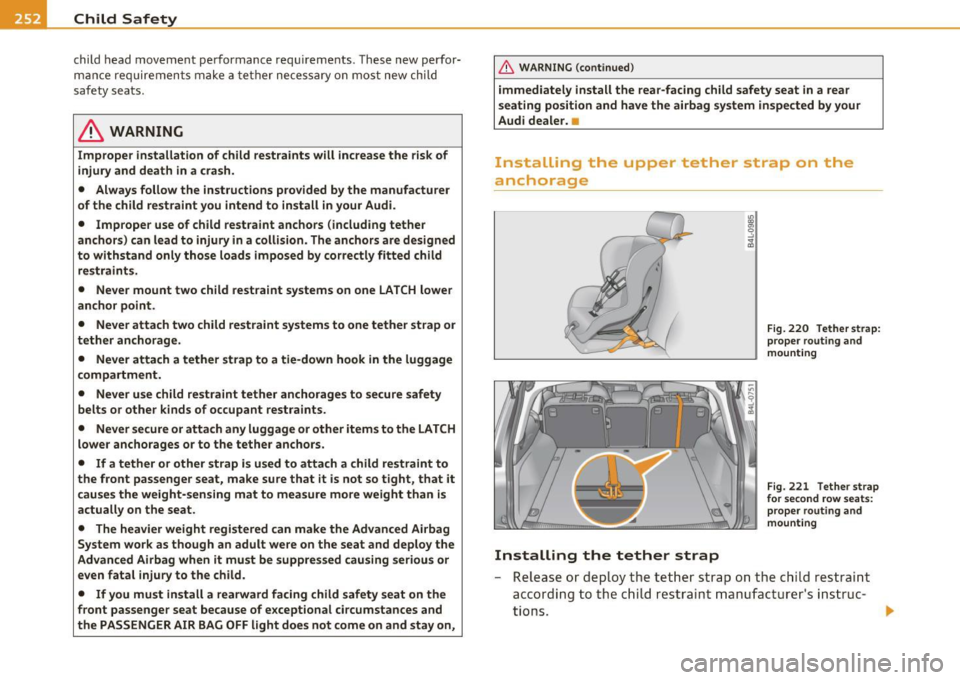
Installing the upper tether strap on the
anchorage
Installing the tether strap
Fig . 220 Tet her strap :
prope r routi ng and
mounting
Fig. 221 Tethe r stra p
for se cond row seats:
prope r ro uti ng and
mounting
- Release or deploy the tet her s trap on the ch ild restrai nt
according t o the child res tra in t m anufac ture r's instruc -
tions .
11'-
Page 255 of 392

Child Safety Ill
-------------------"'---
- Guide the upper tether strap under the rear head restraint
and into the rear cargo area (raise the head restraint if
necessary).
- For the second row of seats: Pull the flooring back, in
order to reach the anchor bracket=>
page 252, fig. 221.
-For the third row of seats:* Remove the plastic cover cap
with a screw driver, in order to reach the anchor bracket
=>
page 251, fig. 219.
- Slide the tether strap hook over the anchor bracket.
- Pull on the tether strap hook so that the spring catch of
the hook engages.
- Tighten the tether strap firmly following the child
restraint manufacturer's instructions.
- For the second row of seats: Push the flooring forward
into place again.
Releasing the tether strap
- Loosen the tension following the child restraint manufac
ture r's instructions.
- Depress the spring catch on the hook and release it from
the anchorage.
- For the second row of seats: Push the flooring forward
into place again.
-For the third row of seats:* Replace the plastic cover cap.
0 Note
If you leave the child restraint with the tether strap firmly installed
for several days, this could leave a mark on the upholstery on the seat
cushion and backrest in the area where the tether strap was installed.
Controls and equip
ment Safety first Vehicle operation
The upholstery would also be permanently stretched around the
tether strap. This
applies especially to leather seats.•
Using tether straps on rearward-facing
child restraints
Currently , few rear-facing child restraint systems come with a tether .
Please read and heed the child restraint system manufacturer's
instructions carefully to determine how to properly install the tether.
& WARNING
A child in a rearward-facing child safety seat installed on the front
passenger seat will be seriously injured and can be killed if the
front airbag inflates· even with an Advanced Airbag System.
• The inflating airbag will hit the child safety seat or infant
carrier with great force and will smash the child safety seat and
child against the backrest, center armrest, or door.
• A tight tether or other strap on a rearward-facing child
restraint attached to the front passenger seat can put too much
pressure on the weight-mat in the seat and register a heavier
weight in the Advanced Airbag System. The heavier weight regis
tered can make the system work as though an adult were on the seat and deploy the Advanced Airbag when it must be suppressed
causing serious or even fatal injury to the child.
• If you must install a rearward facing child safety seat on the
front passenger seat because of exceptional circumstances and
the PASSENGER AIR BAG OFF light does not come on and stay on,
immediately install the rear-facing child safety seat in a rear
seating position and have the airbag system inspected by your
Audi dealer. •
Vehicle care Do-it-yourself service Technical data
Page 276 of 392

Trailer towing
~-----------------------------------------
& WARNING (cont inued)
• The Gro ss Vehicle Weight Rating for your Audi Q7 vehicle,
found on the safety compliance label on the driver's side B-pillar, must never be exceeded under any circumstances . Exceeding the
Gross Vehicle Weight Rating of your vehicle is likely to damage
your vehicle, and such damage will not be covered by your Limited
New Vehicle Warranty. Exceeding the Gross Vehicle Weight
Rating will also change the performance and handling character
istics of your vehicle, whi ch could cause a crash resulting in serious
injury or death.
• The Gro ss Vehicle Weight Rating for your Audi Q7 would be
exceeded if your vehicle is simultaneously equipped with
Panoramic sliding sunroof; third-row seating ; trailer towing
equipment (factory or dealer-installed ), and running boards
(dealer-installed) . UNDER NO CIRCUMSTANCES MAY ALL SUCH
ITEMS BE INSTALLED ON THE SAME VEHICLE .•
Operating instructions
M AX 6 .9"
MA X
175mm
Trailer towing weights
Fig. 223 Permitted
ball position of the
tra iler hit ch
With a factory -installed tra ile r hi tch, the maximum pe rmissib le
t ra iler weig ht is 6,615 lbs (3,000 kg). The maximum pe rmissib le
unbraked trailer we igh t is 1,650 lbs (750 kg) . With an
aftermarket
trail er hi tch, the m axi mum permissibl e traile r weig ht i s 5,5 12 lbs (2,500
kg) . These specifications app ly when driv ing on roads havi ng
an in cline o f less t han 12%.
Permissible tongue load
For best ve hicle handl ing un der t hese ch ange d co ndition s, adju st the
tra ile r l oad so that the tongue load is at the maxim um a llowab le or
sligh tly lower. You can get an app roxim atio n of the tongue load w it h
a bat hroom scale or you ca n measure the load at a t ruc king company
or we ighing st ation.
W it h a
factory-installed trailer h itch, the max imum pe rmissible load
on t he ba ll hitc h may not exceed 662 lbs (300 kg). W it h an
after
market
tra ile r hi tc h, t he ma ximum pe rm issi ble loa d on the b all hi tch
may not exceed 551 lbs (250 kg). It is recommended to use the
maxim um permi ssible loa d.
Trailer load distribution
Be su re the load in t he tra ile r i s held se curely in p lace to p revent it
from shi fting forward, backwa rd or sideways.
Never allow a passenger to ride in a trailer=> & in "Dr ivin g in struc
t ions" on
page 275.
Ball mount
The tra ile r hitch may on ly be used w ith suitable ball mount and ball
=> fi g. 223 . Ins tallat ion of the hi tch b all mus t be c arrie d out in acco r
dance with the manufacturer's instructions . At the height d imension
of 1. 5 in (38 .5 mm) a toler ance of+/- 0.5 in ( 12. 7 mm ) is per miss ible
Engine cooling system
Towing a trailer makes t he eng ine work harder. It is impo rtant that
t he cooling system 's performan ce is up to the addi tional loa d. Mak e
sure that the coo ling system has enough fluid .
Tire pressure
When towing a trailer, inf late the tires ofyourvehicle to the cold tire
pre ssure listed unde r "Full lo ad" on t he tire pre ssu re lab el. Th e tire ...
Page 277 of 392

pressure label is located o n the dr iver's side B-pillar. Inflate trailer
t ires to tra ile r and t ire ma nufacturers' spec ifications.
Lights
T he headl ight settings shou ld be chec ked with the tr ailer attached
before driving off. Check to make sure both vehicle and trailer lights
are wo rking properly.
Safety chains
Be sure tra ile r safety cha ins are p roperly connected from the t rai ler
to the hitch on the vehicle. Leave enough slack in the chains to perm it
tu rning corners . When you install sa fe ty ch ains, ma ke sure they will
not drag on the road when you are driving.
T he chains should cross under the trai ler tongue to prevent it from
dropping in case of separation from the h itch .
0 Note
If you are goi ng to tow a trai ler , you must activate the trai ler opera
tion mode =>
page 182, "Towing a trailer". •
Driving instructior,s
Driving with a trailer always requires e xtra care and
consideration.
To obtain the best possib le handling of ve hicle a nd trailer ,
please note the following :
- Do not tow a loaded trailer when your car itself is not
loaded.
- Be especia lly careful when pass ing other vehicles .
- Observe speed limi ts.
- Do not drive at the maximum pe rmissible speed.
Controls and equip
ment Safety first Vehicle operation
- Always apply brakes early.
- Mo
nitor the temperature gauge.
Weight distri but ion
T owing a loaded trailer with an empty car results in a highly unstable
distribution of we ight . If t his cannot be avoided , drive at very low
speeds only to avoid the risk of losing steering control.
A "balanced" rig is easier to operate and control. This means that the
tow veh icle shou ld be loaded to the extent poss ible and permissib le,
wh ile keeping the tra ile r as lig ht as poss ible unde r the ci rc u mstances.
Whe never possible, transfer some cargo to the luggage compart
me nt o f the tow vehicle while observing tongue load requirements
and vehicle loading considerations.
Speed
The higher the speed, the more d ifficult it becomes for the driver to
control the r ig . Do not dr ive at the maxim um permiss ible speed .
Reduce your speed eve n more if load, weather or w ind conditions are
unfavorable -particular ly when going downhill.
Reduce vehicle speed
immed iately if the tra ile r shows the slightest
sign of swaying.
Do not tr y to stop the s wayi ng by a ccele rating .
Observe speed lim its. In some areas, speeds for veh icles towing
trailers are lowe r than for regular veh icles .
Always apply brakes early. When driving downhi ll, shift into a lower
gear to use the engine brak ing effect to slow t he ve hicle . Use of the
brakes alone can cause them to overheat and fa il.
Coolant temperatur e
The coo lant temperature gauge=> page 10 must be observed care
fu lly. If the needle moves close to the upper end of the sca le, reduce
speed immediately and/or turn off the air conditioner.
If the coo lant temperature warning light in the instrument clus ter
starts flash ing
- F- , pull off the road, stop and let the engine idle for
about two m inutes to prevent hea t buil d-up.
Vehicle care Do-it-yourself service Technical data
Page 278 of 392

Trailer towing
"---------------------------------------------------
in. WARNING
Anyone not properly restrained in a moving vehicle is at a much
greater risk in an a ccident . Never let an yone ride in y our car who i s
not prop erly wearing the re straints provided by Audi. •
Trailer towing tips
Important to know
Your vehicle handles differe ntly when tow ing a tra iler because of the
additiona l weight and different we ight distribution. Safety, perfor
man ce and economy w ill greatly depend on how ca refu lly yo u load
your trailer and operate your rig.
Be fore you actua lly tow your tra ile r, prac tice turning, stopp ing and
back ing u p in a n area away from traffic. Keep pract ic in g until you have
become completely familiar with the way your vehicle -trailer combi
nation behaves and responds .
Backing up is diff icult and requ ires pract ice. Backing up w ith a trailer
gene rally requires s teer ing a ction opposi te to th at when ba cki ng up
your vehicle witho ut a trailer.
Maintain a greate r d istance between your ve hicl e and the one in front
of yo u. You will need more room to stop . T o compensate fo r the
trai ler, you will need a larger than normal turning radius .
W hen p assing, remember that you c annot acceler ate as fast as yo u
normally wou ld because of the added load. Make sure yo u have
enoug h room to pass. After passi ng, allow plen ty of room fo r yo ur
tra iler before changing lanes again .
Avoid jerky starts, sharp turns or rapid lane changes .
[ i ] Tips
• Do not tow a trai ler d uring the brea k-in perio d of your vehicle. •
If you tow a tra iler, your Aud i may require more frequent mai nte
n an ce due to the ex tra load:::::>
page 368. •
Parking on a slope
Do not park on a slope with a trailer. If it cannot be
av oided, do so only after doing the following:
When parking:
- Apply the foot brak e.
- Have someone p lac e chocks un der bo th the vehicle and t he
traile r w he els .
- With c hoc ks i n place, slowly release the brakes u ntil the
wheel c hoc ks absorb t he load.
- Turn the w hee ls towards t he curb .
- A pply the parking brake.
- M ove th e selector le v er to
P.
When restarting after parking:
- A pply the foot brake .
- Start the engine .
- Mov e th e s elector lever to
D .
- Release the par king brake a nd s low ly pull o ut and away
fro m the w heel chocks.
- Stop a nd have someone retr ieve the w heel chocks .
(I) Tips
If you move the se lector lever of the a utomat ic t ransmiss ion to P
befo re applying t he par king br ake an d befo re blo cking the w heels, II-
Page 320 of 392
-~_T_ ir_e_ s_ a_ n_ d_ w_ h_e_ e_ ls _______________________________________________ _
Tires and wheels
Tires
General notes
Tires may be the least appreciated and most abused
parts of a motor vehicle.
T ir es may be the least apprec iated and most abused pa rts of a moto r
vehicle. Tires are, however, one of the most important parts of a
veh icle, parti cularly conside ring the comparative ly small patch of
rubber on eac h tire that assu res that all- important co ntact between
you , your ve hicle and the road .
Ma inta in ing t he correct t ire pressu re, making s ure that your veh icle
and i ts tires do not have to carry more weight than they can safely
hand le, avoid ing damage from road ha za rds and reg ula rly inspect ing
tires for damage incl ud ing c uts, s lashes irregular wea r and overall
condi tion are the mos t important th ings that you can do to help avoi d
sudden tire fa ilure includ ing t read separation and blowouts .
Avoiding damage
If you have to drive over a curb or sim ilar obstacle, drive very s lowly
and as close as poss ible at a right angle to the cu rb .
Always keep chemicals including grease, oil , gasoline and bra ke fl uid
o ff the t ires .
Inspect the ti res regularly for damage (cuts, crac ks o r bl ist ers, e tc .).
Remove any foreign bodies embed ded in the trea ds.
Storing tires
M ar k tires when yo u remove t hem to indica te the d irect ion of rota
tion . This ens ures yo u to be able to mo unt them co rrectly whe n you
re insta ll them.
Wh en r emoved, t he wheels or tires s hould be sto red in a c ool, dry and
preferably da rk p lace. Sto
re tires in a ver tica l pos it ion if they a re not mounted on rims, in a
hor izonta l position if they are mo unted on r ims.
New tires
N ew tires have to be bro ken in~ & .
Th e tread dep th of new tires may v ary, ac cor ding to t he type an d
make of t ire and the tread pattern.
Hidden damage
Dama ge to t ires and rims is often not readi ly visible . If yo u notice
unusu al v ib rat ion o r the veh icle pulls to one sid e, t his may i ndicate
that one of the tires has been damaged. The tires must be c hecke d
i m medi ately by an a uthor ized A udi deale r or quali fied w or ksh op .
Unidirectional tires
A u nidirectional tire can be identified by arrows on the sidewall, that
point in the d irect io n the tire is des igned to rotate. Yo u m ust follow
t he s peci fied dire ction of ro tation . T his is nece ssary so th at t hese
tires can develop the ir optimum c haracter istics regarding gr ip, road
noise, we ar and hy dropl aning res istance. For more informa tion
~page 348 .
& WARNING
New tires or tires that are old , worn or damaged cannot provide
maximum control and braking ability.
• New tires tend to be slippery and must be broken in. To reduce
the risk of losing control, a collision and serious personal injuries, drive with special care for the first 350 miles (560 km) .
• Driving with worn or damaged tires can lead to loss of control,
sudden tire failure , including a blowout and sudden deflation ,
crashes and serious personal injuries. Have worn or damaged tires
replaced immediately. .,_
Page 321 of 392
________________________________________________ T_i_re _ s_ a _ n_d_ w_ h_ e_ e_l_s __ _
& WARNING (co ntinued )
• Tires age even if they are not be ing used and can fail suddenly ,
e specially at high speeds . Tires that are more than 6 year s old can
only be used in an emergency and then with special care and at low
s peed .
Glossary of tire and loading terminology
Accessory weight
means the combined weigh t (in excess of those sta ndard items wh ich
may be replaced) of automatic transmission, power steer ing, power
bra kes, powe r win dows, power sea ts, radio, and heate r, to the exte nt
that these items are available as factory-insta lled equipment
(whet her i ns ta lled or no t).
Aspect ratio
means the r atio of t he he ight to t he widt h of the t ire in percent.
N umbers of 55 or lower indicate a low sidewa ll for improved steer ing
res ponse and bet ter over all h andling on dry p avemen t.
Bead
means the part of the t ire that is made of stee l wi res, w rapped or
re in forced by ply cords and that is shaped to fit the rim.
Bead separation
means a brea kdown of the bond between components in the bead.
Cord
means the st rands forming the plies in the ti re.
Safety first
& W ARNING (co ntinued )
• Never mount u sed tires on your vehicle if you are not sure of
their "previous history ." Old u sed tires may have been damaged
eventhoughthedamagecannotbeseenthatcanleadtosudden
tire failure and loss of vehicle control.
• If you notice unusual vibr ation or if the vehicle pulls to one side
when driving, always stop as soon as it is safe to do so and check
the wheels and tires for damage. •
Cold tire inflation pressure
means the t ire pressu re recom mended by the vehicle manufa ctu rer
for a tire of a desig nate d size that has not been driven for more than
a couple of m iles ( kilomete rs) a t low speeds in the t hree hour per io d
before the tire pressu re is measured or adjusted.
Curb weight
means the weight of a moto r vehicle wit h standard equipment
incl uding the max imum ca pac it y of fue l, o il, and coo lan t, air condi
tioning and additiona l weig ht of optional eq uipment.
Extra load tire
means a tire design to operate at higher loads and at higher inflat ion
pressures than t he co rresponding sta ndard t ire. Extra load tires may
be identif ied as "XL", "xl", "EXTRA LOAD", or "RF" on the sidewa ll.
Gross Axle Weight Rating ( "GAWR ")
means the loa d-carrying capac ity of a sing le ax le system, measure d at
the t ire-grou nd interfaces.
Gross Vehicle Weight Rating ("GVWR")
mea ns the maximum tota l loaded we ig ht of the vehicle .
Vehicle care Technical data