brake pads AUDI Q7 2011 Owner´s Manual
[x] Cancel search | Manufacturer: AUDI, Model Year: 2011, Model line: Q7, Model: AUDI Q7 2011Pages: 392, PDF Size: 93.29 MB
Page 22 of 392
Instruments and warning/indicator lights
Malfunction in the electronic differential lock (EDL)
The ED L works toge ther w ith the ABS. The ABS warn ing lig ht w ill
come on if there is a mal func tion in the EDL system=>
page 258 . See
your authorized A udi dea le r as soon as poss ible .
& WARNING
• If the .. (USA models )/ ...,. (Canada models ) wa rning light
does not go out , or if it comes on while driving, the ABS system is
not working properly. The vehicle can then be stopped only with
the standard brakes (without ABS ). You will not have the p rotec
tion ABS provides. Contact your authorized Audi dealer a s soon as
pos sible.
• USA models : If the BRAKE warning light and the M, warning
light come on together, the rear wheels could lock up fir st under
hard braking. Rea r wheel lock-up can cause loss of vehicle cont rol
and an accident . Have your vehicle repaired immediately by your
autho rized Audi dealer or a qualified work shop. Dri ve slowly and
avoid sudden, hard brake applications.
• Canada models: If the brake warning light 0 and the ABS
warning light come on together, the rear wheels could lock up
first under hard braking. Rear wheel lock -up can cause loss of
vehicle control and an accident . Have your vehicle repaired imme
diately by you r authorized Audi dealer or a qualified wo rkshop.
Drive slowly and avoid sudden , hard brake applications .•
Parking brake
~[ (USA models)/ (®) (Canada models)
The indicator light monitors the p arking br ake.
W hen the parking br ake is app lied a nd the ignition is switched on, the
indicator light comes on©. The ind icator light must go out when the
par king b rake is released. •
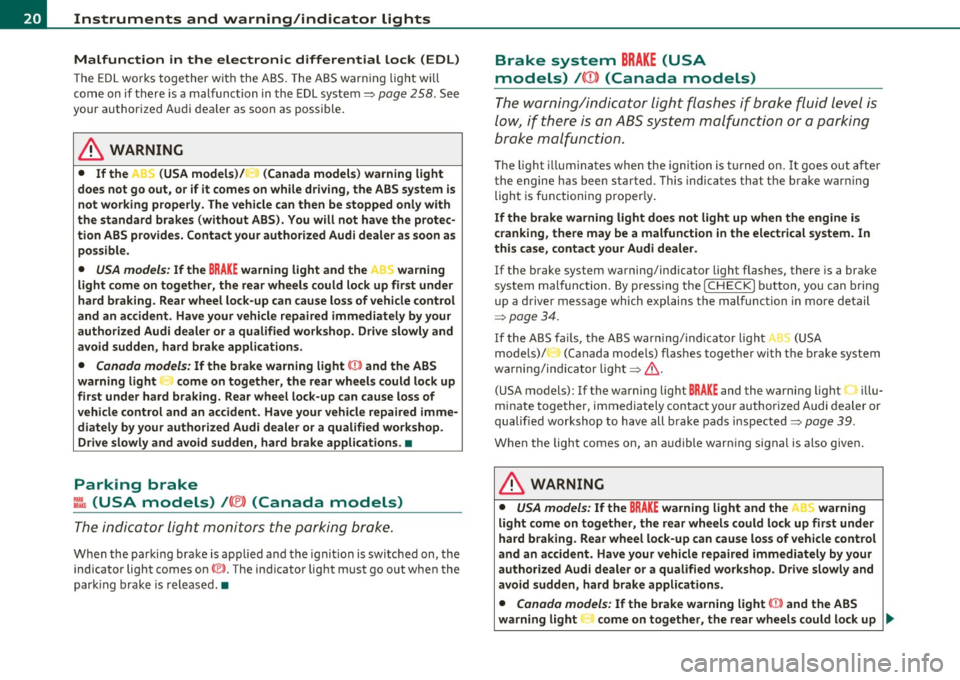
Brake system BRAKE (USA
models)
/ ((D) (Canada models)
The warning/i ndica tor light flashes if b ra ke fluid le vel is
low, if there is an ABS system malfunction or a parking
brake malfunction.
Th e ligh t ill umin ates whe n the igni tio n is tur ned on. It goes out afte r
the engine has been started . This indicates that t he brake war ning
ligh t is functioni ng p roper ly .
If the brake warning light does not light up when the engine is
cranking , there may be a malfun ct ion in the electrical system. In
thi s ca se, contact your Audi dealer.
If the brake system warning/indicator light flashes , there is a brake
system mal function. By press ing the
I C H ECK ] b utton, yo u can bring
up a driver message which exp lains the malfunction in more detail
:::> page 34.
If th e ABS fa ils, t he ABS war ning/ indi cato r light O (USA
mode ls)/ (Canada mode ls) flashes together with t he b rake system
wa rni ng/ind icator light=> & .
(USA models): If the warning light
BRA KE and the warning light illu
minate together, immedia tely contac t your author ized Audi dealer or
qualified workshop to have all brake pads inspected=>
page 39.
When the light comes on, an a udible warn ing signal is also given.
& WARNING
• USA models : If the BRAKE warning light and the I .. S warning
light come on together, the rear wheels could lock up first under
hard braking . Rear wheel lock-up can cause lo ss of vehicle control
and an accident . Have your vehicle repa ired immediately by your
authorized Audi dealer or a qualified workshop. Drive slowly and
avoid sudd en, hard brake application s.
• Canada model s: If the b rake warning light CCI» and the ABS
warning light come on together, the rear wheels could lock up
~
Page 40 of 392
Driver information display
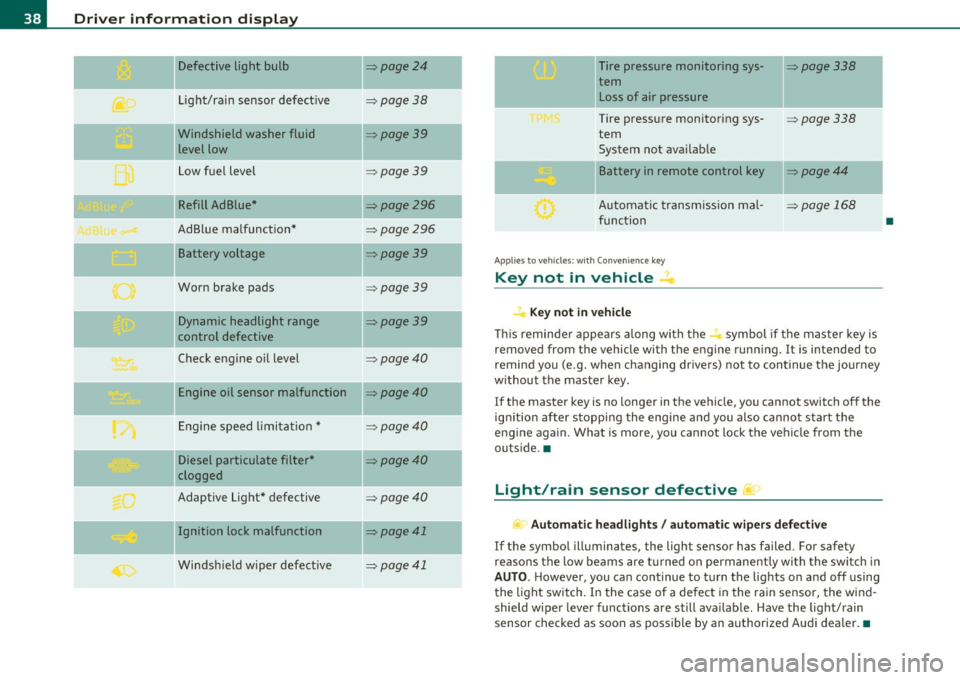
Defective light bulb ::::>page24
._ -
Light/rain sensor defective :::>page 38
-Windshield washer fluid =>page39
level low
Low fuel level
::::>page39
Refill Ad Blue* ::::>page296
AdBlue malfunction* =>page 296
-Battery voltage ::::>page39
Worn brake pads ::::>page39
Dynamic headlight range ::::>page39
control defective
-
Check engine oil level ::::>page40
Engine oil sensor malfunction =>page40
Engine speed limitation* ::::>page40
Diesel particulate filter* ::::>page40
clogged
Adaptive Light* defective
=>page40
Ignition lock malfunction ::::>page41
--
Windshield wiper defective => page 41
-
-
-
-
-
-
Tire pressure monitoring sys-::::>page338
tern Loss of air pressure
Tire pressure monitoring sys-=> page338
tern
System not available
- -
11
sattery in remote control key ::::>page44
Automatic transmission mal-=> page 168
function
Applies to veh icles: with Conven ience key
Key not in vehicle ..Z..
Key not in vehicle
This reminder appears along with the -i. symbol if the master key is
removed from the vehicle with the engine running. It is intended to
remind you (e.g. when changing drivers) not to continue the journey
without the master key.
If the master key is no longer in the vehicle, you cannot switch off the
ignition after stopping the engine and you also cannot start the
engine again. What is more, you cannot lock the vehicle from the
outside. •
Light/rain sensor defective ~'j.
Automatic headlights/ automatic wipers defective
If the symbol illuminates, the light sensor has failed. For safety
reasons the low beams are turned on permanently with the switch in
AUTO. However, you can continue to turn the lights on and off using
the light switch. In the case of a defect in the rain sensor, the wind
shield wiper lever functions are still available. Have the light/rain
sensor checked as soon as possible by an authorized Audi dealer. •
•
Page 41 of 392
Windshield washer fluid Level too Low :5
Please refill washer fluid
If the symbol illumi nates, add winds hield washe r fluid to the washer
system and also to the headlight washer system=>
page 316. •
Fuel supply too Low ""~
A Plea se refuel
When t his symbo l illuminates for t he first time, the fuel reserve in
your vehicle is still between 2 .6 and 3 .2 gallons (10- 12 li te rs) . Refuel
as soon as possible =>
page 293.
If the symbol lights up, even whe n there is ample fue l in the t ank, and
the text Tank system malfunction! Contact workshop appears in the
displ ay, the re is a fa ult in the system. Con tact a qualified workshop to
have the fault rectified .•
Battery voltage U
If the battery's state of charge is not in the optima l range, the -,
s ymbo l is show n in the display and the d river mess age Low battery
charge: battery will be charged while driving appears.
Wh ile this driver notification is displayed, you have to be prepared for
limited sta rting capabili ty .
Driver message appears and goes out again
If th is driver message appears a fter the ignit ion is t urned on or while
driving and it goes o ut again after a while, the battery has been
adequate ly recharged.
Driver message appears and does not go out again
If th is dr iver no tification appears after the ign ition is turned o n or
whi le driving and does not go ou t agai n, the battery 's s ta te of charge
Controls and equip
ment Safety first
Driver information display
is not in the opt
imal range . Starting capability is restricted. Have the
ba ttery che cked by an au thor ized A udi dealer as soon as possible. •
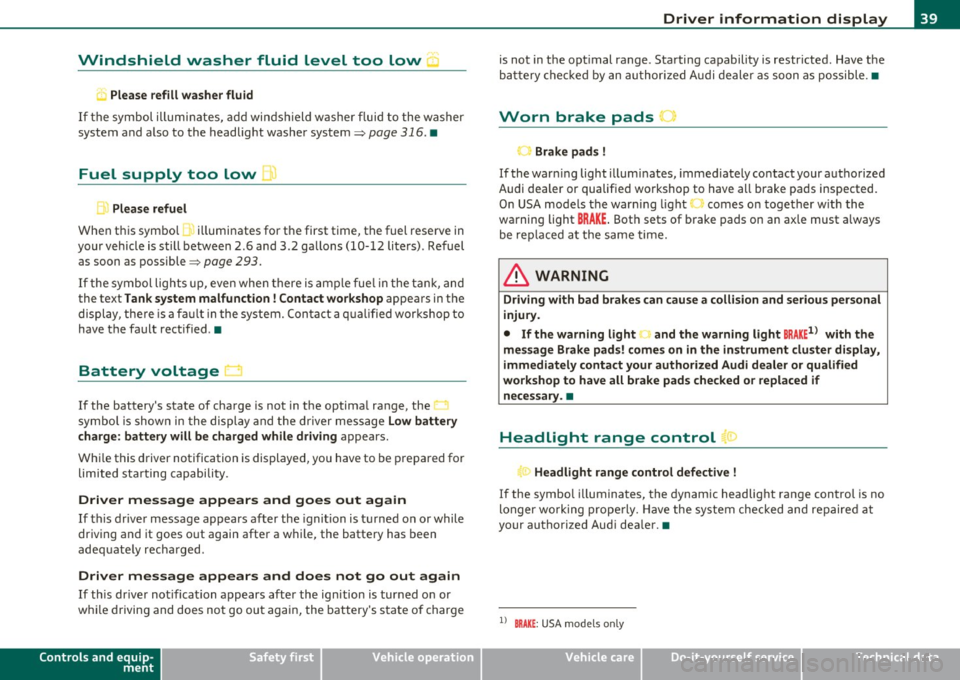
Worn brake pads ~
-Brake pad s !
If the warning light illum inates, immediately contact your a uthorized
Audi dealer or qualified wo rkshop to have all brake pads inspected.
On USA mode ls the warn ing light
t comes o n together w it h the
warning light
BRAKE . Both sets of brake pads on an axle must a lways
be re place d at the same time.
& WARNING
Driving with bad brakes can cause a collision and serious personal
injury.
• If the warning light', and the warning light
8RAKE1l with the
me ssage Brake pads! comes on in the in strument cluster display ,
immediately contact your authorized Audi dealer or qualified
workshop to have all brake pads checked or replaced if necessary. •
Headlight range control 1©
"'Headl ight range control defective !
If the symbo l illuminates, the dynamic headlight range contro l is no
longer wo rking prope rly. Have the syste m checked and repaired at
your authorized Aud i dea ler. •
ll BRAKE : USA mode ls on ly
Vehicle care Technical data
Page 140 of 392

lffll.___A_ d_ a_,_ p_t _i_ v _e _ C_r_ u_ i_ s_ e_ C_ o_ n_ t_ r_ o_ l __________________________________________ _
Applie s to veh icles : wi th Adap tiv e Crui se Con tro l
How does Adaptive Cruise Control work?
Vehicles traveling ahead ore detected with the aid of a
radar sensor.
Fig. 132 Basic prin
ciple diagram: Radar
sensor measurement
range
Adaptive Cruise Control uses a radar sensor in the front of the vehicle
=>
page 138, fig. 132 . The system has limitations=> page 149.
Things that are not moving in your lane and in your direction of travel
w ill not be detected. The sensor measures the distance to reflective
surfaces that must have a certain size. The system responds only
after the distance measurement has been made . If a measurement is
not possible, the system cannot respond and will not react to a
vehicle or someth ing else up ahead.
Open road
When the road is clear, the Adaptive Cru ise Control works like cruise
control. It maintains a constant target speed specified by the driver .
Driving in traffic
If a slower veh icle driv ing ahead is detected, the Adaptive Cruise
Control decelerates (within the limits of the system)=>
page 148,
"Driver intervention prompt" and => page 149, "System limitations"
to its speed and after adjusting, tries to ma inta in the set distance
from the vehicle ahead. The vehicle may temporarily drive slower
than the set speed whi le adjusting=>
& in "Descr iption" on
page 136.
If the vehicle in front accelerates, Adaptive Cruise Control also accel
erates up to the speed that you have set.
If the vehicle ahead slows to a stop, ACC w ill slow your vehicle down
and to a complete stop if this is possible within the system's limits
and capabilities . ACC will not make an emergency stop. The text
message
ACC off: manual control! appears in the instrument cluster
display. Once the vehicle stops, you must depress the brake pedal to
prevent the veh icle from moving forward or "creeping". Depressing
the brake pedal turns off ACC. When the vehicle ahead accelerates
you can reactivate ACC =>
page 141, as soon as your vehicle has
reached a speed of 1 mph (2 km/h) .
Situations requiring driver intervention
In some situations you will have to use the footbrake to slow the
vehicle down in order to keep a safe distance from vehicle in front of
you or to avoid a rear-end collision. In this situation, a symbol
appears and a warning tone sounds=>
page 148.
Passing another vehicle
If you move into the passing lane and no vehicle is detected ahead,
the Adaptive Cruise Control accelerates to the speed you have set and
maintains it.
Overriding ACC
You can increase your speed at any time by stepping on the acceler
ator pedal. After you release the accelerator pedal, the system
adjusts back down to the speed you previously set.
Reduc ing stopping distance
If the radar sensor detects that the distance to the vehicle ahead is
less than defined minimum distance, the brakes are automatically
prepared for emergency braking by the driver. The brake pads are
moved very close to the brake discs withou t actually bra king the
vehicle. This brake assistant feature reacts more quickly to the driver's braking, and also works when Adaptive Cruise Control is off.
The stopping d istance is reduced as a result of this advance brake .,_
Page 261 of 392

_________________________________________ I_ n_ t_ e_ ll_,igent technology ,__E~-
The ASR works in conjunction with the ABS. If a malfunction should
occur in the ABS, the ASR w ill also be out of action.
& WARNING
The increased safety afforded by ASR does not mean that you can
take safety risks. Always adapt your driving style to the road
conditions and traffic situation.
[ i] Tips
To ensure that the ASR works properly, all four whee ls must be fitted
with ident ical tires. Any differences in rolling radius of the tires can
cause the system to reduce engine power when th is is not desired.
See also=>
page 330, "New tires and replacing tires and whee ls" .•
Braking
General information
What affects braking efficiency?
Operating conditions and driving habits
The brakes on today's automobiles are still subject to wear,
depending large ly on operating conditions and driving habits=>& .
On vehicles that are either driven mostly in stop -and -go city traffic or
are driven hard, the brake pads should be checked by your authorized
Audi dealer more often than specified in the
Warranty & Mainte
nance booklet.
Failure to have your brake pads inspected can result
in reduced brake pe rformance .
On steep slopes, you should use the brak ing effect of the engine . This
way, you prevent unnecessary wear on the brake system. If you must
use your brakes, do not hold the brakes down continuously. Pump the
brakes at intervals.
Noises may occur when braking depending on the speed , braking
force and outside conditions such as temperature and humidity.
Safety first
Moisture or road salt
If you are driving faster than 31 mph (SO km/h) and the windshield
wipers are on, the brake pads wi ll briefly touch the brake discs in
regular interva ls so as to improve reaction time when braking on wet
surfaces . You, the driver, will not not ice anything.
Under certain cond itions, for example, when driving through wa ter or
very heavy rain, or even after washing yo ur vehicle , the braking effect
can be reduced due to moisture (or in free zing conditions ice) on the
brake pads. A few careful brake applications should dry off the brake
pads or remove any ice coatings .
The effect iveness of the brakes can be reduced when the vehicle is
dr iven on a sa lt-covered road and the brakes are not used. Here too,
you should clean off accumu lated salt coating from brake discs and
pads with a few careful applications of the brake=> & -
Corrosion
There may be a tendency for dirt to build up o n the brake pads and
corrosion to form on the dis cs if the car is no t driven regularly or only
for short trips with little use of the brakes.
If the brakes are not used frequently, or if corrosion has formed on
the discs, it is advisable to clean off the pads and discs by braking
firmly a few times from a moderately high speed=> &.
Faults in the brake system
If you should notice a sudden increase in brake pedal travel, then one
o f the two brake circuits may have failed==>& .
Low brake fluid level
Malfunctions can occur in the brake system if the brake fluid level is
too low. The brake fluid level is monitored e lectron ically .
Brake lining wear status
Brake lining wear may be checked by visual inspection of the condi
tion of the brake pads through the openings in the wheel. If neces
sary, the wheel may be removed for this inspection =>
page 343,
"Changing a wheel". ._.
Vehicle care Technical data
Page 262 of 392
Intelligent technology
'-----------------------------------------------
in. WARNING
• You should perform braking maneuvers for the purpose of
cleaning the brake system only if road condition s permit. Other
road u sers must not b e put at r isk - you may cau se an ac cident!
• Before d esc ending a steep gr ade , redu ce speed and shift tran s
mission into a lower gear or lower driving range. Do not ride the
brakes or hold the pedal down too long or too often . This could
cause the brake s to get hot and diminish braking efficiency.
• Do not "ride the brakes " by re sting your foot on the pedal when
you do not intend to brake. Thi s may caus e the brakes to overheat ,
premature wear and increa sed stopping di stance.
• Under certain climatic and operating conditions such as
pas sing through water, driving in heavy rain or after washing the
vehicle, the effectiveness of the brake s can be reduced . In winter,
ice can accumulate on the brake pads , linings , disc s and drums .
Carefully apply brakes for a test. Brake s will dry and ice coatings
will be cleaned off after a few careful brake applications.
• Driving for an extended period of time on salt -cov ered roads
without using your brakes can al so affect braking efficiency. Clean
off accumulated salt coating from brake d iscs and pads with a few
careful brake applications.
• If you damage the front spoiler , or if you install a different
s poiler , be sure the air flow to the front brakes is not obstructed.
Otherwise the brake system could overheat reducing the effective
ness of the entire brake system.
• Failure of one brake circuit will impair the braking capability
resulting in an increased stopping distance. Avoid driving the
vehicle and have it towed to the nearest authorized Audi dealer or
qualified wo rkshop. •
Brake booster
The brake booster adds e xtra brakin g pow er .
The brake booster works with vacuum pressure which is created only
w hen the en gine is ru nning =>& .
in. WARNING
• Never let the vehicle roll to a stop with the engine shut off .
• If the brake booster i s not working , for example when towing
your vehicle , or because the brake booster has somehow been
damaged , the brake pedal must be p ressed considerably harder to
make up for the lack of booster assistan ce.
Functioning of Anti-Lock Brake System
(ABS)
AB S prevents the wheels from locki ng up under braking.
T he ABS co ntribu tes effectively to vehicle co ntrol s ince it prevents t he
w hee ls from
locking when the b rakes are a pplied. This means t hat t he
veh icle rema ins steerable and is less likely to s kid .
W ith ABS you do not need to
pump the brake. Just hold the brake
pedal down .
However, do not expect the ABS to shorten braking distance u nder
oil
circums tances. When driving on grave l or on newly fa llen snow on top
of icy su rfaces, braking dis tance may be even longer, therefore, under
these c irc umstances, it is especially important that you dr ive slowly
and w it h great care .
How the ABS system works
An automatic check is made when a speed of about 12 mph (20 km/h)
is reached . Whe n this happens, a p umping noise can be hea rd. ._
Page 267 of 392

Driving and environment
----------------------------------------------'
Driving and environment
The first 1,000 miles (1,500 km)
and afterwards
New engine
The engine needs to be run-in during the first 1,0 00 miles
(1,50 0 km) .
For the first 600 miles (1,000 kilometers):
- Do not use fu ll thrott le .
- Do not drive at engine speeds that are more than 2/3 of
the maximum permitted RPM .
From 600 to 1,000 miles (1 ,000 to 1 ,500
kilometers):
- Speeds can
gradually be increased to the maxim um
perm iss ible road or engine s peed .
During and after break-in period
- Do no t rev the eng ine up to high speeds when it is co ld.
T h is app lies w hether th e t ransmission is in N ( Neutral) o r
1 n gear .
After the break-in period - Do not exceed maximum engine speed under any circum
stances.
- U pshift i nto the nex t higher gear
before reach ing t he red
area at t he end of the tachometer scale==>
page 10.
Dur ing the first few hours of driving, the engine's interna l friction is
hig her than later w hen all the moving pa rts have been broken in. How
Controls and equip ment Safety first Vehicle operation we
ll th is b reak-in p rocess is done depends to a cons iderab le extent on
the way the veh icle is d riven dur ing the f irst 1,000 miles (1,500 kilo
meters).
0 Note
E x tremely high e ngine speeds are automatic ally reduced. However,
these rpm limits are programmed for an engine well run- in, not a new
engi ne.
~ For the sake of the environment
Do no t dr ive with u nnecess arily hig h engine speeds -upshift ing early
saves f uel, reduces noise and protects the environme nt.•
New tires
If y our veh icle is run nin g on n ew tir es, dr ive parti cula rl y
carefu l for the fi rst 35 0 mil es (500 kil ometer s) af ter fit ting.
& WARNING
New tires tend to be slippery and must also be "broken -in ". Be
sure to remember this dur ing the first 350 miles (500 kilome
ter s) . Brake gently. Avoid following closely behind other vehicles
or other situations that might require sudden, hard braking.
u
New brake pads
Remember tha t new brak e pa ds d o no t hav e a fu ll braki ng
eff ect d uri ng the first 250 mi les (400 k ilomet ers) after they
are i nsta lled.
Vehicle care Do-it-yourself service Technical data
Page 268 of 392
Driving and environment
New brake pads have to be "burnished in" before they have optimal
grab ~& .
Dur ing the break-in period, you should avoid putting severe loads on
the bra kes. Severe loads incl ude, for example, sudden hard braking,
in part icu lar at very high speeds or, for examp le, on mountain passes .
& WARNING
New brake pads don't have the be st stopping power and must be
" b roken-in " du ring the initial 100 to 150 miles (150 to 200 kilo
meters ) of normal city driving . You can compensate for this by
pressing the brake pedal more firml y. This also applies later when
new pad s are installed.
'1
Ap plies to veh icles : w it h gasoline eng ine
Catalyt·c converter
It is very important tha t your emission con trol system
(catalytic c onverte r) is f unctioning properly to ensure
that your vehicle is running in an environmentally sound
manner.
- Always use lead-free gasoline~ page 291, "Gasoline" .
- Never ru n the tan k down a ll the way to empty .
- Nev er put to o mu ch mot or oil in y our engin e~
pag e 306,
"Add ing engin e oil~" -
- Neve r try to push -or tow-start yo ur vehicle .
The catalytic converter is an efficient "clean-up" dev ice built into the
exhaust system of the ve hicle. The catalytic converter burns many of
the pollutants in the exhaust gas before they are released into the
atmosphere. The exclusive
use of unleaded fuel is critically important for the life of
t he c atal ytic converte r and proper f unct ion in g of t he engi ne.
& WARNING
• Do not park or operate the vehicle in areas where the hot
e x haust system may come in contact with dry grass , brush , fuel
s pill or other material whi ch can cau se a fire.
• Do not apply additional undercoating or rustp roofing on or
near the exhau st manifold, exhaust pipe s, catalytic converter or
heat shields. During driving , the substance used for undercoating
c ould overheat and cau se a fire .
0 Note
• Be aware th at just one tank fi lling wit h le aded fu el w ill alre ady
ser iously degrade the performance of the catalytic co nverter.
• Do not excee d the correct engine oil leve l~
page 306.
• Do not drive unti l the f uel tank becomes complete ly empty . The
eng ine could misfire. Unbu rned fuel could also ge t into the exha ust
system and th is could cause the catalytic converter to overheat.
• Do not tu rn off the igni tion whi le the veh icle is moving .
• Do not contin ue to operate your vehicle under these conditions, as
o therwise fuel can reach the cata lytic converter . This could result in
overheating of the converte r, requiring its rep lacement.
• To assu re eff icient operat ion of the Emission Co ntrol System:
- Have yo ur vehicle main taine d pr operly and in a ccordan ce wi th
the service recommendations in your Warranty
& Maintenance
booklet .
- Lack of p roper maintenance as well as improper use of the
veh icle w ill imp air the f unction of the emiss io n con trol syste m and
could lead to damage. ..
Page 274 of 392

Driving off road
- Use the hill descent control~ page 257 when dr iving
down steep sections on hills .
Unpaved roads and offroad
Drive slowly on unfamiliar roads and unknown offroad sections, and
loo k ou t for unexpec ted obsta cles (e.g. potho les, rocks, t ree st umps,
etc.).
T o prevent the vehicle from bottoming and avoid damage to the
unde rbody, you should d rive st raight ac ross severe b umps in the
ground with on ly one s ide of the vehicle so that on ly two of your
w heels cross the bumps.
Drive brisk ly throug h sandy or marshy offroad sections and do not
stop, if at all possible.
Driv ing th rough water
N ote the following to avoid vehicle dam age when driving throug h
water, for example on flooded roads:
• T he wate r must not be any higher than the bottom of the ve hicle
body .
• Do not drive faste r th an wal king speed .
Driving on a slope
If yo u ever find you rsel f not able to climb a slope, do not t ry to turn
around, drive back down in
re verse . Otherw ise, you run t he risk of
t ipping over .
If the vehicle threatens to t ip over when driving across a slope, you
must immediately steer downhill in the direction of the slope.
Do not park yo ur vehicle o n steep s lopes o r gr ad es.
To red uce the risk of tipp ing over, drive on s lopes in the di rect io n of
t he downward slo pe (fa ll line) -
not crosswi se .
Driv ing on snow-covered ground
T he s tandard tires fi tted to yo ur vehi cle are not snow t ires. So yo u
should mount wheels with snow t ires in good t ime where winter road
conditions p revail. Befo re dr iv ing on unp lowed stretches o f deep snow, install tire chains
. For tech nica l reasons, t ire chains may only
be ins talle d on the re a r wheels -never on the front whee ls.
& WARNING
After driving through water , mud, slush, etc. , the brakes may be
slow to take effect because of wet brake rotors and pads.
Dry the
brake s first by braking carefully to re store the full braking effe ct.
0 Note
Vehicle components such as the engine, trans mission, s uspension or
electrical system can be severely damaged by dr iv ing through water.
(I) Tips
• Check the dept h of the water before dr iv in g through it.
• Do not stop the vehicle, dr ive in reverse or sw itch the e ngine off
when driving through water.
• K eep in m ind th at on coming vehicles m ay cre ate w aves t hat ra ise
the water level and make it too deep for your vehicle to drive through
safe ly.
• Avoid dr iving through sa lt water because it ca n cause corrosion .•
Page 313 of 392

Checking and filling -
------------- ------=------=:;______,.J,,...
<£> For the sake of the environment
Drained coolant sho uld not be reused. A lways dispose of used coolan t
w hile observing a ll enviro nmental regulations .•
Radiator fan
The radia tor fa n switc hes on a utoma tically by itself
The radiator fan is driven by the engine via the V-belt. The v iscous
cl utch reg ulates the spee d of t he fan accord ing to t he tem pera ture o f
the coolant.
An aux ili ar y e lec tric r adi ator fan* sw itches on and o ff depend ing o n
coo la nt temperat ure and other vehicle operating conditions.
After you switch the engine off, the auxiliary fan can continue r unning
for up to 10 minutes -eve n w it h t he igni tion o ff.
It can even swit ch on
again later by itse lf => & , if
• t he tem pera ture of the e ngi ne coola nt rises due to the hea t build
up from the eng ine in the engine compa rtment, o r
• th e engine compar tmen t heats up because the ve hicl e is parked in
intense s unlight.
& WARNING
• To reduce the risk of personal injury never touch the radiator
fan .
• The auxiliary electric fan is temperature cont rolled and can
switch on suddenly even when the engine i s not running.
• The auxiliary radiator fan switche s on automatically when the
engine coolant reaches a certain temperatu re and will continue to
run until the coolant temperature drops. •
Vehicle OP-eration
Brake fluid
Checking brake fluid level
The brake flu id l eve l can be checke d with a quick gl ance .
Fig . 238 E ngine
compa rtment : Brake
fluid rese rvoir
Before you check a nyt hin g i n th e eng ine compa rtment ,
always read and heed all WARNINGS=> & in " Working in
the e ng ine compartmen t" on
page 301 .
-Read the brake fluid level from t he bra ke flu id reservoir
=> fig. 238 . T he bra ke fluid leve l must be between the
" MIN " and "MAX" markings.
Th e brake fl uid rese rvoir is located at the rear partition of t he engine
compartment on the left side=>
page 302.
The fluid level may drop slightly after some time due to the auto
m atic adjus tment o f th e brake pads. This is no t ca use for alarm .
If the brake fluid level falls
considerably below the "MIN" mark, t he
brake warn ing/i nd icator lig ht ( U.S. models :
BRAKE, Canadian mode ls:
ill ) will come on=> page 20 and=> page 34. Do not continue to
operate the vehicle . The complete brake system s hould be thorough ly
che cked by an au thori zed Aud i dea le r o r q ua lified wor kshop a nd the
cause corrected.
If t h e brake fl uid leve l is too low, the brake .,,_
Vehicle care Do-it-yourselt service iTechnical data