service interval AUDI Q7 2011 Owner´s Manual
[x] Cancel search | Manufacturer: AUDI, Model Year: 2011, Model line: Q7, Model: AUDI Q7 2011Pages: 392, PDF Size: 93.29 MB
Page 24 of 392
Driver information display
Driver information display
Introduction
General notes
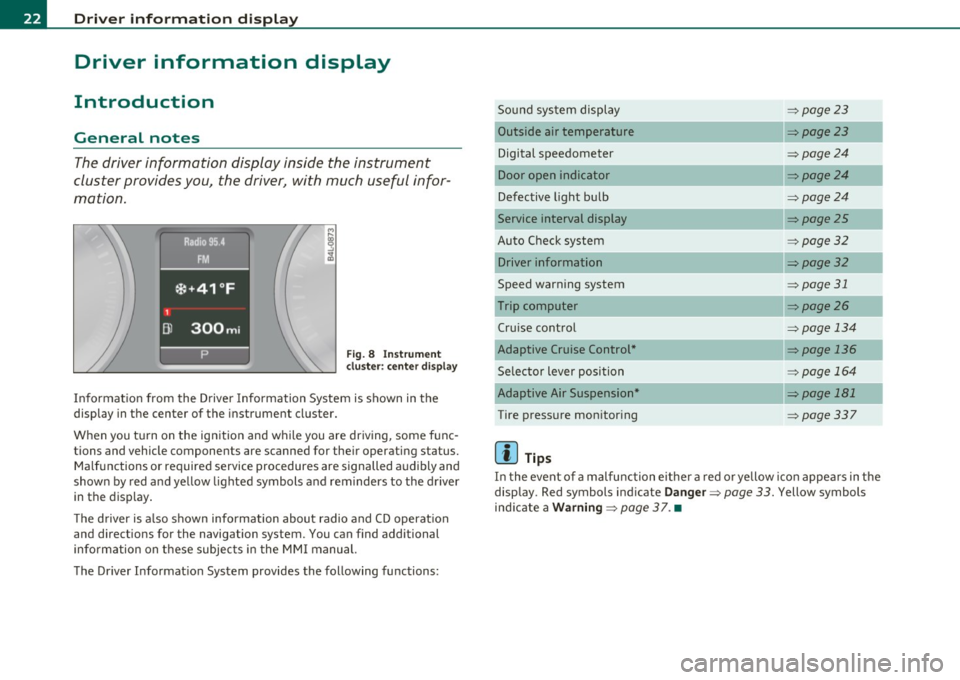
The driver information display inside the instrument
cluster provides you, the driver, with much useful infor
mation .
Fig. 8 Instrument
cl uste r: center display
Informat ion from the Driver Information System is shown in the
display in the center of the instrument cluster.
When you tu rn on the ig nition and while you are driving, some func
tions and vehicle components are scanned for their operating status. Malfunctions or required service procedures are signalled audibly and
shown by red and yellow lighted symbols and reminders to the driver
in the display.
Th e d river is also shown information about radio and CD operat ion
and directions for the navigation system. You can find additional
information on these subjects in the MMI manual.
The Driver Informat ion System provides the following functions: Sound system display
=>
page23
Outside air temperature =>page23
Digital speedometer =>page24
Door open indicator =>page24
Defective light bulb =>page24
Service interval display =>page25
Auto Check system => page 32
Driver information =>page32
Speed warning system => page 31
Trip computer => page26
Cru ise control => page 134
Adaptive Cruise Control* => page 136
Selector lever position => page 164
Adaptive Air Suspension* => page 181
Tire pressure monitoring =>page337
[ i ] Tips
In the event of a malfunction either a red or yellow icon appea rs in the
display. Red symbols indicate
Danger => page 33. Yellow symbols
ind icate a
Warning => page 37. •
Page 27 of 392
& WARNING (co ntinued )
• Wo rk with due care when handling the high-volt age section of
gas di scharge (xenon) lights. Failure to do so could result in death
or ser ious injury.
[ i ] Tips
Have the bulb replaced or the connection repaired by your autho rized
Audi Se rvice departmen t.•
Service interval display
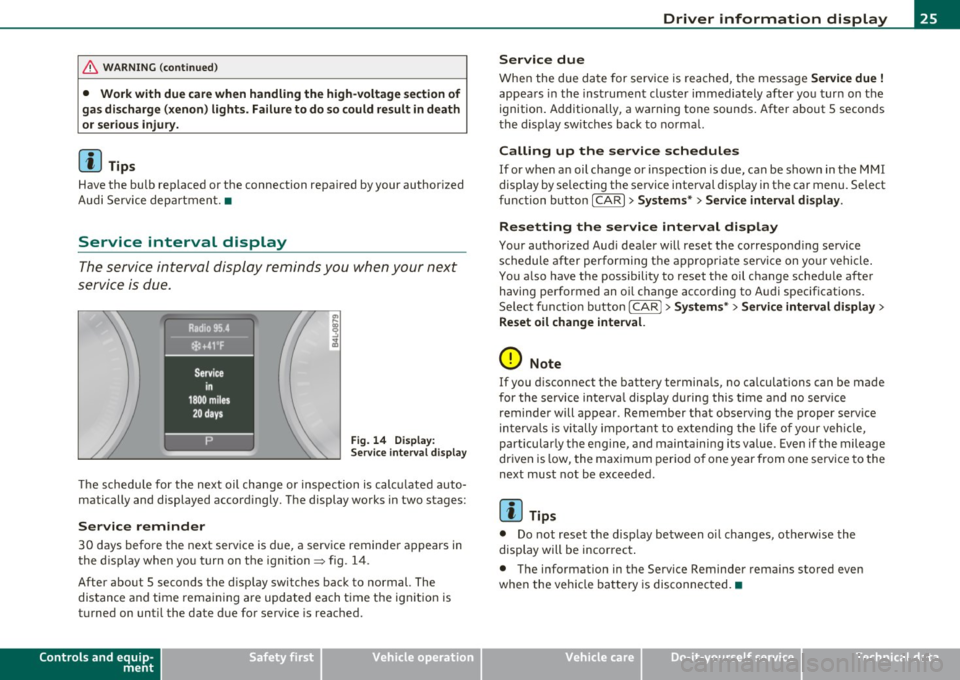
The service interval display reminds you when your next
service is due.
Fig . 14 D ispl ay :
Service inte rval disp la y
Th e schedu le for the next oil change or inspection is c alc ul ated auto
matically and displayed accord ingly. The display works in two stages:
Service reminder
30 days before the next serv ice is due, a serv ice reminder a ppears in
the display when yo u turn on t he ign it ion=> fig. 14 .
After about 5 seconds the d isp lay switches back to normal. The
dis tan ce and time rema ining are updated each t ime t he ig nition is
turned on unti l the date due for service is reac hed .
Controls and equip
ment Safety first
Driver information display
Service due
W
hen the due da te for service is rea ched, t he message Service due !
appea rs in the inst rument cluste r immediately afte r yo u tur n on the
ignition. Additiona lly, a wa rning tone sounds. After about 5 secon ds
the d isp lay sw itches back to no rma l.
Calling up the service schedules
If or when an oil change or inspection is due, can be shown in the MMI
display by se lecting the se rvice interval display in the car menu. Se lect
fu nction button
I CAR ]> Systems *> Service interval display.
Resetting the service interval display
Your authorized Aud i dea ler will reset the correspond ing se rvice
schedule after performing the a ppropriate service on yo ur vehicle .
You a lso have the possibility to reset t he oil c hange sched ule afte r
having performed an o il change acco rding to A udi specifications.
Se lect f unct io n butto n
I CAR j >Systems *> Service interval display >
Reset oil change interval.
0 Note
If you d isconnect the batte ry termina ls, no ca lculations can be made
for the se rvice in terva l display d uring this time and no serv ice
reminder will appear . Remember that observing the proper service
in terv als is vi tally import ant to ex te ndi ng the life of your vehi cle,
particularly the engine, and maintaining its value . Even if the mileage
dr iven is low, the max imum per io d of one year from one serv ice to the
next must not be exceeded.
[I] Tips
• Do not reset the display between oi l changes, otherw ise the
display will be incor rec t.
• The info rmation in the Service Reminder rema ins stored even
when the vehicle ba tte ry is disconnec ted. •
Vehicle care Technical data
Page 38 of 392

Driver information display
& WARNING (continued)
• Never open the hood if you see or hear steam or coolant
escaping from the engine compartment -you risk being scalded.
Wait until you can no longer see or hear steam or coolant
escaping.
• The engine compartment of any vehicle is a dangerous area.
Before you perform any work in the engine compartment, turn of
the engine and allow it to cool. Follow the warning stickers
=> page 290, "Engine compartment".
0 Note
Do not continue driving if the_¥_ symbol illuminates. There is a
malfunction in the engine cooling system -you could damage your
engine. •
Engine oil pressure malfunction 't:::f:
The red engine oil pressure warning symbol requires
immediate service or repair. Driving with a low-oil-pres
sure indication is likely to inflict severe damage to the
engine.
If the ~ symbol appears in the display and blinks, the oil
pressure is too low. An additional driver message can also be
displayed by pressing the
[CHECK] button :
Switch off engine! Oil pressure too low
Immediate actions
- Pull off the road.
- Stop the vehicle.
- Turn off the engine .
-Check the engine oil level with the dipstick => page 305.
Dipstick readings checks too low
- Top off oil to the proper level=> page 306 .
Make sure that the oil pressure warning symbol~
appears no longer in the display before you start driving
again.
Dipstick reading checks OK
- If the oil pressure warning symbol ~ starts flashing
again even though the engine oil level checks OK on the
dipstick,
do not continue driving and do not let the
engine run in idle.
Instead, contact your authorized Audi
dealer for assistance.
[I) Tips
• The engine oil pressure symbol~ is not an indicator for a low
engine oil level. Do not rely on it. Instead, check the oil level in your
engine at regular intervals, preferably each time you refuel, and
always before going on a long trip.
• The yellow oil level warning indication
~ requires oil refill or
workshop service without delay. Do not wait until the red oil pres
sure warning ~ starts to flash before you respond to the low oil
level warning
..'!' . By then, your engine may already have suffered
serious damage. •
Steering malfunction i
If there is a malfunction in the electronic steering column
lock, the steering cannot be unlocked.
If the i symbol in the display blinks, there is a malfunction
in the electronic steering column lock. An additional driver
~
Page 113 of 392
Warm and cold -
----------------
Warm and cold
Climate control
Description
The air conditioner is fully automatic and is designed to
maintain a comfortable and uniform climate inside the
vehicle.
We recommend the following settings:
- Set the temperature to 72
°F (+22 °C).
- Press the
[AUTO] button.
With this setting, you attain maximum comfort in the least amount
of time. Change this setting , as desired , to meet your personal needs.
The climate controls are a combination of heating, ventilation and cooling systems, which automatically reduce humidity and cool the
air inside your vehicle .
The air temperature, air flow and air distribution are automatically regulated to achieve and maintain the desired passenger compart
ment temperature as quickly as possible.
The system automatically compensates for changes in outside
temperature and for the intensity of the sunlight entering the
vehicle. We recommend you use the
Automatic mode ~ page 114
for year-round comfort .
Please note the following:
Turn on the air conditioner to reduce humidity in the vehicle. This also
prevents the windows from fogging up.
When the outside temperature is high and the air is very humid,
condensation from the evaporator may drip under the vehicle . This is
normal and does not indicate a leak.
Controls and equip
ment Safety first
If the outside temperature is
low, the fan normally only switches to a
higher speed once the engine coolant has warmed up sufficiently .
The air conditioner temporarily switches off when you drive off from
a standstill using full throttle to save engine power.
The compressor also switches off if the coolant temperature is too
high, so that the engine can be adequately cooled under extreme
loads.
Air pollutants filter
The air pollutants filter (a combined particle filter and activated char
coal filter) reduces or prevents outside air pollution (dust, or pollen)
from entering the vehicle. The air is also filtered in air recirculation
mode.
The air pollutants filter must be changed at the intervals specified in
your Warranty
& Maintenance booklet, so that the air conditioner can
properly work.
If you drive your vehicle in an area with high air pollution, the filter
may need to be changed more frequently than specified in your Audi
Warranty
& Maintenance booklet. If in doubt, ask your authorized
Audi Service Advisor for advice .
Key coded settings
The air conditioner settings selected are automatically stored and
assigned to the key being used. When the vehicle is started, the air
conditioner automatically selects the settings assigned to that key.
This way every driver will maintain his/her own personal settings and
does not have to reset them manually.
If a different driver uses your key and changes the air conditioner
settings, the latest adjustments will erase and replace the settings
you have stored. _.,
Vehicle care Technical data
Page 147 of 392
__________________________________________ A_ d_a""" p:....- t_iv _ e_ C_ r_ u _is _ e_C_ o_n_ t_ r_ o_ L_....J_
Certa in pieces of information in the bottom part of the display are not
shown permanent ly. Information is displayed only if you set or
change the speed setting, change the t ime interval, when messages
are displayed or if the Adapt ive Cruise Control is turned off for safety
reasons. •
Applies to veh icles: with Adaptiv e Cruise Contro l
Display in the speedometer
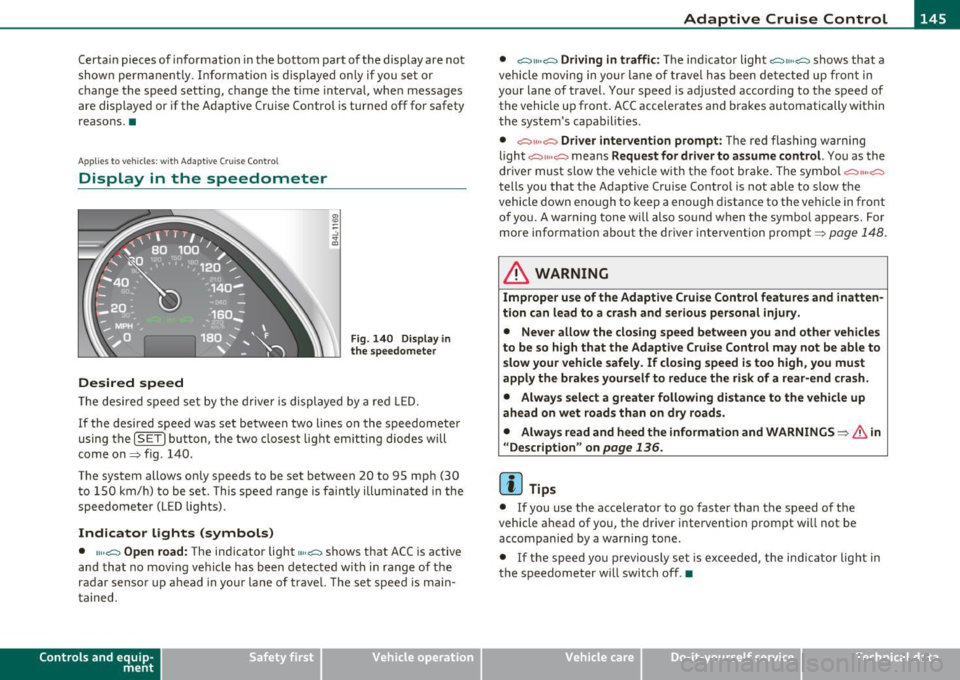
Desired speed
Fig . 140 Display in
the speedometer
Th e desired speed set by the driver is displayed by a red LED.
If the desired speed was set between two lines on the speedometer
using the
[SET) bu tton, the two closest light emitting diodes w ill
come on=> fig. 140.
The system allows only speeds to be set between 20 to 95 mph (30 t o 150 km/h) to be set. This speed range is fa int ly illumina ted in the
speedometer (LED lights).
Indicator lights (symbols)
• ""~ Open road: The indicator light""~ shows that ACC is active
and that no mov ing vehicle has been detected with in range of the
radar sensor up ahead in your lane of travel. The set speed is main
ta ined.
Con tro ls a nd e quip
m en t Vehicle
OP-eration •
~" "~ Driving in traffic:
The indicator light ~11 .. c::::., shows that a
vehicle moving in yo ur lane of travel has been detected up front in
your lane of travel. Your speed is adjusted accord ing to the speed of
the vehicle up front. ACC accelerates and brakes automatically within
the system's capabilit ies .
• ~" "~ Driver intervention prompt: The red flashing warning
light
c::::., 11 .. o::::::) means Request for driver to assume control. You as the
driver must slow the veh icle with the foot brake . T he symbol
~""o::::::)
tells you that the Adaptive Cruise Control is not able to slow the
vehicle down enough to keep a enough distance to the vehicle in front
of you. A warning tone will also sound when the symbol appears. For
more information about the driver intervention prompt=>
page 148.
& WARNING
Improper use of the Adaptive Cruise Control features and inatten
tion can lead to a crash and serious personal injury.
• Never allow the closing speed between you and other vehicles
to be so high that the Adaptive Cruise Control may not be able to
slow your vehicle safely. If closing speed is too high, you must
apply the brakes yourself to reduce the risk of a rear-end crash.
• Always select a greater following distance to the vehicle up
ahead on wet roads than on dry roads.
• Alway s read and heed the information and WARNINGS=>
& in
" Description" on
page 136.
[ i ] Tips
• If you use the accelerator to go faster than the speed of the
vehicle ahead of you, the driver intervention prompt will not be
accompanied by a warn ing to ne.
• If the speed yo u previously set is exceeded, the indica tor light in
the speedometer will switch off .•
Vehicle care Do-it-yourselt service iTechnical data
Page 270 of 392
Driving and environment
Avoid full throttle
Driving at moderate speeds saves fuel and improves your
mileage.
-Try and keep well below your car's maximum speed.
Accelerating gently reduces fuel consumption, engine wear, and does
not disturb the environment.
Fuel consumption , exhaust emiss ions and eng ine no ise increase
disproportionately at high speeds . If you drive at approximately three
quarte rs of top speed, fuel consumption will be reduced by one ha lf.
Never drive faster than the posted speed limit and weather condi
tions permit. •
Reducing unnecessary idling
Even when your car is just idling it burns up fuel.
- Shut the engine off when you are not driving the vehicle.
- Do not warm up the vehicle by letting the engine run at
idle .
It makes sense to shut off the engine in traffic jams, when waiting for
trains to pass at railroad crossings , or at traffic lights that have long
waits on red. Turning the engine off for just 30-40 seconds saves
more fuel than is burned starting the engine aga in.
It takes a long time for the engine to warm up fully when it is running
at idle . However, wea r and noxious emiss ions are especially high
when the engine is warming up. So you should drive away as soon as
you start the engine and avoid running at high rpms while the engine
is still warming up .
0 Note
Do not leave engine idling unattended after starting. If warning
lights should come on to indicate improper operation, they would go
unheeded. Extended idling also produces heat, which could result in
ove rheating or other damage to the vehicle or other property. •
Regular maintenance
A badly tuned engine unnecessarily wastes a lot of fuel .
-Have your vehicle serviced at regular intervals .
By having your vehicle regularly serv iced by an authorized Aud i dealer
helps to ensure that it runs properly and economically. The condition
of your vehicle not only affects its safety and ability to hold its value,
it a lso affects
fuel consumption.
Check your oil each time you fill your tank.
The amount of oil used is related to engine load and speed .
It is norma l for the oil consumption of a new engine to reach its
lowest value after a certain mileage has been d riven.
You must drive your vehicle about 3,000 miles (5,000 kilometers) befo re you can properly assess oi l consumption.
This also app lies to fuel consumption and engine output .
0 Note
• Have your veh icle ma inta ined properly and in accordance w ith the
service recommendations in your Warranty
& Maintenance booklet.
Lack of proper maintenance as well as im proper use of the vehicle will
impair the function of the emission control system and could lead to
damage .
• Do not alter or remove any component of the Emission Control
System un less approved by the manufacturer. ._
Page 306 of 392

lffll __ C_ h_e _c_ k_ i_ n _ g_ a_ n _ d_ f_il _l _in ____ g ___________________________________________ _
Applies to vehicles with diesel engine only : Only if the level of t he
oil is a t or be low the m inimum m ark o n the o il d ipstick -and no o il
that express ly conforms to A udi o il standard VW 507 00 spec ifica
tions is available -may you top off with a high q ua lity engine oil , that
meets ACEA C3 o r API CF spec ifications, but even then, on ly in
viscosity gra des SAE 5W- 40, SAE SW -30, or SAE OW -40 . However,
dur ing t he e ntire time between o il change i nte rvals, neve r top off
w ith more than a tota l of 0.5 qt/liter engine oil that does not
c onfor m to Audi o il specification VW 5 07 00.
For more information about eng ine oi l th at has been approved for
your vehicle, please con tact either your au thorized A udi dea le r or
Aud i Customer Relations at 1 (800) 822 -2834 or vis it our web site at
www.aud iusa .com or www .aud icanada.ca . He re yo u w ill also find a
cu rrent list of oils (manufactu rers, brand names e tc.) that co nform to
Audi oil standard VW 502 00 (vehicles with gaso line e ngine) or VW
507 00 (vehicles w it h die sel eng ine).
Changing the engine oil
The eng ine oil and oil fi lter mus t be changed according to the mileage
(kilome ters) and t ime intervals specified i n your vehicle 's Warranty &
Ma intenance booklet . Do not exceed these interva ls - harmful
deposi ts from o ld engi ne oil can reduce engine pe rfo rmance and ca n
lead to expensive engine repa irs.
C hangi ng the oil at the recommende d interva ls is so very imp ortant
because the lubricating properties of o il decrease gradually during
normal ve hicl e use. If yo u ar e not sure w hen you have yo ur oil
changed, ask your author ized Audi Service Adv isor .
Under some circumstances the eng ine o il should even be changed
more fr eq uent ly. Chang e oil mor e of ten if you d rive mostly short
distances, operate the veh icle in d usty areas or mostly under stop
and -go t raff ic condi tion s, or when you use yo ur vehicle where tempe r
atures stay be low free zing po int for long periods.
De tergen t ad dit ives in the o il wi ll m ake fres h oil look dark a fter the
eng ine has bee n ru nning for a short t ime . This is normal and is not a
reason to ch ang e the oil mo re of ten t han re commended.
Damage or malfunctions due to lack of maintenance
It is essentia l that you change your o il at the recommended intervals
using only en gine oil th at com plies wi th A udi o il st and ard VW 502 0 0
(vehicles w ith gasoline eng ine) o r VW 507 00 (vehicles with d iesel
eng ine) . Your Limited New Vehicle Wa rranty does not cover damage
or ma lfunct ions due to fa ilure to follow recomm ended maintena nce
and use requirements as set forth in t he Au di Owner's Man ua l and
W arranty
& M aintenance boo klet. Y ou r deale r will have to deny
wa rranty coverage unless yo u present to the dealer proof i n th e form
of Se rvice o r Rep air O rders tha t al l sche dul ed main tena nce was
performed in a time ly ma nner. •
Engine oil consumption
To provide effective lubr ication a nd cooling for interna l eng ine parts,
a ll in ter na l c omb ustion e ngines use some oil. Oil cons umption v aries
from engine to engine and may change over the life of the eng ine .
E ngines te nd to use m ore oi l dur ing the b re a k-i n period t han t hey do
after ward, when oil consumption has stab ilized. Depending on t he
way the vehicle is driven and the operatin g cond itions, oi l cons ump
tion ca n be up to 1 qua rt pe r 1,200 m iles
(I liter per 2 ,000 km).
Consumption may be higher withi n th e first 3,0 00 miles (5,00 0 km).
Under nor mal co ndi tions, the rate o f oi l consu mptio n depe nds o n oil
quality as well as viscosity, engine speed ( rpm), o utside tempe rature,
roa d condi tion s, the amou nt of o il d ilution caused by co nde nsed
water or fu el residue, and oxidation of the oil. O il cons umption may
increase wi th en gine we ar ove r time, un til repl aceme nt of worn
eng ine pa rts may become necessa ry.
Because of all these var ia bles, there is no standa rd o r "norma l" rate
of oil consumption .
We urge you to check the engine oil level at
regular intervals, preferably every time you fill the fuel tank, and
always before a long trip .
The oil pressure warning light
~ is not an indicator of low eng ine
oil level. If the warning light does not go out after starting, or
flashes while driving (above 1500 rpm), a buzzer will sound . It
indicates that the oil pressure is too low. Stop the engine immedi- _.,,
Page 331 of 392
________________________________________________ T_i_re _ s_ a _ n_d_ w_ h_ e_ e_l_s __ _
Tire pressure
Incorrect tire pressure cau se s prema ture we ar and c an cau se sudden
ti re blow-o ut. Fo r this reaso n, tir e press ure must be ch ecked at l eas t
once a mo nth ;:::,
page 324 .
Driving style
Driv in g fast aro und curves, heavy a cce le ra ti on and hard bra kin g
increase tire wea r.
Rotating tires for more even wear
Fo r all fou r tir es on your ve hicle to have the same service life, we
re co mm end th at t he fron t and rear tire s ar e rotat ed acco rd ing t o the
tire ma nufact urer's s uggested tire rotation intervals. Please
remem be r th e fo llow ing:
• Tir e ro tat io n in terv als ma y differ from t he ve hicle serv ice in terv als
out lined in your Warranty
& Maintenance bo oklet .
• Th e long er o ne tire is used i n one location on t he veh icle, t he mo re
it wears at certa in po ints; t herefore, we recommend t hat you follow
th e tir e m an ufac ture r's sugges ted tire r ota tion in te rv a ls .
• Vehicles w ith fro nt-w hee l dr ive experience mo re tread wea r on the
fron t w heels compared to all-whe el driv e (qua ttro ®).
• P leas e ro tate tires as sh own ;:::, fig. 244.
• Extra care m ust be ta ken when rotat ing direction-specific tires
=:, p age 3 48 .
Wheel balancing
The w heels on new ve hicl es a re bala nced. However, v ario us sit uatio ns
dur ing everyday driving can cause them to become unba lanced,
re su lt ing in vibra tions yo u can usually fee l throug h the stee rin g
w hee l.
Unbalanced whee ls mus t be rebalanced to avoid excessive wear on
s t eer ing, suspension and t ir e s. A wheel must also b e rebalanced
w hen a new tire is installed.
Safety first
Incorrect wheel alignment
Incorrec t wheel a lignment can c ause excessive t ire wear, im pair ing
t he sa fety o f the ve hicle . If t ires s how exc essive wear, hav e the wheel
alignment checked by an author ized A udi dealer o r qualifie d wo rk
shop.
All Wheel Drive
Vehicles with quattro ® must a lways have tires of the same s ize,
constr uctio n an d trea d type . For details see ;:::,
page 262.
& WARNING
Sudden tire failure can lead to loss of control, a crash and serious
personal injury!
• Never drive a vehicle when the tread on any tire is worn down
to the wear ind icators .
• Worn tires are a safety hazard, they do not grip well on wet
roads and increase your risk of "hydroplaning" and loss of control.
• Always keep chemicals that can cause tire damage, such as
grease, oil , gasoline and brake fluid away from tires.
• Tires age even if they are not being used and can fail suddenly,
especially at high speeds. Tires that are more than 6 years old can
only be used in an emergency and then with special care and at
lower speeds.
• Never mount used tires on your vehicle if you are not sure of
their "previous history." Old used tires may have been damaged
eventhoughthedamagecannotbeseenthatcanleadtosudden
tire failure and loss of vehicle control. •
Vehicle care Technical data
Page 370 of 392
___ C_ o_n_ s _ u_m_ e_ r_ I_ n_ f_o _r_ m_ a_ t_io _ n _____________________________________________ _
Consumer Information
Warranty coverages
Your Audi is cov ered by the following warrantie s:
• New Vehicle Limited Warranty
• Limited Warranty Against Corrosion Perforation
• Emissions Control System Warranty
• Emissions Performance Warrant y
• California Emissions Control Warranty (USA vehicles only)
• California Emissions Performance Warranty (USA vehicles only)
Detailed informa tion regarding your warran ties can be fo und in your
Warranty & Maintenance boo klet .•
Operating your vehicle outside the
U.S.A. or Canada
Government regulat ions in the United States and Canada req uire t hat
au tomobiles meet spe cific emi ss ion regula tions and safe ty s tan
dards . There fore, ve hicles bui lt for the U.S.A . and Canada differ from
vehicles so ld in othe r countries.
If you plan to take your vehicle ou tside the continental lim its of the
United States or Canada, the re is the possibility that
• unle aded fue ls for vehicle s w ith c ataly tic converte r may n ot be
available;
• fue l may have a conside rably lower octa ne rat ing . Imp roper f ue l
may cause engine damage;
• serv ice may be inadequate due to lack of proper serv ice fac ilities,
too ls or testing eq uipment;
• replacement parts may not be read ily avai lab le . • N
avigation syst ems for veh icles built fo r th e U.S.A. and Canada
w ill not necessar ily work in Europe, and may not wo rk in other coun
tries outs ide North Ame rica.
0 Note
Audi canno t be responsib le for mech anical dam age th at could res ult
from inadeq uate fue l, se rvice o r parts ava ilability. •
Audi Service Repair Manuals and
Literature
Audi Off ic ia l Facto ry Service Manuals and Lite rature are published as
so on a s po ssibl e afte r mo del intro duction . Se rvice Manuals and lite r
ature are avai lab le to order from t he Aud i Tec hnical Lite rature
O rder ing Cente r at:
www.audi .techliterature .com •
Maintenance
General
Your vehicle has been des igned t o help keep m ainten ance re quire
ments to a min imum. However, a certain amount of regular ma inte
n an ce i s still ne cessary to assure your ve hicle's sa fe ty, ec onomy and
re liability . For deta iled veh icle maintena nce consult your Warranty
&
Maint enance bookle t.
Under difficult operating conditions, for example at extreme ly low
outs ide temperatures, in very dusty regions , when towing a trai le r
very frequent ly, etc., some se rv ic e w ork s hou ld be perfo rmed
between t he intervals specif ied. This app lies part icularly to: .,_
Page 381 of 392
___________________________________________ A_ l::.. p _h _a_ b_ e_t _ic _a_ l_ in_ d _ e_x __ _
Oil grades ...... ....... ..... .. .. . 303
Recommended oil check intervals ... 305
Specification and viscosity ......... 303
Engine oil level ...................... 40
Engine oil pressure
Malfunction ........ .... .. .. .. .. .. 36
Engine oil sensor defective ............. 40
Engine speed limitation ............... 40
Entry assist
Rear seats ......... ...... .. .. .. .. 91
Environment Break-in period .. .. .............. 265
Catalytic converter . .. ... ... .. ..... 266
Diesel particulate filter ... .. .. .. .. . 267
Disposing of your vehicle battery ... . 316
Driving at high speeds .......... .. . 268
Driving to minimize pollution and noise . 267
Fuel ............... ...... .. .. .. . 294
Fuel economy ............... ..... 267
Leaks under your vehicle .......... . 301
Letting the vehicle stand and warm up ..
268
Proper disposal of drained brake fluid 312
Proper disposal of drained engine coolant 310
Proper disposal of drained engine oil 306,
307
Recycling used engine oil ......... . 306
Unleaded fuel ........... .... .... 291
What should I do with an old battery? ...
316
EPC
See Electronic power control ........ 16
Controls and equip
ment Safety first
ESP
See Electronic
stabHization program (ESP)
16
Event Data Recorder (EDR) . ... ..... ... 256
Exhaust tai l pipes
Cleaning ...................... .. 285
Expansion tank .. ........... .. .. .. .. 309
Explanation of some technical terms ... 270
Exterior lighting in the mirror housing . .. 70
Eyeglasses compartment .... ......... 109
F
Fall line ...... ...... .... .. .. .. ..... 270
Fan Four -zone automatic comfort air
conditioning ................... 119
Radiator ................ .. ... ... 311
Fastening Booster seats ............ ...... .. 241
Convertible child safety seats ..... .. 239
Infant seats .. ................... 238
Filler flap ... .. .. .. ..... ... .... ... .. 298
Flat tire Changing . ... ................... 343
Floor mats ....................... .. 196
Fog lights ................. .. .. .. .. . 69
Folding chocks .. ... ....... ......... 340
Folding master key with remote control .. 42
Foot pedals ..... .. ................. 196
For the sake of the environment
Gasoline fumes an d the env ironment 294
Letting your engine warm up .. ..... 127 Reducing engine
noise by early upshifting
10
Refueling ... .. .. .. .............. 294
Saving fuel by early upshifting ....... 10
Using the rear window defogger .... 115
Four-zone automatic comfort air conditioning 118
Automatic mode in rear . .......... 119
Heated rear seats ...... ..... .. .. . 122
Rear air distribution ..... .. .. .. .. . 119
Rear controls ............ ... .. ... 118
Rear fan ............ .... ... ..... 119
Rear operation ...... ...... .. .. .. . 121
Reartemperature ............. .. . 119
Synchron ization .. .. ............. . 120
T urning on/off ................... 118
Front airbags Description .. .. .... ............. . 215
How they wo rk ...... ...... .. .. .. . 220
Front fog lights .......... .... .. .. .. .. 69
Front seats ......................... 85
Adjusting ....................... 193
Child restraints in the front seat ... . 213
Frontal collisions and the laws of physics 202
Fuel Additives ................ ...... . 291
Blended gasoline ................. 291
Consumption ........ . ... ... .. ... . 26
Filler neck . .. .. ... ... .. ...... .... 293
Fuel gauge .. .... .. .. .. ........... 12
Gasoline ........... .. .. .. .... .. . 291
Gasoline additives .. .............. 292
Low fuel leve l . . . . . . . . . . . . . . . . . 12, 39
Octane rating ....... .. .... .. .. ... 291
Vehicle operation Vehicle care Do-it-yourself service Technical data