change wheel AUDI Q7 2014 Owner´s Manual
[x] Cancel search | Manufacturer: AUDI, Model Year: 2014, Model line: Q7, Model: AUDI Q7 2014Pages: 340, PDF Size: 85.02 MB
Page 245 of 340
have become completely familiar with the way
your vehicle-trailer combination behaves and responds.
Backing up is difficu lt and requires practice.
Backing up with a trai ler genera lly requires
steering action opposite to that when backing up your vehicle without a trailer .
Maintain a greater distance between your ve
hicle and the one in front of you. You will need
more room to stop . To compensate for the
trai ler, you will need a larger than norma l
turning radius.
When passing, remember that you cannot ac
celerate as fast as you normally would be
cause of the added load . Make sure you have
enough room to pass. After passing, allow plenty of room for your tra iler before chang
ing lanes again .
Avoid jerky starts, sharp turns or rapid lane
changes.
@ Tips
- Do not tow a traile r during the break-in
period of your vehicle.
- If you tow a trailer, your A udi may re
quire more frequent maintenance due to
the extra load
<=> page 316.
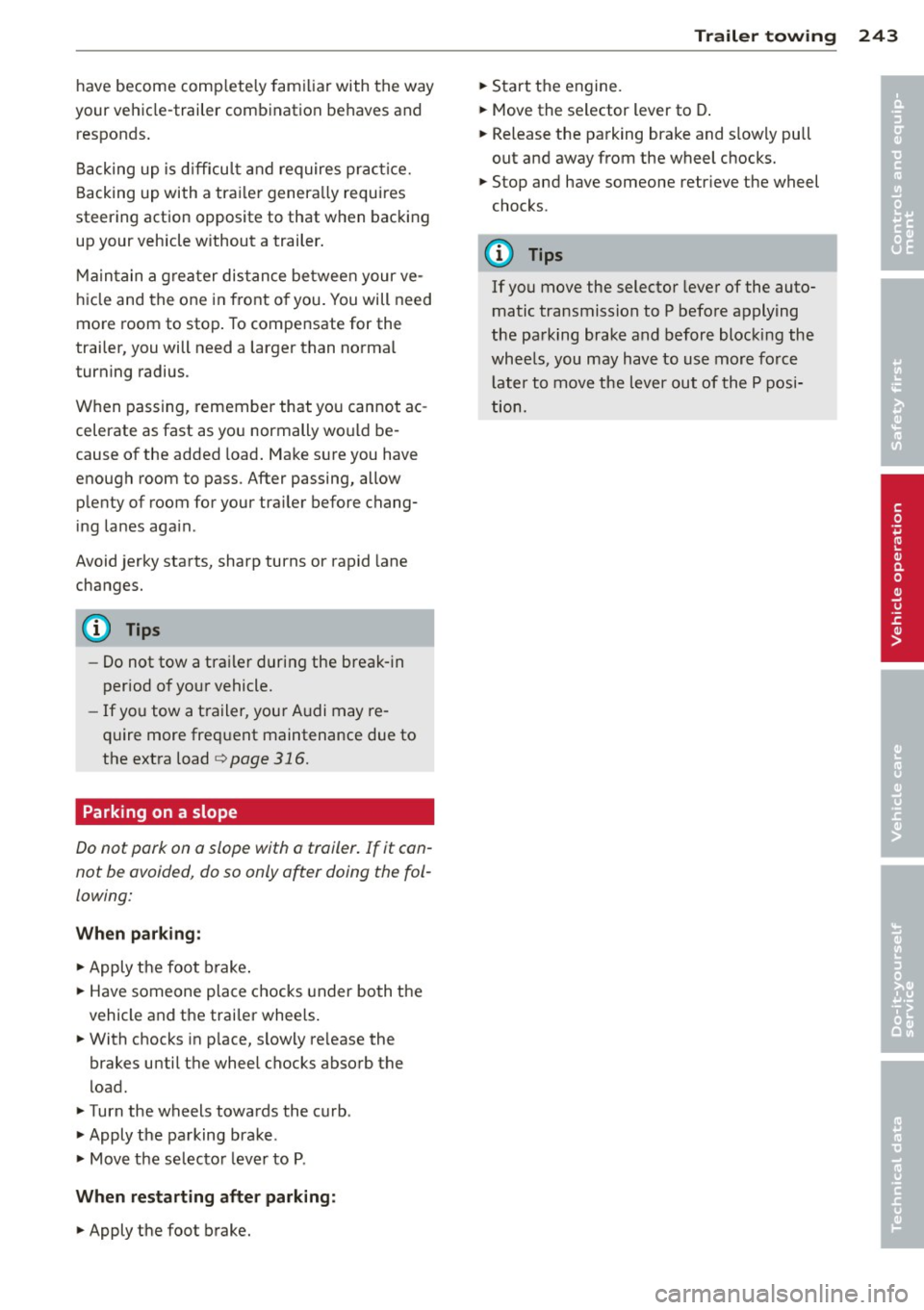
Parking on a slope
Do not park on a slope with a trailer. If it can
not be avoided, do so only after doing the fol
lowing:
When parking:
.. Apply the foot brake .
.. Have someone place chocks under both the
vehicle and the trai ler wheels .
.. With chocks in place, slowly re lease the
brakes until the wheel chocks absorb the
load .
.. Turn the wheels towards the curb .
.. Apply the parking brake .
.. Move the selector lever to P.
When restarting after parking:
.. Apply the foot brake.
Trailer towing 243
.. Start the engine.
.. Move the selector lever to D.
.. Release the parking brake and s low ly pull
out and away from the wheel chocks.
.. Stop and have someone retr ieve the wheel
chocks.
(D Tips
If you move the selector lever of the auto
matic transmission to P before applying
the parking brake and before blocking the
whee ls, you may have to use more force
l ater to move the lever out of the
P posi
tion.
•
•
Page 277 of 340

Groove
means the space between two adjacent tread
ribs.
Load rating (code)
means the maximum load that a tire is rated
to carry for a given inflation pressure. You
may not find this information on all tires be
cause it is no t req uired by law.
Maximum load rating
means the load rating for a t ire at the max i
mum permissible inflation pressure for that
tire.
Maximum loaded vehicle weight
means the sum of:
(a) Curb weight
(b) Accessory weight
(c) Vehicle capacity weight, and
(d) Production options weight
Maximum (permissible) inflation pressure
means the maximum cold inflation pressure
to which a tire may be inflated. Also called "maximum inflation pressure."
Normal occupant weight
means 150 lbs. (68 kilograms) times the
number of occupants seated in the vehicle up
to the total seating capacity of your vehicle.
Occupant distribution
means distribution of occupants in a vehicle.
Outer diameter
means the overa ll diamete r of an inflated new
tire.
Overall width
means the linear distance between the exteri
ors of the sidewalls of an inflated tire, includ
in g elevations due to labeling, decorations, or
protective bands or ribs.
Ply
means a layer of rubber-coated parallel cords.
Tires and wheels 275
Production options weight
means the combined weight of those installed
regular production options we ighing over 5
lbs. (2.3 kg) in excess of those standard items
which they replace, not previously considered
in curb weight or accessory weight, including
heavy duty brakes, ride levelers, roof rack,
heavy duty battery, and spec ial tr im .
Radial ply tire
means a pneumatic tire in which the ply cords
that extend to the beads are laid at substan
tia lly 90 degrees to the center line of the
tread .
Recommended inflation pressure
see ¢ page 2 7 4, Cold tire inflation pressure.
Reinforced tire
means a t ire design to operate at higher loads
and at h igher inflation pressures than the cor
re sp onding standard tire. Reinforced tires
may be identified as "XL", "xl", "EXTRA LOAD",
or "RF" on the sidewa ll.
Rim
means a metal support for a tire or a t ire and
tube assembly upon which the tire beads are
seated.
Rim diameter
means nom inal diameter of the bead seat. If
you change your wheel s ize, you will have to
purchase new tires to match the new rim di
ameter.
Rim size designation
means r im diameter and width .
Rim width
means nominal distance between rim flanges .
Sidewall
means that portion of a tire between the
tread and bead.
•
•
Page 280 of 340
278 Tires and wheels
you have stored. The system does not recog
nize the load condition of your vehicle.
The effectiveness of the tire pressure monitor
ing system w ill be impaired if yo u store nor
mal load pressures but then operate the vehi
cle at its maximum load¢.&. .
See the illustration¢
fig. 249 for the location
of the label on driver's side 8-pillar (color of
the actua l label and exact location on the ve
hicle wi ll vary slightly).
Note that the following table is accurate at
the time of going to press and is subject to
Model/ Tire designation
change. In the event of discrepancies, the tir e
pressure label located on the driver's side 8-
pillar always takes precedence.
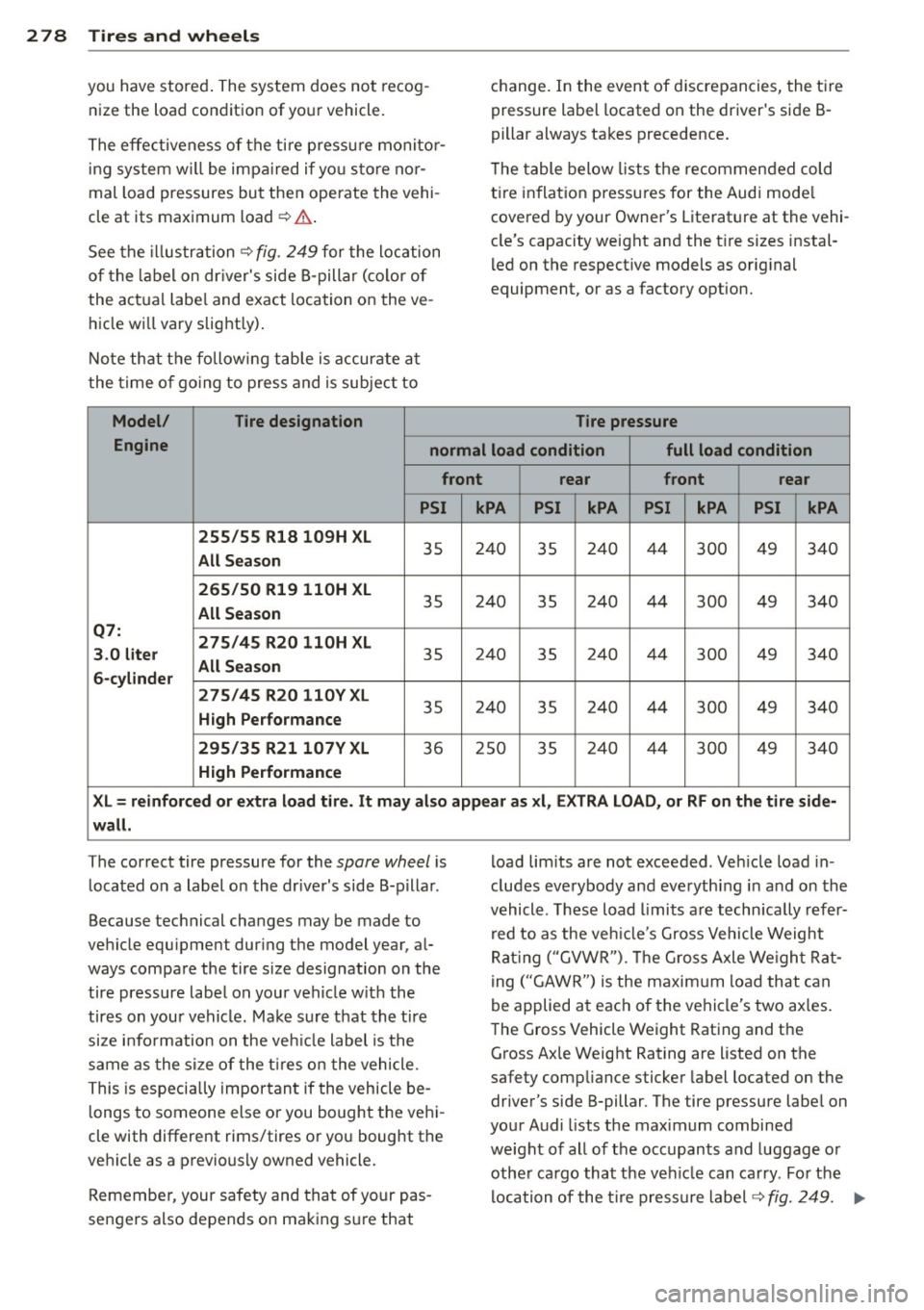
T he table below lists the recommended cold
ti re inflation pressures for the Audi mode l
covered by your Owner's Literature at the vehi
cle's capacity weight and the t ire sizes instal
l ed on the respective models as original
equipment, or as a factory option.
Tire pressure
Engine normal load condition full load condition
front rear
front rear
PSI kPA PSI kPA PSI kPA PSI kPA
255/55 Rl8 109H XL
35 240 35 240 44
300 49 340 All Season
265/50 Rl9 llOH XL
35 240
35 240
44
300 49 340 All Season
Q7: 275/45 R20 llOH XL
3 .0 liter
35 240
35 240 44
300 49 340 All Season
6-cylinder
275/45 R20 llOYXL
35 240 35 240 44 300 49 340 High Performance
295/35 R21 107V XL
36 250 35 240 44 300 49 340
High Performance
XL= reinforced or extra load tire. It may also appear as xl, EXTRA LOAD, or RF on the tire side-
wall.
The correct tire pressure for the spare wheel is
located on a label on the driver's side 8-p illar .
Because technical changes may be made to
vehicle equipment dur ing the model year, al
ways compare the tire size designation on the
tire pressure label on your vehicle w ith the
tires on your vehicle. Make sure that the tire
size info rmation on the vehicle label is the
same as the size of the tires on the vehicle.
This is especially important if the vehicle be
l ongs to someone else or you bought the vehi
cle with different rims/tires or you bought the
vehicle as a previously owned vehicle.
Remember, your safety and that of yo ur pas
sengers also depends on making s ure that load
limits are not exceeded . Veh icle load in
cludes everybody and eve ryth ing in and on the
vehicle. These load limits are techn ica lly refer
red to as the veh icle's Gross Vehicle Weight
Rating ("GVWR"). The Gross Axle We ight Rat
ing ("GAWR") is the maximum load that can
be applied at each of the vehicle's two ax les.
The Gross Vehicle Weight Rating and the Gross Axle Weight Rating are listed on the
safety comp liance sticker label located on the
driver's side 8-pillar . The tire pressure label on
your Audi lists the maximum combined
weight of all of the occupants and luggage or
other cargo that the veh icle can carry . For the
location of the tire pressure label¢
fig. 249. ..,_
Page 283 of 340
-If the ti re is not flat and y ou do not have
to change a wheel immed iate ly, drive at
reduced speed to the nearest service sta
t ion to check the tire pressure and add
air as required.
(D Note
Dr iving without va lve stem caps can cause
damage to the t ire va lves. To prevent this,
always make sure that factory installed
valve stem caps on all wheels are secu re ly
mounted on the va lve.
@) For the sake of the environment
Underinflated tires will a lso increase the
fue l consumption.
Tires and vehicle load limits
There are limits to the amount of load or
weight t hat any veh icle and any t ire ca n car ry.
A vehicle that is overloaded w ill not handle
well and is more difficult to stop. Overload ing
can not on ly lead to loss of vehicle contro l,
but can a lso damage important parts of the
vehicle and can lead to sudden tire failure, in
cluding a blowout and sudden deflation that
can cause the ve hicle to crash.
Your safety and that of yo ur passenge rs a lso
depends on making sure that load limits are
not exceeded. Vehicle load includes everybody
and everyth ing in and on the vehicle. These
load limits a re tech nica lly referred to as the
ve hicle's
Gross Veh icle Weight Rating
("GVWR").
The "GVWR" includes the we ight of the basic
ve hicle, all factory installed accessories, a full
tank of f uel, oil, coo lant and othe r fluids plus
max imum load. The maximum load includes
the number o f passenger s that the ve hicl e is
intended to carry ("se ating capacity") w it h an
assumed weig ht o f 150 lbs (68 kg) for each
passenger at a designated seating position
and the tota l weight of any luggage in the ve
h icle. If you tow a trailer, the weight of the
trailer hitch and the tong ue weight of the
Tire s an d wheel s 281
loaded tra ile r must be included as part of the
vehicle load .
T he
Gro ss Ax le Weight Rating (" GAWR") is
the max imum load th at can be applied at each
of the vehicle's two axles .
T he Gross Vehicle Weight Rat ing and t he
G ross Ax le Weig ht Ra ting are l iste d on the
s af ety comp liance s tic ke r la bel lo cated on the
driver's side 8 -pillar . Your Audi has 5 seating
positions, 2 in the front and 3 in the rear fo r
total seating capacity of 5. On vehicles with
s ix seats*, your vehicle has two front seats,
two seats in the second row seat ing and two
seats in the th ird row seati ng. On veh icles
with seven seats*, your vehicle has two front
seats, t hree seats in the second row s eating
and two seats in t he third row seating. Ea ch
seat ing pos itio n has a se at belt
~page 174,
Safety be lts .
The fact that ther e is a n upper limit to you r
vehicle's G ross Vehicle Weigh t Rati ng means
that the to tal weig ht of whatever is bei ng car
ried in the vehicle ( in cl ud ing the weight of a
trailer hitch and the tongue weight of the l oa ded trai le r) is limite d. The more passen
gers in the vehicle or passengers who are heavier than the standard we ights assumed
mean that less we ight can be carried as lug
gage.
The tire pressure label on your Audi also lists
the max imum combined weight of all of the
occupants and luggage or other cargo that
t h e ve hicle can carry. Fo r the locat ion of the
label
~page 277, fig . 249.
A WARNING
Overloading a veh icl e can cause loss of ve
h icl e cont ro l, a crash or o ther accide nt, se
rio us pe rson al inj ury, a nd eve n death .
- Ca rrying more we ight tha n your ve hicle
was des igned to carry w ill prevent the
veh icle from h andling proper ly and in
crease the risk of the loss o f vehicle con
trol.
•
•
Page 294 of 340

292 Tires and wheels
TPMS malfunction indicato r is combined with
the low tire pressure telltale . When the sys
tem detects a malfunct ion, the te lltale will
flash for approximately one minute and then
remain continuously illuminated. This se
quence will continue upon subsequent vehicle
start-ups as long as the malfunction exists.
When the malfunction indicator is illuminat
ed, the system may not be able to detect or
signal low t ire pressure as intended. TPMS
malfunctions may occur for a variety of rea
sons, includ ing the installat ion of replace
ment or alt ernate tires or wheels on the vehi
cle that prevent the TPMS from functioning
properly. Always check the TPMS malfunct ion
tellta le after replacing one or more tires or
wheels on your vehicle to ensure that the re p lacement or a lternate tires and wheels allow
the TPMS to continue to function properly.
Tire pressure indicator appears
The tire pressure indicator in the instrument
cluster informs you if the tire pressure is too
low or if there is a system malfunction.
Fig. 254 D isplay: underinflat ion wa rning
Using the ABS sensors, the tire pressure moni
toring system compares the tire tread circum
ference and vibration characteristics of the in
dividual tires. If the pressure decreases in one
or more tires, this is indicated in the instr u
ment cluster with a
[D] warning symbol and a
message ¢
fig. 254. The driver message in the
display goes out after S seconds. The driver
message can be displayed again by pressing
the
! CHECK I button . If only one tire is affect
ed, the display will indicate its position . The tire pressure
monitoring must be reset via
MMI each time the pressures are adjusted (e.
g. when switching between partial and full
load pressure) or after changing or replacing a
tire on your vehicle¢
page 293. The TPMS in
dicator on ly monitors the tire pressure that
you have prev iously stored . You can find the
re commended t ire pressures for your vehicle
on the label on driver's s ide B-pillar
¢page 277.
Tire tread circumference and vibration charac
teristics can change and cause a tire pressure
warning if:
- the t ire pressure in one or more tires is too
low,
- the t ire has structural damage,
- the t ire pressure was changed, wheels rotat-
ed or replaced but the TPMS was not reset
¢page 293.
Warning symbols
[D] Loss of pressure in at least one tire¢.&. .
Check the tire or tires and replace or repa ir if
necessary. The
[I] indicator light in the instru
ment cluster also illuminates
¢page 14.
Check/correct the pressures of all four tires
and reset TPMS via MMI.
@m (T ire Pressure Mon itor ing System) Tire
pressure: System malfunction!.
If ffiim appears afte r switching the ignition on
or whi le dr iving and the
[D] indicator light in
the instrument cluster blinks for approx i
mately one minute and then stays on, there is
a system malfunct ion .
Attempt to store the correct tire pressure
¢
page 293. If the indicator light does not
turn off or if it turns on shortly thereafter, im
med iate ly drive your vehicle to a n author ized
Audi dealer or authorized repair facility to
have the malfunction corrected.
.&_ WARNING
- If the tire pressure indicato r appears in
th e ins trum ent cluster display, one or
more of your tires is significantly under
inflated . Reduce your speed immediately ..,_
Page 295 of 340
and avoid any hard steering or braking
maneuvers. Stop as soon as possible and
check the tires and their pressures. In·
flate the tire pressure to the proper pres
sure as indicated on the vehicle's tire
pressure label ¢
page 2 77. Driving on a
significantly under-inflated tire causes
the tire to overheat and can lead to tire
failure. Under-inflation also is likely to
impair the vehicle's handling and stop
ping ability.
- The driver is responsible for maintaining
the correct tire pressures. You must
check the tire pressures regularly.
- Under certain conditions (such as a spor
ty driving style, winter conditions or un
paved roads), the pressure monitor indi
cator may be delayed.
- Ask your authorized Audi dealer if run
flat tires may be used on your vehicle.
Your vehicle registration becomes invalid
if you use these tires when not permit
ted. Damage to your vehicle or accidents could also result.
@ Tips
- The tire pressure monitoring system
stops working when there is an ESC/ABS
malfunction.
- Using snow chains may result in a system
malfunction.
- The tire pressure monitoring system on
your Audi was developed using tires with
the "AO" or "RO" identification on the
tire sidewall¢
page 284. We recom
mend using these tires.
Reset tire pressure monitoring system
If the tire pressure is adjusted, wheels are ro tated or changed, the TPMS must be reset via
MMI.
.,. Before resetting the TPMS, the current pres
sures of all four tires must correspond to
the specified values. Adjust the tire pressure and reset the pressure in the tire pressure
Tires and wheels 293
monitoring system according to the load
you are carrying
¢ page 277.
.,. Turn on the ignition.
.,. Select:
!CAR I function button > Systems*
control button > Tire pressure monitoring >
Store now. Or
.,. Select:
!CAR I function button> Car systems*
control button > Servicing & checks > Tire
pressure monitoring
> Store tire pressures .
@ Tips
Do not store the tire pressure if there are
snow chains on the tire.
•
•
Page 297 of 340
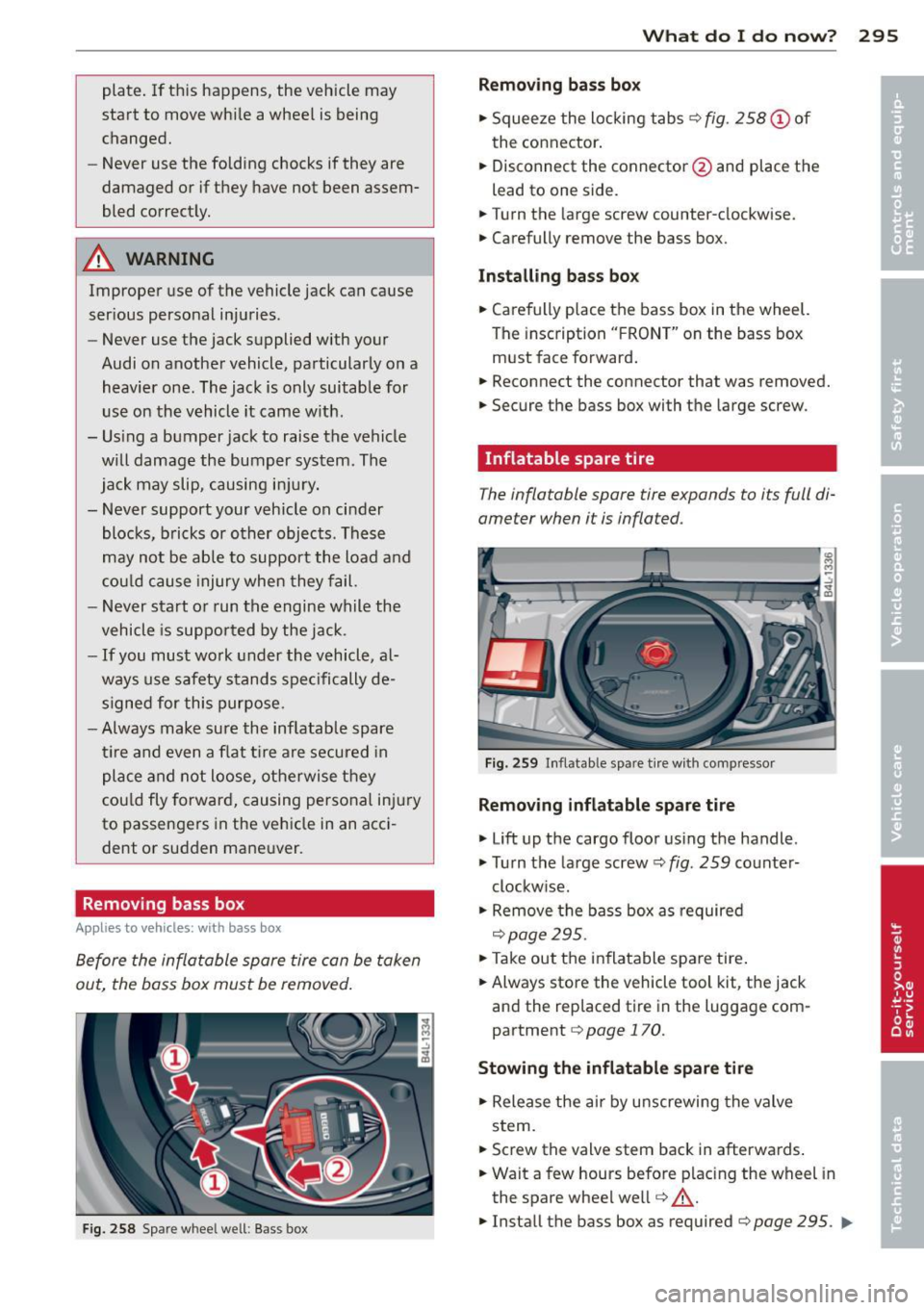
plate. If this hap pens , the vehicle may
start to m ove whi le a whee l is being
changed.
- Never use the folding chocks if they are
damaged or i f they have not been assem
bled correct ly.
A WARNING
Improper use of the vehicle jack can cause
ser ious personal injuries.
- Never use the jack supplied with your
Audi on another vehicle, particularly on a heavier one. The jack is only suitable for
use on the vehicle it came w ith .
- Us ing a bumper jack to raise the vehicle
will damage the bumper system. The
jack may slip, causing i njury.
- Never support your vehicle on cinder bloc ks, b ricks or other objects. Th ese
may not be able to support the load and
cou ld cause injury when they fail.
- Never start or run t he engine while the
vehicle is suppor ted by the jack.
- If you must wo rk under the vehicle, al
ways use safety stand s spe cifically de
signed for this purpose.
- Always make sure the inflatable spare
tir e a nd even a f lat t ire are se cured in
place and not loose, ot herwise they
cou ld fly forward, causing personal inj ury
to passengers in the veh icle in an acc i
dent or sudden mane uver.
Removing bass box
Applies to vehicles: with bass box
Before the inflatable spare tire can be taken
out, the bass box must be removed .
Fig . 2 58 Spare wheel well: Sass box
What do I do now ? 295
Removing bass box
.,. Squee ze the locking tabs ~ fig . 258 (D of
the conne ctor .
.,. Disconnect the connector @and place the
lead to one side.
.,. Turn the large screw counter-clockwise .
.,. Carefully remove the bass box.
Installing bass bo x
.,. Carefully p lace the bass box in the wheel.
The inscription "F RO NT" on the bass box
must face forward .
.,. Reconnect the connector that was removed.
.,. Secure the bass box with the large screw .
Inflatable spare tire
The inflatable spare tire expands to its full di
ameter when it is inflated.
Fig. 25 9 In flatable spare tir e w ith compressor
Removing inflatable spare tire
.,. Lift up the cargo floo r us ing the handle .
"' Turn the large screw
9 fig . 259 co unte r-
clockw ise.
"' Remove the bass box as required
¢ page 295 .
.,. Take out the in flatable spare tire .
.,. Always store the vehicle tool kit, the jack
and the replaced tire in the luggage com
partment
9 page 170.
Stowing the inflatable spare t ire
"' Release the ai r by u nscrewing the valve
stem .
.,. Screw the valve stem back in afterwards .
.,. Wait a few hours before p lac ing the wheel in
the spare wheel we ll¢ ,& .
"' Install the bass box as required ¢
page 295 . ..,_
Page 298 of 340
2 9 6 What do I do no w?
• Secure the wheel with the large screw.
• Fold the cargo floor back down .
After using th e inflat able spare wheel
The inflatable spare t ire can be re-used as
l ong as it is not damaged and is not worn
down to the tread wear indicators
c::> A .
When you let the air out of the inflatable
spa re tire, it does not assume its folded shape
again for several ho urs. Until then, it cannot
be p laced back in the spare wheel well and
stowed securely.
A WARNING
- Never use the spare tire if it is damaged
or if it is worn down to the tread wear in
dicators.
- If the inflatable spare tire is more than 6
years old, use it on ly in an emergency
and with extreme caut ion and careful
driv ing .
- The inflatable spare tire is intended only
for temporary and short-term use .
It
should be replaced as soon as possible
with the no rmal wheel and tire .
- The tire pressure value for the inflatable
spare t ire is located on the driver's side
B-p illar
c::> page 277, fig . 250.
-Maximum perm iss ible speed is SO mph
(80 km/h).
- Avoid full-throttle acce lerat ion, heavy
braking, and fast corner ing .
- When the air is let out of the inflatable
spare wheel, it does not assume its fold
ed shape for several hours . Until then, it
cannot be placed back in the spare wheel
we ll and stowed secu rely.
- Never drive with more than one inflata
ble spare ti re.
- For technical reasons, the use of tire
chains on the inf latable spare tire is not
permitted.
If i t is necessary to drive w ith
t ir e cha ins, the infla table spare wheel
must be mounted on the front axle in the
event of a flat in a rear tire . The newly
available front whee l must the n be in
sta lled in place of the rear wheel with the flat tire
. Insta lling the ti re cha in be
fore mounting the wheel and tire is rec
ommended.
- Loose items in the passenger compart
ment can cause serious personal injury
during hard brak ing or in an accident.
Never store the inflatable spare tire or
jack and tools in the passenge r compart
ment.
(D Note
- The inflatable spare tire has been deve l
oped specifically for th is veh icle model.
It must not be exchanged or used for
other vehicle models. Sim ila rly, inflata
ble t ires from other vehicle models m ust
no t be used.
- Norma l summer or w inte r ti res must not
be ins talled on the infla table t ire rim.
Inflating inflatable spare tire
• Remove the compressor from the luggage
compartment
c::> page 295 , fig. 259.
• Unscrew the valve stem from the spare tire.
• Screw the tire f iller hose from the compres
sor firmly onto the
valve of the spare tire.
• Insert the plug from the compressor into an
outlet of the ve hicle
c::> page 88 .
• Switch the comp ressor on .
• Let the compressor run unti l the va lue speci
fied on the ti re p ressu re label is reached
c::> page 2 77, fig. 250 . Switc h the compres
sor off after running for 12 m inutes at the
most -danger of overheating!
A WARNING
-The compressor and the tire f iller hose can
become extremely hot while they are run
n ing -danger of burns!
([) Note
Switch the compressor off after running
for 12 min utes at the most -danger of
overheating! Allow the compressor to cool
down for a few m inutes before you use it
again .
Page 299 of 340
Changing a wheel
Before changing a wheel
Observe the following precautions for your
own and your passenger's safety when chang
ing a wheel .
.,. After you experience a tire fa ilure, pull the
car well away from moving traffic and try to
reach
level gro und before you stop¢.&_ .
.. All passengers should
leav e the car and
move to a safe location (fo r instan ce, be hind
the guardra il) ¢.&_ .
.,. Engage the
parkin g brake to prevent your
vehicle from ro lling unintentionally ¢.&_ .
.. Move
selecto r le ver to p osition P ¢ .&_ .
1> Ifyou are towing a trai ler: unhitch the trail
er from your veh icle.
.,. Block the diagonally opposite wheel with
the folding chocks or other objects .
.. Take the
jack and the inflatab le spare tire
out of the luggage compartment
¢ page 294.
& WARNING
You or your passengers cou ld be injured
while changing a whee l if yo u do not fol
low these safety precautions:
- If you have a flat t ire, move a safe dis
tance off the road . Turn off the eng ine,
t ur n the emergency flashers o n and use
other warning devices to alert other mo
torists .
- Make sure that passengers wait in a safe
place away from the vehicle and well
away from the road and traffic.
- To he lp prevent the veh icle from mov ing
sudden ly and possibly slipping off the
jack, always fully set the parking b rake
and block the whee l diagonally opposite
the wheel being cha nged with the fo ld
ing chocks or othe r objects. When one
front whee l is lifted off the g ro und, plac
ing the A utomat ic Transm iss ion in P
(Park) wi ll
not prevent the vehicle from
moving .
-
What do I do now? 297
-Before you change a whee l, be sure the
ground is level and firm. If necessary,
use a sturdy board under the jack.
- Always store the vehicle tool kit, the jack
and the replaced tire in the luggage com
partment
<=:>page 170 .
Changing a wheel
When you change a wheel , follow these
quence described below step-by-step and in
exactly that order.
1. Activate the vehicle jack mode (only
vehicles with Adaptive Air S uspension)
¢ page 159 .
2. Remove the decorati ve wheel co ver* . For
more details see also <=:>
page 298, Deco
rative wheel covers
or <=:> page 298,
Wheels with wheel bolt caps .
3. Loosen the wheel bolt s¢ page 298 .
4. Loca te the p roper mounting point for the
jack and align the jack be low that point
¢ page 299.
5. Lift the car with the jack Q page 299 .
6. Remove the wheel with the flat ti re and
then install the
inflatable spare tire
¢ page 300.
7. Tig hte n all wheel bolts lightly.
8 .
Lowe r the vehicle with the jack .
9. Use the wheel bolt w rench and
firmly
t ighten all wheel bolts¢ page 298 .
10. Replace the decora tive whe el co ver* .
11. Deactivate the vehicle jack mode (on ly
vehicles with Adaptive Air S uspension)
¢ page 159 .
A WARNING
Always read and follow all WARNINGS and
informat ion<=:>
& in Raising the vehicle on
page 300
and <=:> page 301.
•
•
Page 300 of 340
2 98 What do I do now ?
After changing a wheel
A wheel change is no t complete without do
ing the following .
"'Always store the vehicle tool kit, the jack
and the replaced ti re i n the luggage com
partment
¢ page 170.
"'As soon as possible, have the tightening
torques
on a ll wheel bo lts ch ecked with a
tor que wrench. The correct tigh ten ing tor
que is 120
ft lb (160 N m).
"' Have the flat tire
replaced as soon as poss i
b le.
@ Tips
- I f yo u notice t hat the wheel bolts are
corroded and difficult to turn w hile
changing a t ire, they should be re p laced
b ef ore yo u check the tighten ing torque.
- Drive at red uced s peed unti l y o u have the
t ig htening torq ues chec ked.
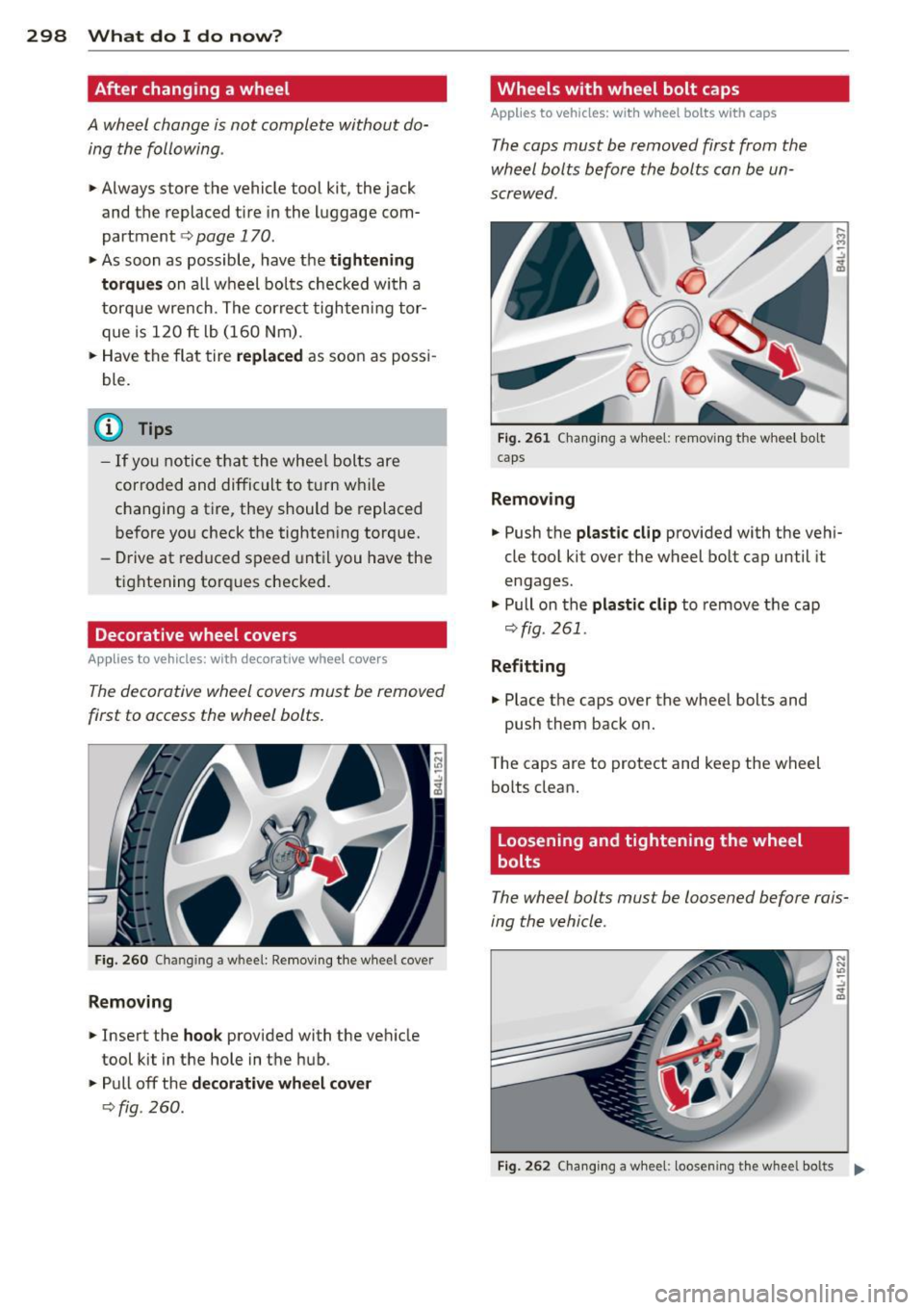
Decorative wheel covers
App lies to vehicles: with decorative wheel covers
The decorative wheel covers must be removed
first to access the wheel bolts.
Fig . 260 C han ging a w hee l: R em ovin g the whee l cove r
Removing
"'Insert the hook provided with the ve hicle
tool kit in the hole in t he hub.
"' Pull off the
decorat ive wheel cover
c:> fig . 260 .
' Wheels with wheel bolt caps
Applies to vehicles: with wheel bolts with caps
The caps must be removed first from the
wheel bolts before the bolts can be un
s crewed .
Fig. 261 Chang ing a w heel: re m ov ing th e w hee l b o lt
caps
Removing
"' Push t he plastic clip provided with the ve hi
cle tool kit over the w heel bo lt cap until it
engages .
"' Pull on th e
plastic clip to remove t he cap
c:> fig. 261 .
Refitting
"' Place t he caps over the whee l b olts and
push them back o n.
The caps are to protect and keep the wh eel
bolts clean.
Loosening and tightening the wheel
bolts
The wheel bolts mus t be loosened before rais
ing the v ehicle .
Fig. 26 2 Cha ng ing a w hee l: loosening th e w hee l bo lts II--