cooling AUDI Q7 2014 Owner´s Manual
[x] Cancel search | Manufacturer: AUDI, Model Year: 2014, Model line: Q7, Model: AUDI Q7 2014Pages: 340, PDF Size: 85.02 MB
Page 101 of 340
Synchronizing rear air conditioning: By
pressing and holding the regulator on the rear
left side, the temperature sett ing of the rear
left side can be switched to the rear right side
and v ice versa. The new temperature is shown
in the display .
Turning on and off~
App lies to vehicles: with four-zone automatic comfort air
cond it ioning
Turning the climate control on
• Press the !ON/OFF I button, or
• Press the
!AU TO I button.
Turning the climate control off
• Press the !ON/O FF I button to switch the cli
mate control off and to block the air supply
from the outside .
The air conditioner turns back on when you
press the
temperature regulator or one of the
buttons.
(D Tips
If the power child safety lock is on, the
rea r air conditioning control element will
not operate . In this case, dashes" ••• " wi ll
appear in the air conditioning control ele
ment disp lay.
Automatic mode in rear~
Applies to vehicles: with four-zone automatic comfort air
conditioning
The automatic mode is the standard setting
for all seasons.
• Se lect temperature between 60 °F (+16 °C)
and
84 °F (+28 °().
• Press the
!AUTO I button.
Automatic operation ensures constant tem
peratu res in the inter ior and dehumidifies the
air inside the vehicle. Ai r temperature, volume
and distribution are controlled automatically
to reach or maintain the desired interior tem
perature as quickly as possible. Fluctuations
in exterior temperature and the effects of
Warm and cold 99
temperature from the position of the sun a re
compensated for automatically .
T his operating mode works on ly in the adjust
able temperature range, from
60 °F (+ 16 °()
to
84 °F ( +28 °C) . If a temperature below 60
°F (+ 16 °C) is se lected, LO appears in the dis
play . At temperatures above
84 °F (+ 28 °(),
HI is displayed . At both extreme sett ings, cli
mate control runs continuously at maximum
cooling or heating power . There is no temper
ature regulat io n.
Setting rear temperature
Applies to vehicles: with four -zone automatic comfort air
conditioning
The temperature can be separately adjusted
for the rear left and right sides.
• Rotate the regulator to the left to reduce
the temperature, or to the right to increase
the temperature .
T he selected temperature appears on the cli
mate control display.
Rear fan~
Applies to vehicles: with four-zon e automatic comfort air
conditioning
The automatically preset fan speed can be re
duced or increased.
• Press the~ button .
• Rotate the regulator to the desired fan
speed .
The climate control system automatically reg
ulates fan speed depending on inter ior tem
perature. You ca n adjust the volume of air pro
duced by the fan to your own requirements .
(D Tips
It is possible that the fan speed may
change automatically. This occurs to en
sure that the desired temperature setting
i s reached as quickly as possible.
Page 243 of 340
Weight Rating will also change the per
formance and handling characteristics of
your vehicle, which could cause a crash resulting in serious injury or death .
- The Gross Vehicle Weight Rating for your
vehicle would be exceeded if your vehicle
is simultaneously equipped with Panor
amic sliding sunroof; third-row seating;
trailer towing equipment (factory or
dealer-installed), and running boards
(dealer-installed) . UNDER NO CIRCUM
STANCES MAY ALL SUCH ITEMS BE IN
STALLED ON THE SAME VEHICLE.
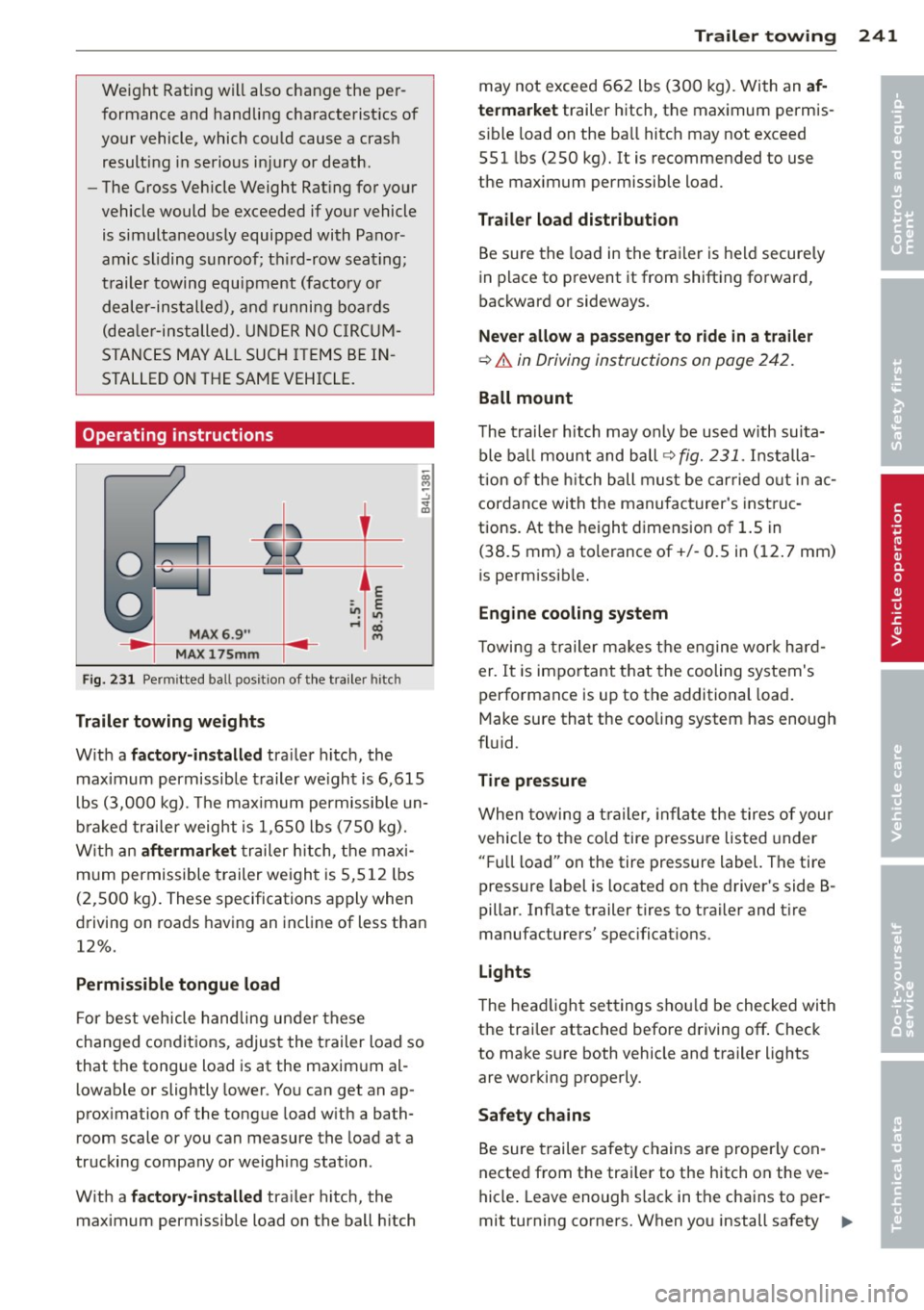
Operating instructions
MAX 6.9"
MAX175mm
E
1/1 E 1/1 ... a)
m
Fig. 231 Perm itted ba ll posit ion of the trailer hitch
Trailer towing weights
With a factory-installed trailer hitch, the
maximum permissible trailer weight is 6,615
lbs (3,000 kg). The maximum permissible un
braked trailer weight is 1,650 lbs (750 kg).
With an
aftermarket trailer hitch, the maxi
mum permissible trailer weight is 5,512 lbs
(2,500 kg). These specifications apply when
driving on roads having an incline of less than
12%.
Permissible tongue load
For best vehicle handling under these
changed cond itions, adjust the trailer load so
that the tongue load is at the maximum al
lowable or slightly lower. You can get an ap
proximation of the tongue load with a bath
room scale or you can measure the load at a
trucking company or weighing station .
With a
factory-installed trailer hitch, the
maximum permissible load on the ball hitch Trailer towing 241
may not exceed 662 lbs (300 kg). With an
af
termarket
trailer hitch, the maximum permis
sible load on the ball hitch may not exceed
551 lbs (250 kg).
It is recommended to use
the maximum permissible load.
Trailer load distribution
Be sure the load in the trailer is held securely
in place to prevent it from shifting forward,
backward or sideways.
Never allow a passenger to ride in a trailer
¢ .& in Driving instructions on page 242.
Ball mount
The trailer hitch may only be used with suita
ble ball mount and ball ¢
fig. 231. Installa
tion of the hitch ball must be carried out in ac
cordance with the manufacturer's instruc
tions. At the height dimension of 1.5 in
(38.S mm) a tolerance of+/- 0.5 in (12. 7 mm)
is permissible.
Engine cooling system
Towing a trailer makes the engine work hard
er . It is important that the cooling system's
performance is up to the additional load.
Make sure that the cooling system has enough
fluid .
Tire pressure
When towing a trailer, inflate the tires of your
vehicle to the cold tire pressure listed under
"Full load" on the tire pressure label. The tire
pressure label is located on the driver's side B
pillar . Inflate trailer tires to trailer and tire
manufacturers' specifications .
Lights
The headlight settings should be checked with
the trailer attached before driving
off. Check
to make sure both vehicle and trailer lights
are working properly .
Safety chains
Be sure trailer safety chains are properly con
nected from the trailer to the hitch on the
ve
hicle. Leave enough slack in the chains to per
mit turning corners. When you install safety
Ill-
•
•
Page 263 of 340
VW 502 00 (vehicles with gasoline engine) or
VW
507 00 (vehicles with diesel engine).
C han gin g the en gin e o il
The engine oil and oil filter must be changed
according to the m ileage (ki lomete rs) and
time inte rva ls specified in your vehicle 's War
r anty
& M aintenance booklet. Do not ex ceed
t hese intervals -harmf ul depos its from old
engine oi l can reduce engine performance and
can lead to expensive engine repairs.
Changing the o il at the recommended inte r
va ls is so very important because the lub ric at
ing p roperties o f oi l decrease grad ually during
norma l vehicle use . If you are not sure when
you have yo ur oi l changed, ask your a uthor
ized A udi Service Advisor.
Unde r some ci rc u mstances the engine o il
should even be changed more frequently.
Change o il more often if you drive mostly
short distances, operate the vehicle in dusty
areas or mostly under stop-and-go traffic con
d itions, or when you use your vehicle where
temperatures stay below freezing po int for
l ong periods .
Detergent addit ives in the o il w ill make fresh
oil look dark after the eng ine has been run
ni ng fo r a short time . This is no rmal and is not
a reason to change the o il mo re often than
r ec om mended.
Damage or malfun ctions due to lack of
maintenance
It is essential that yo u change your oil at the
recommended interva ls using only engine oil
that complies with Audi oi l standard
VW
502 00 (vehicles with gasoli ne engine) or
VW
507 00 (veh icles with diesel engine) . You r
Lim ited New Vehicle Wa rra nty does not cove r
damage or m alfu nct ions due to f ailure to fol
l ow recommended maintenance and use re
q uir ements as set forth in the A udi Owner's
M anual and Warranty
& M aintenance book let.
Your dea ler will have to deny warranty cover
age un less you present to the dea ler proof in
the form of Service or Repa ir Orders that all
Checkin g and fillin g 261
scheduled maintenance was performed in a
timely manner.
· Engine oil consumption
To provide effective l ubr ication and cooling for
interna l eng ine parts, all interna l combustion
engines use some oi l. Oi l consumption varies
from eng ine to engine and may change over
the life of the engine . Engines tend to use
more o il du ring the b reak-in period tha n they
do afterward, when o il cons umption has sta
bilized. Depend ing on the way the vehicle is
driven and the operating conditions, oil con
s u mption can be up to
1 quart per 1,200
miles (l liter per 2,000 km) . Consumption
may be higher within the first
3,000 m iles
(5,000 km) .
U nder normal conditions , the rate of oi l con
s u mption depends on oi l quality as well as vis
cosity, engine speed (rpm), outs ide tempera
ture, road conditions, the amount of oil dilu
tion caused by condensed water or fue l resi
due, and ox idat ion of the o il. Oi l consumption
may increas e with eng ine wear over time, un
t il rep lacement of worn engine pa rts may be
come ne cessa ry.
Because of all these var iables, there is no
standard o r "n orma l" rate of o il cons umption .
We urge you to check the engine oil level at
regular interval s, preferably every time y ou
fill the fuel t ank, and always before a long
trip .
The oil pres sure warning light. i s not an
indicator of low engine oil level. If the warn
ing light does not go out after starting, or
flashes while dr iving (above 1500 rpm), a
buzzer will sound. It indicate s that the oil
pressure is too low . Stop the engine immedi
ately , check the engine oil level and add oil if
necessa ry. If the engine oil level is normal,
but the l ight continues to fla sh, do not keep
driving or let the engine idle, as damage may
occur .
IIJ,
•
•
Page 266 of 340
264 Check ing and filling
a reason to change the oil more often than
recommended.
A WARNING
Stop! Before working in the engine com
partment, a lways read and heed all WARN
INGS
c> .&. in Working in the engine com
partment on page 257. The engine com
partment of any motor veh icle is a poten
tially dangerous a rea and can cause ser i
ous personal injury.
A WARNING
If you must change the engine oil in your
vehicle:
- Always wea r eye p rotection.
- T o reduce the r isk of burns from hot en-
gine oil let the engine cool down to the
touch.
- When removing the oil drai n plug with
yo ur finge rs, stay as far away as possible.
Always keep your forea rm pa ra ll el t o the
ground to he lp prevent hot oil from run
ning down your arm.
- Dr ain the o il into a container designed
for this p urpose, one large enough to
hold at least the total amount of oil in
yo ur engine .
- T o reduce the r is k of po ison ing, never use
empty food or beverage containers that
might mis lead someone into drinking
from them.
- Engine oil is poisono us. Keep it well out
of the reach of children.
- Cont inuo us contact with used engine oil
is harmful to your skin . Always protect
yo ur sk in by washing thoro ughly with
soap and water.
@ Note
Never mix oil ad ditives with your engine
oil. These additives can damage your en
gine and adverse ly affect your Audi Limit
ed New Vehicle Warranty.
(® For the sake of the environment
- Before changing the oil, first make sure
you know where you can prope rly dispose
of the old o il.
- Always dispose of used oil p roperly. Nev
er dump it on garden soil, in wooded
areas, into streams or down sewage
dra ins.
- Recycle used o il by tak ing it to a used en
gine oil collection facility in your area, or
contact a se rvice station.
- We strongly recommend that yo u have
your oil cha nged by an authorized Audi
dealer or a qualified workshop with the
special tools a nd expert ise required, and
prope r m eans of disposal.
Engine cooling system
Coolant
The engine coolant performs two functions: it
keeps the engine from overheating and it pro
tects the engine from freezing in the winter.
T he cooling sys tem is sealed and genera lly re
quires little attention.
T he coo lin g sys tem has been fi lled a t the fac
tory with a permanent coolan t which does not
need to be changed . The coo lant cons ists of a
mixture of specially conditioned water and the
manufacture r's g lycol-basedcoo lant add i-
t ive
Gl3 antifreeze with anticorrosion addi
t ives (SO% for USA models; 60% for Canadian
models). This mixture both assures the neces
sa ry frost protection and protects metal com
ponents in the eng ine's cooling system from
corros io n and scaling.
It also ra ises the bo il
i ng po in t of the coolan t.
Do not reduce the concentration of the cool
ant in the summer by addi ng p lain water .
The
proportion of coolant additiv e must be at
lea st 50 % but not more than 60°/o
to main
t ai n ant ifree ze pro te ct io n and cooling eff ic ien
cy .
If the coo lant fros t protec tion is too low '
t h e coo lant co uld freeze and damage the vehi-
cle heating and engine cooling system. ..,.
Page 267 of 340

For year-round driv ing, antifreeze is added at
the factory for temperatures down to:
- - 31 °F (- 35 °C) USA
- - 40 °F ( - 40 °C) Canada .
If you mus t add coolant, use a mixture of wa
ter and coolant additive. Mixing the coolant
additive with distilled water is recommended .
A WARNING
-
Before you check anything in the engine
compartment, always read and heed all
WARNINGS ¢
A in Working in the engine
compartment on page 257.
(D Note
-Before winter sets in, have the coolant
checked to see if the coolant additive in
your vehicle is sufficient to meet the cli
mate conditions. This is especially impor
tant if you live in a region where the win
ter is extremely cold.
If necessary, in
crease the proportion of coolant additive
to 60%.
- When adding coolant additive to your
cooling system, remember:
- We recommend using only coolant ad
ditive Gl2++ or G13 for your vehicle.
This coolant additive is available at au
thorized Audi dealers. Other types of
antifreeze can significantly reduce cor
rosion protection . The resulting corro
sion can cause a loss of coolant and se
rious engine damage.
- Do not add any type of radiator leak seal
ant to your vehicle's engine coolant.
Adding radiator repair fluid may adverse
ly affect the function and performance of
your cooling system and could result in damage not covered by your New Vehicle
Limited Warranty.
Checking and filling 265
Checking the engine coolant level
T he engine coolant level can be checked with
a quick glance.
Fig. 245 En gin e compar tment: Coolant expansion tank
Before you check anything in the engine com
partment,
always read and heed all WARN
INGS ¢ A in Working in the engine comport
ment on page 257 .
.,. Park your vehicle on a level surface.
.,. Turn
off the ignition .
.,. Let the engine cool down.
.,. Place a thick rag over the coolant expans ion
tank ¢
fig. 245, c> page 259, fig. 241 and
carefully twist the cap counter-clockwise
¢,&. .
.,. Read the engine coolant level in the open
coolant expansion tank. With a cold engine,
the coolant level should be between the
"min " and "max" markings. When the en
gine is warm, the level may be slightly
above
the "max" marking.
The location of the coolant expansion tank
can be seen in the engine compartment illus
tration
¢ page 259 .
To obtain an accurate reading, the engine
must be switched
off.
The expansion tank in your vehicle is equipped
with an electric coolant level sensor .
When the coolant level is too low, the warning
light in the Auto-Check System¢
page 32 will
blink until you add coolant and the level has
been restored to normal. Even though there is
an electric coolant level sensor, we still rec ommend you check the coolant level from
time to time .
Page 268 of 340
26 6 Ch eck ing and filling
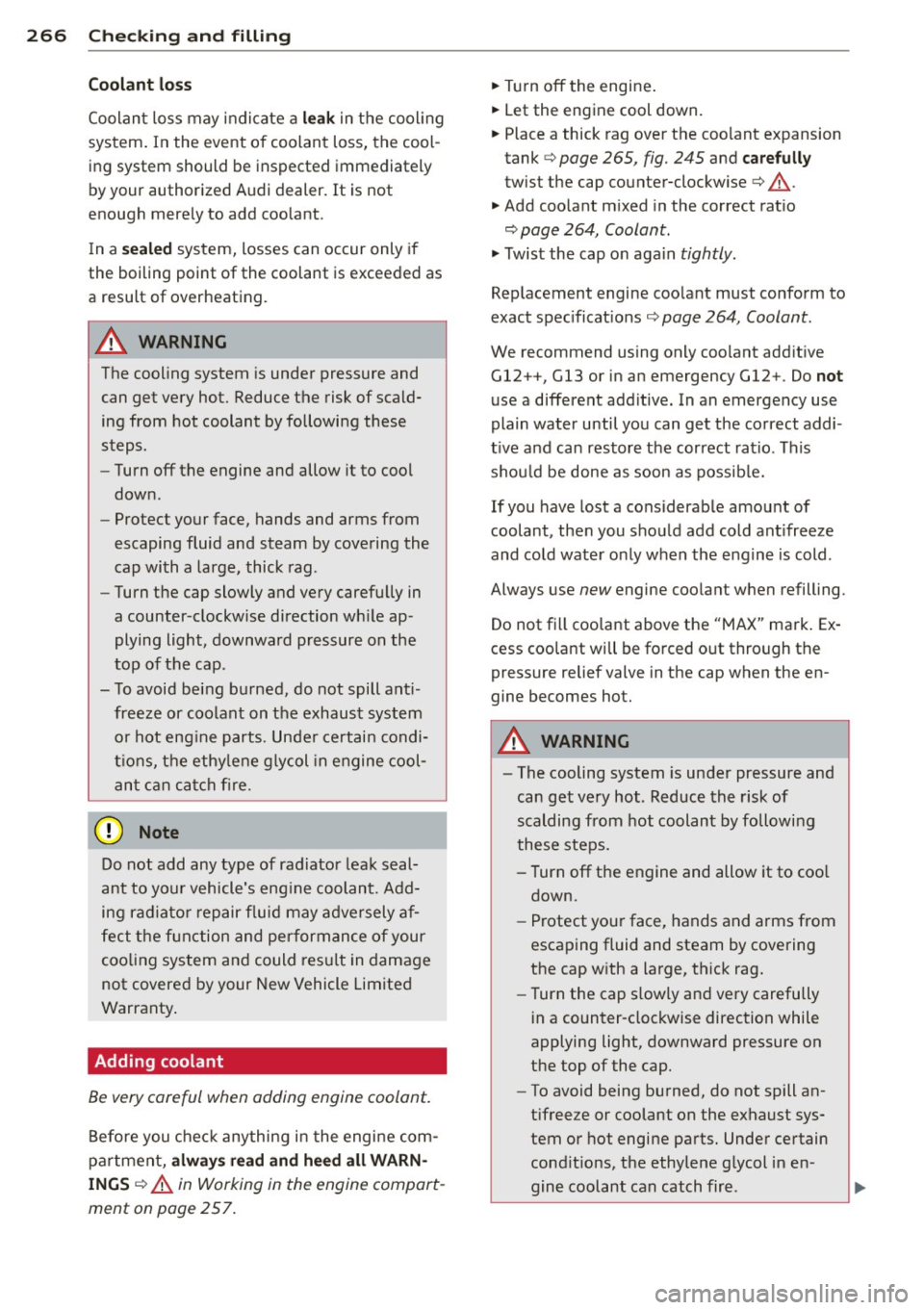
Coolant lo ss
Coolant loss may indicate a l ea k in t he cooling
system. In the event of coolant loss, the cool
ing system should be inspected immediately
by your authorized Audi dealer. It is not
enough merely to add coolant.
I n a
se ale d system, losses can occur only if
the boiling point of the coolant is exceeded as
a result of overheating.
A WARNING
The cooling system is under pressure and
can get very hot. Reduce the risk of scald
ing from hot coolant by following these
steps .
- Turn off the engine and allow it to cool
down.
- Protect your face, hands and arms from
escaping fluid and steam by covering the
cap with a large, thick rag .
- Turn the cap slowly and very carefully in
a counter -clockwise direction wh ile ap
plying light, downward pressure on the
top of the cap .
- To avoid being burned, do not spill ant i
freeze or coolant on the exhaust system
or hot eng ine parts. Under certain condi
t ions, the ethy lene g lycol in engine cool
an t can ca tch f ire.
0 Note
Do not add any type of radiator leak seal
ant to your vehicle's eng ine coolant. Add
ing radiato r repair fluid may adve rsely af
fect the function and performance of your
cooling system and could res ult in damage
not covered by your New Vehicle Limited
Warranty .
Adding coolant
Be very careful when adding engine coolant.
Before you check anything i n the engine com
pa rtmen t,
a lwa ys rea d and h eed all WARN
INGS c:::> A in Working in the engine compart
ment on page 257.
.. Tu rn off the engine .
.. Let the engine cool down.
.. Place a thick rag over the coo lant expansion
tank
c> page 265 , fig. 245 and car efully
twist the cap counter-clockwise c> ,&. .
.. Add coo lant m ixed in the correct rat io
c:::> page 264, Coolant.
.. Twist the cap on again tightly.
Replacement engine coolant must conform to
exact spec ificat ions
c> page 264, Coolant.
We recommend using only coo lant additive
G12 ++, G13 or in an emergency G12 +. Do
not
use a different add itive. In an emergency use
plain water until you can get the correct addi
t ive and can restore the correct ratio . This
shou ld be done as soon as poss ib le.
If you have lost a considerable amount of
coolant, then you should add cold ant ifreeze
and co ld water only when the eng ine is cold .
Always use
new engine coolant when refilling.
Do not fi ll coolant above the "MAX" mark. Ex
cess coolant will be forc ed out through the
pressure relief valve in the cap when the en
gine becomes hot.
A WARNING
- The cooling system is under pressure and
can get very hot. Reduce the risk of
scalding from hot coolant by following
these steps.
- Turn off the engine and allow it to coo l
down.
- Protect your face, hands and arms from
escaping fluid and steam by covering
the cap with a large, th ick rag.
- Turn the cap s low ly and very carefully
in a counter-clockwise direction while
applying light, downward pressure on
the top of the cap.
- To avoid being burned, do not spill an
tifreeze or coolant on the exhaust sys
tem or hot engine parts. Under certain
cond it ions, the ethylene g lycol in en
gine coolant can catch fire .
Page 326 of 340
324 Index
Controls .... .. .. ..... ... .. .. .... .. 93
Defrosting/defogging . . . . . . . . . . . . . . . 95
Descr ipt ion .. .. ... .... ... .. .. .... .. 92
Energy management . . . . . . . . . . . . . . . . 92
Fan . .. .. .... ........... ........ .. 95
Front seat ventilation ...... ... .. ... 101
H eated seats, front ....... .. .. .. .. . 10 1
Key coded sett ing .............. ..... 92
Recircu lation mode (automatic) ... ... 100
Recommended se ttings .............. 92
Residua l heat ... ...... ... .. .. .... .. 94
Setting the temperature ... .. .. .... . . 95
Supp lementary heater ... .. .. ... ... . 101
Synchron izat ion ............ .. .... . 100
Turn ing on and off ........ .. .. .... .. 94
Using climate control economically . . . . 98
C lock ... .... ... . ...... ... .. .. .... .. 11
C losing
P anoramic slid ing su nroof .. .. .. .. .. . . 55
Coat hooks . . . . . . . . . . . . . . . . . . . . . . . . . 90
Cold ti re inflat ion p ressure ... .. .. .... . 27 7
Compass m irror ..... ...... .. .. .. .. .. 70
Comp liance .. ............. .. .. .. ... 319
Consumer Info rmation . . . . . . . . . . 1 71, 3 16
Contact ing NHTSA ...... .... ... .... . 171
Controls Cleaning ... ... .. ..... ... .. .. .... . 246
Conve nience key ..................... 49
Dr iver messages ........ .. .. .. .. .. . 108
L ock ing vehicle ... ..... ... .. .. .... .. 50
START button .. .. ..... ... .. .. .... . 10 7
Starting engine ....... ... .. .. .... . 107
STOP button ...................... 108
Sw itching engine off ............... 108
Sw itching on ignition .. ..... ..... .. . 107
Unlock ing vehicle .......... ... .. .... 49
Convertible c hil d safety seats . ... .. .. . 211
Conve rtible locking retracto r
Activating ........................ 216
Deactivating . . . . . . . . . . . . . . . . . . . . . . 217
Using to secure a chi ld safety seat 21 4, 2 16
Coolant system ................. .... 264
Cooling box in g love compartment .. .... 89
Cooling System Expansion tank . .. ..... ... .. .. .... . 265
Corner ing light .. .... ...... .. .. .. .. .. 59 Cruise cont
ro l
Changing speed .. .. ... ..... ... .. .. 111
Presett ing your speed .. ..... ... .. .. 112
Switching off ..................... 112
Switching on ..... ............. .... 111
Warning/ind icator lights ........... .. 18
also refer to Adaptive cruise control ... 113
Cruising range . . . . . . . . . . . . . . . . . . . . . . . 24
(upholder . . . . . . . . . . . . . . . . . . . 79 , 86, 8 7
D
Damp ing
refer to Adapt ive A ir Suspension . 155, 15 7
Data recorder ... .. ............. .. .. 224
Date d is p lay . . . . . . . . . . . . . . . . . . . . . . . . 11
Daytime run ning l ights... ....... .. 57, 58
Declarat ion of compliance
Adaptive cruise control ............. 319
Audi side ass ist ................... 319
Cell phone package . . . . . . . . . . . . . . . . 319
Convenience key .. .. ... ....... ... .. 319
E lectronic i mmob i Lizer . . . . . . . . . . . . . . 319
Homel in k universal remo te control ... 319
Remote contro l key ............ .... 319
Decorative parts/tr im
Cleaning ...... .................. . 246
def What does this mean when it appears in
the tr ip odometer display? ........... 12
De fective light bu lb warning . ... .. .. .. . 23
Defrost ing/defogg ing the w indows ... .. . 95
Defrost ing/defogging windows ......... 97
De term ining co rrect load limit ........ 282
Diesel fuel .. .. .. .. .. ... ....... ... .. 250
Diesel pa rticulate f ilter . . . . . . . . . . 36, 233
Digital cloc k . . . . . . . . . . . . . . . . . . . . . . . . 11
Digital compass . . . . . . . . . . . . . . . . . . . . . 70
Digital speedometer . . . . . . . . . . . . . . . . . . 22
Dime nsio ns .. ... ................... 314
Dimming the rearview mirror ... .. .. .. . 69
D ipst ick
Reading the d ipst ic k properly ........ 262
Displays Cleaning . . . . . . . . . . . . . . . . . . . . . . . . . 246
Distance control system
refer to Adapt ive cruise control ..... .. 113
Page 329 of 340
_______________________________ ___:I~n ~d ~e:.::x 327
Fuel gauge .... ... ...... ... .. .. .... 12
Gasoline ... ................ ... ... 249
Gasoline additives ....... .... ... .. . 250
Low fuel level . . . . . . . . . . . . . . . . . . 12, 35
Octane rating ............ .... .. ... 249
Recommendation .............. .... 249
Refuelling .. ... .. .. ...... .. .. .. .. . 252
Reserve .. ............ ...... .... ... 12
Tank capacity ............ .. .. .. .. . 315
Un loc kin g the fue l filler flap by hand . . 254
Fue l economy messages (efficiency pro-
gram) . .. .. .. .. ........ ... .. ... ... .. 27
Fuse arrangement ............ ... .. . 302
G
Garage door opener (Homelink) . ... .. . 16 1
Gas discharge lamps ........... .... .. 305
Gauges Engine coolant temperature .. .. .. .. .. 10
Fuel gauge . . . . . . . . . . . . . . . . . . . . . . . . 12
Speedometer . .............. ... ... . 12
Tachometer . . . . . . . . . . . . . . . . . . . . . . . 11
Trip odometer . . . . . . . . . . . . . . . . . . . . . 12
General illustration Instruments and controls . . . . . . . . . . . . . 8
General rules and driving tips .... .. .. . 237
Before driving off road ........ ... .. . 23 7
Driving offroad ........... .. .. .. .. . 237
Glossary of t ire and loading te rmino logy 274
Glove compartment . . . . . . . . . . . . . . . . . . 89
Cooling box . . . . . . . . . . . . . . . . . . . . . . . . 89
Va let key function ............... ... 41
Glove compartment - emergency unlock-
ing ... .. .. .. .. .. ........... .. .. .. .. 89
Glow plug system Indicator light .............. ... .. .. 15
Gradient angle ... ......... .... .. .. . 237
Gross Vehicle Weight Rating (GVWR) .. . 313
Ground clearance 237
H
Headlights .. .... ......... .... .. .. .. 57
Adapt ive light ............ .. .. .. .. .. 59
C leaning ... .. .............. ... ... 245
Defective .. .. .............. ... .... 23
Fr ont fog lights . . . . . . . . . . . . . . . . . . . . 58 Headlight range control
............. 36
Switching off .. .. .. .............. .. 57
Switching on ... .. .. ................ 57
Washer system . . . . . . . . . . . . . . . . . . . . . 66
Xenon headlights . . . . . . . . . . . . . . . . . . . 5 7
Headlight washer reservoir ......... .. 272
Head restraints .. ... ............... . 167
Adjust ing . .. .. .. ... .. .......... .. 16 7
Front seats . . . . . . . . . . . . . . . . . . . . . . . . 77
Rear seats . .. .. .. .. . ... ........... . 78
Heated Exterior mirrors . . . . . . . . . . . . . . . . . . . . 68
Front seats .. .. .. .. .. .... ....... .. 101
Rear seats . .. .. .. .. .. ........... .. 102
Rear seats (four-zone automat ic comfort
air conditioning) .. .. .............. . 102
Steering wheel ..... .............. . 102
Washer je ts . . . . . . . . . . . . . . . . . . . . . . . 63
Heating Climate controls .. .... ......... .. .. . 92
Heavy clothing and safety belts ........ 177
High beam... ..... .............. 57 , 60
Warning/ind icator lights . ....... .. .. . 18
High voltage warning label ....... .. .. 313
Hill descent control . . . . . . . . . . . . 140, 225
Hill ho ld
Starting on hills .... .............. . 110
Homelink (remote control)
Hood Opening 161
25 7
Release lever .. .. .. . .. ... ... ...... 257
Horn ........ .. .. .... ............. .. 8
How are child restraint system anchors re-
lated to child safety .... ...... ....... 217
How many a irbags does my vehicle have? 190
How often should I ch eck my tire pres-
sures? 280
How safety belt pretens ioners work .. .. 181
Hydroplaning ....... .......... ..... 284
I
Ignition key . .. .. .. ... ..... ....... .. 105
Ignition lock . ....... ............... 105
Malfunction . . . . . . . . . . . . . . . . . . . 34, 37
Ign it ion lock posit ions .......... .... . 105
Important things to do before driving .. 164
•
•