heating AUDI Q7 2014 Owner´s Manual
[x] Cancel search | Manufacturer: AUDI, Model Year: 2014, Model line: Q7, Model: AUDI Q7 2014Pages: 340, PDF Size: 85.02 MB
Page 107 of 340
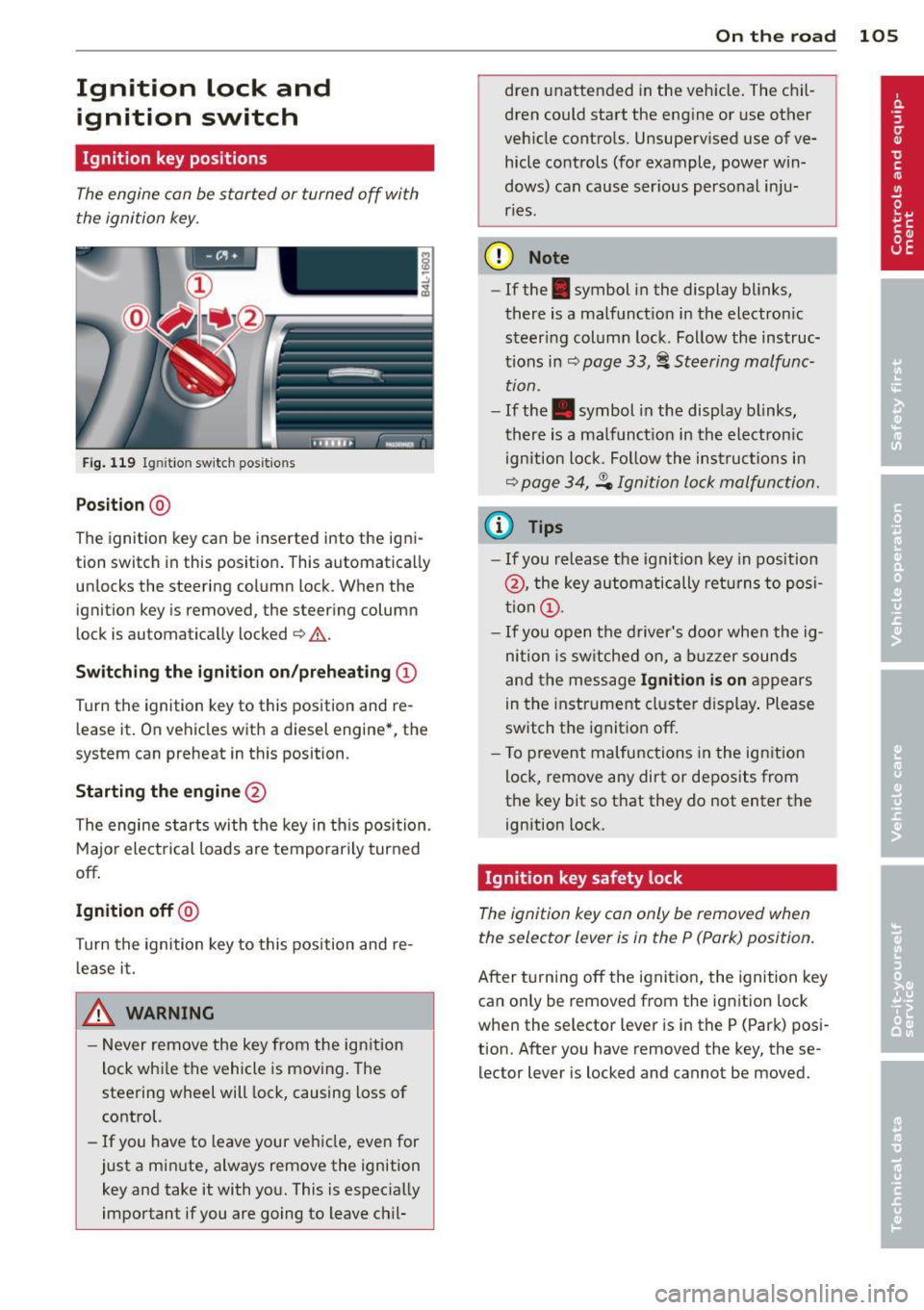
Ignition lock and ignition switch
Ignition key positions
The engine con be started or turned off with
the ignition key.
Fig. 119 Igni tion switch pos it io n s
Position @
The ignition key can be inserted into the igni
tion switch in this position . This automatically
unlocks the steering column lock . When the
ignition key is removed, the steering column
lock is automatically locked
Q .&. .
Switching the ignition on/preheating (D
Turn the ignition key to this position and re
lease it. On vehicles with a d iesel engine*, the
system can preheat in this position .
Starting the engine@
The engine starts with the key in this position.
Major electrical loads are temporarily turned
off.
Ignition off@
Turn the ignition key to this position and re
lease it.
A WARNING ,~ ~
- Never remove the key from the ign ition
lock whi le the vehicle is moving. The
steering wheel will lock, causing loss of
control.
- If you have to leave your vehicle, even for
just a minute, always remove the ignition key and take it with you. This is especially
important if you are going to leave chil-
On the road 105
dren unattended in the vehicle. The chil
dren could start the engine or use other
vehicle controls. Unsupervised use of ve
hicle controls (for example, power win
dows) can cause ser ious personal inju
ries.
(D Note
- If the . symbol in the display blinks,
there is a malfunction in the electronic
steering column lock . Follow the instruc
tions in
Q page 33, i Steering malfunc
tion .
-If the . symbol in the display blinks,
there is a malfunction in the electronic
ignition lock . Fol low the instructions in
Q page 34, .P. Ignition lock malfunction.
a) Tips
-If you release the ignition key in position
@, the key automatically returns to posi
tion (!).
- If you open the driver's door when the ig
nition is sw itched on, a buzzer sounds
and the message
Ignition is on appears
in the instrument cluster display. Please
switch the ignition off.
- T o prevent malfunctions in the ign ition
lock, remove any dirt or deposits from
the key bit so that they do not enter the
ignition lock.
Ignition key safety lock
The ignition key con only be removed when
the selector lever is in the P (Pork) position.
After turning off the ignition, the ignition key
can only be removed from the ignition lock
when the selector lever is in the P (Park) posi
tion. Afte r you have removed the key, these
lector lever is locked and cannot be moved.
Page 108 of 340
106 On the road
Starting and stopping
the engine
Starting the engine
The engine can only be started with your orig
inal Audi key.
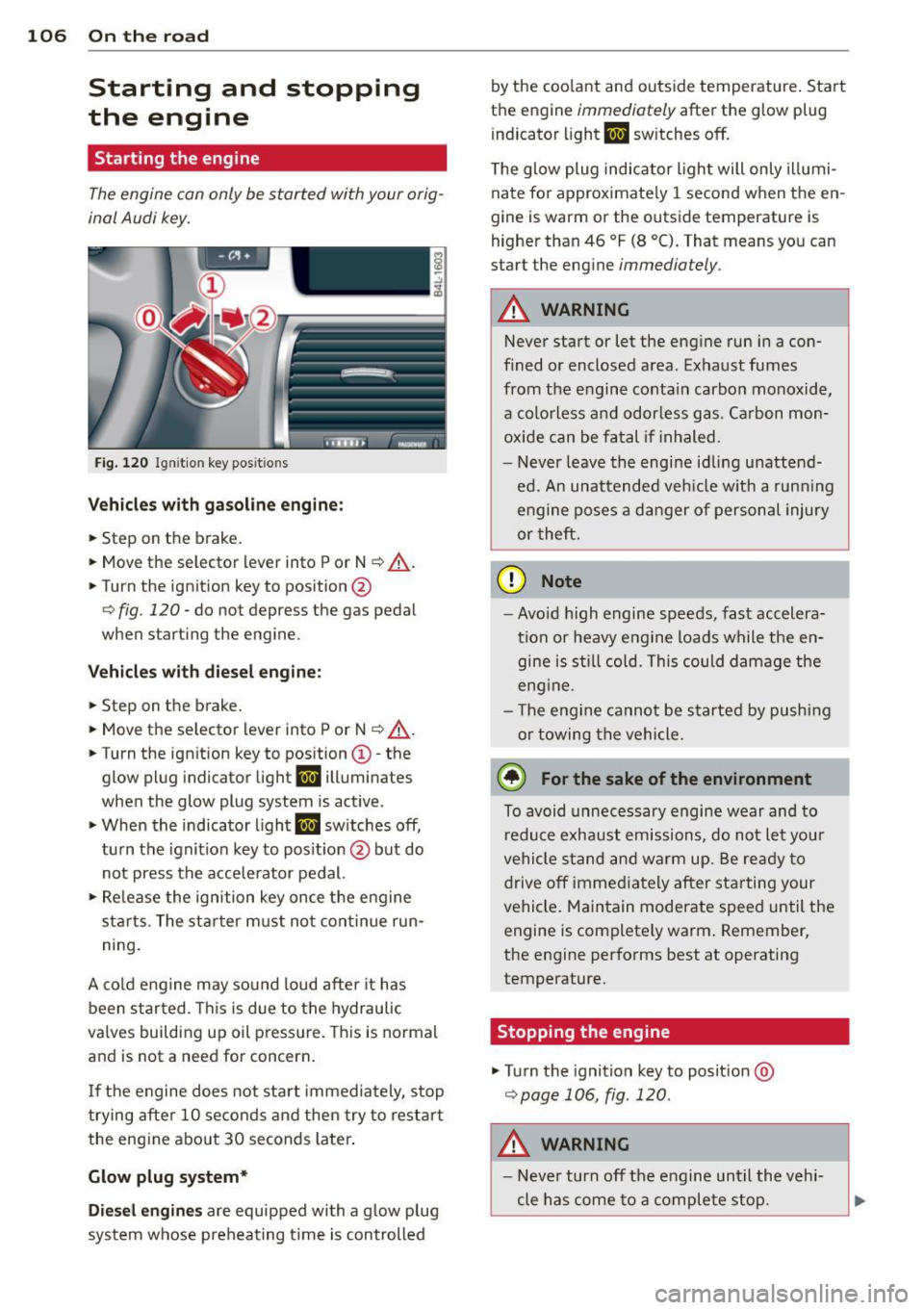
Fig. 120 I gni tion key positio ns
Vehicles with gasoline engine:
.. Step on the brake .
.. Move the selector lever into P or N
~ ,&. .
.. Tu rn the ignition key to position @
~ fig. 120 -do not depress the gas pedal
when starting the engine.
Vehicles with diesel engine:
.. Step on the brake .
.. Move the selector lever into P or N
~ ,&..
.. Turn the ign ition key to position ©- the
glow plug indicator light
m illuminates
when the glow plug system is act ive .
.,. When the indicator l ight
I.I sw itches off,
turn the ignition key to pos it ion @ but do
not press the accelerator pedal.
.,. Re lease the ignition key once the engine
sta rts. The starter must not continue run
ning.
A cold engine may sound loud after it has
been started . This is due to the hydraulic
va lves building up oil pressure. This is normal
and is not a need for concern.
If the engine does not start immediately, stop
trying after 10 seconds and then try to restart
the engine about 30 seconds Later.
Glow plug system*
Diesel engines are equipped with a glow plug
system whose preheating t ime is controlled by the coo
lant and outs ide temperature . Start
the engine
immediately after the glow plug
indicator light
m sw itches off.
The glow plug indicator light will only illumi
nate for approximate ly 1 second when the en
gine is warm or the outside temperature is
higher than 46 °F (8 °C). That means you can
start the engine
immediately .
A WARNING
-Never start or let the engine run in a con-
fined or enclosed area. Exhaust fumes
from the engine contain carbon monoxide,
a colorless and odorless gas . Carbon mon
oxide can be fatal if inhaled.
- Never leave the engine idling unattend
ed. An unattended veh icle w ith a runn ing
engine poses a danger of personal injury
or theft .
(D Note
- Avo id high engine speeds, fast accelera
tion or heavy engine loads while the en gine is still cold. This could damage the
eng ine .
- Th e engine cannot be started by pushing
or towing the vehicle .
@ For the sake of the environment
To avoid unnecessary engine wear and to
reduce exhaust emissions, do not let your
vehicle stand and warm up. Be ready to
drive
off immediately after starting your
vehicle. Maintain moderate speed until the
engine is completely warm . Remember,
the engine performs best at operating
temperature.
· Stopping the engine
.,. Turn the ignition key to posit ion @
~page 106, fig . 120 .
A WARNING
-
-Never turn off the engine until the vehi-
cle has come to a complete stop.
Page 109 of 340
-The brake booster and servotronic only
work when the engine is running. With
the ignition turned off, you have to apply
more force when steering or braking.
S ince you cannot steer and stop normal
ly, this can lead to accidents and ser ious
injuries.
- The rad iator fan can continue to run for
up to 10 min utes even after you have
turned off the engine and removed the ign ition key. The radiator fan can also
turn on again if the engine coolant heats
up because of intense sunlight or heat
build -up in the engine compartment.
«I) Note
Do not stop the engine immed iate ly after
hard or extended dr iving. Keep the engine
running for approximately two minutes to
prevent excessive heat build-up .
Starting and stopping
the engine with
Convenience key
Starting the engine with the~
button
App lies to vehicles: with Convenie nce key
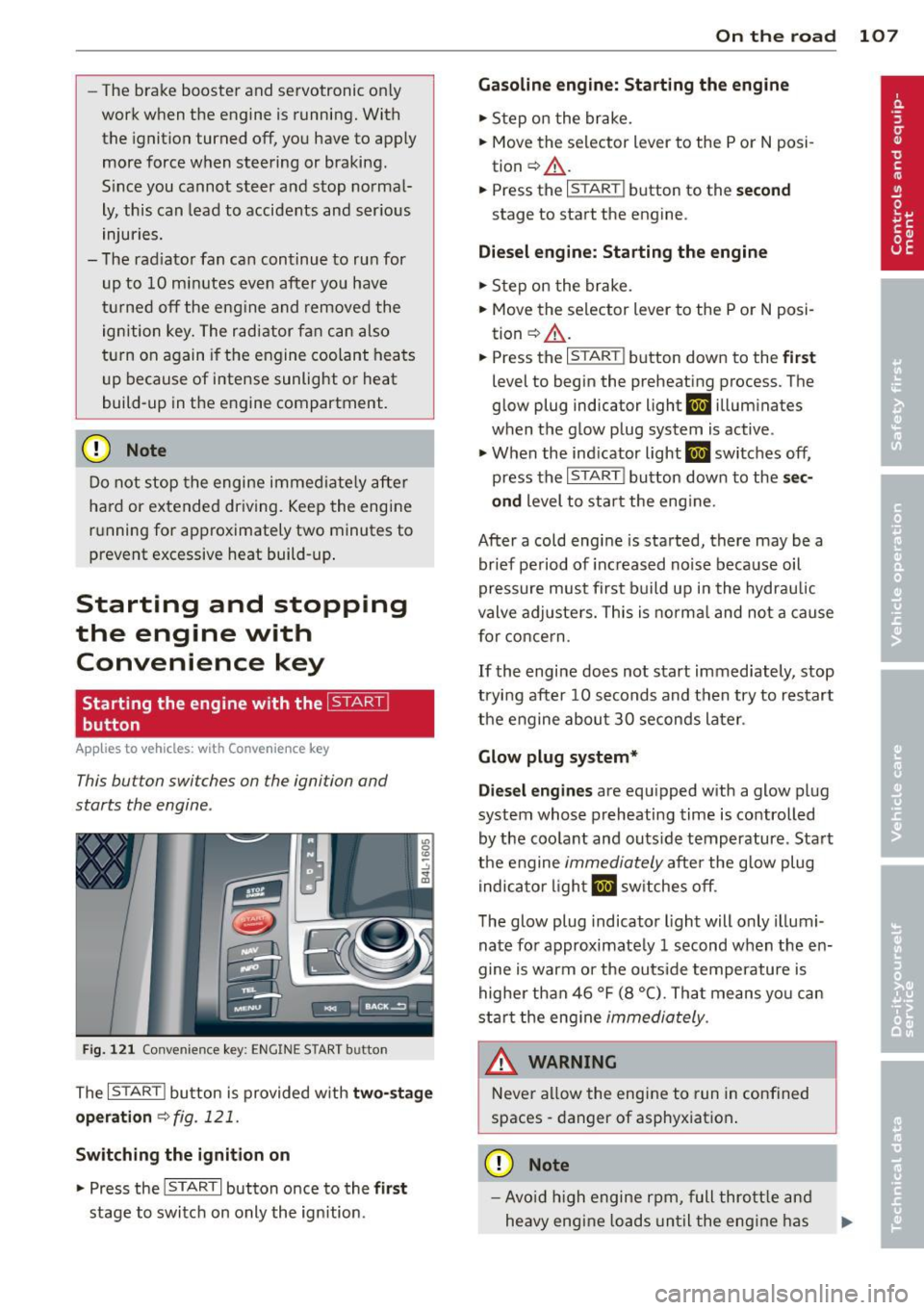
This button switches on the ignition and
starts the engine .
Fig. 121 Convenience key: ENGINE START button
The I STAR T! button is provided w ith two -sta ge
o p era tion
¢ fig. 121.
Sw itching the ignition on
.. Press the !START I button once to the fi rs t
stage to switch on only the ign ition.
On th e road 107
Gasoline eng in e: St arting th e engine
.. Step on the brake.
.. Move the se lector lever to the P or N posi
tion ¢.&, .
.. Press the
r:: 1s=T:--:-A =RT=i button to the secon d
stage to start the engine .
Diesel en gine : Starting the engine
.. Step on the brake.
.. Move the selector lever to the P or N posi
tion ¢.&, .
.. Press the
r:: 1s=TA c:--=RT= I button down to the first
level to begin the preheating process. The
glow plug indicator light
II illuminates
when t he glow plug system is active .
.. When the ind icator light
II switches off,
press the
I START ! button down to the se c
ond
level to star t the eng ine.
After a cold engine is started, there may be a br ief period of increased no ise because oil
pressure must first build up i n the hydraulic
valve adjuste rs. This is norma l and not a cause
for concern .
If the engine does not start immediately, stop
trying after 10 seconds and then try to restart
the engine abou t 30 seconds later .
Glow plug system*
Die sel engine s
are equ ipped with a glow plug
system whose preheating time is controlled
by the coo lant and outs ide temperature . Start
the engine
immediately afte r the glow plug
indicator light
II sw itches off.
The glow plug indicator light will only illumi
nate fo r approximate ly 1 second when the en
gine is warm or the outs ide temperature is
higher than 46 °F (8 °C). That means yo u can
star t the eng ine
immediately .
WARNING
Never allow the engine to run in confined
spaces -danger of asphyxiation .
(D Note
-Avo id h igh engine rpm, full thrott le and
heavy engine loads until the eng ine has
Page 232 of 340
230 Intellig ent technol ogy
What you should know
The highest priority is given to maintaining
starting capability.
The battery is severely taxed in short-distance
driving, in city traffic and during the cold time
of year. Abundant electr ical energy is re
qu ired, but only a little is generated. It is also
cr itical if the e ngine is not running and elect ri
cal components a re turned on. In th is in
stance energy is being consumed but none is being generated .
I t is in precisely these situations that you w ill
notice energy management actively regulat
ing the distrib ution of energy.
Vehicle stand s for an ext ende d period
If you do not drive your vehicle over a period
of several days or weeks, electrical compo
nents are gradually cut back o r switched off .
This reduces energy cons umption and main
tains starting capab ility
over a longer period.
Take into consideration that when you un lock
your ve hicle, some convenience functions,
such as the interior ligh ts or the power seat
ad justmen t, may not be available. The con
venience functions will be available again
when you turn on the ignition and start the
engine.
With the engine turned off
I f you listen to the radio, for example, with
the eng ine turned off or use other MM I func
tions, the battery is being discharged .
I f sta rting capability is jeopa rdized due to en
e rgy consumpt ion, the follow ing warning ap
pears in the MMI disp lay:
Ple ase s tart engin e, otherwi se system will
s wit ch off in 3 minute s.
The warning ind icates that the system will be
turned off automatically after 3 m inutes .
If
you wish to cont inue us ing the functions, you
have to start the engine.
With the eng in e runnin g
Although e lectrical energy is gene rated when
the vehicle is being driven, the battery can be
come discharged. This happens mostly when
little energy is being generated and a great
deal consumed and the battery's state of
charge is not optimal.
To bring the energy balance back into equili brium, consumers which req uire especially
large amounts of energy are temporar ily cut
back or sw itched off. Heat ing systems in par
t icular require a great deal of energy. If you
notice, for example, that the heated seats* or
the heated rear window are not heating, they
have been tempora rily cut back or switched
off . These systems w ill be available again as
soon as t he energy balance has been restored.
You w ill also notice that engine id le speed has
been increased slightly . T h is is normal and not
a cause for con cern. By inc reas ing engine id le
speed the additional energy required is gener
ated and the battery is charged.
Driver notification in the instrument
cluster display
If battery power drops into the range where it
can limit the ability of the engine to start, this
is shown in the instrument cluster display
with the fo llow ing driver message:
(•) low batte ry charge: bat tery w ill be
ch arg ed whil e dri ving
This notificat ion reminds you that the starting
capability of the engine may be lim ited. As
soon as you start dr iv ing again, the battery
will be recharged and the not ificat io n will go
out .
Driver notific ation app ear s a nd goe s out
again
If this driver notification appears after the ig
nition is turned on or wh ile driving and it goes
out again after a while, the battery has been
adequately recharged. .,.
Page 235 of 340
Catalytic converter
Applies to vehicles: with gasoline engine
It is very important that your emission con
trol system (catalytic converter) is function
ing properly to ensure that your vehicle is run
ning in an environmentally sound manner .
... Always use lead-free gasoline c::> page 249,
Gasoline .
... Never run the tank down all the way to emp
ty .
... Never put too much motor oil in your engine
c::> page 263, Adding engine oil 't=r..
.,. Never try to push-or tow-start your veh icle.
The catalytic converter is an eff icient "clean
up" device built into the exhaust system of
the vehicle. The catalytic converter burns
many of the pollutants in the exhaust gas be
fore they are released into the atmosphere.
The exclus ive use of unleaded fuel is cr it ically
i mportant for the life of the cata lytic convert
e r and proper functioning of the engine.
& WARNING ,~
T he temperature of the exhaust system is
high, both when driving and after stopping
the engine .
- Never touch the exha ust tail pipes once
they have become hot. This could result
in burns.
- Do not park or operate the vehicle in
areas where the hot exhaust system may
come in contact with dry grass, brush,
fuel spill or other material which can
cause a fire.
- Do not apply additional undercoating or
rustproofing on or near the exhaust
manifold, exhaust p ipes, catalytic con
verter or heat shields . During driving, the
substance used for undercoating cou ld
overheat and cause a fire.
(D Note
- Be aware that just one tank f illing with
leaded fuel will already seriously de-
grade the performance of the catalytic
conve rter.
Dri vin g and en vironm ent 233
-Do not exceed the correct engine oil level
c::> page 263.
- Do not drive until the fue l tank becomes
completely empty. The engine cou ld mis
fire. Unburned fuel could also get into
the exhaust system and this cou ld cause
the catalytic converter to overheat.
- Do not turn off the ignition while the ve
hicle is mov ing.
- Do not continue to operate your veh icle
under these conditions, as otherwise fuel
can reach the catalyt ic converter. Th is
cou ld result in overheating of the con
verter, requir ing its replacement.
- To assure efficient operation of the Emis
sion Control System:
- Have you r vehicle main tained properly
and in accordance w ith the se rv ice rec
ommendations in your Warranty & Maintenance book let.
- Lack of proper maintenance as we ll as
improper use of t he vehicle will impair
the function of the emission contro l
system and could lead to damage.
@) For the sa ke of the env ironment
Even when the Emission Control System is
operating properly, the exhaust gas can have a sulfur-like exhaust gas smell under
some operat ing states. This depends on
the sulfur content of the fuel being used .
Using a different brand of fuel may help,
or filling the tank with lead-free s uper
g rade gasoline.
Diesel particulate filter
App lies to vehicles: wit h diese l eng ine
The diesel part iculate filter filters nearly all of
the soot pa rticles out of the exhaust . T he fil
te r clea ns itself automat ica lly under no rma l
driv ing cond itions. If the filter cannot clean it
self (for example, because you are on ly driving
short distances), the fi lter becomes clogged
with soot and the
Ill symbo l for the diesel
particulate filter i lluminates
c::> page 36. ..,_
•
•
Page 237 of 340
Reducing unnecessary idling
Even when your car is just idling it burns up
fuel.
11-Shut the engine off when you are not driving
the vehicle.
11-Do not warm up the vehicle by letting the
engine run at idle .
It makes sense to shut
off the engine in traffic
jams, when waiting for trains to pass at rail
road cross ings, or at traffic lights that have
long waits on red. Turning the engine
off for
just 30-40 seconds saves more fuel than is
burned starting the engine again.
It takes a long time for the engine to warm up
fully when it is running at idle. However, wear
and noxious emissions are especially high
when the engine is warming up. So you should
drive away as soon as you start the engine and
avoid running at high rpms while the engine is
still warming up .
(D Note
Do not leave engine idling unattended af
ter starting. If warning lights should come
on to indicate improper operation, they
wou ld go unheeded. Extended idling also
produces heat, which cou ld result in over
heating or other damage to the vehicle or
other property .
Regular maintenance
A badly tuned engine unnecessarily wastes a lot of fuel .
11-Have your vehicle serviced at regular inter-
vals.
By having your vehicle regularly serviced by an
authorized Audi dealer helps to ensure that it
runs properly and economically. The condition
of your vehicle not only affects its safe ty and
ab ility to hold its value, it also affects fuel
consumption .
Check your oil each time you fill your tank.
Driving and environment 235
The amount of oil used is re lated to engine
load and speed.
It is normal for the oil consumption of a new
engine to reach its lowest value after a certain
mileage has been driven.
You must drive your vehicle about 3,000 miles
(S,000 kilometers) before you can properly
assess oil consumpt ion.
This also app lies to fue l consumption and en
gine output.
(D Note
- Have your veh icle ma inta ined properly
and in accordance with the service rec
ommendations in your Warranty
& Main
t enance booklet. Lack of prop er mainte
nance as well as improper use of the ve
hicle will impair the function of the
emission cont ro l system and could lead
to damage.
- Do not alter or remove any component of
the Emission Control System unless ap
proved by the manufacturer.
- Do not alter or remove any device, such
as heat shields, switches, ignition wires,
valves, which are designed to protect
your vehicle's Emission Control System and other important vehicle compo
nents.
Fewer short trips
Fuel consumption will always be relatively
high on short trips .
11-Try to avoid driv ing short distances w ith a
cold engine.
T he engine and cata lytic converter have to
reach their optimal operating temperature to
reduce fuel consumpt ion and noxious emis
s ions effectively .
Just after starting, a co ld engine in a mid-size
car on ly achieves a fuel economy of 6-8 mi les
per gallon (30-40 l/l00km). After about a
half a mile, fuel economy climbs to 12 mpg
(20 l/100 km). After about
2 .5 miles (4 km), liJI,
•
•
Page 250 of 340
248 Vehicle care and cleaning
- Never use abrasive cleaning materials
or alcohol to clean the camera lens.
Th is could cause scratches and cracks.
-Windows
- Remove snow and ice on windows and
exterior mirrors with a plastic scraper.
To avoid scratches, move the scraper only in one direction and not back and
forth.
- Never remove snow or ice from win
dows and mirrors using warm or hot
water because this could cause cracks
to form.
- To avoid damage to the rear window
defogger, do not apply any stickers on
the heating wires on the inside of the
window.
- Decorative parts/trim
- Never use chrome care or cleaning
products.
- Paint
-To reduce the risk of scratches, the ve-
hicle must be free of dirt and dust be
fore polishing or waxing.
- To prevent paint damage, do not polish
or wax the vehicle in direct sunlight.
- To reduce the risk of paint damage, do
not polish away rust film .
-Displays
- To avoid scratches, do not use dry
cleaning methods on displays.
- Controls
- Make sure that no fluids enter the con-
trols, because this could cause dam
age.
-Safety belts
- Do not remove the safety belts to clean
them.
- Never clean safety belts or their com
ponents chemically or with corrosive
fluids or solvents and never allow sharp objects to come into contact
with the safety belts. This could cause damage to the belt webbing.
- If there is damage to the webbing, the connections, the retractors or the buck
les, have them replaced by an author- ized Audi dealer or a qualified work
shop.
- Textiles/Vinyl/Alcantara
- Never treat Vinyl/ Alcantara with leath-
er care products, solvents, floor polish,
shoe polish, stain remover or similar products.
- To avoid damage, have stubborn stains
removed by an authorized Audi dealer
or a qualified workshop.
- Never use steam cleaners, brushes, hard sponges, etc. when cleaning.
- Objects with sharp edges such as zip
pers, rivets on clothing or belts can
cause damage to the surface.
- Open hook and loop fasteners, for ex ample on clothing, can damage seat
covers. Make sure hook and loop fas
teners are closed.
- Natural leather
- Never treat leather with solvents, floor
polish, shoe polish, stain remover or
similar products.
- Objects with sharp edges such as zip pers, rivets on clothing or belts can
cause damage to the surface.
- Never use steam cleaners, brushes,
hard sponges, etc. when cleaning.
- To help prevent the leather from fad
ing, do not leave the vehicle in direct
sunlight for long periods of time. If leaving the vehicle parked for long pe
riods of time, you should cover the
leather to protect it from direct sun
light.
(D Tips
- Insects are easier to remove from paint
that has been freshly waxed.
- Regular waxing can prevent rust film
from forming.
Page 253 of 340
Winter operation
At temperatures below 20° F (-7° C), Diesel
fuel No.
2 loses its fluidity due to wax separa
tion, which may clog the fuel filter or tank fil
ter and keep the engine from running .
To help the filter from being clogged by wax,
the fuel filter in your vehicle is automatically
preheated. Preheating the fuel filter makes
operation of your vehicle possible with Diesel
fuel No . 2 down to -10° F (-24° C).
If you expect temperatures below 5° F
(-15° C) ask your fuel dealer whether their
Diese l fuel No. 2 is sufficiently winterized for
the prevailing and expected temperatures.
If not winterized or insufficiently winterized
Diesel fuel has already thickened to the extent
that the engine will not start, warm the vehi
cle up by leaving it in a heated garage.
It is normal that the engine noise leve l (die
seling) is louder during the warm-up period in
winter.
It is also norma l when whitish-blue
smoke comes out of the tailpipe after start ing
and during warm-up . The amount of smoke
depends on the outs ide temperature.
Do not let your Diese l engine id le unnecessari
ly after a cold start. Driving off slowly will
shorten the warm-up period .
A WARNING
-Never use "starting assist fluids." They
may be potent ially explosive or cause a
"run-away" engine condition. This could
result in serious engine damage and per
sonal injury.
- Never use fuel line anti-freeze offered for
gasoline engines .
0 Note
- Refueling with gasoline when your vehi
cle has a diesel engine can cause very se
rious and expens ive engine and fuel sys
tem damage that is not covered by any
A udi Limited Warranty.
- If you put any amou nt of incorrect fuel in
the fuel tank, do not start the engine un-
-
Fuel supply and filling your fuel tank 251
der any circumstances. Immediately con
tact the nearest authorized Audi dea ler
or authorized Audi Service Fac ility for as
sistance. These fuels contain substances
that can severely damage the fuel sys
tem and the engine if the engine is start
ed .
- Veh icles with diesel engines must never
be refueled or driven with gasoline, kero
sene, heating oil, or other non-specified
fuels that have not been expressly ap proved for use with the diesel engine.
Other kinds of fuel can cause serious
damage to the fuel system and the en
gine that is not covered by any Audi Lim
ited Warranty.
- If Diesel fuel should get on any rubber
hose, it must be wiped off immediately.
Then wash the contaminated hose por
tion with soap and warm water. Do not
allow D iesel fuel to remain on connect
ing hoses . They may develop leaks and
cause serious damage.
Fuel tank
Fuel filler neck
The fuel filler neck is located on the right rear
side panel behind the fuel filler flap.
If the power locking system shou ld fai l, you
can still open the flap manually -for detailed
instructions see¢
page 254.
You can find the fuel tank capacity of your ve
hicle inc::>
page 315.
The label on the inside of the fuel filler flap
tells you the correct fuel for your veh icle. For
more information abo ut fuel specifications,
see c::>
page 249.
Your vehicle fuel tank has an on-board refuel
ling vapor recovery system. This feature helps
to prevent fue l vapors from escaping from the
tank and pollut ing the environment while you
refuel yo ur vehicle. In order to fill the tank
properly while protecting the environment,
please follow this refueling procedure careful-
~-~
•
•
Page 266 of 340
264 Check ing and filling
a reason to change the oil more often than
recommended.
A WARNING
Stop! Before working in the engine com
partment, a lways read and heed all WARN
INGS
c> .&. in Working in the engine com
partment on page 257. The engine com
partment of any motor veh icle is a poten
tially dangerous a rea and can cause ser i
ous personal injury.
A WARNING
If you must change the engine oil in your
vehicle:
- Always wea r eye p rotection.
- T o reduce the r isk of burns from hot en-
gine oil let the engine cool down to the
touch.
- When removing the oil drai n plug with
yo ur finge rs, stay as far away as possible.
Always keep your forea rm pa ra ll el t o the
ground to he lp prevent hot oil from run
ning down your arm.
- Dr ain the o il into a container designed
for this p urpose, one large enough to
hold at least the total amount of oil in
yo ur engine .
- T o reduce the r is k of po ison ing, never use
empty food or beverage containers that
might mis lead someone into drinking
from them.
- Engine oil is poisono us. Keep it well out
of the reach of children.
- Cont inuo us contact with used engine oil
is harmful to your skin . Always protect
yo ur sk in by washing thoro ughly with
soap and water.
@ Note
Never mix oil ad ditives with your engine
oil. These additives can damage your en
gine and adverse ly affect your Audi Limit
ed New Vehicle Warranty.
(® For the sake of the environment
- Before changing the oil, first make sure
you know where you can prope rly dispose
of the old o il.
- Always dispose of used oil p roperly. Nev
er dump it on garden soil, in wooded
areas, into streams or down sewage
dra ins.
- Recycle used o il by tak ing it to a used en
gine oil collection facility in your area, or
contact a se rvice station.
- We strongly recommend that yo u have
your oil cha nged by an authorized Audi
dealer or a qualified workshop with the
special tools a nd expert ise required, and
prope r m eans of disposal.
Engine cooling system
Coolant
The engine coolant performs two functions: it
keeps the engine from overheating and it pro
tects the engine from freezing in the winter.
T he cooling sys tem is sealed and genera lly re
quires little attention.
T he coo lin g sys tem has been fi lled a t the fac
tory with a permanent coolan t which does not
need to be changed . The coo lant cons ists of a
mixture of specially conditioned water and the
manufacture r's g lycol-basedcoo lant add i-
t ive
Gl3 antifreeze with anticorrosion addi
t ives (SO% for USA models; 60% for Canadian
models). This mixture both assures the neces
sa ry frost protection and protects metal com
ponents in the eng ine's cooling system from
corros io n and scaling.
It also ra ises the bo il
i ng po in t of the coolan t.
Do not reduce the concentration of the cool
ant in the summer by addi ng p lain water .
The
proportion of coolant additiv e must be at
lea st 50 % but not more than 60°/o
to main
t ai n ant ifree ze pro te ct io n and cooling eff ic ien
cy .
If the coo lant fros t protec tion is too low '
t h e coo lant co uld freeze and damage the vehi-
cle heating and engine cooling system. ..,.
Page 268 of 340
26 6 Ch eck ing and filling
Coolant lo ss
Coolant loss may indicate a l ea k in t he cooling
system. In the event of coolant loss, the cool
ing system should be inspected immediately
by your authorized Audi dealer. It is not
enough merely to add coolant.
I n a
se ale d system, losses can occur only if
the boiling point of the coolant is exceeded as
a result of overheating.
A WARNING
The cooling system is under pressure and
can get very hot. Reduce the risk of scald
ing from hot coolant by following these
steps .
- Turn off the engine and allow it to cool
down.
- Protect your face, hands and arms from
escaping fluid and steam by covering the
cap with a large, thick rag .
- Turn the cap slowly and very carefully in
a counter -clockwise direction wh ile ap
plying light, downward pressure on the
top of the cap .
- To avoid being burned, do not spill ant i
freeze or coolant on the exhaust system
or hot eng ine parts. Under certain condi
t ions, the ethy lene g lycol in engine cool
an t can ca tch f ire.
0 Note
Do not add any type of radiator leak seal
ant to your vehicle's eng ine coolant. Add
ing radiato r repair fluid may adve rsely af
fect the function and performance of your
cooling system and could res ult in damage
not covered by your New Vehicle Limited
Warranty .
Adding coolant
Be very careful when adding engine coolant.
Before you check anything i n the engine com
pa rtmen t,
a lwa ys rea d and h eed all WARN
INGS c:::> A in Working in the engine compart
ment on page 257.
.. Tu rn off the engine .
.. Let the engine cool down.
.. Place a thick rag over the coo lant expansion
tank
c> page 265 , fig. 245 and car efully
twist the cap counter-clockwise c> ,&. .
.. Add coo lant m ixed in the correct rat io
c:::> page 264, Coolant.
.. Twist the cap on again tightly.
Replacement engine coolant must conform to
exact spec ificat ions
c> page 264, Coolant.
We recommend using only coo lant additive
G12 ++, G13 or in an emergency G12 +. Do
not
use a different add itive. In an emergency use
plain water until you can get the correct addi
t ive and can restore the correct ratio . This
shou ld be done as soon as poss ib le.
If you have lost a considerable amount of
coolant, then you should add cold ant ifreeze
and co ld water only when the eng ine is cold .
Always use
new engine coolant when refilling.
Do not fi ll coolant above the "MAX" mark. Ex
cess coolant will be forc ed out through the
pressure relief valve in the cap when the en
gine becomes hot.
A WARNING
- The cooling system is under pressure and
can get very hot. Reduce the risk of
scalding from hot coolant by following
these steps.
- Turn off the engine and allow it to coo l
down.
- Protect your face, hands and arms from
escaping fluid and steam by covering
the cap with a large, th ick rag.
- Turn the cap s low ly and very carefully
in a counter-clockwise direction while
applying light, downward pressure on
the top of the cap.
- To avoid being burned, do not spill an
tifreeze or coolant on the exhaust sys
tem or hot engine parts. Under certain
cond it ions, the ethylene g lycol in en
gine coolant can catch fire .