instrument panel AUDI Q7 2014 Owner´s Manual
[x] Cancel search | Manufacturer: AUDI, Model Year: 2014, Model line: Q7, Model: AUDI Q7 2014Pages: 340, PDF Size: 85.02 MB
Page 190 of 340
188 Airbag system
conditions is impossible in all conceiva
ble situations that may happen during
the useful life of your vehicle.
- The Advanced Airbag System can deploy
in accordance with the "low risk" option
under the U.S. Federal Standard if a child
that is heavier than the typical one-year
old child is on the front passenger seat
and the other conditions for airbag de
ployment are met.
-Accident statistics have shown that chil
dren are generally safer in the rear seat
area than in the front seating position.
- For their own safety, all children, espe
cially 12 years and younger, should al
ways ride in the back properly restrained
for their age and size.
Advanced front airbag system
Your vehicle is equipped with a front Advanced
Airbag System in compliance with United
States Federal Motor Vehicle Safety Standard
208 as applicable at the time your vehicle was
manufactured.
The front Advanced Airbag System supple ments the safety belts to provide additional
protection for the driver's and front passeng
er's heads and upper bodies in frontal crashes .
The airbags inflate only in frontal impacts
when the vehicle deceleration is high enough.
The front Advanced Airbag System for the
front seat occupants is not a substitute for
your safety belts. Rather, it is part of the over
all occupant restraint system in your vehicle.
Always remember that the airbag system can
only help to protect you, if you are sitting up
right , wearing your safety belt and wearing it
properly. This is why you and your passengers
must always be properly restrained, not just
because the law requires you to be.
The Advanced Airbag System in your vehicle has been certified to meet the "low risk" re
quirements for 3 and 6 year-old children on
the passenger side and very small adults on
the driver side. The low risk deployment crite
ria are intended to help reduce the risk of in- jury through interaction with the front airbag
that can occur, for example, by being too close to the steering wheel and instrument
panel when the airbag inflates.
In addition, the system has been certified to
comply with the "suppression" requirements
of the Safety Standard, to turn off the front
airbag for infants 12 months old and younger
who are restrained on the front passenger
seat in child restraints that are listed in the Standard
~ page 206, Child restraints and
Advanced Airbags .
"Suppression" requires the front airbag on the
passenger side to be turned off if:
- a child up to about one year of age is re
strained on the front passenger seat in one
of the rear-facing or forward-facing infant
restraints listed in Federal Motor Vehicle
Safety Standard 208 with which the Ad
vanced Airbag System in your vehicle was
certified. For a listing of the child restraints
that were used to certify your vehicle's com
pliance with the US Safety Standard
~page 206,
-weight less than a threshold level stored in
the control unit is detected on the front pas
senger seat.
When a person is detected on the front pas senger seat, weighing more than the total
weight of a child that is about 1 year old re
strained in one of the rear-facing or forward
facing infant restraints (listed in Federal Mo
tor Vehicle Safety Standard 208 with which
the Advanced Airbag System in your vehicle
was certified), the front airbag on the passen ger side may or may not deploy.
The
PASSENGER AIR BAG OFF light comes on
when the electronic control unit detects a to
tal weight on the front passenger seat that re quires the front airbag to be turned off. If the
PASSENGER AIR BAG OFF light does not
come on, the front airbag on the passenger
side has not been turned off by the control
unit and can deploy if the control unit senses
an impact that meets the conditions stored in
its memory.
ll-
Page 191 of 340
If the total weight on the front passenger
seat is more than that of a typical 1 year -old,
but less than the weight of a small adult, the
front airbag on the passenger side may deploy (the
P ASS ENGER AIR B AG OFF light does not
come on).
For example, th e airbag may depl oy if:
-a small child that is heavier than a typical 1
year-o ld child is on the front passenger seat
(regardless of whether the child is in one of
the chi ld safety seats listed
<=) page 206),
-a chi ld who has outgrown child restraints is
on the front passenger seat.
I f the front passenger airbag is turned
off, the
PA SSENGER AIR B AG OFF light in the center
of the instrument panel wi ll come on and stay
on.
The front a irbag on the passenger side may
not deploy (the PA SSENG ER AIR BAG O FF
light does not ill uminate and stay lit) if:
- a small adu lt or teenager is on the front pas
senger seat
- a passenger who is not sitt ing upright w ith
their back against a non-reclined backrest
with their feet on the vehicle floo r in front
of the seat is on the front passenge r seat .
If the front passenger airbag deploys, the
Federal Standard requires the a irbag to meet
the " low risk" deployment cr iteria to help re
duce the risk of inju ry through interaction
with the airbag. "Low risk" deployment occurs in those crashes that take place at lower de
celerations as defined in the electronic control
un it.
<=) page 194
Al ways rememb er: Even tho ugh your vehicle
is equipped with Advanced Airbags, the safest
p lace for children is properly restrained on the
back seat. Please be sure to read the impor
tant information in the sect ions that follow
and be sure to heed all of the WARNINGS.
A WARNING
To reduce the risk of injury when an airbag inflates, a lways wear safety belts prope rly.
A irbag system 189
-If you are unrestrained, leaning forward,
sitt ing s ideways or out of pos ition in any
way, your risk of injury is much higher.
- You will a lso receive serious injuries and
could even be killed if you are up aga inst
the airbag or too close to it when it in
flates -even w ith an Advanced A irbag
<=)page 183 .
A WARNING
-
A child in a rearward-fac ing ch ild safety
seat installed on the front passenger seat
will be ser ious ly injured and can be killed if
the front airbag inflates -even with an Ad
vanced A irbag System.
- Al tho ugh the Advanced Airbag System in
your veh icle is designed to turn
off the
front airbag when a rearward -facing
child restraint has been insta lled on the
front passenger seat, nobody can abso
lutely guarantee that dep loyment is im
possible in all conceivable s ituations that
may happen dur ing the usefu l life of your
veh icle.
- The inflating airbag will h it the ch ild
safety seat or infant carrier with great
force and will smash the child safety seat
and child against the bac krest, center
armrest, doo r, or roof.
- Always install rearward-facing chi ld re
straints on the rear seat.
- If you must install a rearwa rd fac ing
child safety seat on the fro nt passenger
seat because of exceptiona l circumstan
ces and the
PASSENGER AIR BAG OFF
light does not come on and s tay on, im
mediately insta ll the rear-facing ch ild
safety seat in a rear seating position and
have the airbag system inspected by your
author ized Audi dealer.
A WARNING
If, in except iona l circumstances, you must
install a forward-facing child restraint on
the front passenger's seat:
~
•
•
Page 192 of 340
190 Airbag sys tem
-Always make sure the forward-facing
seat has been des igned and certified by
its manufacturer for use on a front seat
with a passenger front and side airbag .
- Never put the forward-facing child re
straint up aga inst or very near the instru
ment panel.
- Always move the passenger seat into its
rearmost position in the seat's fore and
aft adjustment range, as far away from
the a irbag as poss ible, before insta lli ng
the fo rward-facing chi ld restraint. The
b ackres t must be adjus ted to an upr igh t
posit io n.
- Make su re that the
PASSENGER AIR BAG
OFF
light co m es on and s tays on all the
t ime whenever the ignition is switched
on.
Advanced Airbag System components
The front passenger seat in your vehicle has a lot of very important parts of the Advanced
Airbag System in it. These parts include the
weight-sens ing mat, sensors, wiring, brack
ets, and more . The fu nction of the system in
the front passenger seat is checked by the
e lectronic control u nit when the ignit ion is on.
The control unit mo nitors the Advanced Air
bag Sys tem and turns the airbag indicator
light on when a ma lfunction in the system
components is detected . The function of the
ai rbag ind icator light is described in greater
detai l below. Because the front passenger
seat contains important parts of the Ad
vanced A irbag System, you must take care to
prevent it from be ing damaged . Damage to
the seat may prevent the Advanced A irbag for
the front passenger seat from doing its job in
a cra sh .
The front Advanced Airbag System
consists of the following:
- Crash senso rs in the front of the veh icle that
measu re ve hicle ac celera tion/de ce le ra ti on
to provide info rm ation to the Advanced Air
bag System abo ut the severity of the crash . -
An elect ronic contro l unit, with integrated
crash sensors for front and side impacts .
The control un it "decides" whether to fi re
the front a irbags based on the informat ion
received from the crash sensors. The contro l
un it also "decides" whether the safety belt
prete nsioners shou ld be act ivated .
- An Advanced A irbag w ith gas generator for
the dr iver inside the stee ring wheel hub .
- An Advanced A irbag w ith gas generator in
side the instrument panel for the front pas
senge r.
- A we ight-sensing mat under the up ho lstery
padding of the front passenger seat cushion
that measures the total weight on the seat .
The informat io n registe red is sent continu
ou sly to the elec troni c con tro l unit to regu
la te deployment of the front Advanced Air
bag on the passenger side .
- An airbag monitoring sys tem and in dicator
light in t he instr ument cluster
~ page 194.
-The PASSENGER AIR BAG OFF ligh t comes
on and sta ys on in the cen ter o f th e instr u
ment panel
~ page 194, fig . 210 and tells
you whe n the front Advanced Airbag on the
passenger side has been tu rned off .
- A sensor below the safety be lt latch for the
front seat passenger to meas ure the tension
on the safety be lt . The tension on the safety
be lt and the weight registered by the
weight-sensing mat he lp the control unit
"decide" whether the front airbag for the
front passenger seat should be turned off or
not
~ pag e 185, Child restraints on th e
front seat -some important things to
know.
- A senso r in the safety belt latch fo r th e d riv
er a nd fo r the front sea t passenger tha t
senses w het he r th at safety bel t is latched or
no t and transmi ts this information to the
electronic control unit.
A WARNING
Damage to the fr ont passenger seat can
p revent the front airbag from work ing
properly.
-
Page 195 of 340
-when the weight on the front passenger
seat as sensed by the Advanced Airbag Sys
tem indicates that the front airbag on the
passenger side has to be turned off by the
electronic control unit (the
PASSENGER AIR
BAG OFF
light comes on and stays on)
A WARNING
Sitting in the wrong position can increase
the risk of serious injury in crashes.
- To reduce the risk of injury when the air
bags inflate, the driver and passengers
must always sit in an upright position,
must not lean against or place any part
of their body too close to the area where
the airbags are located.
- Occupants who are unbelted, out of posi
tion or too close to the airbag can be se
riously injured by an airbag as it unfolds
with great force in the blink of an eye
c> page 185.
A WARNING -
A child in a rearward-facing child safety
seat installed on the front passenger seat
will be seriously injured and can be killed if
the front airbag inflates -even with an Ad
vanced Airbag System.
- The inflating airbag will hit the child
safety seat or infant carrier with great
force and will smash the child safety seat
and child against the backrest, center
armrest, door or roof.
- Always install rear-facing child safety
seats on the rear seat.
- If you must install a rearward-facing
child safety seat on the front passenger
seat because of exceptional circumstan
ces and the
PASSENGER AIR BAG OFF
light does not come on and stay on, im
mediately install the rear-facing child
safety seat in a rear seating position and
have the airbag system inspected by your
authorized Audi dealer .
Airbag system 193
A WARNING
Objects between you and the airbag will
increase the risk of injury in a crash by in
terfering with the way the airbag unfolds
or by being pushed into you as the airbag inflates .
- Never hold things in your hands or on
your lap when the vehicle is in use.
- Never transport items on or in the area
of the front passenger seat . Objects
could move into the area of the front air
bags during braking or other sudden ma
neuvers and become dangerous projec
tiles that can cause serious personal in
jury if the airbags inflate.
- Never place or attach accessories or oth
er objects (such as cupholders, tele
phone brackets, large, heavy or bulky ob
jects) on the doors, over or near the area marked "AIRBAG" on the steering wheel,
instrument panel, seat backrests or be
tween those areas and yourself . These
objects could cause injury in a crash, es
pecially when the airbags inflate.
- Never recline the front passenger's seat
to transport objects. Items can also
move into the area of the side airbag or
the front airbag during braking or in a sudden maneuver. Objects near the air
bags can become projectiles and cause
injury, particularly when the seat is re
clined.
- Never tilt the front passenger seat back
rest forward when the vehicle is moving.
An inflating airbag will force the back
rest backward and can injure rear seat oc
cupants.
A WARNING
The fine dust created when airbags deploy
can cause breathing problems for people
with a history of asthma or other breath ing conditions.
-
- To reduce the risk of breathing problems,
those with asthma or other respiratory
.___ c_ o_ n_ d_ it_ i_o _ ns_ sh_o_ u_ l_ d _:g:_ e_ t _f_re _s_ h_ a_ i_r _ri ..:::g :....h _t __
_J ~
•
•
Page 198 of 340
196 Airbag sys te m
- accessory seat covers or cushions or other
things that may cause an incorrect reading
or impress ion on the weight-sens ing mat
under the upholstery of the seat have been
removed from the front passenger seat,
- a safety belt extender has not been left in
the safety belt latch for the front passenger
seat.
In addition to the
PA SSENGER AIR B AG OFF
light in the center of the instrument panel,
the message
PASS ENGER AIR B AG O FF or
PASS ENGER AIR B AG O N will briefly appear
in the instrument cluster display . T his is to in
form the driver of the current front passenger
a irbag status .
Important safety instructions on
monitoring the Advanced Airbag System
_&. WARNING
An airbag system that is not functioning
prope rly cannot provide supplemental pro
tect ion in a frontal crash.
- If the airbag indicator light
c::> page 16
comes when the vehicle is be ing used,
have the system inspected immediately
by you r authorized Aud i dea ler.
It is pos
sible that the airbag will inflate when it
is not supposed to, or w ill not inflate
when it should .
_&. WARNING
If the front airbag inflates, a child witho ut
a child restraint, or in a rearward-facing
child safety seat, or in a forward-facing
child restraint that has not been properly
installed will be seriously injured and can
be killed .
- Even though your veh icle is equipped
with an Advanced Airbag System, make certain that all children, especially 12
years and younger, a lways ride on the
back seat properly restrained for their
age and size.
- Always install forwa rd or rear-facing
child safety seats on the rear seat -even
with an Advanced Airbag System. -
If you must install a rearward-facing
child safety seat on the front passenger
seat because of exceptional c ircumstan
ces and the
PA SS ENGER AIR BA G OFF
light does not appear and stay on, imme
diate ly install the rear-facing child safety
seat in a rear seat ing pos ition and have
the airbag system inspected by your au
thorized A udi dealer.
- A tight tether or other strap on a rear ward-facing child restraint attached to the front passenger seat can p ut too
m uch pressure on the weight-sensing
mat in the seat and register more weight
than is actually on the seat. The heavier
weight registered can make the system
work as though an adult were on the seat
and deploy the Advanced Airbag when it
must be suppressed causing ser ious or
even fata l injury to the ch ild.
- If, in exceptional circumstances, you
must install a forward-fac ing ch ild re
straint on the front passenger seat, al
ways move the seat into its rearmos t po
sition in the seat's fore and aft adjust
ment range, as far away from the airbag
as possible. The backrest must be adjust
ed to an upright position. Make sure that
the
PASSEN GER AIR BAG OFF light
comes on and stays on all the time when
ever the ignit ion is switched on .
_&. WARNING
r-
- If the PASSENGER AIR BAG OFF light
does not go out when an adult is sitting
on the front passenger seat after taking
the steps described above, make sure the
adu lt is properly seated and restra ined at
one of the rea r seat ing pos itions.
- Have the airbag system inspected by
your author ized Audi dealer befo re trans
port ing anyone on the front passenger
seat.
('D Tips
If t he weight-sensing mat in the front pas
senger seat de tects an empty seat, the
front airbag on the passenger side wi ll be
jll,,
Page 204 of 340
202 Airbag system
inflates in side impacts and only when the ve
hicle acceleration registered by the control
unit is high enough. If this rate is below the
reference value programmed into the contro l
unit, the side airbags will not be triggered,
even though the car may be badly damaged as
a result of the collision . It is not possible to
define an airbag triggering range that will
cover every possible angle of impact, since the
circ umstances w ill vary cons iderably between
one co llision and another. Important factors
include, for examp le, the nat ure (hard or soft)
of the impacting object, the angle of impact,
vehicle speed, etc. c:>
page 202, How side cur
tain airbags work.
Aside from their normal safety function, safe
ty belts work to he lp keep the driver or front
passenger in position in the event of a co lli
sion so that the side curta in airbags can pro
vide protection.
The airbag system is not a substitute for your
safety belt. Rather, it is part of the overall oc
cupant restraint system in your ve hicle. Al
ways remember that the airbag system can
only help to protect you if you are wearing
your safety belt a nd wear ing it prope rly. Th is
is ano ther reason why you shou ld a lways wear
your safety bel ts, not just beca use the law re
qu ires you to do soc:>
page 174, General
notes.
It is important to remember that whi le the
side curta in a irbag system is des igned to he lp
redu ce the like lihood of serious injuries, othe r
injuries, fo r example, swell ing, bruising, and
minor abrasions can also be associated wit h
these airbags upon deployment. Remember
too, these a irbags w ill deploy on ly once and
only in certain kinds of accidents -your safety
be lts are a lways there to offer protection .
The side curtain airbag system basically
con sists of :
-The electronic control module and external
side impact sensors
- The side curtain airbags above the front and rear side w indows - The airbag indicator light in the instrument
panel
T he airbag system is mon itore d elec tronically
to make certain i t is func tioning properly at all
times . Each t ime you turn on the ignition, the
airbag system indicator light will come on for
a few seconds (sel f diagnostics).
The side curtain airbag is not activated:
- if the ignition is turned off
- in side co llision s when the accele ration
meas ured by the sensor is too low
- in rear-end col lisions .
A WARNING
-Safety belts and the airbag system will
only provide pro te ction when occupant s
are i n the proper seating posi tion
<=>page 72, General recommendations.
- If th e airbag ind ica tor light <=>page 16
comes when the veh icle is being used,
have the system inspected immediately
by your authorized A udi dealer. It is pos
sible that the airbag will inflate when it
is not supposed to, or will not inflate
when it should .
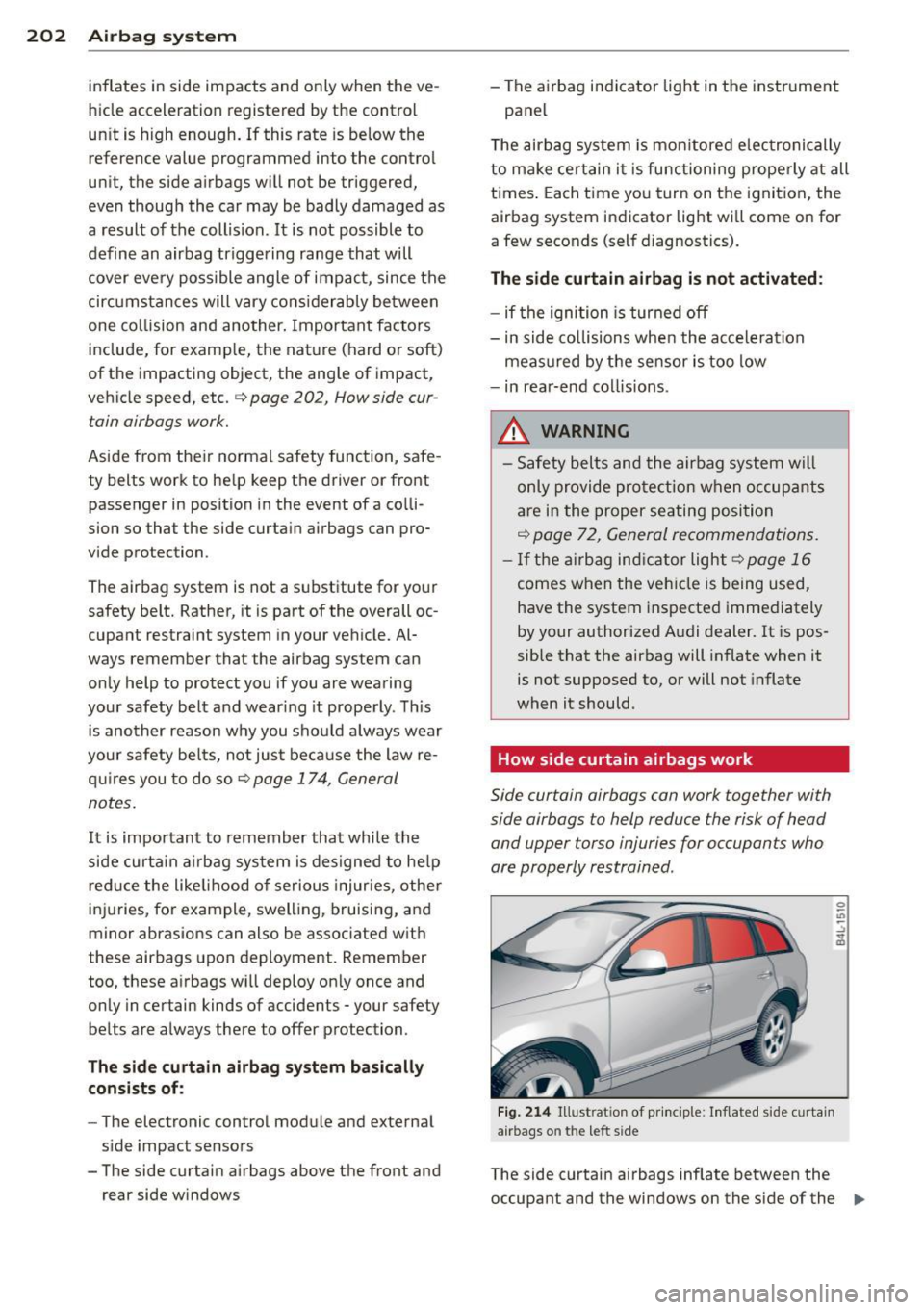
How side curtain airbags work
Side curtain airbags can work together with
side airbags to help reduce the risk of head
and upper torso injuries for occupants who
are properly restrained .
Fig. 2 14 Illust rat ion of p rincip le : I n flated side curtai n
airbags o n th e left side
The side curtain airbags inflate between the
occupant and the windows on the s ide of the
IJ>
Page 207 of 340
-Always install rear-facing child safety
seats on the rear seat.
- If you must install a rearward facing
child safety seat on the front passenger
seat in exceptional circumstances and
the
PASSENGER AIR BAG OFF light does
not come on and stay on, immediately
install the rear-facing child safety seat in
a rear seating position and have the air
bag system inspected immediately by
your Audi dealer.
_& WARNING
If, in exceptional circumstances, you must
install a forward-facing child restraint on
the front passenger's seat:
- Always make sure the forward-facing
seat has been designed and certified by its manufacturer for use on a front seat
with a passenger front and side airbag.
- Always follow the manufacturer's in
structions provided with the child safety
seat or carrier.
- Always move the passenger seat into its
rearmost position in the seat's fore and
aft adjustment range, as far away from
the airbag as possible before installing
the child restraint. The backrest must be
adjusted to an upright position .
- Always make sure that the
PASSENGER
AIR BAG OFF
light comes on and stays
on all the time whenever the ignition is
switched on.
(D Tips
Always replace child restraints that were
installed in a vehicle during a crash. Dam
age to a child restraint that is not visible
could cause it to fail in another collision
situation.
Advanced front airbag system and children
Your vehicle is equipped with an "Advanced
Airbag System" in compliance with United
States Federal Motor Vehicle Safety Standard
Child Safety 205
(FMVSS) 208 as applicable at the time your
vehicle was manufactured.
The Advanced Airbag system in your vehicle
has been certified to meet the "low-risk" re
quirements for 3- and 6-year old children on
the passenger side and small adults on the driver side. The low risk deployment criteria
are intended to reduce the risk of injury
through interaction with the airbag that can
occur, for example, by being too close to the
steering wheel and instrument panel when
the airbag inflates . In addition, the system
has been certified to comply with the "sup
pression" requirements of the Safety Stand
ard, to turn off the front airbag for infants up
to 12 months who are restrained on the front
passenger seat in child restraints that are list
ed in the Standard.
Even though your vehicle is equipped with an
Advanced Airbag system, all children, espe cially those 12 years and younger, should al
ways ride in the back seat properly restrained
for their age and size. The airbag on the pas
senger side makes the front seat a potentially dangerous place for a child to ride . The front
seat is not the safest place for a child in a for
ward-facing child safety seat. It can be a very
dangerous place for an infant or a larger child
in a rearward-facing seat .
Advanced Airbags and the weight
sensing mat in the front seat
The Advanced Airbag System in your vehicle
detects the presence of an infant or child in a
child restraint on the front passenger seat us
ing the weight -sensing mat in the seat cush
ion and the sensor below the safety belt latch
on the front passenger seat that measures the
tension on the safety belt.
The weight -sensing mat measures total
weight of the child and the child safety seat
and a child blanket on the front passenger seat. The weight on the front passenger seat
is related to the design of the child restraint
and its "footprint", the size and shape of the
bottom of the child restraint as it sits on the ..,.
•
•
Page 256 of 340
254 Fuel supply and filling your fuel tank
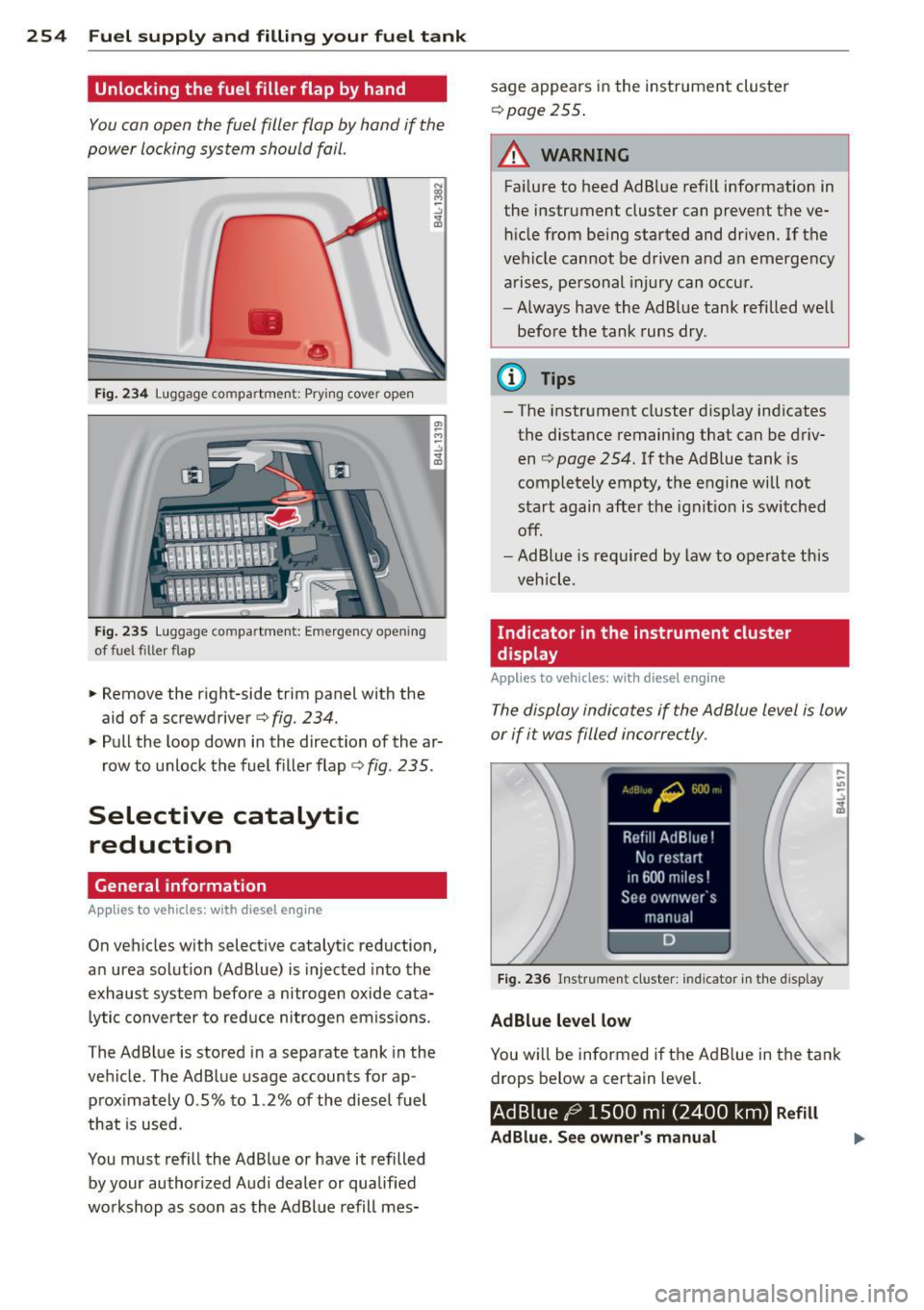
Unlocking the fuel filler flap by hand
You can open the fuel filler flap by hand if the
power locking system should fail .
•
Fig. 234 Luggag e compart men t: Pry ing cover open
Fig. 235 Luggage compartmen t: Eme rgency open ing
of fuel filler flap
.. Remove the right-side trim panel with the
aid of a screwdriver
c:> fig. 234.
.. Pull the loop down in the direction of the ar
row to unlock the fuel f iller flap
c:> fig. 235.
Selective catalytic
reduction
General information
Applies to vehicles: with diesel engine
On vehicles with selective catalytic reduction,
an urea solution (Ad Blue) is injected into the
exhaust system before a nitrogen oxide cata lytic converter to reduce nitrogen emiss ions.
The AdBlue is stored in a separate tank in the
vehicle. The AdBlue usage accounts for ap
proximately 0.5% to 1.2% of the diesel fuel
that is used.
You must refill the Ad Blue or have it refilled
by your author ized Audi dealer or qualified
workshop as soon as the AdBlue refill mes- sage appears
in the instrum ent cluster
r=>page 255.
.&_ WARNING
-
Failure to heed AdBlue refill information in
the instrument cluster can prevent the ve hicle from being started and driven. If the
vehicle cannot be driven and an emergency
arises, personal injury can occur.
- Always have the AdBlue tank refilled well
before the tank runs dry.
(D Tips
- The instrument cluster disp lay ind icates
the distance remaining that can be driv
en
r=> page 254. If the AdBlue tank is
completely empty, the engine will not
start again after the ignit ion is switched
off.
- AdBlue is required by law to operate this
vehicle.
Indicator in the instrument cluster
display
Appl ies to vehicles: with diesel engine
The display indicates if the Ad Blue level is low
or if it was filled incorrectly .
Fig. 236 Instrument cluster: indicator in the display
AdBlue level low
You will be informed if the Ad Blue in the tank
drops below a certain level.
AdBlue l;) 1500 mi (2400 km) Refill
AdBlue. See owner's manual
Page 259 of 340

Checking and filling Engine hood
Releasing the engine hood
The engine hood is released from inside the
vehicle .
Fig. 23 9 Drive r's s id e footw ell: eng in e hood relea se
l e v e r
"' Open the driver's door .
"' Pull the release lever on the left under the
instrument panel
i=> fig . 239 in the d irection
of the arrow .
The hood pops up slight ly under spring pres
sure.
Opening the engine hood
F ig . 2 40 Relea se le ve r u nde r the e ngin e hood
Before opening the engi ne hood, make sure
that the windshie ld wipers are flat against the
windshie ld. Otherwise, they cou ld damage the
pain t on the hood.
"' Lift the hood slight ly ¢
_A .
"' Pull up on the release under the hood
¢ fig . 240. This releases the catch.
"' Open the hood all the way . Checkin
g and fillin g 257
A WARNING
Hot engine coolant can burn you.
- To reduce the risk of being burned, never open the hood if you see or hear steam
or coo lant escaping from the eng ine
compartment . Wait unt il no steam or
coolant can be seen or heard before care
fu lly opening the hood.
Closing the engine hood
"' Pull the hood down until the pressure from
the stru ts is reduced.
"' Let the hood
drop down and latch in p lace.
Do not try to push it shut ; it may fail to en
gage ¢_& .
A WARNING
--
A hood that is not completely latched
could fly up and b lock your view while dr iv
i n g.
- When you close the engine hood, check it
to make sure the safety catch has p roper
ly engaged . The hood shou ld be flush
with the surround ing vehicle body parts.
- If you notice while driv ing that the hood
is not secured prope rly, stop at once and
close it .
Working in the engine compartment
Be especially careful whenever you work in
the engine compartment.
Whene ver you must perform any wo rk in the
eng ine compartment, for e xample checking
and filling different fluids, there is a risk of injury, burns and accidents. To pr event per
sonal injury always observe the following
WARNINGS . The engine compartment of an y
vehicle i s a hazardou s area
¢ Lh, .
A WARNING ~
To help avoid injury, befo re yo u check any
thing under the hood:
- Tu rn off the engi ne.
- Remove the igni tion key.
Page 305 of 340
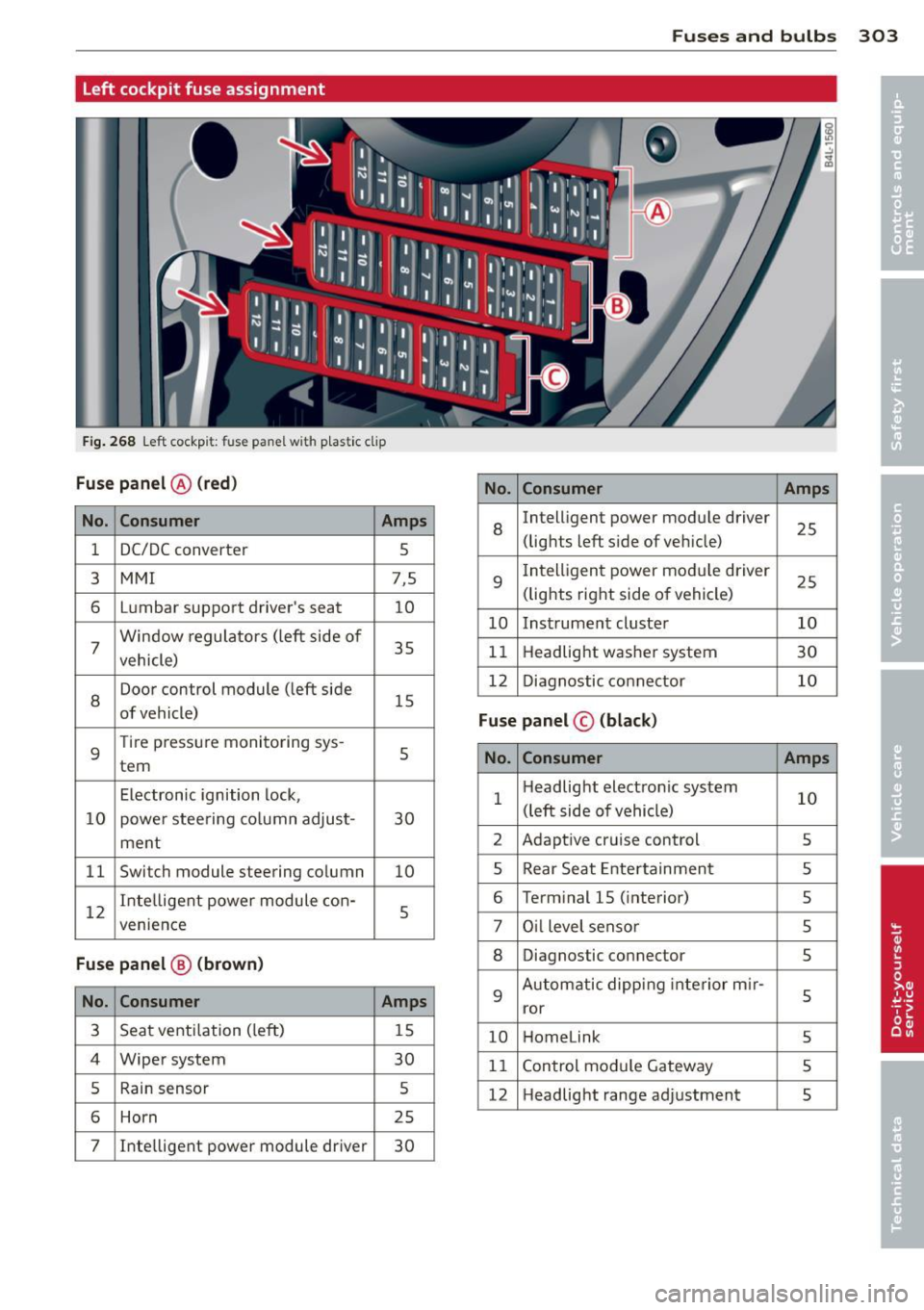
Fuses and bulbs 303
Left cockpit fuse assignment
F ig . 268 Left cockpit: fuse panel with p lastic clip
Fuse panel @ (red)
No. Consumer Amps
No. Consumer Amps
1 DC/DC converter
5
8
Intelligent power module driver
25
(lights left side of veh icle)
3
MMI 7,5
6 L umbar support driver's seat
10
7 Window
regulators (left side of
35
vehicle)
9
I ntelligent power module driver
25
(lights right side of vehicle)
10 Instrument cluster 10
11 Headlight washer system
30
8
Door control module (left side
15
of vehicle) 12
Diagnostic connector 10
Fuse panel © (black)
9
Tire pressure monitoring sys -
tern 5
No. Consumer
Amps
Electronic ignition lock,
10 power steering co lumn adjust- 30 1
Headlight
electronic system
10
(left side of vehicle)
ment 2
Adaptive cruise control
5
11 Switch module steering column
10 5 Rear
Seat Entertainment
5
12 Intelligent
power module con-
5
venience
6 Term inal 15 ( interior)
5
7 Oil level sensor
5
Fuse panel @ (brown) 8 Diagnostic connector
5
No.
Consumer Amps 9
Automatic dipping interior m ir-
5
ror
3 Seat ventilation (left)
15
10 Homelink
5
4 Wiper system
30
11 Control module Gateway 5
5 Rain sensor 5
12 Headlight
range adjustment
5
6 Horn 25
7 Inte
lligent power module driver
30