parking brake AUDI Q7 2014 Owner´s Manual
[x] Cancel search | Manufacturer: AUDI, Model Year: 2014, Model line: Q7, Model: AUDI Q7 2014Pages: 340, PDF Size: 85.02 MB
Page 230 of 340
228 Intellig ent technol ogy
- Never let the vehicle ro ll to a stop with
the engine shut off.
- If the brake booster is not working, the
brake pedal must be pressed considera
bly harder to make up for the lack of
booster assistance.
Servotronic - advanced
power steering system
The power steering systems uses the power of
the running engine to allow precise steering
with little effort.
The advanced Servotronic power steering sys
tem senses the road speed and electronically
adjusts powe r assistance to provide comforta
b le and safe steering response exact ly match
ed to the vehicle speed.
Power steering w ill not work if the eng ine is
off. As a result, the steering wheel w ill be hard
to turn.
The power steering fluid level is checked dur
ing the scheduled ma intenance serv ices .
@ Note
If the re is an electronic malfunct ion, ser
votronic
w ill still function like a conven
tional power steer ing system, p roviding a
constant steer ing support force that is no
longer proportionate to the vehicle speed .
This is most noticeab le when turning the
steering whee l at low speeds (for examp le
when parking), -more effort will be re
quired than usual.
- Be aware of the different than usua l
steering response and adjust your steer i ng force accord ingly.
- Have the prob lem checked and set right
by an Aud i dealer as soon as possible.
- When the engine is running , never hold
the steering whee l turned all the way to
the right or to the left for longer than
15
seconds . The power steer ing pump w ill
overheat the hydraulic flu id if you keep holding the steering wheel turned all the
way . This is likely to damage the power
steering system.
- If the powe r stee ring system sho uld fail
entirely, or if the engine is not running
(for example, whi le be ing towed), you
will still be able to steer the ve hicle.
However,
considerably more effort will
be required to do so .
- If the power steering system should
have a leak, or is not functioning proper
ly, contact your author ized Audi dealer
immediately .
- The power steering system requ ires a
specially formulated hyd ra ulic fluid . The
powe r stee ring reservoir is the one locat
ed farthest to the rear on the left s ide of
the engine comp artment r=;,
page 259.
T he correct fluid level in the reservoir is
important for proper functioning of the
power steering .
Driving with your
quattro
With all-wheel drive , all four wheels are driv
en .
Gen eral information
With all-wheel drive, power is distributed to
all four wheels. This happens au toma tically
depending on your driving style and the road
condit ions at the time . See also r=;,
page 224 .
Winter tire s
When driving in the winter, yo ur vehicle with
a ll-wheel drive has an advantage, even wi th
regular tires . In winter road conditions it may
be advisable to mount winter tires (or all -sea
son tires) for improved dr iveability and brak
ing : these tires must be mounted o n
all four
wheels. See also r=;, page 288, Winter tires.
Tire chains
Where tire chains are mandatory on certain
roads, this normally also appl ies to veh icles
with all-wheel driver=;,
page 289, Snow
chains .
Page 245 of 340
have become completely familiar with the way
your vehicle-trailer combination behaves and responds.
Backing up is difficu lt and requires practice.
Backing up with a trai ler genera lly requires
steering action opposite to that when backing up your vehicle without a trailer .
Maintain a greater distance between your ve
hicle and the one in front of you. You will need
more room to stop . To compensate for the
trai ler, you will need a larger than norma l
turning radius.
When passing, remember that you cannot ac
celerate as fast as you normally would be
cause of the added load . Make sure you have
enough room to pass. After passing, allow plenty of room for your tra iler before chang
ing lanes again .
Avoid jerky starts, sharp turns or rapid lane
changes.
@ Tips
- Do not tow a traile r during the break-in
period of your vehicle.
- If you tow a trailer, your A udi may re
quire more frequent maintenance due to
the extra load
<=> page 316.
Parking on a slope
Do not park on a slope with a trailer. If it can
not be avoided, do so only after doing the fol
lowing:
When parking:
.. Apply the foot brake .
.. Have someone place chocks under both the
vehicle and the trai ler wheels .
.. With chocks in place, slowly re lease the
brakes until the wheel chocks absorb the
load .
.. Turn the wheels towards the curb .
.. Apply the parking brake .
.. Move the selector lever to P.
When restarting after parking:
.. Apply the foot brake.
Trailer towing 243
.. Start the engine.
.. Move the selector lever to D.
.. Release the parking brake and s low ly pull
out and away from the wheel chocks.
.. Stop and have someone retr ieve the wheel
chocks.
(D Tips
If you move the selector lever of the auto
matic transmission to P before applying
the parking brake and before blocking the
whee ls, you may have to use more force
l ater to move the lever out of the
P posi
tion.
•
•
Page 260 of 340
258 Checking and filling
-Apply the parking brake.
- Move selector lever to P (Park).
- Always let the engine cool down. Hot
components will burn skin on contact.
- To reduce the risk of being burned, never
open the hood if you see or hear steam
or coolant escaping from the engine
compartment. Wait until no steam or
coolant can be seen or heard before care
fully opening the hood.
- Keep children away from the engine com
partment.
- Never spill fluids on hot engine compo
nents. They can cause a fire.
- Never touch the radiator fan. The auxili
ary electric fan is temperature controlled
and can switch on suddenly.
- Never open the coolant reservoir cap
when the engine is still warm. The cool
ant system is pressurized and hot cool
ant could spray out.
- Protect your face, hands and arm from
steam or hot engine coolant by placing a
th ick rag over the cap when you open the
coolant reservoir .
- Do not remove the engine cover under
any circumstances. This increases the
risk of burns.
- If work on the fuel system or the electri
cal system is necessary:
- Always disconnect the battery .
- Never smoke or work near heaters or
open flames. Fluids in the engine com
partment could start a fire.
- Keep an approved fire extinguisher im
mediately available.
- To avoid electrical shock and personal in
jury while the engine is running or being
started, never touch:
- Ignition cables
- Other components of the high voltage
electronic ignition system.
- If you must perform a check or repair
with the engine running: -
First, fully apply the parking brake,
move selector lever to P (Park).
- Always use extreme caution to prevent
clothing, jewelry, or long hair from get
ting caught in the radiator fan, V-belts
or other moving parts, or from contact ing hot parts. Tie back hair before
starting, and do not wear clothing that
will hang or droop into the engine.
- Minimize exposure to emission and chemical hazards
~ &, .
A WARNING
=
California Proposition 65 Warning:
- Engine exhaust, some of its constituents, and certain vehicle components contain
or emit chemicals known to the State of
California to cause cancer and birth de
fects and reproductive harm. In addition,
certain fluids contained in vehicles and
certain products of component wear con
tain or emit chemicals known to the
State of California to cause cancer and
birth defects or other reproductive harm.
- Battery posts, terminals and related ac
cessories contain lead and lead com
pounds, chemicals known to the State of
California to cause cancer and reproduc
tive harms. Wash hands after handling.
(D Note
When adding fluids, always make sure that
they are poured into the proper container
or filler opening, otherwise serious dam
age to vehicle systems will occur.
@) For the sake of the environment
To detect leaks in time, inspect the vehicle
floor pan from underneath regularly. If
you see spots from oil or other vehicle flu ids, have your vehicle inspected by an au
thorized Audi dealer.
Page 299 of 340
Changing a wheel
Before changing a wheel
Observe the following precautions for your
own and your passenger's safety when chang
ing a wheel .
.,. After you experience a tire fa ilure, pull the
car well away from moving traffic and try to
reach
level gro und before you stop¢.&_ .
.. All passengers should
leav e the car and
move to a safe location (fo r instan ce, be hind
the guardra il) ¢.&_ .
.,. Engage the
parkin g brake to prevent your
vehicle from ro lling unintentionally ¢.&_ .
.. Move
selecto r le ver to p osition P ¢ .&_ .
1> Ifyou are towing a trai ler: unhitch the trail
er from your veh icle.
.,. Block the diagonally opposite wheel with
the folding chocks or other objects .
.. Take the
jack and the inflatab le spare tire
out of the luggage compartment
¢ page 294.
& WARNING
You or your passengers cou ld be injured
while changing a whee l if yo u do not fol
low these safety precautions:
- If you have a flat t ire, move a safe dis
tance off the road . Turn off the eng ine,
t ur n the emergency flashers o n and use
other warning devices to alert other mo
torists .
- Make sure that passengers wait in a safe
place away from the vehicle and well
away from the road and traffic.
- To he lp prevent the veh icle from mov ing
sudden ly and possibly slipping off the
jack, always fully set the parking b rake
and block the whee l diagonally opposite
the wheel being cha nged with the fo ld
ing chocks or othe r objects. When one
front whee l is lifted off the g ro und, plac
ing the A utomat ic Transm iss ion in P
(Park) wi ll
not prevent the vehicle from
moving .
-
What do I do now? 297
-Before you change a whee l, be sure the
ground is level and firm. If necessary,
use a sturdy board under the jack.
- Always store the vehicle tool kit, the jack
and the replaced tire in the luggage com
partment
<=:>page 170 .
Changing a wheel
When you change a wheel , follow these
quence described below step-by-step and in
exactly that order.
1. Activate the vehicle jack mode (only
vehicles with Adaptive Air S uspension)
¢ page 159 .
2. Remove the decorati ve wheel co ver* . For
more details see also <=:>
page 298, Deco
rative wheel covers
or <=:> page 298,
Wheels with wheel bolt caps .
3. Loosen the wheel bolt s¢ page 298 .
4. Loca te the p roper mounting point for the
jack and align the jack be low that point
¢ page 299.
5. Lift the car with the jack Q page 299 .
6. Remove the wheel with the flat ti re and
then install the
inflatable spare tire
¢ page 300.
7. Tig hte n all wheel bolts lightly.
8 .
Lowe r the vehicle with the jack .
9. Use the wheel bolt w rench and
firmly
t ighten all wheel bolts¢ page 298 .
10. Replace the decora tive whe el co ver* .
11. Deactivate the vehicle jack mode (on ly
vehicles with Adaptive Air S uspension)
¢ page 159 .
A WARNING
Always read and follow all WARNINGS and
informat ion<=:>
& in Raising the vehicle on
page 300
and <=:> page 301.
•
•
Page 301 of 340
Loosening
• Install the wheel bolt wrench over the
whee l bolt and push it down as far as it wi ll
go.
• Take tight hold of th e
end of the wrench
handle and turn the whee l bolts
counter
clockwise
abou t one single turn in the di rec·
tion of arrow
c::> fig. 262 .
Tightening
• Install the wheel bolt wrench over the
wheel bolt and push it down as far as it will
go .
• Take tight hold of the
end of the wrench
handle and turn each wheel bolt
clockwise
until it is seated .
& WARNING
-Do not use force or hurry when changi ng
a whee l· you can cause the vehicle to slip
off the jac k and cause serious personal
injuries .
-Do not loosen the wheel bolts more than
one turn
before you raise the veh icle with
the jack. -You risk an injury.
(j) Tips
If a wheel bolt is very tight, you may find it
easie r to loosen by carefully pushing down
on the end of the wheel bolt wrench with
one foot only. As you do so, hold on to the
car to keep yo ur balance and take care not
to slip.
Raising the vehicle
The vehicle must be lifted with th e jack first
before the wheel can be removed .
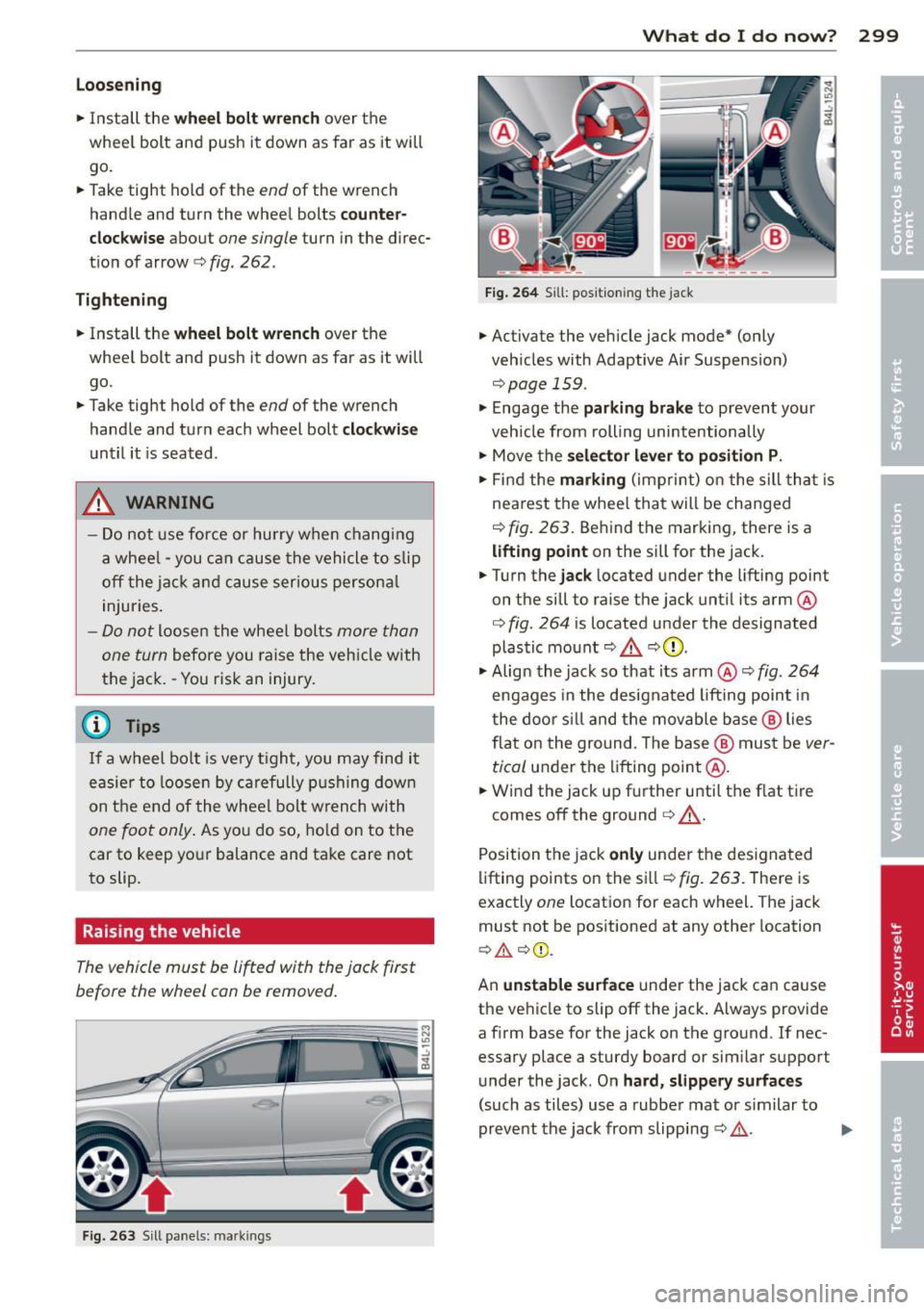
Fig. 263 Sill pane ls: m arkin gs
What do I do now? 299
Fig. 264 Sill: p ositioning the jack
• Activate the vehicle jack mode* (only
veh icles with Adaptive Air Suspension)
c::> page 159 .
• Engage the parking brake to prevent your
vehicle from rolling unintentionally
• Move the
selector lever to position P .
• Find the marking (imprint) on the sill that is
nea rest the whee l that will be changed
c::>fig. 263. Behind the marking, there is a
lifting point on the sill for the jack.
• Turn the
jack located under the lifting point
on the sill to raise the jack until its arm@
c::> fig. 264 is located under the designated
plastic mount
c::> .&. c::> Q) .
• Align the jack so that its arm@ c::> fig. 264
engages in the designated lifting point in
the door s ill and the movable base® lies
flat on the ground. The base@ must be
ver
tical
under the lifting point@.
• Wind the jack up further until the flat tire
comes off the ground
c::> .,& .
Position the jack only under the designated
lifting points on the sill
c::> fig. 263. There is
exactly
one locat ion for each whe el. The jack
must not be positioned at any other location
c::> .&. c::> Q).
An unstable surface under the jack ca n cause
the vehicle to slip off the jack. Always provide
a firm base for the jack on the ground . If nec
essary place a sturdy board or similar support
under the jack . On
hard, slippery surfaces
(such as tiles) use a rubber mat or similar to
prevent the jack from slipping
c::> ,&.. .,,.
Page 310 of 340
308 Emergen cy si tuation s
@ Tips
- The discharged battery must be properly
connected to the vehicle's electrical sys
tem. When jump starting or charging the
battery, never connect the negative
ground cable to the battery negative post because the battery manager sys
tem must be ab le to detect the battery 's
state of cha rge. A lways connect the neg
at ive g round c able to the neg ative
ground post o f the battery manager co n
trol uni t.
Use of jumper cables
Make sure to connect the jumper coble
clomps in exactly the order described below!
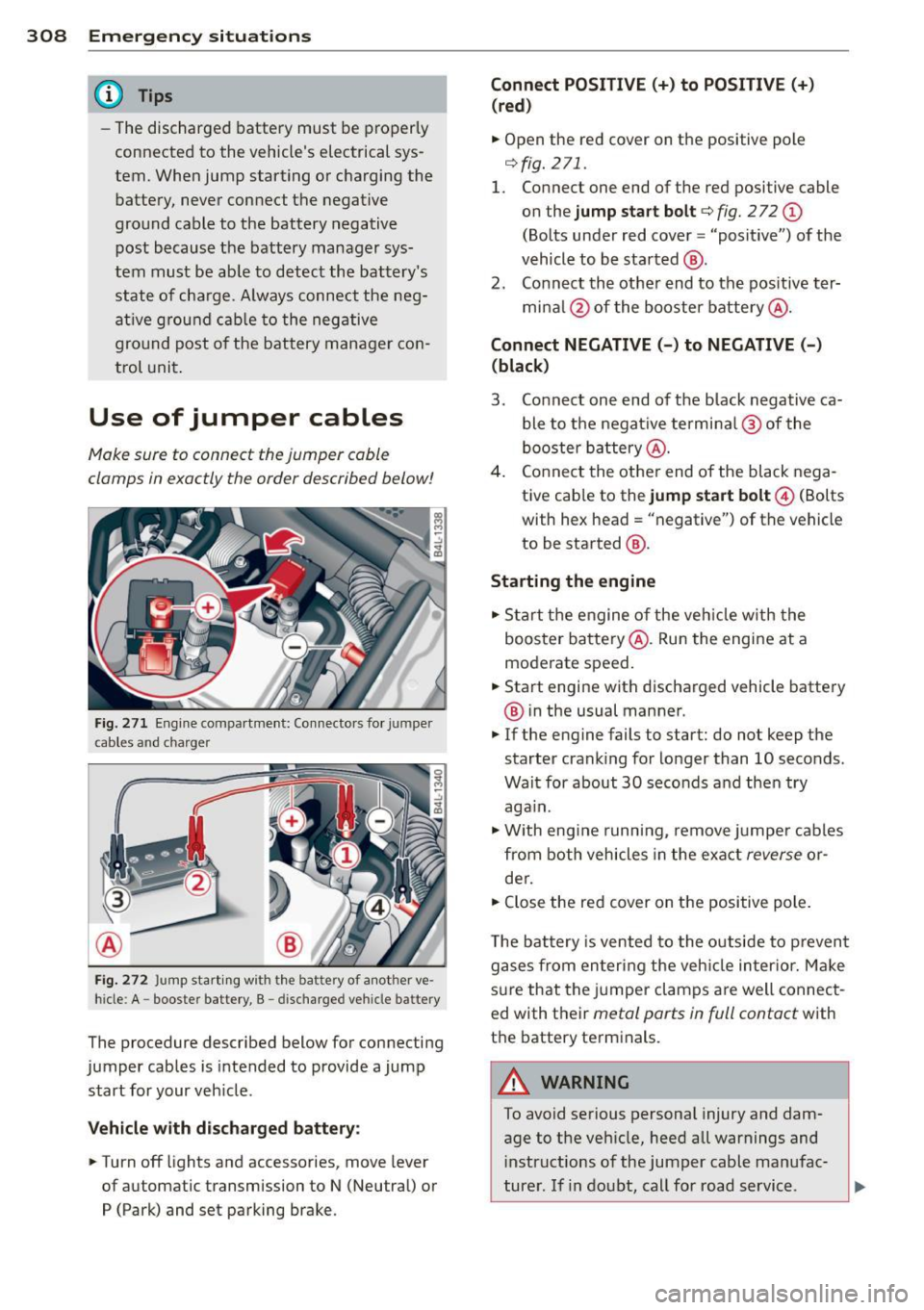
Fig. 271 Eng ine compartme nt: Co nnecto rs fo r jumper
cab les and c harger
®
Fi g. 272 Jump starting with the battery of another ve
hicle: A - booste r battery, B - discha rged vehicle battery
The procedure described below for connecting
jumper cables is intended to provide a jump
start for your veh icle.
Vehicle with discharged b attery :
.. Turn
off lights and accessories, move lever
of automatic transmission to N (Neutral) or
P (Park) and set parking brake. Connect POSITIVE(+) to POSITIVE(+
)
(red )
.. Open the red cover on the positive pole
¢fig. 271.
1. Connect one end of the red positive cable
on the
jump start bolt c::;, fig. 2 72 @
(Bolts under red cover = "positive") of the
vehicle to be started @.
2. Connect th e othe r end to the positive ter-
mi na l@ of the booster batte ry @ .
Connect NEGATIVE (-) to NEGATIVE (-)
(black )
3. Connect one end of the b lack negative ca
ble to the negat ive termi na l@ of the
booster ba ttery @.
4 . Connect the othe r end of the black nega
tive cab le to the
jump start bolt@ (Bolts
with hex head= "negative") of the vehicle
to be started @.
Sta rting the engine
.. Start t he engine o f the veh icle w ith the
booste r ba ttery @. Run the engine at a
moderate speed .
.. Start engine with discharged vehicle battery
@ in the usual manner.
.. If the engine fails to start: do not keep the
starter crank ing for lo nger than 10 seconds.
Wait for about 30 seconds an d the n try
again.
"" With engine running, remove j umpe r cab les
from both vehicles in the exact
reverse o r·
de r .
.. Close the red cover on the positive pole .
T he battery is vente d to the outside to p reven t
gases from entering the veh icle inter ior. M ake
s u re that the j umper clamps are well connec t
ed with their
metal ports in full contact with
the battery term inals.
A WARNING
-
To avoid serious persona l injury and dam-
age to the veh icle, h eed all warnings and
i nstructions of the jumper cable ma nufac-
turer. If in doubt , call for road service. ,..
Page 324 of 340
322 Index
Alcantara Cleaning 247
All-wheel drive . ........... .... .... . 228
Winter tires
Alternator 288
Malfunction . . . . . . . . . . . . . . . . . . . . . . . 31
Ambience lighting Lighting profiles .......... .... .... .. 62
Anti-freeze
refer to Engine coolant system ....... 264
Anti-lock brake system ...... .. .. .. .. . 224
Warning/indicator lights . . . . . . . . . 16, 18
Anti-slip regulation ........ .. .. .... . 224
Warning/indicator lights ... .. .. .. .. .. 16
Anti-theft systems Anti-theft alarm system . . . . . . . . . . . . . SO
Electronic immobilizer ............. .. 40
Approach/departure angle . .. .. .. .. .. . 237
Ashtray . .. ... ............ .. .. .. .. .. 87
Asterisk What does it mean when something is
marked with an asterisk? . . . . . . . . . . . . . . 6
Audi braking guard ....... .. .. .. .. .. . 127
Error messages .............. .... . 128
Settings . . . . . . . . . . . . . . . . . . . . . . . . . 128
Status messages . . . . . . . . . . . . . . . . . . 128
Switching on and off ...... .. .. .. .. . 128
Audi Service Repair Manuals and Litera-
ture .. .. .. .. ............. .. .. .... . 316
Auto -Check Control . . . . . . . . . . . . . . . . . . 30
Automatic belt retractor ..... .... ... . 178
Automatic mode
Four-zone automatic comfort air condi-
tioning ........................... 99
Automatic Shift Lock (ASL) . . . . . . . . . . . 138
Automatic transmission ..... .. .. .... . 137
Automatic Shift Lock (ASL) . .. .. .. .. . 138
Driving .. ................. .. .... . 139
Emergency mode .......... ... .. .. . 141
Emergency release ......... ... .. .. . 141
Hill descent control ........... .. ... 140
Ignition key safety lock ...... .. .. .. . 105
Kick-down .. ... .......... .. .. .. .. . 141
Manual shift program ......... .. .. . 140
Selector lever .................... . 13 7
Shift buttons . . . . . . . . . . . . . . . . . . . . . 140 AUTO mode
A/C climate controls ............ ... . 95
Auto Safety Hotline ............. .... 171
Average speed . . . . . . . . . . . . . . . . . . . . . . . 24
Avoid damaging the vehicle ........ ... 234
B
Bass box
Battery .... .. .. .. .. ........... ... .
Battery location .. ................ .
Charging ...... .. .. ... ........... .
Important warnings when working on
the battery .... .. ............. ... . 295
268
269
270
269
Jump starting .. .. ... .......... .. .. 307
Low ..... ..... ............... .... 229
Replacing the battery .............. 272
State of charge ................... . 229
Voltage ... .... ................... . 35
Winter operation . ............. .... 268
Working on the battery .. .... ... .. .. 269
Before driving ..... ............. .... 164
Blended gasoline .. ................ . 249
Booster seats . . . . . . . . . . . . . . . . . . . . . . 212
Brake fluid
Changing the brake fluid ............ 268
Checking the brake fluid level ..... ... 267
Reservoir ... .. .. .. .............. . 267
What is the correct brake fluid level? .. 267
What should I do if the brake fluid warn-
ing light comes on? ...... ...... .. .. 267
Brake light Defective . . . . . . . . . . . . . . . . . . . . . . . . . 23
Brake system .... ... .............. .. 267
Anti-lock brake system . . . . . . . . . . . . . . 18
Brake assist system ................ 224
Brake booster .... ............. .... 226
Brake fluid . ..... ................ . 267
Brake fluid specifications for refill and re-
placement .... .. ............. .... 268
Brake pads .. .. .. ..... ........... . 232
General information .............. . 226
How does moisture or road salt affect the
brakes? . .. .. .. .. ............. .. .. 226
Malfunction . . . . . . . . . . . . . . . . . . . . . . . 32
Parking brake .. .. ... .......... .. .. 109
Warning/indicator lights ............. 19
Worn brake pads symbol . . . . . . . . . . . . . 36
Page 325 of 340
Braking guard
re fer to Audi braking gua rd ... .. .. .. . 127
Break- in pe riod ............ .... .. ... 232
Brake pads . ............. .. .. .. ... 232
T ires .... .. .. ............. .. .. ... 232
Breakoverang le ............ ... ... .. 237
Bulbs ..... .. .. .. .. .. .... ... .. .. ... 305
B umper cover
C au tion when parking near a parking ba r-
rier or c urb ... .... .... ... .. .. .. ... 110
C
Ca lifo rnia Proposit io n 65 Wa rning .. .. . 258
B att ery specific .......... .. .. .. .. . 270
Capac it ies . . . . . . . . . . . . . . . . . . . . . . . . . 315
Car - Systems Ambience lighting ........ .. .. .. .. .. 62
Lighting prof iles .......... .. .. .. .. .. 62
Carbon parts Clean ing . . . . . . . . . . . . . . . . . . . . 246, 247
Care ...... ... ...... ............. .. 24 4
Cargo area
refer to Load ing the luggage compart-
ment .. .. .. .... ... .. ... ... .. .. .. . 170
Cargo floor . ... .... .... ... .. .. .. .... 83
Ca rgo net ...... .............. ... ... . 81
Cata lytic converter ......... .. .. .. .. . 233
Center armrest Cup holder . . . . . . . . . . . . . . . . . . . . . . . . 78
Storage compartment . . . . . . . . . . . . . . . 78
Cente r console in rear ....... .. .. .. .. .. 79
Centra l locking
Emergency locking ........ .. .. .. .. .. 45
Panoramic slid ing su nroof ...... . ... .. SS
Certification . . . . . . . . . . . . . . . . . . . . . . . 319
C hanging a flat tire ......... .. .. .. .. . 297
Changing a w heel .......... .. .. .. .. . 297
Changing engine o il ..... ... .. .. .. .. . 263
Chass is
refer to Adaptive Air Suspe nsion . lSS, 157
CHECK button ............. .... .. .... 12
C hec king
Eng ine coolant leve l .... ... .. .. .. .. . 265
Checking tire pressure ......... .... .. 279
Inde x 323
Child rest raints
Danger of using child restraints in the
f ront seat . . . . . . . . . . . . . . . . . . . . . . . . 185
Where can I get additional informat ion
about child restraints and the ir use? .. 223
Child rest rain t system anchors . ... .. .. 217
Child safety ....... .. ............... 204
Co nve rtib le loc kin g retractor ..... .. .. 214
G ui dance fixtures for lower ancho rages 219
Impo rtant sa fe ty inst ructions for using
c hi ld safety seats ... . .. ..... ... .. .. 207
Impo rtant t hings to know when driving
with children . ...... .. .. ..... ... .. 204
Installing a ch ild restra int using the
LATCH system .. .. ................. 220
Mounting and releasing the anchorage
hook . ...... .. .... .......... ..... 220
T ether anchors .... ............... . 221
T ether st raps .. .. .... ........... .. 221
Child safety lock rear doors (power) . . . . . . . . . . . . . . . . . . 48
Child safety seats .... . .. ..... ... .. .. 210
Booster seats . ..... . .. .. ..... ... .. 212
Convertib le child seats ............. 211
Convertib le locking retractor ....... .. 214
Danger of using child restraints in the
front seat . . . . . . . . . . . . . . . . . . . . . . . . 18S
How do I properly install a child safety
seat in my veh icle? ............. .... 20 7
Infan t seats . .. .. .... ............. 210
Installing . .. .. .. ............... .. 214
L ATCH system . ...... .. .. ..... ... .. 220
Safety instr uctions . .. .. ..... ... .. .. 207
Un used safety be lts on the rear seat 209
Child sea ts
L owe r anchorages .... ......... .. .. 218
Cleaning ......... .. ..... .......... 244
Climate control . ..... . .. .. ..... ... .. . 92
Synchroni zing .. ...... ............. . 93
Warm and co ld . .. ............. .. .. . 92
Climate controls Air conditioner on/off ... .... ... .. .. . 94
Air distrib ution ..... . .. ..... ... .. .. . 9S
Air out lets .. .. .. ................. . 97
Air out lets (rear) . ................. . 97
Air recircu lation .. .. ........... .... . 96
AUTO (standard sett ing) .. .. ... ... .. . 9S
Bas ic sett ings .. .. .. ..... .......... 100
•
•
Page 331 of 340
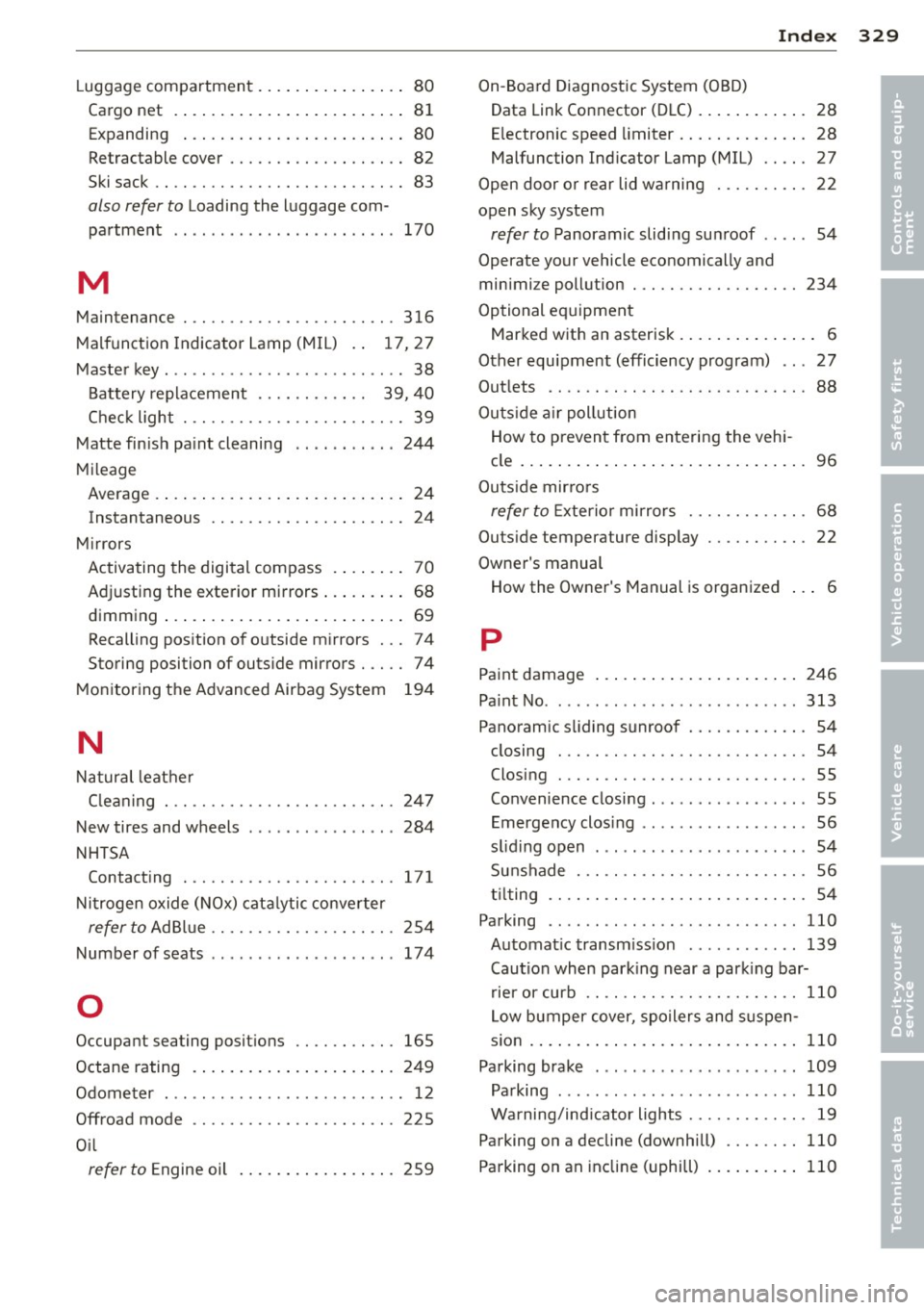
Index 329 ____________________________ ...:.:..:.=.:::.::.:
Luggage compartment ... ... .. .. .. .. .. 80
Cargo net . ..... .. .... ... .. .. .. .... 81
Expanding ..... ...... ... .. .. .. .. .. 80
Retractable cover . . . . . . . . . . . . . . . . . . . 82
Ski sack .. ............... ...... .... 83
also refer to Loading the luggage com-
pa rtment
170
M
M'
aintenance .............. .... .. ... 316
M alfunction Indicator Lamp (MIL) . . 1 7, 2 7
Master key . . . . . . . . . . . . . . . . . . . . . . . . . . 38
B attery rep lacement . . . . . . . . . . . .
39, 40
Chec k light . .. .. ......... .. .. .. .... 39
Matte fin is h pa int cleaning .. .. .. .. .. . 244
M ileage
Average .... .. .. ...... ... .. .. .. ....
24
Instantaneous . . . . . . . . . . . . . . . . . . . . . 24
Mir rors
Activa ting the digi tal compass . ... ....
70
Ad justi ng the exterior mi rrors ... .. .. .. 68
d ' . 1mm 1ng ... .. .. .. .... ... .. .. .. .... 69
Recalling pos it ion of outside m irrors . .. 74
Storing position of outs ide mirrors . .. .. 74
M on itoring the Advanced Airbag Sys tem 194
N
N atural leat her
C le an ing
New tires and wheels
NHTSA
247
284
Contact ing . ............. .... .. ...
171
N it rogen o xide (NOx) cata lytic converter
refer to Ad Blue ........... .... .. .. . 254
Number of seats ................. ... 174
0
Occupant seating posit io ns 165
Octane rating . .. .. ..... ... .. .. .. ... 24 9
Odome ter . . . . . . . . . . . . . . . . . . . . . . . . . .
12
Offroad mode ............. .... .. ... 225
O il
refer to Engine oil ..... ... .. .. .. .. . 2 59
On-Boa rd D iagnost ic System (O BD)
Data Link Connector (D LC) .... ... .. .. . 28
E lectronic speed limiter . ..... ... .. .. . 28
Malfunction Ind icator Lamp (MIL) .. .. .
27
Open door or rear lid wa rning ..... .. .. . 22
open sky system
refer to Panoramic slid ing su nroof ..... 54
Operate your vehicle economically and
minimi ze poll ution . .. ...............
234
Optional eq uipment
Mar ked with an asterisk . . . . . . . . . . . . . . . 6
Other equipment ( efficiency program) .. .
27
Out lets .... .. .. .. .. .. ........... .. . 88
Outs ide a ir pollution
How to preven t from entering the vehi-
cle .. ... .. .. .... .. . .. .. ..... ... .. .
96
Outs ide mirro rs
refer to E xte rior mirrors . . . . . . . . . . . . . 68
Outs ide temperature disp lay ...... .. .. . 22
Owner's manual How the Owner 's Manual is organized ...
6
p
Pa int damage ....... . .. .. ..... ... .. 246
Pa int No .... .. .. .. .. . .. .... .... .. .. 313
Panoramic s liding sunroof ............ . 54
closing ... .. .. .. ... ............ .. . 54
Closing ... .. .. .. ................. . 55
Convenience closing . . . . . . . . . . . . . . . . . 55
E mergency clos ing .. .......... .... ..
56
l'd '
s I ing open . . . . . . . . . . . . . . . . . . . . . . . 54
Sunshade . .. .. .. ... ............ .. .
56
tilt ing .. .. .. .. .. .. . .. .......... .. . 54
Parking .. .. .. .. .. .. . .. .... .... .. ..
110
Automat ic transm iss ion ........... . 139
Caution when par king near a park ing bar
r ier or curb . . . . . . . . . . . . . . . . . . . . . . .
110
Low bumper cover, spo ilers and suspen -
s io n .. .. .. .. .... .. . .. ... .... ... . .
110
Parking brake ...... ............... . 109
Parking . . . . . . . . . . . . . . . . . . . . . . . . . . 110
Wa rning/ind icator lights ........ .... . 19
Parking on a decline (downh ill) ........ 110
Parking on an incline (uphill) ... ... .. .. 110
•
•