seat adjustment AUDI Q7 2014 Owner´s Manual
[x] Cancel search | Manufacturer: AUDI, Model Year: 2014, Model line: Q7, Model: AUDI Q7 2014Pages: 340, PDF Size: 85.02 MB
Page 166 of 340
164 Driving Safel y
Driving Safely
General notes
Safe driving habits
Please remember -safety first!
This chapter contains important information,
tips, instructions and warnings that you need
to read and observe for your own safety, the
safety of your passengers and others . We have
summarized here what you need to know
about safety belts, a irbags, ch ild restra ints as
well as child safety. Your safety is for us
priori
ty number 1.
Always observe the info rmat ion
and warn ings in th is sect ion -fo r yo ur own
safety as well as that of your passengers .
The information in this se ction app lies to all
model ve rsions of your veh icle . Some of the
feat ures desc ribed in this sec tions may be
standard equipment on some models, or may
be optional equipment on others . If you are
not sure, ask your authorized Aud i dealer.
A WARNING
- Always make sure that you follow the in
struct ions and heed the WARNINGS in
this manual. It is in your interest and in
the inte rest of you r passengers.
- Always keep all of the Owner's Literature
man uals in your Audi when you lend or
sell your veh icle so that this impo rtant
information will a lways be availab le to
the drive r and pas sengers.
- Always keep the Owner's Literature han
dy so tha t you can find it easily if yo u
have ques tions.
Safety equipment
The safety features are part of the occupant
restraint system and work together to help
redu ce the risk of injury in a wide variety of
accident situations.
Your safety and the safety of you r passenge rs
should not be left to chance. Advances in
technology have made a varie ty o f fea tures
avai la bl e to he lp re duce the risk of inj ury in an accident
. The following is a list of just a few of
the safety features in your Audi:
- sophis tic ated s afety be lts for d rive r and a ll
passenger sea ting pos it ions,
- be lt te nsione rs fo r th e fro nt sea ts a nd the
ou ter sea ting posit ions in the second row
seating,
- be lt h eight adjustment fo r th e front sea ts
an d the o ute r seat ing pos itions in the sec
ond row seating,
- he ad restra ints for e ach sea ting pos ition,
- fro nt airbags,
- side airbags in the fro nt seats and the outer
seating positions in the second row seat ing*,
- side curta in ai rbags,
- specia l LATCH anchorages for child re-
st raints,
- ad justab le steering colum n.
These individual safety features, can work to gether as a system to he lp protect you and
your passengers in a wide range of accidents .
These features cannot work as a system if
they are not always correctly adjusted and cor rectly used .
Safety is everybody's responsibil ity!
Important things to do before driving
Safety is everybody 's job! Vehicle and occu
pant safety always depends on the informed
and careful driver.
Fo r yo ur safety and the safety of your passen
gers,
before driving always:
.. Ma ke s ure t hat all lights and sign als are op
erati ng correctly .
.. Make s ure t hat the tire pressure is correct.
.. Make s ure that all windows are clean and af
ford good vis ibility to the outs ide.
.. Secure all luggage and other items carefu lly
¢ page 88.
.. Make s ure that nothing can inte rfere with
the peda ls.
.. Adj ust fron t seat, head restraint and m irrors
correc tly fo r you r height . .,.
Page 169 of 340
unfolds with great force in the blink of
an eye .
- Always make sure that there are at least
10 inches (25 cm) between the front
passenger 's breastbone and the instru
ment panel.
- Each passenger must always sit on a seat of the ir own and properly fasten and
wear the safety belt be longing to that
seat .
- Before driving, always adjust the front
passenger seat and head restra int prop
erly .
- Always keep your feet on the f loor in
front of the seat. Never rest them on the
seat, instrument panel, out of the win dow, etc. The airbag system and safety
belt w il l not be ab le to protec t you prop
er ly and can even increase the risk of in
jury in a crash .
- Never drive with the backrest reclined o r
ti lted far back! The farther the backrests
are ti lted back , the greater the risk of in
jury due to incorrect positioning of the
safety belt and improper seating posi
t ion.
- Children must always ride in child safety
seats
c> page 204 . Special precautions
apply when installing a child safety seat
on the front passenger seat
c> page 183 .
Proper seating positions for passengers
in rear seats
Rear seat passengers must sit upright with
both feet on the floor consistent with their
physical size and be properly restrained whenever the vehicle is in use .
To reduce the risk of injury caused by an incor
rect seat ing pos ition in the event of a sudden
brak ing maneuve r or an acc ident , your pas
se ngers on the rea r bench seat must always
observe the fo llow ing :
~ If there are passengers in the rear seat, fold
the head rest ra ints up on the occupied seats
or slide the center head restrain t upward at
least to the next notch
c> page 78 .
Drivin g Sa fely 167
~ Make sure that the seatback is secure ly
latch ed in the upright posi tion
c> page 80.
~ Keep both feet flat in the footwell in front of
the rear seat .
~ Fasten and wear safety belts proper ly
<=> page 178 .
~ Make sure that children are always properly
restrained in a child restraint that is appro
pria te for the ir s ize and age
c> page 204.
A WARNING
Passengers who are imp roperly seated on
the rea r seat can be seriously inj ured in a
crash .
- Each passenger must always si t on a seat
of their own and properly fasten and
wear the safety belt belonging to that
seat.
- Safety belts only offer maximum protec
tion when the seatback is sec urely latch
ed in the upright position and the safety
bel ts are properly posit ioned on the
body . By not sitting upright, a rear seat
passenger increases the risk of personal
in ju ry from improperly positioned safety
be lts!
- Always adjust the head rest raint p roperly
so that it can give maximum protection .
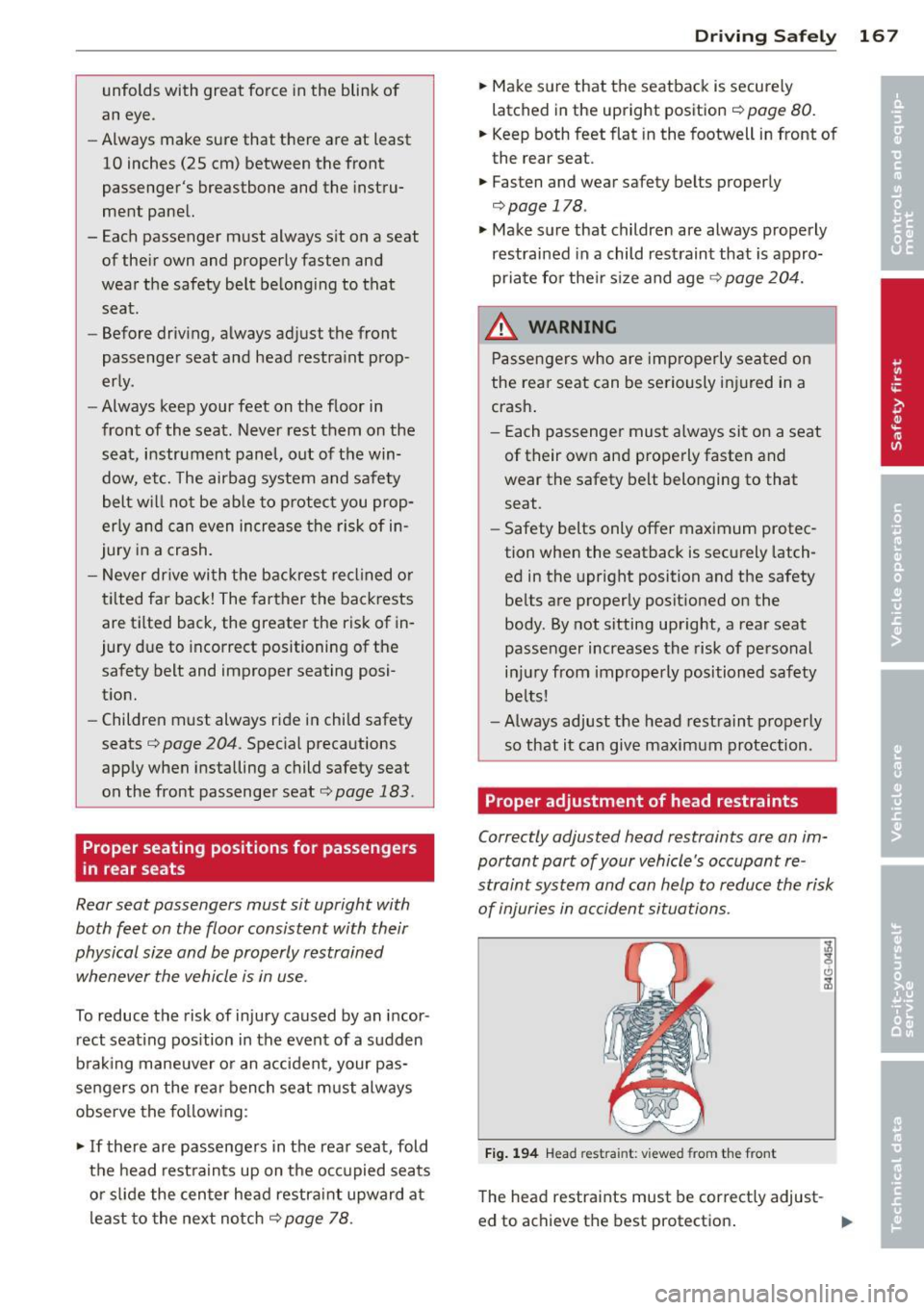
Proper adjustment of head restraints
Correctly adjusted head restraints are an im
portant port of your vehicle's occupant re
straint system and can help to reduce the risk
of injuries in accident situations .
Fig. 1 94 Head restr ain t: v ie wed from th e front
The head restraints must be correct ly adjust-
ed to achieve the best protectio n. ..,.
Page 181 of 340
the wrong buckle will reduce safety belt
effectiveness and can cause serious per
sonal injury.
- A passenger who is not properly restrain
ed can be seriously injured by the safety
belt i tself when it moves from the stron
ger parts of the body into critical areas
like the abdomen .
- Always lock the convertible locking re
tractor when you are secur ing a child
safety seat in the vehicle~
page 216.
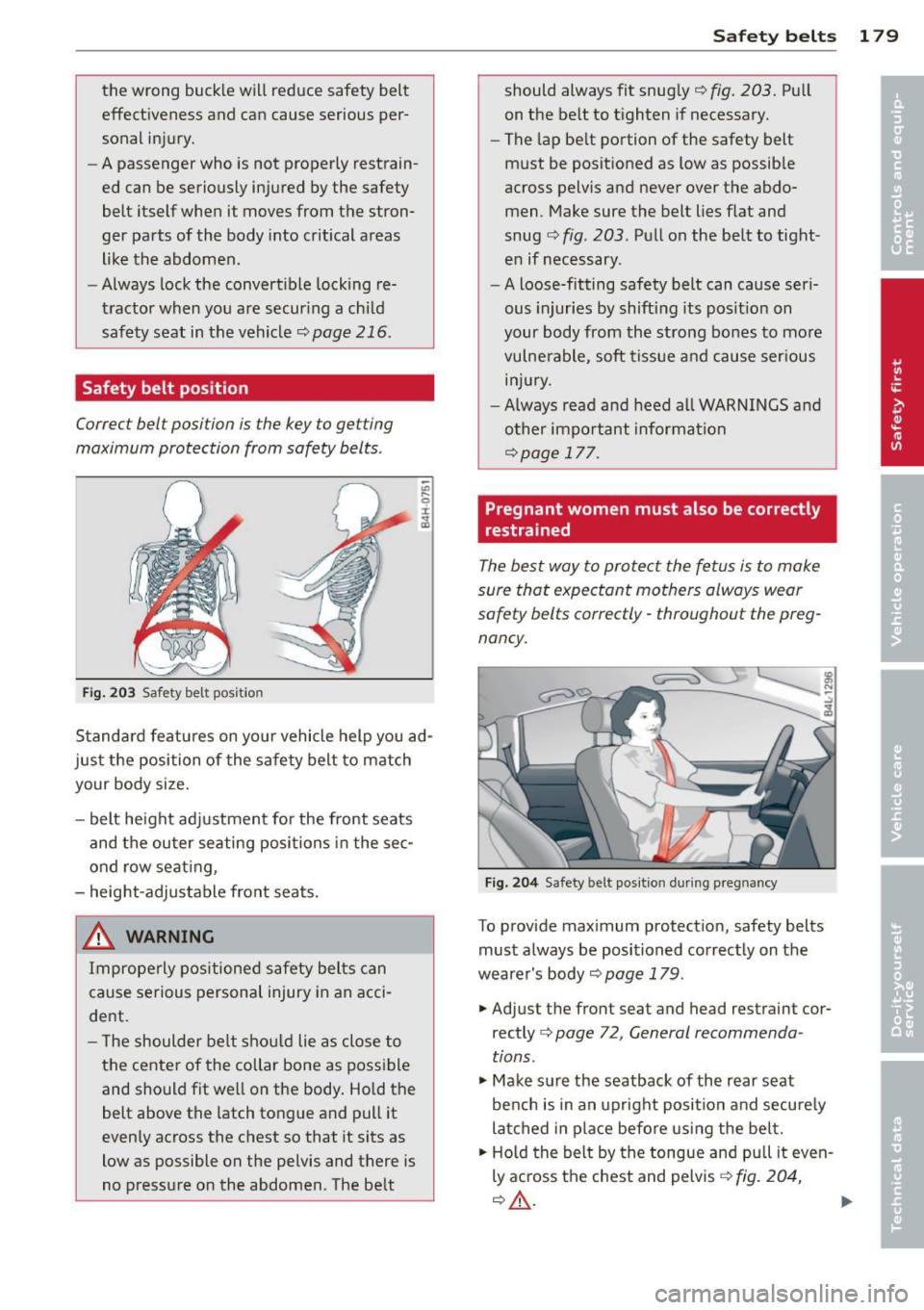
Safety belt position
Correc t bel t posi tion is the key to ge tting
maximum protection from safety belts .
Fig. 203 Safety belt pos it io n
Standard features on your vehicle help you ad
just the position of the safety belt to match
your body size.
- belt height adjustment for the front seats
and the outer seating positions in the sec
ond row seating,
- height-adjustable front seats.
A WARNING
Improperly positioned safety belts can
cause serious personal injury in an acci
dent.
-
- The shoulder belt should lie as close to
the center of the collar bone as possible
and should fit well on the body. Ho ld the
belt above the latch tongue and pull it
evenly across the chest so that it sits as
low as possible on the pelvis and there is
no pressure on the abdomen . The belt
Safety belts 179
should always fit snugly= fig. 203. Pull
on the belt to tighten if necessary.
- The lap belt portion of the safety belt
must be positioned as low as possible
across pelvis and never over the abdo
men . Make sure the belt lies flat and
snug ¢
fig. 203 . Pull on the belt to tight
en if necessary .
- A loose-fitting safety belt can cause seri
ous injuries by shifting its pos ition on
your body from the strong bones to more
vulnerable , soft tissue and cause serious
injury.
- Always read and heed all WARNINGS and
other important information
¢ page 177 .
Pregnant women must also be correctly
restrained
The best way to protect the fetus is to make
sure that expectant mothers always wear
saf ety belts correctly -throughout the preg
nancy.
Fig. 204 Safety belt pos ition du ring pregnan cy
To provide max imum protection, safety belts
must always be positioned correctly on the
wearer's body
¢ page 179 .
... Adjus t the fron t seat and head restra in t cor
rectly ¢
page 72, General recommenda
tions .
.,. Make sure the seatback of the rear seat
bench is in an upright position and securely
latched in place before using the belt.
... Hold the belt by the tongue and pu ll it even
ly across the chest and pelvis¢
fig. 204,
=A . ~
Page 185 of 340
Airbag system Important things to know
Importance of wearing safety belts and
sitting properly
Airbags are only supplemental restraints. For
airbags to do their job , occupants must al
ways properly wear their safety belts and be
in a proper seating position.
For your safety and the safety of your passen
gers, before driving off, always:
"" Adjust the driver's seat and steering wheel
properly
¢ page 165,
"" Adjust the front passenger's seat properly
¢ page 73 ,
""Wear safety be lts properly r::::> page 177,
""Always properly use the proper child re-
straint to protect chi ldren
r::::> page 204.
In a collision, airbags must inflate within the
blink of an eye and with considerable force .
The supplemental airbags can cause injuries if
the driver or the front seat passenger is not
seated properly . T herefore in order to help the
a irbag to do its job, it is important, both as a
driver and as a passenge r to s it properly at all
times.
By keeping room between your body and the
steer ing whee l and the front of the passenger
compartment, the airbag can inflate fully and
comp lete ly and provide supp lemental protec
tion in certain frontal collisions
r::::> page 165,
Proper occupant seating positions.
F or detai ls
on the operation of the seat adjustment con
trols ¢
page 73.
It's especially important that children a re
properly restrained
r::::> page 204.
There is a lot that the driver and the passen
gers can and must do to help the individual
safety features installed in your Aud i work to
gether as a system.
Prope r seat ing pos ition is important so that
the front airbag on the driver side ca n do its
job. If you have a physical impa irment or con-
A irbag system 183
dition that prevents you from sitting properly
on the driver seat with the safety belt properly
fastened and reaching the pedals, or if you
have concerns with regard to the function or
operation o f the Advanced Airbag System,
please contact your author ized Audi dealer or
qualified workshop, or call Audi Customer Re
l ations at 1-800-822-2834 for poss ible modi
ficat io ns to your veh icle.
When the airbag system dep loys, a gas gener
ator will fill the a irbags, break open the pad
ded covers, and inflate between the steer ing
whee l and the dr iver and between the instru
ment panel and the front passenger. The a ir
bags will deflate immediately after dep loy
ment so that the front occupants can see
through the windshield again witho ut inter
ruption .
A ll of th is takes place in the blink o f an eye, so
fast that many people don't even realize that
the airbags have deployed. The airbags a lso
inflate with a great dea l of force and nothing
should be in their way when they deploy.
Front a irbags in combinat ion with properly
worn safety belts slow down and lim it the oc
cupant's forward movement . Together they
help to prevent the driver and front seat pas
senger from h itti ng pa rts of the inside of the
vehicle while reducing the forces acting on the
occupant during the crash . In this way they
help to reduce the risk of injury to the head
and upper body in the crash. Airbags do not
protect the arms or the lower parts of the
body.
Both front airbags will not inflate in all fronta l
collisions . The triggering of the airbag system
depends on the vehicle de ce lerat ion rate
caused by the collision and regis te red by the
elec tron ic control unit. If th is rate is below
the reference value programmed into the con
trol unit, the airbags will not be trigge red,
even though the car may be bad ly damaged as
a res ult of the co llision . Ve hicl e damage, re
pair costs or even the lack of ve hicle damage
is not necessarily an indication of whether an
airbag should inflate or not . •
•
Page 192 of 340
190 Airbag sys tem
-Always make sure the forward-facing
seat has been des igned and certified by
its manufacturer for use on a front seat
with a passenger front and side airbag .
- Never put the forward-facing child re
straint up aga inst or very near the instru
ment panel.
- Always move the passenger seat into its
rearmost position in the seat's fore and
aft adjustment range, as far away from
the a irbag as poss ible, before insta lli ng
the fo rward-facing chi ld restraint. The
b ackres t must be adjus ted to an upr igh t
posit io n.
- Make su re that the
PASSENGER AIR BAG
OFF
light co m es on and s tays on all the
t ime whenever the ignition is switched
on.
Advanced Airbag System components
The front passenger seat in your vehicle has a lot of very important parts of the Advanced
Airbag System in it. These parts include the
weight-sens ing mat, sensors, wiring, brack
ets, and more . The fu nction of the system in
the front passenger seat is checked by the
e lectronic control u nit when the ignit ion is on.
The control unit mo nitors the Advanced Air
bag Sys tem and turns the airbag indicator
light on when a ma lfunction in the system
components is detected . The function of the
ai rbag ind icator light is described in greater
detai l below. Because the front passenger
seat contains important parts of the Ad
vanced A irbag System, you must take care to
prevent it from be ing damaged . Damage to
the seat may prevent the Advanced A irbag for
the front passenger seat from doing its job in
a cra sh .
The front Advanced Airbag System
consists of the following:
- Crash senso rs in the front of the veh icle that
measu re ve hicle ac celera tion/de ce le ra ti on
to provide info rm ation to the Advanced Air
bag System abo ut the severity of the crash . -
An elect ronic contro l unit, with integrated
crash sensors for front and side impacts .
The control un it "decides" whether to fi re
the front a irbags based on the informat ion
received from the crash sensors. The contro l
un it also "decides" whether the safety belt
prete nsioners shou ld be act ivated .
- An Advanced A irbag w ith gas generator for
the dr iver inside the stee ring wheel hub .
- An Advanced A irbag w ith gas generator in
side the instrument panel for the front pas
senge r.
- A we ight-sensing mat under the up ho lstery
padding of the front passenger seat cushion
that measures the total weight on the seat .
The informat io n registe red is sent continu
ou sly to the elec troni c con tro l unit to regu
la te deployment of the front Advanced Air
bag on the passenger side .
- An airbag monitoring sys tem and in dicator
light in t he instr ument cluster
~ page 194.
-The PASSENGER AIR BAG OFF ligh t comes
on and sta ys on in the cen ter o f th e instr u
ment panel
~ page 194, fig . 210 and tells
you whe n the front Advanced Airbag on the
passenger side has been tu rned off .
- A sensor below the safety be lt latch for the
front seat passenger to meas ure the tension
on the safety be lt . The tension on the safety
be lt and the weight registered by the
weight-sensing mat he lp the control unit
"decide" whether the front airbag for the
front passenger seat should be turned off or
not
~ pag e 185, Child restraints on th e
front seat -some important things to
know.
- A senso r in the safety belt latch fo r th e d riv
er a nd fo r the front sea t passenger tha t
senses w het he r th at safety bel t is latched or
no t and transmi ts this information to the
electronic control unit.
A WARNING
Damage to the fr ont passenger seat can
p revent the front airbag from work ing
properly.
-
Page 207 of 340
-Always install rear-facing child safety
seats on the rear seat.
- If you must install a rearward facing
child safety seat on the front passenger
seat in exceptional circumstances and
the
PASSENGER AIR BAG OFF light does
not come on and stay on, immediately
install the rear-facing child safety seat in
a rear seating position and have the air
bag system inspected immediately by
your Audi dealer.
_& WARNING
If, in exceptional circumstances, you must
install a forward-facing child restraint on
the front passenger's seat:
- Always make sure the forward-facing
seat has been designed and certified by its manufacturer for use on a front seat
with a passenger front and side airbag.
- Always follow the manufacturer's in
structions provided with the child safety
seat or carrier.
- Always move the passenger seat into its
rearmost position in the seat's fore and
aft adjustment range, as far away from
the airbag as possible before installing
the child restraint. The backrest must be
adjusted to an upright position .
- Always make sure that the
PASSENGER
AIR BAG OFF
light comes on and stays
on all the time whenever the ignition is
switched on.
(D Tips
Always replace child restraints that were
installed in a vehicle during a crash. Dam
age to a child restraint that is not visible
could cause it to fail in another collision
situation.
Advanced front airbag system and children
Your vehicle is equipped with an "Advanced
Airbag System" in compliance with United
States Federal Motor Vehicle Safety Standard
Child Safety 205
(FMVSS) 208 as applicable at the time your
vehicle was manufactured.
The Advanced Airbag system in your vehicle
has been certified to meet the "low-risk" re
quirements for 3- and 6-year old children on
the passenger side and small adults on the driver side. The low risk deployment criteria
are intended to reduce the risk of injury
through interaction with the airbag that can
occur, for example, by being too close to the
steering wheel and instrument panel when
the airbag inflates . In addition, the system
has been certified to comply with the "sup
pression" requirements of the Safety Stand
ard, to turn off the front airbag for infants up
to 12 months who are restrained on the front
passenger seat in child restraints that are list
ed in the Standard.
Even though your vehicle is equipped with an
Advanced Airbag system, all children, espe cially those 12 years and younger, should al
ways ride in the back seat properly restrained
for their age and size. The airbag on the pas
senger side makes the front seat a potentially dangerous place for a child to ride . The front
seat is not the safest place for a child in a for
ward-facing child safety seat. It can be a very
dangerous place for an infant or a larger child
in a rearward-facing seat .
Advanced Airbags and the weight
sensing mat in the front seat
The Advanced Airbag System in your vehicle
detects the presence of an infant or child in a
child restraint on the front passenger seat us
ing the weight -sensing mat in the seat cush
ion and the sensor below the safety belt latch
on the front passenger seat that measures the
tension on the safety belt.
The weight -sensing mat measures total
weight of the child and the child safety seat
and a child blanket on the front passenger seat. The weight on the front passenger seat
is related to the design of the child restraint
and its "footprint", the size and shape of the
bottom of the child restraint as it sits on the ..,.
•
•
Page 210 of 340
208 Child Safety
&_ WARNING
Not using a child safety seat, using the
wrong child safety seat or improperly in
stalling a child restraint increases the risk
of serious personal injury and death .
-All vehicle occupants and especially chil
dren must always be restrained properly
whenever riding in a vehicle.
-
- An unrestrained or improperly restrain
ed child can be injured or killed by be
ing thrown against the inside of the ve
hicle or by being ejected from it during
a sudden maneuver or impact .
- An unrestrained or improperly restrain
ed child is at much greater risk of injury
or death by being struck by an inflating
airbag.
- Commercially available child safety seats
are required to comply with U.S. Federal
Motor Vehicle Safety Standard (FMVSS)
213 (in Canada CMVSS 213).
- When buying a child restraint, select
one that fits your child and the vehicle.
- Only use child restraint systems that
fully contact the flat portion of the
seat cushion. The child restraint must
not tip or lean to either side. Audi does
not recommend using child safety
seats that rest on legs or tube -like
frames . They do not provide adequate
contact with the seat.
-Always heed all legal requirements per
taining to the installation and use of
child safety seats and carefully follow
the instructions provided by the manu
facturer of the seat you are using.
- Never allow children under 57 inches
(1.45 meters) to wear a normal safety
belt. They must always be restrained by a
proper child restraint system. Otherwise,
they could sustain injuries to the abdo
men and neck areas during sudden brak
ing maneuvers or accidents.
- Never let more than one child occupy a
child safety seat . -
Never let babies or older children ride in
a vehicle while sitting on the lap of an
other passenger .
- Holding a child in your arms is never a
substitute for a child restraint system .
- The strongest person could not hold
the child with the forces that exist in
an accident. The child will strike the in
terior of the vehicle and can also be
struck by the passenger.
- The child and the passenger can also
injure each another in an accident.
- Never install rear-facing child safety
seats or infant carriers on the front pas
senger seat. A child will be seriously in
jured and can be killed when the passen
ger airbag inflates -even with an Ad
vanced Airbag System .
- The inflating airbag will hit the child
safety seat or infant carrier with great
force and will smash the child safety seat
and child against the backrest, center
armrest, door or roof .
-Always install rear-facing child safety
seats or infant carriers on the rear seat .
- Forward-facing child safety seats instal
led on the front passenger's seat can in
terfere with the airbag when it inflates
and cause serious injury to the child. Al
ways install forward-facing child safety
seats on the rear seat .
- If exceptional circumstances require the
use of a forward-facing child restraint on
the front passenger's seat, the child's
safety and well-being require that the
following special precautions be taken :
- Make sure the forward-facing seat has
been designed and certified by its man
ufacturer for use on a front seat with a
passenger front and side airbag.
-Always carefully follow the manufac
turer's instructions provided with the child safety seat or carrier.
- Always move the front passenger seat
into the rearmost position of the pas
senger seat's fore and aft adjustment range, and as far away from the airbag
Page 211 of 340
as possible before installing the child
restraint.
- Always make sure that nothing pre
vents the front passenger's seat from
be ing moved to the rearmost position
in its fore and aft adjustment range.
- Always make sure that the backrest is
in the upr ight position.
- Always buck le the child safety seat firmly
in place even if a child is not sitting in it.
A loose ch ild safety seat can fly around
dur ing a sudden stop or in a col lision .
- Always read and heed all WARNINGS
whenever using a child restrained in ave
hicle is being used¢
page 174, Safety
belts,¢ page 183, Airbag system
and
¢ page 204, Child Safety.
A WARNING
To reduce t he ris k of serious injury, make
sure that the
PASSENGER AIR BAG OFF
light comes on and stays on whenever a
child rest raint is installed on the front pas
senger seat and the ignition is switc hed
on.
- Take the child restraint off t he fro nt pas
senger seat and install it properly at one of the rear seat positions if the
PASSEN ·
GER AIR BAG OFF
light does not stay on.
- Have the airbag system inspected by
your authorized Aud i dealer immediate
ly.
Secure unused safety belts on the rear
seat
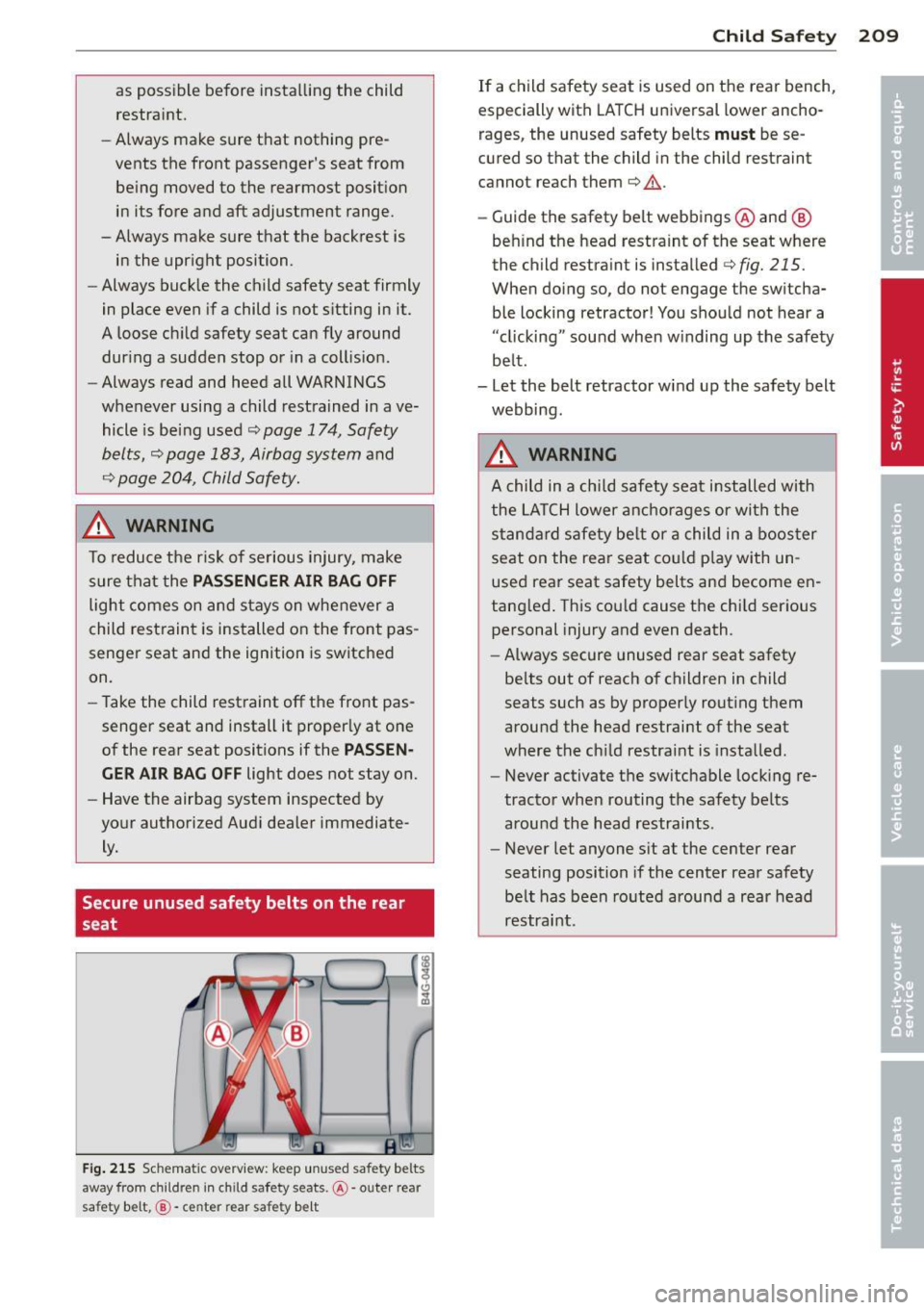
F ig. 21 5 Schematic overv iew : keep un used safety belts
away from children in child safety seats.@-oute r rear
safety belt,
@ -center rear safety belt
Child S afety 209
If a child safety seat is used on the rea r bench,
especially with LATCH universal lower ancho
rages, the unused safety belts
must be se
cured so that the child in the child restraint
cannot reach them¢&.
- Guide the safety belt webbings @and @
beh ind the head restraint of the seat where
the child restra int is insta lled ¢
fig. 215.
When doing so, do not engage the switcha
ble locking retracto r! You shou ld not hear a
"cl icking" sound when w inding up the safety
be lt .
- Let the belt retractor wind up the safety belt
webbing.
A WARNING
A child in a chi ld safety seat i nstalled with
the LA TCH lower ancho rages or with the
standard s afety be lt or a child in a boos ter
seat on the rea r seat co uld p lay with un
use d rea r seat safety belts and become en
tang led . This could cause t he chi ld ser ious
personal injury and even death.
- Always secure unused rear seat safety
be lts out of reach of children in child
seats such as by proper ly rout ing t hem
around the head restrai nt of the seat
where the ch ild restraint is installed.
- Never activate t he switchable l ock ing re
tracto r when routing the safety be lts
arou nd the head restraints.
- Never let anyone s it at the center rear
seating position if the center rea r safety
be lt has been routed around a rear head
restraint.
Page 214 of 340
212 Child Safety
to the backrest on the vehicle seat. Ad
just or remove the rear seat head restraint if it is difficult to install the
child seat with the head restraint in place
<=> page 78 . Install the head restraint
again immediately once the child seat is
removed. Driving without head restraints
or with head restraints that are not prop erly adjusted increases the risk of serious
or fatal neck injury dramatically.
- Always read and heed all WARNINGS
whenever using a child restrained in ave
hicle is being used<=>
page 174, Safety
belts,
<=> page 183, Airbag system and
i=> page 204, Important things to know.
A WARNING
If exceptional circumstances require the
use of a forward-facing child restraint on
the front passenger's seat, the child's safe
ty and well-being require that the follow ing special precautions be taken:
- Make sure the forward-facing seat has
been designed and certified by its manu
facturer for use on a front seat with a passenger front and side airbag.
-A lways follow the manufacturer's in
structions provided with the child safety
seat or infant carrier.
- Always move the front passenger seat in
to the rearmost position of the passen
ger seat's fore and aft adjustment range, and as far away from the airbag as possi
ble before installing the child restraint.
- Always make sure that nothing prevents
the front passenger's seat from being
moved to the rearmost position in its
fore and aft adjustment range.
- Always make sure the backrest is in an
upright position.
- Make sure that the
PASSENGER AIR BAG
OFF
light comes on and stays on all the
time whenever the ignition is switched
on.
- If the light does not stay on, perform the
checks
<=> page 194, Monitoring the Ad
vanced Airbag System.
-
- Take the child restraint off the front pas
senger seat and install it properly at one
of the rear seat positions if the
PASSEN
GER AIR BAG OFF
light does not stay on
whenever the ignition is switched on.
Booster seats and safety belts
Properly used booster seats can help protect
children weighing between about 40 lbs. and
80 lbs. (18 kg and 36 kg) who are less than 4
ft.
9 in . (57 inches/1 .45 meters) tall.
"' ....
"' 0 ±
o5
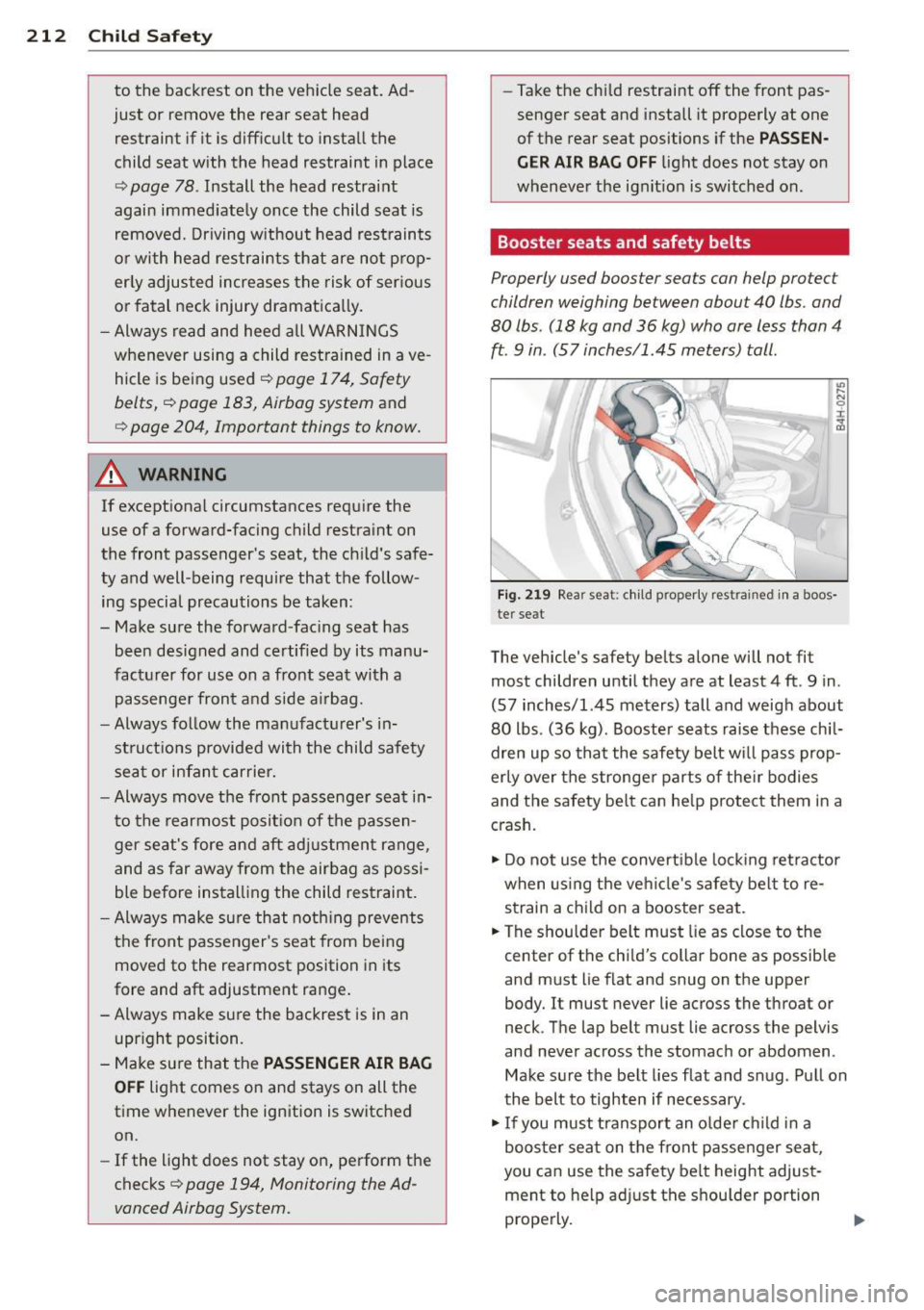
Fig. 219 Rear seat: c hild properly restrained in a boos
te r seat
The vehicle 's safety belts alone will not fit
most children until they are at least 4 ft. 9 in .
(57 inches/1.45 meters) tall and weigh about
80 lbs. (36 kg). Booster seats raise these chil
dren up so that the safety belt will pass prop
erly over the stronger parts of their bodies
and the safety belt can help protect them in a
crash.
.,. Do not use the convertible locking retractor
when using the vehicle's safety belt to re
strain a child on a booster seat.
.. The shoulder belt must lie as close to the
center of the child's collar bone as possible
and must lie flat and snug on the upper
body. It must never lie across the throat or
neck . The lap be lt must lie across the pelvis
and never across the stomach or abdomen .
Make sure the belt lies flat and snug. Pull on
the belt to tighten if necessary .
.,. If you must transport an older child in a
booster seat on the front passenger seat,
you can use the safety belt height adjust
ment to help adjust the shoulder portion
properly.
Page 217 of 340
and child against the backrest, center
armrest, door or roof.
- Always install rear-facing child safety
seats or infant carriers on the rear seat.
- Forward-facing child safety seats or in
fant carriers installed on the front pas
senger's seat may interfere with the de
ployment of the airbag and cause serious
injury to the child.
- It is safer to install a forward-facing
child safety seat on the rear seat .
- Always read and heed all WARNINGS whenever using a child restrained in ave
hicle is being used¢
page 204 . Special
precautions apply when installing a child
safety seat on the front passenger seat
¢ page 185, Child restraints on the front
seat -some important things to know.
A WARNING
Always take special precautions if you
must install a forward or rearward-facing
child restraint on the front passenger's
seat in exceptional situations:
-Whenever a forward or rearward-facing
child restraint is installed on the front
passenger seat, the
PASSENGER AIR
BAG OFF
light must come on and stay on
whenever the ignition is switched on.
- If the
PASSENGER AIR BAG OFF light
does not come on and stay on, perform
the checks described¢
page 194, Moni
toring the Advanced Airbag System.
- Take the child restraint off the front pas
senger seat and install it properly at one
of the rear seat positions if the
PASSEN
GER AIR BAG OFF
light does not stay on
whenever the ignition is switched on.
- Improper installation of child restraints
can reduce their effectiveness or even
prevent them from providing any protec
tion.
- An improperly installed child restraint
can interfere with the airbag as it de
ploys and seriously injure or even kill the
child.
Child Safety 215
- Always carefully follow the manufactur
er's instructions provided with the child
safety seat or carrier.
- Never place additional items on the seat
that can increase the total weight regis
tered by the weight-sensing mat and can
cause injury in a crash .
A WARNING
Forward-facing child restraints:
- Always make sure the forward-facing
seat has been designed and certified by its manufacturer for use on a front seat
with a passenger front and side airbag.
- Never put the forward-facing child re straint up, against or very near the in
strument panel.
- Always move the passenger seat into its rearmost position in the seat's fore and
aft adjustment range, as far away from
the airbag as possible before installing
the forward-facing child restraint. The
backrest must be adjusted to an upright
position.
- Make sure that the PASSENGER AIR BAG
OFF
light comes on and stays on all the
time whenever the ignition is switched
on .
A WARNING
Rearward-facing child restraints:
- A child in a rearward-facing child safety
seat installed on the front passenger
seat will be seriously injured and can be killed if the front airbag inflates -even
with an Advanced Airbag System.
- The inflating airbag will hit the child
safety seat or infant carrier with great
force and will smash the child safety seat
and child against the backrest, center
armrest, door or roof .
-Always be especially careful if you must
install a rearward facing child safety seat
on the front passenger seat in exception-
al circumstances. .,.
•
•