ECU AUDI Q7 2014 Owner´s Manual
[x] Cancel search | Manufacturer: AUDI, Model Year: 2014, Model line: Q7, Model: AUDI Q7 2014Pages: 340, PDF Size: 85.02 MB
Page 209 of 340
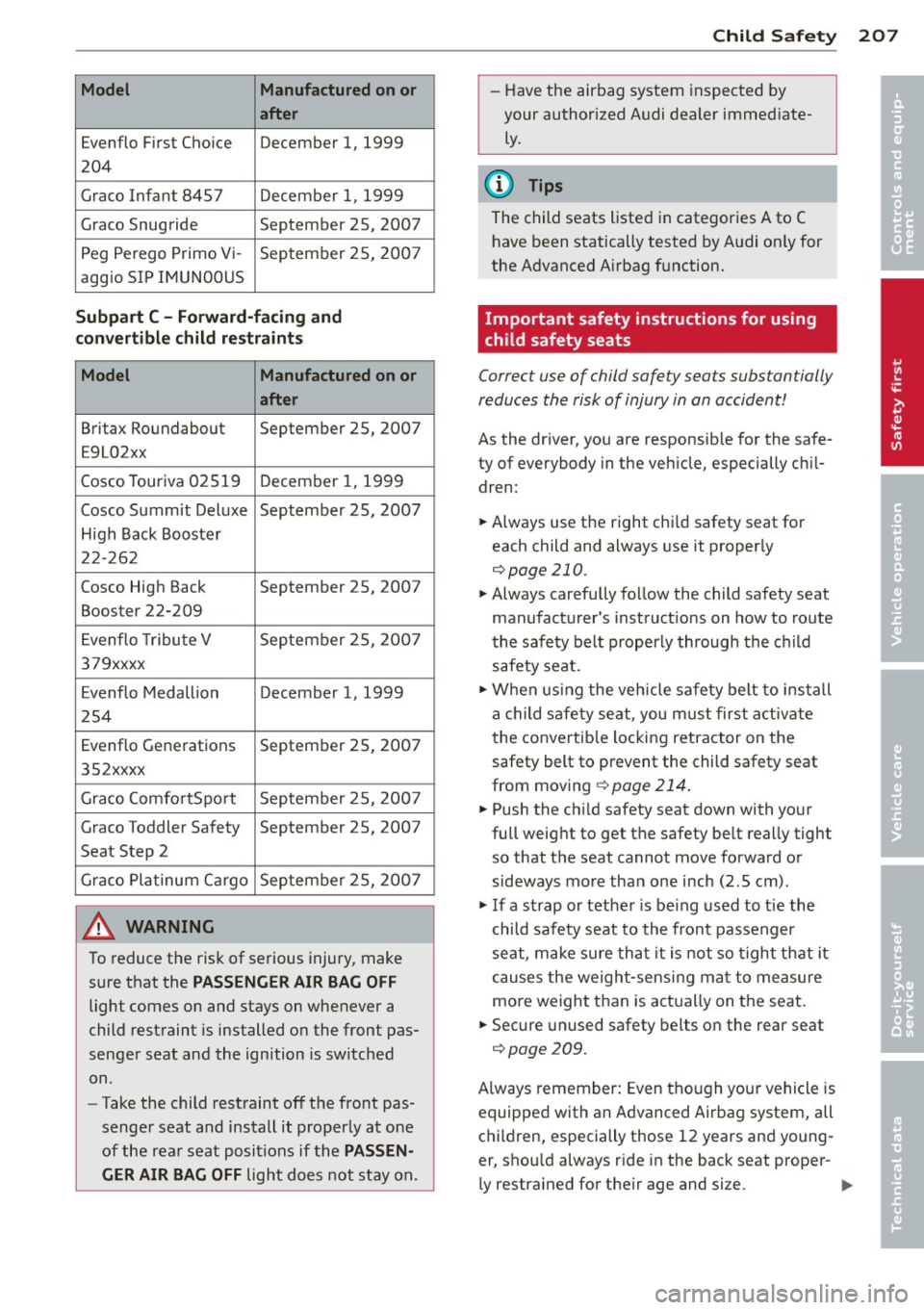
Model Manufactured on or
after
Evenflo First Choice December 1, 1999
204
Graco Infant 8457 December 1, 1999
Graco Snugride September 25, 2007
Peg Perego Primo Vi- September 25, 2007
aggio SIP IMUN00US
Subpart C - Forward-facing and
convertible child restraints
Model Manufactured on or
after
Britax Roundabout September 25, 2007
E9L02xx
Cosco Touriva 02519 December 1, 1999
Cosco Summit Deluxe September 25, 2007
H igh Back Booster
22-262
Cosco High Back September 25, 2007
Booster 22-209
Evenflo Tribute V September 25, 2007
379xxxx
Evenflo Medallion December 1, 1999
254
Evenflo Generations September 25, 2007
352xxxx
Graco Comfo rtSport September 25, 2007
Graco Toddler Safety September 25, 2007
Seat Step 2
Graco Platinum Cargo September 25, 2007
A WARNING
To reduce the risk of serious injury, make
sure that the
PASSENGER AIR BAG OFF
light comes on and stays on whenever a
child restraint is installed on the front pas
senger seat and the ignition is switched
on.
- Take the child restraint off the front pas
senger seat and install it properly at one
of the rear seat positions if the
PASSEN
GER AIR BAG OFF
light does not stay on.
Child Safety 207
-Have the airbag system inspected by
your author ized Audi dealer immed iate
ly.
@ Tips
The child seats listed in categories A to C
have been statically tested by Audi on ly for
the Advanced Airbag function.
Important safety instructions for using
child safety seats
Correct use of child safety seats substantially
reduces the risk of injury in an accident!
As the driver, you are responsib le for the safe
ty of everybody in the veh icle, especially ch il
dren:
... Always use the right chi ld safety seat for
each child and always use it properly
¢page 210.
... Always carefully follow the child safety seat
manufacturer's instruct ions on how to route
the safety belt properly through the child
safety sea t .
... When using the vehicle safety belt to install
a child safety seat, you must first activate
t he convertible locking retractor on the
safety belt to prevent the child safety seat
from moving
¢ page 214.
... Push the ch ild safety seat down with yo ur
full weight to get the safety belt really tight
so that the seat cannot move forward or
sideways more than one inch (2 .5 cm) .
... If a strap or tether is be ing used to tie the
child safety seat to the front passenger
seat, make sure that it is not so tight that it
causes the weight-sens ing mat to measure
more weight than is actually on the seat.
... Secure unused safety belts on the rear seat
¢page 209.
Always remember: Even though your vehicle is
equipped with an Advanced Airbag system, all
c hild ren, especially those 12 years and young
er, shou ld always r ide in the back seat proper-
ly restrained for the ir age and size. ..,. •
•
Page 211 of 340
as possible before installing the child
restraint.
- Always make sure that nothing pre
vents the front passenger's seat from
be ing moved to the rearmost position
in its fore and aft adjustment range.
- Always make sure that the backrest is
in the upr ight position.
- Always buck le the child safety seat firmly
in place even if a child is not sitting in it.
A loose ch ild safety seat can fly around
dur ing a sudden stop or in a col lision .
- Always read and heed all WARNINGS
whenever using a child restrained in ave
hicle is being used¢
page 174, Safety
belts,¢ page 183, Airbag system
and
¢ page 204, Child Safety.
A WARNING
To reduce t he ris k of serious injury, make
sure that the
PASSENGER AIR BAG OFF
light comes on and stays on whenever a
child rest raint is installed on the front pas
senger seat and the ignition is switc hed
on.
- Take the child restraint off t he fro nt pas
senger seat and install it properly at one of the rear seat positions if the
PASSEN ·
GER AIR BAG OFF
light does not stay on.
- Have the airbag system inspected by
your authorized Aud i dealer immediate
ly.
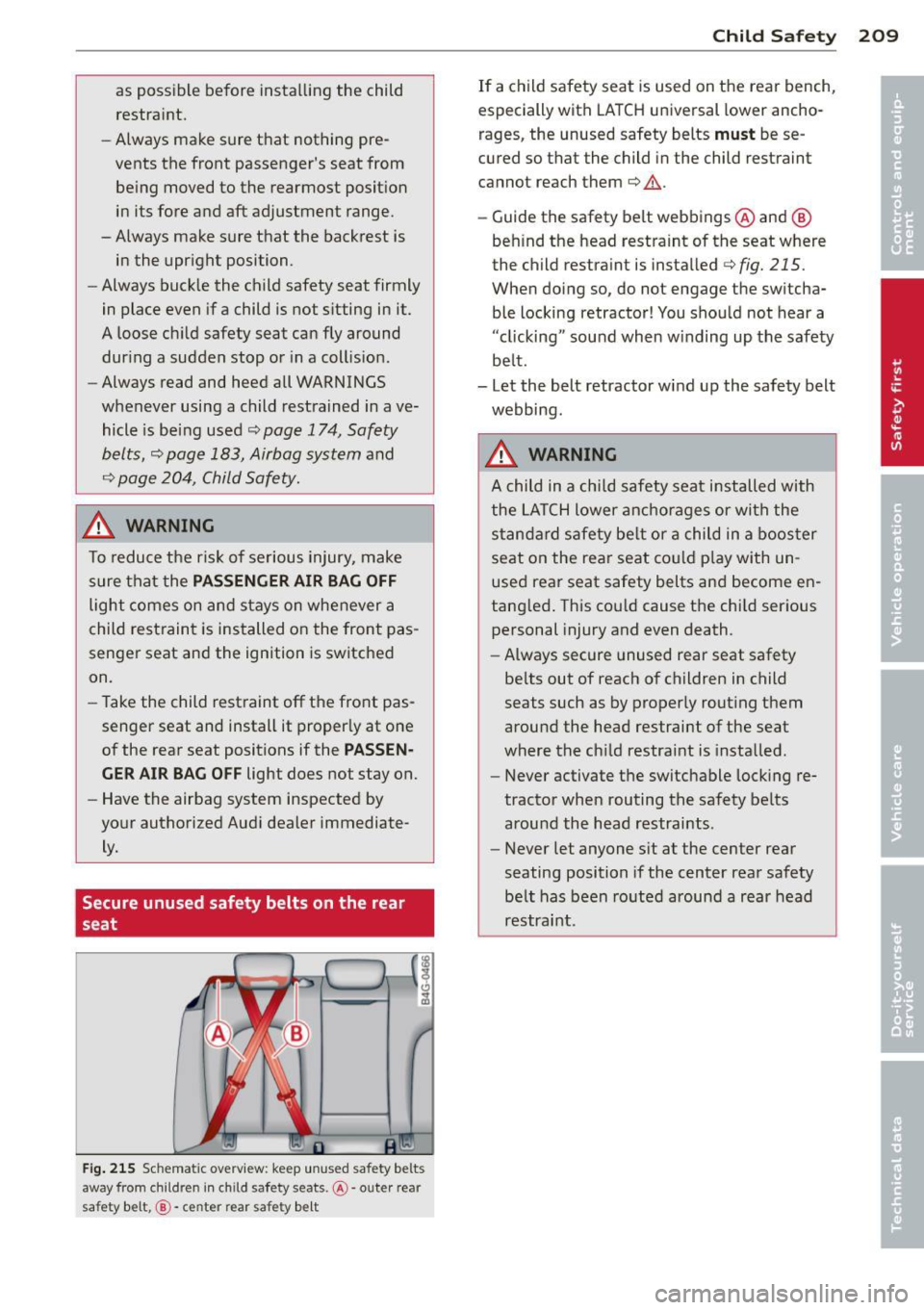
Secure unused safety belts on the rear
seat
F ig. 21 5 Schematic overv iew : keep un used safety belts
away from children in child safety seats.@-oute r rear
safety belt,
@ -center rear safety belt
Child S afety 209
If a child safety seat is used on the rea r bench,
especially with LATCH universal lower ancho
rages, the unused safety belts
must be se
cured so that the child in the child restraint
cannot reach them¢&.
- Guide the safety belt webbings @and @
beh ind the head restraint of the seat where
the child restra int is insta lled ¢
fig. 215.
When doing so, do not engage the switcha
ble locking retracto r! You shou ld not hear a
"cl icking" sound when w inding up the safety
be lt .
- Let the belt retractor wind up the safety belt
webbing.
A WARNING
A child in a chi ld safety seat i nstalled with
the LA TCH lower ancho rages or with the
standard s afety be lt or a child in a boos ter
seat on the rea r seat co uld p lay with un
use d rea r seat safety belts and become en
tang led . This could cause t he chi ld ser ious
personal injury and even death.
- Always secure unused rear seat safety
be lts out of reach of children in child
seats such as by proper ly rout ing t hem
around the head restrai nt of the seat
where the ch ild restraint is installed.
- Never activate t he switchable l ock ing re
tracto r when routing the safety be lts
arou nd the head restraints.
- Never let anyone s it at the center rear
seating position if the center rea r safety
be lt has been routed around a rear head
restraint.
Page 212 of 340
210 Child Safe ty
Child safety seats
Infant seats
Babies and infants up to about one year old
and 20 lbs. or 9 kg need special rearward-fac
ing child restraints that support the back,
neck and head in a crash.
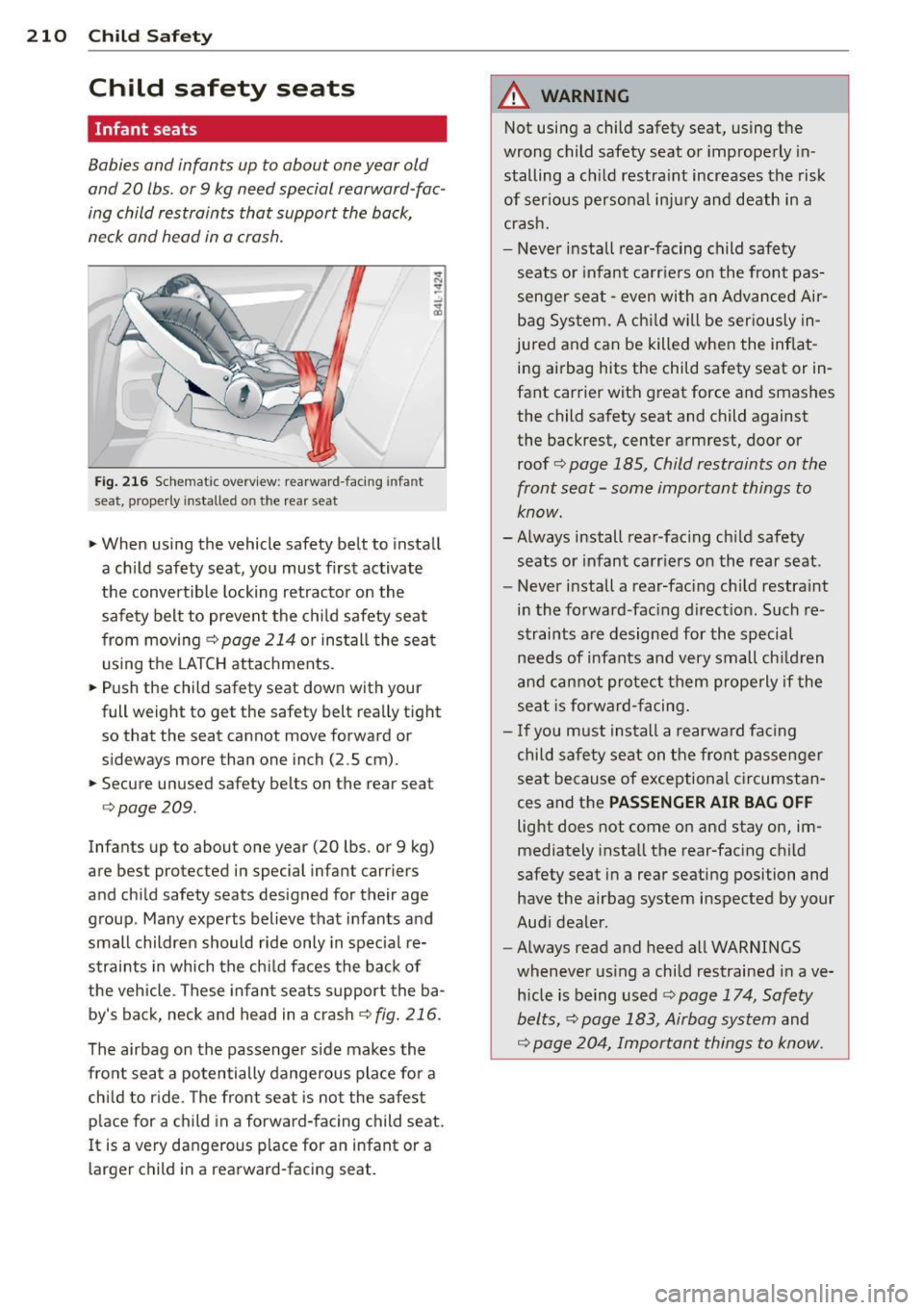
-- /
Fig . 216 Sche matic overview: rearward- facing infant
seat, properly installed o n the rear seat
> When using the vehicle safety belt to install
a ch ild safety seat, you must first activate
the convertible locking retractor on the
safety belt to prevent the child safety seat
from moving ¢
page 214 or install the seat
using the LATCH attachments.
> Push the child safety seat down with your
full weight to get the safety belt rea lly tight
so that the seat cannot move forward or
sideways more than one inch (2.5 cm).
> Secure unused safety belts on the rear seat
¢page 209.
Infants up to about one year (20 lbs. or 9 kg)
are best protected in special infant carriers
and child safety seats designed for their age
group . Many experts believe that infants and
small children should ride only in spec ial re
straints in which the chi ld faces the back of
the vehicle . These infant seats support the ba
by's back, neck and head in a crash ¢
fig. 216.
The airbag on the passenger side makes the
fro nt seat a potentially dangerous place for a
child to r ide . The front seat is not the safest
p lace for a child in a forwa rd-facing child seat.
I t is a very dangerous p lace for an infant or a
larger child in a rearward-facing seat.
A WARNING
-Not using a child safety seat, using the
wrong child safety seat or improperly in
stalling a ch ild restra int increases the risk
of ser ious personal in jury and death in a
crash.
- Never install rear-facing child safety
seats or infant ca rr ie rs on the front pas
senger sea t -even with an Advanced Air
bag Sys tem. A c hild will be ser iously in
jured and can be killed whe n the inflat
ing ai rbag hits the child safety seat or in
fant carrier with great force and smashes the child safety seat and child against
the backrest, center armrest, door or
roof ¢
page 185, Child restraints on the
front seat -some important things to
know.
- Always install rear-facing ch ild safety
seats or infant ca rr ie rs on the rear seat .
- Never install a rear-fac ing ch ild restra int
in the forward-fac ing direct ion. Such re
straints are designed for the special needs of infants and very small ch ild ren
a nd cannot protect them prope rly if the
seat is forward- facing.
- If you m ust insta ll a rearwa rd fa cing
child safety seat on the fro nt passenger
seat because of exceptiona l circumstan
ces and the
PASSENGER AIR BAG OFF
light does not come o n and stay on, im
mediately insta ll the rear-fac ing child
safety seat in a rear seating position and
have the airbag system inspected by your
Aud i deale r.
- Always read and heed all WARNINGS
whenever us ing a child restrained in ave
h icle is being used¢
page 174 , Safety
belts, ~ page 183, Airbag system
and
c::> page 204, Important things to know.
Page 213 of 340
Convertible child safety seats
Properly used convertible child safety seats
can help protect toddlers and children over
age one who weigh between 20 and 40 lbs. (9
and 18 kg) in a crash.
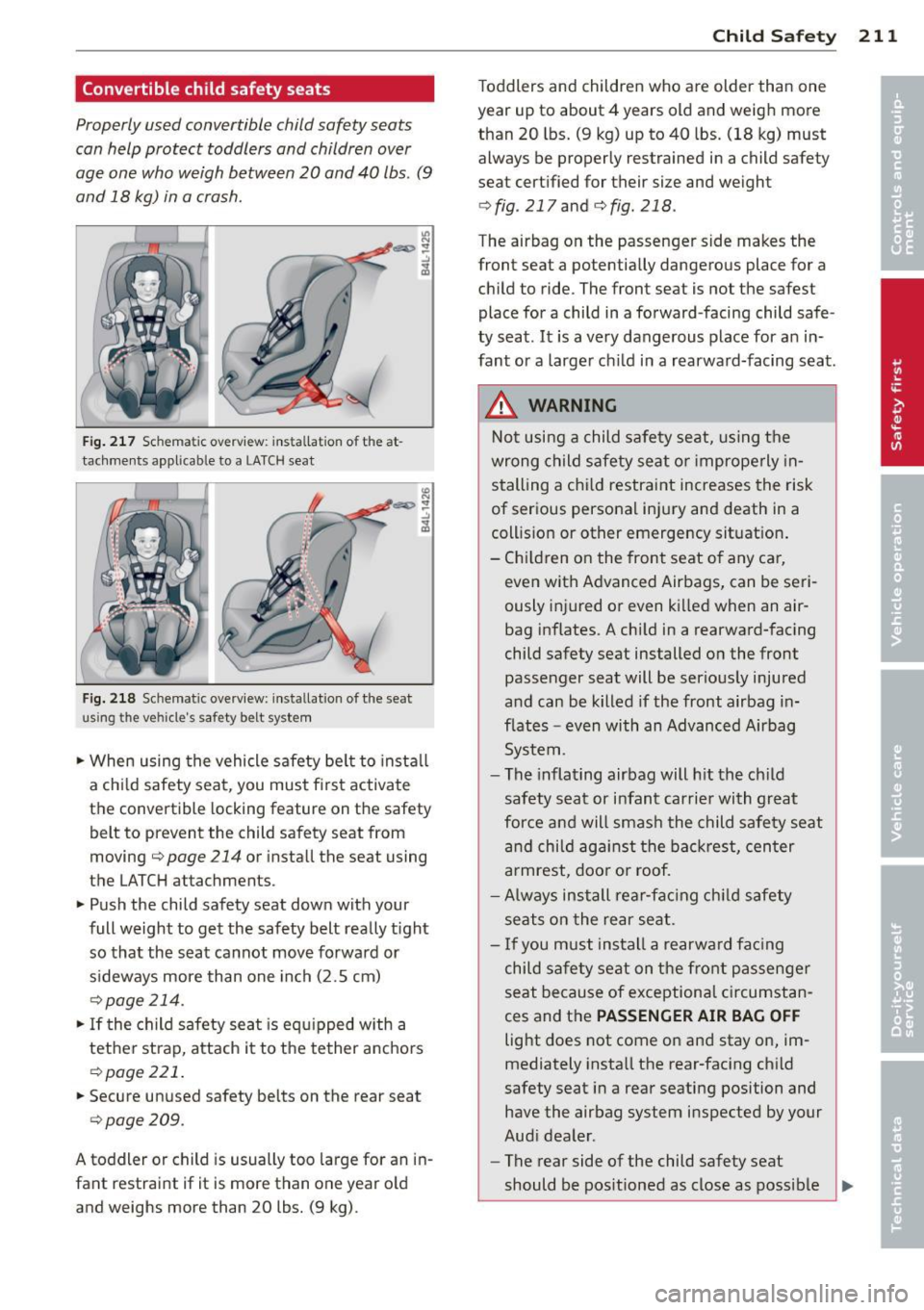
F ig . 217 Sche mati c overvi ew : ins tallat ion o f the at
tachments appl icable to a LA TCH seat
F ig. 2 18 Schem atic overview: installat ion of t he seat
u sing the ve hicle' s safety b elt sy stem
.. When using the vehicle safety be lt to insta ll
a chi ld safety seat, you must f irst activate
the convertible locking feature on the safety
belt to prevent the child safety seat from
moving
c::> page 214 or install the seat using
the LATCH attachments .
.,. Push the child safety seat down with your
full weight to get the safety belt really t ight
so that the seat cannot
move forward or
s ideways more than one inch (2.5 cm)
c::>page 214.
.,. If the child safety seat is equ ipped with a
tet her strap, attach it to the tether anchors
c::> poge 221.
.. Secure unused safety belts on the rear seat
c:;, page 209.
A toddler or child is usually too large for an in
fant restraint if it is more than one year o ld
and weighs more than 20 lbs. (9 kg) .
Child Safety 211
Toddlers and children who are older than one
year up to about 4 years old and weigh more
than 20 lbs. (9 kg) up to 40 lbs. (18 kg) must always be properly restrained in a child safety
seat cert ified for their si ze and weight
c::> fig . 217and c::>fig. 218 .
The airbag on the passenger side makes the
front seat a potentially dangerous place for a
child to ride . The front sea t is not the sa fest
place for a child in a forward -facing child safe
ty seat .
It is a very dangerous place for a n in
fant or a large r ch ild in a rearward-facing seat .
.&_ WARNING
Not using a child safety seat, using the
wrong child s afety seat o r imprope rly in
stalling a chi ld restraint increases the risk
of serious personal injury and death in a
collision or other emergency situation .
- Ch ildren on the front seat o f any car,
even with Advanced Airbags, can be se ri
ously injured or
even killed when an air
bag inflates. A chi ld in a rearward-facing
child safety seat installed o n the front
passenger seat will be serious ly injured
and can be k illed if the front airbag in
flates -even with an Advanced Airbag
System .
- The inflating airbag will h it the ch ild
safety seat or infant carrier with great
force a nd will smash the child safety seat
and child against the backrest, center
a rmrest, doo r or roof.
- Always install rear-fac ing ch ild safety
seats o n the rear seat .
- If you must install a rearwa rd fac ing
child safety seat on the fro nt passenger
seat because of exceptional circumstan
ces and t he
PASSENGER AIR BAG OFF
light does not come on and stay on, im
mediately insta ll the rear -facing chi ld
safety seat in a rear seating position and have the airbag system inspected by your
Aud i dea ler .
- The rear side of the child safety seat
should be pos itioned as close as poss ib le
~
Page 215 of 340
~ Secure unused safety belts on the rear seat
¢ page 209.
Children up to at least 8 years old (over 40
lbs. or 18 kg) are best protected in child safe
ty seats designed for their age and weight. Ex perts say that the skeletal structure, particu
larly the pelvis, of these children is not fully
developed, and they must not use the vehicle
safety belts without a suitable child restraint .
It is usually best to put these children in ap
propriate booster seats. Be sure the booster
seat meets all applicable safety standards .
Booster seats raise the seating position of the
child and reposition both the lap and shoulder
parts of the safety belt so that they pass
across the child 's body in the right places. The
routing of the belt over the child's body is very
important for the child's protection, whether
or not a booster seat is used . Children age 12
and under must always ride in the rear seat.
Children who are at least 4
ft . 9 in. (57 in
ches/1.45 meters) tall can generally use the
vehicle's three point lap and shoulder belts .
Never use the lap belt portion of the vehicle's
safety belt alone to restrain any child, regard
less of how big the child is. Always remember
that children do not have the pronounced pel
vic structure required for the proper function
of lap belt portion of the vehicle's three point
lap and shoulder belts. The child's safety ab
solutely requires that a lap belt portion of the
safety belt be fastened snugly and as low as
possible around the pelvis. Never let the lap
belt portion of the safety belt pass over the
child's stomach or abdomen.
In a crash, airbags must inflate within a blink
of an eye and with considerable force. In order
to do its job, the airbag needs room to inflate
so that it will be there to protect the occupant
as the occupant moves forward into the air bag.
A vehicle occupant who is out of position and
too close to the airbag gets in the way of an inflating airbag. When an occupant is too
close, he or she will be struck violently and
Child Safety 213
will receive serious or possibly even fatal in
jury.
In order for the airbag to offer protection, it is
important that all vehicle occupants, especial
ly any children, who must be in the front seat
because of exceptional circumstances, be
properly restrained and as far away from the
airbag as possible . By keeping room between
the child's body and the front of the passen
ger compartment, the airbag can inflate com
pletely and provide supplemental protection
in certain frontal collisions .
_&. WARNING
Not using a booster seat, using the boos
ter seat improperly, incorrectly installing a booster seat or using the vehicle safety
belt improperly increases the risk of seri
ous personal injury and death in a collision
or other emergency situation. To help re
duce the risk of serious personal injury
and/or death:
- The shoulder belt must lie as close to the
center of the child's collar bone as possi
ble and must lie flat and snug on the up
per body . It must never lie across the
throat or neck . The lap belt must lie
across the pelvis and never across the
stomach or abdomen. Make sure the belt lies flat and snug. Pull on the belt to
tighten if necessary.
- Failure to properly route safety belts
over a child's body will cause severe inju
ries in an accident or other emergency
situation
¢page 174.
- The rear side of the child safety seat
should be positioned as close as possible
to the backrest on the vehicle seat. Ad
just or remove the rear seat head re straint if it is difficult to install the child
seat with the head restraint in place
¢ page 78. Install the head restraint
again immediately once the child seat is
removed . Driving without head restraints
or with head restraints that are not prop
erly adjusted increases the risk of serious
-
or fatal neck injury dramatically. ~
•
•
Page 216 of 340
214 Child Saf ety
- Childre n on the front seat of any car,
even with Advanced A irba gs, can be seri
ous ly injured or even killed when an a ir
bag inflates .
- Never let a child stand or knee l on any
seat, for exam ple the front seat.
- Never let a child ride in the cargo area of your vehicle .
- Always remember that a chi ld leaning
forward, sitt ing s ideways or out of posi
t ion in any way during an acc ident can be
struck by a deploying airbag . This will re
sult in serious personal injury or death .
- If you must install a booster seat on the
front passenger seat because of excep
t ional circumstances the
PASSENGER
AIR BAG OFF
light must come on and
stay on, whenever the ignition is sw itch
ed on.
- If the
PASSENGER AIR BAG OFF light
does not come on and stay on, perform
the checks described¢
page 194, Moni
toring the Advanced Airbag System.
- T ake the child restrain t off the front pas
senger seat and install it properly at one
of the rear seat positions if the
PASSEN
GER AIR BAG O FF
light does not stay on
whenever the ignition is switched on.
- Always read and heed all WARNINGS
whenever using a child restrained in ave
hicle is being used
¢page 174, Safety
belts,
c:::;, page 183, Airbag system and
c:::;, page 204, Important things to know.
Installing a child safety
seat
Securing a child safety seat using a
safety belt
Safety belts for the rear seats and the front
passenger can be locked with the convertible locking retractor to properly secure child
safety seats .
The safety belts emergency locking retractors
for the rear seats safety belts and for the
front passenger's seat safety belt have a con
ve rtible locking retracto r fo r child restra ints . T
he safety belt m ust be locked so that be lt
webbing cannot unree l. The retractor can be
activated to lock the safety belt and prevent
the safety belt webbing from loosening up
during norma l dr iving. A child safety seat can
o n ly be properly insta lled when the safety belt
i s loc ked so that the child and child safety
sea t w ill stay in place .
Always remember: Even tho ugh your vehicle is
equipped with an Advanced Airbag system, all
c h ildren, especially those 12 years and young
er, shou ld always r ide in the back seat prope r
l y restra ined fo r the ir age and size.
_& WARNING
Imp ro perly ins talled ch ild safety sea ts in
crease the risk of serious pe rsonal injury
and death in a co llision.
- Always make s ure that the safe ty belt re
trac to r i s loc ked when insta lling a child
safety seat . An un locked safety belt re
tracto r cannot hold the child safety seat
in place dur ing norma l driving or in a
crash.
- Always buckle the child sa fety seat firmly
in place even if a ch ild is not sitt ing in it.
A loose child safety seat can fly around du ring a sudden stop or in a collision.
- Always make sure that the rear seat
backrest to wh ich the center rear safety
be lt is attached is securely latched when
eve r the rea r center safety belt is being
used to secure a c hild restra int.
- If the backrest is not securely la tched,
the child and the child restraint will be
thrown forward togethe r with t he back
rest and will strike part s of the vehicle
interior. The child can be seriously in
jured or killed.
- Never inst all rear-facing child s afety
seats or in fant ca rrie rs on the front pas
senger seat . A child will be serious ly in
jured and can be killed when the passen ger airbag in flates.
- The inflating air bag will h it the ch ild
safety seat or infant carrier with great
force and will smash the child safety seat ..,.
Page 218 of 340
216 Child Safety
-A tight tether strap on a rearward-facing
child restraint attached to the front pas
senger seat can put too much pressure on the weight-mat in the seat and regis
ter a heavier weight in the Advanced Air
bag System. The heavier weight regis
tered can make the system work as
though an adult were on the seat and de
ploy the Advanced Airbag when it must
be suppressed causing serious or even
fatal injury to the child.
- Make sure that the
PASSENGER AIR BAG
OFF
light comes on and stays on all the
time whenever the ignition is switched
on.
- If the
PASSENGER AIR BAG OFF light
does not come on and stay on, immedi
ately install the rear-facing child safety
seat in a rear seating position and have
the airbag system inspected by your Audi dealer.
Activating the convertible locking
retractor
Use the convertible locking retractor to se
cure a child restraint.
Always heed the child safety seat manufactur
er's instructions when installing a child re
straint in your vehicle. To activate the conver
tible locking retractor:
• Place the child restraint on a seat, prefera
bly on the rear seat.
• Slowly pull the belt
all the way out.
• Route it around or through the child re
straint belt path¢,&.
• Push the child safety seat down with your
full weight to get the safety belt really tight.
• Insert the belt tongue into the buckle for
that seating position.
• Guide the safety belt back into the retractor
until the belt lies flat and snug on the child
safety seat.
• You should hear a "clicking" noise as the
belt winds back into the inertia reel. Test the
convertible locking retractor by pulling on
the belt . You should no longer be able to pull the belt out of the retractor.
The con
vertible locking retractor is now activated.
• Make sure that the red release button is fac
ing away from the child restraint so that it
can be unbuckled quickly.
• Pull on the belt to make sure the safety belt
is properly tight and fastened so that the
seat cannot move forward or sideways more
than one inch (2 .5 cm).
_&. WARNING
-
Using the wrong child restraint or an im
properly installed child restraint can cause
serious personal injury or death in a crash.
- Always make sure that the safety belt re-
tractor is locked when installing a child
safety seat. An unlocked safety belt re
tractor cannot hold the child safety seat
in place during normal driving or in a
crash.
- Always buckle the child safety seat firmly
in place even if a child is not sitting in it.
A loose child safety seat can fly around
during a sudden stop or in a crash.
- Always make sure the seat backrest to
which the child restraint is installed is in
an upright position and securely latched
into place and cannot fold forward . Oth
erwise, the seatback with the child safety
seat attached to it could fly forward in
the event of an accident or other emer
gency situation.
- Always read and heed all WARNINGS
whenever using a child restrained in ave
hicle is being used~
page 204. Special
precautions apply when installing a child
safety seat on the front passenger seat
¢ page 185, Child restraints on the front
seat -some important things to know .
Page 220 of 340
218 Child Safety
-Always follow the instructions provided
by the manufacturer of the ch ild re
straint you intend to install in your veh i
cle.
- Never install a child restraint without a
properly attached top tether strap if the
child restraint manufacturer's instruc
t ions requ ire the top tether strap to be
used.
- Improper use of child restra int LATCH
lower anchorage points can lead to injury
in a collision. The LATCH lower anchorage
points are designed to withstand only
those loads imposed by correctly fitted
child restraints.
- Never mount two child restraint systems
on one LATCH lower anchorage point.
- Never secure or attach any lu gg age or
other item to the LATCH lo wer anchorag
es .
(j) Tips
-In Canada , the terms "top tether" with
"lowe r universal anchorages " (or " lower
un iversa l anchorage bars") are used to
describe the system.
- In other countries, the term "ISOFIX" is
u sed to describe the lower anchorages.
Location
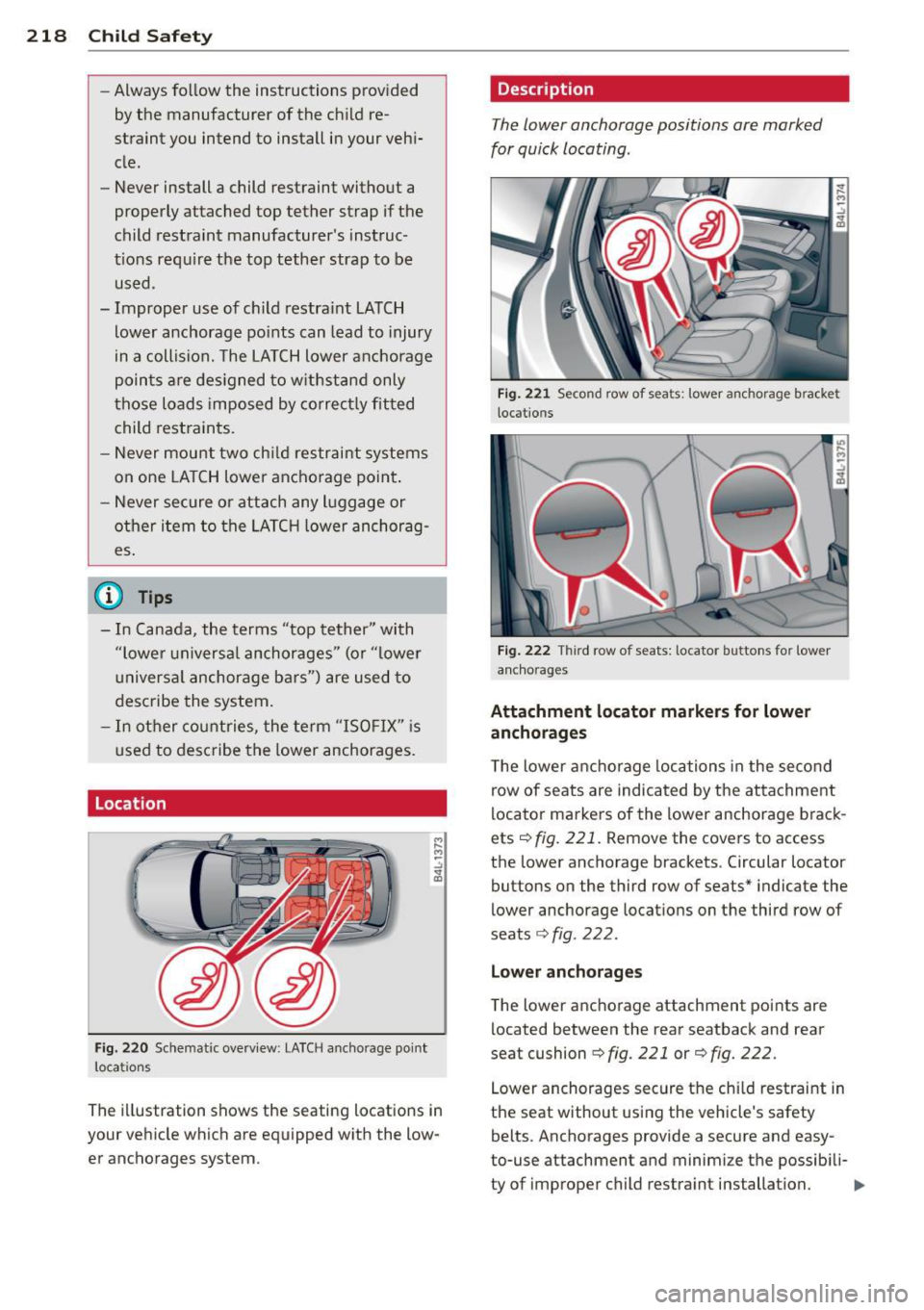
Fig. 220 Schematic overview: LATCH an ch orage point
locations
The illustration shows the seating locations in
your vehicle which are equipped with the low er anchorages system.
Description
The lower anchorage positions are marked
for quick locating.
Fig. 221 Second row of seats : lower ancho rage bracket
loc ations
Fig. 222 Thir d row of seats: locator butto ns for lower
anchorages
Attachment locator markers for lower
anchorages
T he lower anchorage locations in the second
row of seats are indicated by the attachment
locator markers of the lower anchorage brack
ets¢
fig. 221. Remove the covers to access
the lower anchorage brackets. Circular locator
buttons on the third row of seats* indicate the
lower anchorage locations on the third row of
seats
¢fig. 222.
Lower anchorages
The lower anchorage attachment po ints are
located between the rear seatback and rear
seat cushion
9 fig. 221 or¢ fig. 222.
Lower anchorages secure the chi ld restraint in
the seat without using the vehicle's safety
belts. Anchorages provide a secure and easy
to-use attachment and minimize the possib ili-
ty of improper child restra int installation.
II>
Page 221 of 340
All child restraints manufactured after Sep
tember 1, 2002, must have lower anchorage
attachments for the
LATCH system.
Remembe r that the lower anchorage points
are only intended for installation and attach
ment of child restraints specifically certified
for use w ith
LATCH l ower anchorages. Child
restraints that are not equipped with the low
er anchorage attachments can still be instal
led in compliance with the child restra int
manufacturer's inst ruct ions on us ing vehicle
safety belts .
A WARNING
Improper use of LATCH lower anchorages
can cause serio us personal injury i n an ac
cident.
- Alway s ca refully fo llow the child re
straints manufac turer's instru ct ions for
proper installation of the child restra int
and proper use of the lowe r anchorages
or safety belts in your vehicle .
- Never secure or attach any l uggage or
other items to t he
LATCH lower ancho
rages.
- Always read and heed the important in
format ion about child restra ints in this
chapter and WARNINGS
¢ page 204,
Child Safety.
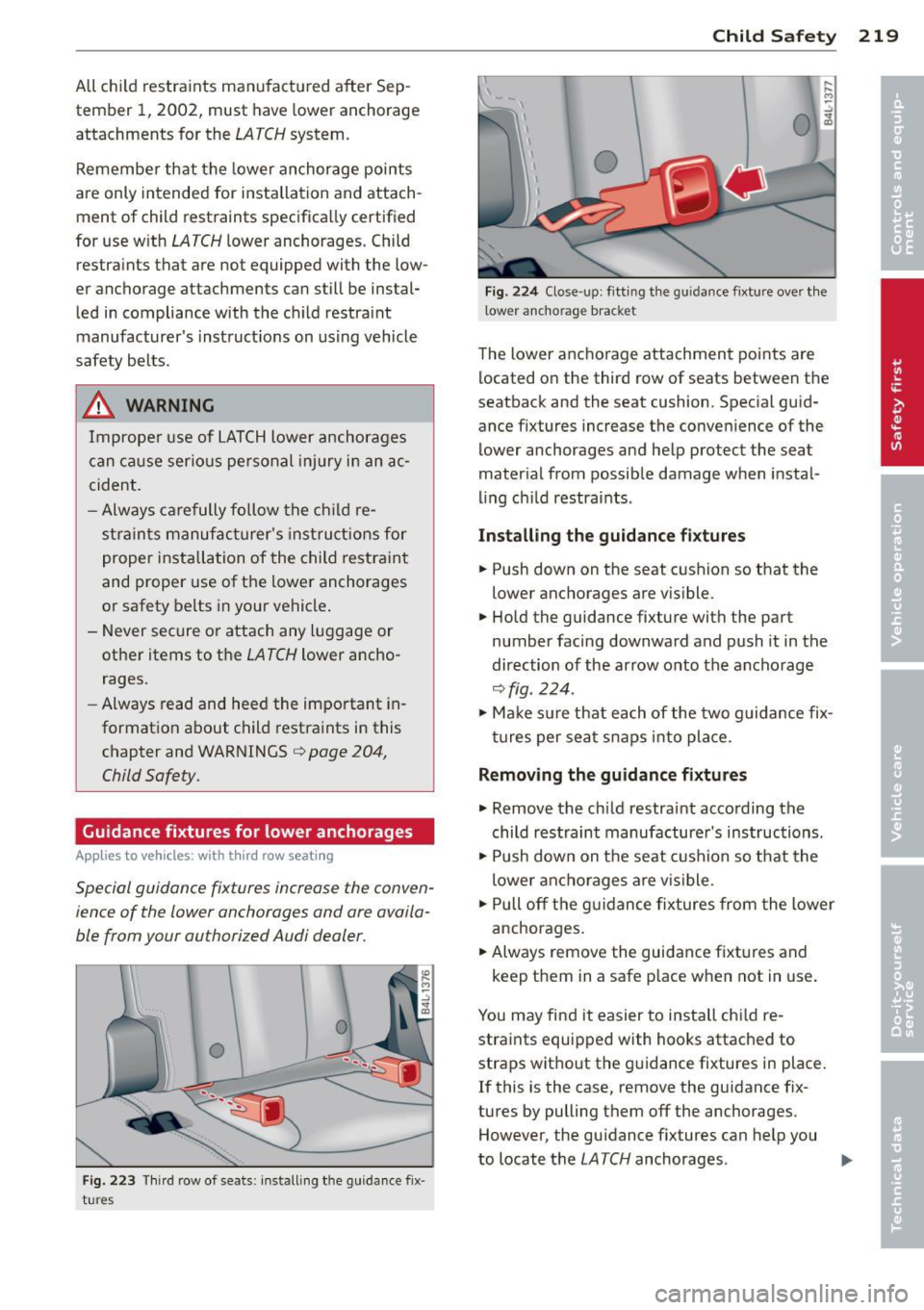
Guidance fixtures for lower anchorages
App lies to vehicles: with third row seating
Special guidance fixtures increase the conven
ience of the lower anchorages and ore availa
ble from your authorized Audi dealer.
Fig. 223 Th ird row of seats: installi ng the gu idance fix
tures
Child S afety 219
'
0
Fig. 224 Close-up: fitt ing the guidance fixture over the
l ower anchorage bracket
The lower anchorage attachment points are
located on the third row of seats between the
seatback and the seat cushion. Special guid
ance fixtures increase the convenience of the
lower anchorages and help protect the seat
mater ial from possible damage when instal
ling ch ild restraints .
Installing the guidance fi xtur es
... Push down on the seat cu shion so that the
lower anchorages are visible.
.,. Hold the guidance fixture with the part
number facing downward and push it in the
direction of the arrow onto the anchorage
¢fig. 224.
.,. Make sure that each of the two guidance fix
t ures per seat snaps into place.
Removing the gu idance fixtures
... Remove the child restraint according the
child restraint manufacturer's instructions .
.,. Push down on the seat cushion so that the
lower an cho rages are visible.
.,. Pull off t he gui dance fixtures from the lower
anchorages.
... Always remove the guidance fixtures and
keep them in a safe place when not in use .
You may find it easier to install child re
straints equipped with hooks attached to
straps without the guidance fixtures in place.
If this is the case, remove the guidance fix
tures by pulling them off the anchorages.
However, the guidance fixtures can help you
to locate the
LATCH anchorages. .,..
Page 222 of 340
220 Child Safe ty
& WARNING
Improper use of tether anchorages or low
er anchorages can cause serious personal
injury in a crash.
- Always carefully follow the ch ild re
straint manufacturer's instructions for proper installation and use of child re
st raint systems .
- Never use the
LATCH or tethe r anchorag
es to attach safety belts or other kinds of
occupant restraints.
- Child restraint tether attachments and
lower attachments are only des igned to
se cu re a child res traint that has been
equipped to use these anchorages.
- T ether anchorages and lower an chorages
are designed to withstand only those loads imposed by correct ly fitted ch ild
res traints . Under no circumstances can
they be used safe ly for adu lt or chi ld
safety belts or harnesses.
- Never mount more than one chi ld re
st raint to a sing le tether or to a lower an
chorage point. Attac hing two chi ld re
straints to a sing le anchorage poi nt can
cause the anchorage to fail and cause se
rious personal injury in a crash.
(D Note
- Remove the guidance f ixtures before
fo ld ing the rear seatback to prevent
damaging the seat cushion.
- If you leave the guidance fixtures instal
l ed for several days, they could leave a
mark on the upho lstery on the seat cush
i o n and backrest in the area that the
guidance fixtures were insta lled. The up
ho lstery would also be permanently
stretched around the guid ance fixt ures.
This applies especially to leather seats.
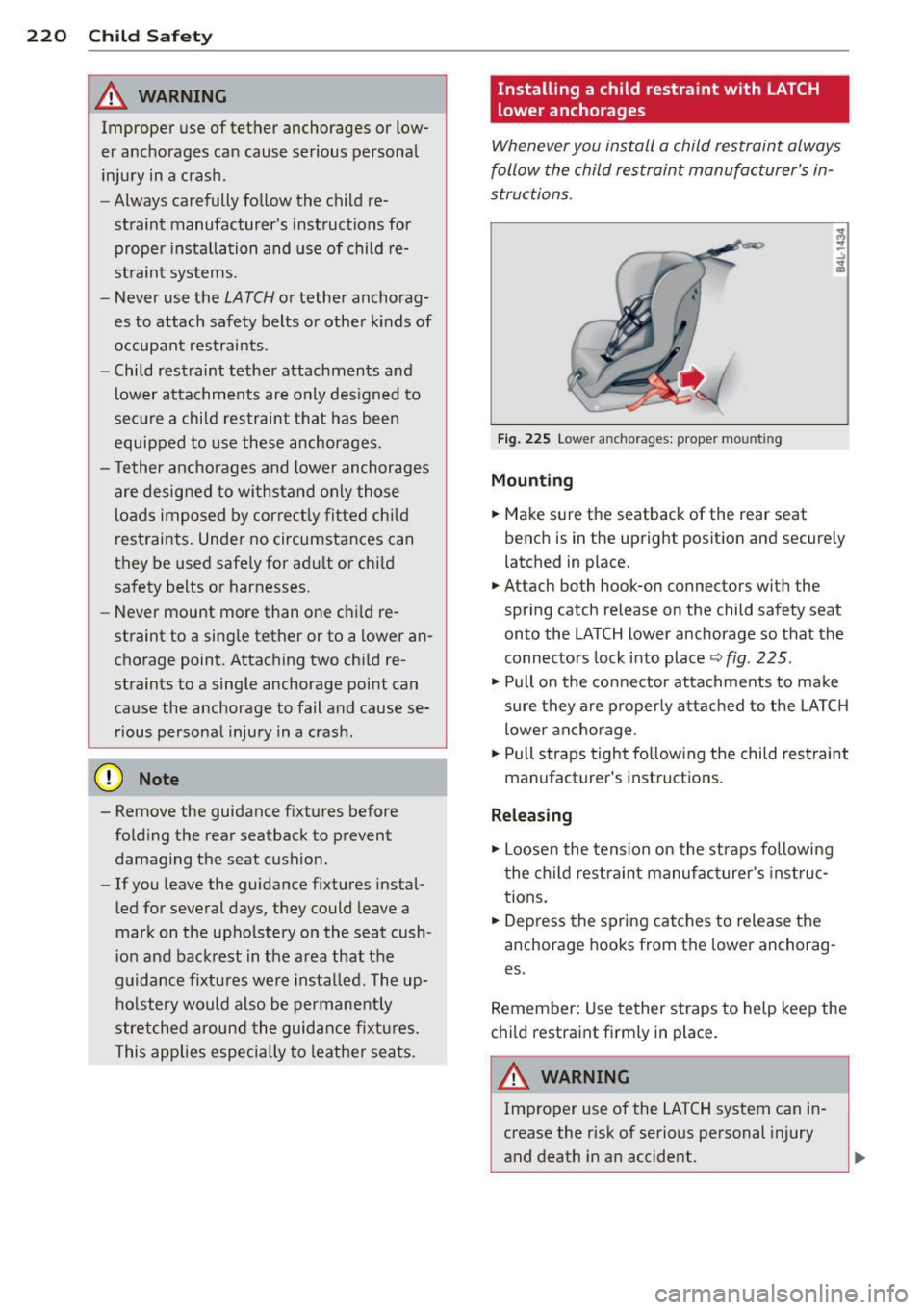
Installing a child restraint with LATCH
lower anchorages
Whenever you install a child restraint always
follow the child restraint manufacturer's in
structions.
F ig . 225 Lower a ncho rages: proper mount ing
Mo unting
.,. Make s ure the seatback of the rear seat
benc h is in the upright position and securely
latched in place.
.,. Attach both hook-on connectors with the
spring catch release on the child safety seat
onto the LATCH lower anchorage so that the
connectors lock into place ~
fig. 225 .
.,. Pull on the connector attachments to ma ke
sure they are properly attac hed to the LATC H
lower ancho rage .
.,. Pull straps tight fo llow ing the child res traint
manufacturer's instruct ions.
Releasing
.,. Loose n the tension on the straps fo llowing
t he child restra int manufac turer's inst ruc
tions .
.. Depress the spring catches to release the
anchorage hooks from t he lower anchorag
es.
Remember: Use tether straps to help keep the
c h ild restraint firmly in place .
A WARNING
'-
Improper use of the LATCH system can in-
crease the risk of serious personal in jury
and death in an accident.