ESP AUDI Q7 2014 Owner´s Manual
[x] Cancel search | Manufacturer: AUDI, Model Year: 2014, Model line: Q7, Model: AUDI Q7 2014Pages: 340, PDF Size: 85.02 MB
Page 255 of 340
-Never get back into your vehicle while re
fueling. If in exceptional circumstances
you must get back in your vehicle while refueling, make certain that you close
the door and touch metal to discharge
static electricity before touching the fill
er nozzle again. Stat ic electricity can
cause sparks that can ignite fuel vapors
released during refueling .
- Never smoke or have an open flame any
where in or near your vehicle when refu
eling or filling a portable fuel container.
- For your safety, we strongly recommend
that you do not trave l w ith a portab le
fuel container in your vehicle. The con
tainer, full or empty may leak and cou ld
cause a fire, especia lly in a crash .
-If, under exceptional circumstances, you
must transport a portable fuel container,
please observe the following:
- Never fill a portable fuel container
while it is anywhere in or on the vehicle
(for examp le, in the luggage compart
ment, or on the trunk). Static electr ici
ty can bui ld up while fi lling and can ig
nite fuel vapors causing a fire.
- Always p lace a portable fuel container
on the ground before filling.
-Always keep the filler nozzle complete
ly inside the portable container before
and during filling .
- If filling a portable container made of
metal, the filler nozz le must always be
in contact with the container. This will
he lp prevent static electricity from dis
charging and cause a fire.
- Never spill fuel inside the vehicle or
luggage compartment. Fue l vapors are
h ighly flammable.
- Always observe local and state/provin
cial laws regarding the use, storage
and transportation of fuel containers.
- Make certain the fuel container meets
industry standards (ANSI/ ASTM
F852 -86).
Fuel supply and filling your fuel tank 253
@ Note
If any fuel has spilled onto the car, it
shou ld be removed immediately to prevent
damage to the paint.
@ For the sake of the environment
As soon as the correct ly operated nozzle
switches off automat ically for the first
time, the tank is full. Do not try to add
more fuel because fuel may spill out. In
addition, the expansion space in the fuel
tank w ill be filled -causing the fuel to
overflow when it becomes warm and pol
lute the environment.
0) Tips
-Running your eng ine while refuelling
may cause vapors to escape or even
cause fuel to sp ill out of the tank . Th is
would then shut off the fuel nozzle be
fore the tank is ful l.
- Do not refuel your vehicle with the igni
tion turned on. The fuel gauge may oth
erwise not indicate the correct f uel level
after refuelling.
- Diesel vehicles* are equipped with a d ie
sel misfueling protector . It allows the
vehicle to be fueled only with a diese l
fuel pump nozzle. A worn or damaged
nozzle or a nozzle that is too small may
not be able to open the diesel misfueling
protector. If this is the case, try turning
the nozzle before inserting it in the fuel
filler neck, use a different fuel pump or
see your authorized Aud i dea ler or au
thorized repair facility for assistance. •
•
Page 259 of 340

Checking and filling Engine hood
Releasing the engine hood
The engine hood is released from inside the
vehicle .
Fig. 23 9 Drive r's s id e footw ell: eng in e hood relea se
l e v e r
"' Open the driver's door .
"' Pull the release lever on the left under the
instrument panel
i=> fig . 239 in the d irection
of the arrow .
The hood pops up slight ly under spring pres
sure.
Opening the engine hood
F ig . 2 40 Relea se le ve r u nde r the e ngin e hood
Before opening the engi ne hood, make sure
that the windshie ld wipers are flat against the
windshie ld. Otherwise, they cou ld damage the
pain t on the hood.
"' Lift the hood slight ly ¢
_A .
"' Pull up on the release under the hood
¢ fig . 240. This releases the catch.
"' Open the hood all the way . Checkin
g and fillin g 257
A WARNING
Hot engine coolant can burn you.
- To reduce the risk of being burned, never open the hood if you see or hear steam
or coo lant escaping from the eng ine
compartment . Wait unt il no steam or
coolant can be seen or heard before care
fu lly opening the hood.
Closing the engine hood
"' Pull the hood down until the pressure from
the stru ts is reduced.
"' Let the hood
drop down and latch in p lace.
Do not try to push it shut ; it may fail to en
gage ¢_& .
A WARNING
--
A hood that is not completely latched
could fly up and b lock your view while dr iv
i n g.
- When you close the engine hood, check it
to make sure the safety catch has p roper
ly engaged . The hood shou ld be flush
with the surround ing vehicle body parts.
- If you notice while driv ing that the hood
is not secured prope rly, stop at once and
close it .
Working in the engine compartment
Be especially careful whenever you work in
the engine compartment.
Whene ver you must perform any wo rk in the
eng ine compartment, for e xample checking
and filling different fluids, there is a risk of injury, burns and accidents. To pr event per
sonal injury always observe the following
WARNINGS . The engine compartment of an y
vehicle i s a hazardou s area
¢ Lh, .
A WARNING ~
To help avoid injury, befo re yo u check any
thing under the hood:
- Tu rn off the engi ne.
- Remove the igni tion key.
Page 267 of 340

For year-round driv ing, antifreeze is added at
the factory for temperatures down to:
- - 31 °F (- 35 °C) USA
- - 40 °F ( - 40 °C) Canada .
If you mus t add coolant, use a mixture of wa
ter and coolant additive. Mixing the coolant
additive with distilled water is recommended .
A WARNING
-
Before you check anything in the engine
compartment, always read and heed all
WARNINGS ¢
A in Working in the engine
compartment on page 257.
(D Note
-Before winter sets in, have the coolant
checked to see if the coolant additive in
your vehicle is sufficient to meet the cli
mate conditions. This is especially impor
tant if you live in a region where the win
ter is extremely cold.
If necessary, in
crease the proportion of coolant additive
to 60%.
- When adding coolant additive to your
cooling system, remember:
- We recommend using only coolant ad
ditive Gl2++ or G13 for your vehicle.
This coolant additive is available at au
thorized Audi dealers. Other types of
antifreeze can significantly reduce cor
rosion protection . The resulting corro
sion can cause a loss of coolant and se
rious engine damage.
- Do not add any type of radiator leak seal
ant to your vehicle's engine coolant.
Adding radiator repair fluid may adverse
ly affect the function and performance of
your cooling system and could result in damage not covered by your New Vehicle
Limited Warranty.
Checking and filling 265
Checking the engine coolant level
T he engine coolant level can be checked with
a quick glance.
Fig. 245 En gin e compar tment: Coolant expansion tank
Before you check anything in the engine com
partment,
always read and heed all WARN
INGS ¢ A in Working in the engine comport
ment on page 257 .
.,. Park your vehicle on a level surface.
.,. Turn
off the ignition .
.,. Let the engine cool down.
.,. Place a thick rag over the coolant expans ion
tank ¢
fig. 245, c> page 259, fig. 241 and
carefully twist the cap counter-clockwise
¢,&. .
.,. Read the engine coolant level in the open
coolant expansion tank. With a cold engine,
the coolant level should be between the
"min " and "max" markings. When the en
gine is warm, the level may be slightly
above
the "max" marking.
The location of the coolant expansion tank
can be seen in the engine compartment illus
tration
¢ page 259 .
To obtain an accurate reading, the engine
must be switched
off.
The expansion tank in your vehicle is equipped
with an electric coolant level sensor .
When the coolant level is too low, the warning
light in the Auto-Check System¢
page 32 will
blink until you add coolant and the level has
been restored to normal. Even though there is
an electric coolant level sensor, we still rec ommend you check the coolant level from
time to time .
Page 271 of 340
Disconne cting the batt ery t erminals
Some vehicle functions (power w indow regu
l ators, for example) are lost if the battery ter
minals are disconnected . These functions have
to be re learned after the battery terminals are
connected again. To prevent this, the battery
should only be disconnected from the vehicle
electrical system when absolutely necessary
for repairs .
Vehicle s not driven fo r lo ng period s
If you do not drive your vehicle over a period
of several days or weeks, electrical compo
nents are gradually cut back or switched off .
This reduces energy consumption and main
tains starting capab ility over a longer per iod
¢ page 229 .
Take into consideration that when you unlock
your vehicle, some convenience functions,
such as the inter ior lights or the power seat
adjustment, may not be available . The con
ve nience funct ions w ill be available again
when yo u turn on the ignition and start the
engine.
Winter op eration
During the winter months, battery capacity
tends to decrease as tempe ratures d rop . This
i s because more powe r is also consumed while
start ing, and the headl ights, rea r window de
fogger, etc., are used more often.
Avo id unnecessary power consumption, par
ticularly in c ity t raffic or when t rave ling on ly
short d istances. Let you r autho rized Aud i
dealer check the capacity of the vehicle bat
tery before winter sets in ¢
page 270. A we ll
charged battery wi ll not only prevent starting
prob lems when the weather is cold, but will
also last longer .
If your vehicle is left standing for severa l
weeks at extremely low temperat ures, the
veh icle battery should be removed and
stored where it will not freeze. This will
prevent it from bei ng damaged and hav ing
to be replaced.
Checkin g and fillin g 269
Working on the battery
Be especially careful when working on or near
the battery.
The battery is located under the driver 's seat.
Before you check anyth ing under the dr iver's
seat,
read and h eed all WARNINGS G &_ .
Always heed the safety warnings , when work
ing on the vehicle battery or the vehicle e lec
trical system to prevent injury .
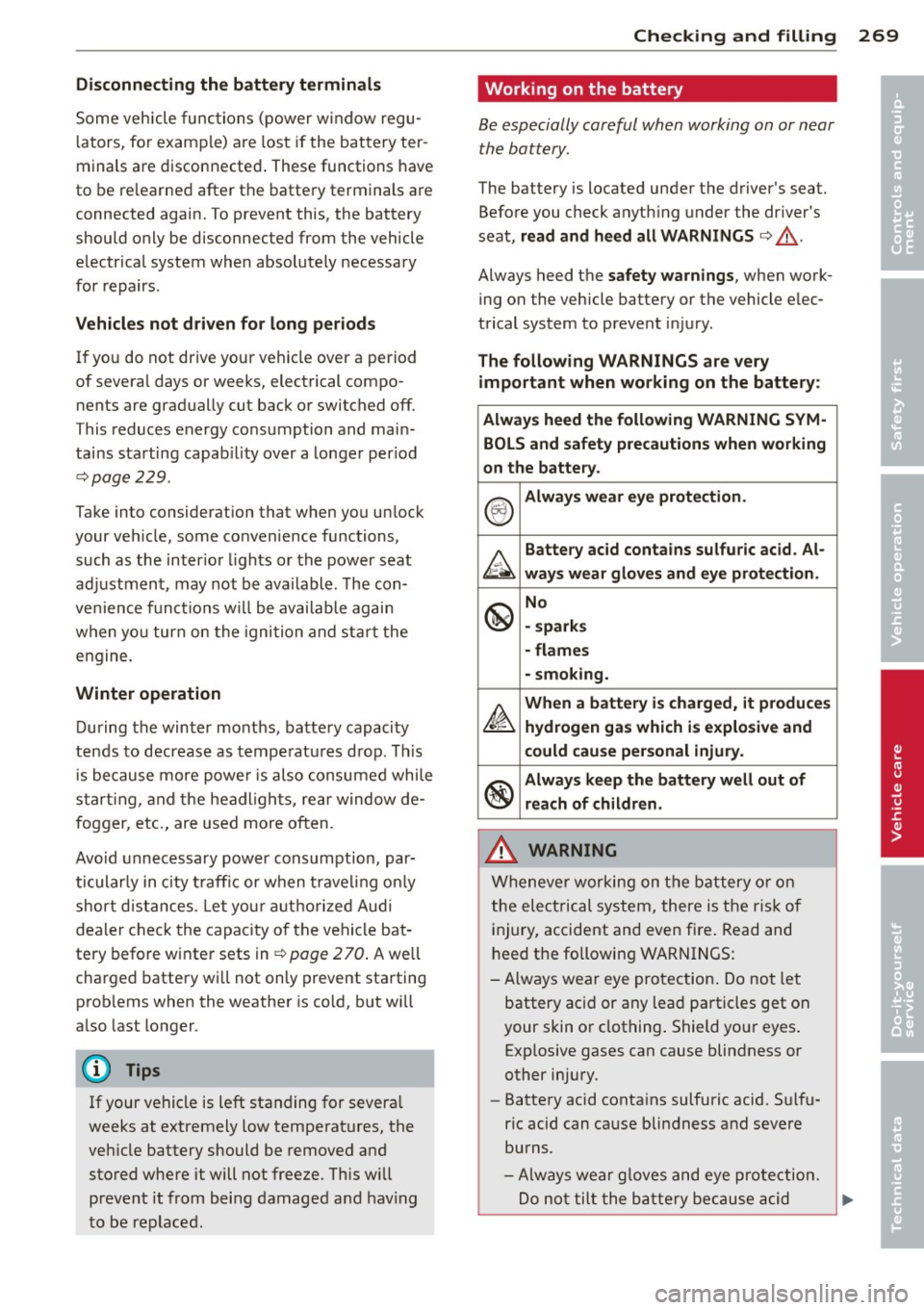
The following WARNINGS are ver y
important when working on the batter y:
Alway s heed the following WARN IN G SY M-
BOLS a nd safety p re caution s when working
on the battery .
®
Alway s wear e ye prote ction.
&
Bat te ry acid contains s ulfuric acid. Al-
ways w ear glov es and ey e prot ect ion .
@
No
-spar ks
- flames
- smo kin g.
A
When a batt ery i s charged , it produ ce s
hydro gen g as whi ch i s explo sive and
c o uld cau se pe rsonal injur y.
®
Alw ays k eep th e batt ery w ell out of
reac h of chi ldr en .
.8, WARNING
Whenever working on the battery or on
the electrical system, there is the risk of
injury, accident and even fire . Read and
heed the following WARNINGS:
- Always wear eye protection. Do not let
battery ac id or any lead particles get on
your skin or clothing . Shield you r eyes .
Exp losive gases can cause blindness or
other injury.
- Battery acid contains sulfuric acid. Sulfu
ric acid can cause blindness and severe
burns.
- Always wear g loves and eye protection.
-
Do no t tilt the ba ttery because acid .,. •
•
Page 274 of 340

272 Ch eck ing and filling
Battery replacement
The new battery must have the same specifi
cations and dimensions as the original equip
ment battery.
Intelligen t energy management in your veh i
cle is respons ible for d istributing the e lectr i
cal en ergy throughout your vehicle
¢
page 229. T he intell igent e nergy manage
ment system w ill keep the eng ine battery
cha rged better then vehicles w ithout this sys
tem . To make sure the additional e lectrica l en
ergy is availab le once again after you have
changed the battery, we recommend that you install batteries of the same type and manu
facture only (the same as those installed at
the time your vehicle was delivered). Specifi
cations are listed on the battery hous ing . Your
author ized dealer must code the battery in
the ene rgy management system to enable you
to use the energy management f unct ions co r
rectly after replac ing the battery.
If it is not poss ible to use a battery of this
type, the new battery must have the same ca
pac ity, voltage (12 volts), amperage , con
struction and plug seal ing.
When insta lling the battery, make sure the ig
n it ion and all e lectr ica l consumers a re turned
off.
Q;) Note
Make sure the venti lation hose on the s ide
of the battery is connected, otherwise
fumes or battery ac id can leak o ut.
@ For the sake of the environment
Because of the problem of proper d isposa l
of a battery, we recommend your autho r
i z ed Audi dealer change the ba tte ry for
you. Bat teries con tain s ulfu ric ac id and
lead and m ust always be disposed of prop
erly in compliance with all environmental
reg ulations. Disposing of vehicle batteries
improper ly is very dangerous to the envi
ronment.
Windshield/headlight
washer container
F ig . 24 8 Eng in e compar tment : cover on t he wi nds hield
and headl ig ht* washe r flu id reservoi r
The washer fluid co nta iner is marked w ith the
symbol Won its cap ¢
fig. 248, ¢ page 259,
fig. 241 .
.. Before you check anything in the engine
compartment,
alwa ys read and he ed all
W ARNING S
¢ & in Working in the engine
compartment on page 257 .
.. Lift the fille r cap tongue to add washer flu
id. You can fi ll the container to the top.
.. Press the cap back onto the fi ller neck afte r
fi lling the container.
You can find the reservo ir
capacity in the table
in
¢ page 315.
Clean water should be used when filling up . If
poss ible, use soft water to prevent scaling on
the washer jets. A lways add a glass clea ne r
so lution (with frost prote ction in the winter).
0 Note
Do not mix engine coolant antifreeze o r
any other additives to fill up the wind
s hi eld washer rese rvoir.
Page 275 of 340
Tires and wheels
Tires
General notes
Tires may be the least appreciated and most
abused parts of a motor vehicle .
Tires may be the least appreciated and most
abused parts of a motor vehicle . T ires are,
however, one of the most important parts of a
vehicle, particularly considering the compara
tively small patch of rubber on eac h tire that
assures that a ll- important contact between
you, you r vehicle and the road.
Maintaining the correct tire pressure, mak ing
sure that your vehicle and its tires do not have
to carry mo re weight than they can safely han
d le, avoiding damage from road hazards and
r eg ularly inspec ting t ires for damage i nclud
ing cuts, slashes irregu la r wear and ove rall
condition are the most important things that
you can do to he lp avoid sudden tire failure in
cluding tread separat ion and blowouts.
Avoiding damage If you have to d rive over a curb or similar ob
stacle, drive very slow ly and as close as possi
b le at a right angle to the curb.
A lways keep chemicals includ ing grease, o il ,
gasoline and brake fluid off the t ires .
I nspect the t ires regularly for damage (cuts,
cracks or b listers, etc.). Remove any fo reign
bod ies embedde d in the treads.
Storing tires Mark tires when you remove them to indicate
the direction of rotation . T his ensures you to
be ab le to mount them correctly when you re
i nstall them .
When removed, the whee ls or t ires should be
sto red in a cool, d ry and preferably dark place .
Store tires in a vertical pos ition if they are not
mounted on rims, in a horizontal pos it ion if
they are mounted on rims .
Tires an d wheel s 273
New tires
New tir es have to be broken in ¢ & .
The tread depth of new t ires may vary, accord
ing to the type a nd make of t ire and the tread
pa tte rn.
Hidden damage
Damage to tires and r ims is ofte n not readily
visible . If you notice unusual v ib rat io n or the
vehicle p ulls to one s ide, th is may ind icate
that one of the t ires has been damaged . T he
ti res m ust be chec ked immed iate ly by an au
thorized Audi dea le r or q ua lified wor kshop .
Unidirectional tires
A un idirectional tire can be identified by ar
rows on the s idewa ll, that po int in the direc
tion the t ire is designed to rotate. You mus t
f ol low the specified di rection o f rotation . T his
is necessary so that these tires can develop
their optimum characteristics regarding grip, road noise, wear and hydrop laning resistance.
For more information ¢
page 301.
A WARNING
New tires or t ires that are o ld, worn or
damaged cannot provide maximum con
trol and braking ability .
-
-New tires tend to be slippery and must
be broken in. To reduce the r isk of losing
control, a co llision and ser ious personal
in ju ries, d rive with special ca re fo r the
fi rst 350 m iles ( 560 km).
- Driving with worn or damaged tires can
lead to loss of control, sudden tire fail
ure, including a blowout and sudden de
fl ation, c ras hes and se riou s personal in
juries . Have wo rn or damaged t ires re
placed immediate ly.
- Ti res age even if they are not being used
and can fai l sudden ly, especially at hig h
spee ds. Tires that are more than 6 years
old can only be used in an emergency
and then w ith special care and at low
speed.
•
•
Page 276 of 340
274 T ire s and wheel s
-Never mount used tires on yo ur vehicle if
you are not sure of their "previous histo
ry." Old used tires may have been dam
aged even though the damage cannot be
seen that can lead to sudden t ire failure
and loss of vehicle control.
- If you notice unusual vibration or if the
vehicle pulls to one side when driving, al
ways stop as soon as it is safe to do so
and check the wheels and tires for dam
age.
(D Note
Please note that summer and winter tires
are designed for the cond itions that are
Glossary of tire and loading terminology
Accessory weight
means t he comb ined we ight (in excess of
those sta ndard items which may be rep laced)
of au toma tic tra nsmission, power steer ing,
power brakes, power windows, power seats,
radio, and heater, to the extent that th ese
items are availab le as factory -installed equip
ment (whether installed or not) .
Aspect ratio
means t he ratio of the he ight to the w idth of
the tire in percent . Numbers of 55 or lower in
dicate a low sidewall for improved steering re
sponse and better overall handling on dry pavement .
Bead
means the part of the ti re that is made of
steel wires, wrapped or reinforced by ply cords
and that is shaped to fit the rim.
Bead separation
means a b reakdown of the bond between
components in the bead.
Cord
means the strands forming the plies in the
tire . typ
ica l in those seasons . Audi recommends
using winter tires during the winter
months . Low temperatures signif icant ly
decrease the e lasticity of summer tires,
which affects tract ion and brak ing ability.
If summer tires are used in very co ld tem
peratures, cracks ca n form on the tread
bars, res ulting in permanent tire damage
that can cause loud driving no ise and un
balan ced t ires. Audi is not responsible for
th is type of damage .
Cold tire inflation pressure
means the tire p ressu re recommended by t he
vehicle manufacturer fo r a tire of a des igna ted
s iz e that has not bee n driven for more than a
coup le of miles (k ilometers) at low speeds in
t h e three hour period before the tire pressure
is measured or adjusted.
Curb weight
mea ns the we ight of a motor ve hicl e w ith
standard equipment including the max imum
capacity of fuel, oil, and coolant, air condi
tioning and additional weight of optiona l
equipment.
Extra load tire
me ans a t ire design to operate at higher loads
and at h igher inflation pressures than the cor
responding standard tire . Extra load tires may
be identified as "XL", "x l" , "EXTRA LOAD", or
"RF" on the sidewall.
Gross A xle Weight Rating ("GAWR ")
means the lo ad -c a rry ing c apac ity of a s ingle
axle system , measured a t the tire-ground in
terfaces.
Gross Vehicle Weight Rating ("GVWR ")
mea ns the maximum total loaded we ight of
t h e ve hicl e. .,.
Page 279 of 340
Tires and wheels 277
Occupant loading and distribution for vehicle normal load fo r various d esignated seat ing
capaci tie s
Designated seating capacity , Vehicle normal load , number Occupant distribution in a nor-
number of occupants of occupants mally loaded vehicle
5/6*/7" 3 2 in front, 1 in second seat
Cold tire inflation pressure
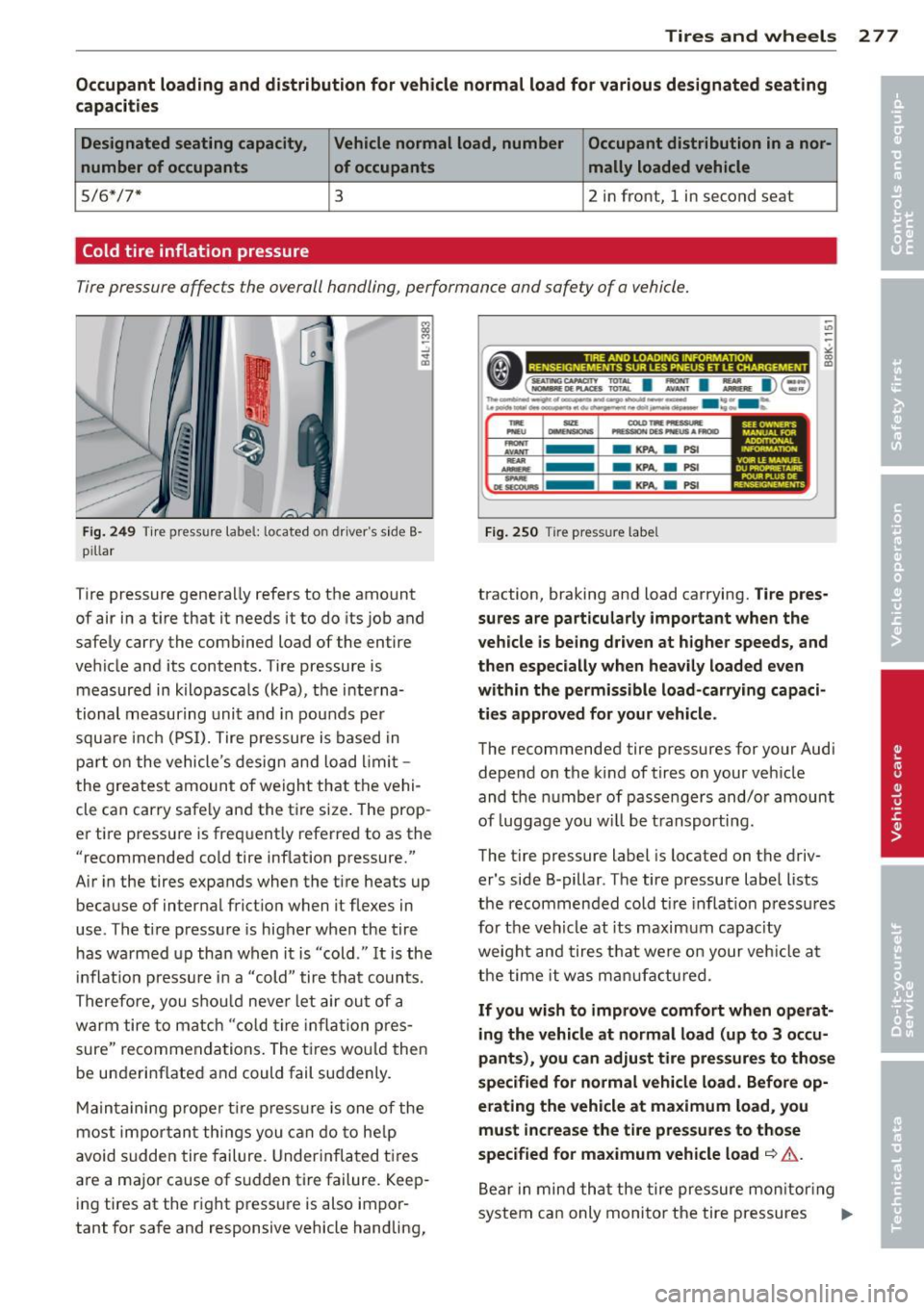
Tire pressure affects the overall handling, performance and safety of a vehicle.
I
JJ
0
Fig. 249 Tire pressure labe l: located on driver 's s ide B·
p ill ar
Tire pressure genera lly refers to the amount
of air in a tire that it needs it to do its job and
safely carry the combined load of the entire
vehicle and its contents . Tire pressure is
measured in kilopasca ls (kPa), the i nte rna
tional measur ing unit and in pounds pe r
squa re i nch (PSI). Tire pressure is based in
part on the vehicle 's design and load limi t -
the greatest amount of weight that the vehi cle can carry safe ly and the t ire size . The prop
er tire pressure is frequent ly referred to as the
"recommended cold tire inflation pressure."
A ir in the tires expands when the tire heats up
because of internal friction when it flexes in
use . The tire p ressu re is higher when the tire
has warmed up than when it is "cold ."
It is the
i nflat ion p ressure i n a "cold " tire that counts.
Therefo re, you shou ld neve r let air out of a
warm tire to ma tch "cold tire infla tion pres
sure" recommendations. The t ires wo uld then
be underinflated and could fail suddenly .
M aintaining p roper t ire press ure is one of the
most impor tant things you can do to he lp
avoid sudden tire failure. Underinflated t ires
are a ma jo r cause of s udden tire failure . Keep·
ing tires at the right pressure is also impor
tant for safe and responsive vehicle handling,
-tD
-
---------------------.. ,;
•(==.: I :::; I :,,. I)@ gi n. ............ .,_____, .... -.ito._.. ____ .... _ ...
&..p0idit,101111-~--.,...,....-- ..... ~ .... ..
-··-.....
-
-Dlst<:OURS
- KPA.. a PSI
- KPA..
a PS I
- KPA.. a PSI
Fig. 2 50 Tire pressu re labe l
traction, braking and load carrying. Tire p res
sures are particularly importa nt when the
vehicle is being dr iven at higher speeds, and
th en e spe cially when heav ily load ed even
with in the permissible load-carrying capaci
ties approved for your veh icle.
The recommended tire pressures for your Audi
depend on the kind of tires on your ve hicle
and the n umbe r of passengers and/o r amount
of luggage you w ill be transporti ng.
The tire pressure label is located on the driv
er's side B -pillar . The tire pressure labe l lists
the recommended cold t ire inflat io n pressures
for t he vehicle at its maxi mum capac ity
weight and tires that were on your veh icle at
t he time it was m anufactu red.
If you wish to improve comfort wh en operat
ing the vehicle at normal load (up to 3 occu
pant s), you can adju st tire press ures to those
spe cified for n ormal vehi cle load . Before op
erating the vehicle at maximum load , you
must increase the tire pre ssure s to those
specified for ma ximum vehicle load
¢ & .
Bear in mind that the tire pressure mon itor ing
system can only monitor the tire pressures
II>
Page 280 of 340
278 Tires and wheels
you have stored. The system does not recog
nize the load condition of your vehicle.
The effectiveness of the tire pressure monitor
ing system w ill be impaired if yo u store nor
mal load pressures but then operate the vehi
cle at its maximum load¢.&. .
See the illustration¢
fig. 249 for the location
of the label on driver's side 8-pillar (color of
the actua l label and exact location on the ve
hicle wi ll vary slightly).
Note that the following table is accurate at
the time of going to press and is subject to
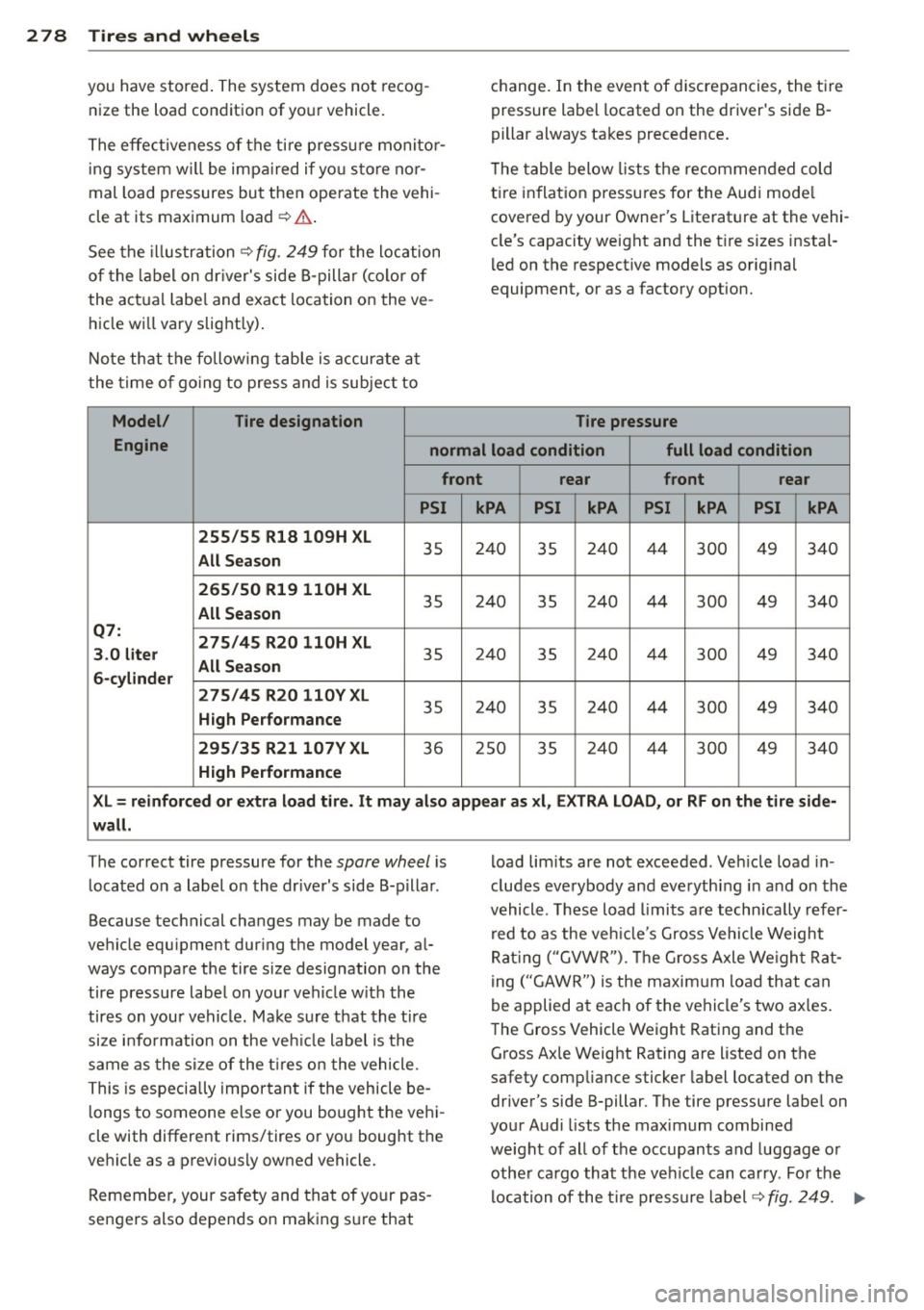
Model/ Tire designation
change. In the event of discrepancies, the tir e
pressure label located on the driver's side 8-
pillar always takes precedence.
T he table below lists the recommended cold
ti re inflation pressures for the Audi mode l
covered by your Owner's Literature at the vehi
cle's capacity weight and the t ire sizes instal
l ed on the respective models as original
equipment, or as a factory option.
Tire pressure
Engine normal load condition full load condition
front rear
front rear
PSI kPA PSI kPA PSI kPA PSI kPA
255/55 Rl8 109H XL
35 240 35 240 44
300 49 340 All Season
265/50 Rl9 llOH XL
35 240
35 240
44
300 49 340 All Season
Q7: 275/45 R20 llOH XL
3 .0 liter
35 240
35 240 44
300 49 340 All Season
6-cylinder
275/45 R20 llOYXL
35 240 35 240 44 300 49 340 High Performance
295/35 R21 107V XL
36 250 35 240 44 300 49 340
High Performance
XL= reinforced or extra load tire. It may also appear as xl, EXTRA LOAD, or RF on the tire side-
wall.
The correct tire pressure for the spare wheel is
located on a label on the driver's side 8-p illar .
Because technical changes may be made to
vehicle equipment dur ing the model year, al
ways compare the tire size designation on the
tire pressure label on your vehicle w ith the
tires on your vehicle. Make sure that the tire
size info rmation on the vehicle label is the
same as the size of the tires on the vehicle.
This is especially important if the vehicle be
l ongs to someone else or you bought the vehi
cle with different rims/tires or you bought the
vehicle as a previously owned vehicle.
Remember, your safety and that of yo ur pas
sengers also depends on making s ure that load
limits are not exceeded . Veh icle load in
cludes everybody and eve ryth ing in and on the
vehicle. These load limits are techn ica lly refer
red to as the veh icle's Gross Vehicle Weight
Rating ("GVWR"). The Gross Axle We ight Rat
ing ("GAWR") is the maximum load that can
be applied at each of the vehicle's two ax les.
The Gross Vehicle Weight Rating and the Gross Axle Weight Rating are listed on the
safety comp liance sticker label located on the
driver's side 8-pillar . The tire pressure label on
your Audi lists the maximum combined
weight of all of the occupants and luggage or
other cargo that the veh icle can carry . For the
location of the tire pressure label¢
fig. 249. ..,_
Page 282 of 340
28 0 T ire s and wheel s
your veh icle and in this manua l and the kind
of driving yo u plan to do .
Neve r e xcee d the m ax imum inflati on pres
s u re list e d on th e tir e s ide wall f or a ny r ea
s on.
Remember that the vehicle manufacturer, not
the tire manufacturer , determ ines the co rrect
tire pressure for the t ires on your veh icle .
It is important to check the tire pressure when
the tires a re cold .
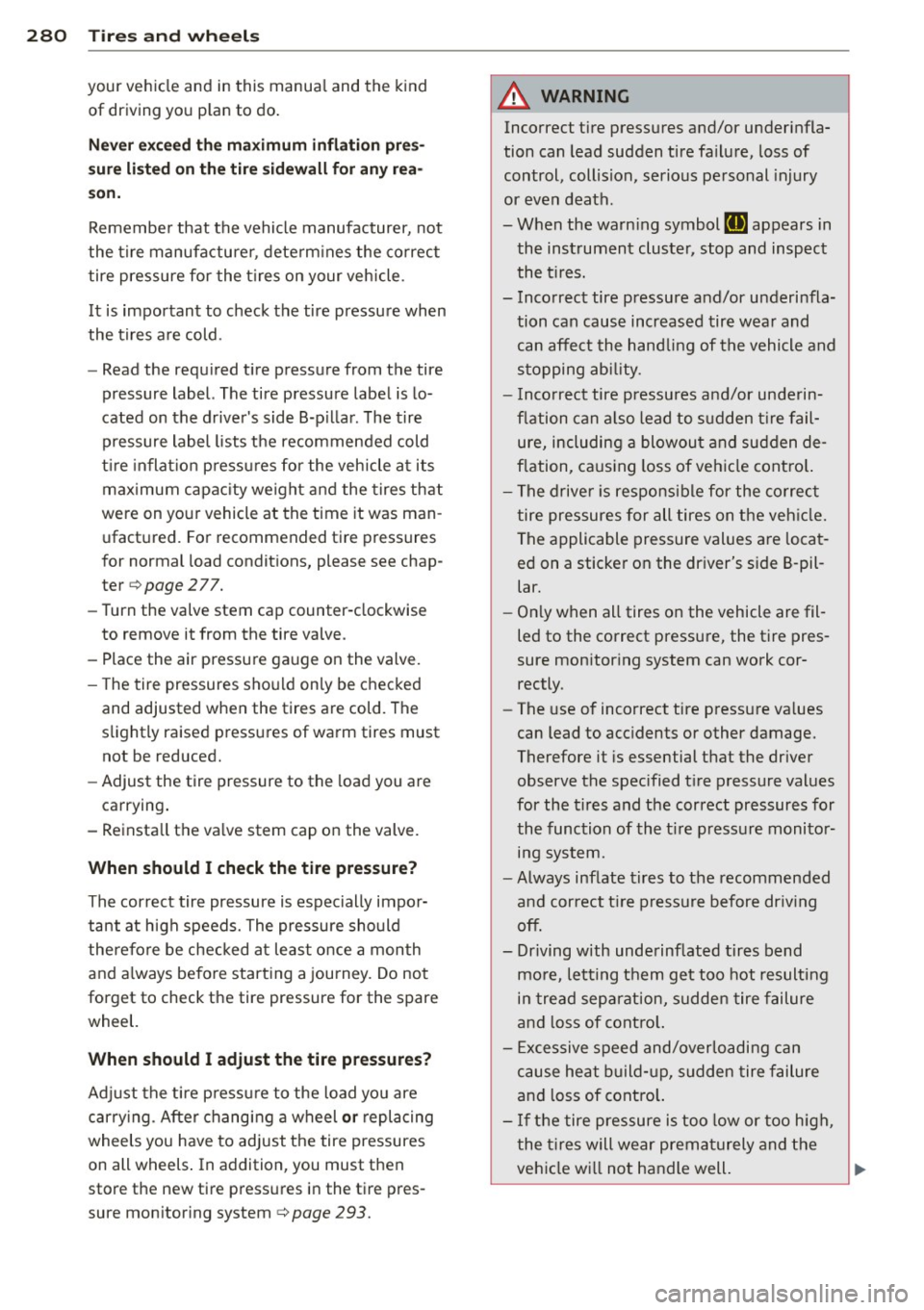
- Read the required t ire pres sure from the tire
pressure label. The ti re pressure label is lo
cated on the driver's side 8-p illar . The t ire
pressure label lists the recommended cold
t ire inflat ion p ressu res for the veh icle at its
maximum capacity we ight and the tires that
were on you r vehicle at the time it was man
ufactured . For recommended tire pressures
for normal load condit ions, please see chap
ter
c:> page 2 77.
- Turn the valve stem cap counter-clockwise
to remove it from the tire valve.
- Place the a ir pressure gauge on the valve.
- T he tire pressures should on ly be checked
and adjusted when the tires are cold. The
s li ghtly raised pressures of warm tires must
not be reduced.
- Adjust the tire pressure to the load you are
carrying .
- Reinsta ll the va lve stem cap on the valve.
When should I check the tire pressur e?
The correct tire pressure is especially impor
tant at high speeds. The pressure should
therefore be checked at least once a month
and always befo re starting a journey. Do not
forget to check the tire pressure for the spare wheel.
When should I ad ju st th e tire p re ss ures?
Adj ust the tire p ressure to the load you are
carry ing . After chang ing a wheel
or replacing
wheels you have to adjust the tire pressures
on all wheels . In addition, you must then
store the new tire press ures in the tir e pres
sure monito ring system
c:> page 293.
A WARNING
Incorrect tire pressures and/or underinfla
tion can lead sudden tire fa ilure, loss of
control, collision, serious personal injury
or even death .
- When the warn ing symbol
[I] appears in
the instrument cluster, stop and inspect
the t ires.
- Incorrect tire pressure and/or underinfla
tion can cause increased tire wear and
can affect the hand ling of the vehicle and
stopping abi lity.
- I nco rrect tire pressures a nd/or underin
f lation can a lso lead to sudden t ire fail
ure, including a blowout and sudden de
flation, ca using loss of vehicle contro l.
- The drive r is responsible for the correc t
tire pressures for all tires on the veh icle.
The applicable pressure values are locat
ed on a sticker on the driver's side B -pil
lar.
- On ly when all tires on the vehicle are fil
led to the correct pressure, the tire pres
sure mon itoring system can work cor
rectly.
- The use of incorrect tire pressure va lues
can lead to acc idents or other damage.
Therefore it is essential that the driver
observe the spec ified t ire pressure values
for the tires and the correct pressures for
the function of the t i re press ure monitor
ing system.
- Always inflate t ires to the recommended
and correct t ire p ressure before dr iv ing
off.
- Driving with underinf lated tires bend
mo re, letting them get too hot resulting
in tread sepa ration, s udde n tire failure
and loss of cont ro l.
- E xcessive speed and/overloadi ng can
cause heat b uild- up, sudden tire failure
and loss of cont ro l.
- I f the tire pressure is too low or too high,
the t ires will wear prema turely and the
vehicle wi ll not handle well. ..,