fuel pressure AUDI Q7 2014 Owner´s Manual
[x] Cancel search | Manufacturer: AUDI, Model Year: 2014, Model line: Q7, Model: AUDI Q7 2014Pages: 340, PDF Size: 85.02 MB
Page 5 of 340
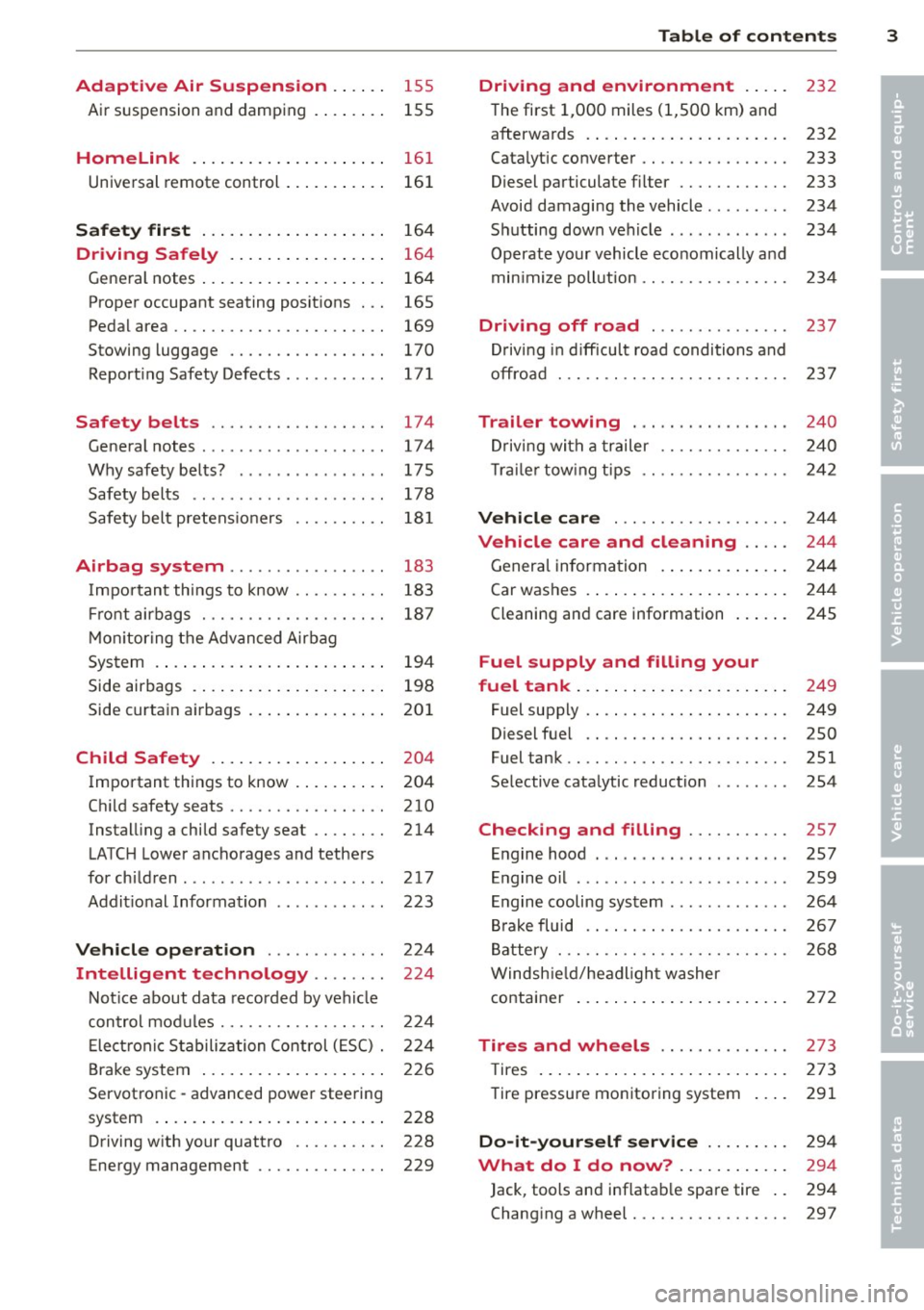
Adaptive Air Suspension .. .. . .
Air suspension and damping 155
155
Homelink . . . . . . . . . . . . . . . . . . . . . 161
Universal remote control . . . . . . . . . . . 161
Safety first . . . . . . . . . . . . . . . . . . . . 164
Driving Safely . . . . . . . . . . . . . . . . . 164
General notes ................... .
Proper occupant seating positions . . .
Pedal area .. .. ............. .. .. . .
Stowing luggage ......... .... .. . .
Reporting Safety Defects ....... ... .
Safety belts ............... .. . .
General notes ......... ...... .... .
Why safety belts? ........... .... .
Safety belts ..... .. ...... .. .. .. . .
Safety belt pretensioners .. .. .. .. . .
Airbag system .......... ... ... .
Important things to know .... .. .. . .
Front airbags ................ .. . .
Monitoring the Advanced Airbag
System .... .. .............. ... . .
Side airbags ................ ... . .
Side curtain airbags .......... ... . .
Child Safety ................. . .
Important things to know ........ . .
Child safety seats ......... .... .. . .
Installing a child safety seat .. .. .. . .
LATCH Lower anchorages and tethers
for children .... .. .. ...... .. .. .. . .
Additional Information
Vehicle operation ....... .. .. . .
Intelligent technology .. .. . .. .
164
165
169
170
171
174 174
175
178
181
183
183
187
194
198
201
204
204
210
214
217
223
224
224
Notice about data recorded by vehicle
control modules . . . . . . . . . . . . . . . . . . 224
Electronic Stabilization Control (ESC) . 224
Brake system . . . . . . . . . . . . . . . . . . . . 226
Servotronic -advanced power steering
system . . . . . . . . . . . . . . . . . . . . . . . . . 228
Driving with your quattro . . . . . . . . . . 228
Energy management . . . . . . . . . . . . . . 229
Table of contents 3
Driving and environment . . . . .
232
The first 1,000 miles (1,500 km) and
afterwards . . . . . . . . . . . . . . . . . . . . . . 232
Catalytic converter . . . . . . . . . . . . . . . . 233
Diesel particulate filter . . . . . . . . . . . . 233
Avoid damaging the vehicle . . . . . . . . . 234
Shutting down vehicle . . . . . . . . . . . . . 234
Operate your vehicle economically and
min imize pollution .. . ............ .
Driving off road .............. .
Driving in difficult road conditions and
offroad . .. .. .. .. .... ........... .
Trailer towing .... .. .. ... ..... .
Driving with a trailer ........... .. .
Trailer towing tips .. . ............ .
Vehicle care ... .. .. ........... .
Vehicle care and cleaning .... .
General information ............. .
Car washes . ....... ............. .
Cleaning and care information ..... .
Fuel supply and filling your
fuel tank ... .... .. ............. .
Fuel supply . ... .. .. ............. .
Diesel fuel .. .. ...... ........... .
Fuel tank .. .. .. .. ... ............ .
Selective catalytic reduction ....... .
Checking and filling .......... .
Engine hood ..... .... .... ... .... .
Engine oil ... .. .. .. . .. .... ...... .
Engine cooling system ............ .
Brake fluid .. .. .. ............... .
Battery ..... .. .. .. .. ........... .
Windshield/headlight washer 234
237
237
240
240
242
244
244
244
244
245
249
249
250
251
254
257
257
259
264
267
268
container . . . . . . . . . . . . . . . . . . . . . . . 272
Tires and wheels . . . . . . . . . . . . . . 273
T ires . . . . . . . . . . . . . . . . . . . . . . . . . . . 273
Tire pressure monitoring system 291
Do-it-yourself service . . . . . . . . . 294
What do I do now? . . . . . . . . . . . . 294
Jack, tools and inflatable spare tire . . 294
Changing a wheel . . . . . . . . . . . . . . . . . 297
•
•
Page 35 of 340
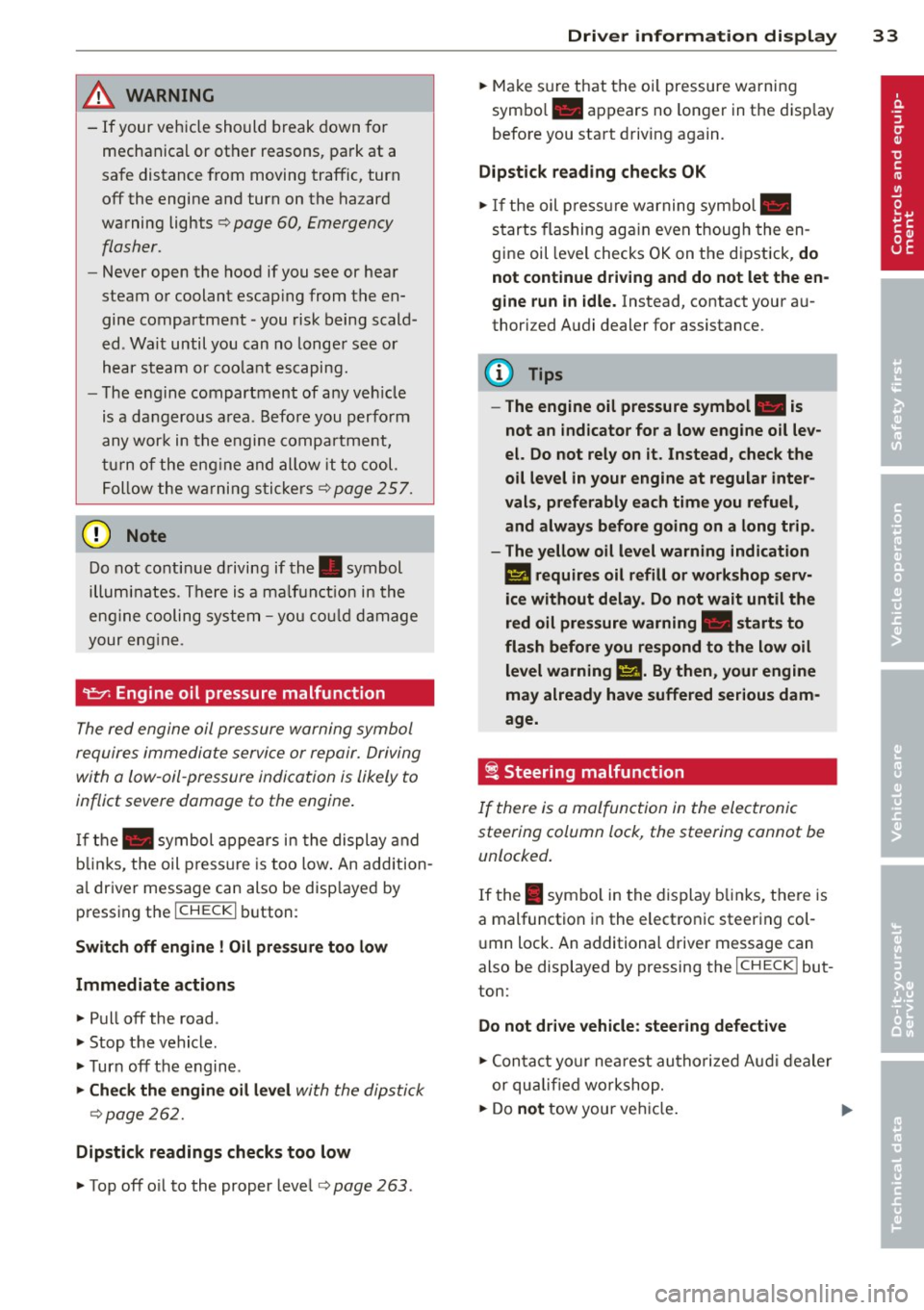
& WARNING
-If your veh icle should break down for
mechanical or other reasons, park at a
safe distance from moving traffic, turn off the engine and turn on the ha zard
warning lights¢
page 60, Emergency
flasher .
-
-Never open the hood if you see or hear
steam or coolant escap ing from the en
gine compartme nt -you risk being scald
ed . Wa it until you can no longe r see or
hear stea m or coo la nt escaping.
- The eng ine compartment of a ny veh icle
is a dangerous a rea . Before you perfo rm
any wor k in the engine compa rtme nt,
t ur n o f the eng ine and allow it to cool.
F ollow the warning stick ers ¢
page 257.
(D Note
Do not co nti nu e d riving if the . symbol
illumi nates. T here is a m alf unct io n in the
eng ine cooling system -you co uld dam age
your eng ine .
"t:::7: Engine oil pressure malfunction
The red engine oil pressure warning symbol
requires immediate servi ce or repair. Driving
with a low -oil -pressure indication is likely to
inflict severe damage to the engine .
If the. symbol appe ars in the display and
b links, the oil press ure is too low . An addition
a l driver message can also be disp layed by
pressing the
I CH ECK i button :
Switch off engine! Oil pre ssure too low
Immediate actions
~ Pull off the road .
~ Stop the vehicle.
~T urnoff the engine .
~ Check the engine oil lev el with the dipsti ck
¢page 262.
Dipstick readings checks too low
~ Top off o il to the proper level¢ page 263 .
Driver information di spla y 33
~ Make s ure that the oi l pressure wa rning
symbo l. appears no longer in the disp lay
befo re you sta rt driv ing again.
Dipstick reading checks OK
~ If the oil press ure warning symbol.
starts flashing aga in even thoug h the en
gine oil leve l checks OK on the dipstick,
do
not continue driving and do not let the en
gine run in idle .
Instead, contact your au
thori zed A udi dealer for assistance.
(D Tips
- The engine oil pressure symbol. is
not an indicator for a low engine o il lev
el. Do not rely on it . Instead, check the
oil level in your engine at regular inter
vals, preferably each time you refuel,
and always b efore going on a long trip .
- The yellow oil level warning indication
l!I requires oil refill or workshop serv
ice without delay . Do not wait until the
red oil pressure warning. start s to
fla sh before you. respond to th e low oil
level warning l!I. By then, your engine
may already have suffered serious dam
age.
i Steering malfunction
If there is a malfunction in the electronic
steering column lock, the steering cannot be
unlocked .
If the . symbo l in the display b links, the re is
a malfunction i n the elect ro nic steer ing col
u mn lock. An additional driver message can
also be displayed by pressing the
ICHECK I but
ton:
Do not drive vehicle: steering defective
~ Contact your nea rest au thori zed Aud i deale r
or qu alified worksho p.
~ Do not tow your ve hicle. .,..
Page 37 of 340
•
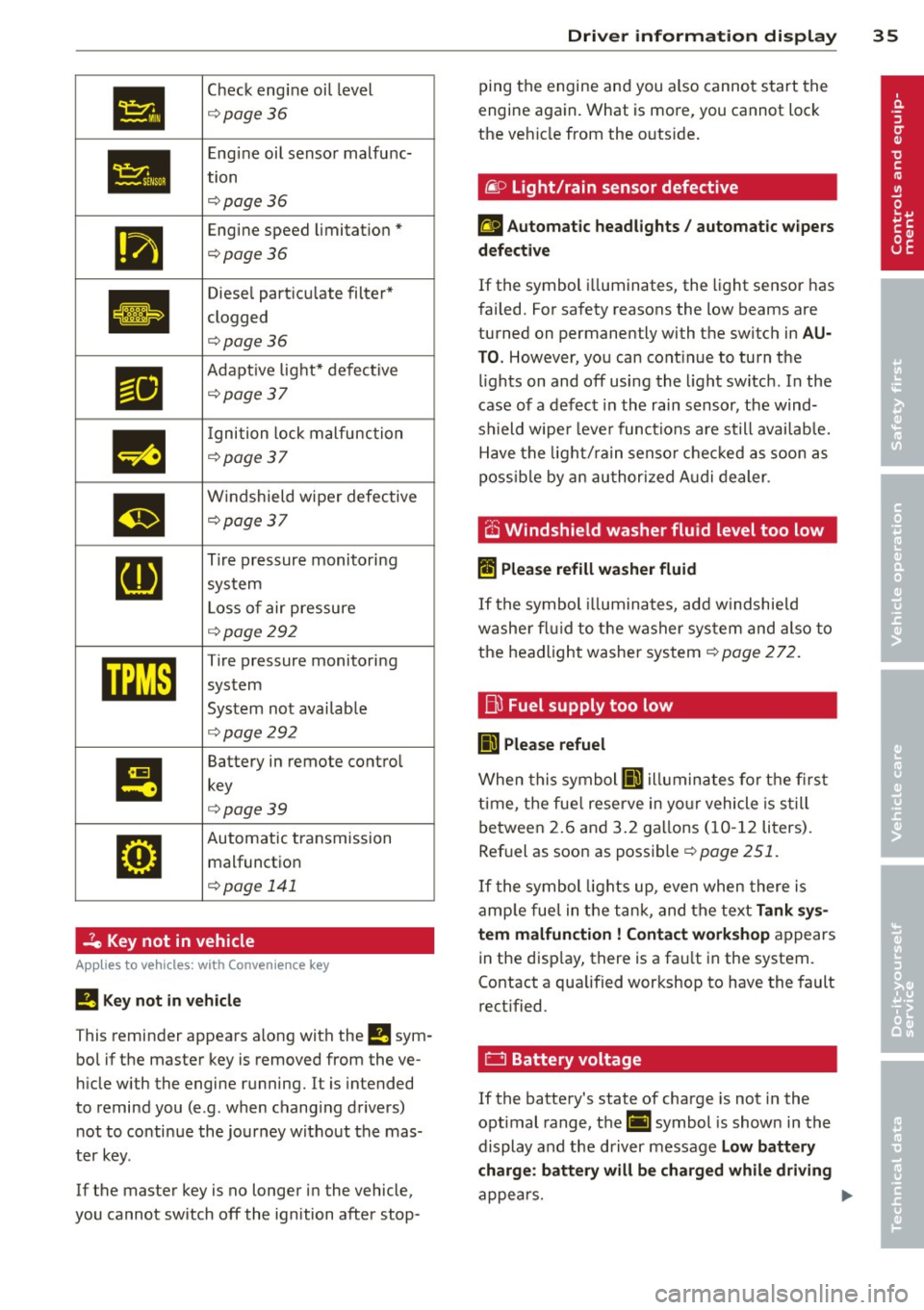
Check engine oi l level
¢ page36
•
Engine oil sensor malfunc-
tion
¢page 36
111
Engine speed limitation*
¢page36
Ill
Diesel particu late filter*
clogged
.
¢page36
Ill
Adapt ive light* defective
¢page37
m
I gnition lock malfunction
¢page 37
m
Windshield wiper defective
¢page37
[I]
Tire pressure monitoring
system
L oss of air pressure
¢ page292
mm
Tire pressure monitoring
system
System not avai lab le
¢ page292
I!
Battery in remote contro l
key
¢page39
•
Automatic transmission malfunction
¢ page 141
2e Key not in vehicle
Applies to vehicles: with Convenience key
!I Key not in ve hicle
This reminder appears a long with the !I sym
bo l if the master key is removed from the ve
hi cle with the engine running.
It is intended
to remind you (e.g. when changing drivers) not to continue the journey w ithout the mas
ter key.
If the master key is no longer in the vehicle,
you cannot sw itch
off the ignition after stop-
Dri ver information di spla y 35
ping the engine and you also cannot start the
engine again. What is more, you cannot lock
the ve hicle from the outs ide .
liP Light/rain sensor defective
£I Automatic headlights / automatic w ipers
d efe ctiv e
If the symbol i lluminates, the light sensor has
failed. For safety reasons the low beams are
turned on permanently with the switch in
AU
T O . However, you can cont inue to turn the
l ights on and
off using the l ight sw itch. In the
case of a defect in the rain sensor, the wind
shield wipe r lever functions a re still availab le.
Have the light/ rain senso r chec ked as soon as
poss ib le by an au thorized A udi dealer .
.-v ~,
O Windshield washer fluid level too low
II Plea se refill wa she r fluid
If the symbol illum ina tes, add w indshie ld
washe r fl ui d to the washer sys tem and also to
the headlight washer system¢
page 272.
fj)
Fuel supply too low
II) Ple ase refuel
When this symbol II) illuminates for the first
t ime, the fue l reserve in yo ur vehicle is s till
between 2.6 and 3.2 ga llons (10- 12 liters).
Ref uel as soon as possible¢
page 251.
If the symbol lights up, even when there is
amp le fue l in the tank, and the text
Tank sy s
tem malfuncti on! Contact work shop
appears
in the disp lay, there is a fa ult in the system.
Contact a qualified workshop to have the fault
rect ified.
0 Battery voltage
If the battery's state of charge is not in the
optimal range, the(•] symbol is shown in the
display and the driver message
Low battery
charge : batt ery will be char ged whil e driving
appea rs. .,.
Page 68 of 340
66 Clear vis ion
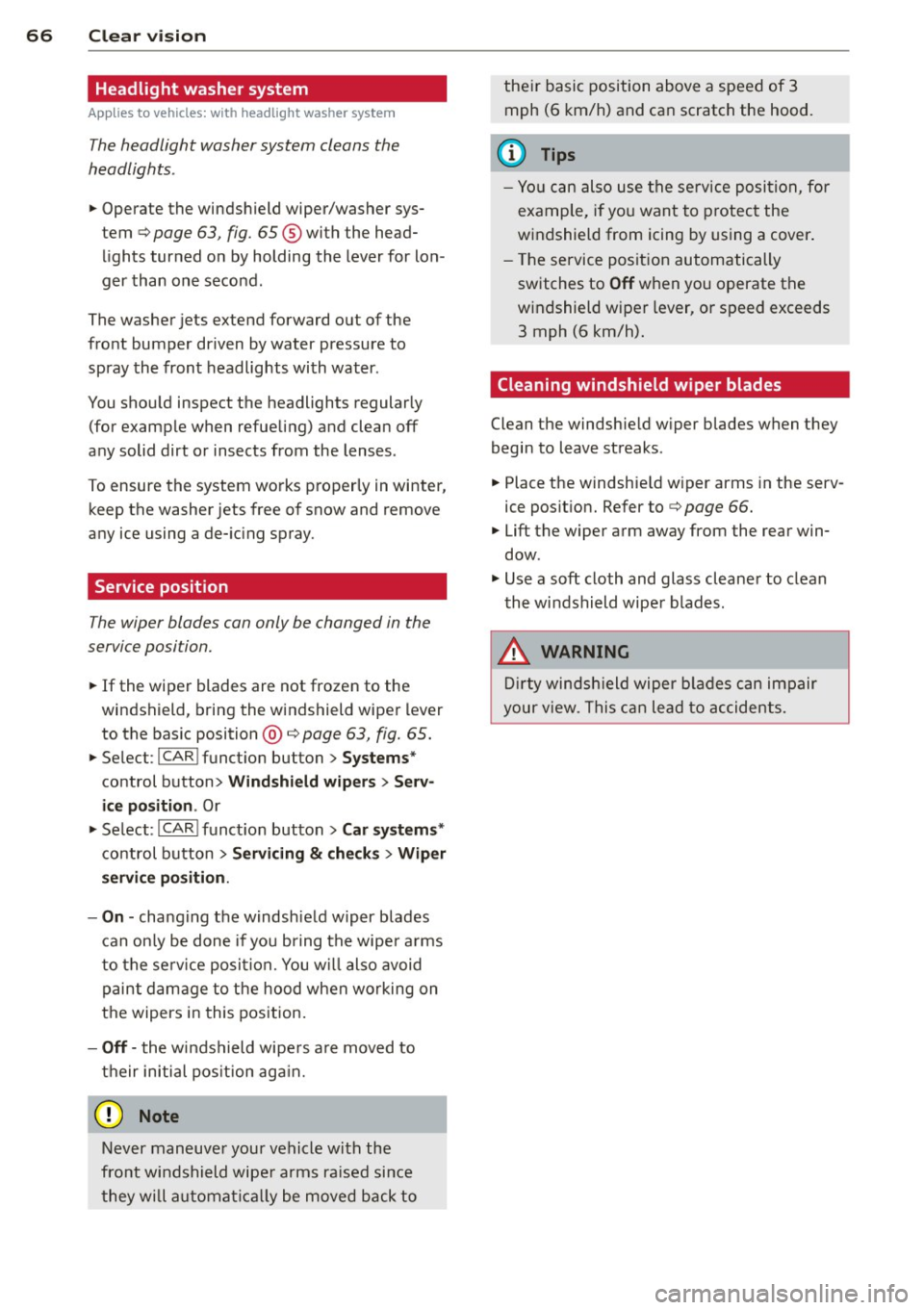
Headlight washer system
Ap plies to vehicles: with hea dlig ht washer syste m
The headlight washer system cleans the
headlights .
.. Operate the windshield wiper/washer sys
tem
q page 63, fig. 65 ® with the head
lights turned on by holding the lever for lon
ger than one second .
The washer jets extend forward out of the
front bumper driven by water pressure to
spray the front headlights with water .
You shou ld inspect the headlights regularly
(for example when refueling) and clean off
any solid dirt or insects from the lenses .
To ensure the system works proper ly in winter,
keep the washer jets free of snow and remove
any ice using a de- ic ing spray.
Service position
The wiper blades can only be changed in the
service position.
.. If the wiper blades are not frozen to the
windshield, bring the windshield wiper lever
to the basic position@¢
page 63 , fig. 65 .
.. Se lect :
I CAR I function button> S ystems *
control button> Windshi eld w ip e rs > S er v
ice positi on.
Or
.. Se lect :
I CAR ! funct io n button > Car sy stems *
control button > Servicing & checks > Wiper
servic e po sition .
-On -chang ing the windshield w iper b lades
can on ly be done if you bring the wiper a rms
to the se rv ice posi tion. You w ill also avoid
paint damage to t he hood when working on
the wipers in this pos ition.
- Off -the wi ndshield wipe rs a re moved to
their initial pos ition aga in.
(D Note
N ever maneuve r your vehicle with the
front windshield wipe r arms ra ised si nce
they wi ll a utomat ica lly be moved back to the
ir basic position above a speed of 3
mph
(6 km/h) and ca n scratch the hood.
(D Tips
- Yo u can also use the se rv ice posi tion, for
examp le, i f you want to p rotec t the
windshield from icing by using a cover .
- T he service posit ion automatically
switches to
Off when you operate the
w indshield wiper lever, or speed exceeds
3 mph (6 km/h).
Cleaning windshield wiper blades
Clean the windshie ld w iper b lades when they
begin to leave st reaks .
.. Place the windsh ie ld w iper arms in the serv
ice pos it ion. Refer to ¢
page 66.
.. Lift the wiper arm away from the rear win
dow .
.. Use a soft cloth and glass cleane r to clean
the wi ndshield wipe r blades.
.&_ WARNING
Dir ty windsh ield wipe r blades can impair
your view. This can lead to accidents.
.
Page 263 of 340
VW 502 00 (vehicles with gasoline engine) or
VW
507 00 (vehicles with diesel engine).
C han gin g the en gin e o il
The engine oil and oil filter must be changed
according to the m ileage (ki lomete rs) and
time inte rva ls specified in your vehicle 's War
r anty
& M aintenance booklet. Do not ex ceed
t hese intervals -harmf ul depos its from old
engine oi l can reduce engine performance and
can lead to expensive engine repairs.
Changing the o il at the recommended inte r
va ls is so very important because the lub ric at
ing p roperties o f oi l decrease grad ually during
norma l vehicle use . If you are not sure when
you have yo ur oi l changed, ask your a uthor
ized A udi Service Advisor.
Unde r some ci rc u mstances the engine o il
should even be changed more frequently.
Change o il more often if you drive mostly
short distances, operate the vehicle in dusty
areas or mostly under stop-and-go traffic con
d itions, or when you use your vehicle where
temperatures stay below freezing po int for
l ong periods .
Detergent addit ives in the o il w ill make fresh
oil look dark after the eng ine has been run
ni ng fo r a short time . This is no rmal and is not
a reason to change the o il mo re often than
r ec om mended.
Damage or malfun ctions due to lack of
maintenance
It is essential that yo u change your oil at the
recommended interva ls using only engine oil
that complies with Audi oi l standard
VW
502 00 (vehicles with gasoli ne engine) or
VW
507 00 (veh icles with diesel engine) . You r
Lim ited New Vehicle Wa rra nty does not cove r
damage or m alfu nct ions due to f ailure to fol
l ow recommended maintenance and use re
q uir ements as set forth in the A udi Owner's
M anual and Warranty
& M aintenance book let.
Your dea ler will have to deny warranty cover
age un less you present to the dea ler proof in
the form of Service or Repa ir Orders that all
Checkin g and fillin g 261
scheduled maintenance was performed in a
timely manner.
· Engine oil consumption
To provide effective l ubr ication and cooling for
interna l eng ine parts, all interna l combustion
engines use some oi l. Oi l consumption varies
from eng ine to engine and may change over
the life of the engine . Engines tend to use
more o il du ring the b reak-in period tha n they
do afterward, when o il cons umption has sta
bilized. Depend ing on the way the vehicle is
driven and the operating conditions, oil con
s u mption can be up to
1 quart per 1,200
miles (l liter per 2,000 km) . Consumption
may be higher within the first
3,000 m iles
(5,000 km) .
U nder normal conditions , the rate of oi l con
s u mption depends on oi l quality as well as vis
cosity, engine speed (rpm), outs ide tempera
ture, road conditions, the amount of oil dilu
tion caused by condensed water or fue l resi
due, and ox idat ion of the o il. Oi l consumption
may increas e with eng ine wear over time, un
t il rep lacement of worn engine pa rts may be
come ne cessa ry.
Because of all these var iables, there is no
standard o r "n orma l" rate of o il cons umption .
We urge you to check the engine oil level at
regular interval s, preferably every time y ou
fill the fuel t ank, and always before a long
trip .
The oil pres sure warning light. i s not an
indicator of low engine oil level. If the warn
ing light does not go out after starting, or
flashes while dr iving (above 1500 rpm), a
buzzer will sound. It indicate s that the oil
pressure is too low . Stop the engine immedi
ately , check the engine oil level and add oil if
necessa ry. If the engine oil level is normal,
but the l ight continues to fla sh, do not keep
driving or let the engine idle, as damage may
occur .
IIJ,
•
•
Page 276 of 340
274 T ire s and wheel s
-Never mount used tires on yo ur vehicle if
you are not sure of their "previous histo
ry." Old used tires may have been dam
aged even though the damage cannot be
seen that can lead to sudden t ire failure
and loss of vehicle control.
- If you notice unusual vibration or if the
vehicle pulls to one side when driving, al
ways stop as soon as it is safe to do so
and check the wheels and tires for dam
age.
(D Note
Please note that summer and winter tires
are designed for the cond itions that are
Glossary of tire and loading terminology
Accessory weight
means t he comb ined we ight (in excess of
those sta ndard items which may be rep laced)
of au toma tic tra nsmission, power steer ing,
power brakes, power windows, power seats,
radio, and heater, to the extent that th ese
items are availab le as factory -installed equip
ment (whether installed or not) .
Aspect ratio
means t he ratio of the he ight to the w idth of
the tire in percent . Numbers of 55 or lower in
dicate a low sidewall for improved steering re
sponse and better overall handling on dry pavement .
Bead
means the part of the ti re that is made of
steel wires, wrapped or reinforced by ply cords
and that is shaped to fit the rim.
Bead separation
means a b reakdown of the bond between
components in the bead.
Cord
means the strands forming the plies in the
tire . typ
ica l in those seasons . Audi recommends
using winter tires during the winter
months . Low temperatures signif icant ly
decrease the e lasticity of summer tires,
which affects tract ion and brak ing ability.
If summer tires are used in very co ld tem
peratures, cracks ca n form on the tread
bars, res ulting in permanent tire damage
that can cause loud driving no ise and un
balan ced t ires. Audi is not responsible for
th is type of damage .
Cold tire inflation pressure
means the tire p ressu re recommended by t he
vehicle manufacturer fo r a tire of a des igna ted
s iz e that has not bee n driven for more than a
coup le of miles (k ilometers) at low speeds in
t h e three hour period before the tire pressure
is measured or adjusted.
Curb weight
mea ns the we ight of a motor ve hicl e w ith
standard equipment including the max imum
capacity of fuel, oil, and coolant, air condi
tioning and additional weight of optiona l
equipment.
Extra load tire
me ans a t ire design to operate at higher loads
and at h igher inflation pressures than the cor
responding standard tire . Extra load tires may
be identified as "XL", "x l" , "EXTRA LOAD", or
"RF" on the sidewall.
Gross A xle Weight Rating ("GAWR ")
means the lo ad -c a rry ing c apac ity of a s ingle
axle system , measured a t the tire-ground in
terfaces.
Gross Vehicle Weight Rating ("GVWR ")
mea ns the maximum total loaded we ight of
t h e ve hicl e. .,.
Page 293 of 340
month and always before a long trip
¢ page 2 79, Checking tire pressure.
What you can do to avoid tire and rim
damage
L ow aspect ratio tires can be damaged more
easi ly by impact with potho les, curbs, gu llies
or ridges on the road, particularly if the tire is
underinflated.
I n order to minimize the occurrence o f impact
damage to the tires of your vehicle, we recom
mend that you observe the following precau
tions :
- Always maintain recommended inflation
pressures. Check your tire pressure every
2,000 miles (3,000 km) and add air if neces
sary.
- Drive carefully on roads with potholes, deep
gullies or ridges. The impact from driving
through or over such obstacles can damage
your tires. Impact with a curb may also cause damage to your tires.
- After any impact, immediately inspect your
t ires or have them inspected by the nearest
authorized Aud i dealer . Replace a damaged
t ir e as soon as possible .
- Inspect your t ires every 2,000 miles (3,000
km) for damage and wear . Damage is not al
ways easy to see. Damage can lead to loss of
air and unde rinflation, wh ich could eventu
ally cause tire failure. If you be lieve that a
tire may have been damaged, replace the
tire as soon as possible.
- These tires may wea r more quickly than oth
ers.
- Please also remember that, while these tires
deliver responsive handling, they may ride
less comfortably and make more noise than
other choices .
Reduced performance in winter/cold
season conditions
All tires are designed for certain purposes .
The low aspect ratio, ultra high performance
tires originally installed on your veh icle are in
tended for max imum dry and wet road per
formance and handling . They are not suitable
for cold, snowy or icy weather condit ions . If
Tires and wheels 2 91
you drive under those ci rcumstances, you
shou ld equip your vehicle with all-season or
winter tires, which offer better traction under
those conditions. We suggest you use the rec ommended snow or all-season t ires specified
for your vehicle, or their equivalent .
Refer to
¢ page 288 for more detailed infor
mation regarding winter tires .
Tire pressure
monitoring system
ill General notes
Each tire, incl uding the spare (if provided),
shou ld be checked monthly when co ld and in
flated to the inflation pressure recommended by the veh icle manufacturer on the veh icle
placard or tire inflation pressure label. (If your
vehicle has tires of a d ifferent size than the
s iz e indicated o n the vehicle placard or tire in
flat io n pressu re lab el, you sho uld determine
the p roper tire inflation pressure for those
tires).
As an added safe ty feature, your veh icle has
been equipped with a tire pressure monito ring
system ( TPMS) that illuminates a low ti re
pressure telltale when one or more of your
tires is significantly under-inflated. According
l y, when the low tire pressure te lltale illumi
nates, you should stop and check your tires as
soon as possible, and inflate them to the
proper pressure . Driving on a sign ificantly un
der- inflated t ire causes the tire to overheat
and can lead to tire fa ilure. Under-inflation al
so reduces fuel efficien cy and tire tread life,
and may affect the vehicle's hand ling and
stopping ability .
Please note that the TPMS is not a subst itute
for proper tire maintenance, and it is the driv
er's responsibility to maintain correct tire
pressure, even if under-inflation has not
reached the leve l to tr igger illumination of the
T PMS low tire pressure tellta le .
Your vehicle has also been eq uipped with a
T PMS ma lfunction indicator to indicate when
the system is not operating properly. The
ll-
•
•
Page 328 of 340

326 Index
Engine oil level .... ..... ... .. .. .... .. 36 Fan
Eng ine oil pressure
M alfunct io n ............. .... .... .. 33
Eng ine oil sensor defective .... .. .... .. 36
E ngine speed limitation ... .. .. ... ... .. 36
Entry assist Rear seats . . . . . . . . . . . . . . . . . . . . . . . . . 76
Environment Break- in period ........... .... .... . 232
Cata lytic converter ......... ... .. ... 233
D iesel part iculate filter .. .. .. .. .. .. . 233
Disposing of your vehicle batte ry ..... 272
Dr iving a t high speeds ... .. .. .. .. .. . 234
Dr iving to m inim ize pollution and no ise 234
Fu el ... .. .. .. . .. ..... ... .. .. .... . 252
Fu el economy .. .. ..... ... .. .. .... . 234
Leaks under your vehicle ... .. ... ... . 257
Lett ing the vehicle stand and warm up . 235
Proper disposal of drained brake fluid . 268
Proper disposal of drained engine coo l-
ant ..... .. ................ ... ... 266
P roper disposal of dra ined engine oil .. 263
Recycl ing used engine oil . ...... .. .. . 263
Unleaded fuel ............. ...... .. 249
What should I do with an old ba ttery? 27 2
EPC
refer to Electron ic power control .. .. . . 1 5
E SC
refer to Electronic Stab iliza tion Control
(ESC) .. .. ................. .. .... .. 16
E vent Data Reco rder ( EDR) ... .. ... ... . 224
Exhaust tail p ipes
C leaning ................ .. .. .... . 246
Expansion tank .............. .. .... . 265
E xplanation of some technical terms . .. 23 7
Exterio r lighting in the mirror housing 59
Exterior mirrors
Ad justing ............... .... .... .. 68
Dimming . .. ............. .. .. .. ... . 69
H eating .. .. ... .... ...... ... ... .. .. 68
Eyeg lasses compartment . ... .. .... .. . . 90
F
Fa ll li ne . .. ... ............ .... .. .. . 23 7 Fo
ur-zone automatic comfort air condi-
t ion ing ... .. .. .. ... .. ..... ... .. .. . 99
Radiator .. .... .. ............. .... 267
F astening
Booster seats .... .. ... ..... ... .. .. 212
Convertib le child safety seats . .... . .. 211
Infant seats ..... ... .. ..... ... .. .. 210
Flat tire
Changi ng ... .. . .. ............ .. .. 29 7
Floor mats ...... ................... 169
Fog lights . ..... .. .. ... ..... ... .. .. . 58
Fold ing chocks .. . .. ............ .. .. 294
Folding master key with remote control .. 38
F oot peda ls ..... .. .. ... ..... ... .. .. 169
For the sake of the environment Gasoli ne fumes and the env ironme nt .. 252
Letting your eng ine warm up ........ 106
Red ucing engine noise by early upshift-
ing .. ... .. .... .. .. ... .. ..... ... .. . 10
R ef ueling ..... .. ... .. ..... ... .. .. 252
Sav ing fu el by early upshifting ... .. .. . 10
Using the rear window defogger .. .... . 96
F o ur -z o ne autom atic com fort air condi-
tioning ... .. .... .. ... .. .. ..... ... .. . 98
Automatic mode in rear . ..... ... .. .. . 99
Heated rear seats ... ... ..... ... .. .. 102
Rear air distrib ution . . . . . . . . . . . . . . . . 100
Rear controls ...................... 98
Rea r fan .. .. ... . ... ... .... ... .. .. . 99
Rear operation . .. ................ . 101
Rea r temperature . . . . . . . . . . . . . . . . . . . 99
Sy nchr onization ............... .... 101
T urning on/off . .. ............. .... . 99
Front a irbags
Description ...... ................ . 187
How they wor k ... .. ... ....... ... .. 192
Frontal coll is ions and the laws of phys ics 175
F ron t fog lights . . . . . . . . . . . . . . . . . . . . . . 58
Front seats . . . . . . . . . . . . . . . . . . . . . . . . . 72
Adjusting ..... ............ ....... 166
Child rest raints in the front seat ...... 185
Fuel Additives .. .... .. ............. .... 249
B lended gasoline ... ... ....... ... .. 249
Cons umption .. .. ................ .. 24
Filler neck ..... .................. . 251
Page 336 of 340
334 Index
Tread Wear Indicator (TWI) . ... .. .... . 283
Trip computer Fuel consumption . . . . . . . . . . . . . . . . . . 24
M ileage .... ............. .. .. .. .. .. 24
Sing le -tr ip memory ....... .. .. .... .. 25
Total -t rip memo ry . . . . . . . . . . . . . . . . . . 25
Trip odometer .............. ... .. ... . 12
What does it mean whe n dEF appears in
the t rip odomete r d isplay? . .. .. .... .. 12
Trunk
refer to Rear lid . . . . . . . . . . . . . . . . 45, 46
T u rn ing rear air conditioning on/off
Four -z one automatic comfort a ir condi-
tioning ...... ........... .. .. .... .. 99
T u rn signa ls . ... . .. ..... ... .. .. .... .. 60
Warning/indicator lights ... .. .. .... . . 16
u
Unfasten ing sa fe ty be lts
Unid irect iona l tires .......... ... .. .. .
Uniform ti re quality g rading ... .... .. .
Un lo ck ing 180
273
287
P owe r locking sw itch .... .. .. .. .. .. . . 44
Rear lid/trunk l id ......... .... .... .. 45
Remote control key . . . . . . . . . . . . . . . . . 4 3
Using the key . . . . . . . . . . . . . . . . . . . . . . 43
V
Va let key function
Activa ting and deactivating ... ... ... .. 41
Vanity m irror . . . . . . . . . . . . . . . . . . . . . . . . 62
Vehicle Care/clean ing ............ .. .. .... . 244
Vehicle ident ificat ion labe l ... .. .. .. .. . 3 13
Vehicle Identification N umber (VIN) ... . 313
Vehicle jack . . . . . . . . . . . . . . . . . . . 294, 299
Vehi cle liter ature . . . . . . . . . . . . . . . . . . . . . 5
Vehicle shut-down .......... ... .. .. . 234
Vent ilation
Climate controls . . . . . . . . . . . . . . . . . . . . 92
V in yl
C le a ning ... ... .......... .. .. .. .. . 247
w
Warning/ind ica tor lights . ..... .... . .. . 10
Adaptive Air Suspension . . . . . . . . . . . . . 17
Adaptive cruise control . ..... ... .. .. 121
Airbag system .................... . 16
Anti- lock brake system (ABS) . . . . . . . . . 18
Brake system ...... .... .... ... .. .. . 19
Cruise contro l . . . . . . . . . . . . . . . . . . . . . . 18
E lectronic power cont rol ... ...... ... . 15
El ectronic Stab ilization Contro l (ESC) .. . 16
G low p lug sys tem ............. .... . 15
Hig h beam .. .. .. ... .......... .. .. . 18
Malfunction Ind icator Lamp (M IL) .. .. . 17
Pa rking brake .... .. .... .... ... .. .. . 19
Safety be lt . . . . . . . . . . . . . . . . . . . . . . . . 18
Tire pressure monitoring system . . . . . . 18
Trail er turn s ignal assembly ... .. .... . 17
Turn signals ... .. ... .. .. ... ..... .. . 16
Warning lights . . . . . . . . . . . . . . . . . . . . . . 14
Wa rranty coverages .... ... ...... .. .. 316
Washer reservo ir .... ........... .. .. 272
Wea r indica to r .. .. .. .... .... ... .. .. 28 3
We ights ....... ... ................ . 313
What happens if yo u wear your safety belt
too loose? .. .... .. ............. .... 179
Wh at happens to unbelted o ccupants? .. 176
What impai rs driving safety? ....... ... 16S
What shou ld I do after changing a
whee l? . .... .... .. ................. 280
Wh at shou ld I do afte r repla cing whee ls? 280
Wheel bolts Torque ....... ... ................ . 290
Wheels . ... .... .. ... .. ..... .... . .. 273
Checking t ire pressure .......... .. .. 279
Cleaning .. .... .. ... .......... .... 246
Co ld tire inflation pressure .. ... ... .. 277
General notes .. .. .......... ...... . 273
G lossary of tire and loading terminolo-
gy ... .. .. .. .. .. ............... .. 274
New t ires and whee ls ........... .... 28 4
T ires and veh icle loa d limits ..... .... 281
When must a safety be lt be replaced? .. 177
When m ust the airbag system be inspect -
ed? .... .... .... .. ................. 194
When should I adjus t the tire pressures? 280
When should I check the tire press ures? . 280