tires AUDI Q7 2014 Owner´s Manual
[x] Cancel search | Manufacturer: AUDI, Model Year: 2014, Model line: Q7, Model: AUDI Q7 2014Pages: 340, PDF Size: 85.02 MB
Page 5 of 340
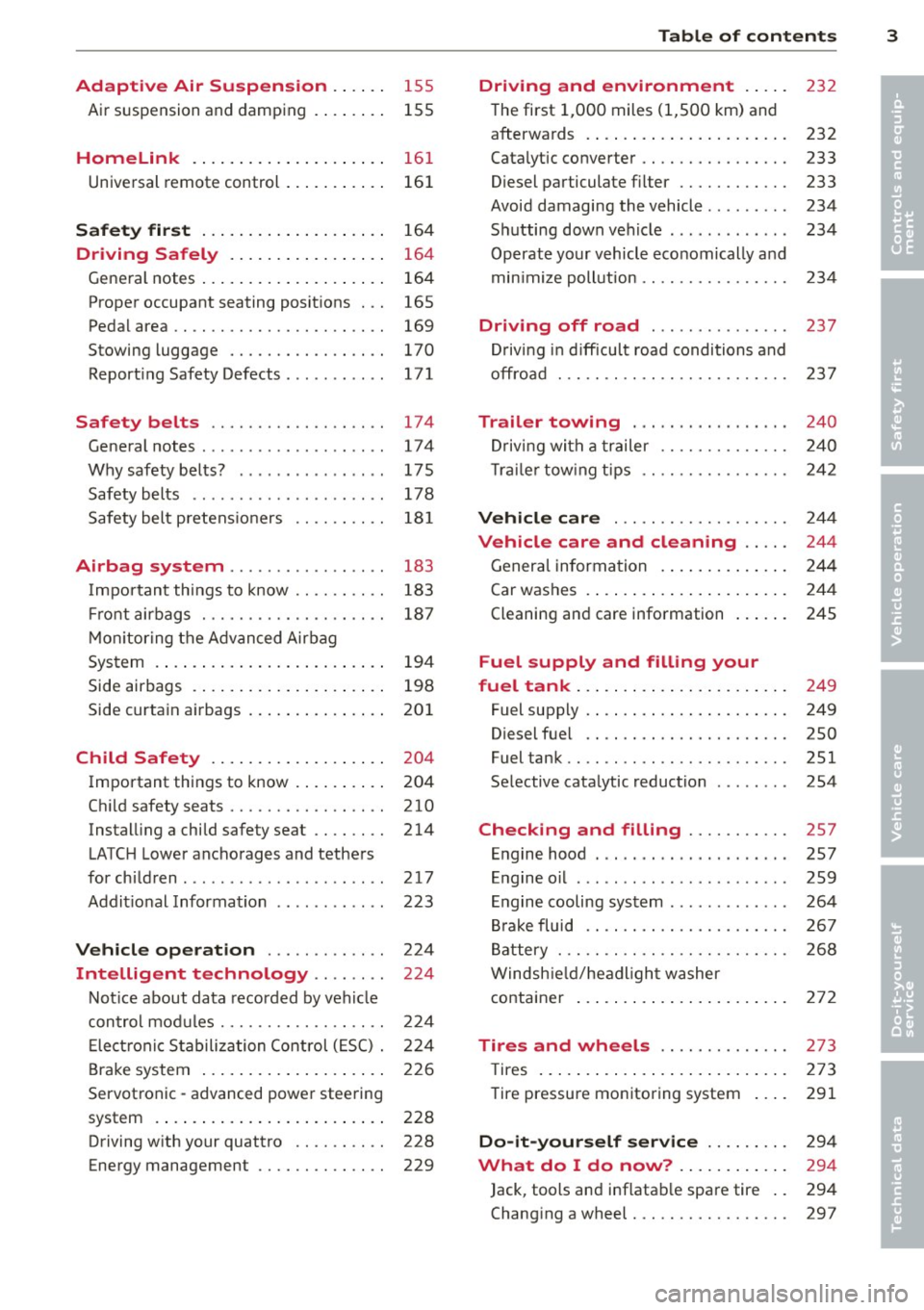
Adaptive Air Suspension .. .. . .
Air suspension and damping 155
155
Homelink . . . . . . . . . . . . . . . . . . . . . 161
Universal remote control . . . . . . . . . . . 161
Safety first . . . . . . . . . . . . . . . . . . . . 164
Driving Safely . . . . . . . . . . . . . . . . . 164
General notes ................... .
Proper occupant seating positions . . .
Pedal area .. .. ............. .. .. . .
Stowing luggage ......... .... .. . .
Reporting Safety Defects ....... ... .
Safety belts ............... .. . .
General notes ......... ...... .... .
Why safety belts? ........... .... .
Safety belts ..... .. ...... .. .. .. . .
Safety belt pretensioners .. .. .. .. . .
Airbag system .......... ... ... .
Important things to know .... .. .. . .
Front airbags ................ .. . .
Monitoring the Advanced Airbag
System .... .. .............. ... . .
Side airbags ................ ... . .
Side curtain airbags .......... ... . .
Child Safety ................. . .
Important things to know ........ . .
Child safety seats ......... .... .. . .
Installing a child safety seat .. .. .. . .
LATCH Lower anchorages and tethers
for children .... .. .. ...... .. .. .. . .
Additional Information
Vehicle operation ....... .. .. . .
Intelligent technology .. .. . .. .
164
165
169
170
171
174 174
175
178
181
183
183
187
194
198
201
204
204
210
214
217
223
224
224
Notice about data recorded by vehicle
control modules . . . . . . . . . . . . . . . . . . 224
Electronic Stabilization Control (ESC) . 224
Brake system . . . . . . . . . . . . . . . . . . . . 226
Servotronic -advanced power steering
system . . . . . . . . . . . . . . . . . . . . . . . . . 228
Driving with your quattro . . . . . . . . . . 228
Energy management . . . . . . . . . . . . . . 229
Table of contents 3
Driving and environment . . . . .
232
The first 1,000 miles (1,500 km) and
afterwards . . . . . . . . . . . . . . . . . . . . . . 232
Catalytic converter . . . . . . . . . . . . . . . . 233
Diesel particulate filter . . . . . . . . . . . . 233
Avoid damaging the vehicle . . . . . . . . . 234
Shutting down vehicle . . . . . . . . . . . . . 234
Operate your vehicle economically and
min imize pollution .. . ............ .
Driving off road .............. .
Driving in difficult road conditions and
offroad . .. .. .. .. .... ........... .
Trailer towing .... .. .. ... ..... .
Driving with a trailer ........... .. .
Trailer towing tips .. . ............ .
Vehicle care ... .. .. ........... .
Vehicle care and cleaning .... .
General information ............. .
Car washes . ....... ............. .
Cleaning and care information ..... .
Fuel supply and filling your
fuel tank ... .... .. ............. .
Fuel supply . ... .. .. ............. .
Diesel fuel .. .. ...... ........... .
Fuel tank .. .. .. .. ... ............ .
Selective catalytic reduction ....... .
Checking and filling .......... .
Engine hood ..... .... .... ... .... .
Engine oil ... .. .. .. . .. .... ...... .
Engine cooling system ............ .
Brake fluid .. .. .. ............... .
Battery ..... .. .. .. .. ........... .
Windshield/headlight washer 234
237
237
240
240
242
244
244
244
244
245
249
249
250
251
254
257
257
259
264
267
268
container . . . . . . . . . . . . . . . . . . . . . . . 272
Tires and wheels . . . . . . . . . . . . . . 273
T ires . . . . . . . . . . . . . . . . . . . . . . . . . . . 273
Tire pressure monitoring system 291
Do-it-yourself service . . . . . . . . . 294
What do I do now? . . . . . . . . . . . . 294
Jack, tools and inflatable spare tire . . 294
Changing a wheel . . . . . . . . . . . . . . . . . 297
•
•
Page 30 of 340
28 Driver information d isplay
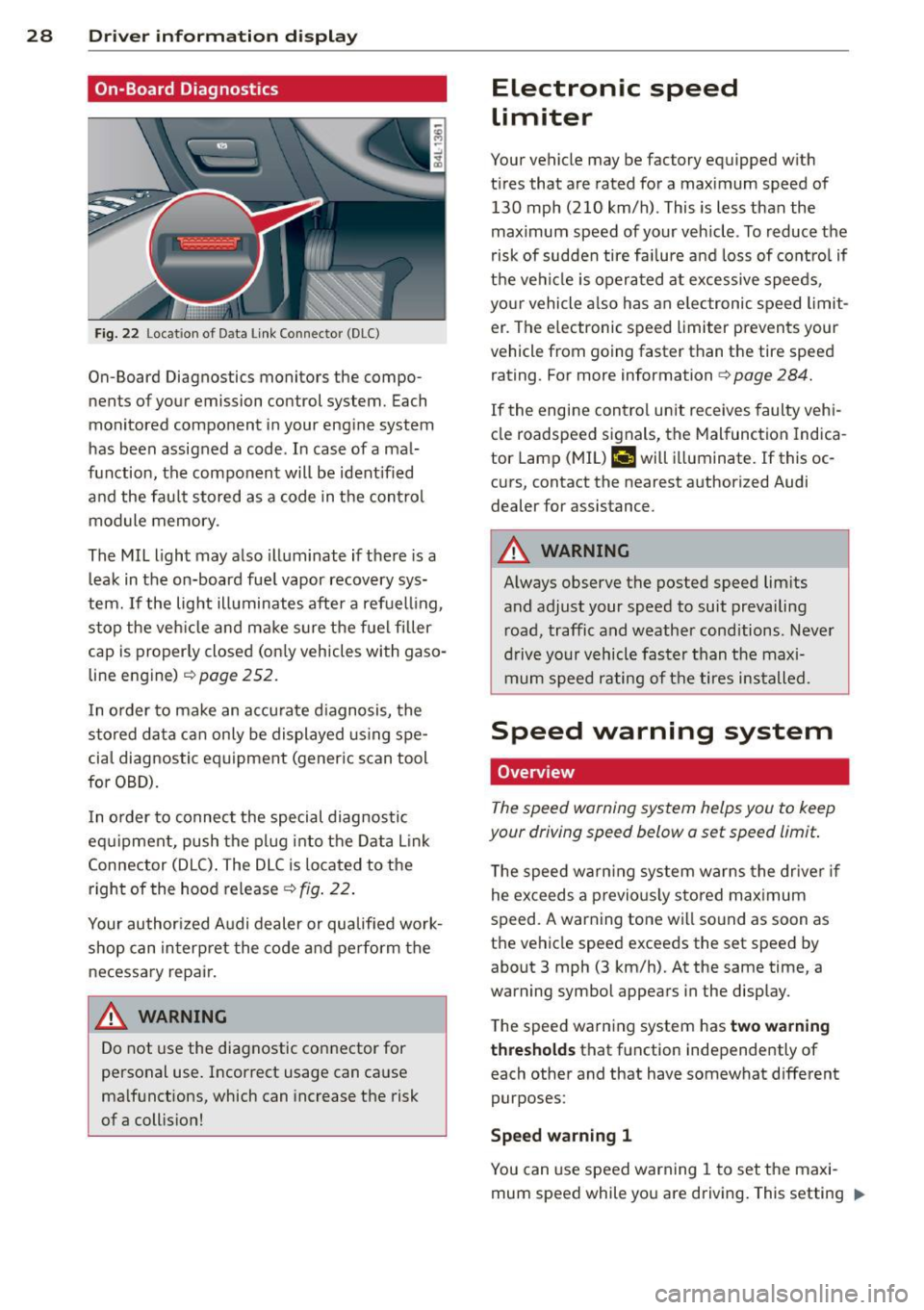
On-Board Diagnostics
Fig. 22 Locat ion of Data Link Connector (DLC)
On-Board Diagnostics monitors the compo
nents of your emission control system. Each
monitored component in your engine system
has been assigned a code . In case of a mal
function, the component will be ident ified
and the fault stored as a code in the control
module memory .
The MIL light may also illuminate if there is a
leak in the on-board fue l vapor recovery sys
tem.
If the light illuminates after a refuelling ,
stop the veh icle and make sure the fuel filler
cap is proper ly closed (on ly vehicles with gaso
line engine)
c::>page 252.
In o rder to make an accurate d iagnosis, the
stored data can only be displayed using spe
cial diagnostic equipment (generic scan tool
for OBD).
I n o rder to connect the special diagnostic
equipment, push the plug into the Data Link
Connector (DLC) . The DLC is located to the
right of the hood release
c::> fig . 22.
Your author ized Audi dealer or qualified work
shop can interpret the code and perform the
necessary repair.
A WARNING
Do not use the diagnostic connector for
personal use. Incorrect usage can cause
ma lfunctions, which can increase the risk
of a collis ion!
Electronic speed
limiter
Your vehicle may be factory equipped w ith
t ir es that are rated for a maximum speed of
130 mph (210 km/h) . This is less than the
maximum speed of your vehicle . To reduce the
risk of sudden tire fa ilure a nd loss of contro l if
the vehicle is operated at excessive speeds,
your vehicle also has an elec tronic speed limit
er . The e lectronic speed limiter prevents your
vehicle from going faster than the tire speed
rating . For more information
c::> page 284.
If the engine control unit receives faulty vehi
cle roadspeed signals, the Malfunction Indica
tor Lamp (MIL)
II will illuminate. If this oc
curs, contact the nearest authorized Audi
dealer for assistance.
A WARNING
-
Always observe the posted speed limits
and adjust your speed to suit prevailing
road, traffic and weather cond itions . Never
drive your vehicle faster than the maxi
mum speed rating of the tires installed.
-
Speed warning system
Overview
The speed warning system helps you to keep
your driving speed below a set speed limit.
T he speed warning system warns the driver if
he exceeds a previo usly stored maximum
speed . A warning tone wi ll so und as soon as
the vehicle speed exceeds the set speed by about 3 mph (3 km/h). At the same time, a
warning symbol appears in the display.
The speed warning system has
two warning
thresholds
that function independently of
each other and that have somewhat different
purposes:
Speed warning 1
You can use speed warning 1 to set the maxi
mum speed while you are driving. This setting "'
Page 31 of 340
will remain in effect until you turn off the igni
tion, assum ing that you have not changed or
reset the setting.
The speed warning symbol. (USA models)/
• (Canada mode ls) in the warning 1 display
appears when you exceed the maximum
speed . It goes out when the speed falls below
t he stored maximum speed.
The speed warning symbo l wi ll also go out if
the speed exceeds the stored maximum speed
by more than about 2S mph (40 km/h) for at
least 10 seconds. The stored maximum speed
is deleted .
Setting speed warning 1 <:!;>page 29.
Speed warn ing 2
Storing warn ing 2 is recommended if you al
ways want to be reminded of a certa in speed ,
for example when you a re traveling in a coun
try that has a general maximum speed limit,
or if you do not want to exceed a specified
speed for winter tires .
The speed warning 2 symbol, . (USA mod
els)/ . (Canada models) appears in the d is
p lay when you exceed the stored speed limit.
Unlike warning 1, it will not go out unti l the
vehicle speed drop s below the stored speed
limit.
Setting speed warning 2
r:!;> page 29.
@ Tips
Even though your vehicle is equipped with
a speed warning system, you should sti ll
watch the speedometer to make sure you
are not driving faster than the speed lim it.
Dri ver inform ation di spl ay 29
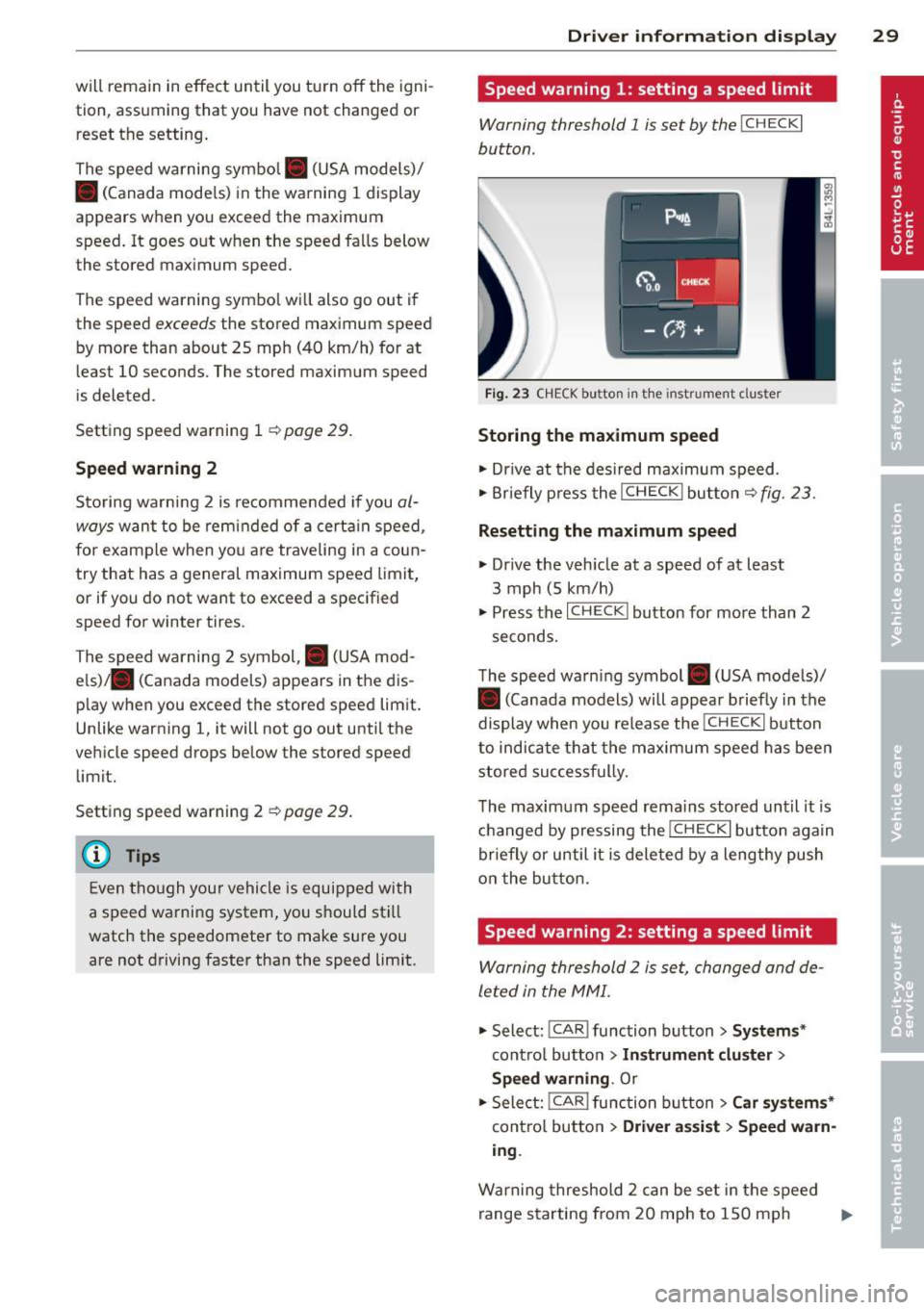
Speed warning 1: setting a speed limit
Warning threshold 1 is set by the I CH ECKi
button .
Fig . 23 CHECK button in the instr umen t clu ster
Storing the ma ximum speed
.,. Dr ive at the desired maximum speed .
.,. Briefly p ress the
I CHECK I but to n c::> fig. 23.
Resetting the m aximum speed
.,. Dr ive the veh icle at a speed of at least
3 mph (5 km/h)
.,. Press the
I CHECK ! button for more than 2
seconds.
T he speed warn ing symbol . (USA models)/
• (Canada models) will appear briefly in the
display when you release the
!CH ECK I button
to indicate t hat the maximum speed has been
stored suc cessf ully.
T he maximum speed rema ins stored until it is
changed by pressing the
! CHECK I button again
briefly or until it is deleted by a lengthy push
o n the bu tton.
Speed warning 2: setting a speed limit
Warning threshold 2 is set, changed and de
le ted in the MMI .
.,. Select:
I CAR I function button > Sys tem s*
contro l button > In strum ent clu ste r >
Spe ed warning .
Or
.,. Select: !CAR I function b utton > C ar sy ste m s*
cont ro l butto n > Driver a ssist > Speed w arn
ing .
Warning threshold 2 can be set in the speed
range starting from 20 mph to 150 mph ..,.
Page 112 of 340
110 On the road
The parking brake warning light. (USA)/ .
(CON) illuminates when the parking brake is
set and you switch on the ignition.
A WARNING
-
Always release the parking brake com
pletely. A partially engaged brake will
overheat the rear brakes, reduce their ef
fectiveness and cause excessive wear. This could lead to brake failure and an accident .
(D Note
Only after the vehicle has come to com
plete stop, should you firmly set the park
ing brake and
move the selector lever into
P.
Parking
• Press the brake pedal to stop the vehicle .
• Apply the parking brake firmly
r=,> page 109,
fig. 123 @.
• Move the selector lever to P.
.. Turn the engine off~_& .
.. When on inclines or declines, turn the steer
ing wheel so that the vehicle will roll into
the curb if it begins to
move.
A WARNING
This is how you can reduce the risk of in
jury when leaving your vehicle.
- Never park the vehicle where it can come
in contact with dry grass, spilled fuel or
any other flammable materials.
- When parking on hills, always turn the
wheels so that the front wheels will first
roll into the curb, if the vehicle should
start to roll.
- Never allow anyone - especially small
children - to remain in the vehicle when
it is locked. Locked doors make it more
difficult for rescuers to access the pas
senger compartment in the event of an
emergency. Danger to life!
- Never leave children unsupervised in the
vehicle. Children could release the park
ing brake or
move the gearshift lever out
-
of gear. The vehicle could start to roll
away and cause an accident.
- No matter what the season is, the tem
perature in a parked vehicle can reach
dangerous levels.
Q) Note
- Please exercise care when you park your
vehicle in parking areas with parking bar
riers or curbs. Parking barriers and curbs
vary in height and could damage your
bumper and related components as the
front of your vehicle
moves over a barrier
or curb that is too high, as you park or as
you back out of a parking spot. In order
to be sure that no such damage can oc
cur, you may wish to stop short of having
the front tires of your car touch the park
ing barrier or curb.
- Please also exercise exceptional care
when you drive up or down steep ramps
or drive
over curbs or other obstacles, for
which the vehicle is not designed, be
cause components of th@ vehicle close to
the ground, such as bumper covers,
spoilers and suspension and exhaust sys
tem components, may become dam
aged.
Starting on hills
Hill Hold makes it easier to start on hills.
The system is activated when the brake pedal
is depressed
for a few seconds . For this, the
vehicle must be standing in uphill driving di rection.
After releasing the brake pedal, the brake power is held for a
brief moment to prevent
the vehicle from rolling back when starting. At
this time, you can easily begin to
move your
vehicle.
A WARNING
- If you did not begin moving immediately
after releasing the brake pedal, under
certain circumstances, the vehicle would
begin to roll backward. Depress the ..,.
Page 157 of 340

Adaptive Air Suspension
Air suspension and damping
Description
App lies to vehicles: with Adapt ive Air S uspe nsio n
Air suspension and damping con be adjusted
separately.
Adaptive A ir Suspension is an electronically
controlled springing and damping system.
This chassis system makes it easier on the
driver by adapt ing to the particular situation
through imperceptible control processes.
The
Adaptive Air Suspension component reg
ulates ground clearance depending on vehicle
speed and driver input. It functions independ
ently from the load condition . Accelerating to
a speed above a predetermined limit will make the vehicle lower itself. On the other
hand, driving more slowly results in the vehi
cle raising again at specific speeds.
The
damping component provides individual
control of the damping forces . For example,
w ith damping characterist ics set to provide
greater comfort, damping is set somewhat
harder for a br ief per iod only as required, for
example, when go ing aro und a curve or when
braking.
Settings
Adapt ive Air Suspension prov ides the driver
with the opportun ity to set the chassis charac
ter istics also to their individual preference.
W ith the driving modes
Comfort, Automatic
and Dynamic the driver has three chassis set
tings available, ranging from comfort to spor
ty. The
Offrood mode can be selected for driv
ing on poor quality stretches of road. In addi
tion,
Lift provides a fifth mode, which can be
selected when exceptionally high ground
clearance is needed
c::;, page 155, Chassis con
trols .
The modes are set in MMI <::;,page 157.
Adaptive A ir Suspension 155
A WARNING
The height of the parked vehicle can
change due to temperature fluctuations or
changes in load .
@ Note
- Whenever you park your vehicle, a lways
make sure there is adequate clearance
above and below the vehicle. The he ight
of the parked vehicle can change as the
result of temperature fluctuations,
changes in load condition and changes in
the driving mode (ground clearance).
- If the vehicle is being transported (e.g .
by tow truck, train, ship, etc.), mount the
tie-down chains/cables over the running
surface (circumference) o f the tires. Nev
er secure the vehicle by the axle, the sus
pension struts or the front or rear tow
line eye . For technica l reasons, the pres
sure in the suspens ion struts may change
during the transport, which could result
in the vehicle no longer being secured
properly .
- If you are going to tow a trailer with a
trailer hitch that was
not installed ac
cording to factory specif ications, you
must activate the traile r operation mode
man ually
<::;,page 159.
(D Tips
-Before you can raise your vehicle using
the vehicle jack (for example, when
chang ing a flat tire) or a vehicle lift, yo u
must activate the jacking mode
c::;, page 159.
- On some models, the vehicle can reach
its maximum speed only in the
Automat
ic
and Dynamic modes.
Chassis controls
App lies to vehicles : wit h Adaptive A ir Suspensio n
Five different driving modes can be set by the
driver.
T he automatic control processes are speed
and t ime-dependent. For example, it is not
Page 173 of 340
to reduce the risk of inj ury when the vehi
cle is not be ing used.
- After closing the rear lid, always make
sure that it is properly closed and locked.
- Never leave your vehicle unattended es
pecially with the rear lid left open . A
child could crawl into the vehicle through
the luggage compartment and close the
rear lid becoming trapped and unable to
get out . Be ing trapped in a vehicle can
lead to serious persona l injury .
- Never let children play in or around the vehicle .
- Never let passengers r ide in the luggage
compartment . Veh icle occupants must
always be properly restrained in one of
the vehicle's seating positions.
(D Tips
- Air c irculation helps to reduce window
fogging . Sta le air escapes to the outside
th rough vents in the trim pane l. Be sure
to keep these slots free and open .
-The t ire pressure must correspond to the
load. The t ire pressure is shown on the
tire p ress ure label. The tire pressure la
bel is located on the d river's s ide B-pi llar.
The t ire pressure label lists the recom
mended cold tire inflat ion pressures for
the vehicle at its maximum capacity
weight and the tires that were on your
vehicle at the time it was manufactured .
For recommended t ire pressures for nor
mal load conditions, please see chapter
c:> page277 .
Tie-downs
The luggage compartment is equipped with
four tie-downs to secure luggage and other
items .
Use the tie-downs to secure your cargo prop
erly
c:> page 1 70, Loading the luggage com
partment.
In a coll is ion, the l aws of phys ics mean that
even smaller items that are loose in the vehi
cle will become heavy missiles that can cause
Dr iving S afel y 171
serious injury. Items in the veh icle possess en
ergy which vary with vehicle speed and th e
weight of the item . Vehicle speed is the most
s ignificant factor.
For example, in a fronta l collision at a speed
of 30 mph (48 km/h), the forces acting on a
10 -lb (5 kg) object are about 20 times the
normal weight of the item. This means th at
the weigh t of the item would suddenly be
about 200 lbs. (90 kg) . You can imagine the
i njur ies that a 200 lbs . (90 kg) item flying
freely th rough the passenger compartment
could cause in a co llision like this.
A WARNING
Weak, damaged or improper straps used
to secure items to tie-downs can fail dur
ing hard braking or in a collision and cause
serious personal injury.
-Always use s uitable mount ing straps and
properly secu re items to the tie-downs in
the l uggage compartment to he lp pre
vent items from shift ing or f lying fo r
ward as dangerous missiles.
- When the rear seat backrest is folded
down, a lways use suitable mounting
straps and properly secure items to the
tie-downs in the luggage compartment
to help p revent items from fly ing for
ward as dangerous missiles into the pas
senger compartment .
- Never attach a chi ld safety seat tether
strap to a t ie-down .
Reporting Safety
Defects
Applicable to U.S.A.
If yo u b elieve that your vehicle
ha s a defec t w hi ch could cau se
a c rash or co uld cause i njur y or
d ea th, you sh ould imm ediat ely
inform th e National Hi ghwa y
Tr affi c Sa fet y Admini strati on ..,.
•
•
Page 227 of 340
A WARNING 1-=
-ESC, ABS, ASR and EDL cannot overcome
the laws of physics. This is espec ially im
portant on slippery or wet roads. If the
systems begin act ing to stab ilize your ve
hicle, you should immediately change
your speed to match the road and traffic conditions. Do not let the increased sa fe
ty provided by these systems tempt you
to take r isks. Doing so will increase the
risk of a loss of vehicle control, collision
and ser ious persona l injuries.
- Always adapt your speed to road, traffic
and weather conditions. The risk of los
ing control of the vehicle increases when
dr iv ing too fast, especially through
curves and on slippery or wet roads, and
w hen driving too close to vehicles up
ahead. ESC, ABS, the b rake assist sys
tem, ASR and EDL cannot prevent co lli
sions.
Switching on/off --- -
Intellig ent technolog y 225
-Always accelerate with special care on
even, smooth surfaces such as those that
are wet or covered with ice and snow.
The drive wheels can spin even with
these assistance systems that cannot al
ways he lp to reduce the risk of loss of ve
hicle control.
@ Tips
- ABS and ASR only work correctly when
all four wheels are equipped with identi
cal tires. D iffe rent tire sizes can lead to a
reduction in engine powe r.
- Yo u may hear noises when the systems
descr ibed are working.
- If the ind icator light
DJ or ~ (USA
mode ls)/ ii] (Canada models) appears,
there may be a malfunction~
page 16,
¢page 18.
•
•
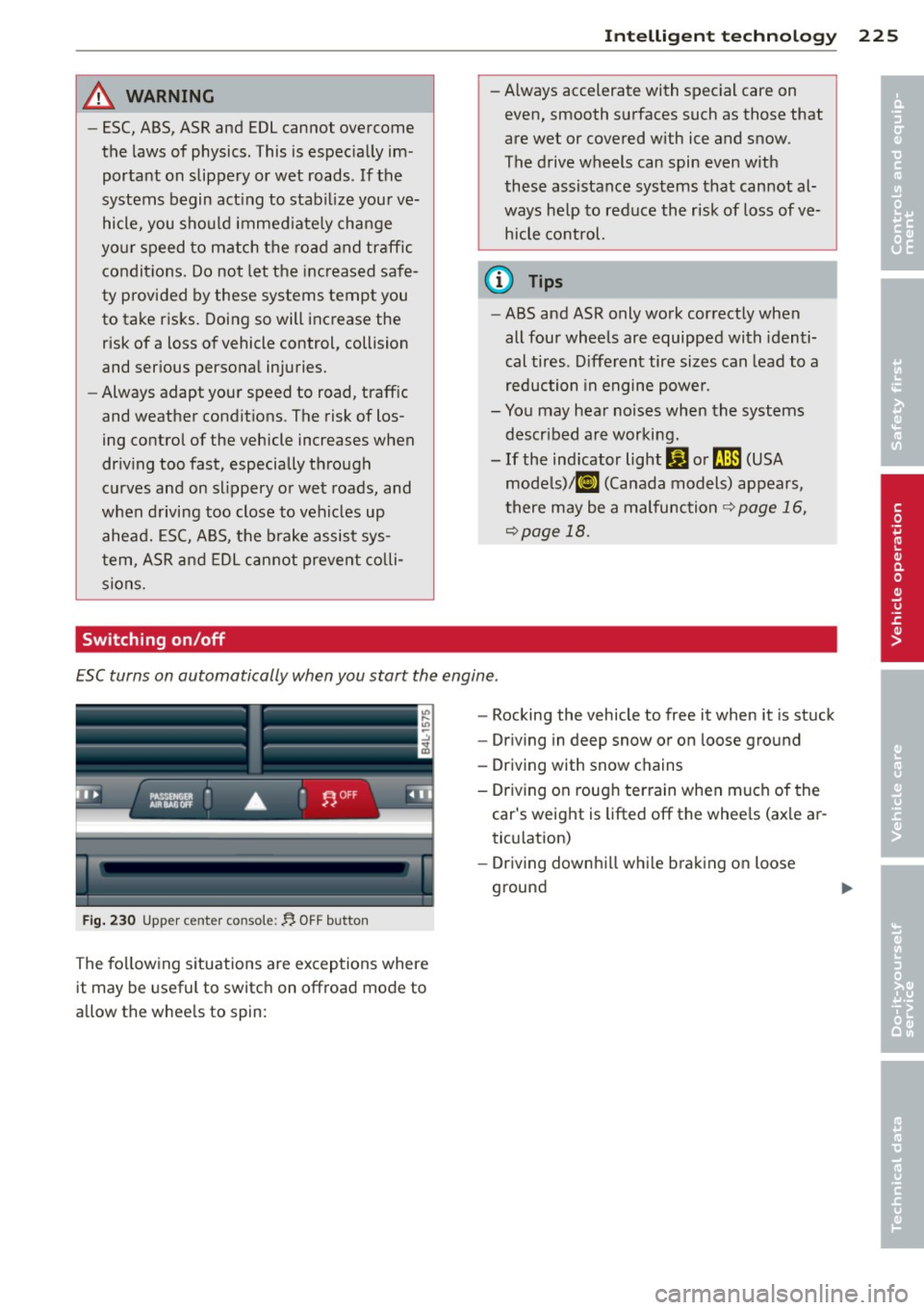
ESC turns on automatically when you start the engine .
. ...---------.,
--------------
Fig. 230 Upper center conso le : ~ O FF button
The fo llow ing situations are exceptions where
it may be useful to switch on offroad mode to
allow the whee ls to spin: -
Rocking the vehicle to free it when it is stuck
- Dr iving in deep snow or on loose ground
- Driving with snow chains
- Dr iving on roug h terrain when much of the
car's weight is lifted off the whee ls (ax le ar
ticu lation)
- Dr iving downhi ll wh ile braking on loose
ground
Page 230 of 340
228 Intellig ent technol ogy
- Never let the vehicle ro ll to a stop with
the engine shut off.
- If the brake booster is not working, the
brake pedal must be pressed considera
bly harder to make up for the lack of
booster assistance.
Servotronic - advanced
power steering system
The power steering systems uses the power of
the running engine to allow precise steering
with little effort.
The advanced Servotronic power steering sys
tem senses the road speed and electronically
adjusts powe r assistance to provide comforta
b le and safe steering response exact ly match
ed to the vehicle speed.
Power steering w ill not work if the eng ine is
off. As a result, the steering wheel w ill be hard
to turn.
The power steering fluid level is checked dur
ing the scheduled ma intenance serv ices .
@ Note
If the re is an electronic malfunct ion, ser
votronic
w ill still function like a conven
tional power steer ing system, p roviding a
constant steer ing support force that is no
longer proportionate to the vehicle speed .
This is most noticeab le when turning the
steering whee l at low speeds (for examp le
when parking), -more effort will be re
quired than usual.
- Be aware of the different than usua l
steering response and adjust your steer i ng force accord ingly.
- Have the prob lem checked and set right
by an Aud i dealer as soon as possible.
- When the engine is running , never hold
the steering whee l turned all the way to
the right or to the left for longer than
15
seconds . The power steer ing pump w ill
overheat the hydraulic flu id if you keep holding the steering wheel turned all the
way . This is likely to damage the power
steering system.
- If the powe r stee ring system sho uld fail
entirely, or if the engine is not running
(for example, whi le be ing towed), you
will still be able to steer the ve hicle.
However,
considerably more effort will
be required to do so .
- If the power steering system should
have a leak, or is not functioning proper
ly, contact your author ized Audi dealer
immediately .
- The power steering system requ ires a
specially formulated hyd ra ulic fluid . The
powe r stee ring reservoir is the one locat
ed farthest to the rear on the left s ide of
the engine comp artment r=;,
page 259.
T he correct fluid level in the reservoir is
important for proper functioning of the
power steering .
Driving with your
quattro
With all-wheel drive , all four wheels are driv
en .
Gen eral information
With all-wheel drive, power is distributed to
all four wheels. This happens au toma tically
depending on your driving style and the road
condit ions at the time . See also r=;,
page 224 .
Winter tire s
When driving in the winter, yo ur vehicle with
a ll-wheel drive has an advantage, even wi th
regular tires . In winter road conditions it may
be advisable to mount winter tires (or all -sea
son tires) for improved dr iveability and brak
ing : these tires must be mounted o n
all four
wheels. See also r=;, page 288, Winter tires.
Tire chains
Where tire chains are mandatory on certain
roads, this normally also appl ies to veh icles
with all-wheel driver=;,
page 289, Snow
chains .
Page 231 of 340
Replacing wh eels/ tire s
Vehicles w ith all-wheel drive must a lways
have tires of the same size. Also avoid tires
with different tread depths. For details see
page ¢
page 284, New tires and replacing
tires and wheels .
.&_ WARNING
Always adjust your driving to road and traf
fic conditions . Do not let the extra safety
afforded by all-wheel dr ive tempt you into
tak ing extra risks.
-Although the all-wheel dr ive is very ef
fective, always remember that braking
capacity is limited by t ire traction . You
sho uld therefore not dr ive at excessive
speeds on icy or s lippery road surfaces.
- On wet road su rfaces, be careful not to
dr ive too fast because t he front wheels
cou ld beg in to s lide on top of the wa ter
(aquaplaning). If this sho uld occ ur, you
w ill have no warning from a sudden in
crease in engine speed as with a front
whee l drive vehicle. A lways drive at
speeds wh ich are suited to the road con
ditions -risk of c rash.
Energy management
Starting ability is optimized
Energy management controls the distribution
of electrical energy and thus optimizes the
availability of electrical energy for starting
the engine.
I f a vehicle w it h a conventional energy system
i s not driven for a long pe riod of time, the bat
tery is disch arged by idling c urrent cons umers
(e .g. immobilizer) . In ce rtain c ircumstances it
can result in there being insufficient energy
ava ilab le to start the engine .
I n tell igen t energy management in your vehi
cle hand les the d istribution of electrical ener
gy . Starting abi lity is marked ly imp roved and
the life of the battery is extended.
Int ellig ent technolog y 229
Basica lly, energy management consis ts of
batte ry diagnosi s, idling cur rent manage
ment
and dynamic energy management.
Battery diagnosis
B attery diagnosis continuously de termines
the state of the battery . Sensors determine
batte ry voltage, battery current and battery
temperature . This determines the current
state of charge and the power of the battery.
Idling current management
Id lin g cur ren t man agement reduces energy
consumption while the vehi cle is standing.
With the ig nition switched off, it controls the
energy supply to the various electrical compo nents. Data from battery diagnos is is cons id
ered.
Depend ing on the battery's state of cha rge,
individual cons umers are gradually turned off
to prevent excessive discharge of the battery
and thus maintain starting capability.
Dynamic energy manag ement
While the vehicle is being driven, dynamic en
ergy management distrib utes the energy ge n
erated according to the needs of the individ u
al components. It regulates consumption, so
that more electrical energy is not being used
than is be ing generated and ensures an opti
mal state of charge for the battery .
(D Tips
-But even e nergy management cannot
negate the limits of physics. Consider
t hat the powe r and l ife of a bat tery are
l imited.
- If start ing ability is threatened, you are
informed by a warning ¢
page 230,
Driver notification in the instrument
cluster display.
•
•
Page 234 of 340
232 Driving and environment
Driving and
environment
The first 1,000 miles
(1,500 km) and
afterwards
New engine
The engine needs to be run-in during the first
1,000 miles (1,500 km).
For the fir st 600 miles (1,000
kilometers ):
.,. Do not use full throttle.
... Do not d rive at engine speeds that are more
than 2/3 of the max imum permitted RPM.
From 600 to 1,000 miles (1 ,000 to
1,500 kilomete rs):
.,. Speeds can gradually be increased to the
max imum pe rm iss ible road or eng ine speed .
During and after break-in per iod
... Do not rev the eng ine up to high speeds
when it is cold. Th is app lies whether the
transmission is in N (Neutra l) or in gear.
After the brea k-in period
... Do not exceed max imum engine speed un
der any circumstances.
... Upshift into the next higher gear before
reaching the red area at the end of the tach
ometer scale¢ page 10.
During the first few hours of driving, the en
g ine's inter na l friction is higher than later
when all the moving parts have been broken
i n. How well this break- in process is done de
pends to a conside rable extent on the way the
ve hicle is driven du ring the first 1,000 miles
(1, 500 kilome ters).
(D Note
E xtremely high engi ne speeds are auto
mat ica lly r educed. However, these rpm
lim its are programmed for a n engine well
r u n- in, not a new eng ine.
{® For the sake of the environment
Do not drive with unnecessarily high en
g ine speeds - upshifting ear ly saves fuel,
reduces no ise and protects the environ
ment.
, New tires
If your vehicle is runni ng on new tires, drive
part icularly caref ul for the first 350 miles
(500 kilomete rs) afte r fitt ing.
A WARNING
N ew tires tend to be sl ippery and mus t al
so be "b roken -in" . Be s ure to remember
this dur ing the fi rst 350 mi les (500 kilo
meters) . Brake gently . Avoid fo llow ing
closely behind other vehicles or other sit
uations that m ight require sudden, hard
braking.
New brake pads
Remember that new brake pads do not have a
full bra king effect dur ing the fi rst 250 m iles
(400 kilomete rs) afte r they a re insta lled.
New brake pads have to be "burnished in" be
fo re t hey have optima l grab¢
A .
During the break- in period, you should avoid
putting severe loads on the brakes. Severe
l oads include, for example, sudden hard brak
i ng, in particular at very high speeds or, for
example, on mounta in passes .
A WARNING
New b rake pa ds don't have t he bes t stop
pi ng power and mus t be "broke n-in " dur
i ng the in iti al 1 00 to 150 mi les (150 to
20 0 kilometers) of no rma l city driving . You
can compensate for this by pressing the
br ake peda l mo re f irm ly . This also applies
l ater when new pads are installed.