light AUDI Q7 2015 Owner´s Manual
[x] Cancel search | Manufacturer: AUDI, Model Year: 2015, Model line: Q7, Model: AUDI Q7 2015Pages: 350, PDF Size: 86 MB
Page 282 of 350
280 Tires and wheels
If you wish to improve comfort See the illustration ¢ fig. 250
when operating the vehicle at for the location of the label on
normal load (up to 3 occu-driver's side B-pillar (color of
pants), you can adjust tire the actual label and exact loca-
pressures to those specified tion on the vehicle will vary
for normal vehicle load. Before slightly).
operating the vehicle at maxi-Note that the following table is
mum load, you must increase accurate at the time of going to
the tire pressures to those press and is subject to change .
specified for maximum vehicle In the event of discrepancies,
load¢&. the tire pressure label located
Bear in mind that the tire pres- on the driver's side B-pillar al-
sure monitoring system can on- ways takes precedence.
ly monitor the tire pressures
The table below lists the rec-
you have stored . The system
ommended cold tire inflation
does not recognize the load
pressures for the Audi model
condition of your vehicle. covered by your Owner's Litera-
The effectiveness of the tire ture at the vehicle's capacity
pressure monitoring system weight and the tire sizes instal-
will be impaired if you store led on the respective models as
normal load pressures but then original equipment, or as a fac-
operate the vehicle at its maxi-tory option.
...
mum load¢&.
Page 286 of 350
284 Tires and whee ls
If the pressure in any tire is too were on your vehicle at the
low, note the difference be- time it was manufactured . For
tween the pressure in the cold recommended tire pressures
tire and the pressure you need for normal load conditions, and add the air that you need to please see chapter
reach the correct pressure for
¢ page 278 .
the vehicle load (passengers
-Turn the valve stem cap coun-
and luggage) for the tires on ter-clockwise to remove it
your veh icle as listed on the on
from the tire valve.
your veh icle and in this manual
-Place the air pressure gauge
and the kind of driving you p lan
on the valve.
to do .
-The tire pressures should only
Never e xceed the maximum in -be checked and adjusted when
flation pressure listed on the the tires are cold . The slightly
ti re sidewall for any reason. raised pressures of warm tires
must not be reduced .
Remember that the vehicle
-Adjust the tire pressure to the
manufacturer, not the t ire man-
load you are carrying .
ufacturer, determines the car- -Reinstall the valve stem cap
rect t ire pressure for the tires
on the valve.
on your vehicle.
It is important to check the tire
When should I check the tire
pressure?
p ressure when the tires are
cold . The correct tire pressure is es-
-Read the required tire pres- pecially important at
high
speeds . The pressure should
sure from the tire pressure la- therefore be checked at least
bel. The tire pressure label is once a month and always be-
located on the driver's side B -
fore starting a journey . Do not
pi llar . The tire pressure label
forget to check the tire pres -
lists the recommended co ld
sure for the spare wheel.
..
tire inflation pressures for the
vehicle at its max imum capaci-
ty weight and the tires that
Page 304 of 350

302 Tire s and whee ls
Tire pressure indicator appears
The tire pressure indicator in the instrument
cluster informs you if the tire pressure is too
low or if there is a system malfunction.
F ig . 255 D isp lay: underinflation warn ing
Using the ABS sensors, the tire pressure moni
toring system compares the tire tread circum
ference and vibration characteristics of the in
d iv idual tires. If the pressure decreases in one
or more tires, this is indicated in the instru ment cluster with a
RE warning symbol and a
message ¢
fig. 255 . The dr iver message in the
d isplay goes out after 5 seconds . The dr iver
message can be displayed again by pressing
the
! CHECK I button. If only one tire is affect
ed, the display will indica te its pos ition.
The tire pressure monitoring must be reset via MMI each time the pressures are adjusted (e.
g. when switch ing between partial and full
l oad pressure) or after changing or replac ing a
tire on your vehicle¢
page 303. The TPMS in
dicator only monitors the tire pressure that
you have previously stored. You can find the
recommended tire pressures for your vehicle
on the label on dr iver's side 8-pillar
¢page 278.
Tire tread circumference and vibration charac
teristics can change and cause a tire pressure
warn ing if:
- the tire pressure in one or more tires is too
l ow,
- the tire has st ructural damage,
- the tire pressure was changed, whee ls rotat-
ed o r replaced but the TPMS was not reset
¢ page 303,
-the sp are tire* is mounted.
Warn ing symbo ls
RE Loss of pressure in at least one tire¢,&..
Check the tire or tires and rep lace or repa ir if
necessary . The
RE indicator light in the instru
ment cluster also illuminates
¢ page 14.
Check/correct the pressures of all four tires
and reset TPMS via MMI.
[m'El (T ire Pressure Monitoring System) Tire
pre ssure: System m alfunction!. If [m'El ap
pears after switching the ignition on or while
driving and the
RE i ndicator light in the in
strument cluster bli nks for approx imately one
minute and then stays on, there is a system
malfunction . Attempt to store the correct tire
pressure
¢ page 303. If the indicator light
does not tu rn off or if it t urn s on sho rtly
thereafte r, immediately d rive yo ur vehicle to
an a uthorized Audi dea ler or a uthorized repair
facility to have the malfunction corrected.
A WARNING ......_
- If the tire pressure ind icator appears in
the instrument cluster display, one or
more of your t ires is sign ificant ly under
inflated . Reduce your speed immediately
and avoid any hard steer ing or b raking
maneuvers. Stop as soon as possib le and
check the tires and their pressu res. In
flate the ti re p ressu re to the proper pres
sure as indicated on the vehicle's tire
pressure labe l
r=:>page 278. Driving on a
sign ificantly under-inflated tire causes
the t ire to overheat and can lead to tire
fa ilure. Under-inflation also is likely to
impair the vehicle's handl ing and stop
p ing ability .
- The driver is responsible for maintaining
the correct tire pressures. You must
check the tire pressures regu larly.
- Under certain conditions (such as a spor
ty driv ing style, winter conditions or un
paved roads), the pressure monitor indi
cator may be delayed .
-Ask you r aut horized Aud i dea ler if run
flat t ires may be used on you r vehicle.
Page 309 of 350
M N
0 ..J
'SI: ,...., \!) ..,.,
,...., ..,., ,....,
Changing a wheel
Before changing a wheel
Observe the following precautions for your
own and your passenger's safety when chang
ing a wheel .
.,. After you experience a tire fa ilure, pull the
car well away from moving traffic and try to
reach
level gro und before you stop¢.&_ .
.. All passengers should
leav e the car and
move to a safe location (fo r instan ce, be hind
the guardra il)¢ .&_.
.,. Engage the
parkin g brake to prevent your
vehicle from ro lling unintentionally¢ .&_.
.. Move
selecto r le ver to p osition P ¢ .&_ .
1> Ifyou are towing a trai ler: unhitch the trail
er from your veh icle.
.,. Block the diagonally opposite wheel with
the folding chocks or other objects.
.. Take the
jack and the inflatab le spare tire
out of the luggage compartment
¢page 304.
& WARNING
You or your passengers cou ld be injured
while changing a whee l if yo u do not fol
low these safety precautions:
- If you have a flat t ire, move a safe dis
tance off the road . Turn off the eng ine,
t ur n the emergency flashers o n and use
other warning devices to alert other mo
torists.
- Make sure that passengers wait in a safe
place away from the vehicle and well
away from the road and traffic.
- To he lp prevent the veh icle from mov ing
sudden ly and possibly slipping off the
jack, always fully set the parking b rake
and block the whee l diagonally opposite
the wheel being cha nged with the fo ld
ing chocks or othe r objects. When one
front whee l is lifted off the g ro und, plac
ing the A utomat ic Transm iss ion in P
(Park) wi ll
not prevent the vehicle from
moving .
-
What do I do now? 307
-Before you change a whee l, be sure the
ground is level and firm. If necessary,
use a sturdy board under the jack.
- Always store the vehicle tool kit, the jack
and the replaced tire in the luggage com
partment
<=:>page 169 .
Changing a wheel
When you change a wheel, follow these
quence described below step-by-step and in
exactly that order.
1. Activate the vehicle jack mode (only
vehicles with Adaptive Air S uspension)
¢ page 161 .
2. Remove the decorati ve wheel co ver* . For
more details see also <=:>
page 308, Deco
rative wheel covers
or <=:> page 308,
Wheels with wheel bolt caps.
3. Loosen the wh eel bolt s¢ page 308 .
4. Loca te the p roper mounting point for the
jack and align the jack be low that point
¢ page 309.
5. Lift the car with the jack Q page 309 .
6. Remove the wheel with the flat ti re and
then install the
inflatable spare tire
¢ page 310.
7. Tig hte n all wheel bolts lightly.
8.
L owe r the vehicle with the jack .
9. Use the wheel bolt w rench and
firmly
t ighten all wheel bolts¢ page 308.
10. Replace the decora tive whe el co ver* .
11. Deactivate the vehicle jack mode (on ly
vehicles with Adaptive Air S uspension)
¢ page 161 .
A WARNING
Always read and follow all WARNINGS and
informat ion<=:>
& in Raising the vehicle on
page 310
and <=:> page 311.
•
•
Page 312 of 350

310 What do I do now?
& WARNING
-You or your passengers could be injured
while changing a wheel if you do not
follow these safety precautions:
- Position the jack only at the designated
lifting points and align the jack. Other
wise, the jack could slip and cause an injury if it does not have sufficient hold
on the vehicle.
- A soft or unstable surface under the
jack may cause the vehicle to slip off the jack. Always provide a firm base for
the jack on the ground . If necessary,
use a sturdy board under the jack.
- On hard, slippery surface (such as tiles)
use a rubber mat or similar to prevent
the jack from slipping.
- To help prevent injury to yourself and
your passengers:
- Do not raise the vehicle until you are
sure the jack is securely engaged.
- Passengers must not remain in the ve
hicle when it is jacked up.
- Make sure that passengers wait in a
safe place away from the vehicle and
well away from the road and traffic.
- Make sure jack position is correct, ad
just as necessary and then continue to
raise the jack.
(D Note
Do not lift the vehicle by the sill. Position
the jack only at the designated lifting
points on the sill. Otherwise , your vehicle
will be damaged.
Taking the wheel off /installing the
inflatable spare tire
Follow these instructions step-by-step for
changing the wheel
Fig. 266 Changing a wheel: alignment pin inside the
top hole
After you have loosened all wheel bolts and raised the vehicle off the ground, remove and
replace the wheel as follows:
Removing the wheel
.,. Remove the topmost wheel bolt completely
and set it aside on a
clean surface.
.,. Screw the threaded end of the
alignment
pin
from the tool kit hand-tight into the
empty bolt hole
¢ fig . 266.
.,. Then remove the other wheel bolts as de
scribed above.
.,._Takeoff the wheel leaving the alignment pin
in the bolt hole ¢(D.
Putting on the inflatable spare tire
.,. Inflate the inflatable spare tire ¢ page 306
and push the wheel over the alignment pin.
"Screw in and tighten all wheel bolts
slightly.
.,. Remove the alignment pin and insert and
tighten the remaining wheel bolt slightly
like the rest .
.,. Turn the jack handle counter-clockwise to
lower the vehicle until the jack is fully re
leased .
" Use the wheel bolt wrench to tighten all
wheel bolts firmly ¢
page 308 . Tighten
them
crosswise, from one bolt to the (ap
proximately) opposite one, to keep the
wheel centered.
Page 315 of 350

M
"' 0 ..J '
"' rl
Left cockpit fuse assignment
Fig . 269 Left cockp it: fuse panel with plast ic clip
Fuse panel @ (red)
No. Consumer Amps
1 DC/DC converter
5
3
MMI 7,5
6 L u mbar support driver's seat
10
7 Window
regula tors (left side of
35
vehicle)
8
Doo r control module (left side
15
of vehicle)
9
Tir e pr essu re monitoring sys -
tern 5
E lectronic ignition lock,
10 power steering column adjust- 30
ment
11 Switch module
steering column
10
12 Intellig
ent power module con-
5
venience
Fuse panel @ (brown)
No. Consumer Amps
3 Seat ventilation (left)
15
4 Wiper system
30
5 Rain sensor 5
6 Horn
25
7 Inte
lligent power module driver
30
Fuses and bulbs 313
No . Consumer Amps
8
Intelligent power module driver
25
(lights left side of vehicle)
9
I ntelligent power modu le driver
25
(lights right side of vehicle)
10 Instrument cluster 10
1 1 Headlight washer
system
30
12 Diagnost ic connector 10
Fuse panel © (black)
No. Consumer Amps
1 Head
light electron ic system
10
(left side of vehicle)
2 Adaptive
cruise control
5
5 Rea r Seat Enterta inmen t
5
6 Term inal 15 (interior)
5
7 Oil level sensor
5
8 Diagnostic connector
5
9
Automatic dipping interior m ir-
5
ror
10 Home link
5
11 Control module Gat eway
5
12 He
adlig ht range ad justmen t
5
Page 316 of 350

314 Fuses and bulbs
Right cockpit fuse assignment
Fig. 270 Right cockpit: fuse pane l w ith plastic clip
Fuse panel @ (black)
No. Consumer Amps
No. Consumer Amps 6
Automatic transmission
5/20
1 Heated rear seats
20
2 Telephone, cell phone package 5
7
Electronic Stabilization Control
5
(ESC)
3 Front seat
hating/seat ventila-
30/15
tion (right) 8
Shift gate automatic transmis-
s sion
4 Electronic
Stabil iz at ion Control
20
(ESC) 9 Parking system s
10 A
irbag 5
5 Door control module (right side
15
of vehicle) 11
Heat ed rear seats 5
12 A ir-conditioning
5
6 Rear electrical outlets 25
7
Lumbar support passenger's
10
seat
Fuse panel © (red)
No. Consumer Amps
9
Front electrica l outlets
25 1
Instrument cluster 10
10 A/C controls 10 2
Rearvi ew camera 5
11 Coo
ler
15 3 CD player, DVD drive
5
12 Inte
lligent power module pas-
15
4 MMI Display 5
senge r 5 Automatic t ransmission 15
Fuse panel@ (brown ) 7 Panoramic
sliding sunroof seg-
ment 1 20
No.
Consumer Amps
1 Headlight e
lectronic system
10
(right side of veh icle)
2 Ride height adjustment 5
8
Panoramic sliding sunroof seg-
20
ment 2
9 Panoramic
sliding sunroof sun-
20
blind
3 Telephone package 5
4 Audi side assist
5 11
W
indow regulators (right side
35
of vehicle)
s
Electronic Stabilization Control
(ESC) 5 12
Rear air-conditioning controls 10
Page 317 of 350
M
"' 0 ..J
"". rl I.O
"' rl
"' rl
Fuses and bulbs 315
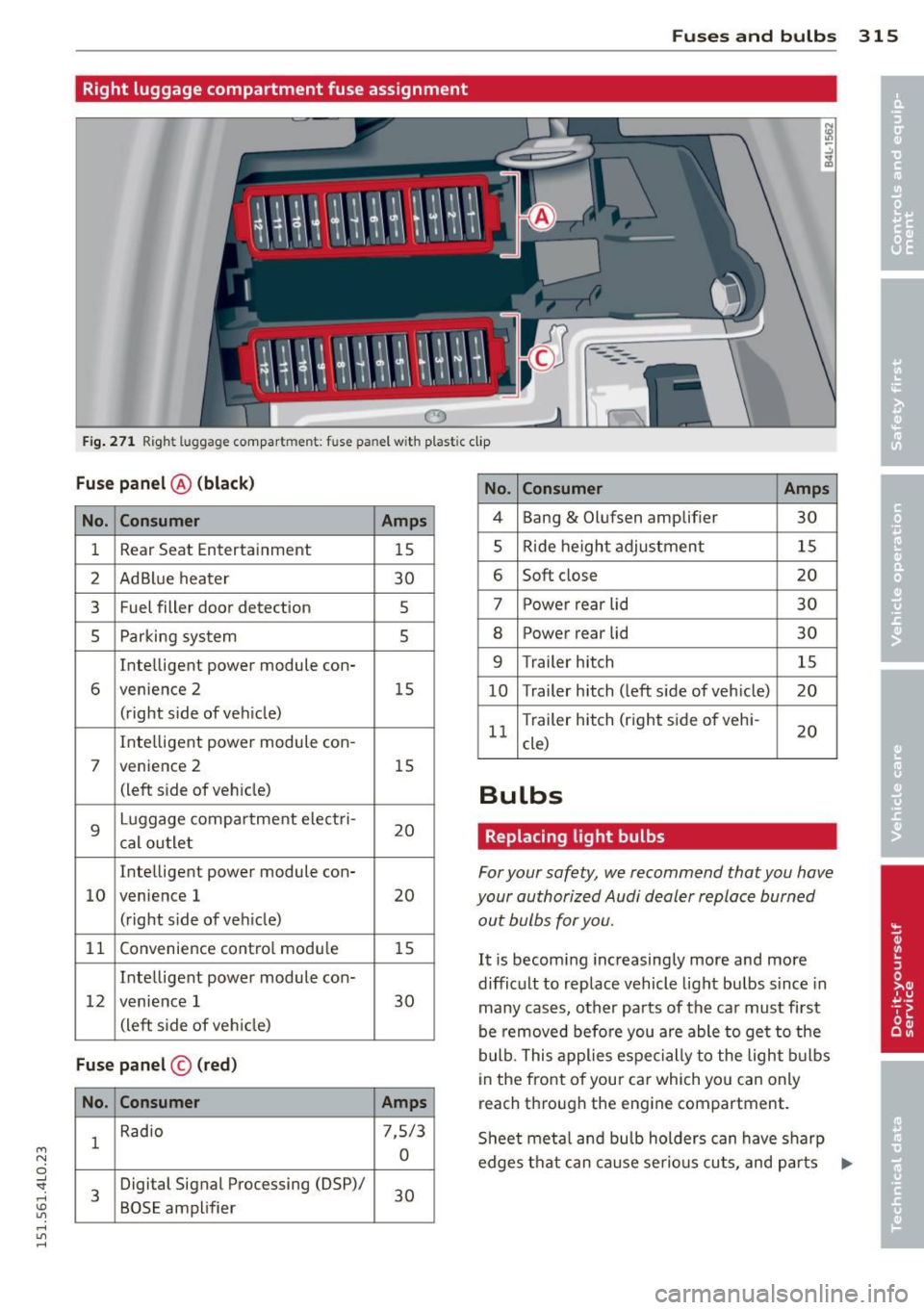
Right luggage compartment fuse assignment
0
Fig . 271 Right luggage compartment: fuse panel with plastic clip
Fuse panel @ (black )
No. Consumer Amps
1 Rear Seat Entertainment
15
2 AdBlue heater 30
3 Fuel filler door detection 5
5 Parking system 5
Inte lligent power module con-
6 venience 2
15
(right side of vehicle)
Intelligent power module con-
7 venience 2 15
(left side of veh icle)
9
Luggage compartm ent electri-
20
cal outlet
Intelligent power module con-
10 venience 1
20
(right s ide of veh icle)
11 Convenience
control modu le
15
Intelligent power module con-
12 venience 1 30
(left s ide of ve hicle)
Fuse panel © (red)
No. Consumer
Amps
1 Radio
7,5/3
0
3 Digital Signal Processing (DSP)/
30
BOSE amplifier
No . Consumer Amps
4 Bang & Olufsen amplifier
30
5 Ride height adjustment 15
6 Soft close 20
7 Power rear lid 30
8 Power rear lid
30
9 Trailer hitch 15
10 Trailer
hitch (left side of vehicle) 20
11 Trailer hitch (right side of vehi-
20
cle)
Bulbs
Replacing light bulbs
For your safety, we recommend that you have
your authorized Audi dealer replace burned
out bulbs for you.
It is becoming increasingly more and more
difficult to replace vehicle light bulbs since in
many cases, other parts of the car must first
be removed before you are able to get to the
bulb. This applies especially to the light bulbs
in the front of your car which you can only
reach through the engine compartment.
Sheet metal and bulb holders can have sharp
edges that can cause serious cuts, and parts
IJ>
Page 318 of 350

316 Fuses and bulbs
must be co rrectly taken apart and then prop
erly put back together to help prevent break
age of parts and long term damage from wa
te r that can enter housings that have not been
properly resealed.
F or your safety, we recommend that you have
your author ized Audi deale r replace any bulbs
for you, since your dealer has the proper tools,
the correct bulbs and the expertise.
Gas discharge lamps (Xenon lights)*:
Due to the high electrical vo ltage, have the
bu lbs rep laced by a qualified technician.
Headlights with Xenon light can be identified
by the high voltage sticker.
A WARNING
Contact with high-voltage components of
the electrical system and improper re placement of gas discharge (Xenon) head
light bulbs can cause serious personal in
jury and death .
- Xenon bulbs are pressurized and can ex
plode when be ing changed .
-Chang ing Xenon lamps requires the spe
cial train ing, instructions and equip
ment .
- Only an authorized Audi dealer or other
qualified workshop should change the
bulbs in gas d ischarge lamps.
A WARNING
There are parts with sharp edges on the
openings and on the bulb holders that can
cause serious cuts.
- If you are uncertain about what to do,
have the work performed by an author
ized Audi dea le r or other qualified work
shop. Serious personal injury may result
from improperly performed work .
(j) Tips
-If you must replace the light bu lbs your
se lf, always remembe r that the engine
compartment of any vehicle is a hazard
ous area to work in . Always read and
heed all WARNINGS
c::> page 256 c::> _& .
-
- It is best to ask your authorized Audi
dealer whenever you need to change a
bulb .
Page 319 of 350
M N
0 ...J
'SI: ,...., \!) ..,.,
,...., ..,., ,....,
Emergency situations
General
This chapter is intended for trained emer
gency crews and working personnel who have the necessary tools and equipment to
perform these operations.
Starting by pushing or
towing
(D Note
Your v ehicl e is e quipped w ith an automatic
tra nsm iss io n. Cons eque ntly, the e ngine
cann ot be started by pus hing o r tow ing.
Starting with jumper
cables
If necessary, the engine can be started by
connecting it to the battery of another vehi
cle.
If th e engine shou ld fail to start because of a
d ischarged o r weak battery, the battery can be
connected to the battery of
another veh icle,
usi ng a
pair of jumper cables to start the en
gine .
Jumper c ables
Use only jumper cab les of sufficiently large
cross section to carry the starter cur rent safe
l y. Refer to the man ufacturer's specifications.
Use only jumper cables with
insulated te rm i
na l clamps w hich are d istinctly mar ked:
plus(+ ) cable in mos t ca ses co lore d red
minus(-) cable
i n most cases colored black .
A WARNING
Batteries con tai n elec trici ty, a cid, and gas.
Any o f these c an caus e ve ry ser ious or f atal
injury . Foll ow the instruc tions below fo r
safe han dling of your veh icle's battery .
- Alw ays s hield y our eyes and a void le an
ing over the batte ry w henever possib le .
Emergency situations 31 7
- A discharged battery can freeze at tem
pe rat ures just below 32 °F (0 °C). Before
connecting a jumpe r cable, you must
thaw the frozen battery c omp lete ly, ot h
e rwise it could explode.
- Do not allow battery acid to co ntact eyes
or skin . Fl ush any con tacted area wi th
wat er immediately .
- Imp roper use of a booster battery to
s tart a vehicle may cause an ex plosion.
- Vehicle batter ies generate expl osive gas
es. Keep sparks, flame and lighted c iga
rettes away from ba tte ries.
- Do not t ry to jump start a ny ve hicle w it h
a low ac id leve l in the battery.
- The voltage of the booste r batte ry m ust
also have a 12-Vo lt rat ing. T he capac ity
(Ah) of the booste r batt ery sho uld not b e
lowe r than that of th e discharged bat
t ery. Use o f batt eries of d iffe ren t vol tage
or su bstan tia lly differen t "Ah" rat ing
may cause an exp losion and pers onal in
jury .
- N ever ch arge a fr ozen batt ery. Gas t ra p
pe d i n the ice may c ause an ex plosion .
- N ev e r ch arge o r use a batt ery th at h as
been fro zen . Th e batte ry case may have
be weake ned.
- U se o f batter ies of di ffere nt vol tage or
substantially differen t ca pa city (Ah) rat
i ng may cause an exp losion and injury .
T he ca pa c ity (Ah) of the booster battery
should not be lower than that of the dis
charged battery.
- Before you check anything in the engine
compa rtment, always read an d heed a ll
WARNINGS¢
page 256.
(D Note
- App lyi ng a hi gher vo ltage booste r ba t
t ery wi ll cause expens ive damage to sen
sit ive e lectronic components, such as
cont ro l units, relays, rad io , etc.
- There must be no electrical c ontact be
tween the vehicles as otherw ise current
co uld already start to f low as soon as t he
posi tive(+) terminals a re con nect ed. ..,. •
•