driver seat adjustment AUDI Q7 2015 Owner´s Manual
[x] Cancel search | Manufacturer: AUDI, Model Year: 2015, Model line: Q7, Model: AUDI Q7 2015Pages: 350, PDF Size: 86 MB
Page 230 of 350

228 Intelligent technology
will have no warning from a sudden in
crease in engine speed as with a front
wheel drive vehicle. Always drive at speeds wh ich are suited to the road con
ditions -risk of crash.
Energy management
Starting ability is optimized
Energy management controls the distribution
of electrical energy and thus optimizes the
availability of electrical energy for starting
the engine.
I f a vehicle with a conventional energy system
is not driven for a long period of time, the bat
tery is discharged by idling current consumers
(e.g. immobilizer) . In certain circumstances it
can result in there being insufficient energy
available to start the engine.
I ntelligent energy management in your vehi
cle handles the distribution of electrical ener
gy . Starting ability is markedly improved and
the life of the battery is extended.
Basically , energy management consists o f
battery diagnosis, idling current manage
ment
and dynamic energy management.
Battery diagnosis
Battery diagnosis continuously determines
the state of the battery. Sensors determine
battery vo ltage, battery current and battery
temperature. This determines the current
state of charge and the power of the battery.
Idling current management
I dling current management reduces energy
consumption while the vehicle is standing.
With the ignition switched off, it contro ls the
energy supply to the various e lectrica l compo
nents. Data from battery diagnosis is consid
ered.
Depending on the battery's state of charge,
individual consumers are gradually turned off
to prevent excessive discharge of the battery
and thus ma intain starting capability.
Dynamic energy management
While the vehicle is being driven, dynamic en
ergy management distributes the energy gen
erated according to the needs of the individu
al components.
It regulates consumption, so
that more electrical energy is not being used
than is being generated and ensures an opti
mal state of charge for the battery.
(!) Tips
- But even energy management cannot
negate the limits of physics. Consider
that the power and life of a battery are
limited.
- If start ing ability is threatened, you are
informed by a warning
¢ page 229,
Driver notification in the instrument
cluster display.
What you should know
The highest priority is given to maintaining
starting capability.
The battery is severely taxed in short-distance
driv ing, in city traffic and during the cold time
of year. Abundant electrical energy is re
quired, but only a little is generated . It is also
critical if the engine is not running and electri
cal components are turned on. In this in
stance energy is being consumed but none is
being generated.
It i s in precise ly these s ituations that you will
notice energy management actively regu lat
ing the distribution of energy.
Vehicle stands for an extended period
If you do not drive your vehicle over a period
of several days or weeks, e lectr ica l compo
nents are gradually cut back or sw itched off.
T his reduces energy consumption and ma in
ta ins starting capability over a longer period.
T ake into consideration that when you unlock
your vehicle, some convenience functions,
such as the interior lights or the power seat
adjustment, may not be availab le. The con
venience functions will be availab le again
Page 269 of 350
M N
0 ...J
'SI: ,...., \!) ..,.,
,...., ..,., ,....,
Disconne cting the batt ery t erminals
Some vehicle functions (power w indow regu
l ators, for example) are lost if the battery ter
minals are disconnected . These functions have
to be re learned after the battery terminals are
connected again. To prevent this, the battery
should only be disconnected from the vehicle
electrical system when absolutely necessary
for repairs .
Vehicle s not driven fo r lo ng period s
If you do not drive your vehicle over a period
of several days or weeks, electrical compo
nents are gradually cut back or switched off .
This reduces energy consumption and main
tains starting capab ility over a longer per iod
¢ page 228 .
Take into consideration that when you unlock
your vehicle, some convenience functions,
such as the inter ior lights or the power seat
adjustment, may not be available . The con
ve nience funct ions w ill be available again
when yo u turn on the ignition and start the
engine.
Winter op eration
During the winter months, battery capacity
tends to decrease as tempe ratures d rop . This
i s because more powe r is also consumed while
start ing, and the headl ights, rea r window de
fogger, etc., are used more often.
Avo id unnecessary power consumption, par
ticularly in c ity t raffic or when t rave ling on ly
short d istances. Let you r autho rized Aud i
dealer check the capacity of the vehicle bat
tery before winter sets in ¢
page 268. A well
charged battery wi ll not only prevent starting
prob lems when the weather is cold, but will
also last longer .
If your vehicle is left standing for severa l
weeks at extremely low temperat ures, the
veh icle battery should be removed and
stored where it will not freeze. This will
prevent it from bei ng damaged and hav ing
to be replaced.
Checkin g and fillin g 267
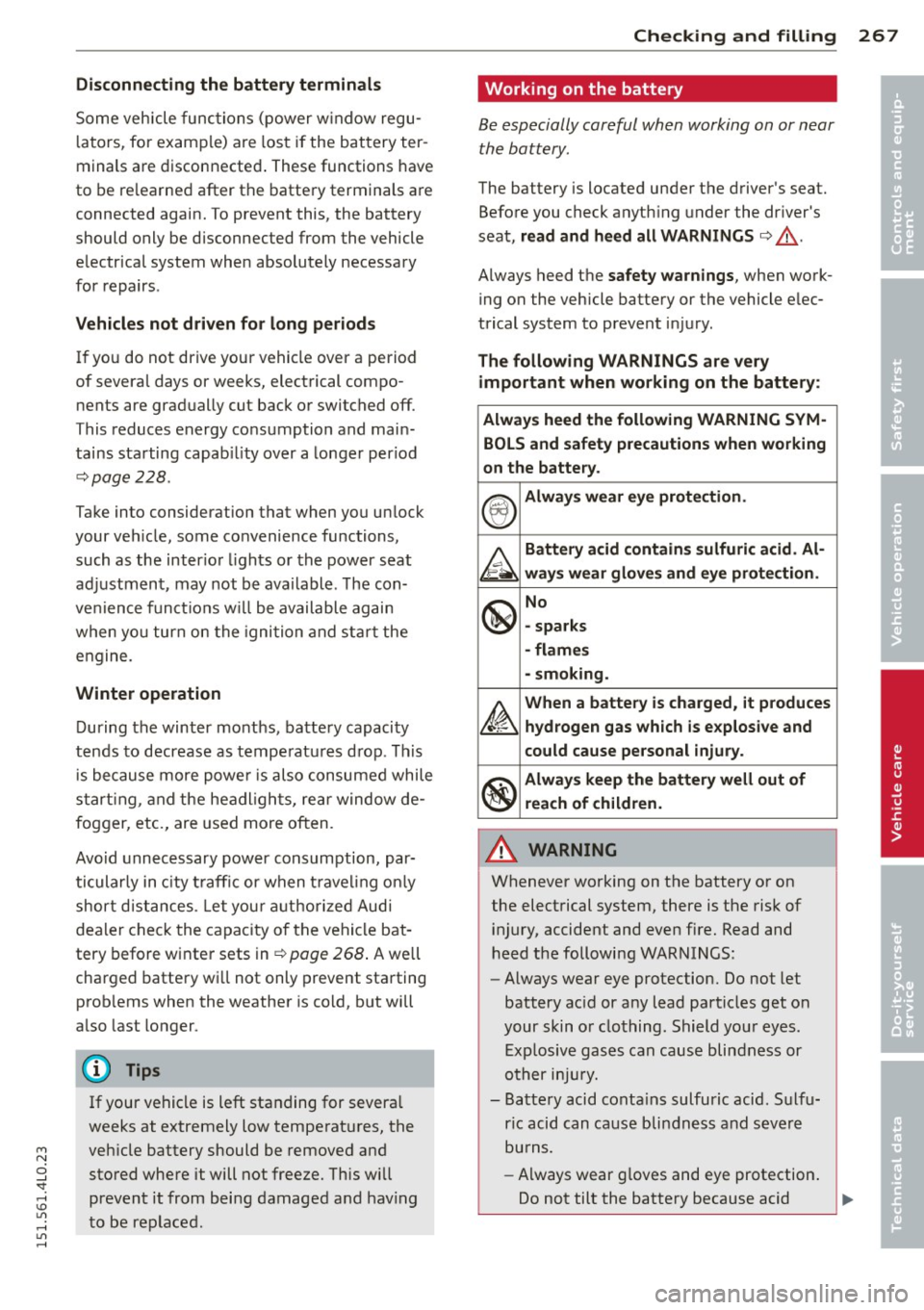
Working on the battery
Be especially careful when working on or near
the battery.
The battery is located under the driver 's seat.
Before you check anyth ing under the dr iver's
seat,
read and h eed all WARNINGS G &_ .
Always heed the safety warnings , when work
ing on the vehicle battery or the vehicle e lec
trical system to prevent injury .
The following WARNINGS are ver y
important when working on the batter y:
Alway s heed the following WARN IN G SY M-
BOLS a nd safety p re caution s when working
on the battery .
®
Alway s wear e ye prote ction.
~
Batt ery acid contain s sulfuric acid. Al -
w ay s we ar gloves and eye prot ection.
@
No
-spa rk s
- flam es
- smoking .
~
When a b atter y is ch arged , it produces
h y drogen g as w hic h is e xplosi ve and
could cause pe rsonal injur y.
®
Alw ays keep the batt ery well out of
r e a ch of childr en.
A WARNING
Whenever working on the battery or on
the electrical system, there is the risk of
injury, accident and even fire. Read and
heed the following WARNINGS:
- Always wear eye protection. Do not let
battery ac id or any lead particles get on
your skin or clothing. Shield your eyes.
Exp losive gases can cause blindness or
other inju ry.
- Battery acid conta ins sulfuric acid. Sulfu
ric acid can cause blindness and severe
bu rns.
- Always wear g loves and eye protection.
Do not tilt the battery because acid
~
•
•
Page 337 of 350
M N
0 ...J
'SI: ,...., \!) 1.1'1 ,...., 1.1'1 ,....,
Doors
Power child saf ety lock . ... .. .. .. .. .. 48
Dr iver information system ... .. .. .. .. .. 2 1
Di gita l speedomete r ...... .. .. .. .. .. 22
D river info rmation messages . . . . . . . . . 30
Open door or rear lid warning . . . . . . . . . 22
Outside temperature display . ... .. .. .. 22
Sound system display .. ... .. .. .. .. .. 21
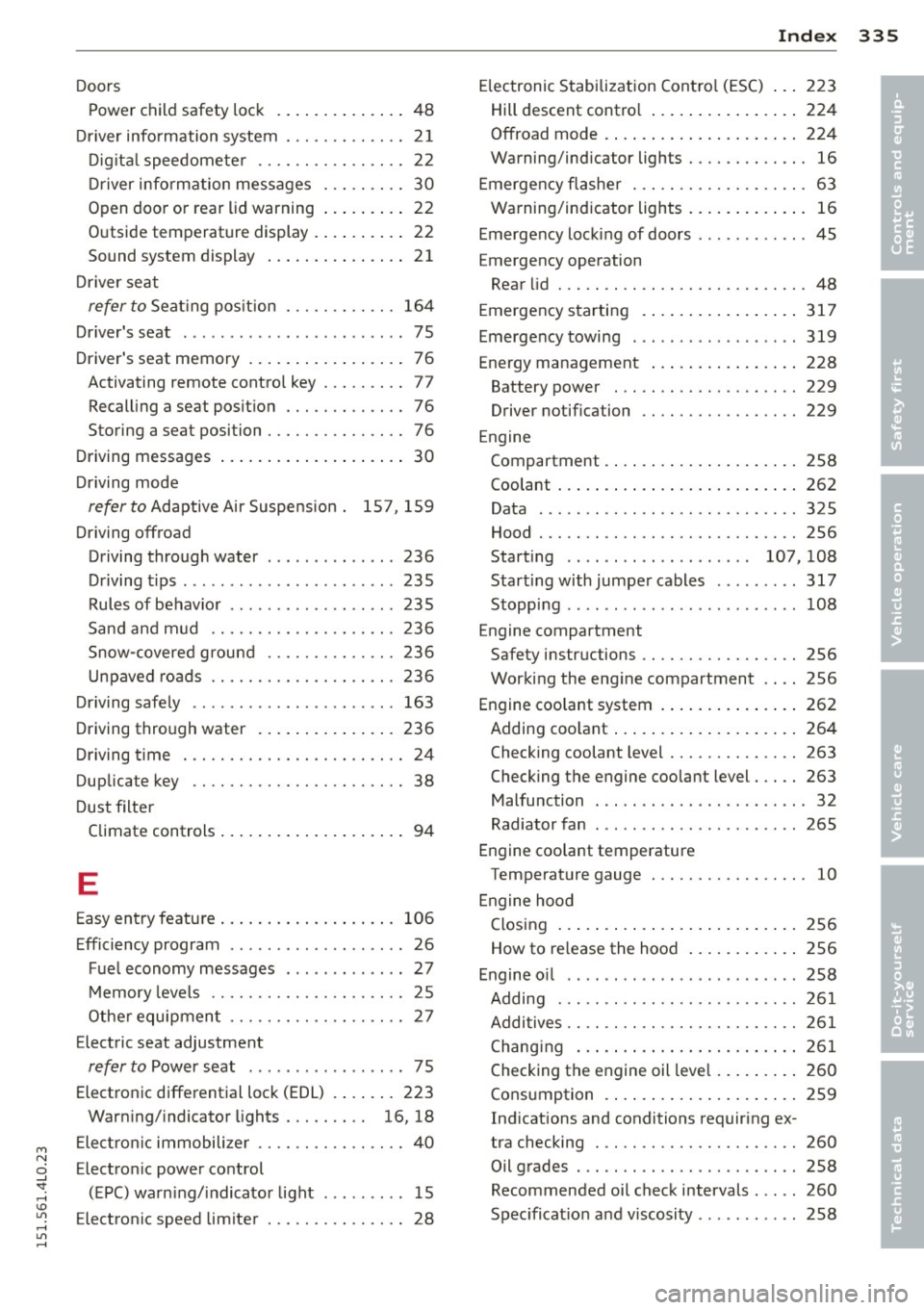
D river seat
refer to Seat ing pos it ion ... .. .. .. .. . 164
Driver's seat ................. .... ... 75
Driver's seat memory . . . . . . . . . . . . . . . . . 76
Activating remote control key . . . . . . . . . 77
Recall ing a seat posit ion ... .. .. .. .. .. 76
Sto ring a seat position . . . . . . . . . . . . . . . 76
D riving messages . . . . . . . . . . . . . . . . . . . . 30
Driving mode
refer to Adaptive Air Suspe nsion. 157, 1 59
Driving offroad Driving through water ......... ... .. 236
Driving tips .... ........... ... ... .. 235
Rul es of behav io r ............ .. .... 235
S and and m ud ........... .... .. .. . 236
Snow-covered groun d ..... .. .. .. .. .
236
Unpaved roads ........... .... .. ... 23 6
Driving safe ly .......... ...... .... .. 163
Driving through water ... ... .. .. .. .. . 236
D riving t ime . . . . . . . . . . . . . . . . . . . . . . . . 24
Duplicate key . . . . . . . . . . . . . . . . . . . . . . . 38
D ust filter
Climate controls . . . . . . . . . . . . . . . . . . . . 94
E
Easy en try featu re .. ..... ... .. .. .. .. . 10 6
E fficiency program . . . . . . . . . . . . . . . . . . . 26
Fue l economy messages . ...... ... ... 27
M emory levels . . . . . . . . . . . . . . . . . . . . . 25
Othe r equipmen t ......... .. .. .. .. .. 2 7
Electric seat adjustment
refer to Power seat . . . . . . . . . . . . . . . . . 7 5
Electro nic differential lock (EDL) . ... .. . 223
Warn ing/ indicator lights . . . . . . . . . 16, 18
E le ctr onic immobili ze r ...... .. .. .. .. .. 40
Electronic power co ntrol
( E PC) wa rn ing/indicator light ... ... ... 15
Electronic speed limiter . . . . . . . . . . . . . . . 28
Inde x 335
Electronic Stabilization Cont ro l (E SC) ... 223
Hill descent contro l ..... .... ... .. .. 224
•
Offroad mode .. .. .. . .. ... .... ... .. 224 •
Warning/ind icator lights .......... .. . 16
E merge ncy flashe r . . . . . . . . . . . . . . . . . . . 63
Wa rning/ind icator lights ..... ... .. .. . 16
Emergency locking of doors ............ 45
Emergency operation Rear lid . .. .. .. .. .. ............... . 48
Emergency starting . .. .. ..... ... .. .. 317
Emerge ncy towing ... . .. .. .. ... ... .. 319
Energy management ... .. .... ... .. .. 228
Battery power . .. .... ........... .. 229
Driver notification ................. 229
Engine Compartment .... .. . .. .. ..... ... .. 258
Coolant ... .. .... .. . .. .. ..... ... .. 262
Data ..... .. .. .. ... ............ .. 325
Hood ..... .. .. .. ................. 256
Start ing . . . . . . . . . . . . . . . . . . . . 107, 108
Starting with jumpe r cables ........ . 317
Stopping ........ .. ............... 108
Engine compartment
Safety instr uctions .. ........... .... 256
Work ing the eng ine compartment .. .. 256
Engine coolant system . .. ..... ... .. .. 262
Adding coo lant ..... . .. .. ..... ... .. 264
Checking coolant level .............. 263
Checking the engine coolant level ... .. 263
Malfunction . . . . . . . . . . . . . . . . . . . . . . . 32
Radiator fan ..... .. ............... 265
E ngine coolant temperature
Temperat ure gauge ............ .... . 10
E ngine hood
Closing ... .. .... .. . .. .. ..... ... .. 2 56
How to re lease the hood ..... ... .. .. 256
Engine o il ..... ... .. ............... 258
Adding ... .. .. .. ............... .. 261
Addi tives .... .. ...... ........... .. 261
Chang ing ... .. .... .. ... ..... ... .. 261
Checking the engine oil leve l .. ... .. .. 260
Consumption . ..... . .. .. ..... ... .. 259
Ind ications and conditions requir ing ex-
tra checking . .. .. ............... .. 260
Oil grades . .. .. .. ................. 258
Recommended oil check intervals . .. .. 260
Spec ificat io n and viscosity .......... . 258
Page 342 of 350
34 0 Index
Parking systems ........ ... .. .. .... . 145
Adjusting the disp lay/warning tone . .. 155
Audi parking system plus with front- and
rearv iew camera . . . . . . . . . . . . . . . . . . . 150
Audi parking system plus with rearv iew
camera .. .. ................ ... ... 146
Cleaning sensors/camera lenses ... .. . 243
Malfunct ion . . . . . . . . . . . . . . . . . . . . . . 155
Rear pa rk ass ist ........ .. .. .. .. .. . 146
Safety precautions ........ .. .. .... . 147
Trailer hitch . ... ...... ... .. .. .... . 155
Part icle fi lter
refer to Diesel part iculate filter . .. .... 36
Parts replacement .................. 328
PASSENG ER AIR BAG OFF l ight . .. .... . 193
Passenger's seat ............... .. .... 75
Passive safety system .. ... .. .. ... ... . 163
Pedals .. .. .... ........... .... .... . 168
Perimeter light ing ................... 62
Physica l pr inciples of a frontal collision 174
Plastic parts Cleaning . .. ..... ........... ... .. . 244
Polishing . . . . . . . . . . . . . . . . . . . . . . . . . . 244
P ollen filte r
Climate controls . . . . . . . . . . . . . . . . . . . . 94
Power locking switch . . . . . . . . . . . . . . . . . 44
Power locking system ................. 41
Conven ience close/open feature ... .... 53
Lock ing and unlocking the vehicle from
ins ide ... ................. ...... .. 44
Opening and clos ing the w indows ...... 53
Rear lid/t runk lid ................... 45
Remote cont rol key ................ . 38
Selec tive unlock fea ture ... .. .. .... .. 44
Settings ... ... . ...... ... .. .. .... .. 44
Unlock ing and locking veh icle ..... .. . . 43
Powe r outlets 90
Power seat
Con trols . . . . . . . . . . . . . . . . . . . . . . . . . . 7 5
Seat adjustment .............. .. .... 75
Power steering .. .. ..... ... .. .. .... . 226
Powe r window swi tches ..... .. .. .. .. . . 5 1
I n the driver 's door ................. 52
I n t he front passenger's door . . . . . . . . . 53
Reactivating the system . . . . . . . . . . . . . 54 Pregnant women
Special considerations when wearing a
safety belt .. .. .. ... .. ..... ... .. .. 178
Proper occ upan t seating positions . .. .. 164
Proper safety belt position ............ 178
Proper seating position Front passenger .. .. ... ..... ... .. .. 165
Occ upants . .... .. ............. .... 164
Rear passengers .. ............. .. .. 166
Protecting . . . . . . . . . . . . . . . . . . . . . . . . . 24 4
Protective tray . . . . . . . . . . . . . . . . . . . . . . . 85
Q
quattro
refer to All -wheel drive
Question What happens to unbelted occupants?
Why safety belts? ... .......... .. . .
R
227
175
173
Radiator fan .... .. ... .. ..... .... . .. 265
Rain sensor . . . . . . . . . . . . . . . . . . . . . . . . . 66
Rain sensor defective .............. .. . 35
Reading lights Front ... .. .... .. .. .... . ..... ... .. . 64
Rea r . .. .. .... .. .. ... .. ..... ... .. . 64
Rea r asht ray .... ... .............. .. . 89
Rear fog lights ...................... 62
Rea r lid
Automatic operation . . . . . . . . . . . . . . . . 46
Emergency un locking ........... .... . 48
Open ing and closing ........... .. .. . 45
Valet key function ............. .... . 41
Rea r light
Defective . . . . . . . . . . . . . . . . . . . . . . . . . 23
Rea r operation
Fo ur-z one automatic comfort air condi-
t io ni ng ..... .. .. .. ........... .... 103
Rea r seats
Adjust ing seat ... .. ... ....... ... .. . 78
E nt ry assist . . . . . . . . . . . . . . . . . . . . . . . . 78
Folding seatba ck up and down ..... .. . 79
Rearv iew camera
refer to Park ing systems ............ 146
Rea r view m irror ... .. .... .... ... .. .. . 71
Rea r window de fogger ........... .. .. . 98