tires AUDI Q7 2015 Owner´s Manual
[x] Cancel search | Manufacturer: AUDI, Model Year: 2015, Model line: Q7, Model: AUDI Q7 2015Pages: 350, PDF Size: 86 MB
Page 241 of 350
M N
0 ...J
'SI: ,...., \!) 1.1'1 ,...., 1.1'1 ,....,
Weight Rating will also change the per
formance and handling characteristics of
your vehicle, which could cause a crash result ing in serious injury or death .
- The Gross Vehicle Weight Rat ing for your
vehicle would be exceeded if your vehicle is simultaneously equipped with Panor
amic sliding sunroof; th ird-row seating;
trailer towing equipment (factory or
dealer-installed), and running boards
(dea ler-installed) . UNDER NO CIRCUM
STANCES MAY ALL SUCH ITEMS BE IN
STALLED ON THE SAME VEHICLE.
Operating instructions
MAX 6.9"
MAX175mm
E
1/1 E 1/1 ... a)
m
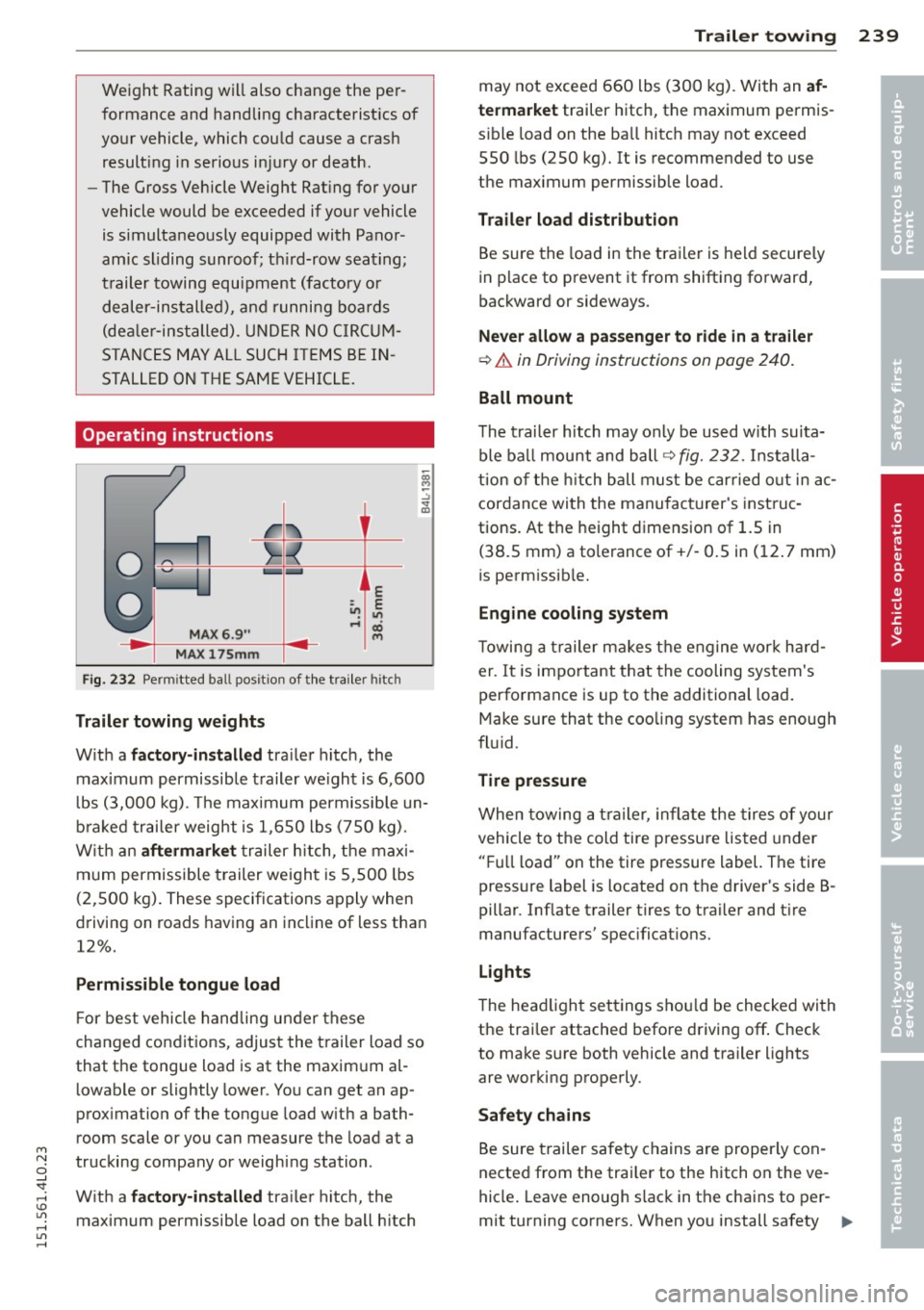
Fig. 232 Perm itted ba ll posit ion of t he tra iler hitch
Trailer towing weights
W ith a factory-installed tra iler hitch, the
maximum permissible trailer we ight is 6,600
l bs (3,000 kg). The maximum permissible un
braked trailer weight is 1,650 lbs (750 kg).
With an
aftermarket trailer hitch, the maxi
mum permissible t railer we ight is 5,500 lbs
(2,500 kg). These specifications apply when
driving on roads having an incline of less than
12%.
Permissible tongue load
For best vehicle handling under these
changed cond itions, adjust the trailer load so
that the tongue load is at the maximum al
l owable or slightly lower. You can get an ap
prox imation of the tongue load with a bath
room scale or you can measure the load at a
trucking company or weighing station .
With a
factory-installed tra iler hitch, the
maximum permissible load on the ball hitch
Trailer towing 239
may not exceed 660 lbs (300 kg). With an af
termarket
trailer hitch, the maximum permis
s ib le load on the ba ll hitch may not exceed
550 lbs (250 kg).
It is recommended to use
the maximum permissible load.
Trailer load distribution
Be sure the load in the trailer is held secure ly
in place to prevent it from shifting forward,
backward or sideways.
Never allow a passenger to ride in a trailer
¢.& in Driving instructions on page 240.
Ball mount
The trailer hitch may only be used w ith suita
ble ball mount and ball ¢
fig. 232. Installa
t ion of the hitch ball must be carried out in ac
cordance with the manufacturer's instruc
tions. At the height dimension of 1.5 in
(38.5 mm) a tolerance of+/- 0.5 in (12 . 7 mm)
is perm issib le.
Engine cooling system
Towing a trailer makes the engine work hard
er . It is important that the cooling system's
performance is up to the additional load .
Make sure that the cooling system has enough
fluid .
Tire pressure
When towing a tra iler, inflate the tires of your
vehicle to the cold tire pressure listed under
" Full load" on the tire pressure label. The tire
pressure label is located on the driver's side B
pillar . Inf late trailer tires to trai ler and t ire
manufacturers' spec ificat ions .
Lights
The headlight settings sho uld be checked with
the trailer attached before driving
off . Check
to make sure both vehicle and trailer lights
are working properly .
Safety chains
Be sure trailer safety chains are properly con
nected from the trailer to the hitch on the
ve
hicle . Leave enough slack in the chains to per
mit turning corners. When you install safety
Ill-
•
•
Page 245 of 350

M N
0 ...J
'SI: ,...., \!) ..,.,
,...., ..,., ,....,
Vehicl e ca re a nd cl eanin g 243
& WARNING
-Only wash the vehicle when the ignition
is off and follow the instructions from
the car wash operator to reduce the risk
of accidents.
- To reduce the risk of cuts, protect your
self from sharp meta l components when
washing the underbody or the inside of
the wheel housings.
- After washing the vehicle, the braking ef
fect may be delayed due to moisture on
the brake rotors or ice in the winter . The
brakes must be dried first with a few
careful brake applicat ions .
{[) Note
-If you wash the vehicle in an automatic
car wash, you must fold the exterior m ir
rors in to reduce the r isk of damage to
the mirrors . Power folding exterior m ir
ro rs* must only be folded in and out us
i ng the power folding function.
- Compare the track of your vehicle w ith
the d istance between the gu ide ra ils of
the faci lity- there is a risk of damage to
the wheels and tires.
- Compare the height and width of you r
vehicle with the he ight and width of the
tunnel at the facility. -
To prevent paint damage, do not wash
the vehicle in direct sunlight.
- To reduce the r isk o f damage to the sur
face, do not use insect removing spong
es, kitchen sponges or similar items.
- Matte finish painted vehicle compo
nents:
- To reduce the risk of damage to the
surface, do not use polishing agents or
ha rd wax .
- Never use car wash cycles that apply
protective wax.
It can destroy the
matte fin ish effect .
- Do not place any stickers o r magnet ic
signs on vehicle parts painted w ith
matte fin ish paint. The pai nt cou ld be
damaged when the stickers o r magnets
a re removed.
@ For the sake of the environment
Only wash the ve hicl e in facilities spe cially
designed for that purpose . This will red uce
the r is k of dirty water contam ina ted with
oil from entering the sewer system.
Cleaning and care information
When cle aning and caring for individua l vehi
cle components, refe r to the fo llowing tab les.
The information contained there is simply rec
ommendations. For questions or for compo -nents that are not listed,
re fer to an author
ized Audi dealer or a qualified workshop . Also
follow the information fo und in¢.& .
Cle aning ex terio r
Component Situation Solution
Wipe r bla des
Dirty c:> page 69, Cleaning windshield wiper blades
H eadligh ts/ Dirty Soft sponge with a m ild soap solutiona >
tail lights
S ensors /
Dirty Sensors: soft cloth with a so lvent-free cleaning product
camera l enses Came ra lenses : soft cloth with an alcohol -free cleaning
solution
Snow/ice Hand brush/solvent-free de-icing spray
•
•
Page 273 of 350
Tires and wheels
Tires
General notes
Tires may be the least appreci
ated and most abused parts of
a motor vehicle .
Tires may be the least appreci
ated and most abused parts of
a motor vehicle. Tires are, how
ever, one of the most important
parts of a vehicle, particularly
considering the comparatively
small patch of rubber on each
tire that assures that all-impor
tant contact between you, your
vehicle and the road.
Maintaining the correct tire
pressure, making sure that your
vehicle and its tires do not have
to carry more weight than they can safely handle, avoiding
damage from road hazards and
regularly inspecting tires for
damage including cuts, slashes
irregular wear and overall con
dition are the most important
things that you can do to help avoid sudden tire failure includ
ing tread separation and blow-
~ outs.
0 ...J
'SI: ,...., \!) 1.1'1 ,....,
"' ,....,
Tires and wheels 2 71
Avoiding damage
If you have to drive over a curb
or similar obstacle , drive very
slowly and as close as possible
at a right angle to the curb.
Always keep chemicals includ ing grease, oil, gasoline and
brake fluid off the tires.
Inspect the t ires regularly for
damage (cuts, cracks or blis
ters, etc.). Remove any foreign bodies embedded in the treads.
Storing tires
Mark tires when you remove
them to indicate the direction
of rotation. This ensures you to be able to mount them correct
ly when you reinstall them.
When removed, the wheels or
tires should be stored in a cool, dry and preferably dark place.
Store tires in a vertical position if they are not mounted on
rims, in a horizontal position if
they are mounted on rims.
New tires
New tires have to be broken in
¢ _&. .
The tread depth of new tires
may vary , according to the type .,.
•
•
'
Page 274 of 350
272 Tires a nd whee ls
and make of tire and the tread
pattern.
Hidden damage
Damage to tires and rims is of
ten not readily visible. If you notice unusua l vibration or the
vehicle pulls to one side, this may indicate that one of the
t ires has been damaged . The
tires must be checked immedi
ately by an authorized Audi
dealer or qualified workshop .
Unidirectional tires
A unidirectional tire can be
identified by arrows on the
sidewall, that point in the direc
tion the tire is designed to ro
tate. You must follow the speci
fied direction of rotation . This is
necessary so that these tires
can develop their optimum
characteristics regarding grip,
road noise, wear and hydro
planing resistance. For more in
format ion
c:> page 311 .
&_ WAR NIN G
New tires or tires that are
old, worn or damaged cannot
provide maximum control
and braking ability. -
New tires tend to be slip
pery and must be broken in .
To reduce the risk of losing
control, a collision and seri
ous personal injuries, drive
with special care for the
first 350 miles (560 km).
-Driv ing with worn or dam
aged tires can lead to loss of
control, sudden tire fa ilure,
including a blowout and
sudden deflation, crashes
and serious personal inju
ries. Have worn or damaged
tires replaced immediately.
-Tires age even if they are
not being used and can fail
suddenly, especially at high
speeds . Tires that are more
than 6 years old can only be
used in an emergency and
then with special care and
at low speed .
-Never mount used tires on your vehicle if you are not
sure of their "previous history." Old used tires may have
been damaged even though
the damage cannot be seen
that can lead to sudden tire
failure and loss of vehic le
control.
Page 275 of 350

M N
0 ...J
'SI: ,...., \!) 1.1'1 ,...., 1.1'1 ,....,
-If you notice unusual vibra
tion or if the vehicle pulls to one side when driving, al
ways stop as soon as it is safe to do so and check the
wheels and tires for dam age.
(D Note
-Please note that summer
and winter tires are de
signed for the conditions
that are typical in those sea
sons. Audi recommends using winter tires during the
winter months. Low tem peratures significantly de
crease the elasticity of
summer tires, which affects
traction and braking ability.
Tires and wheels 273
If summer tires are used in
very cold temperatures, cracks can form on the tread
bars, resulting in perma
nent tire damage that can
cause loud driving noise and unbalanced tires. Audi is not
responsible for this type of
damage.
-Burnished, polished or chromed rims must not be used in winter road condi
tions. The surface of the
rims does not have suffi
cient corrosion protection
for this and could be perma
nently damaged by road salt
or similar substances.
•
•
'
Glossary of tire and loading terminology
Accessory weight
means the combined weight (in
excess of those standard items
which may be replaced) of auto matic transmission, power
steering, power brakes, power
windows, power seats, radio, and heater, to the extent that
these items are available as fac
tory-installed equipment (whether installed or not).
Aspect ratio
means the ratio of the height to
the width of the tire in percent. Numbers of 55 or lower indi
cate a low sidewall for im
proved steering response and
better overall handling on dry
pavement.
Page 276 of 350
274 Tir es a nd whee ls
Bead Extra load tire
means the part of the tire that means a tire design to operate
is made of steel wires, wrapped at higher loads and at higher
or reinforced by p ly cords and inflation pressures than the
that is shaped to fit the rim . corresponding standard tire .
Bead separation Extra load tires may be identi-
fied as "XL", "xl", " EXTRA
means a breakdown of the bond LOAD", or "RF" on the sidewall.
between components in the
bead .
Gross A xle Weight Rating
(" GAWR ")
Cord
means the load-carrying capaci-
means the strands forming the ty of a single axle system,
p lies in the tire .
measured at the tire-ground in-
Cold tire inflation pressure terfaces.
means the tire pressure recom-
Gross Vehicle Weight Rating
mended by the vehicle manu-( "GVWR ")
facturer for a t ire of a designat-
means the maximum total
ed size that has not been driven loaded weight of the vehicle.
for more than a couple of miles
Groove
(kilometers) at low speeds in
the three hour period before means the space between two
the tire pressure is measured or adjacent tread ribs.
adjusted.
Load rating (code )
Curb weight
means the max imum load that
means the weight of a motor a tire
is rated to carry for a giv-
vehicle with standard equip -en inflation pressure
. You may
ment including the maximum not find th
is information on all
capacity of fuel, oil, and cool- tires because it is not required
ant, air condit ioning and addi- by law.
...
tional weight of optional equip-
ment.
Page 277 of 350

M N
0 ...J
'SI: ,...., \!) 1.1'1 ,...., 1.1'1 ,....,
Maximum load rating
means the load rating for a tire
at the maximum permissible in
flation pressure for that tire.
Maximum loaded vehicle
weight
means the sum of:
(a) Curb weight
(b) Accessory weight
(c) Vehicle capacity weight, and
(d) Production options weight
Maximum (permissible)
inflation pressure
means the maximum cold infla
tion pressure to which a tire
may be inflated. Also called
"maximum inflation pressure."
Normal occupant weight
means 150 lbs. (68 kilograms)
times the number of occupants seated in the vehicle up to the
total seating capacity of your
vehicle.
Occupant distribution
means distribution of occu pants in a vehicle.
Outer diameter
means the overall diameter of
an inflated new tire.
Tires and wheels 275
Overall width
means the linear distance be
tween the exteriors of the side
walls of an inflated tire, includ ing elevations due to labeling,
decorations, or protective bands or ribs.
Ply
means a layer of rubber-coated
parallel cords.
Production options weight
means the combined weight of
those installed regular produc
tion options weighing over 5 lbs. (2 . 3 kg) in excess of those
standard items which they re
place, not previously consid
ered in curb weight or accessory
weight, including heavy duty
brakes, ride levelers, roof rack,
heavy duty battery, and special
trim.
Radial ply tire
means a pneumatic tire in
which the ply cords that extend
to the beads are laid at sub stantially 90 degrees to the
centerline of the tread.
•
•
'
Page 278 of 350

276 Tires a nd whee ls
Recommended inflation Sidewall
pressure
means that portion of a tire be -
see
c:::> page 2 7 4, Cold tire infla-tween the tread and bead.
tion pressure.
Speed rating (letter code )
Reinforced tire
means the speed at which a tire
means a tire design to operate is designed to be driven for ex-
at higher loads and at higher tended periods of time. The rat-
inflation pressures than the ings range from 93 mph (150
corresponding standard tire .
km/h) to 186 mph (298 km/h)
Reinforced tires may be identi -
c:::> page 294. You may not find
fied as "XL", "xl", "EXTRA
this information on all tires be-
LOAD", or "RF" on the sidewall.
cause it is not required by law.
Rim The speed rating letter code,
means a metal support for a where applicable, is molded on
tire or a tire and tube assembly the tire sidewall and indicates
upon which the tire beads are the maximum permissible
road
seated . speeds
c:::> A in Winter tires on
Rim d
iameter
page 298.
means nominal diameter of the
T ir e pressure mon itoring
system
bead seat. If you change your means a system that detects
wheel size, you will have to pur-
chase new tires to match the when one or more of a vehicle's
new rim diameter . tires are underinflated and illu-
Rim
size de signation
m inates a low tire pressure
warning telltale.
means rim diameter and width.
Tread
R im width
means that portion of a tire
means nominal distance be- that comes into contact with
tween rim flanges. the road.
...
Page 279 of 350
Tires and wheels 2 77
Tread separation UTQG information on the tires, •
means pulling away of the molded into the sidewalls. • '
tread from the tire carcass. U.S. DOT Tire Identification
Treadwear indicators (TWI) Number (TIN)
means the projections within
This is the tire's "serial number"
the principal grooves designed It begins with the letters "DOT"
to give a visual indication of the and indicates that the tire
degrees of wear of the tread. meets all federal standards.
See¢
page 289, Tread Wear The next two numbers or let-
Indicator (TWI) for more infor- ters indicate the plant where it
mation on measuring tire wear. was manufactured, and the last
Uniform Tire Quality Grading
four numbers represent the
week and year of manufacture.
is a tire information system de- For example,
veloped by the United States
DOT ... 2214 ...
National Highway Traffic Safety
Administration (NHTSA) that is means that the tire was pro-
designed to help buyers make duced in the 22nd week of
relative comparisons among 2014. The other numbers are
tires. The UTQG is not a safety marketing codes that may or
rating and not a guarantee that may not be used by the tire
a tire will last for a prescribed manufacturer. This information
number of miles (kilometers) or is used to contact consumers if
perform in a certain way. It a tire defect requires a recall.
simply gives tire buyers addi-
Vehicle capacity weight
tional information to combine means the rated cargo and lug-
with other considerations, such gage load plus 1
SO lbs.
as price, brand loyalty and deal- (68 kilograms) times the vehi-
er recommendations. Under cle's total seating capacity as
UTQG, tires are graded by the listed on the label located on
M tire manufacturers in three N the driver's side 8-pillar. 0
...
...J areas: treadwear, traction, and 'SI: ,...., \!) 1.1'1 temperature resistance. The ,...., 1.1'1 ,....,
Page 280 of 350
278 Tires a nd whee ls
Vehicle ma ximum load on
the tire
means that load on an individu
al tire that is determ ined by
distr ibuting to each axle its
share of the maximum loaded
vehicle weight and div iding by
two.
Vehicle normal load on the
tire
means that load on an in div id u
al t ire that is determ ined by d
istribut ing to each axle its
share of the curb weight, acces
sory weight, and normal occ u
pant weigh t (distributed in ac
cordance with table below
¢ page 2 78) and dividing by
two .
Occupant loading and distribution for vehicle normal load for
v arious designated seating capac ities
Designated seating Vehicle normal load, Occupant distribu-
capacity , number of number of occupants tion in a normally
occupants loaded vehicle
5/6*/7* 3 2 in front, 1 in sec -
ond seat
Cold tire inflation pressure
Tire pressure affects the overall handling, performance and safety
of a vehicle.
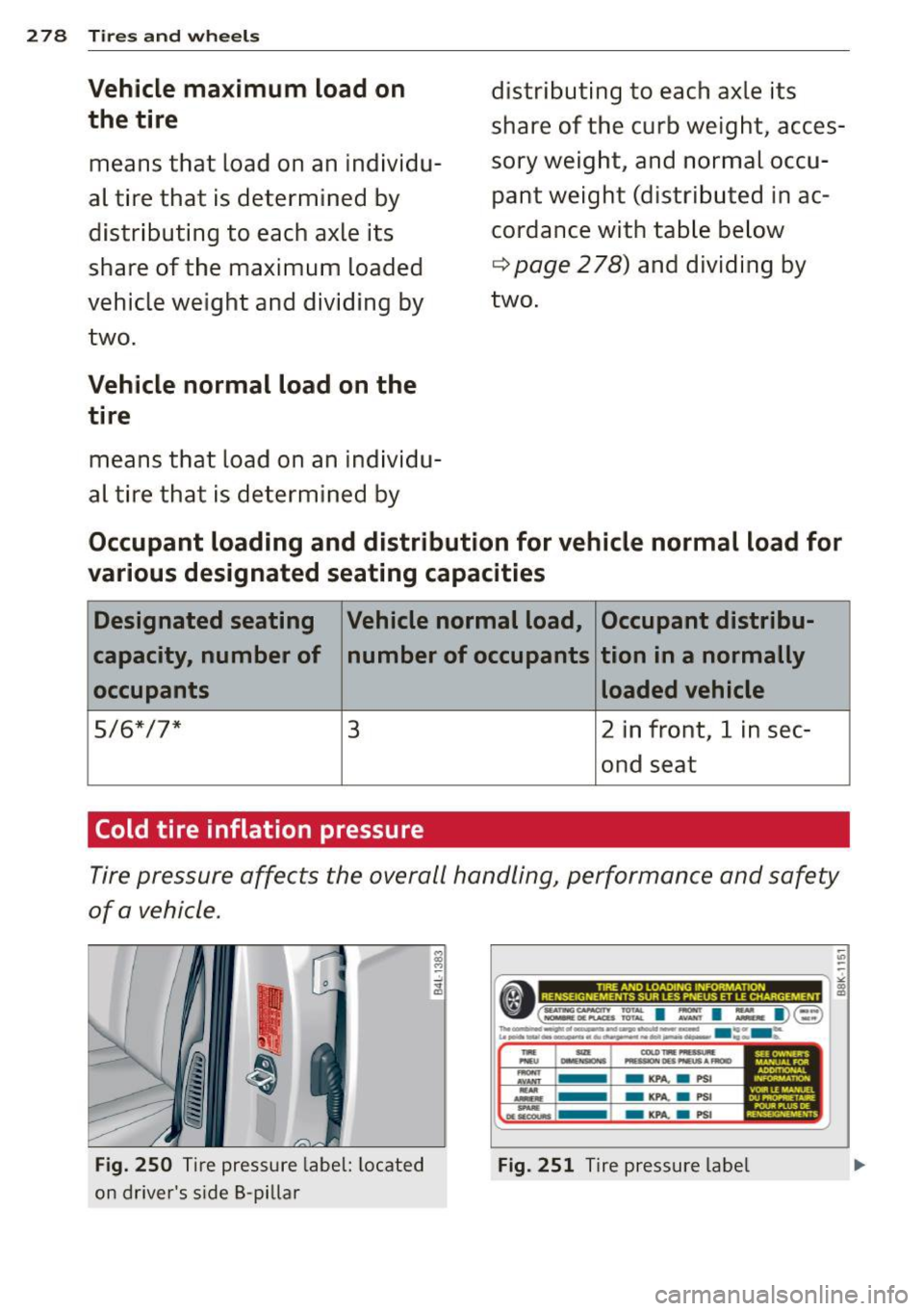
F ig. 25 0 Tire pressure label: located
on driver's side 8 -pillar
~----------~"'
MW OWE lSlllHS P'RES5l0H OES f'Nall A, FIIICJD
:"" -ICPA. • PSI
.::. -KPA.. . PSI
°'~ -KPA. -PSI
Fig. 251 Tire pressure label