transmission AUDI Q7 2015 Owner´s Manual
[x] Cancel search | Manufacturer: AUDI, Model Year: 2015, Model line: Q7, Model: AUDI Q7 2015Pages: 350, PDF Size: 86 MB
Page 238 of 350
236 Driving o ff road
- Veh icles wi thout air spring s: ground clear
ance : 8.1 in (204 .8 mm)
- Veh icles w ith adap tiv e air su sp en sion *:
maximum ground clearance: 9.4 in
(239.8 mm) at high level 2
A WARNING
Exceeding the stated maximum figures
can result in severe injuries or vehicle dam
age.
- All the information was gathered on lev el, firm and non-slippery road surfaces,
and under dry weather conditions.
- Ideal conditions do not prevail offroad.
Never utilize the maximum read ings to
their fullest, always leave a safety re
serve .
Driving tips
On poor road and offroad, there is always on
ly one motto : Plan ahead and drive slowly!
P lease obse rve the following when dr iving
away from paved road s:
• Drive only on roads and offroad sections
which match the design of your vehicle and
your abilities as a driver. Never take risks!
• Drive slowly and plan ahead!
• Take in to consideration the
g round cl ea r
a nc e
of your vehicle .
• Activate the
offroad m ode Q page 223 as
needed.
• Use the
hill desce nt control ~ page 225
when driving down steep sect ions on hills.
Unp aved road s and offroad
Drive slowly on unfamiliar roads and unknown
offroad sections, and look out for unexpected
obstacles (e.g. potho les, rocks , tree stumps ,
etc .).
To prevent the vehicle from bottom ing and
avoid damage to the underbody, you should
d rive st ra ight ac ross severe bumps in the
g round with on ly one s ide of the vehicle so
that on ly two of your wheels cross the bumps. Drive brisk
ly through sandy or marshy offroad
sections and do not stop , if at all possible .
Driving through w ater
Note the following to avoid veh icle damage
when d riving through wate r, for example on
flooded roads :
- The water must not be any higher than the
bottom of the vehicle body.
- Do not dr ive faster than walk ing speed .
Driving on a slope
If you ever find you rself not able to climb a
s lope, do not try to turn around, drive back
down in
r e v erse . Otherwise, you run the r isk
of tipp ing over .
If the veh icle th re at en s to t ip ov er whe n
dr ivin g a cross a slop e, you mus t immediate
ly ste er downhill in the dir ection of th e
s lop e.
Do not park your vehicle on steep slopes or
grades .
To reduce the risk of t ipping over, drive on
s lopes in th e direction of the downward s lope
(fall line) -
not c ross wise.
A WARNING
-After driv ing through water, mud, slush,
etc ., the brakes may be s low to take effect
because of wet brake rotors and pads . D ry
the brakes first by brak ing carefully to re
store t he fu ll braking effect.
(D Note
Vehicle components such as the eng ine,
transmission, suspension or e lectrica l sys
tem can be severe ly damaged by dr iv ing
th rough water .
(D Tips
-Check the depth of the water before d riv
ing through it .
- Do not stop the vehicle, drive in reverse or switch the engine off when driving
through water.
Page 243 of 350
M N
0 ...J
'SI: ,...., \!) 1.1'1 ,...., 1.1'1 ,....,
have become completely familiar with the way
your vehicle-trailer combination behaves and responds.
Backing up is difficu lt and requires practice.
Backing up with a trai ler genera lly requires
steering action opposite to that when backing up your vehicle without a trailer .
Maintain a greater distance between your ve
hicle and the one in front of you. You will need
more room to stop . To compensate for the
trai ler, you will need a larger than norma l
turning radius.
When passing, remember that you cannot ac
celerate as fast as you normally would be
cause of the added load . Make sure you have
enough room to pass. After passing, allow plenty of room for your tra iler before chang
ing lanes again .
Avoid jerky starts, sharp turns or rapid lane
changes.
@ Tips
- Do not tow a traile r during the break-in
period of your vehicle.
- If you tow a trailer, your A udi may re
quire more frequent maintenance due to
the extra load
¢ page 326.
Parking on a slope
Do not park on a slope with a trailer. If it can
not be avoided, do so only after doing the fol
lowing:
When parking:
.. Apply the foot brake .
.. Have someone place chocks under both the
vehicle and the trai ler wheels .
.. With chocks in place, slowly re lease the
brakes until the wheel chocks absorb the
load .
.. Turn the wheels towards the curb .
.. Apply the parking brake.
.. Move the selector lever to P.
When restarting after parking:
.. Apply the foot brake.
Trailer towing 241
.. Start the engine.
.. Move the selector lever to D.
.. Release the parking brake and s low ly pull
out and away from the wheel chocks.
.. Stop and have someone retr ieve the wheel
chocks.
(D Tips
If you move the selector lever of the auto
matic transmission to P before applying
the parking brake and before blocking the
whee ls, you may have to use more force
l ater to move the lever out of the
P posi
tion.
•
•
Page 275 of 350

M N
0 ...J
'SI: ,...., \!) 1.1'1 ,...., 1.1'1 ,....,
-If you notice unusual vibra
tion or if the vehicle pulls to one side when driving, al
ways stop as soon as it is safe to do so and check the
wheels and tires for dam age.
(D Note
-Please note that summer
and winter tires are de
signed for the conditions
that are typical in those sea
sons. Audi recommends using winter tires during the
winter months. Low tem peratures significantly de
crease the elasticity of
summer tires, which affects
traction and braking ability.
Tires and wheels 273
If summer tires are used in
very cold temperatures, cracks can form on the tread
bars, resulting in perma
nent tire damage that can
cause loud driving noise and unbalanced tires. Audi is not
responsible for this type of
damage.
-Burnished, polished or chromed rims must not be used in winter road condi
tions. The surface of the
rims does not have suffi
cient corrosion protection
for this and could be perma
nently damaged by road salt
or similar substances.
•
•
'
Glossary of tire and loading terminology
Accessory weight
means the combined weight (in
excess of those standard items
which may be replaced) of auto matic transmission, power
steering, power brakes, power
windows, power seats, radio, and heater, to the extent that
these items are available as fac
tory-installed equipment (whether installed or not).
Aspect ratio
means the ratio of the height to
the width of the tire in percent. Numbers of 55 or lower indi
cate a low sidewall for im
proved steering response and
better overall handling on dry
pavement.
Page 316 of 350

314 Fuses and bulbs
Right cockpit fuse assignment
Fig. 270 Right cockpit: fuse pane l w ith plastic clip
Fuse panel @ (black)
No. Consumer Amps
No. Consumer Amps 6
Automatic transmission
5/20
1 Heated rear seats
20
2 Telephone, cell phone package 5
7
Electronic Stabilization Control
5
(ESC)
3 Front seat
hating/seat ventila-
30/15
tion (right) 8
Shift gate automatic transmis-
s sion
4 Electronic
Stabil iz at ion Control
20
(ESC) 9 Parking system s
10 A
irbag 5
5 Door control module (right side
15
of vehicle) 11
Heat ed rear seats 5
12 A ir-conditioning
5
6 Rear electrical outlets 25
7
Lumbar support passenger's
10
seat
Fuse panel © (red)
No. Consumer Amps
9
Front electrica l outlets
25 1
Instrument cluster 10
10 A/C controls 10 2
Rearvi ew camera 5
11 Coo
ler
15 3 CD player, DVD drive
5
12 Inte
lligent power module pas-
15
4 MMI Display 5
senge r 5 Automatic t ransmission 15
Fuse panel@ (brown ) 7 Panoramic
sliding sunroof seg-
ment 1 20
No.
Consumer Amps
1 Headlight e
lectronic system
10
(right side of veh icle)
2 Ride height adjustment 5
8
Panoramic sliding sunroof seg-
20
ment 2
9 Panoramic
sliding sunroof sun-
20
blind
3 Telephone package 5
4 Audi side assist
5 11
W
indow regulators (right side
35
of vehicle)
s
Electronic Stabilization Control
(ESC) 5 12
Rear air-conditioning controls 10
Page 320 of 350
318 Emergency situations
@ Tips
- The discharged battery must be properly
connected to the vehicle's electrical sys
tem. When jump starting or charging the
battery, never connect the negative
ground cable to the battery negative
post because the battery manager sys
tem must be able to detect the battery's
state of charge . Always connect the neg
ative ground cable to the negative
ground post of the battery manager con
trol unit.
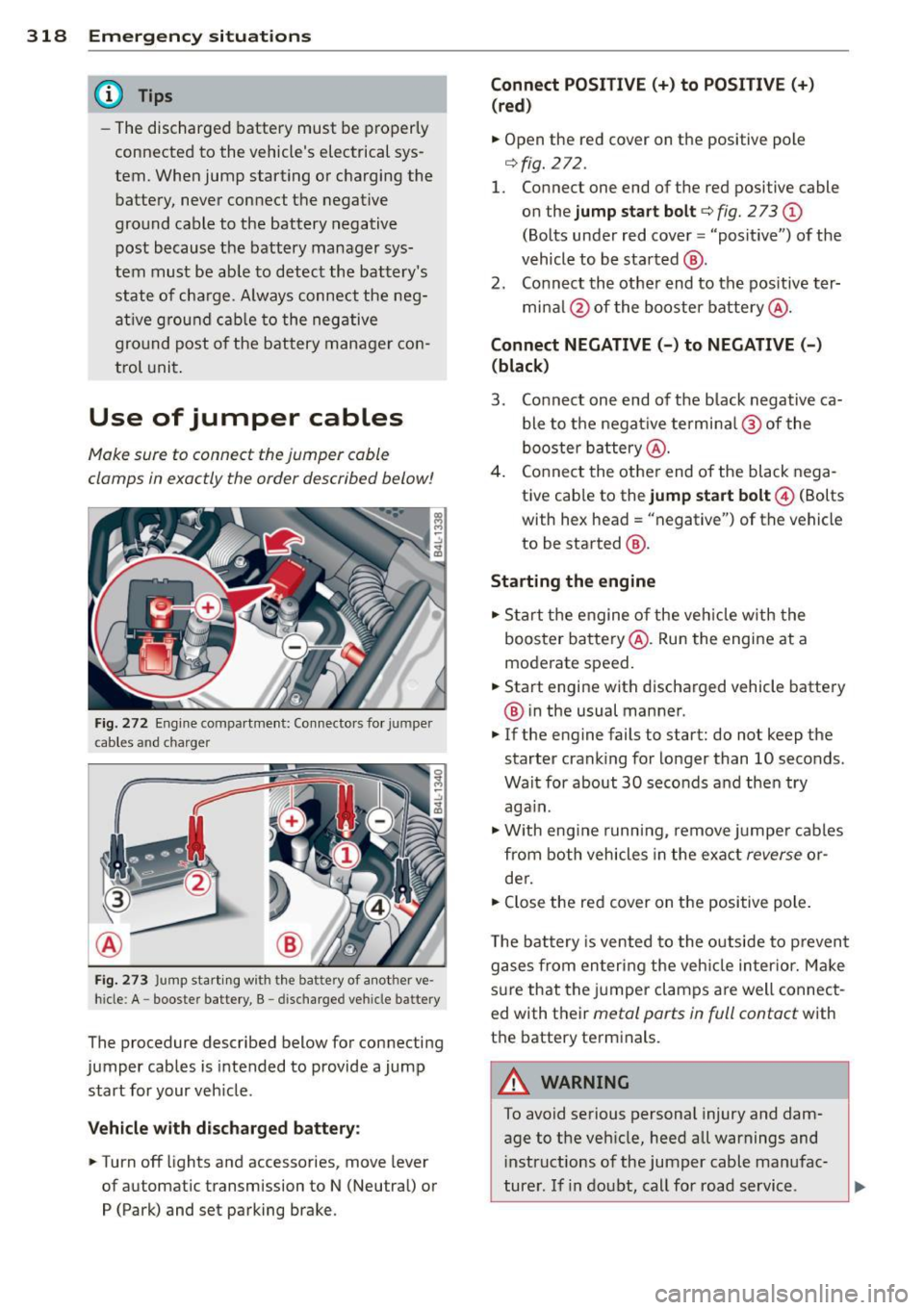
Use of jumper cables
Make sure to connect the jumper coble
clomps in exactly the order described below!
Fig . 272 Engine co mpartment: Conne cto rs fo r jum per
c ables a nd charger
®
Fig. 273 Ju m p sta rt in g w it h the bat te ry of anot her ve
h icle : A - b ooster battery, B - discharge d ve hicl e batte ry
The procedure described below for connecting
jumper cables is intended to provide a jump
start for your veh icle .
Vehicle with discharged battery:
.. Turn
off lights and accessories, move lever
of automatic transmission to N (Neutral) or
P (Park) and set parking brake. Connect
POSITIVE(+) to POSITIVE(+)
(red)
.. Open the red cover on the pos itive pole
¢ fig. 272 .
1. Connect one end of the red positive cable
on the jump start bolt
c::;, fig. 2 73@
(Bolts under red cover = "positive") of the
vehicle to be started @.
2. Connect the other end to the positive ter-
mina l@ of the booster battery@.
Connect NEGATIVE (-) to NEGATIVE (-)
(black)
3. Connect one end of the black negative ca
ble to the negat ive terminal @ of the
booster battery @.
4. Connect the other end of the black nega
tive cable to the jump start bolt@ (Bolts
with hex head= "negative") of the vehicle
to be started @.
Starting the engine
.. Start the engine of the vehicle w ith the
booster battery@. Run the engine at a
moderate speed .
.. Start engine with discharged vehicle battery
@ in the usual manner.
.. If the engine fails to start: do not keep the
starter crank ing for longer than 10 seconds .
Wait for about 30 seconds and then try
again .
""W ith engine running, remove jumper cables
from both vehicles in the exact
reverse or·
de r .
.. Close the red cover on the positive pole.
T he battery is vented to the outside to prevent
gases from entering the veh icle interior. Make
sure that the jumper clamps are well connect
ed with their
metal ports in full contact with
the battery terminals.
A WARNING
-
To avoid serious persona l injury and dam-
age to the vehicle, heed all warnings and i nstructions of the jumper cable manufac-
turer . If in doubt, call for road service . ,..
Page 324 of 350

322 Emergency situations
fall from a lift if there is a change in ve
hicle weight distribution and balance.
This might happen, for example, when
heavy components such as the engine
block or transmission are removed .
- When removing heavy components like
these, anchor vehicle to hoist or add cor
responding weights to maintain the cen
ter of gravity. Otherwise, the vehicle
might tilt or slip off the hoist, causing
serious personal injury.
(D Note
- Be aware of the following points before
lifting the vehicle:
-The vehicle should never be lifted or
jacked up from underneath the engine
oil pan, the transmission housing, the
front or rear axle or the body side
members. This could lead to serious
damage.
- To avoid damage to the underbody or
chassis frame, a rubber pad must be
inserted between the floor jack and
the lift points.
- Before driving over a workshop hoist,
check that the vehicle weight does not
exceed the permissible lifting capacity
of the hoist.
- Before driving over a workshop hoist,
ensure that there is sufficient clear
ance between the hoist and low parts
of the vehicle.
Page 325 of 350

Technical Data
Vehicle identification
F ig. 281 Veh ide Identificat ion Number (VlN) plate: lo ·
c ation on d river 's s ide das h pane l
XXXXX XX · X -XXXX XXX
~ fAllftlli. -llllll · NR. ~ W!ru -llllll -NO.
xx
XXXX XXXX XX X XXXXXXXX
XXX XXX
IYP /TYPE
XX XXXXXXX XX X X XX
XXX KW XXX
®i ~W.::·f :l~~ XXXX XXX XXX
©+ ::rw= xxxx I xxxx XXX I xx
M. · AUSSt I IJ'IIDIIS
~--
EOA 7D 5 4UB 6XM SSG SRW
2E H JDZ 1LB lA S 18A
3FC SMU 7X l
FD A 9G3 OG7 OYH OJF
TL6 3 KA 8EH UlA X98 027
lXW 803 908 824 D2D
7T6 CV7 7KO 4X3 2K2
3L4 4KC 3YO 413 502
1S A 7GB 01A 4GO
XX. X XX X XX X XXXX
Fig. 282
Vehicle identificat io n label: inside the lug
ga ge compar tmen t
Vehicle Identification Number (VlN)
The Veh icle Iden tifica tion Number is located
in different p laces :
- under the windshield on the driver's side
¢fig. 281.
-in the MMI: Select: !CAR ! function button>
Systems* contro l bu tton > Vehicle ID num
ber (VIN)
or select: I CAR I function button >
Car systems* control button > Servicing &
~ checks > VIN number .
:3 -on the vehicle identification label. ""'. rl I.O
"' rl
"' rl
Technical Data 323
Vehicle identification label
The vehicle identification label is located in
the luggage compartment under the cargo
floor cover.
T he label¢
fig. 282 shows the following vehi
cle data :
(D Vehicle Ident ificat ion Number (VIN)
@ Vehicle type, engine o utput, transmission
® Engine and transmission code
© Paint number and interior
® Optional equipment numbers
The information of the vehicle identification
label can also be found in your Warranty
&
Maintenance booklet.
Safety compliance sticker
The safety compliance sticker is your assur
ance that your new veh icle complies with all
applicable Federal Motor Vehicle Safety
Standards which were in effect at the time the
vehicle was manufactured . You can find this
sticker on the door jamb on the driver's side.
It shows the month and year of production
and the vehicle ident ificat ion number of your
vehicle (perforation) a s well as the Gross Veh i
cle Weight Rating (GVWR) and the Gross Axle
Weight Rating (GAWR) .
High voltage warning label
The high voltage warning label is located in
the engine compartment next to the engine hood re lease. The spark ign ition system com
plies with the Ca nadian standard ICES-002 .
Weights
Gross Vehicle Weight Rating
The Gross Vehicle Weight Rating (GVWR), and
the Gross Axle Weight Rating (GAWR) for
front and rear are listed on a sticke r on the
door jamb on the driver's side .
The Gross Vehicle Weight Rating includes the
weight of the bas ic vehicle plus full fuel tank,
o il and coolant, plus maximum load, which in
cludes passenger we ight (150 lbs/68 kg per
II>--
Page 330 of 350
328 Con sumer Inf ormation
-Always make su re the transmission se
lector l ever (automat ic transmiss ion) is
in P (Park position) an d th e park brake is
firmly applied .
@) For the sake of the environment
-Changing the en gine settin gs wi ll ad
versely affect em iss ion levels . This is det
rimental to the enviro nment and incr eas
es fuel consumption .
- Always observe env ironmental regula
tions when dispos ing of old engine oil,
used brake fluid, dirty engine coolant,
spent batteries or worn o ut tires.
- Undeployed airbag modules and preten
s ioners might be classified as Perchlo
rate Mate rial -spec ial handling may ap
ply, see www.dtsc.ca .gov/hazardous
was te/perch lorate . When the veh icle or
parts of the res traint system in cl uding
airbag modules safety belts wit h preten
sioners are scrapped, all applicable laws
and regulations must be observed. Your
authori zed Aud i dea ler is familiar with
these requirements and we recommend
that you have your dealer perform this
serv ice for you .
Additional accessories,
modifications and
parts replacement
Additional accessories and parts
replacement
Always consult an authorized Audi dealer be
fore purchasing accessories.
Your veh icle incorporates the latest safety de
sig n featu res ensu ring a high standard of a c
tive and passive safety .
This safety could be comp romised by non-ap
proved changes to the ve hicle. For this reason ,
if pa rts have to be replaced , please obse rve
the following points when install ing addition
a l accessories: Approved Audi accesso
ries and genuine Aud i
parts are available from authorized A udi deal
ers.
T hese dea le rs a lso have the necessary facili
ties, tools and tra ined specialists to install the
parts and acc essories proper ly .
A WARNING
-Using the wrong spare pa rts or using non-
approved accessories ca n cause damage to
the veh icle and ser ious persona l injury.
- Use on ly accessories express ly approved
by Audi and ge nuine Audi spare parts
- These parts and accessories have been
specia lly designed to be used on yo ur ve
h icle .
- Never install accessor ies such as tele
phone crad les or beverage ho lders on a ir
bag covers or within the airbag deploy
ment zones . Do ing so will increase the
risk of injury if a irbags are triggered in an
accide nt!
- Before you check anything in the engine
compa rtment, always read and heed a ll
WARNI NGS
9 page 256 .
(D Note
-If items other than genu ine Audi spare
par ts, add-on equipmen t and accessory
items are used o r if repair wo rk is not
performed ac co rd ing to specified meth
ods, this c an resu lt in seve re damage to
yo ur vehicle's eng ine and body (such as
co rrosion) and adversely affect yo ur vehi
cle's warranty .
- If emergency repairs must be performe d
elsew here, have the vehicle examined by
an authorized A udi dealer as soon as
possible .
- The manufacturer cannot be held liable
for damage wh ic h occ urs due to failure
to comply with these stipu lations.
Page 334 of 350
332 Index
Alcantara
C leaning 245
A ll-w heel drive . ........... .... .... . 227
Winter tir es
A lternator 298
Malfunction . . . . . . . . . . . . . . . . . . . . . . . 31
Ambience lighting Lighting profiles .......... .... .... .. 65
Anti -freeze
refer to Engine coo lant system ...... . 262
Anti-lock brake system ..... ... .. .. .. . 223
Warn ing/ indicator lights . . . . . . . . . 16, 18
Anti-slip regulation ........ .. .. .... . 223
Warn ing/ indicator lights ... .. .. .. .. .. 16
Anti-theft systems Anti-theft alarm system . . . . . . . . . . . . . 50
Electronic immobilizer ... .. .. .. .... . . 40
Approach/departure angle . .. .. .. .. .. . 235
Ashtray . .. ... ............ .. .. .. .. .. 89
Asterisk What does it mean when something is
marked with an asterisk? . . . . . . . . . . . . . . 6
Aud i b rak ing guard ....... .. .. .. .. .. . 129
Error messages .... ....... ... .... . 130
Settings . . . . . . . . . . . . . . . . . . . . . . . . . 130
Status messages . . . . . . . . . . . . . . . . . . 130
Switching on and off ...... .. .. .. .. . 130
Aud i Service Repair Man uals and Litera-
ture .. .. .. .. ............. .. .. .... . 326
Auto -Check Control . . . . . . . . . . . . . . . . . . 30
Automatic belt retractor ... ... .. .. ... 177
Automatic mode
F our-zone automatic comfort air condi-
tioning .... ... .. ..... ... .. .. .... . 101
Automatic Shift Lock (ASL) . . . . . . . . . . . 140
Automatic transmission ..... .. .. .... . 139
Automatic Shift Lock (ASL) . .. .. .. .. . 140
Driving .. ................. .. .... . 141
Emergency mode . . . . . . . . . . . . . . . . . . 143
Emergency release ......... ... .. .. . 143
H ill descent contro l ........ ... .. ... 142
I gn ition key safety lock .... .. .. .. .. . 107
Kick-down . . . . . . . . . . . . . . . . . . . . . . . . 143
M anual s hift program ......... .. .. . 1 42
Selector lever ........... ... .. .... . 139
Shift paddles . . . . . . . . . . . . . . . . . . . . . 142 AUTO mode
A/C climate controls ... ..... ... .. .. . 97
Auto Safety Hot line ............. .... 170
Average speed . . . . . . . . . . . . . . . . . . . . . . . 24
Avoid damaging the vehicle .... ... .. .. 232
B
Bass box
Battery .... .. .. .. .. ........... ... .
Battery location .. ................ .
Charg ing ... ... .. .. ... ........... .
Impo rtant warnings when working on
the battery .... .. ............. ... . 30S
266
267
268
267
Jump start ing .. .. ... .......... .. .. 317
Low .. .. .. .... .. ... .. ..... ... .. .. 228
Replacing the battery ... .... ... .. .. 270
State of charge ... .. ... ......... ... 228
Voltage ... .... ................... . 35
Winter operation . ............. .... 266
Working on the battery .. .... ... .. .. 267
Before driving ..... ... .. ..... .... . .. 163
B lended gasoline .. ................ . 248
Booster seats . . . . . . . . . . . . . . . . . . . . . . 211
Brake fluid
Changing the brake fluid ..... ... .. .. 266
Checking the brake fluid level . ... .. .. 265
Reservoir ... .. .. .. .... .... .... ... 265
What is the correct brake fluid level? .. 265
What shou ld I do if the brake fluid warn-
ing light comes on? .... .. ... ... .. .. 265
Brake light Defective . . . . . . . . . . . . . . . . . . . . . . . . . 23
Brake system .... ... .............. .. 265
Anti- lock brake system . . . . . . . . . . . . . . 18
Brake assist system ..... .... ... .. .. 223
Brake booster .... ... .. ..... .... . .. 225
Brake fluid . ..... ... .. ..... ... .. .. 265
Brake fluid specifications for refill and re-
placement .... .. ............. .... 266
Brake pads .. .. .. ..... ........... . 230
General information .............. . 225
How does moisture or road sa lt affect the
brakes? . .. .. .. .. ............. .. .. 225
Malfunction . . . . . . . . . . . . . . . . . . . . . . . 32
Parking brake .. .. ... .......... .. .. 111
Warning/indicator lights ..... ... .. .. . 19
Worn brake pads symbo l . . . . . . . . . . . . . 36
Page 345 of 350
M N
0 ...J
'SI: ,...., \!) 1.1"1 ,...., 1.1"1 ,....,
Synchronization
Climat e controls ... .... ... .. .. .. ... 102
Four -zone automatic comfort a ir cond i
t ioning . . . . . . . . . . . . . . . . . . . . . . . . . . 103
Synchron izing clima te con trol .. .. .. .. .. 95
T
Tac home ter . . . . . . . . . . . . . . . . . . . . . . . . . 11
Ta il lights
C leaning . ................ ...... .. 243
Tank flap Unlocking the fue l filler flap by hand .. 252
TO I clea n diese l
refer to Ad Blue ........... .... .. .. . 252
T echnica l data ................ ... ... 323
Technica l modifications .. ... .. .. .. .. . 329
Temperature Clima te con trols . . . . . . . . . . . . . . . . . . . . 9 7
F ou r-zone au tomati c comfo rt air cond i-
tioning .... .. .. ... . .... ... .. .. ... 101
Setting for the driver's and front pas-
senger 's side . ........... .. .. .. .... 97
Tethe r anchors ............ .... .. .. . 220
T ethe r strap . .... .... ... .. .. .. .. .. . 220
Textiles Cleaning ... .. .. .. .. .... ... .. .. ... 245
The first 1,000 mi les (1 ,500 km) and after-
wards . .... .. ................. .. ... 230
T ie -down r ings ............. ... ... ... 83
Tie -downs . . . . . . . . . . . . . . . . . . . . . . . . . 170
T ips fo r the env ironme nt
Saving fue l . . . . . . . . . . . . . . . . . . . . . . . . 8 7
Using the air condi tioner only when nec-
essary ..... .. .... .. .... ... .. .. ... 100
tiptronic Automatic S hift Lock (ASL) . .. .. .. .. . 14 0
D riving .... ................. .. ... 1 41
E mergency mode . . . . . . . . . . . . . . . . . . 14 3
H ill descent control .... ... .. .. .. .. . 14 2
Kick-down .. .. .... .... ... .. .. .. ... 143
M anual shift program .. ... .. .. .. .. . 1 42
Selecto r lever . ........... .. .. .. ... 139
t iptronic (au tomati c transmission) .. .. . 139
T ire pressure ............... ... ... .. 282
Tire pressure monitoring system . ... .. . 30 1
Loss of air pressure . . . . . . . . . . . . . . . . . 18
Inde x 343
Tires .. ... .. .. .... .. . .. .. ..... ... .. 271
Service life . . . . . . . . . . . . . . . . . . . . . . . 289
•
speed rating letter code ..... ... .. .. 294 •
Tire manufact uring date ............ 293
Tire specifications ................. 293
Tread depth ...... ................ 289
U ni form tire quality grading .... ... .. 297
Win ter tires ...... ...... .......... 298
Tires/Whee ls
Low aspect ratio tires ............... 300
Tire pressure mo nitoring system . . . . . . 18
Tires and vehicle load limits .... ... .. .. 286
T ires and wheels
Checking tire pressu re .......... .. .. 282
Co ld tire infl ation p ress ure ........ .. 278
Dimens ions . ... .. .. . ... ...... ... .. 291
General notes ...... . .. .. ..... ... .. 271
G lossary of tire and loading terminolo-
gy ....... .. .. .. .... ............. 273
New t ires and wheels ........... .... 291
Rep lacing . .. .. .. .... ... .... .... .. 292
Snow cha ins ...... ...... .......... 299
T ires and veh icle load limits ......... 286
Whee l bolts . .. .. .... ........... .. 299
Win ter tire s ... .. .. ............... 298
Tire service life .. .. ... ... ...... ..... 289
Too ls . ... .. .. .... ... .. .. ..... ... .. 304
T o rn o r frayed safety belts 176
Towing Front eye let . .. .. ................. 320
Rea r eyelet .. .. .. .. ... ....... ..... 320
T ow t ruck procedu res ... ....... .... . 319
TPMS Tire pressure monitoring system ... .. 301
T ra ile r tow ing . .. .. ............... .. 238
Operating instr uctions .. ..... ... .. .. 239
Pa rking systems .... . .. .. ..... ... .. 155
Technical requirements . . . . . . . . 238, 240
Tongue load . .. .. ................. 239
Trai ler towing tips ................. 240
T rai ler turn signal assembly
Warning/indicator lights ..... ... .. .. . 17
T ransmission .. .... .... .... ... .... .. 139
Malfunction ( indica to r li ght) ....... .. 143
Transport Canada .. ................. 171
T read Wear Indicator (TWI) .... ... .. .. 289