check engine light AUDI Q7 2015 Owner´s Manual
[x] Cancel search | Manufacturer: AUDI, Model Year: 2015, Model line: Q7, Model: AUDI Q7 2015Pages: 350, PDF Size: 86 MB
Page 267 of 350
M
"' 0 ..J
"". rl I.O
"' rl
"' rl
-Antifreeze is poisonous . Always store an
t ifreeze in its or iginal container and well
out of the reach of children.
- If you drain the coolant, it must be
caught and safely stored in a proper con
tainer clearly marked "poison".
(D Note
- Coolant pollutes the environment and
could cause an engine fire. Excess coo l
ant will be forced out through the pres
sure re lief va lve in the cap when the en
gine becomes hot.
- If, in an emergency, only water can be
added, the correct ratio between water
and antifreeze ¢
page 262 must be re
stored as soon as possib le.
@ For the sake of the environment
Drained coolant should not be reused. Al
ways dispose of used coolant while observ ing all environmental regulations .
Radiator fan
The radiator fan switches on automatically by
itself
The radiator fan is driven by the engine via the
V-belt . The viscous clutch regulates the speed
of the fan accord ing to the temperature of the
coolant .
An auxiliary electric radiator fan* switches on
and off depending on coolant temperature
and other vehicle operating conditions .
After you switch the engine off, the auxilia ry
fan can continue running for up to 10 minutes
- even with the ignition off. It can even switch
on again later by itself¢& , if
- the temperature of the engine coolant rises due to the heat build-up from the engine in
the engine compartment, or
- the engine compartment hea ts up because
the vehicle is parked in intense sunlight .
Checking and fillin g 265
A WARNING
-To reduce the risk of personal injury nev
er touch the rad iator fan.
- The auxiliary electric fan is temperature
controlled and can switch on suddenly
even when the engine is not running .
- The auxiliary radiator fan switches on au
tomatically when the engine coolant reaches a certain temperature and will
continue to run until the coo lant temper
ature drops.
Brake fluid
Checking brake fluid level
The brak e fluid lev el can be check ed with a
quick glance.
N
N
-N ,.
:8
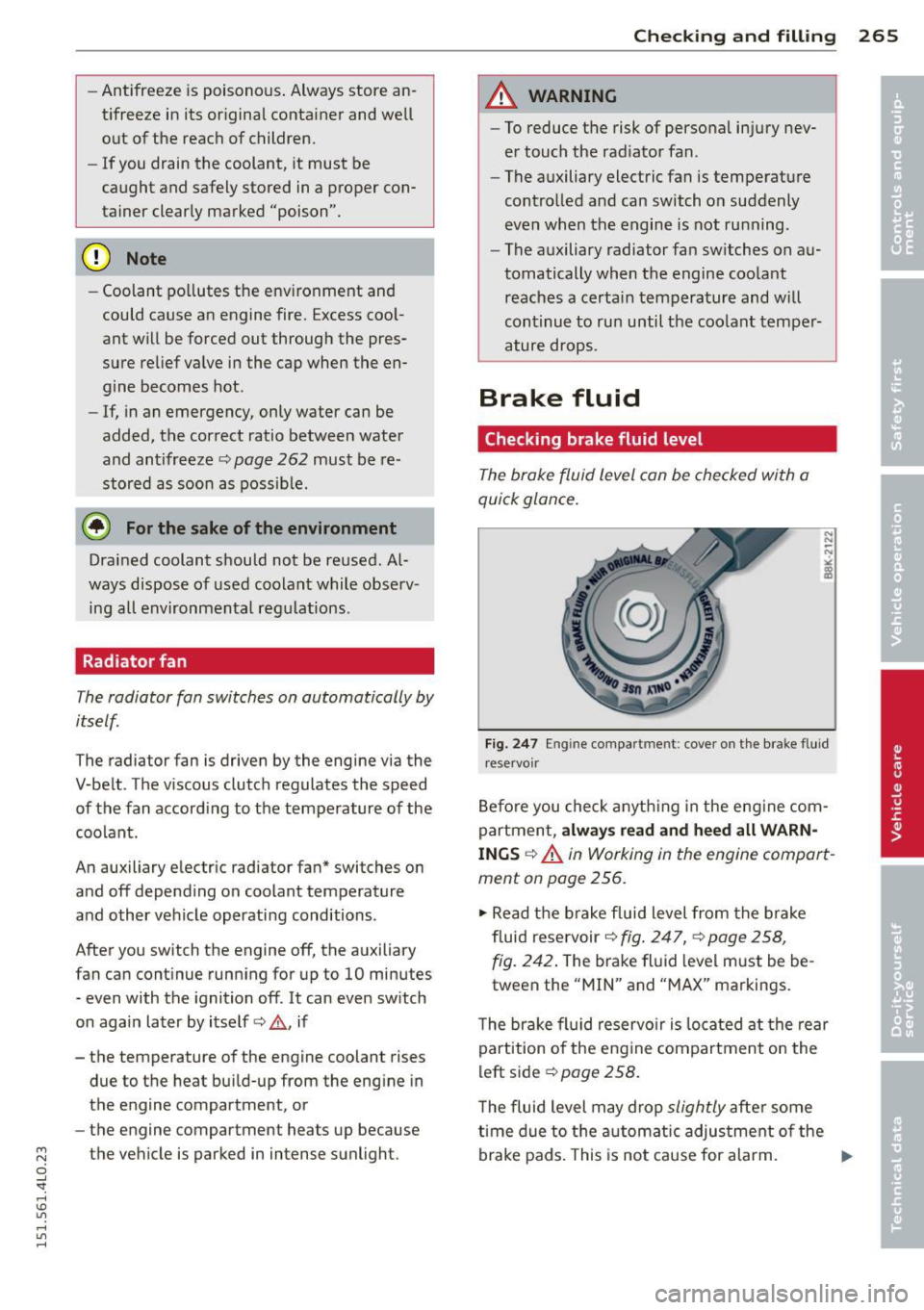
Fi g. 247 En gin e compa rtm en t: cover o n the bra ke fluid
reservoir
Before you check anything in the eng ine com
partment ,
always read and heed all WARN
INGS ¢ A in Working in the engine compart
ment on page 256.
.,. Read the brake fluid level from the brake
fluid reservoir ¢
fig. 247, ¢ page 258,
fig. 242.
The brake fluid level must be be
tween the "MIN" and "MAX" markings .
The brake fluid reservoir is located at the rear
partition of the eng ine compartment on the
left side ¢
page 258.
The fluid level may drop slightly after some
time due to t he automatic adjustment of the
brake pads. This is not cause for alarm. ..,_
Page 269 of 350
M N
0 ...J
'SI: ,...., \!) ..,.,
,...., ..,., ,....,
Disconne cting the batt ery t erminals
Some vehicle functions (power w indow regu
l ators, for example) are lost if the battery ter
minals are disconnected . These functions have
to be re learned after the battery terminals are
connected again. To prevent this, the battery
should only be disconnected from the vehicle
electrical system when absolutely necessary
for repairs .
Vehicle s not driven fo r lo ng period s
If you do not drive your vehicle over a period
of several days or weeks, electrical compo
nents are gradually cut back or switched off .
This reduces energy consumption and main
tains starting capab ility over a longer per iod
¢ page 228 .
Take into consideration that when you unlock
your vehicle, some convenience functions,
such as the inter ior lights or the power seat
adjustment, may not be available . The con
ve nience funct ions w ill be available again
when yo u turn on the ignition and start the
engine.
Winter op eration
During the winter months, battery capacity
tends to decrease as tempe ratures d rop . This
i s because more powe r is also consumed while
start ing, and the headl ights, rea r window de
fogger, etc., are used more often.
Avo id unnecessary power consumption, par
ticularly in c ity t raffic or when t rave ling on ly
short d istances. Let you r autho rized Aud i
dealer check the capacity of the vehicle bat
tery before winter sets in ¢
page 268. A well
charged battery wi ll not only prevent starting
prob lems when the weather is cold, but will
also last longer .
If your vehicle is left standing for severa l
weeks at extremely low temperat ures, the
veh icle battery should be removed and
stored where it will not freeze. This will
prevent it from bei ng damaged and hav ing
to be replaced.
Checkin g and fillin g 267
Working on the battery
Be especially careful when working on or near
the battery.
The battery is located under the driver 's seat.
Before you check anyth ing under the dr iver's
seat,
read and h eed all WARNINGS G &_ .
Always heed the safety warnings , when work
ing on the vehicle battery or the vehicle e lec
trical system to prevent injury .
The following WARNINGS are ver y
important when working on the batter y:
Alway s heed the following WARN IN G SY M-
BOLS a nd safety p re caution s when working
on the battery .
®
Alway s wear e ye prote ction.
~
Batt ery acid contain s sulfuric acid. Al -
w ay s we ar gloves and eye prot ection.
@
No
-spa rk s
- flam es
- smoking .
~
When a b atter y is ch arged , it produces
h y drogen g as w hic h is e xplosi ve and
could cause pe rsonal injur y.
®
Alw ays keep the batt ery well out of
r e a ch of childr en.
A WARNING
Whenever working on the battery or on
the electrical system, there is the risk of
injury, accident and even fire. Read and
heed the following WARNINGS:
- Always wear eye protection. Do not let
battery ac id or any lead particles get on
your skin or clothing. Shield your eyes.
Exp losive gases can cause blindness or
other inju ry.
- Battery acid conta ins sulfuric acid. Sulfu
ric acid can cause blindness and severe
bu rns.
- Always wear g loves and eye protection.
Do not tilt the battery because acid
~
•
•
Page 270 of 350
268 Check ing and filling
could leak out of the venti lation
open ings.
- If you get battery acid in your eyes or
on your skin, immediately rinse with
cold water for several m inutes and get
medical attention.
- If you should ingest any battery acid,
see k medical attention immediately.
- Do not expose the battery to an open
flame, electric sparks or an open light.
- Do not smoke.
- Do not interchange the positive and neg-
ative cab les .
- When wo rking on the battery, be sure
not to short-circuit the terminals with
tools or other metal objects. This would
cause the battery to heat up very quickly,
which could lead to damage or explosion
and personal injury.
- When a battery is charged, it produces
hydrogen gas which is explosive and
could cause personal injury.
- Always keep the battery well out of the
reach of children .
- Before work is done on the electrical sys
tem, disconnect the negative ground ca
ble .
- Before perform ing any work on the elec
trical system, sw itch off the engine and
ignition as well as any electrical equip
ment. The negative cable on the battery
must be disconnected. If you are just go
ing to rep lace a ligh t bu lb, then it is
enough to sw itch off the lights.
- Before dis connect ing the battery, switc h
off the anti-theft alarm system! Other
wise you will set off the alarm.
- Whe n disconnecting the batte ry, first
disconnec t the negative cable and then
the positive cable.
- Before reconnect ing the battery, make
s u re al l electrical consumers are switch
ed off. Reconnect the positive cable first
and then the negative cable . Never inter
change the cables -this co uld start a fire!
- Never charge a frozen or a thawed-out
battery . It co uld explode! If a battery has
frozen, then it must be replaced. A dis- charged batte
ry can freeze over at 32 °F
(0 oc).
-Make sure the vent hose is a lways attach
ed to the opening on the side of the bat
tery .
- Never use batteries wh ich are damaged .
There is the danger of an explosion! Al
ways replace a damaged battery.
A WARNING
-
Ca lifornia Proposition 65 Warning:
- Battery posts, terminals and related ac
cessories conta in lead and lead com
pounds, chemicals known to the State of
California to cause cance r and reproduc
tive problems. Wash hands after han
dling.
(D Note
- Do not disco nnect the vehicle battery
when the ignit ion is switched on or when
the engine is runn ing, otherwise, you will
damage electron ic components in the
electrical system.
- If your vehicle is going to stand for a
long period of ti me without be ing driven,
pro te ct the ba ttery from "freezing", o th
erw ise it will be damaged and will then
have to be replaced .
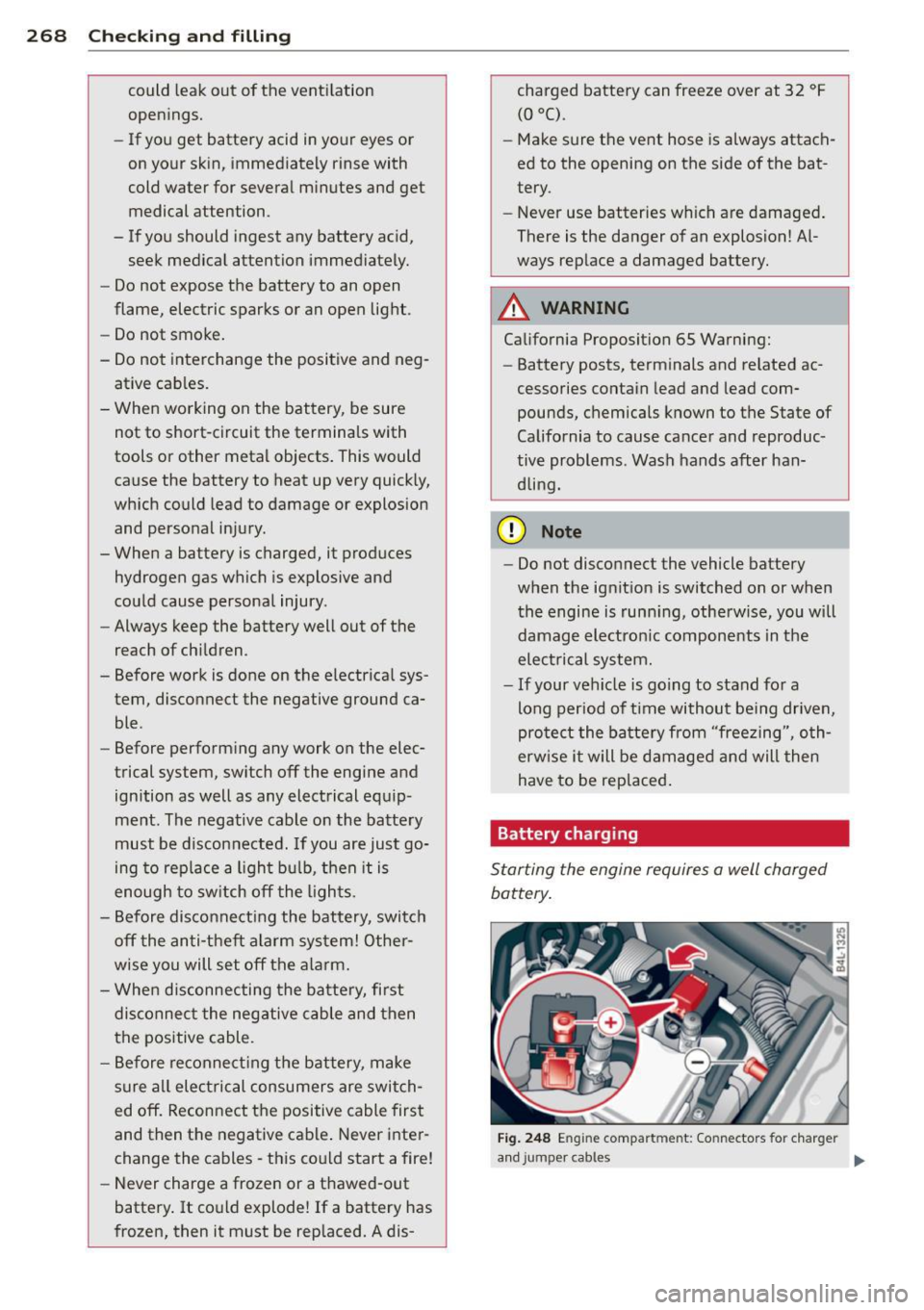
Battery charging
Starting the engine requires a well charged
battery .
Fig. 24 8 Eng ine compart men t: Co nnectors for ch arger
and jumper cables
Ill>
Page 272 of 350
2 70 Ch eck ing and filling
Battery replacement
The new battery must have the same specifi
cations and dimensions as the original equip
ment battery.
Intelligen t energy management in your veh i
cle is respons ible for d istributing the e lectr i
cal en ergy throughout your vehicle
¢ page 228. The intell igent e nergy manage
ment system w ill keep the eng ine battery
cha rged better then vehicles w ithout this sys
tem . To make sure the additional e lectrica l en
ergy is availab le once again after you have
changed the battery, we recommend that you install batteries of the same type and manu
facture only (the same as those installed at
the time your vehicle was delivered). Specifi
cations are listed on the battery hous ing . Your
author ized dealer must code the battery in
the ene rgy management system to enable you
to use the energy management funct ions cor
rectly after replac ing the battery.
If it is not poss ible to use a battery of this
type, the new battery must have the same ca
pac ity, voltage (12 volts), amperage , con
struction and plug seal ing.
When insta lling the battery, make sure the ig
n it ion and all e lectr ica l consumers a re turned
off.
Q;) Note
Make sure the venti lation hose on the s ide
of the battery is connected, otherwise
fumes or battery ac id can leak o ut.
@ For the sake of the environment
Because of the problem of proper d isposa l
of a battery, we recommend your autho r
i z ed Audi dealer change the ba tte ry for
you. Bat teries contain s ulfu ric ac id and
lead and must always be disposed of prop
erly in compliance with all environmental
reg ulations. Disposing of vehicle batteries
improper ly is very dangerous to the envi
ronment.
Windshield/headlight
washer container
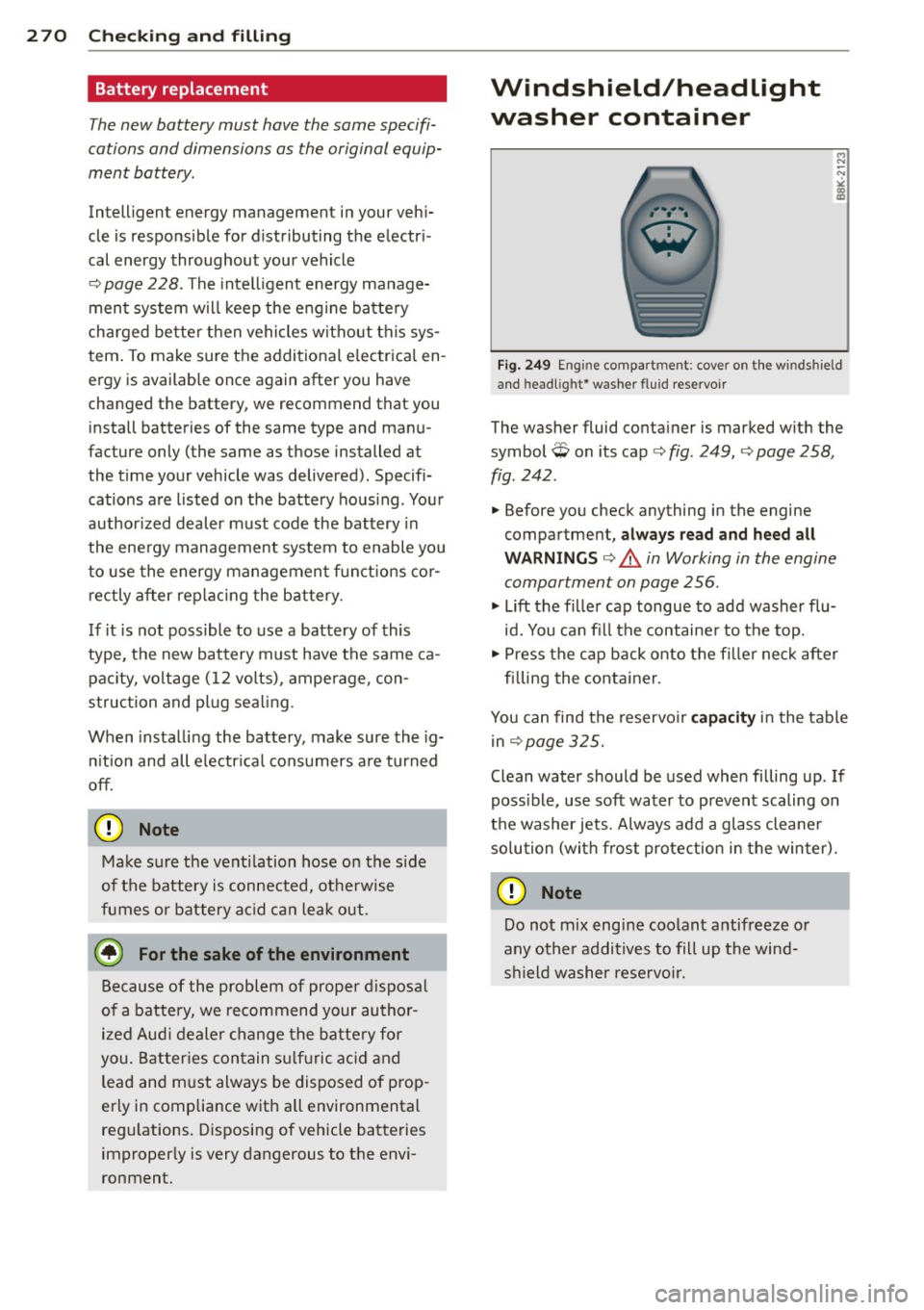
F ig . 24 9 Eng in e compart ment : cover on t he wi nds hield
and headl ig ht* washe r fluid reservoi r
The washer fluid co nta iner is marked w ith the
symbol Won its cap
¢ fig . 249, ¢page 258,
fig. 242 .
.. Before you check anything in the engine
compartment,
alwa ys read and he ed all
W ARNING S
¢ & in Working in the engine
compartment on page 256 .
.. Lift the fille r cap tongue to add washer flu
id. You can fi ll the container to the top.
.. Press the cap back onto the fi ller neck afte r
fi lling the container.
You can find the reservo ir
capacity i n the table
in
¢ page 325.
Clean water should be used when filling up . If
poss ible, use soft water to prevent scaling on
the washer jets. A lways add a glass clea ne r
solution (with frost prote ction in the winter).
0 Note
Do not mix engine coolant antifreeze o r
any other additives to fill up the wind
s hi eld washer rese rvoir.
Page 319 of 350
M N
0 ...J
'SI: ,...., \!) ..,.,
,...., ..,., ,....,
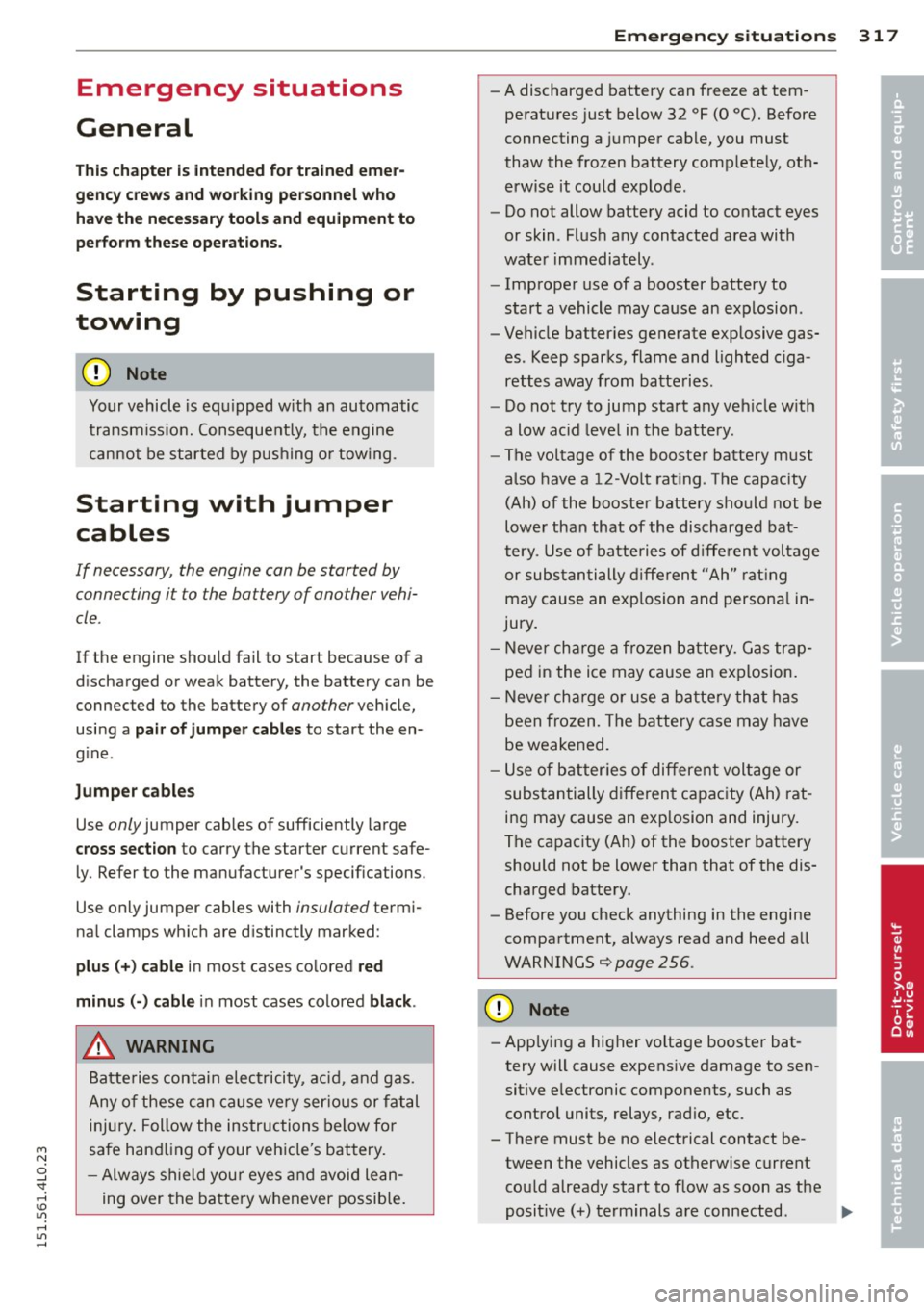
Emergency situations
General
This chapter is intended for trained emer
gency crews and working personnel who have the necessary tools and equipment to
perform these operations.
Starting by pushing or
towing
(D Note
Your v ehicl e is e quipped w ith an automatic
tra nsm iss io n. Cons eque ntly, the e ngine
cann ot be started by pus hing o r tow ing.
Starting with jumper
cables
If necessary, the engine can be started by
connecting it to the battery of another vehi
cle.
If th e engine shou ld fail to start because of a
d ischarged o r weak battery, the battery can be
connected to the battery of
another veh icle,
usi ng a
pair of jumper cables to start the en
gine .
Jumper c ables
Use only jumper cab les of sufficiently large
cross section to carry the starter cur rent safe
l y. Refer to the man ufacturer's specifications.
Use only jumper cables with
insulated te rm i
na l clamps w hich are d istinctly mar ked:
plus(+ ) cable in mos t ca ses co lore d red
minus(-) cable
i n most cases colored black .
A WARNING
Batteries con tai n elec trici ty, a cid, and gas.
Any o f these c an caus e ve ry ser ious or f atal
injury . Foll ow the instruc tions below fo r
safe han dling of your veh icle's battery .
- Alw ays s hield y our eyes and a void le an
ing over the batte ry w henever possib le .
Emergency situations 31 7
- A discharged battery can freeze at tem
pe rat ures just below 32 °F (0 °C). Before
connecting a jumpe r cable, you must
thaw the frozen battery c omp lete ly, ot h
e rwise it could explode.
- Do not allow battery acid to co ntact eyes
or skin . Fl ush any con tacted area wi th
wat er immediately .
- Imp roper use of a booster battery to
s tart a vehicle may cause an ex plosion.
- Vehicle batter ies generate expl osive gas
es. Keep sparks, flame and lighted c iga
rettes away from ba tte ries.
- Do not t ry to jump start a ny ve hicle w it h
a low ac id leve l in the battery.
- The voltage of the booste r batte ry m ust
also have a 12-Vo lt rat ing. T he capac ity
(Ah) of the booste r batt ery sho uld not b e
lowe r than that of th e discharged bat
t ery. Use o f batt eries of d iffe ren t vol tage
or su bstan tia lly differen t "Ah" rat ing
may cause an exp losion and pers onal in
jury .
- N ever ch arge a fr ozen batt ery. Gas t ra p
pe d i n the ice may c ause an ex plosion .
- N ev e r ch arge o r use a batt ery th at h as
been fro zen . Th e batte ry case may have
be weake ned.
- U se o f batter ies of di ffere nt vol tage or
substantially differen t ca pa city (Ah) rat
i ng may cause an exp losion and injury .
T he ca pa c ity (Ah) of the booster battery
should not be lower than that of the dis
charged battery.
- Before you check anything in the engine
compa rtment, always read an d heed a ll
WARNINGS¢
page 256.
(D Note
- App lyi ng a hi gher vo ltage booste r ba t
t ery wi ll cause expens ive damage to sen
sit ive e lectronic components, such as
cont ro l units, relays, rad io , etc.
- There must be no electrical c ontact be
tween the vehicles as otherw ise current
co uld already start to f low as soon as t he
posi tive(+) terminals a re con nect ed. ..,. •
•
Page 334 of 350
332 Index
Alcantara
C leaning 245
A ll-w heel drive . ........... .... .... . 227
Winter tir es
A lternator 298
Malfunction . . . . . . . . . . . . . . . . . . . . . . . 31
Ambience lighting Lighting profiles .......... .... .... .. 65
Anti -freeze
refer to Engine coo lant system ...... . 262
Anti-lock brake system ..... ... .. .. .. . 223
Warn ing/ indicator lights . . . . . . . . . 16, 18
Anti-slip regulation ........ .. .. .... . 223
Warn ing/ indicator lights ... .. .. .. .. .. 16
Anti-theft systems Anti-theft alarm system . . . . . . . . . . . . . 50
Electronic immobilizer ... .. .. .. .... . . 40
Approach/departure angle . .. .. .. .. .. . 235
Ashtray . .. ... ............ .. .. .. .. .. 89
Asterisk What does it mean when something is
marked with an asterisk? . . . . . . . . . . . . . . 6
Aud i b rak ing guard ....... .. .. .. .. .. . 129
Error messages .... ....... ... .... . 130
Settings . . . . . . . . . . . . . . . . . . . . . . . . . 130
Status messages . . . . . . . . . . . . . . . . . . 130
Switching on and off ...... .. .. .. .. . 130
Aud i Service Repair Man uals and Litera-
ture .. .. .. .. ............. .. .. .... . 326
Auto -Check Control . . . . . . . . . . . . . . . . . . 30
Automatic belt retractor ... ... .. .. ... 177
Automatic mode
F our-zone automatic comfort air condi-
tioning .... ... .. ..... ... .. .. .... . 101
Automatic Shift Lock (ASL) . . . . . . . . . . . 140
Automatic transmission ..... .. .. .... . 139
Automatic Shift Lock (ASL) . .. .. .. .. . 140
Driving .. ................. .. .... . 141
Emergency mode . . . . . . . . . . . . . . . . . . 143
Emergency release ......... ... .. .. . 143
H ill descent contro l ........ ... .. ... 142
I gn ition key safety lock .... .. .. .. .. . 107
Kick-down . . . . . . . . . . . . . . . . . . . . . . . . 143
M anual s hift program ......... .. .. . 1 42
Selector lever ........... ... .. .... . 139
Shift paddles . . . . . . . . . . . . . . . . . . . . . 142 AUTO mode
A/C climate controls ... ..... ... .. .. . 97
Auto Safety Hot line ............. .... 170
Average speed . . . . . . . . . . . . . . . . . . . . . . . 24
Avoid damaging the vehicle .... ... .. .. 232
B
Bass box
Battery .... .. .. .. .. ........... ... .
Battery location .. ................ .
Charg ing ... ... .. .. ... ........... .
Impo rtant warnings when working on
the battery .... .. ............. ... . 30S
266
267
268
267
Jump start ing .. .. ... .......... .. .. 317
Low .. .. .. .... .. ... .. ..... ... .. .. 228
Replacing the battery ... .... ... .. .. 270
State of charge ... .. ... ......... ... 228
Voltage ... .... ................... . 35
Winter operation . ............. .... 266
Working on the battery .. .... ... .. .. 267
Before driving ..... ... .. ..... .... . .. 163
B lended gasoline .. ................ . 248
Booster seats . . . . . . . . . . . . . . . . . . . . . . 211
Brake fluid
Changing the brake fluid ..... ... .. .. 266
Checking the brake fluid level . ... .. .. 265
Reservoir ... .. .. .. .... .... .... ... 265
What is the correct brake fluid level? .. 265
What shou ld I do if the brake fluid warn-
ing light comes on? .... .. ... ... .. .. 265
Brake light Defective . . . . . . . . . . . . . . . . . . . . . . . . . 23
Brake system .... ... .............. .. 265
Anti- lock brake system . . . . . . . . . . . . . . 18
Brake assist system ..... .... ... .. .. 223
Brake booster .... ... .. ..... .... . .. 225
Brake fluid . ..... ... .. ..... ... .. .. 265
Brake fluid specifications for refill and re-
placement .... .. ............. .... 266
Brake pads .. .. .. ..... ........... . 230
General information .............. . 225
How does moisture or road sa lt affect the
brakes? . .. .. .. .. ............. .. .. 225
Malfunction . . . . . . . . . . . . . . . . . . . . . . . 32
Parking brake .. .. ... .......... .. .. 111
Warning/indicator lights ..... ... .. .. . 19
Worn brake pads symbo l . . . . . . . . . . . . . 36
Page 335 of 350
Braking guard
re fer to Audi braking gua rd ... .. .. .. . 129
Break- in pe riod ............ .... .. ... 230
Brake pads . ............. .. .. .. ... 230
T ires .... .. .. ............. .. .. ... 230
Breakover ang le ............ ... ... .. 235
Bulbs ..... .. .. .. .. .. .... ... .. .. ... 315
B umper cove r
C au tion when parking near a parking ba r-
rier or c urb ... .... .... ... .. .. .. ... 112
C
Ca lifo rnia Proposit io n 65 Wa rning .. .. . 257
B att ery specific .......... .. .. .. .. . 268
Capac it ies ..... .............. ... ... 325
Car - Systems Ambience lighting ........ .. .. .. .. .. 65
Lighting prof iles .......... .. .. .. .. .. 65
Ca rbon parts
C lean ing . . . . . . . . . . . . . . . . . . . . 244, 245
Care ...... ... ...... ............. .. 24 2
Cargo area
refer to Load ing the luggage compart-
ment .. .. .. .... ... .. ... ... .. .. .. . 169
Cargo floor . ... .... .... ... .. .. .. .... 85
Ca rgo net ...... .............. ... ... . 83
Cata lytic converter ......... .. .. .. .. . 231
Center armrest Cup holder . . . . . . . . . . . . . . . . . . . . . . . . 80
Storage compartment . . . . . . . . . . . . . . . 80
Cente r console in rear ....... .. .. .. .. .. 8 1
Centra l locking
Emergency locking ........ .. .. .. .. .. 45
Panoramic slid ing su nroof ...... . ... .. 55
Certification ... .... .... ... .. .. .. ... 329
C hanging a flat tire ......... .. .. .. .. . 307
Changing a w heel .......... .. .. .. .. . 307
Changing engine o il ..... ... .. .. .. .. . 26 1
Chass is
refer to Adaptive Air Suspe nsion. 157, 159
CHECK button ............. .... .. .... 12
C hec king
~ Eng ine coolant leve l .... ... .. .. .. .. . 263
0
;;f_ Checking tire pressure ......... .... .. 282 ,...., \!) l/'I ,...., l/'I ,....,
Inde x 333
Child rest raints
Danger of using child restraints in the
f ront seat . . . . . . . . . . . . . . . . . . . . . . . . 184
Where can I get additional informat ion
about child restraints and the ir use? .. 222
Child rest rain t system anchors . ... .. .. 216
Child safety ....... .. ............... 203
Co nve rtib le loc kin g retractor ..... .. .. 213
G ui dance fixtures for lower ancho rages 218
Impo rtant sa fe ty inst ructions for using
c hi ld safety seats ... . .. ..... ... .. .. 206
Impo rtant t hings to know when driving
with children . ...... .. .. ..... ... .. 203
Installing a ch ild restra int using the
LATCH system .. .. ................. 219
Mounting and releasing the anchorage
hook . ...... .. .... .......... ..... 219
T ether anchors .... ............... . 220
T ether st raps .. .. .... ........... .. 220
Child safety lock rear doors (power) . . . . . . . . . . . . . . . . . . 48
Child safety seats .... . .. ..... ... .. .. 209
Booster seats . . . . . . . . . . . . . . . . . . . . . 211
Convertib le child seats ............. 210
Co nvertib le locking retractor ....... .. 213
Danger of using child restraints in the
front seat . . . . . . . . . . . . . . . . . . . . . . . . 184
How do I properly install a child safety
seat in my veh icle? ............. .... 206
Infan t seats . .. .. .... ............. 209
Installing . .. .. .. ............... .. 213
L ATCH system . ...... .. .. ..... ... .. 219
Safety instr uctions . .. .. ..... ... .. .. 206
Un used safety be lts on the rear seat 208
Child sea ts
L owe r anchorages . . . . . . . . . . . . . . . . . 217
Cleaning ......... .. ..... .......... 242
Climate control . ..... . .. .. ..... ... .. . 94
Synchroni zing .. ...... ............. . 95
Warm and co ld . .. ............. .. .. . 94
Climate controls Air conditioner on/off ... .... ... .. .. . 96
Air distrib ution ..... . .. ..... ... .. .. . 97
Air out lets .. .. .. ................. . 99
Air out lets (rear) . ................. . 99
Air recircu lation .. .. ........... .... . 98
AUTO (standard sett ing) .. .. ... ... .. . 97
Bas ic sett ings .. .. .. ..... .......... 102
•
•
Page 337 of 350
M N
0 ...J
'SI: ,...., \!) 1.1'1 ,...., 1.1'1 ,....,
Doors
Power child saf ety lock . ... .. .. .. .. .. 48
Dr iver information system ... .. .. .. .. .. 2 1
Di gita l speedomete r ...... .. .. .. .. .. 22
D river info rmation messages . . . . . . . . . 30
Open door or rear lid warning . . . . . . . . . 22
Outside temperature display . ... .. .. .. 22
Sound system display .. ... .. .. .. .. .. 21
D river seat
refer to Seat ing pos it ion ... .. .. .. .. . 164
Driver's seat ................. .... ... 75
Driver's seat memory . . . . . . . . . . . . . . . . . 76
Activating remote control key . . . . . . . . . 77
Recall ing a seat posit ion ... .. .. .. .. .. 76
Sto ring a seat position . . . . . . . . . . . . . . . 76
D riving messages . . . . . . . . . . . . . . . . . . . . 30
Driving mode
refer to Adaptive Air Suspe nsion. 157, 1 59
Driving offroad Driving through water ......... ... .. 236
Driving tips .... ........... ... ... .. 235
Rul es of behav io r ............ .. .... 235
S and and m ud ........... .... .. .. . 236
Snow-covered groun d ..... .. .. .. .. .
236
Unpaved roads ........... .... .. ... 23 6
Driving safe ly .......... ...... .... .. 163
Driving through water ... ... .. .. .. .. . 236
D riving t ime . . . . . . . . . . . . . . . . . . . . . . . . 24
Duplicate key . . . . . . . . . . . . . . . . . . . . . . . 38
D ust filter
Climate controls . . . . . . . . . . . . . . . . . . . . 94
E
Easy en try featu re .. ..... ... .. .. .. .. . 10 6
E fficiency program . . . . . . . . . . . . . . . . . . . 26
Fue l economy messages . ...... ... ... 27
M emory levels . . . . . . . . . . . . . . . . . . . . . 25
Othe r equipmen t ......... .. .. .. .. .. 2 7
Electric seat adjustment
refer to Power seat . . . . . . . . . . . . . . . . . 7 5
Electro nic differential lock (EDL) . ... .. . 223
Warn ing/ indicator lights . . . . . . . . . 16, 18
E le ctr onic immobili ze r ...... .. .. .. .. .. 40
Electronic power co ntrol
( E PC) wa rn ing/indicator light ... ... ... 15
Electronic speed limiter . . . . . . . . . . . . . . . 28
Inde x 335
Electronic Stabilization Cont ro l (E SC) ... 223
Hill descent contro l ..... .... ... .. .. 224
•
Offroad mode .. .. .. . .. ... .... ... .. 224 •
Warning/ind icator lights .......... .. . 16
E merge ncy flashe r . . . . . . . . . . . . . . . . . . . 63
Wa rning/ind icator lights ..... ... .. .. . 16
Emergency locking of doors ............ 45
Emergency operation Rear lid . .. .. .. .. .. ............... . 48
Emergency starting . .. .. ..... ... .. .. 317
Emerge ncy towing ... . .. .. .. ... ... .. 319
Energy management ... .. .... ... .. .. 228
Battery power . .. .... ........... .. 229
Driver notification ................. 229
Engine Compartment .... .. . .. .. ..... ... .. 258
Coolant ... .. .... .. . .. .. ..... ... .. 262
Data ..... .. .. .. ... ............ .. 325
Hood ..... .. .. .. ................. 256
Start ing . . . . . . . . . . . . . . . . . . . . 107, 108
Starting with jumpe r cables ........ . 317
Stopping ........ .. ............... 108
Engine compartment
Safety instr uctions .. ........... .... 256
Work ing the eng ine compartment .. .. 256
Engine coolant system . .. ..... ... .. .. 262
Adding coo lant ..... . .. .. ..... ... .. 264
Checking coolant level .............. 263
Checking the engine coolant level ... .. 263
Malfunction . . . . . . . . . . . . . . . . . . . . . . . 32
Radiator fan ..... .. ............... 265
E ngine coolant temperature
Temperat ure gauge ............ .... . 10
E ngine hood
Closing ... .. .... .. . .. .. ..... ... .. 2 56
How to re lease the hood ..... ... .. .. 256
Engine o il ..... ... .. ............... 258
Adding ... .. .. .. ............... .. 261
Addi tives .... .. ...... ........... .. 261
Chang ing ... .. .... .. ... ..... ... .. 261
Checking the engine oil leve l .. ... .. .. 260
Consumption . ..... . .. .. ..... ... .. 259
Ind ications and conditions requir ing ex-
tra checking . .. .. ............... .. 260
Oil grades . .. .. .. ................. 258
Recommended oil check intervals . .. .. 260
Spec ificat io n and viscosity .......... . 258