child lock AUDI Q7 2015 Owner´s Manual
[x] Cancel search | Manufacturer: AUDI, Model Year: 2015, Model line: Q7, Model: AUDI Q7 2015Pages: 350, PDF Size: 86 MB
Page 211 of 350
M
"' 0 _,
"". rl I.O
"' rl
"' rl
Child safety seats
Infant seats
Babies and infants up to about one year old
and 20 lbs. or 9 kg need special rearward -fac
ing child restraints that support the back,
neck and head in a crash.
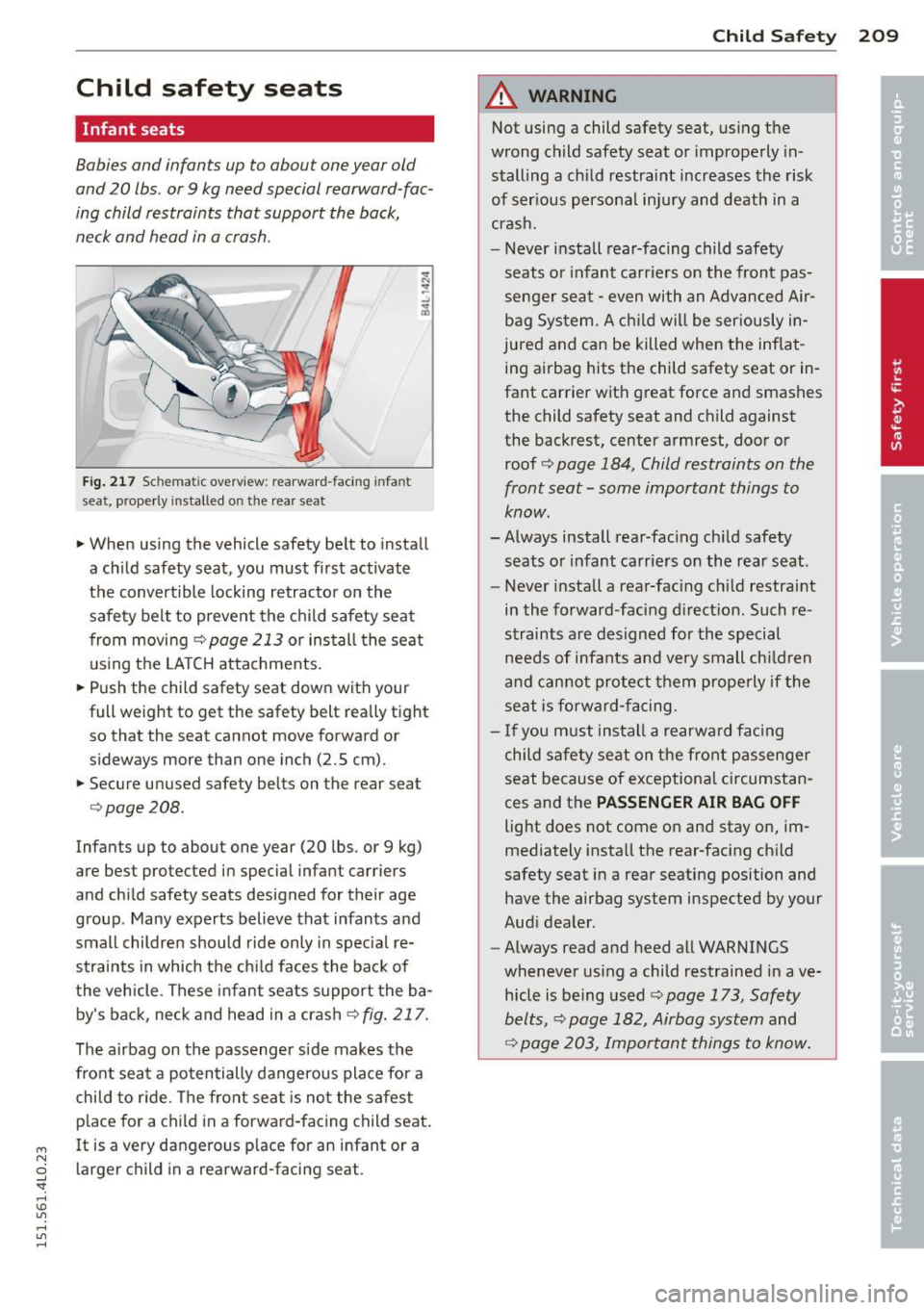
Fig . 217 Sche matic overv iew: rearward-fac ing infant
seat, properly installed o n the rear seat
~ When using the vehicle safety belt to install
a child safety seat, you must first activate
the convertible locking retracto r on the
safety be lt to prevent the child safety seat
from moving ¢
page 213 or install the seat
using the LA T CH attachments.
~ Push the child safety seat down with your
full weight to get the safety belt rea lly tight
so that the seat cannot move forward or
sideways more than one inch (2.5 cm).
~ Secure unused safety belts on the rear seat
¢page 208.
Infants up to about one year (20 lbs. or 9 kg)
are best protected in special infan t carriers
and child safety seats designed for their age
group . Many experts believe that infants and
small children should ride only in spec ial re
straints in which the ch ild faces the back of
the vehicle. These infant seats support the ba
by's back, neck and head in a crash ¢
fig. 217.
The airbag on the passenger side makes the
front seat a po tentially dangerous place for a
child to r ide . The front seat is not the safest
p lace for a child in a forward -facing child seat.
It is a very dangerous p lace for an infant or a
l arger ch ild in a rearward-facing seat.
Child Safety 209
A WARNING
Not using a child safety seat, using t he
wrong child safety seat or improperly in
stall ing a ch ild restraint increases the risk
of ser ious personal injury and death in a
crash.
- Never install rear-facing child safety
seats or infant ca rr ie rs on the front pas
senger seat -even with an Advanced Air
bag Sys tem. A ch ild will be ser iously in
jured and ca n be killed when the inflat
ing airbag hits the child safety seat or in
fant carrier with great force and smashes the child safety seat and child against
the backrest, center armrest, door or
roof ¢
page 184, Child restraints on the
front seat- some important things to
know .
-Always install rear-fac ing ch ild safety
seats or infant carriers on the rear seat .
- Never install a rear-fac ing ch ild restraint
in the forward-fac ing d irect ion. Such re
straints are designed for the special needs of infants and very small ch ild ren
and cannot prote ct them properly if the
seat is forward- facing.
- If you mus t insta ll a rearward fac ing
child sa fety seat on the fro nt passenger
seat because of exceptiona l circumstan
ces and t he
PASSENGER AIR BAG OFF
light does not come on and stay on, im
mediately insta ll the rear -fac ing ch ild
safety seat in a rear seating position and
have the airbag system inspected by your
Aud i dea ler .
- Always read and heed all WARNINGS
wheneve r us ing a child restrained in ave
hicle is being used¢
page 173 , Safety
belts,
¢ page 182, Airbag system and
¢ page 203, Important things to know.
Page 212 of 350
210 Child Safety
Convertible child safety seats
Properly used convertible child safety seats
can help protect toddlers and children over
age one who weigh between
20 and 40 lbs. (9
and 18 kg) in a crash.
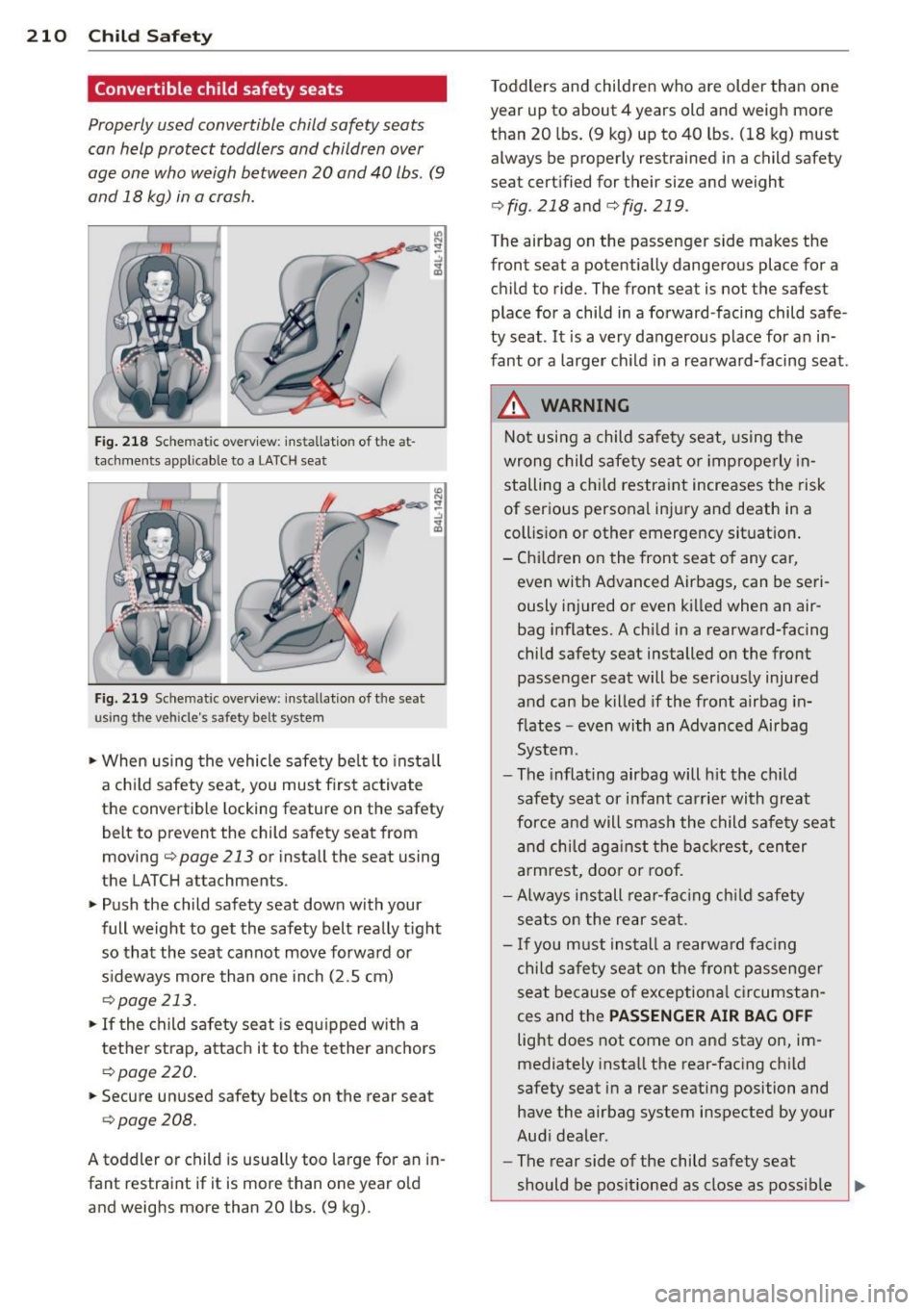
Fig. 218 Schematic overv iew : ins tallat ion of t he at
ta chments applicable to a LATCH seat
Fig. 219 Schematic overview: insta llation of th e sea t
us ing t he veh icle's safety be lt system
.. When using the vehicle safety be lt to install
a chi ld safety seat, you must f irst activate
the convertible locking feature on the safety
belt to prevent the child safety seat from
moving
c::> page 213 or install the seat using
the LATCH attachments .
.. Push the child safety seat down with your
full weight to get the safety belt really t ight
so that the seat cannot move forward or sideways more than one inch (2.5 cm)
c::>page213.
.. If the child safety seat is eq uipped w ith a
tether strap, attach it to the tether anchors
i=>page220.
.. Secure unused safety be lts on the rear seat
c::> page 208.
A toddler or child is usually too large for an in
fant restra int if it is more than one year o ld
and weighs more than 20 lbs. (9 kg). T
oddlers and children who are older than one
year up to about 4 years old and weigh more
than 20 lbs. (9 kg) up to 40 lbs. (18 kg) must
always be properly restrained in a child safety
seat certified for their size and weight
c::> fig . 218 and c::> fig . 219 .
The airbag on the passenger side makes the
front seat a potentia lly dangerous place for a
child to ride. The front seat is not the safest
place for a child in a forward-facing child safe
ty seat . It is a very dangerous place for an in
fant or a larger child in a rearward-facing seat.
_&. WARNING
Not using a child safety seat, using the
wrong child safety seat or improp erly in
stalling a chi ld restraint increases the risk
of serious personal injury and death in a
collision or other emergency situation .
- Children on the front seat of any car,
-
even with Advanced Airbags, can be seri
ously injured or even killed when an air bag inflates . A chi ld in a rearward-facing
child safety seat installed on the front passenger seat will be seriously injured
and can be killed if the front airbag in
f la tes -even with an Advanced Airbag
System .
- The inflating airbag will hit the child
safety seat or infant carrier with great
force and will smash the child safety seat
and child against the backrest, center
armrest, door or roof.
- Always install rear-facing child safety
seats on the rear seat .
- If you must install a rearward facing
child safety seat on the front passenger
seat because of exceptiona l circumstan
ces and the
PASSENGER AIR BAG OFF
light does not come on and stay on, im
mediately insta ll the rear-facing child
safety seat in a rear seating position and
have the airbag system inspected by your
Audi dealer.
- The rear side of the child safety seat
should be pos itioned as close as possible ..,.
Page 213 of 350
M
"' 0 ..J
"". rl I.O
"' rl
"' rl
to the backrest on the vehicle seat. Ad
just or remove the rear seat head restraint if it is difficult to inst all the
child seat with the head restraint in place
¢ page 80. Install the head restraint
again immediately once the child seat is
removed. Driving without head restraints
or with head restraints that are not prop
erly adjusted increases the risk of serious
or fatal neck injury dramatically.
- Always read and heed all WARNINGS
whenever using a child restrained in ave
hicle is being used
¢page 173, Safety
belts,¢ page 182, Airbag system
and
¢ page 203, Important things to know.
A WARNING
If exceptional circumstances require the
use of a forward-facing child restraint on
the front passenger's seat, the child's safe
ty and well-being require that the follow
ing special precautions be taken:
- Make sure the forward-facing seat has been designed and certified by its manu
facturer for use on a front seat with a passenger front and side airbag.
-Always follow the manufacturer's in
structions provided with the child safety
seat or infant carrier.
- Always move the front passenger seat in
to the rearmost position of the passen
ger seat's fore and aft adjustment range,
and as far away from the airbag as possi
ble before installing the child restraint.
- Always make sure that nothing prevents
the front passenger's seat from being
moved to the rearmost position in its
fore and aft adjustment range.
- Always make sure the backrest is in an
upright position.
- Make sure that the
PASSENGER AIR BAG
OFF
light comes on and stays on all the
time whenever the ignition is switched
on.
- If the light does not stay on, perform the
checks¢
page 193, Monitoring the Ad
vanced Airbag System.
-
Child Safety 211
- Ta ke the child restraint off the front pas
senger seat and install it properly at one
of the rear seat positions if the
PASSEN
GER AIR BAG OFF
light does not stay on
whenever the ignition is switched on.
Booster seats and safety belts
Properly used booster seats con help protect
children weighing between about 40 lbs. and
80 lbs. (18 kg and 36 kg) who are less than 4
ft. 9 in . (57 inches/1.45 meters) tall.
In .... N 0 ±
~
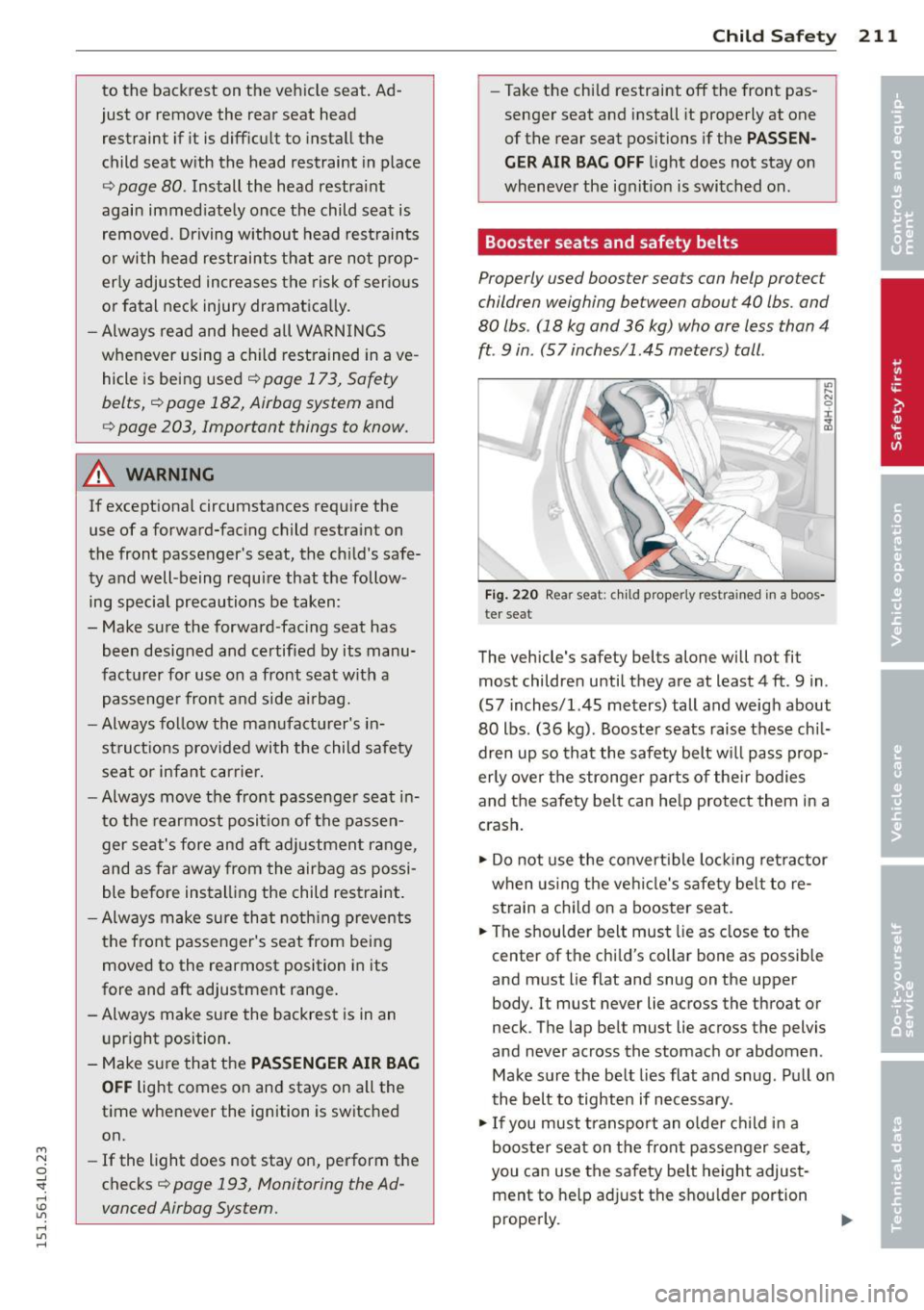
Fig. 220 Rear seat: c hild properly res trained in a boos
ter seat
The vehicle's safety belts alone will not fit
most children until they are at least 4
ft. 9 in .
(57 inches/1.45 meters) tall and weigh about
80 lbs. (36 kg). Booster seats raise these chil
dren up so that the safety belt will pass prop
erly over the stronger parts of their bodies
and the safety belt can help protect them in a
crash.
.,. Do not use the convertible locking retractor
when using the vehicle's safety belt to re
strain a child on a booster seat.
... The shoulder belt must lie as close to the
center of the child's collar bone as possible
and must lie flat and snug on the upper
body. It must never lie across the throat or
neck . The lap belt must lie across the pelvis
and never across the stomac h or abdomen .
Make sure the belt lies flat and snug . Pull on
the belt to tighten if necessary.
.,. If you must transport an older child in a
booster seat on the front passenger seat,
you can use the safety belt height adjust
ment to help adjust the shoulder portion
properly.
Page 215 of 350
M N
0 ...J
'SI: ,...., \!) ..,.,
,...., ..,., ,....,
-Children on the front seat of any car,
even with Advanced A irbags, can be seri
ous ly injured or even killed when an a ir
bag inflates.
- Never let a child stand or kneel on any
seat, for examp le the front seat.
- Never let a child ride in the cargo area of
your vehicle .
- Always remember that a ch ild lean ing
forward, sitt ing sideways or out of posi
t ion in any way during an acc ident can be
struck by a deploying airbag . This will re
sult in se rious personal injury or death .
- If you must install a booster seat on the
front passenger seat because of excep
t ional circumstances the
PASSENGER
AIR BAG OFF
light must come on and
stay on, whenever the ignition is switch
ed on.
- If the
PASSENGER AIR BAG OFF light
does not come on and stay on, perform
the checks described¢
page 193, Moni
toring the Advanced Airbag System.
- Ta ke the child restrain t off the front pas
senger seat and install it properly at one
of the rear seat positions if the
PASSEN
GER AIR BAG OFF
light does not stay on
whenever the ignition is switched on.
- Always read and heed all WARNINGS
whenever using a child restrained in ave
hicle is being used ¢
page 173, Safety
belts,¢ page 182, Airbag system
and
c:> page 203, Important things to know.
Installing a child safety
seat
Securing a child safety seat using a
safety belt
Safety belts for the rear sea ts and the fron t
passenger can be locked wi th the convertible
locking retractor to properly secure child
safety seats .
The safety belts emergency lock ing retractors
for the rear seats safety belts and for the
front passenger's seat safety belt have a con
ve rtible locking retractor for child restraints.
Child Sa fet y 213
The safety belt must be locked so that be lt
webbing cannot unree l. The retractor can be
activated to lock the safety belt and prevent
the safety belt webbing from loosening up
during normal dr iving . A child safety seat can
only be properly installed when the safety belt
i s locked so that the chi ld and child safety
seat w ill stay in place .
Always remember: Even though your vehicle is equipped with an Advanced Airbag system, all
ch ildren, especially those 12 years and young
er, shou ld always r ide in the back seat proper
ly restrai ned fo r the ir age and size.
A WARNING
Improperly installed chi ld safety seats in
crease the risk of serious personal injury
and death in a collision.
- Always ma ke sure that the safety belt re
tracto r is loc ked when installing a child
safety seat . An unlocked safety belt re
tractor cannot hold the child safety seat
in place during normal dr iving or in a
crash.
- Always buckle the child safety seat firmly
in place even if a ch ild is not sitt ing in it.
A loose child safety seat can fly around during a sudden stop or in a collision .
- Always make sure that the rear seat
backrest to which the center rear safety
belt is attached is securely latched when
eve r the rea r center safety belt is being
used to secure a ch ild restra int.
- If the backrest is not securely latched,
the child and the child restraint will be
thrown forward together with the back rest and will strike parts of the vehicle
interior. The child can be seriously in
jured or killed.
- Never install rear-fa cing child safety
seats or infant carrie rs on the front pas
senger seat . A child will be serio usly in
jured and can be killed when the passen ger airbag inflates.
- The inflating airbag will h it the ch ild
safety seat or infant carrier with great
force and will smash the child safety seat
~
•
•
Page 217 of 350
M N
0 ..J
'SI: ,...., \!) 1.1'1 ,...., 1.1'1 ,....,
-A tight tether strap on a rearward-facing
child restraint attached to the front pas
senger seat can put too much pressure on the weight-mat in the seat and regis
ter a heavier weight in the Advanced Air
bag System . The heavier weight regis
tered can make the system work as
though an adult were on the seat and de
ploy the Advanced Airbag when it must
be suppressed causing serious or even
fatal injury to the child .
- Make sure that the
PASSENGER AIR BAG
OFF
light comes on and stays on all the
time whenever the ignition is switched
on.
- If the
PASSENGER AIR BAG OFF light
does not come on and stay on, immedi
ately install the rear-facing child safety
seat in a rear seating position and have
the airbag system inspected by your Audi dealer.
Activating the convertible locking
retractor
Use the convertible locking retractor to se
cure a child restraint.
Always heed the child safety seat manufactur
er's instructions when installing a child re
straint in your vehicle . To activate the conver
tible locking retractor :
.. Place the child restraint on a seat, prefera
bly on the rear seat.
.. Slowly pull the belt
all the way out .
.. Route it around or through the child re
straint belt path~&_ .
.. Push the child safety seat down with your
full weight to get the safety belt really tight.
.. Insert the belt tongue into the buckle for
that seating position .
.. Guide the safety belt back into the retractor
until the belt lies flat and snug on the child
safety seat .
.. You should hear a "clicking " noise as the
belt winds back into the inertia reel. Test the
convertible locking retractor by pulling on
the belt . You should no longer be able to
Child Safety 215
pull the belt out of the retractor. The con
vertible locking retractor is now activated.
.. Make sure that the red release button is fac
ing away from the child restraint so that it
can be unbuckled quickly.
.. Pull on the belt to make sure the safety belt
is properly tight and fastened so that the
seat cannot move forward or sideways more
than one inch (2.5 cm).
_&. WARNING
Using the wrong child restraint or an im
properly installed child restraint can cause
serious personal injury or death in a crash.
- Always make sure that the safety belt re-
tractor is locked when installing a child
safety seat. An unlocked safety belt re
tractor cannot hold the child safety seat
in place during normal driving or in a
crash.
-Always buckle the child safety seat firmly in place even if a child is not sitting in it.
A loose child safety seat can fly around
during a sudden stop or in a crash.
- Always make sure the seat backrest to
which the child restraint is installed is in
an upright position and securely latched
into place and cannot fold forward . Oth
erwise, the seatback with the child safety
seat attached to it could fly forward in
the event of an accident or other emer
gency situation .
- Always read and heed all WARNINGS
whenever using a child restrained in ave
hicle is being used¢
page 203. Special
precautions apply when installing a child
safety seat on the front passenger seat
¢ page 184, Child restraints on the front
seat -some important things to know .
-
•
•
Page 218 of 350
216 Child Saf ety
Deactivating the convertible locking
retractor
The convertible locking retractor for child re
straints will be deactivated automatically when the belt is wound all the way back into the retractor .
.,. Press the red button on the safety belt buck
le. The be lt tongue w ill pop out of the buck
le .
.. Guide the safety belt all the way back into
its stowed position .
A lways le t the safety belt retract complete ly
into its stowed position . The safety belt can
now be used as an ordinary safety belt with
out the convertib le locking retractor for chi ld
restra ints.
If the convertible locking retractor shou ld be
activated inadvertently, the safety belt m ust
be unfastened and guided completely back in
to its stowed position to deactivate th is fea
ture. If the convertible locking retractor is not
deactivated, the safety belt will gradually be
come tighter and uncomfortable to wea r.
A WARNING
Imprope rly insta lled child safety seats in
crease the risk of ser ious personal inju ry
and death in a collision.
- Never unfaste n the safety belt to deacti
vate the convert ible lock ing ret ractor for
c hild rest rain ts while the veh icle is mov
ing. You would not be rest rained and
cou ld be seriously injured in an accident.
- Always read and heed all WARN INGS
whenever using a child rest rained in ave
hicle is being used
¢ page 203. Special
precautions apply when installing a ch ild
safety seat on the front passenger seat
¢ page 184, Child restraints on the front
seat -some important things to know.
LATCH Lower
anchorages and tethers
for children
Child Restraint System anchors and how
are they related to child safety
To p rov ide a simpler and more practicable way
to a ttach the child restra int on the vehi cle
seat, Federal regulat ions req uire spec ia l lowe r
anchorages in vehicles and devices on new
child restraints to attach to the vehicle ancho
rages.
T he combination of the tether anc horages and
the lowe r anchorages is now genera lly ca lled
t h e
LATCH system fo r "Lower Anchorages and
T ethers for Child ren."
F o rward-facing chi ld restrai nts ma nufactured
after September 1, 1999, are requ ired by U .S .
f edera l regu lations to comply with new child
head movement performance req uirements.
These new performance requirements make a
tether necessary on most new child seats.
Installing a child restraint that requires a top
tether without one can seriously impair the performance of the c hild restra int and its abil
ity to protect the child in a coll is ion. Insta lling
a chi ld restraint that requires a top tether
without the top tether may be a violat ion of
state law.
Child restraint manufacturers offer LATCH
lower anchorages on their child seats w ith
hook-on or push-on connectors attached to
adjustable straps.
In add ition to the LATCH lower anchorages,
these chi ld restraint systems usually require
the use of tether straps to he lp keep the chi ld
rest raint firmly in place.
A WARNING
-Imp roper installat ion of ch ild restra ints
will i ncrease the r is k of injury a nd death i n
a crash.
-
Page 221 of 350
M
"' 0 ..J
'
"' rl
_& WARNING
Improper use of tether anchorages or low
er anchorages can cause serious personal
injury in a crash.
- Always ca refully follow the child re
straint manufacturer's instruct ions for
proper installation and use of child re
st raint systems.
- Never use the
LATCH or tether anchorag
es to attach safety belts or othe r kinds of
occupant restraints.
- Child restraint tether attachments a nd
lower attachments are only des igned to
se cur e a child res tra int t hat has been
equipped to use these anchorages.
- T ether anc horages and lower an chorages
are desig ned to withstand o nly those
loads imposed by corre ctly fi tted ch ild
res traints . Under no circumstances can
they be used safe ly for adu lt or child
safety belts or harnesses.
- Never mount more than one chi ld re
st raint to a sing le tether or to a lower an
chorage point. Attac hing two child re
straints to a single anchorage point can cause the anchorage to fail and cause se
rious persona l injury in a crash.
(D Note
- Remove the guidance fixtures before
fo ld ing the rear seatback to prevent
damag ing the seat c ushion.
- If you leave the guidance fixtures instal
l ed for several days, they could leave a
mark on the upho lstery on the seat cush
i on and backrest in the area that the
guidance fixtures wer e insta lled. The up
ho ls tery would a lso be permanently
stretched around the guid ance fixtures.
This applies especially to leat her seats.
Child S afety 219
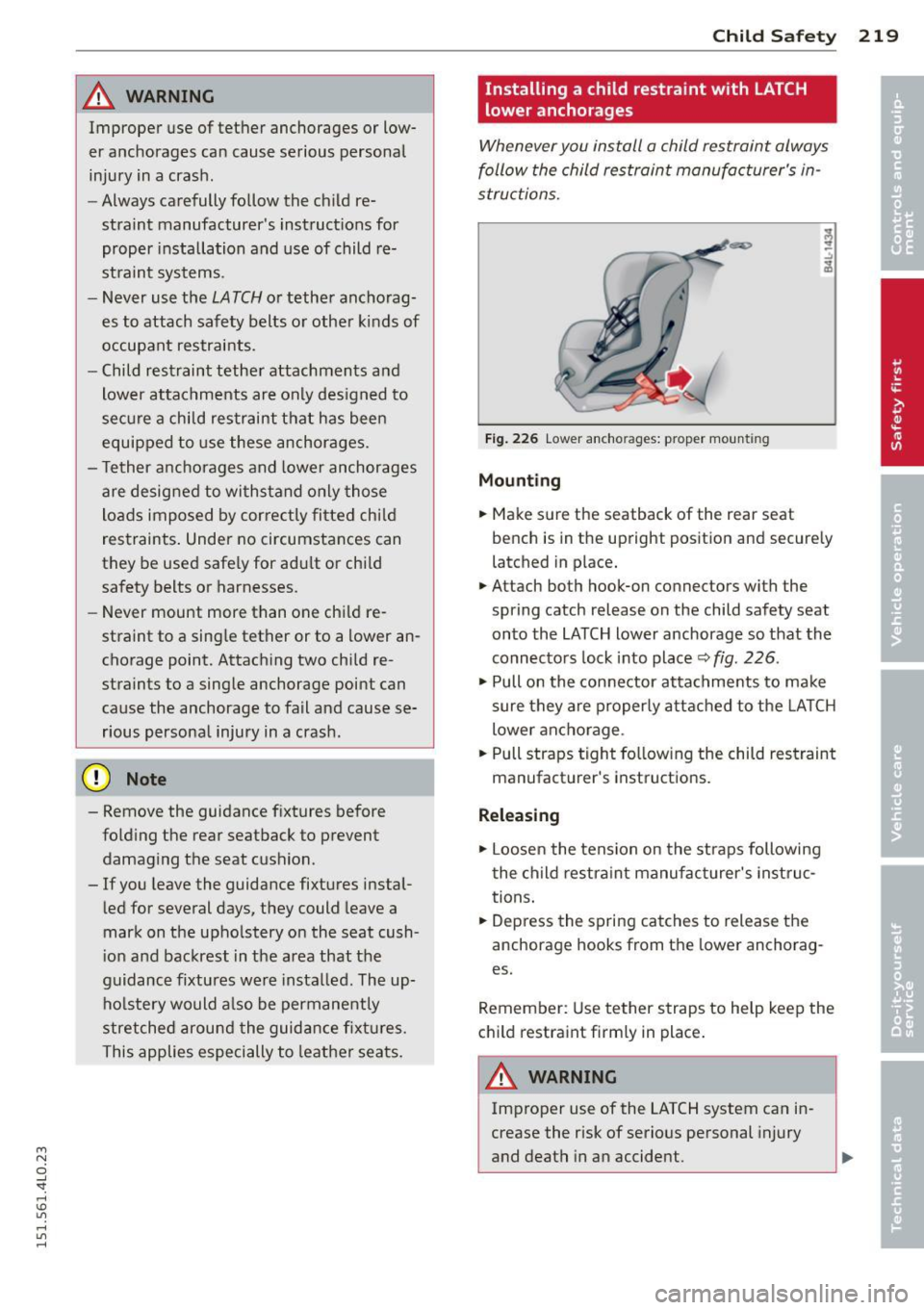
Installing a child restra int with LATCH
lower anchorages
Whenever you install a child restraint always
f o llo w t he child res traint manufa cturer's i n
structions.
F ig . 2 2 6 Lower an cho rages: proper mount ing
Mounting
.. Make s ure the seatback of the rear seat
bench is in the upright pos ition and securely
latched in p lace.
.. Attach both hook-on connectors with the
spring catch release on the child safety seat
onto the LATCH lower anchorage so that the
connecto rs lock into place ¢
fig. 226.
.. Pull on the con nector atta chme nts to ma ke
sure they are properly a ttac hed to the LA T CH
lower ancho rage .
.. Pull straps tight fo llowing the child restraint
manufact ure r's instruct ions .
Releasing
.. loose n the tension on the straps following
t he ch ild restraint manufac turer's instruc
tions .
.. Depress the spring catches to release the
anchorage hooks from t he lower anchorag
es.
Remember: Use te ther s traps to help keep the
chi ld restraint f irmly in place .
A WARNING '-
Imp roper use of the LATCH system can in-
crease the risk of serious personal injury
and death in an accident.
Page 268 of 350
26 6 Ch eck ing and filling
If the brake fluid level falls considerably be
low the "MIN" mark, the brake warning/indi
cator light (U .S . mode ls:
11111 , Canadian
models: .) will come on
<=> page 19 and
<=> page 32. Do not continue to operate the ve
h icle . The complete brake system should be
thoroughly checked by an authorized Aud i
dea ler or qualified workshop and the cause
corrected. If the brake fluid level is too low,
the brake warning/indicator light will illum i
nate . Contact an authorized Aud i dealer
im
m ediatel y.
@ Tips
The brake fluid rese rvoir is located unde r
neath the cove r.
Changing brake fluid
Hove the broke fluid changed by on experi
enced technician.
Brake fluid absorbs moisture from the a ir . If
the water content in the brake fluid is too
h igh , corrosion in the brake system may result
after a per iod of t ime. The bo iling po int of the
brake fluid wi ll also decrease considerably and
decrease braking performance.
Therefore, the brake flu id must be changed
e ver y tw o year s. Always use new b rake fluid
which conforms to Federal Motor Vehicle
Standard "FMVSS 1 16 DO T 4".
The brake flu id reservo ir can be difficult to
reach, therefore, we recommend that you
have the brake f luid changed by you r author
ized
Audi dea ler. Your dea ler has the correct
too ls, the right brake fluid and the know -how
to do this for you.
A WARNING
- Brake fluid is poisonous . It must be stor
ed only i n the closed orig inal container
o ut of the reach of children!
- Brake fa ilure can result from old or inap
propriate b rake fluid. Observe these pre
caut ions: -
Use only brake fluid that meets SAE
specification
J 1703 and conforms to
Federa l Motor Vehicle Standard 116.
Always check with your authorized Audi
dealer to make sure you are using the
correct brake fluid . The correct type of
brake f lu id is also ind icated on the
brake flu id reservoir.
- T he brake fluid must be new. Heavy use
of the bra kes ca n cause a vapo r lock if
the b rake fluid is left in the system too
l ong . This can seriously affect the effi
c iency of the brakes as well as your
safety. This co uld resu lt in an accident.
(D Note
Bra ke fluid will damage the paint of you r
vehicle .
(® For the sake of the environment
Because of the p rob lem of p roper disposal
of b ra ke fluid as well as the spec ial too ls
r equired and the necessary expertise, we
re commend that yo u have the brake fluid
changed by yo ur authorized Aud i dea ler.
Battery
General information
U nder normal ope rat ing cond itions , the bat
tery in yo ur Audi does not need any ma inte
nance. With
high o utside tempe ra tur es or
l ong dai ly drives we recommend that you have
the e lectrolyte level checked by an authorized
Audi dealer or qualif ied workshop. The elec
trolyte level should also be checked each time
the battery is charged
<=> page 268.
Have the battery checked when yo u take your
vehicle in for service. You are well advised to replace a battery that is o lder than 5 years .
With certain types of airbag deployment, the battery is disconnected from the veh icle elec
trical system for safety reasons<=>.&
in Re
pair , core and disposal of the airbags on
page 196.
~
Page 269 of 350
M N
0 ...J
'SI: ,...., \!) ..,.,
,...., ..,., ,....,
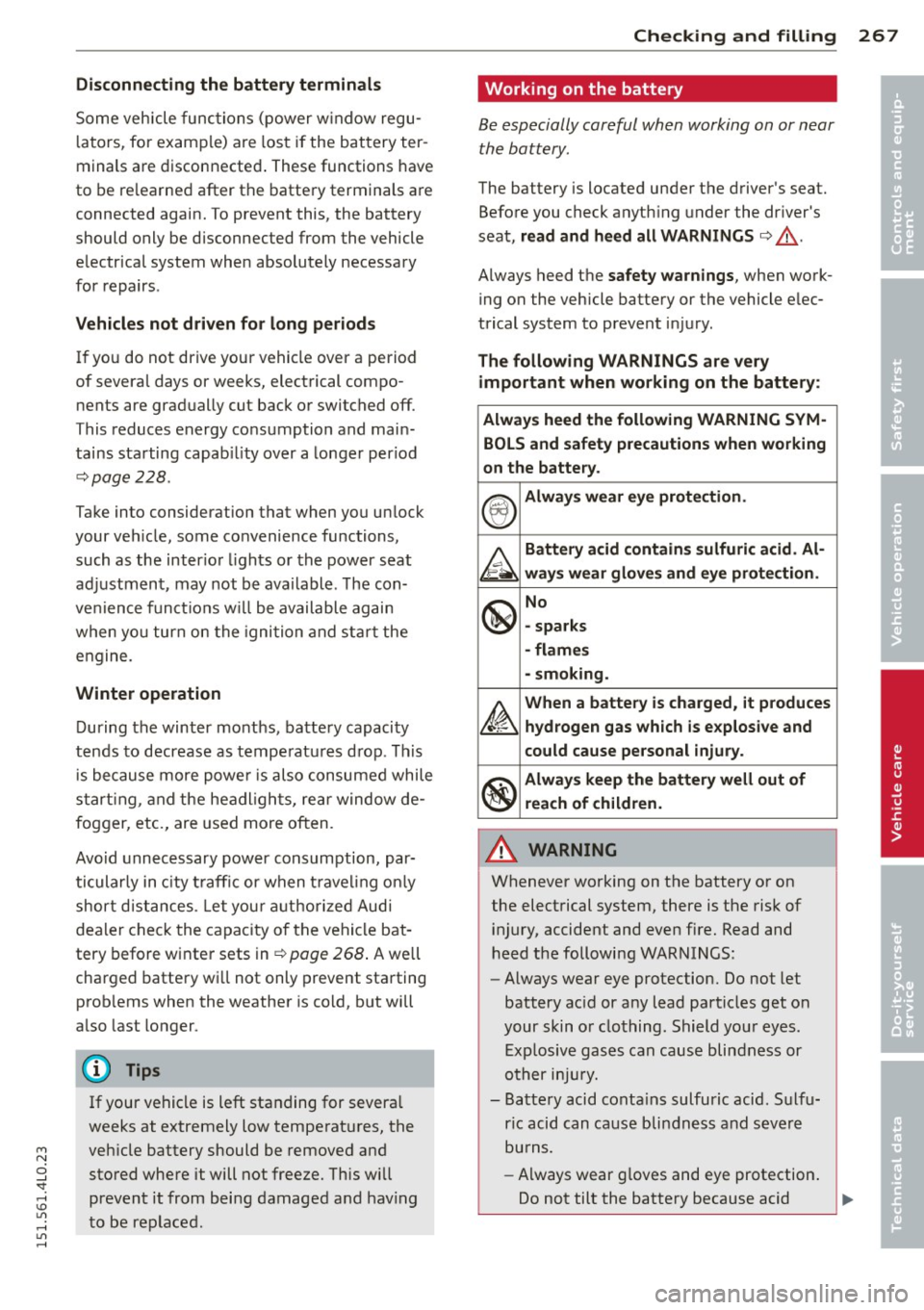
Disconne cting the batt ery t erminals
Some vehicle functions (power w indow regu
l ators, for example) are lost if the battery ter
minals are disconnected . These functions have
to be re learned after the battery terminals are
connected again. To prevent this, the battery
should only be disconnected from the vehicle
electrical system when absolutely necessary
for repairs .
Vehicle s not driven fo r lo ng period s
If you do not drive your vehicle over a period
of several days or weeks, electrical compo
nents are gradually cut back or switched off .
This reduces energy consumption and main
tains starting capab ility over a longer per iod
¢ page 228 .
Take into consideration that when you unlock
your vehicle, some convenience functions,
such as the inter ior lights or the power seat
adjustment, may not be available . The con
ve nience funct ions w ill be available again
when yo u turn on the ignition and start the
engine.
Winter op eration
During the winter months, battery capacity
tends to decrease as tempe ratures d rop . This
i s because more powe r is also consumed while
start ing, and the headl ights, rea r window de
fogger, etc., are used more often.
Avo id unnecessary power consumption, par
ticularly in c ity t raffic or when t rave ling on ly
short d istances. Let you r autho rized Aud i
dealer check the capacity of the vehicle bat
tery before winter sets in ¢
page 268. A well
charged battery wi ll not only prevent starting
prob lems when the weather is cold, but will
also last longer .
If your vehicle is left standing for severa l
weeks at extremely low temperat ures, the
veh icle battery should be removed and
stored where it will not freeze. This will
prevent it from bei ng damaged and hav ing
to be replaced.
Checkin g and fillin g 267
Working on the battery
Be especially careful when working on or near
the battery.
The battery is located under the driver 's seat.
Before you check anyth ing under the dr iver's
seat,
read and h eed all WARNINGS G &_ .
Always heed the safety warnings , when work
ing on the vehicle battery or the vehicle e lec
trical system to prevent injury .
The following WARNINGS are ver y
important when working on the batter y:
Alway s heed the following WARN IN G SY M-
BOLS a nd safety p re caution s when working
on the battery .
®
Alway s wear e ye prote ction.
~
Batt ery acid contain s sulfuric acid. Al -
w ay s we ar gloves and eye prot ection.
@
No
-spa rk s
- flam es
- smoking .
~
When a b atter y is ch arged , it produces
h y drogen g as w hic h is e xplosi ve and
could cause pe rsonal injur y.
®
Alw ays keep the batt ery well out of
r e a ch of childr en.
A WARNING
Whenever working on the battery or on
the electrical system, there is the risk of
injury, accident and even fire. Read and
heed the following WARNINGS:
- Always wear eye protection. Do not let
battery ac id or any lead particles get on
your skin or clothing. Shield your eyes.
Exp losive gases can cause blindness or
other inju ry.
- Battery acid conta ins sulfuric acid. Sulfu
ric acid can cause blindness and severe
bu rns.
- Always wear g loves and eye protection.
Do not tilt the battery because acid
~
•
•
Page 335 of 350
Braking guard
re fer to Audi braking gua rd ... .. .. .. . 129
Break- in pe riod ............ .... .. ... 230
Brake pads . ............. .. .. .. ... 230
T ires .... .. .. ............. .. .. ... 230
Breakover ang le ............ ... ... .. 235
Bulbs ..... .. .. .. .. .. .... ... .. .. ... 315
B umper cove r
C au tion when parking near a parking ba r-
rier or c urb ... .... .... ... .. .. .. ... 112
C
Ca lifo rnia Proposit io n 65 Wa rning .. .. . 257
B att ery specific .......... .. .. .. .. . 268
Capac it ies ..... .............. ... ... 325
Car - Systems Ambience lighting ........ .. .. .. .. .. 65
Lighting prof iles .......... .. .. .. .. .. 65
Ca rbon parts
C lean ing . . . . . . . . . . . . . . . . . . . . 244, 245
Care ...... ... ...... ............. .. 24 2
Cargo area
refer to Load ing the luggage compart-
ment .. .. .. .... ... .. ... ... .. .. .. . 169
Cargo floor . ... .... .... ... .. .. .. .... 85
Ca rgo net ...... .............. ... ... . 83
Cata lytic converter ......... .. .. .. .. . 231
Center armrest Cup holder . . . . . . . . . . . . . . . . . . . . . . . . 80
Storage compartment . . . . . . . . . . . . . . . 80
Cente r console in rear ....... .. .. .. .. .. 8 1
Centra l locking
Emergency locking ........ .. .. .. .. .. 45
Panoramic slid ing su nroof ...... . ... .. 55
Certification ... .... .... ... .. .. .. ... 329
C hanging a flat tire ......... .. .. .. .. . 307
Changing a w heel .......... .. .. .. .. . 307
Changing engine o il ..... ... .. .. .. .. . 26 1
Chass is
refer to Adaptive Air Suspe nsion. 157, 159
CHECK button ............. .... .. .... 12
C hec king
~ Eng ine coolant leve l .... ... .. .. .. .. . 263
0
;;f_ Checking tire pressure ......... .... .. 282 ,...., \!) l/'I ,...., l/'I ,....,
Inde x 333
Child rest raints
Danger of using child restraints in the
f ront seat . . . . . . . . . . . . . . . . . . . . . . . . 184
Where can I get additional informat ion
about child restraints and the ir use? .. 222
Child rest rain t system anchors . ... .. .. 216
Child safety ....... .. ............... 203
Co nve rtib le loc kin g retractor ..... .. .. 213
G ui dance fixtures for lower ancho rages 218
Impo rtant sa fe ty inst ructions for using
c hi ld safety seats ... . .. ..... ... .. .. 206
Impo rtant t hings to know when driving
with children . ...... .. .. ..... ... .. 203
Installing a ch ild restra int using the
LATCH system .. .. ................. 219
Mounting and releasing the anchorage
hook . ...... .. .... .......... ..... 219
T ether anchors .... ............... . 220
T ether st raps .. .. .... ........... .. 220
Child safety lock rear doors (power) . . . . . . . . . . . . . . . . . . 48
Child safety seats .... . .. ..... ... .. .. 209
Booster seats . . . . . . . . . . . . . . . . . . . . . 211
Convertib le child seats ............. 210
Co nvertib le locking retractor ....... .. 213
Danger of using child restraints in the
front seat . . . . . . . . . . . . . . . . . . . . . . . . 184
How do I properly install a child safety
seat in my veh icle? ............. .... 206
Infan t seats . .. .. .... ............. 209
Installing . .. .. .. ............... .. 213
L ATCH system . ...... .. .. ..... ... .. 219
Safety instr uctions . .. .. ..... ... .. .. 206
Un used safety be lts on the rear seat 208
Child sea ts
L owe r anchorages . . . . . . . . . . . . . . . . . 217
Cleaning ......... .. ..... .......... 242
Climate control . ..... . .. .. ..... ... .. . 94
Synchroni zing .. ...... ............. . 95
Warm and co ld . .. ............. .. .. . 94
Climate controls Air conditioner on/off ... .... ... .. .. . 96
Air distrib ution ..... . .. ..... ... .. .. . 97
Air out lets .. .. .. ................. . 99
Air out lets (rear) . ................. . 99
Air recircu lation .. .. ........... .... . 98
AUTO (standard sett ing) .. .. ... ... .. . 97
Bas ic sett ings .. .. .. ..... .......... 102
•
•