tire pressure AUDI Q7 2015 Owner´s Manual
[x] Cancel search | Manufacturer: AUDI, Model Year: 2015, Model line: Q7, Model: AUDI Q7 2015Pages: 350, PDF Size: 86 MB
Page 287 of 350
M N
0 ...J
"': ,...., \!) 1.1'1 ,...., 1.1'1 ,....,
When should I adjust the
tire pressures?
Adjust the tire pressure to the load you are carrying. After
changing a wheel
or replacing
wheels you have to adjust the
tire pressures on all wheels. In addition, you must then store
the new tire pressures in the
tire pressure monitoring sys
tem
c> page 303.
A WARNING
Incorrect tire pressures and/
or underinflation can lead sudden tire failure, loss of
control, collision, serious per
sonal injury or even death .
-When the warning symbol
II] appears in the instru
ment cluster, stop and in
spect the tires.
-Incorrect tire pressure and/ or underinflation can cause
increased tire wear and can
affect the handling of the
vehicle and stopping ability.
- Incorrect tire pressures
and/or underinflation can
also lead to sudden tire fail
ure, including a blowout
and sudden deflation, caus ing loss of vehicle control.
Tires and wheels 285
-The driver is responsible for the correct tire pressures for all tires on the vehicle. The
applicable pressure values
are located on a sticker on
the driver's side 8-pillar.
-Only when all tires on the vehicle are filled to the correct pressure, the tire pres
sure monitoring system can
work correctly.
-The use of incorrect tire pressure values can lead to
accidents or other damage.
Therefore it is essential that
the driver observe the speci
fied tire pressure values for
the tires and the correct
pressures for the function of
the tire pressure monitoring
system.
-Always inflate tires to the recommended and correct
tire pressure before driving
off.
-Driving with underinflated tires bend more, letting
them get too hot resulting
in tread separation, sudden
tire failure and loss of con
trol.
-Excessive speed and/over loading can cause heat •
•
'
Page 288 of 350
286 Tires and wheels
build-up, sudden tire failure
and loss of control.
-If the tire pressure is too low or too high, the tires
will wear prematurely and
the vehicle will not handle
well.
-If the tire is not flat and you
do not have to change a
wheel immediately, drive at reduced speed to the near
est service station to check
the tire pressure and add air
as required.
(D Note
Driving without valve stem
caps can cause damage to
the tire valves. To prevent
this, always make sure that
factory installed valve stem caps on all wheels are secure
ly mounted on the valve .
@ For the sake of the environment
Underinflated tires will also
increase the fuel consump
tion .
Tires and vehicle load limits
There are limits to the amount
of load or weight that any vehi
cle and any tire can carry. Ave
hicle that is overloaded will not handle well and is more diffi
cult to stop. Overloading can not only lead to loss of vehicle
control, but can also damage important parts of the vehicle
and can lead to sudden tire fail
ure, including a blowout and
sudden deflation that can cause
the vehicle to crash .
Your safety and that of your passengers also depends on
making sure that load limits are
not exceeded. Vehicle load in
cludes everybody and every
thing in and on the vehicle.
These load limits are technical
ly referred to as the vehicle's
Gross Vehicle Weight Rating
("GVWR") .
The "GVWR " includes the
weight of the basic vehicle, all
factory installed accessories, a
full tank of fuel, oil, coolant
and other fluids plus maximum load. The maximum load in
cludes the number of passen
gers that the vehicle is intend
ed to carry ("seating capacity")
with an assumed weight of 150 lbs (68 kg) for each pas
senger at a designated seating
position and the total weight of
any luggage in the vehicle. If ""
Page 289 of 350
Tires and wheels 287
you tow a trailer, the weight of the total weight of whatever is •
the trailer hitch and the tongue being carried in the vehicle (in-• '
weight of the loaded trailer eluding the weight of a trailer must be included as part of the hitch and the tongue weight of
vehicle load. the loaded trailer) is limited.
The
Gross Axle Weight Rating The more passengers in the ve- hicle or passengers who are
("GAWR") is the maximum load
that can be applied at each of heavier than the standard
weights assumed mean that
the vehicle's two axles.
The Gross Vehicle Weight Rat- less weight can be carried as
luggage
.
ing and the Gross Axle Weight
The tire pressure label on your
Rating are listed on the safety
Audi also lists the maximum
compliance sticker label locat-
ed on the driver's side B-pillar. combined weight of all of the
Your Audi has 5 seating posi- occupants and luggage or other
cargo that the vehicle can carry.
tions, 2 in the front and 3 in the
rear for total seating capacity For the location of the label
¢
page 278, fig. 250. of 5. On vehicles with six
seats* , your vehicle has two
A WARNING
-~
front seats, two seats in the
Overloading a vehicle can
second row seating and two cause loss of vehicle control,
seats in the third row seating. a crash or other accident, se-
On vehicles with seven seats*, rious personal injury, and
your vehicle has two front even death.
seats, three seats in the second -Carrying more weight than
row seating and two seats in your vehicle was designed
the third row seating . Each
to carry will prevent the ve-
seating position has a seat belt hicle from handling properly
¢ page 173, Safety belts . and increase the risk of the
The fact that there is an upper loss of vehicle control.
M N limit to your vehicle's Gross Ve-0 ...J
'SI:
hicle Weight Rating means that ,...., \!) 1.1'1 ,...., 1.1'1 ,....,
Page 290 of 350
288 Tires and whee ls
- The brakes on a vehicle that
has been overloaded may
not be able to stop the vehi
cle within a safe distance.
-Tires on a vehicle that has been overloaded can fail
suddenly, including a blow
out and sudden deflation,
causing loss of control and a
crash.
-Always make sure that the total load being transported
- including the weight of a
trailer hitch and the tongue
weight of a loaded trailer -
does not make the vehicle
heavier than the vehicle's
Gross Vehicle Weight Rat
ing.
Determining correct load
limit
Use the example below to cal
culate the total weight of the
passengers and luggage or oth
er things that you plan to trans
port so that you can make sure
that your vehicle will not be
overloaded.
Steps for Determining Correct Load Limit
1 . Locate the statement "THE
COMBINED WEIGH T OF OC
CUPANTS AND CARGO
SHOULD NEVER EXCEED XXX KG OR XXX LBS"on your vehi
cle's placard (tire inflation
pressure label)
~ page 2 78,
fig . 250 .
2. Determine the combined
weight of the driver and pas
sengers that will be riding in
your vehicle .
3 . Subtract the combined
weight of the driver and pas
sengers from
"XXX" kilo
grams or
"XXX" pounds
shown on the sticker
~ page 278, fig. 250.
4. The resulting figure equals
the available amount of cargo and luggage load capaci
ty. For example, if the
"XXX"
amount equals 1400 lbs .
and there will be five 150 lbs. passengers in your vehi
cle, the amount of available
cargo and luggage load ca pacity is 650 lbs. (1400 -750
(5
X 150) = 650 lbs.)
5. Determine the combined weight of luggage and cargo .,..
Page 291 of 350
M
"' 0 ..J
""'. rl I.O
"' rl
"' rl
being loaded on the vehicle.
That weight may not safely
exceed the available cargo and luggage load capacity
calculated in Step 4.
6. If your vehicle will be towing
a trailer, load from your trail
er will be transferred to your
vehicle. Consult this manual
to determine how this re
duces the available cargo
and luggage load capacity of
your vehicle.
.,.Check the tire sidewall
(¢ page 291, fig. 254) to de
termine the designated load rating for a specific tire.
Tire service life
The service life of tires depends
on a lot of different things in
cluding proper installation and
balancing, correct tire pressure and driving style .
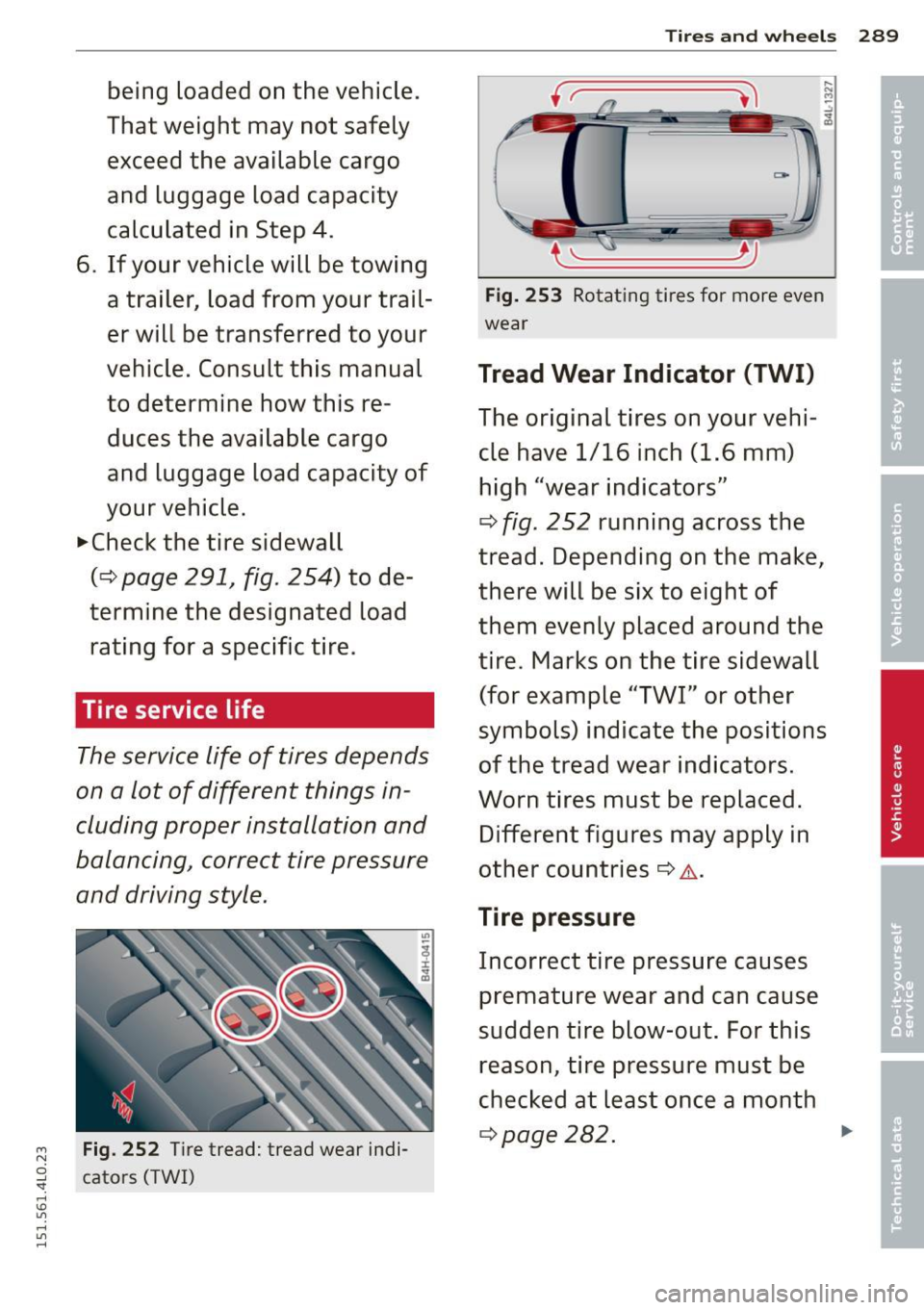
Fig. 252 Tire tread: tread wear indi
cators (TWI)
Tires and wheels 289
.... N M ::;;
;g
Fig. 253 Rotating tires for more even
wear
Tread Wear Indicator (TWI)
The original tires on your vehi
cle have
1/16 inch (1.6 mm)
high "wear indicators"
¢ fig. 252 running across the
tread. Depending on the make,
there will be six to eight of
them evenly placed around the
tire. Marks on the tire sidewall (for example "TWI" or other
symbols) indicate the positions
of the tread wear indicators.
Worn tires must be replaced.
Different figures may apply in
other countries
¢ & .
Tire pressure
Incorrect tire pressure causes
premature wear and can cause
sudden tire blow-out. For this
reason, tire pressure must be
checked at least once a month
¢ page 282.
Page 294 of 350
292 Tires and whee ls
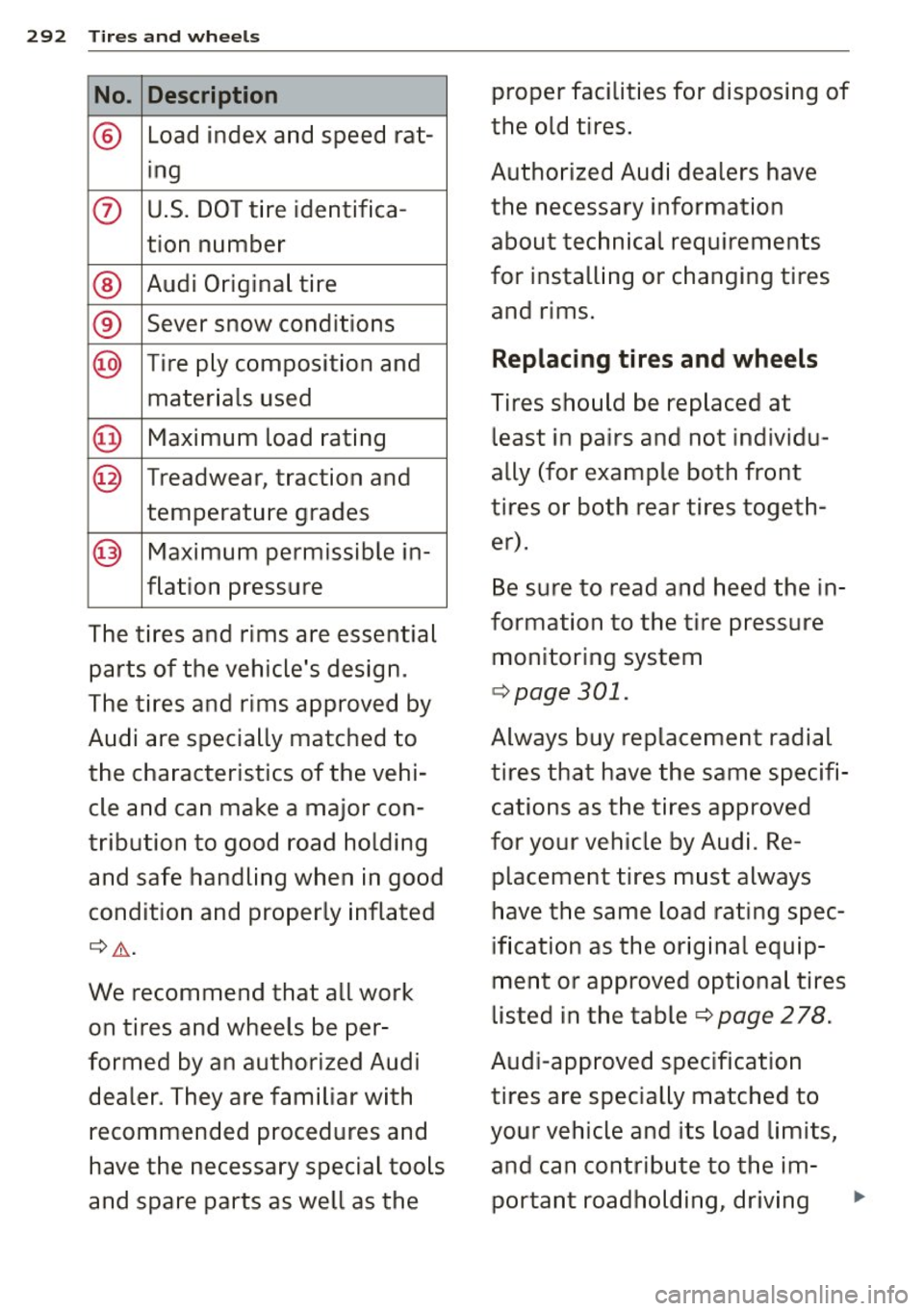
No . Description
® Load index and speed rat-
ing
(J) U .S. DOT tire identifica-
tion number
® Audi Original tire
® Sever snow conditions
@ Tire ply composition and
materials used
@ Maximum load rating
@ Treadwear, traction and
temperature grades
@ Maximum permissible in-
flation pressure
The tires and rims are essential
parts of the vehicle's design .
The tires and rims approved by
Audi are specially matched to
the characteristics of the vehi
cle and can make a major con
tribution to good road holding and safe handling when in good
condition and properly inflated
¢ ,&..
We recommend that all work
on tires and wheels be per
formed by an authorized Audi
dealer. They are familiar with
recommended p rocedures and
have the necessary special too ls
and spare parts as well as the proper facilities for disposing of
the old ti res.
Autho rized Audi dealers have
the necessary information
about technical requirements
for installing or changing tires
and rims .
Replacing tires and wheels
Tires sho uld be replaced at
least in pairs and not individu
ally (for example both front
tires or both rear tires togeth
er).
B e sure to read and heed the in
formation to the tire pressure
monitoring system
c::> page 301.
Always buy replacement radial
tires that have the same specifications as the tires approved
for your vehicle by Audi. Re
placeme nt tires m ust always
have the same load rating spec
ification as the orig inal equip
ment or approved optional tires
listed in the table c::>page
278.
Audi-approved spec ificat io n
tires are specially matched to
your vehicle and its load limits ,
and can contribute to the im- portant roadholding, driving .,.
Page 295 of 350

Tires and wheels 293
characteristics, and safety of This contains the following in-•
the vehicle. The table formation: • '
(¢ page 2 78) lists specifica-p Indicates the tire is for pas-
tions of the tires approved for senger cars (where applica-
the Audi models covered by ble)
your Owner's Literature.
255 Nominal tire width in mm
The tire pressure label located of the tire from sidewall
on the driver's side B-pillar edge to sidewall edge. In
¢page 278~ fig. 251 lists the general, the larger the num-
specifications of the original ber, the wider the tire
equipment tires installed on
55 Height/width ratio in per-
your vehicle at the time it was cent (aspect ratio)
manufactured.
R Tire construction: Radial
Federal law requires tire manu-
18 Rim diameter code (in in-
facturers to place standardized ches)
information on the sidewall of
109 Load rating code
all tires ¢
fig. 254. This infor-H Speed rating letter code
mation identifies and describes
XL (or "xl", "EXTRA LOAD" , or
the fundamental characteris- "RF" Indicates that the tire is
tics, the quality grade of the a"Reinforced" or an "Extra
tire and also provides a tire Load" tire
identification number for safety
M+S (or "M/5") Indicates that
standard certification and in the tire has some mud and
case of a recall. snow capability
Tire specifications The tires could also have the in-
Knowledge of tire specifications formation of direction of rota-
tion
¢
page 2 72.
makes it easier to choose the
correct tires . Radial tires have
Tire manufacturing date
the tire specifications marked
The manufacturing date is also
M on the sidewall, for example: indicated on the tire sidewall N
0 ...J
P255 / 55 R 18 109 H XL (possibly only on the inner side 'SI: ,...., \!)
of the wheel): 1.1'1 .... ,...., 1.1'1 ,....,
Page 297 of 350
M N
0 ...J
'SI: ,...., \!) 1.1'1 ,...., 1.1'1 ,....,
recommend using only these
tires because they meet the highest standards regarding
safety and driving characteris
tics when used correctly. Your
authorized Audi dealer will
gladly provide you with more
information.
Tire ply composition and materials used
The number of plies indicates
the number of layers of rubber
coated fabric in the tire. In gen
eral, the greater the number of plies, the more weight a tire
can support. Tire manufactur
ers also must indicate the ma
terials in the tire, which include steel, nylon, polyester, and oth
ers .
Maximum Load Rating
This number indicates the max
imum load in kilograms and
pounds that can be carried by
the tire.
Tire quality grading for
treadwear, traction, and
temperature resistance
Tread wear , traction and tem
perature grades ¢
page 297.
Tires and wheels 295
Maximum Permissible
Inflation Pressure
This number is the greatest
amount of air pressure that
should ever be put in the tire under normal driving condi
tions.
A WARNING
- Using incorrect or unmatch
ed tires and/ or wheels or
improper tire and wheel
combinations can lead to
loss of control, collision and
serious personal injury.
-Always use tires, rims and wheel bolts that meet the specifications of original
factory-installed tires or
other combinations that have been specifically ap
proved by the vehicle manu
facturer.
-Tires age even if they are not being used and can fail
suddenly, especially at high speeds. Tires that are more
than 6 years old can only be
used in an emergency and
then with special care and at lower speeds.
-Never mount used tires on your vehicle if you are not
•
•
'
Page 302 of 350

300 Tires and wheels
securely and that the brake system functions
correctly .
I n certain circumstances, you may not use
wheel bolts from a different vehicle -even if it
is the same model
¢ page 328.
A WARNING
Improperly tightened or maintained wheel
bolts can become loose causing loss of
control, a collision and serious personal in
jury.
- Always keep the wheel bolts and the
threads in the wheel hubs clean so the
wheel bolts can turn easily and be prop
erly tightened.
- Never grease or oil the wheel bolts and
the threads in the wheel hubs. They can
become loose while driving if greased or
oiled, even if tightened to the specified
torque.
- Only use wheel bolts that belong to the
rim being installed.
- Never use different wheels bolts on your
vehicle .
-Always maintain the correct tighten ing
torque for the wheel bolts to reduce the
risk of a wheel loss.
If the tightening tor
que of the wheel bolts is too low, they
can loos en and come out when the vehi
cle is moving .
If the tightening torque is
too high, the whee l bolts and threads
can be damaged and the wheel can be
come loose.
{[) Note
The specified torq ue for the wheel bolts is
120 ft lb (160 Nm) with a tolerance of
± 7,4 ft lb(± 10 Nm). Torque whee l bolts
diagonally. After changing a whee l, the
torque must be checked as soon as possi
ble with a torque wrench -preferably by an
author ized Audi dealer or qualified work
shop.
Low aspect ratio tires
Your Audi is factory-equipped w ith low aspect
ratio tires. These tires have been thoroughly
tested and been se lected specifically for your
model for their superb performance, road feel
and handling under a variety of driving condi
t ions . Ask your authorized Audi dealer for
more details.
The low aspect ratio of these tires is indicated
by a numera l of
55 or less in the tire's size
designation. The numera l represents the ratio
of the tire's sidewall height in relation to its
tread width expressed in percentage. Conven
t iona l tires have a he ight/w idth ratio of 60 or
more .
The performance of low-aspect-ratio tires is
particularly sensitive to improper inflation
pressure. It is therefore important that low
aspect ratio tires are inflated to the specified
pressure and that the inflation pressure is
regularly checked and maintained. Tire pres
sures should be checked at least once a
month and always before a long trip
¢ page 282, Checking tire pressure .
What you can do to avoid tire and rim
damage
Low aspect ratio tires can be damaged more
easily by impact with potholes, curbs, gullies
or ridges on the road, particularly if the tire is
underinflated .
In order to minimize the occurrence of impact
damage to the tires of your vehicle, we recom
mend that you observe the following precau
tions:
- Always maintain recommended inflation
pressures. Check your tire pressure every
2,000 miles (3,000 km) and add air if neces
sary .
- Drive carefully on roads with potholes, deep
gullies or ridges. The impact from dr iving
through or over such obstacles can damage
your tires. Impact with a curb may also cause damage to your tires .
- After any impact, immed iately inspect your
tires or have them inspected by the nearest
II>
Page 303 of 350
M N
0 ...J
'SI: ,...., \!) 1.1'1 ,...., 1.1'1 ,....,
authorized Audi dealer. Replace a damaged
tire as soon as possible.
- Inspect your tires every 2 ,000 miles (3,000
km) for damage and wear. Damage is not a l
ways easy to see . Damage can lead to loss of
air and underinflation, which could eventu
ally cause tire failure. If you be lieve that a
t ire may have been damaged, replace the
t ire as soon as possible .
- These tires may wear more quick ly than oth
ers .
- Please also remember that, while these tires
deliver respons ive handling, they may ride
less comfortably and make more noise than
other cho ices .
Reduced perform ance in winte r/cold
s eason conditions
All tires are des igned for certai n purposes.
The low aspect ratio, ultra high pe rformance
tires orig inally installed on your veh icle are in
tended fo r max imum dry and wet road per
formance and handling . They are not s uitable
for cold, snowy or icy weather conditions. If
you drive under those circumstances, you should equip your vehicle with all-season or
winter tires, which offer better traction under those cond itions . We suggest you use the rec
ommended snow or all-season tires specified
for your vehicle, or their equ ivalent .
Refer to
c> page 298 for more detailed infor
mat ion regarding winter t ires.
Tire pressure
monitoring system
(D General notes
Each t ire, includ ing the spare (if provided),
should be checked monthly when cold and in
flated to the inflation pressure recommended
by the vehicle manufacturer on the vehicle
p lacard or tire inflation pressure label. (If your
ve hicl e has t ires of a different size than the
si ze ind icated on the vehicle p lacard or tire in
flation pressure label, yo u should determine
the proper tire inflation pressure for those
tires).
Tire s an d wheel s 301
As an added safety featu re, your veh icle has
been equipped with a tire pressure monitoring
system (TPMS) that illum inates a low tire
pressure telltale when one or more of your
tires is significantly under-inflated. According
ly, when the low tire pressure telltale illumi
nates, you should stop and check your tires as
soon as possib le, and inflate them to the
proper pressu re. Driving on a sign ifi cantly un
der- infla ted ti re causes the tire to overhea t
and can lead to tire fa ilure . Unde r-inflation al
so reduces fuel efficiency and tire tread life,
and may affect the vehicle's handling and
stopp ing ability.
Please note that the TPMS is not a substitute
for proper tire maintenance, and it is the driv
er's responsibility to maintain correct tire
pressure, even if under-inflation has not
reached the level to tr igger illuminat ion of the
TPMS low tire pressure tellta le.
Your vehicle has also been equipped with a
T PMS malfunction ind icator to ind icate when
the system is not operating properly . The
TPMS malfunction indicator is combined with
the low tire pressure telltale . Whe n the sys
tem detects a malfunction , the telltale will
flash for approximate ly one m inute and then
rema in continuously illum inated . Thi s se
quence will continue upon s ubseque nt vehicle
start-ups as long as the malfunct ion exists.
When the malfunction indicato r is illum inat
ed, the sys tem may not be ab le to detect or
s ignal low tire pressure as intended. TPMS
malfunctions may occur for a var iety of rea
sons, including the insta llation of rep lace
ment or a lternate tires or wheels on the vehi
cle that prevent the TPMS from functioning
properly. Always check the TPMS malfunction
telltale after rep lacing one or more tires or
whee ls on your vehicle to ensure that the re
placeme nt or alternate ti res and wheels allow
the TPMS to cont inue to funct ion p rope rly . •
•