ESP AUDI Q7 2015 Owner´s Manual
[x] Cancel search | Manufacturer: AUDI, Model Year: 2015, Model line: Q7, Model: AUDI Q7 2015Pages: 350, PDF Size: 86 MB
Page 206 of 350

204 Child Saf ety
- Always install rear-facing child safety
seats on the rear seat.
- If you must install a rearward facing
ch ild safety seat on the front passenger
seat in exceptiona l circumstances and
the
PAS SENGER AIR BA G OFF light does
not come on and stay on, immed iately
install the rear-facing child safety seat in
a rear seating posit ion and have the air
bag system inspec ted immediately by
yo ur Audi dealer.
_& WARNING
If, in exceptional c ircumstances, you mus t
install a forward -facing child restra int on
the front passenger's seat:
- Always make su re the forward-fac ing
seat has been designed and certified by
its manufacturer for use on a front seat
with a passenger front and side airbag.
- Always follow the man ufacturer's in
struct ions provided with the child safety
seat or carrier.
- Always move t he passenger seat into its
rearmost position in the seat 's fore and
aft adjustment range, as far away from
the a irbag as poss ible before installing
the ch ild restraint. The backrest must be
adjusted to an upr ight position .
- Always make sure that the
PASSENGER
AIR BAG OFF
light comes on and stays
on all the time whenever the ignition is
switched on.
(D Tips
Always rep lace child rest raints that were
installed in a vehicle during a crash. Dam
age to a child rest raint that is not visible
could cause i t to fail i n another collisio n
si tua tion.
Advanced front airbag system and
children
Your veh icle is equipped with an "Advanced
A irbag System" in compliance w ith United
States Federal Motor Vehicle Safety Standard (FMVSS) 208 as applicable at the time you
r
vehicle was manufacture d.
T he Adv anced Airbag system in yo ur vehicle
has been certified to mee t the "low-risk" re
quirements for 3-and 6-year old children on
the passenger side and sma ll adults on the
drive r side. The low r is k dep loyment cr iteria
are intended to red uce the risk of in jury
through interact ion w it h the airbag that can
occur, for example, by being too close to the
steering wheel and instrument panel when
the a irbag inflates . In addition, the syst em
has been ce rtified to comply wit h the "sup
pression" re quirements o f th e Safety Sta nd
ard, to t urn off the fron t airbag for infan ts up
to 12 months who are res trained on the front
passenger seat in child restraints that a re list
ed in the Standard.
E ven though your veh icle is eq uipped wit h an
Advanced Airbag system , a ll children, espe
cia lly those 12 years and yo unger, should a l
ways ride in the back seat properly restrained
for their age and size. The airbag on the pas
senger side makes the front seat a potentially
dangerous place for a ch ild to ride . The front
seat is not the safest p lace for a ch ild in a for
ward-fac ing ch ild safety seat. It can be a ve ry
dange rous place fo r an infan t or a large r child
i n a rea rward-f acing se at.
Advanced Airbags and the weight
sensing mat in the front seat
The Advanced A irbag System in your vehicle
detects the presence of an infant or child in a
c h ild restra int on the front passenge r seat us
i ng the weig ht-sens ing mat in the seat cush
ion and the sensor be low th e safe ty belt latch
o n the front passenge r seat that measures t he
tens ion on the s afety be lt.
T he we ight -sensi ng mat measures total
we ight of t he chi ld and the ch ild safety seat
and a c hild b la nk et on the front passenger
seat. The we igh t on the fron t pa sse nger se at
is re late d t o the desig n of the ch ild res trai nt
and its "f ootprint", the s ize and shape o f the
bottom of the chi ld restraint as it sits on the .,..
Page 208 of 350
206 Child Safety
Model Manufactured on or
after
Evenflo First Choice December 1, 1999
204
Graco Infant 8457 December 1, 1999
Graco Snugride September 25, 2007
Peg Perego Primo Vi- September 25, 2007
aggio SIP IMUN00US
Subpart C - Forward-facing and
convertible child restraints
Model Manufactured on or
after
Britax Roundabout September 25, 2007
E9L02xx
Cosco Touriva 02519 December 1,
1999
Cosco Summit Deluxe September 25, 2007
High Back Booster
22-262
Cosco High Back September 25, 2007 Booster 22-209
Evenflo Tribute V September 25, 2007
379xxxx
Evenflo Medallion December 1, 1999
254
Evenflo Generations September 25, 2007
352xxxx
Graco Comfo rtSport September 25, 2007
Graco Toddler Safety September 25, 2007
Seat Step 2
Graco Platinum Cargo September 25, 2007
A WARNING
To reduce the risk of serious injury, make
sure that the
PASSENGER AIR BAG OFF
light comes on and stays on whenever a
child restraint is installed on the front pas
senger seat and the ignition is switched
on.
- Take the child restraint off the front pas
senger seat and install it properly at one
of the rear seat positions if the
PASSEN
GER AIR BAG OFF
light does not stay on. -
Have the airbag system inspected by
your authorized Audi dealer immed iate
ly.
@ Tips
The child seats listed in categories A to C
have been statically tested by Audi only for
the Advanced Airbag function.
Important safety instructions for using
child safety seats
Correct use of child safety seats substantially
reduces the risk of injury in an accident!
As the driver, you are responsib le for the safe
ty of everybody in the vehicle, especially chil
dren:
.. Always use the right chi ld safety seat for
each child and always use it properly
c::;,page 209.
.. Always carefully follow the child safety seat
manufacturer's instruct ions on how to route
the safety belt properly through the child
safety seat .
.. When using the vehicle safety belt to install
a child safety seat, you must first activate
the convertible locking retractor on the
safety belt to prevent the child safety seat
from moving
¢ page 213 .
.. Push the child safety seat down with your
full weight to get the safety belt really tight
so that the seat cannot move forward or
sideways more than one inch (2 .5 cm) .
.,. If a strap or tether is be ing used to tie the
child safety seat to the front passenger
seat , make sure that it is not so tight that it
causes the weight-sensing mat to measure
more weight than is actually on the seat.
.. Secure unused safety belts on the rear seat
c::;, page 208.
Always remember: Even though your vehicle is
equipped with an Advanced Airbag system, all
children, especially those 12 years and young
er, shou ld always ride in the back seat proper-
ly restrained for their age and size . .,.
Page 209 of 350
M N
0 ...J
'SI: ,...., \!) 1.1'1 ,...., 1.1'1 ,....,
A WARNING
1
Not using a child safety seat, using the
wrong child safety seat or improperly in
stalling a child restraint increases the risk
of serious personal injury and death .
-All vehicle occupants and especially chil dren must always be restrained properly
whenever riding in a vehicle.
- An unrestrained or improperly restrain
ed child can be injured or killed by be
ing thrown against the inside of the ve
hicle or by being ejected from it during
a sudden maneuver or impact.
- An unrestrained or improperly restrain
ed child is at much greater risk of injury
or death by being struck by an inflating
airbag.
- Commercially available child safety seats
are required to comply with U.S. Federal
Motor Vehicle Safety Standard (FMVSS)
213 (in Canada CMVSS 213).
- When buying a child restraint, select
one that fits your child and the vehicle.
- Only use child restraint systems that
fully contact the flat portion of the
seat cushion. The child restraint must
not tip or lean to either side. Audi does
not recommend using child safety
seats that rest on legs or tube-like
frames . They do not provide adequate
contact with the seat.
-Always heed all legal requirements per
taining to the installation and use of
child safety seats and carefully follow
the instructions provided by the manu
facturer of the seat you are using.
- Never allow children under 57 inches
(1.45 meters) to wear a normal safety
belt. They must always be restrained by a
proper child restraint system. Otherwise,
they could sustain injuries to the abdo
men and neck areas during sudden brak
ing maneuvers or accidents.
- Never let more than one child occupy a
child safety seat.
Child Safety 207
- Never let babies or older children ride in
a vehicle while sitting on the lap of an
other passenger.
- Holding a child in your arms is never a
substitute for a child restraint system.
- The strongest person could not hold
the child with the forces that exist in
an accident. The child will strike the in
terior of the vehicle and can also be
struck by the passenger.
- The child and the passenger can also
injure each another in an accident.
- Never install rear-facing child safety
seats or infant carriers on the front pas
senger seat . A child will be seriously in
jured and can be killed when the passen
ger airbag inflates -even with an Ad
vanced Airbag System.
- The inflating airbag will hit the child
safety seat or infant carrier with great
force and will smash the child safety seat
and child against the backrest, center
armrest, door or roof .
-Always install rear-facing child safety
seats or infant carriers on the rear seat .
- Forward-facing child safety seats instal
led on the front passenger's seat can in
terfere with the airbag when it inflates
and cause serious injury to the child.
Al
ways install forward-facing child safety
seats on the rear seat .
- If exceptional circumstances require the
use of a forward-facing child restraint on
the front passenger's seat, the child's
safety and well-being require that the
following special precautions be taken:
- Make sure the forward-facing seat has
been designed and certified by its man
ufacturer for use on a front seat with a
passenger front and side airbag.
- Always carefully follow the manufac
turer's instructions provided with the
child safety seat or carrier.
- Always move the front passenger seat
into the rearmost position of the pas
senger seat's fore and aft adjustment
range, and as far away from the airbag •
•
•
•
Page 210 of 350
208 Child Safet y
as possible before insta lling the child
restra int.
- Always make sure t hat nothing pre
vents the front passenger's seat from
being moved to the rearmost position
in its fore and aft adjustment range.
- Always make sure that the backrest is in the upright position .
- Always buck le the child safety seat firmly
in place even if a child is not s itting in it.
A loose ch ild safety seat ca n fly around
dur ing a sudden stop or in a coll is ion.
- Always read and heed all WARNINGS
whenever using a child restrained in ave
hicle is being used
c::> page 173, Safety
belts,
c::> page 182, Airbag system and
c::> page 203, Child Safety.
A WARNING
To reduce the risk of serious injury, make
sure that the
PASSENGER AIR BAG OFF
light comes on and stays on whe never a
child rest raint is installed on the front pas
senge r seat and the ignition is switched
on.
- Take the child rest raint off t he front pas
senger seat and install it proper ly at one
of the rear seat positions if the
PAS SEN
G ER AIR BAG OFF
light does not stay on.
- Have the airbag system inspected by
your authorized Audi dealer immediate ly.
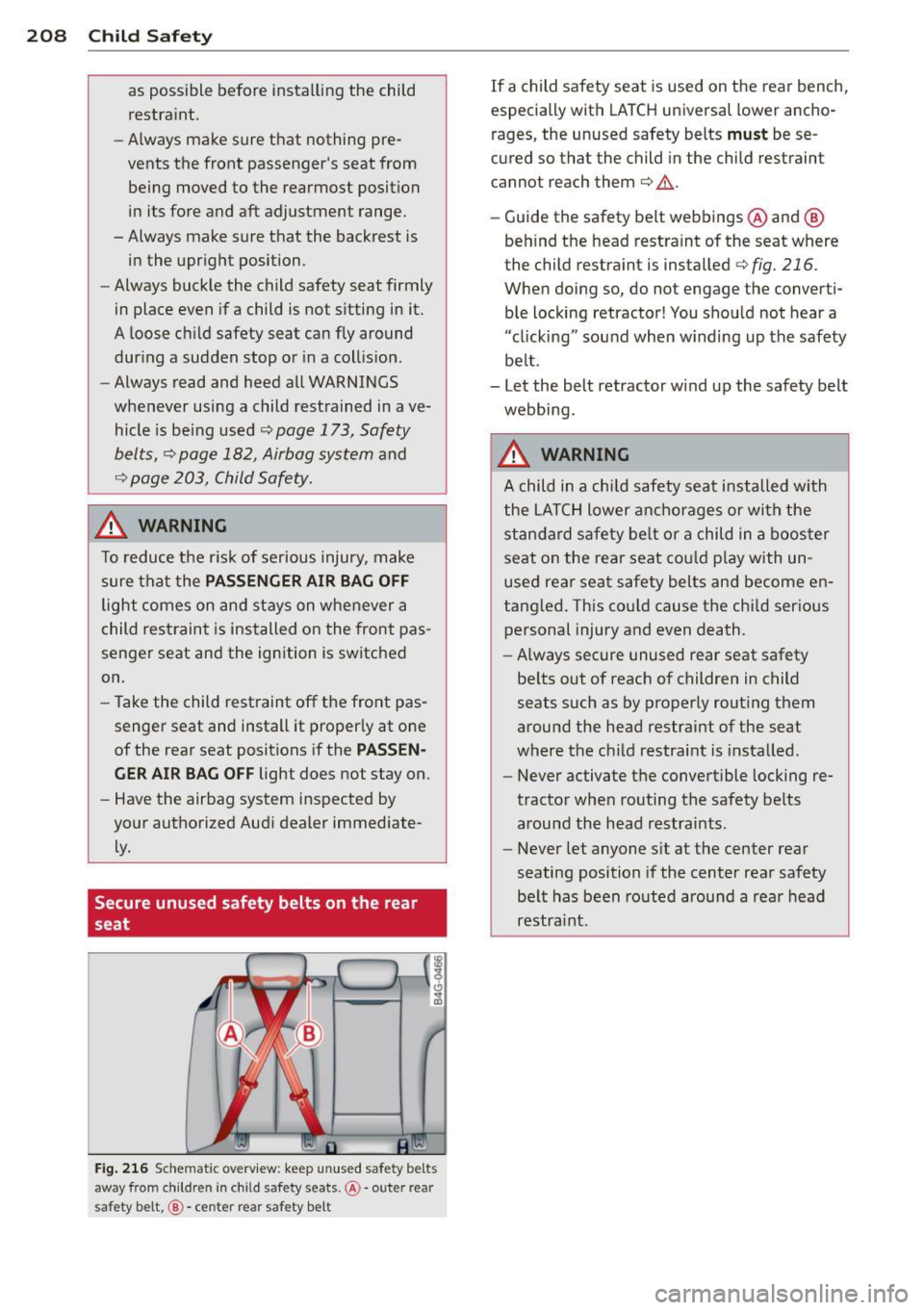
Secure unused safety belts on the rear
seat
Fig . 2 16 Schematic overview: keep un use d safety be lts
away from c hildren in child sa fety seats. @· oute r rear
sa fety be lt, @ · ce nter rear safety be lt
If a child safety seat is used on the rear bench,
especially with LATCH universal lower ancho
rages, the unused safety belts
must be se
cured so that the child in the child restraint
cannot reach them
c::> & .
-Guide the safety belt webbings @and @
beh ind the head restraint of the seat where
the child restra int is insta lled
c:> fig. 216.
When doing so, do not engage the converti
ble locking retractor! You shou ld not hear a
"clicking" sound when w inding up the safety
be lt.
- Let the belt retractor w ind up the safety belt
webbing.
A WARNING
-A child in a chi ld safety seat i nstalled with
the LATCH lower a nchorages or wit h the
standard sa fety be lt or a child in a boos ter
seat on the rear seat co uld p lay with un
used rear seat safety belts and become e n
tang led . This co uld cause t he chi ld ser ious
personal injury and even death.
- Always secure unused rear seat safety
be lts out of reach of children in child
seats such as by proper ly rout ing them
around the head restraint of the seat
where the ch ild restraint is installed.
- Never activate the convertible locking re
tractor when routing the safety be lts
arou nd the head restraints.
- Never let anyone s it at the center rear
seating position if the center rear safety
be lt has been routed a round a rear head
restra int.
Page 214 of 350
212 Child Saf ety
• Secure unused safety belts on the rear seat
9page 208.
Ch ildren up to at least 8 years old (over 40
l bs. or 18 kg) are best protected in chi ld safe
ty seats designed for their age and weight. Ex perts say that the ske leta l structure, particu
larly the pelvis, of these chi ldren is not fully
developed, and they must not use the vehicle
safety belts w ithout a su itable child restraint.
It is us ually best to put these children in ap
propriate booster seats. Be sure the booster
seat meets all applicab le safety standards.
Booster seats raise the seating position of the
child and reposition both the lap and shoulder
parts of the safety belt so that they pass
across the child's body in the right places. The
routing of the belt over the child's body is very
important for the ch ild's protection, whether
or not a booster seat is used . Children age 12
and under must always ride in the rear seat.
Ch ildren who are at least 4
ft. 9 in. (S7 in
ches/1.4S meters) tall can generally use the
vehicle's three po int lap and shoulder belts.
Neve r use the lap belt portion of the veh icle's
safety belt a lone to restrain any child, regard
l ess of how b ig the child is. Always remembe r
that c hildren do not have the pronounced pe l
vic structure required for the proper function
of lap belt portion of the vehicle's three point
lap and shoulder be lts. The child's safety ab
solutely requires that a lap be lt portion of the
safety belt be fastened snugly and as low as
possible around the pelvis . Never let the lap
be lt portion of the safety belt pass over the
chi ld's stomach or abdomen.
In a crash, airbags must inflate within a blink
of an eye and with cons iderable force . In order
to do its job, the airbag needs room to inflate
so that it will be there to protect the occupant
as the occupant moves forward into the air bag.
A vehicle occupant who is out of position and
too close to the airbag gets in the way of an
i n flat ing airbag. When an occupant is too
close, he or she wi ll be struck violen tly and will
receive serious or possib ly even fatal in
jury .
In order fo r the ai rbag to offer protect ion, i t is
i mportant that a ll vehicle occupants, espec ial
ly any children, who m ust be in the front seat
because of exceptiona l circumstances, be
proper ly restrained and as far away from the
airbag as possible. By keeping room between
the child's body and the front of the passen
ger compartment, the airbag can inflate com
pletely and prov ide supplemental protection
in certain frontal collisions.
.&, WARNING
No t using a booste r seat, using the boos
ter seat improperly, inco rrectly installing a
booster seat or using the vehicle safety
belt improperly increases the risk of seri
ous persona l injury and death in a collision
or other emergency situat ion. To he lp re
duce the risk of serious personal injury
and/or death:
- The shou lder belt must lie as close to the
center of the ch ild's collar bone as possi
b le and must lie flat and snug on the up
per body. It must neve r lie across the
throat or neck. The lap belt must lie
across the pe lvis and neve r ac ross t he
stomach o r abdomen. Make sure the belt
liesflat andsnug.Pullon thebeltto
tighten if necessary.
- Failure to p roperly ro ute s afety belts
over a child's body wi ll ca use seve re inj u
ries in an accident or other emergency
situation
¢page 173 .
- The rear side o f the child safety seat
should be pos itioned as close as possib le
to the backrest on the vehicle seat. Ad
just or remove the rear seat head re straint if it is difficu lt to install the ch ild
seat with the head restraint in p lace
c::> page 80. Install the head restraint
aga in immediately once the ch ild seat is
removed. D riving without head restraints
or w ith head restra ints that a re not prop
erly ad justed increases the risk of serious
.
or fatal neck inj ury dramatically . ""
Page 215 of 350
M N
0 ...J
'SI: ,...., \!) ..,.,
,...., ..,., ,....,
-Children on the front seat of any car,
even with Advanced A irbags, can be seri
ous ly injured or even killed when an a ir
bag inflates.
- Never let a child stand or kneel on any
seat, for examp le the front seat.
- Never let a child ride in the cargo area of
your vehicle .
- Always remember that a ch ild lean ing
forward, sitt ing sideways or out of posi
t ion in any way during an acc ident can be
struck by a deploying airbag . This will re
sult in se rious personal injury or death .
- If you must install a booster seat on the
front passenger seat because of excep
t ional circumstances the
PASSENGER
AIR BAG OFF
light must come on and
stay on, whenever the ignition is switch
ed on.
- If the
PASSENGER AIR BAG OFF light
does not come on and stay on, perform
the checks described¢
page 193, Moni
toring the Advanced Airbag System.
- Ta ke the child restrain t off the front pas
senger seat and install it properly at one
of the rear seat positions if the
PASSEN
GER AIR BAG OFF
light does not stay on
whenever the ignition is switched on.
- Always read and heed all WARNINGS
whenever using a child restrained in ave
hicle is being used ¢
page 173, Safety
belts,¢ page 182, Airbag system
and
c:> page 203, Important things to know.
Installing a child safety
seat
Securing a child safety seat using a
safety belt
Safety belts for the rear sea ts and the fron t
passenger can be locked wi th the convertible
locking retractor to properly secure child
safety seats .
The safety belts emergency lock ing retractors
for the rear seats safety belts and for the
front passenger's seat safety belt have a con
ve rtible locking retractor for child restraints.
Child Sa fet y 213
The safety belt must be locked so that be lt
webbing cannot unree l. The retractor can be
activated to lock the safety belt and prevent
the safety belt webbing from loosening up
during normal dr iving . A child safety seat can
only be properly installed when the safety belt
i s locked so that the chi ld and child safety
seat w ill stay in place .
Always remember: Even though your vehicle is equipped with an Advanced Airbag system, all
ch ildren, especially those 12 years and young
er, shou ld always r ide in the back seat proper
ly restrai ned fo r the ir age and size.
A WARNING
Improperly installed chi ld safety seats in
crease the risk of serious personal injury
and death in a collision.
- Always ma ke sure that the safety belt re
tracto r is loc ked when installing a child
safety seat . An unlocked safety belt re
tractor cannot hold the child safety seat
in place during normal dr iving or in a
crash.
- Always buckle the child safety seat firmly
in place even if a ch ild is not sitt ing in it.
A loose child safety seat can fly around during a sudden stop or in a collision .
- Always make sure that the rear seat
backrest to which the center rear safety
belt is attached is securely latched when
eve r the rea r center safety belt is being
used to secure a ch ild restra int.
- If the backrest is not securely latched,
the child and the child restraint will be
thrown forward together with the back rest and will strike parts of the vehicle
interior. The child can be seriously in
jured or killed.
- Never install rear-fa cing child safety
seats or infant carrie rs on the front pas
senger seat . A child will be serio usly in
jured and can be killed when the passen ger airbag inflates.
- The inflating airbag will h it the ch ild
safety seat or infant carrier with great
force and will smash the child safety seat
~
•
•
Page 216 of 350
214 Child Safety
and child against the backrest, center
armrest, door or roof.
- Always install rear-facing child safety
seats or infant carriers on the rear seat.
- Forward-facing child safety seats or in
fant carriers installed on the front pas
senger's seat may interfere with the de
ployment of the airbag and cause serious
injury to the child.
- It is safer to install a forward-facing
child safety seat on the rear seat.
- Always read and heed all WARNINGS whenever using a child restrained in ave
hicle is being used
c::> page 203 . Special
precautions apply when installing a child
safety seat on the front passenger seat
c::> page 184, Child restraints on the front
seat -some important things to know.
A WARNING
Always take special precautions if you
must install a forward or rearward-facing
child restraint on the front passenger's
seat in exceptional situations:
- Whenever a forward or rearward-facing
child restraint is installed on the front
passenger seat, the
PASSENGER AIR
BAG OFF
light must come on and stay on
whenever the ignition is switched on.
- If the
PASSENGER AIR BAG OFF light
does not come on and stay on, perform
the checks described
<=:> page 193, Moni
toring the Advanced Airbag System.
- Take the child restraint off the front pas
senger seat and install it properly at one
of the rear seat positions if the
PASSEN
GER AIR BAG OFF
light does not stay on
whenever the ignition is switched on.
- Improper installation of child restraints
can reduce their effectiveness or even
prevent them from providing any protec
tion.
- An improperly installed child restraint
can interfere with the airbag as it de
ploys and seriously injure or even kill the
child. -
Always carefully follow the manufactur
er's instructions provided with the child
safety seat or carrier.
- Never place additional items on the seat
that can increase the total weight regis
tered by the weight-sensing mat and can
cause injury in a crash .
A WARNING
-Forward-facing child restraints:
- Always make sure the forward-facing
seat has been designed and certified by its manufacturer for use on a front seat
with a passenger front and side airbag .
- Never put the forward-facing child re straint up, against or very near the in
strument panel.
- Always move the passenger seat into its
rearmost position in the seat's fore and
aft adjustment range, as far away from
the airbag as possible before installing
the forward-facing child restraint. The
backrest must be adjusted to an upright
position.
- Make sure that the PASSENGER AIR BAG
OFF
light comes on and stays on all the
time whenever the ignition is switched
on .
A WARNING
Rearward-facing child restraints:
- A child in a rearward-facing child safety
seat installed on the front passenger
seat will be seriously injured and can be killed if the front airbag inflates -even
with an Advanced Airbag System .
- The inflating airbag will hit the child
safety seat or infant carrier with great
force and will smash the child safety seat
and child against the backrest, center
armrest, door or roof.
- Always be especially careful if you must
install a rearward facing child safety seat
on the front passenger seat in exception-
al circumstances.
~
Page 221 of 350
M
"' 0 ..J
'
"' rl
_& WARNING
Improper use of tether anchorages or low
er anchorages can cause serious personal
injury in a crash.
- Always ca refully follow the child re
straint manufacturer's instruct ions for
proper installation and use of child re
st raint systems.
- Never use the
LATCH or tether anchorag
es to attach safety belts or othe r kinds of
occupant restraints.
- Child restraint tether attachments a nd
lower attachments are only des igned to
se cur e a child res tra int t hat has been
equipped to use these anchorages.
- T ether anc horages and lower an chorages
are desig ned to withstand o nly those
loads imposed by corre ctly fi tted ch ild
res traints . Under no circumstances can
they be used safe ly for adu lt or child
safety belts or harnesses.
- Never mount more than one chi ld re
st raint to a sing le tether or to a lower an
chorage point. Attac hing two child re
straints to a single anchorage point can cause the anchorage to fail and cause se
rious persona l injury in a crash.
(D Note
- Remove the guidance fixtures before
fo ld ing the rear seatback to prevent
damag ing the seat c ushion.
- If you leave the guidance fixtures instal
l ed for several days, they could leave a
mark on the upho lstery on the seat cush
i on and backrest in the area that the
guidance fixtures wer e insta lled. The up
ho ls tery would a lso be permanently
stretched around the guid ance fixtures.
This applies especially to leat her seats.
Child S afety 219
Installing a child restra int with LATCH
lower anchorages
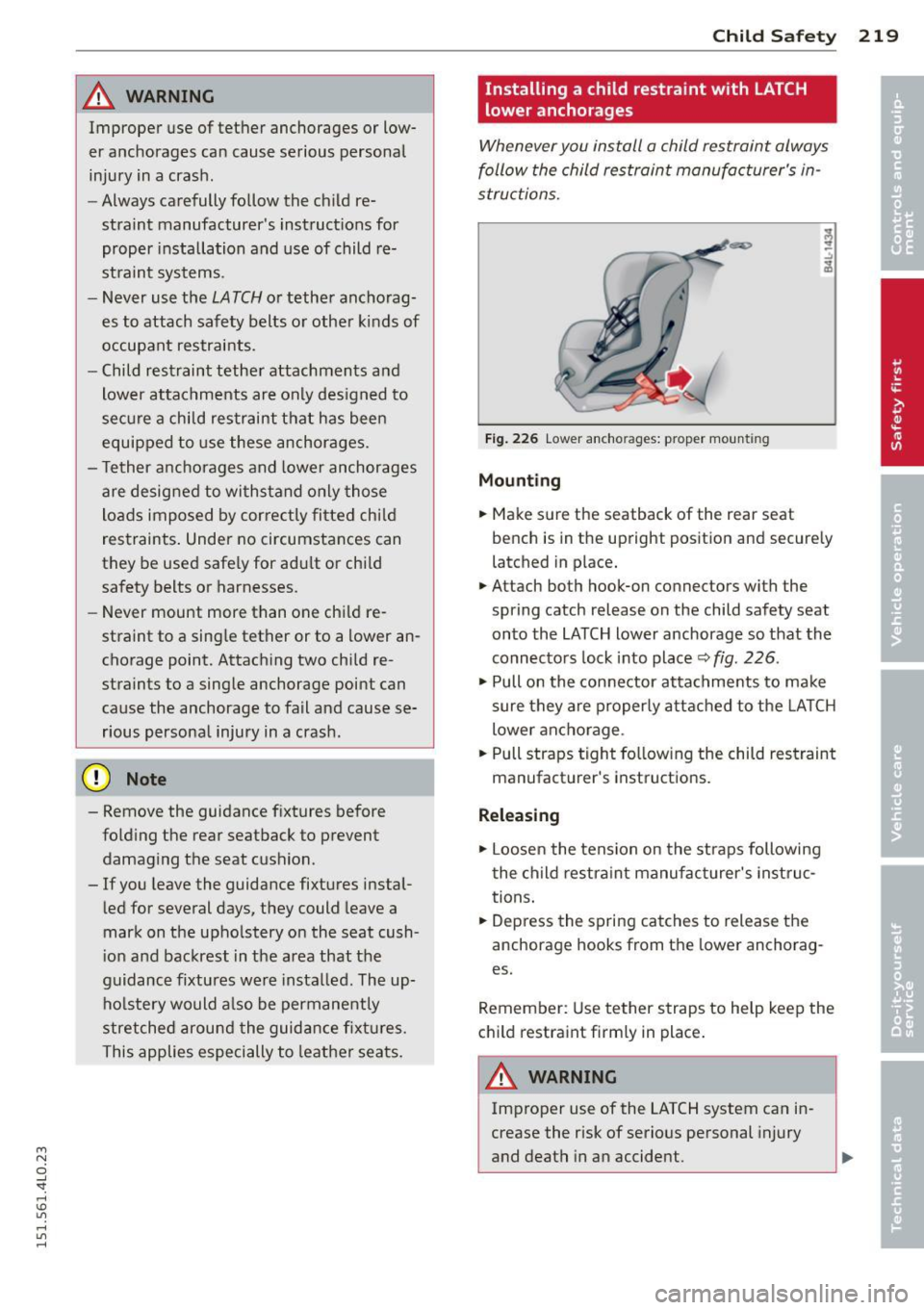
Whenever you install a child restraint always
f o llo w t he child res traint manufa cturer's i n
structions.
F ig . 2 2 6 Lower an cho rages: proper mount ing
Mounting
.. Make s ure the seatback of the rear seat
bench is in the upright pos ition and securely
latched in p lace.
.. Attach both hook-on connectors with the
spring catch release on the child safety seat
onto the LATCH lower anchorage so that the
connecto rs lock into place ¢
fig. 226.
.. Pull on the con nector atta chme nts to ma ke
sure they are properly a ttac hed to the LA T CH
lower ancho rage .
.. Pull straps tight fo llowing the child restraint
manufact ure r's instruct ions .
Releasing
.. loose n the tension on the straps following
t he ch ild restraint manufac turer's instruc
tions .
.. Depress the spring catches to release the
anchorage hooks from t he lower anchorag
es.
Remember: Use te ther s traps to help keep the
chi ld restraint f irmly in place .
A WARNING '-
Imp roper use of the LATCH system can in-
crease the risk of serious personal injury
and death in an accident.
Page 224 of 350
222 Child Safety
Releasing the tether strap
.. Loosen the tension following the child re
straint manufacturer's instructions.
.. Depress the spring catch on the hook and re
lease it from the anchorage.
.. For the second row of seats: Push the floor
ing forward into place again.
.. For the third row of seats:* Replace the
plastic cover cap .
(D Note
If you leave the child restraint with the
tether strap firmly installed for several
days, this could leave a mark on the up
holstery on the seat cushion and backrest
in the area where the tether strap was in
stalled. The upholstery would also be per
manently stretched around the tether
strap. This applies especially to leather
seats.
Using tether straps on rearward-facing
child restraints
Currently , few rear -facing child restraint sys
tems come with a tether . Please read and
heed the child restraint system manufactur
er's instructions carefully to determine how to
properly install the tether.
& WARNING
A child in a rearward-facing child safety
seat installed on the front passenger seat
will be seriously injured and can be killed if
the front airbag inflates - even with an Ad
vanced Airbag System.
- The inflating airbag will hit the child safety seat or infant carrier with great
force and will smash the child safety seat and child against the backrest, center
armrest, or door .
- A tight tether or other strap on a rear
ward-facing child restraint attached to
the front passenger seat can put too much pressure on the weight-mat in the
seat and register a heavier weight in the
Advanced Airbag System. The heavier weight
registered can make the system
work as though an adult were on the seat
and deploy the Advanced Airbag when it
must be suppressed causing serious or
even fatal injury to the child.
- If you must install a rearward facing
child safety seat on the front passenger
seat because of exceptional circumstan
ces and the
PASSENGER AIR BAG OFF
light does not come on and stay on, im
mediately install the rear-facing child
safety seat in a rear seating position and
have the airbag system inspected by your
Audi dealer.
Additional Information
Sources of information about child
restraints and their use
There are a number of sources of additional
information about child restraint selection, in
stallation and use:
NHTSA advises that the best child safety seat
is the one that fits your child and fits in your
vehicle, and that you will use correctly and
consistently.
Try before you buy!
U.S National Highway Traffic Safety Admin
istration
Tel.: 1-888-327-4236 (TIY: 1-800-424-9153)
http://www.nhtsa.gov
National SAFE KIDS Campaign
Tel.: (202) 662-0600
http://www.safekids .org
Safety BeltSafe U.S.A
Tel.: (800) 7 45 -SAFE (Eng Lish)
Tel.: (800) 747-SANO (Spanish)
http://www.carseat.org
Transport Canada Information Centre
Tel.: 1-800 -333-0371 or call
1-613-998-8616 if you are in the Ottawa area
http://www.tc.gc.ca/eng/roadsafety/
menu.htm
Audi Customer Relations
Tel.: (800) 822-2834
Page 225 of 350

M N
0 ...J
'SI: ,...., \!) 1.1'1 ,...., 1.1'1 ,....,
Intelligent technology Notice about data
recorded by vehicle
control modules
Your vehicle is not equipped with an Event Da
ta Recorder (EDR), installed by some manu
facturers for the express purpose of capturing
data for retrieval after an accident or crash
event. EDRs are sometimes called "crash re
corders".
Some state laws restrict the retr ieval or down
loading of data stored by EDRs that were in
stalled in a vehicle for the express purpose of
retrieving data after an accident or crash
event without the owner's consent.
Although your vehicle is not equipped with an
EDR, it is equipped with a number of electron
ic control modules for various vehicle systems
such as, for example, engine function, emis
sion control, as well as for the airbags and
safety belts.
These electronic control modules also record
vehicle-related data during norma l vehicle op
eration for diagnostic and repair purposes.
The recording capacity of the electronic con
trol modules is limited to data (no sound is re
corded) and only a small amount of data is ac
tually recorded over a very limited period of
time and stored when a system fault or other
condition is sensed by a control unit. Some of
the data then stored may relate to vehicle
speed, direction, braking as we ll as restraint
system use and performance in the event of a
crash or other condition. Stored data can only be read and downloaded with special equip
ment.
Electronic Stabilization
Control (ESC)
Description
The Electronic Stabilization Control (ESC) rein
forces driver safety. It reduces the risk of slip
ping and improves driving stability. ESC de
tects critical s ituations such as the vehicle
Intelligent technology 223
oversteering and understeering or the whee ls
spinning . The vehicle is stabilized by applying
the brakes or reducing eng ine torque . Once
the ESC is active, the indicator light
GI blinks
in the instrument cluster.
The following systems are integrated in the
ESC:
Anti-lock brake system (ABS)
ABS prevents the wheels from locking up
when brak ing. The vehicle can sti ll be steered
even during hard braking. Apply steady pres
sure to the brake peda l. Do not pump the ped
al. A pulsing in the brake pedal indicates that
the system is helping you to brake the vehicle.
Brake assist system
The brake assist system can decrease braking
distance.
It increases braking power when the
driver presses the brake peda l quickly in emer
gency situations. You must press and hold the
brake pedal until the situation is over. In
vehicles with adaptive cruise control*, the
brake assist system is more sensitive if the
distance detected to the vehicle ahead is too
small.
Anti-slip regulation (ASR)
ASR reduces engine power when the drive
wheels begin to spin and adapts the force to
the road conditions. This makes it easier to
start, accelerate and dr ive up hi lls.
Electronic differential lock (EDL)
The EDL brakes wheels that are spinning and
transfers the drive power to the other wheels.
This function is not available at higher speeds .
In extreme cases, EDL automatically switches
off to help keep the brake on the braked wheel
from overheating. EDL will switch on again au
tomatically when conditions have returned to
normal.
A WARNING
- The ESC and its integrated systems can
not overcome the laws of physics. This is
especially important on slippery or wet
~
•
•