oil pressure AUDI Q7 2015 Owner´s Manual
[x] Cancel search | Manufacturer: AUDI, Model Year: 2015, Model line: Q7, Model: AUDI Q7 2015Pages: 350, PDF Size: 86 MB
Page 33 of 350
M N
0 ...J
'SI: ,...., \!) 1.1"1 ,...., 1.1"1 ,....,
For example, the symbol II appears in the
display, indicating low windshield washer flu
id level. The follow ing message also appears:
Please refill washer fluid
The driver message disappears after a few
seconds. The driver message can be d isp layed
again by briefly pressing the
!CHECK I button.
Red symbols
Fig. 25 Display: engine coolant level warning (prio rity
1)
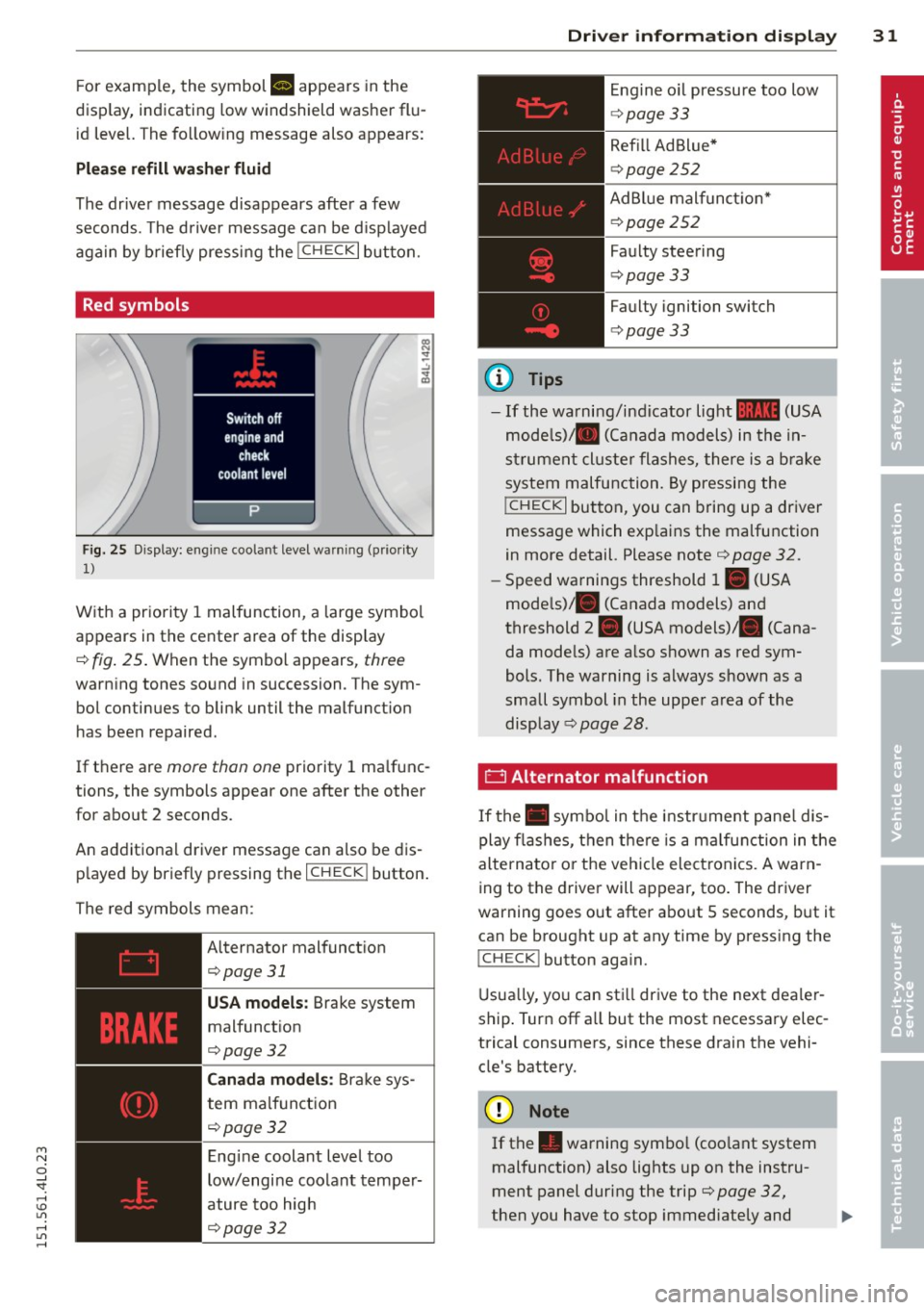
With a priority 1 malfunction, a large symbol
appears in the center area of the display
¢ fig . 25 . Wh en the symbo l appears, three
warning tones sound in succession. The sym
bol continues to blink until the malfunct ion
has been repaired.
If there are
more than one priority 1 ma lfunc
tions, the symbols appear one after the other for about 2 seconds.
An additional driver message can also be dis
played by briefly pressing the
I CHECK ! button.
The red symbols mean:
Alternator malfunct ion
¢page31
USA models: Brake system
malfunction
¢page32
Canada models: Brake sys
tem malfunction
¢pa ge32
Engine coolant level too
low/engine coolant temper
ature too high
¢page32
Driver information display 31
@ Tips
Engine oil pressure too low
¢page 33
Refill Ad Blue*
¢page 252
AdBlue malfunct ion*
c!>page252
Faulty steering
c!>page 33
Faulty ignition switch
¢page 33
-If the warning/indicator light 11111 (USA
models)/ . (Canada models) in the in
strument cluster flashes, there is a brake
system malfunction. By pressing the
!CHECK I button, you can bring up a driver
message which exp lains the malfunction
in more detail. Please note ¢
page 32.
-Speed warnings threshold 1. (USA
mode ls)/ . (Canada models) and
threshold 2. (USA models) . (Cana
da models) are a lso shown as red sym
bols. The warning is always shown as a
small symbol in the uppe r area of the
display
c!> page 28.
0 Alternator malfunction
If the . symbol in the instrument panel dis
play flashes, then there is a malfunction in the
alternator o r the vehicle elect ronics. A warn
ing to the driver will appear, too . The driver
warning goes out after about 5 seconds, but it
can be brought up at any time by pressing the
ICHECK I button aga in.
Usually, you can still drive to the next deale r
ship . Turn off all but the most necessary elec
trical consumers, since these drain the vehi
cle's battery.
([) Note
If the . warning symbo l (coo lant system
malfunction) also lights up on the instru
ment panel during the trip¢
page 32,
then you have to stop immediately and ..,_
Page 35 of 350
M N
0 ...J
'SI: ,...., \!) 1.1"1 ,...., 1.1"1 ,....,
-The e ngine com partment of any ve hicle
is a dangerous area. Before you perform
any work in the engine compartment,
turn of the eng ine and allow it to cool.
Follow the wa rning stickers~
page 256.
(D Note
Do not contin ue driving if the. symbo l
illuminates. There is a ma lfunct ion in the
eng ine cooling system -you cou ld damage
your engine.
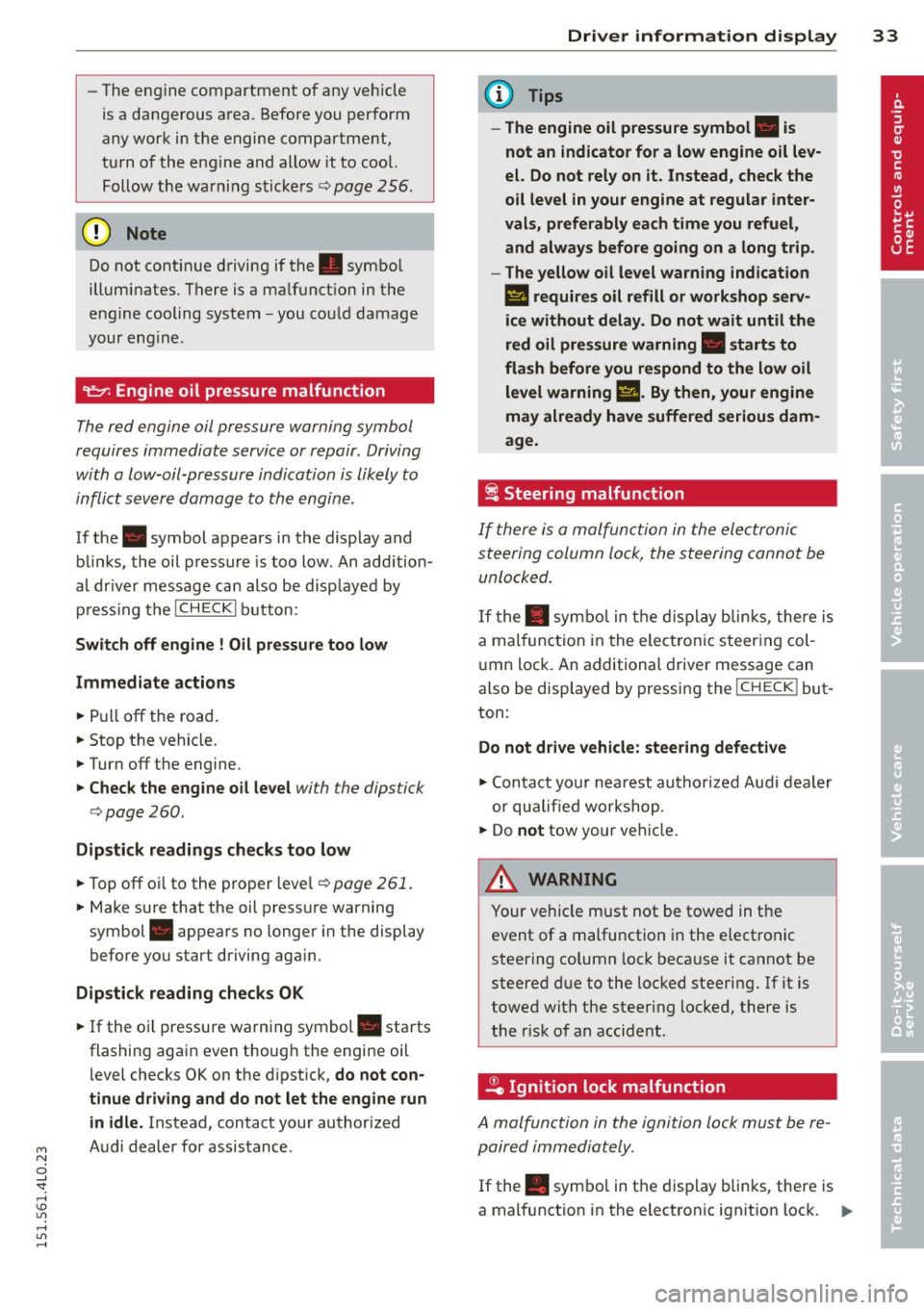
9=:7-: Engine oil pressure malfunction
The red engine oil pressure warning symbol
requires immediate service or repair. Driving
with a low-oil-pressure indication is likely to
inflict severe damage to the engin e.
If the . symbol appears in the display and
b links, the oil pressure is too low. An addition
a l dr ive r message can also be d isp layed by
p ress ing t he
I CH ECKi b utton:
Switch off engine I Oil pressur e too low
Immediate a ction s
~ Pull off the road.
~ Stop the vehicle.
~ Turnoff the engine.
~ Check the engine oil le vel with the dipstick
i=> page
260.
Dipstick reading s checks too low
~ Top off oi l to the proper level~ page 261.
~ Make sure that the oil pressure warning
symbol . appears no longer in the display
before you start driving aga in.
Dipstick reading checks OK
~ If the o il pressure warning symbol. starts
flashing again even though the engi ne oil
l evel checks OK on the d ipst ick,
do not con
tinue driving and do not let the engine run in idle.
Instead , contact your authorized
A udi dealer for assistance.
Dri ver information di spla y 33
(D Tips
- The engine oil pressure symbol. is
not an indicator for a low engine oil lev
el. Do not rely on it . Instead, check the
o il level in your engine at regular inter
vals, preferably each time you refuel, and always before going on a long trip .
- The yellow oil level warn ing indication
l!I requires oil refill or workshop serv
ice without delay . Do not wait until the
red oil pressure warning. start s to
flash before you respond to the low oil
level warning
m. By then, your engine
may already have suffered serious dam
age.
i Steering malfunction
If there is a malfunction in the ele ctronic
steering column lock, the steering cannot be
unlocked .
If the . sym bo l in t he d isplay b links, there is
a mal func tion in the ele ct ronic s teer ing col
u mn lock. An additional drive r message can
also be displayed by pressing the
I CHECK ! but
ton:
Do not d rive vehicle: steering defective
~ Contact your nea rest autho riz ed Aud i dea le r
or qualifie d wo rkshop.
~ Do not tow your ve hicle.
A WARNING
= -
Your ve hicle must not be towed in t he
event of a malfunction in the electro nic
steering column lock beca use it cannot be
steered d ue to the loc ked steering. If it is
t o wed with the steer ing locked, there is
the r isk of an accident .
~ Ignition lock malfunction
A malfunction in the ignition lock must be re
paired immedia tely.
If the . symbol in t he display blinks, there is
a mal function in the electronic ign it ion lock. ..,_
Page 110 of 350
108 On the road
Starting and stopping
the engine
Starting the engine
The engine can only be started with your orig
inal Audi key.
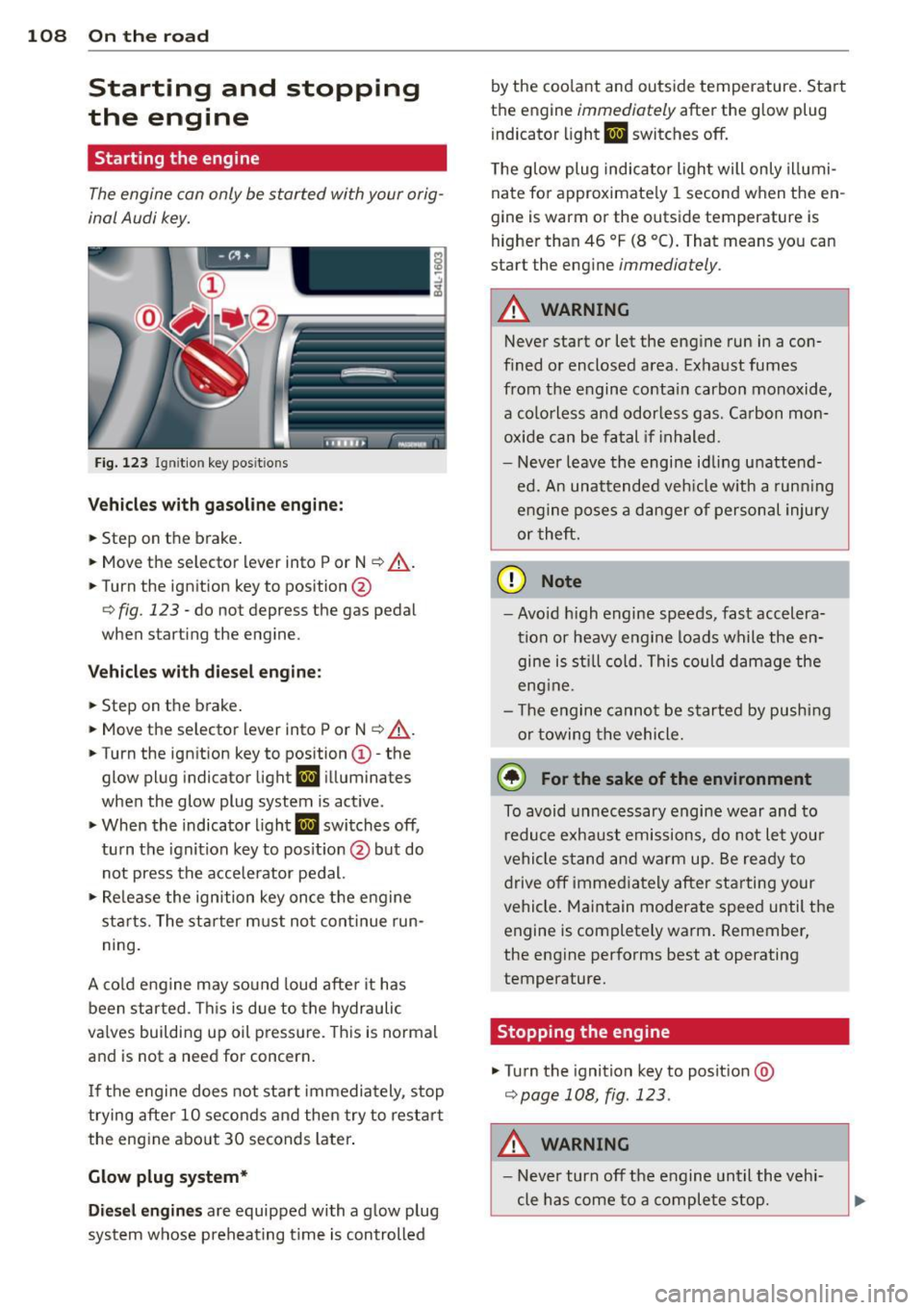
Fig. 123 I gni tion key positio ns
Vehicles with gasoline engine:
.. Step on the brake .
.. Move the selector lever into P or N
~ ,&. .
.. Tu rn the ignition key to position @
~ fig. 123 -do not depress the gas pedal
when starting the engine.
Vehicles with diesel engine:
.. Step on the brake .
.. Move the selector lever into P or N
~ ,&..
.. Turn the ign ition key to position ©- the
glow plug indicator light
II illuminates
when the glow plug system is act ive .
.. When the indicator l ight
II switches off,
turn the ignition key to pos it ion @ but do
not press the accelerator pedal.
.,. Re lease the ignition key once the engine
sta rts. The starter must not continue run
ning.
A cold engine may sound loud after it has
been started . This is due to the hydraulic
va lves building up oil pressure. This is normal
and is not a need for concern.
If the engine does not start immediately, stop
trying after 10 seconds and then try to restart
the engine abo ut 30 seconds later.
Glow plug system*
Diesel engines are equipped with a glow plug
system whose preheating t ime is controlled by the coo
lant and outs ide temperature . Start
the engine
immediately after the glow plug
indicator light
II switches off.
The glow plug indicator light will only illumi
nate for approximate ly 1 second when the en
gine is warm or the outside temperature is
higher than 46 °F (8 °C). That means you can
start the engine
immediately .
A WARNING
-Never start or let the engine run in a con-
fined or enclosed area. Exhaust fumes
from the engine contain carbon monoxide,
a colorless and odorless gas . Carbon mon
oxide can be fatal if in haled.
- Never leave the engine idling unattend
ed. An unattended veh icle w ith a runn ing
engine poses a danger of personal injury
or theft .
(D Note
- Avo id high engine speeds, fast accelera
tion or heavy engine loads while the en gine is still cold. This could damage the
eng ine .
- Th e engine cannot be started by pushing
or towing the vehicle .
@ For the sake of the environment
To avoid unnecessary engine wear and to
reduce exhaust emissions, do not let your
vehicle stand and warm up. Be ready to
drive off immediately after starting your
vehicle. Maintain moderate speed until the
engine is completely warm . Remember,
the engine performs best at operating
temperature.
· Stopping the engine
.,. Turn the ignition key to posit ion @
~page 108, fig . 123.
A WARNING
-
- Never turn off the engine until the vehi-
cle has come to a complete stop.
Page 111 of 350
M
"' 0 ..J
"". rl I.O
"' rl
"' rl
-The brake booster and servotronic on ly
work when the engine is running. With
the ignition turned off, you have to apply
more force when steering or braking .
S ince you cannot steer and stop normal
ly, this can lead to accidents and ser ious
injuries.
- The rad iator fan can continue to run for
up to 10 min utes even after you have
turned off the engine and removed the ign ition key. The radiator fan can also
turn on again if the engine coolant heats
up because of intense sunlight or heat
build -up in the engine compartment.
«I) Note
Do not stop the engine immed iate ly after
hard or extended dr iving. Keep the engine
running for approximately two minutes to
prevent excessive heat build-up .
Starting and stopping
the engine with
Convenience key
Starting the engine with the~
button
App lies to vehicles: with Convenie nce key
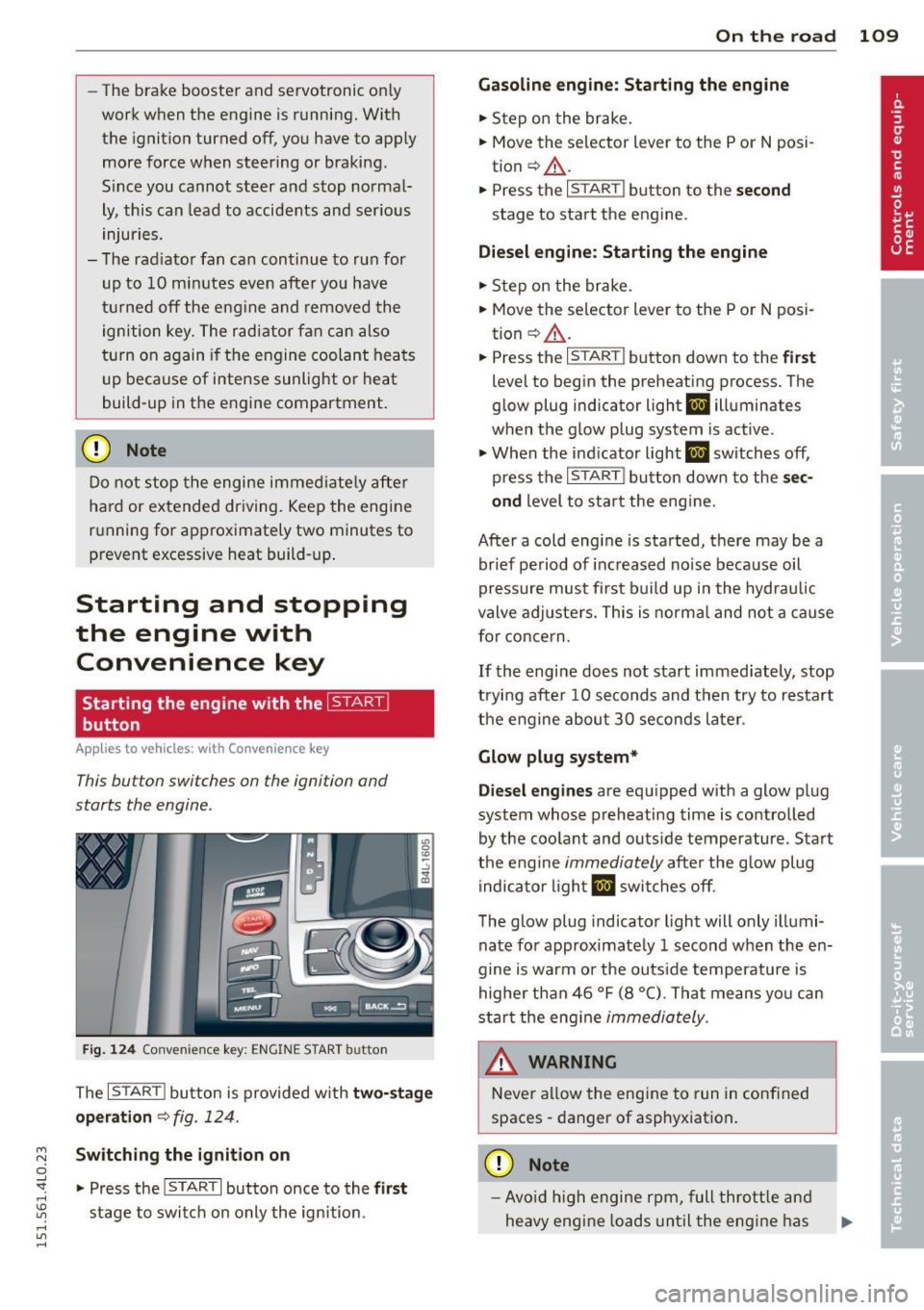
This bu tton swi tches on the ign ition and
starts the engine .
Fig. 124 Co nvenie nce k ey: ENG INE START b utton
The I STAR T! button is provided w ith two -sta ge
o p era tion
¢ fig. 124.
Sw itching the ignition on
.. Press the !STAR T I button once to the firs t
stage to switch on only the ign ition .
On th e road 109
Gasoline eng in e: St arting the engine
.. Step on the brake.
.. Move the s elector lever to the P or N posi
tion ¢.&, .
.. Press th e
r:: 1s =T:--:- A=RT= i button to the secon d
stage to start the engine .
Diesel en gine : Starting the engine
.. Step on the brake.
.. Move the selector lever to the P or N posi
tion ¢.&, .
.. Press th e
r:: 1s =T A c:--=RT= I button down to the first
level to begin the preheating process . The
glow plug indica tor light
II illum ina tes
when the glow plug sy stem is active .
.. When the ind icator light
II switches off,
press the
I ST ART ! button down to the se c
ond
level to star t the eng ine .
After a cold engine is started, there may be a br ief period of inc reased no ise because oil
pressure must first build up i n the hydraulic
valve adjuste rs. This is norma l and not a cause
for concern .
If the engine does not start immediately, stop
trying after 10 seconds and then try to restart
the engine abou t 30 seconds later .
Glow plug system*
Die sel engines
are equ ipped with a glow plug
system whose preheating time is controlled
by the coo lant and outs ide temperature . Start
the engine
immediately afte r the glow plug
indicator light
II swi tches off .
The glow plug indicator light will only illumi
nate fo r approximate ly 1 second when the en
gine is warm or the outs ide temperature is
highe r than 46 °F (8 °C) . That means yo u can
start the eng ine
immediately .
WARNING
Never allow the engine to run in confined
spaces -danger of asphyxiation .
(D Note
-Avo id h igh engine rpm, full thrott le and
heavy engine loads until the eng ine has
Page 228 of 350
226 Intellig ent technol ogy
firm ly a few times from a mode rately high
speed ¢.&. .
Faults in the brake system
If you should notice a sudden increase in
brake peda l travel, t hen one of the two bra ke
circ uits may have failed ¢.&. .
Low brak e flu id le vel
Malfunct ions can occur in the brake system if
the brake fluid level is too low . T he brake fluid
l eve l is monitored electronically .
Bra ke boo ster
The brake booster increases the pressure that
you generate w ith the brake pedal. It only op
erates while the eng ine is running ¢,&. .
Brake lining we ar sta tu s
Brake lining wear may be checked by visual in
spection of the condition of the brake pads
through the openings in the wheel. If neces
sary, the wheel may be removed for this in
spection ¢
page 307, Changing a wheel.
A WARNING
- You should perfo rm bra king maneuve rs
for the p urpose of clean ing the b rake
system on ly if road condit ions permit.
Other road users must not be put at risk -
you may cause an accident!
- Be fore descending a steep grade, reduce
speed and shift transmission into a lower
gear or lower driving range. Do not ride
the brakes or hold the pedal down too long or too often. This could cause the
brakes to get hot and dimin ish braking
efficiency .
- Do not "ride the brakes" by resting your
foot on the pedal when you do not intend
to brake . Th is may cause the brakes to
overheat, premature wear and inc reased
stopping distance.
- Under certain climat ic and operating
condit ions such as passing through wa
ter, driving in heavy ra in or after wash ing
the vehicle, the effect iveness of the
brakes can be reduced . In winter, ice can accumu
late on the brake pads, linings,
discs and drums. Carefully app ly brakes
for a test. Brakes will dry and ice coat ings w ill be cleaned off after a few care
ful brake applicat ions .
- Driving for an extended period of time on
salt-covered roads without using your
brakes can also affect braking efficiency .
Clean off accumulated salt coating from
b rake discs and pads with a few ca reful
brake applications.
- If you damage the front spoiler, or if you
i n stall a diffe rent spoiler, be s ure the a ir
f low to the front brakes is not obs truct
ed . Otherwise the brake system could
overheat reducing the effectiveness of
the entire brake system .
- Fai lure of one brake circuit will impai r
the braking capability resulting in an in
creased stopping distance . Avoid driving
the vehicle and have it towed to the near
est authorized Audi dea ler or qualified
workshop .
- Never let the ve hicle roll to a stop with
the engine shut off.
- If the brake booster is not working, the
brake peda l must be pressed cons idera
b ly harder to make up for the lack of
booster assistance.
Servotronic - advanced power steering system
The power steering systems uses the power of
the running engine to allow precise steering
with Little effort.
T he advanced Servotronic power steer ing sys
tem senses the road speed and electronica lly
adjusts power assistance to provide comforta
ble and safe steering response exactly match
ed to the vehicle speed.
Power s teer ing will not work if the engine is
off. As a result, the steering wheel will be hard
to turn.
T he powe r steering fluid level is checked d ur-
ing the sched uled maintenance services . ..,.
Page 266 of 350
264 Check ing and filling
Coolant lo ss
Coolant loss may indicate a l ea k in t he cooling
system. In the event of coolant loss, the cool
ing system should be inspected immediately
by your authorized Audi dealer. It is not
enough merely to add coolant.
I n a
se ale d system, losses can occur only if
the boiling point of the coolant is exceeded as
a result of overheating.
A WARNING
The cooling system is under pressure and
can get very hot. Reduce the risk of scald
ing from hot coolant by following these
steps.
- Turn off the engine and allow it to cool
down.
- Protect your face, hands and arms from
escaping fluid and steam by covering the
cap with a large, thick rag .
- Turn the cap slowly and very carefully in
a counter-clockwise direction wh ile ap
plying light, downward pressure on the
top of the cap .
- To avoid being burned, do not spill ant i
freeze or coolant on the exhaust system
or hot eng ine parts. Under certain condi
t io ns, the ethy lene g lycol in engine cool
an t ca n ca tch f ire.
0 Note
Do not add any type of radiator leak seal
ant to your vehicle's eng ine coolant. Add
ing radiato r repair fluid may adve rsely af
fect the function and performance of your
cooling system and could res ult in damage
not covered by your New Vehicle Limited
Warranty .
Adding coolant
Be very careful when adding engine coolant.
Before you check anything i n the engine com
pa rtmen t,
a lwa ys read and heed all WARN
INGS c:::> A in Working in the engine compart
ment on page 256.
.. Tu rn off the engine .
.. Let the engine cool down.
.. Place a thick rag over the coo lant expansion
tank
c> page 263 , fig. 246 and carefully
twist the cap counter-clockwise c> ,&. .
.. Add coo lant m ixed in the correct rat io
c:::> page 262, Coolant.
.. Twist the cap o n again tightly.
Rep lacement engine coo lant must conform to
exact spec ificat ions
c> page 262, Coolant.
We recommend using only coo lant add it ive
G12 ++, G13 or in an emergency G12 +. Do
not
use a different add itive. In an emergency use
plain water until you can get the correct addi
t ive and can restore the correct ratio . This
shou ld be done as soon as poss ib le.
If you have lost a considerab le amount of
coolant, the n you should add cold ant ifreeze
and co ld water on ly when the eng ine is cold .
Always use
new engine coolant when refilling.
Do not fi ll coo lant above the "MAX" mark. Ex
cess coolant will be forced o ut through the
pressure relief valve in the cap when the en
gine becomes hot.
A WARNING
- The cooling system is under pressure and
can get very hot. Reduce the risk of
scalding from hot coolant by following
these steps.
- Turn off the engine and allow it to coo l
down.
- Protect your face, hands and arms from
escaping fluid and steam by covering
the cap with a large, th ick rag.
- Turn the cap s low ly and very carefully
in a counter-clockwise direction while
applying light, downward pressure on
the top of the cap.
- To avoid being burned, do not spill an
tifreeze or coolant on the exhaust sys
tem or hot engi ne parts. Under certain
cond it ions, the ethylene g lycol in e n
gine coolant can catch fire .
Page 273 of 350
Tires and wheels
Tires
General notes
Tires may be the least appreci
ated and most abused parts of
a motor vehicle .
Tires may be the least appreci
ated and most abused parts of
a motor vehicle. Tires are, how
ever, one of the most important
parts of a vehicle, particularly
considering the comparatively
small patch of rubber on each
tire that assures that all-impor
tant contact between you, your
vehicle and the road.
Maintaining the correct tire
pressure, making sure that your
vehicle and its tires do not have
to carry more weight than they can safely handle, avoiding
damage from road hazards and
regularly inspecting tires for
damage including cuts, slashes
irregular wear and overall con
dition are the most important
things that you can do to help avoid sudden tire failure includ
ing tread separation and blow-
~ outs.
0 ...J
'SI: ,...., \!) 1.1'1 ,....,
"' ,....,
Tires and wheels 2 71
Avoiding damage
If you have to drive over a curb
or similar obstacle , drive very
slowly and as close as possible
at a right angle to the curb.
Always keep chemicals includ ing grease, oil, gasoline and
brake fluid off the tires.
Inspect the t ires regularly for
damage (cuts, cracks or blis
ters, etc.). Remove any foreign bodies embedded in the treads.
Storing tires
Mark tires when you remove
them to indicate the direction
of rotation. This ensures you to be able to mount them correct
ly when you reinstall them.
When removed, the wheels or
tires should be stored in a cool, dry and preferably dark place.
Store tires in a vertical position if they are not mounted on
rims, in a horizontal position if
they are mounted on rims.
New tires
New tires have to be broken in
¢ _&. .
The tread depth of new tires
may vary , according to the type .,.
•
•
'
Page 276 of 350
274 Tir es a nd whee ls
Bead Extra load tire
means the part of the tire that means a tire design to operate
is made of steel wires, wrapped at higher loads and at higher
or reinforced by p ly cords and inflation pressures than the
that is shaped to fit the rim . corresponding standard tire .
Bead separation Extra load tires may be identi-
fied as "XL", "xl", " EXTRA
means a breakdown of the bond LOAD", or "RF" on the sidewall.
between components in the
bead .
Gross A xle Weight Rating
(" GAWR ")
Cord
means the load-carrying capaci-
means the strands forming the ty of a single axle system,
p lies in the tire .
measured at the tire-ground in-
Cold tire inflation pressure terfaces.
means the tire pressure recom-
Gross Vehicle Weight Rating
mended by the vehicle manu-( "GVWR ")
facturer for a t ire of a designat-
means the maximum total
ed size that has not been driven loaded weight of the vehicle.
for more than a couple of miles
Groove
(kilometers) at low speeds in
the three hour period before means the space between two
the tire pressure is measured or adjacent tread ribs.
adjusted.
Load rating (code )
Curb weight
means the max imum load that
means the weight of a motor a tire
is rated to carry for a giv-
vehicle with standard equip -en inflation pressure
. You may
ment including the maximum not find th
is information on all
capacity of fuel, oil, and cool- tires because it is not required
ant, air condit ioning and addi- by law.
...
tional weight of optional equip-
ment.
Page 288 of 350
286 Tires and wheels
build-up, sudden tire failure
and loss of control.
-If the tire pressure is too low or too high, the tires
will wear prematurely and
the vehicle will not handle
well.
-If the tire is not flat and you
do not have to change a
wheel immediately, drive at reduced speed to the near
est service station to check
the tire pressure and add air
as required.
(D Note
Driving without valve stem
caps can cause damage to
the tire valves. To prevent
this, always make sure that
factory installed valve stem caps on all wheels are secure
ly mounted on the valve .
@ For the sake of the environment
Underinflated tires will also
increase the fuel consump
tion .
Tires and vehicle load limits
There are limits to the amount
of load or weight that any vehi
cle and any tire can carry. Ave
hicle that is overloaded will not handle well and is more diffi
cult to stop. Overloading can not only lead to loss of vehicle
control, but can also damage important parts of the vehicle
and can lead to sudden tire fail
ure, including a blowout and
sudden deflation that can cause
the vehicle to crash .
Your safety and that of your passengers also depends on
making sure that load limits are
not exceeded. Vehicle load in
cludes everybody and every
thing in and on the vehicle.
These load limits are technical
ly referred to as the vehicle's
Gross Vehicle Weight Rating
("GVWR") .
The "GVWR " includes the
weight of the basic vehicle, all
factory installed accessories, a
full tank of fuel, oil, coolant
and other fluids plus maximum load. The maximum load in
cludes the number of passen
gers that the vehicle is intend
ed to carry ("seating capacity")
with an assumed weight of 150 lbs (68 kg) for each pas
senger at a designated seating
position and the total weight of
any luggage in the vehicle. If ""
Page 302 of 350

300 Tires and wheels
securely and that the brake system functions
correctly .
I n certain circumstances, you may not use
wheel bolts from a different vehicle -even if it
is the same model
¢ page 328.
A WARNING
Improperly tightened or maintained wheel
bolts can become loose causing loss of
control, a collision and serious personal in
jury.
- Always keep the wheel bolts and the
threads in the wheel hubs clean so the
wheel bolts can turn easily and be prop
erly tightened.
- Never grease or oil the wheel bolts and
the threads in the wheel hubs. They can
become loose while driving if greased or
oiled, even if tightened to the specified
torque.
- Only use wheel bolts that belong to the
rim being installed.
- Never use different wheels bolts on your
vehicle .
-Always maintain the correct tighten ing
torque for the wheel bolts to reduce the
risk of a wheel loss.
If the tightening tor
que of the wheel bolts is too low, they
can loos en and come out when the vehi
cle is moving .
If the tightening torque is
too high, the whee l bolts and threads
can be damaged and the wheel can be
come loose.
{[) Note
The specified torq ue for the wheel bolts is
120 ft lb (160 Nm) with a tolerance of
± 7,4 ft lb(± 10 Nm). Torque whee l bolts
diagonally. After changing a whee l, the
torque must be checked as soon as possi
ble with a torque wrench -preferably by an
author ized Audi dealer or qualified work
shop.
Low aspect ratio tires
Your Audi is factory-equipped w ith low aspect
ratio tires. These tires have been thoroughly
tested and been se lected specifically for your
model for their superb performance, road feel
and handling under a variety of driving condi
t ions . Ask your authorized Audi dealer for
more details.
The low aspect ratio of these tires is indicated
by a numera l of
55 or less in the tire's size
designation. The numera l represents the ratio
of the tire's sidewall height in relation to its
tread width expressed in percentage. Conven
t iona l tires have a he ight/w idth ratio of 60 or
more .
The performance of low-aspect-ratio tires is
particularly sensitive to improper inflation
pressure. It is therefore important that low
aspect ratio tires are inflated to the specified
pressure and that the inflation pressure is
regularly checked and maintained. Tire pres
sures should be checked at least once a
month and always before a long trip
¢ page 282, Checking tire pressure .
What you can do to avoid tire and rim
damage
Low aspect ratio tires can be damaged more
easily by impact with potholes, curbs, gullies
or ridges on the road, particularly if the tire is
underinflated .
In order to minimize the occurrence of impact
damage to the tires of your vehicle, we recom
mend that you observe the following precau
tions:
- Always maintain recommended inflation
pressures. Check your tire pressure every
2,000 miles (3,000 km) and add air if neces
sary .
- Drive carefully on roads with potholes, deep
gullies or ridges. The impact from dr iving
through or over such obstacles can damage
your tires. Impact with a curb may also cause damage to your tires .
- After any impact, immed iately inspect your
tires or have them inspected by the nearest
II>