tire size AUDI Q7 2015 Owner´s Manual
[x] Cancel search | Manufacturer: AUDI, Model Year: 2015, Model line: Q7, Model: AUDI Q7 2015Pages: 350, PDF Size: 86 MB
Page 226 of 350
224 Intellig ent technol ogy
roads . If the systems begin acting to sta
bilize your vehicle, you should immedi
ately change your speed to match the
road and traff ic conditions. Do not let
the inc reased safety prov ided by these
systems tempt you to take r isks. Doing
so w ill increase the risk of a loss of vehi
cl e con tro l, coll is ion and serio us personal
injuries.
- Always adapt you r speed to road, traff ic
and weather condit ions. The risk of los
ing contro l of the veh icle increases when
driv ing too fast, especia lly t hrough
c u rves and on slippery or wet roads, and
when driving too close to vehicles up
ahead. The ESC and its integrated sys
tems cannot always prevent collisions -
there is still a r isk of accidents!
- Always acce lerate with special care on
even, smooth surfaces such as those that
Switching on/off
are wet or covered with ice and snow.
The drive wheels can spin even w ith
these assistance systems that cannot al
ways help to reduce the risk of loss of ve
h icle control.
(D Tips
- ABS and ASR only work correctly when
all four wheels are equipped with identi
cal tires. D ifferent tire sizes can lead to a
reduction in engine power.
- You may hear noises when the systems
descr ibed are working.
- If the ind icator light
DJ or fil (USA
mode ls)/ ti] (Canada models) appears,
there may be a malfunction
<:;> page 16,
<:;>page 18.
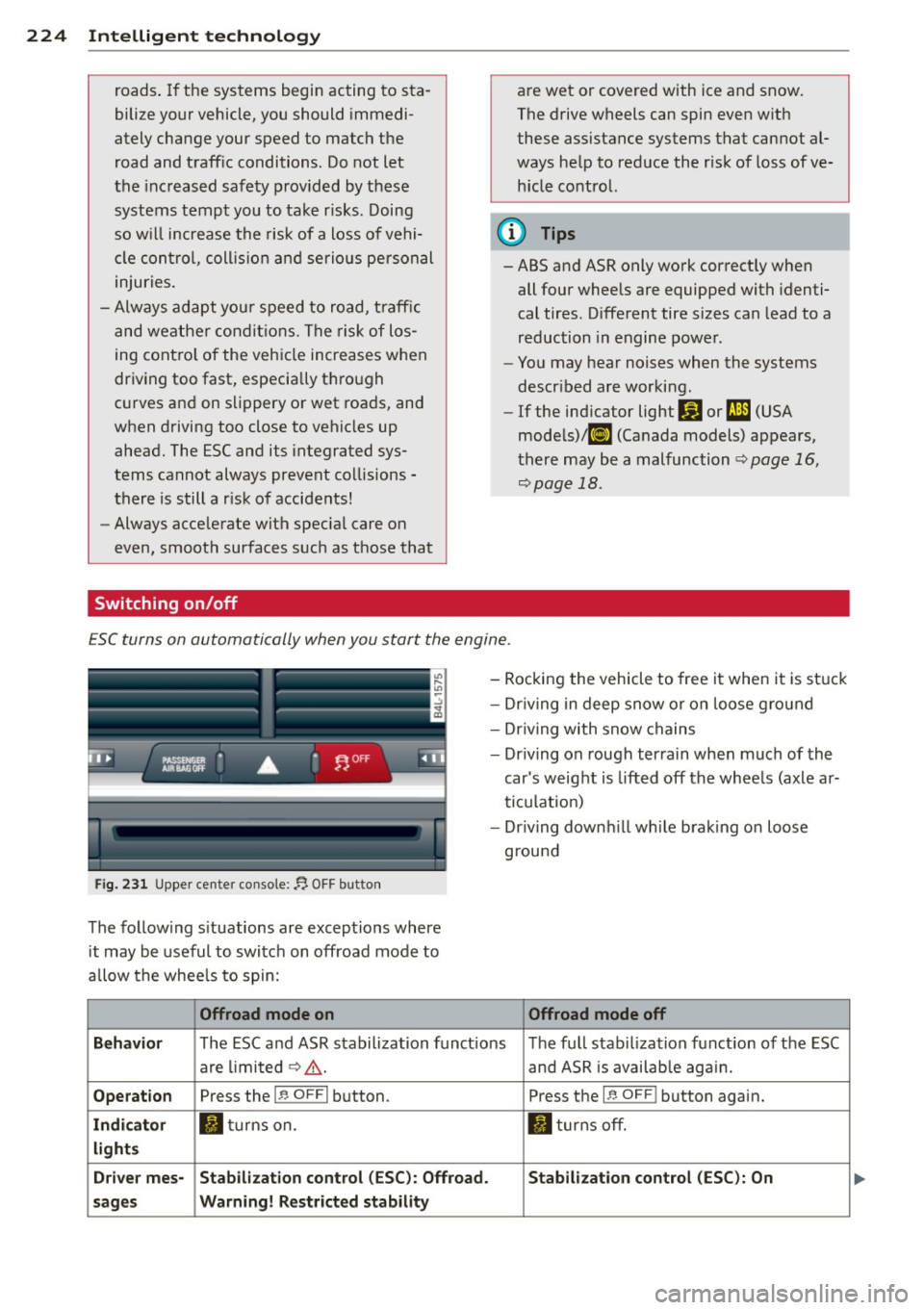
ESC turns on automatically when you start the engine .
,.-------------.,
------------------
Fig. 231 Upper cente r console: f'J OFF button
The follow ing s ituations are exceptions where
it may be useful to switch on offroad mode to
a llow the whee ls to spin:
Offroad mode on
- Rocking the vehicle to free it when it is st uck
- Dr iving in deep snow or on loose ground
- Dr iving with snow chains
- Dr iving on rough terrain when much of the
car's weight is lifted off the whee ls (axle ar
ticulation)
- Dr iving downh ill wh ile brak ing on loose
ground
Offroad mode off
Beha vior
The ESC and ASR stabilization funct ions The fu ll stab ilization funct ion of the ESC
are limited <:;>,&..
and ASR is availab le agai n.
Operat ion Press the I~ O FFI button . Press the I~ OFFI button again.
Indi ca to r IJ tu rnson. II turns off.
li g ht s
D riv er m es- Stabil izat ion cont rol (ES C): O ffroad. S tabil ization contro l (ESC) : On
sa ges Warning! R estricted st ab ility
Page 276 of 350
274 Tir es a nd whee ls
Bead Extra load tire
means the part of the tire that means a tire design to operate
is made of steel wires, wrapped at higher loads and at higher
or reinforced by p ly cords and inflation pressures than the
that is shaped to fit the rim . corresponding standard tire .
Bead separation Extra load tires may be identi-
fied as "XL", "xl", " EXTRA
means a breakdown of the bond LOAD", or "RF" on the sidewall.
between components in the
bead .
Gross A xle Weight Rating
(" GAWR ")
Cord
means the load-carrying capaci-
means the strands forming the ty of a single axle system,
p lies in the tire .
measured at the tire-ground in-
Cold tire inflation pressure terfaces.
means the tire pressure recom-
Gross Vehicle Weight Rating
mended by the vehicle manu-( "GVWR ")
facturer for a t ire of a designat-
means the maximum total
ed size that has not been driven loaded weight of the vehicle.
for more than a couple of miles
Groove
(kilometers) at low speeds in
the three hour period before means the space between two
the tire pressure is measured or adjacent tread ribs.
adjusted.
Load rating (code )
Curb weight
means the max imum load that
means the weight of a motor a tire
is rated to carry for a giv-
vehicle with standard equip -en inflation pressure
. You may
ment including the maximum not find th
is information on all
capacity of fuel, oil, and cool- tires because it is not required
ant, air condit ioning and addi- by law.
...
tional weight of optional equip-
ment.
Page 278 of 350

276 Tires a nd whee ls
Recommended inflation Sidewall
pressure
means that portion of a tire be -
see
c:::> page 2 7 4, Cold tire infla-tween the tread and bead.
tion pressure.
Speed rating (letter code )
Reinforced tire
means the speed at which a tire
means a tire design to operate is designed to be driven for ex-
at higher loads and at higher tended periods of time. The rat-
inflation pressures than the ings range from 93 mph (150
corresponding standard tire .
km/h) to 186 mph (298 km/h)
Reinforced tires may be identi -
c:::> page 294. You may not find
fied as "XL", "xl", "EXTRA
this information on all tires be-
LOAD", or "RF" on the sidewall.
cause it is not required by law.
Rim The speed rating letter code,
means a metal support for a where applicable, is molded on
tire or a tire and tube assembly the tire sidewall and indicates
upon which the tire beads are the maximum permissible
road
seated . speeds
c:::> A in Winter tires on
Rim d
iameter
page 298.
means nominal diameter of the
T ir e pressure mon itoring
system
bead seat. If you change your means a system that detects
wheel size, you will have to pur-
chase new tires to match the when one or more of a vehicle's
new rim diameter . tires are underinflated and illu-
Rim
size de signation
m inates a low tire pressure
warning telltale.
means rim diameter and width.
Tread
R im width
means that portion of a tire
means nominal distance be- that comes into contact with
tween rim flanges. the road.
...
Page 281 of 350
Tires and wheels 2 79
Tire pressure generally refers to tant things you can do to help •
the amount of air in a tire that avoid sudden tire failure. Un-• '
it needs it to do its job and derinflated tires are a major
safely carry the combined load cause of sudden tire failure. of the entire vehicle and its con- Keeping tires at the right pres-
tents. Tire pressure is measured sure is also important for safe
in kilopascals (kPa), the inter- and responsive vehicle han-
national measuring unit and in dling, traction, braking and
pounds per square inch (PSI). load carrying.
Tire pressures
Tire pressure is based in part on are particularly important
the vehicle's design and load when the vehicle is being driv-
limit - the greatest amount of en at higher speeds, and then
weight that the vehicle can car-especially when heavily loaded
ry safely and the tire size. The even within the permissible
proper tire pressure is frequent-load-carrying capacities ap-
ly referred to as the "recom-proved for your vehicle.
mended cold tire inflation pres-The recommended tire pres-
sure." Air in the tires expands sures for your Audi depend on
when the tire heats up because the kind of tires on your vehicle
of internal friction when it flex- and the number of passengers
es in use. The tire pressure is and/or amount of luggage you
higher when the tire has will be transporting.
warmed up than when it is The tire pressure label is locat-
"cold." It is the inflation pres-
ed on the driver's side B-pillar.
sure in a "cold" tire that counts.
Therefore, you should never let The tire pressure label lists the
recommended cold tire infla-
air out of a warm tire to match
"cold tire inflation pressure" tion pressures for the vehicle at
its maximum capacity weight
recommendations. The tires
would then be underinflated and tires that were on your ve-
and could fail suddenly. hicle at the time it was manu-
factured.
M N
0
Maintaining proper tire pres-...J
'SI: ,...., \!)
sure is one of the most impor-1.1'1 ,...., 1.1'1 ,....,
Page 282 of 350
280 Tires and wheels
If you wish to improve comfort See the illustration ¢ fig. 250
when operating the vehicle at for the location of the label on
normal load (up to 3 occu-driver's side B-pillar (color of
pants), you can adjust tire the actual label and exact loca-
pressures to those specified tion on the vehicle will vary
for normal vehicle load. Before slightly).
operating the vehicle at maxi-Note that the following table is
mum load, you must increase accurate at the time of going to
the tire pressures to those press and is subject to change .
specified for maximum vehicle In the event of discrepancies,
load¢&. the tire pressure label located
Bear in mind that the tire pres- on the driver's side B-pillar al-
sure monitoring system can on- ways takes precedence.
ly monitor the tire pressures
The table below lists the rec-
you have stored . The system
ommended cold tire inflation
does not recognize the load
pressures for the Audi model
condition of your vehicle. covered by your Owner's Litera-
The effectiveness of the tire ture at the vehicle's capacity
pressure monitoring system weight and the tire sizes instal-
will be impaired if you store led on the respective models as
normal load pressures but then original equipment, or as a fac-
operate the vehicle at its maxi-tory option.
...
mum load¢&.
Page 283 of 350
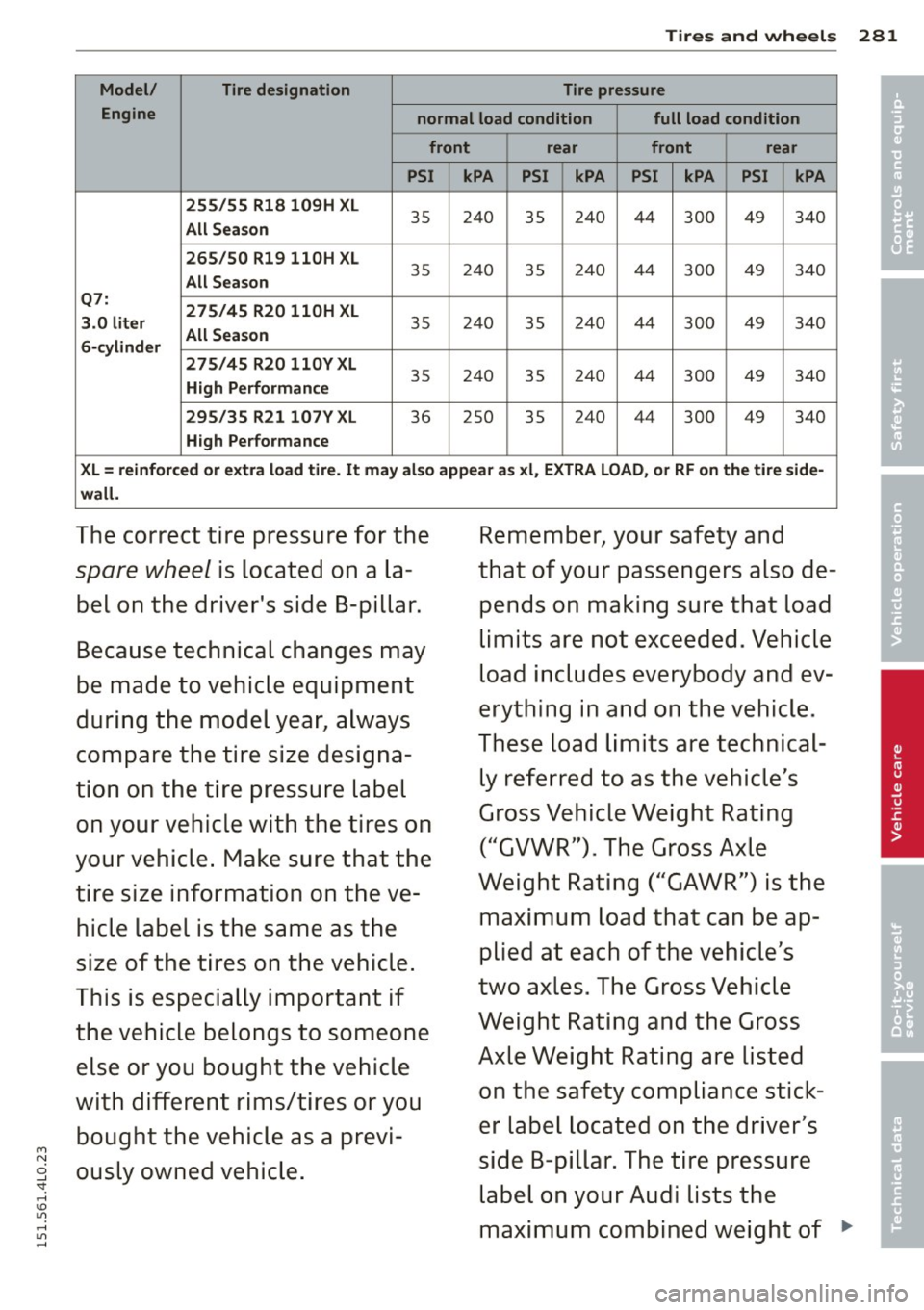
M N
0 ...J 'SI" ,...., \!) 1.1'1 ,...., 1.1'1 ,....,
Tires and wheels 281
Model/ Tire designation Tire pressure
Engine normal load condition full load condition
front rear front rear
PSI kPA PSI kPA PSI kPA PSI
kPA
255/55 R18 109H XL
All Season
35 240
35 240 44
300 49 340
265/50 Rl9 llOH XL
All Season
35 240
35 240 44
300 49 340
Q7:
3.0 liter 275/45 R20 110H XL
All Season
35 240
35 240
44 300 49 340
6-cylinder
275/4S R20 llOY XL
High Performance
35 240 35 240 44 300 49 340
295/35 R21 107V XL 36 250 35 240
44
300 49 340
High Performance
XL~ reinforced or extra load tire. It may also appear as xl, EXTRA LOAD, or RF on the tire side-
wa .
The correct tire pressure for the
spare wheel is located on a la
bel on the driver's side B-pillar.
Because technical changes may
be made to vehicle equipment
during the model year, always
compare the tire size designa
tion on the tire pressure label on your vehicle with the tires on
your vehicle. Make sure that the tire size information on the ve
hicle label is the same as the
size of the tires on the vehicle.
This is especially important if
the vehicle belongs to someone
else or you bought the vehicle
with different rims/tires or you
bought the vehicle as a previ
ously owned vehicle. Remember, your safety and
that of your passengers also de pends on making sure that load
limits are not exceeded. Vehicle
load includes everybody and ev
erything in and on the vehicle.
These load limits are technical- ly referred to as the vehicle's
Gross Vehicle Weight Rating ("GVWR"). The Gross Axle
Weight Rating ("GAWR") is the maximum load that can be ap
plied at each of the vehicle's
two axles. The Gross Vehicle
Weight Rating and the Gross
Axle Weight Rating are listed on the safety compliance stick-
er label located on the driver's
side B-pillar. The tire pressure label on your Audi lists the
maximum combined weight of ""
•
•
'
Page 292 of 350
290 Tires and whee ls
Driving style - Extra care must be taken when
Driving fast around curves, rotating direction-specific
heavy acceleration and hard tires
¢
page 311.
braking increase tire wear. Wheel balancing
Rotating tires for more even
The wheels on new vehicles are
wear ba lanced. However, various sit-
For all four tires on your vehicle uations during everyday driving
to have the same service life, can cause them to become un-
we recommend that the front balanced, resulting in vibra-
and rear tires are rotated ac -tions you can usually feel
cording to the tire manufactur- through the steering wheel.
er's s uggested tire rotation in-
Unbalanced wheels must be re-
tervals . Please remember the
balanced to avoid excessive
following: wear on steering, suspension
-T ire rotation intervals may dif -and tires. A wheel must also be
fer from the vehicle service in· rebalanced when a new tire is
tervals outlined in your War -insta
lled .
ranty
& Maintenance booklet . Incorrect wheel alignment
-The longer one tire is used in
Incorrect wheel alignment can
one location on the vehic le,
cause excessive ti re wear, im-
the more it wears at certain
pairi ng the safety of the vehi-
points; t herefore, we recom-
cle . If t ires show excessive
mend that you fo llow the tire
wear, have the wheel alignment
manufacturer's suggested tire
checked by an authorized Audi
rotation interva ls.
dealer or qualified wo rkshop.
-Vehicles with front-wheel
dr ive experience more t read
All-wheel drive
wear on the front wheels com-
Vehicles with quattro must al -
pared to all-wheel drive (quat- ways have tires of the same
tro) .
size, construction and tread
-Please rotate tires as shown type. For details see
¢ fig. 253.
¢page 227. ...
Page 298 of 350
296 Tires and wheels
sure of their "previous histo-
and sudden deflation and
ry." Old used tires may have loss of control.
been damaged even though -Temperature grades apply
the damage cannot be seen to tires that are properly in-
that can lead to sudden tire flated and not over or un-
failure and loss of vehicle
derinflated.
control. -For technical reasons it is
-All four wheels must be fit-
not always possible to use
ted with radial tires of the wheels from other vehicles -
same type, size (rolling cir- in some cases not even
cumference) and the same wheels from the same vehi-
tread pattern. Driving with cle model.
different tires reduces vehi- -If you install wheel trim
cle handling and can lead to
discs on the vehicle wheels,
a loss of control. make sure that the air flow
-If the spare tire is not the to the brakes is not blocked.
same as the tires that are Reduced airflow to the
mounted on the vehicle -for
brakes can them to over-
example with winter tires -
heat, increasing stopping
only use the spare tire for a distances and causing a col-
short period of time and lision.
drive with extra care. Refit -Run flat tires may only be
the normal road wheel as used on vehicles that were
soon as safely possible. equipped with them at the
-Never drive faster than the
factory. The vehicle must
maximum speed for which have a chassis designed for
the tires on your vehicle are run flat tires. Incorrect use rated because tires that are of run flat tires can lead to
driven faster than their rat-
vehicle damage or acci-
ed speed can fail suddenly. dents. Check with an au-
-Overloading tires cause heat thorized Audi dealer or tire build-up, sudden tire fail- specialist to see if your vehi-
ure, including a blowout cle can be equipped with
..
Page 300 of 350
298 Tires and wheels
Sustained high temperature can cause the
materia l of the tire to degenerate and reduce
tire life, and excessive temperature can lead
to sudden tire failure<=>,& .
The grade C corresponds to a level of perform
ance which a ll passenger car tires must meet
under the Federa l Motor Veh icle Safety Stand
ard No.
109. Grades Band A represent higher
levels of performance on the laboratory test
wheel than the minimum required by law.
A WARNING
The traction grade assigned to this t ire is
based on stra ight-ahead braking traction
tests, and does not include acceleration,
cornering, hydroplanin g or peak traction
characteristics.
A WARNING ,.,.____
The temperature grade for this tire is es
tablished for a tire that is properly inflated
and not overloaded. Excessive speed, un
derinflation, or excessive loading, either
separately or in combination, can cause heat buildup and possible tire fa ilure.
Winter tires
Winter tires can improve vehicle handling on
snow and ice. At temperatures below 45 °F
(7 °C) we recommend changing to winter
tires .
In some heavy snow areas, loca l governments
may require true winter or "snow" tires, those
with very deeply cut tread. These t ires should
only be used in pairs and be installed on all
four wheels. Make sure you purchase snow
tires that are the same size and construct ion
type as the other tires on your ve hicle.
Your veh icle is equipped with all -wheel drive,
this will improve traction during w inter driv
i ng, even with the standard tires. However, we
strongly recommend that you always equip all
four whee ls on your veh icle w ith correctly fit
ted winter ti res or all-season tires, when win
ter road conditions are expected. This a lso im- proves the vehicle's
braking performance and
reduces stopping distances.
Summer tires provide less gr ip on ice and
snow.
Winter tires (snow tires) must always be fitted
on all four wheels.
Ask your authorized Audi dealer or qualified
workshop for perm itted
winter tire sizes . Use
only rad ial winter t ires .
Winter tires lose their effectiveness when the
tread is worn down to a depth of
0.157 inch
(4 mm).
Only drive w ith w inter t ires under winter con
ditions. Summer t ires handle better when
there is no snow or ice on the roads and the
temperature is above 45 °F (7 °() .
If you have a flat tire, see notes on spare
wheel<=>
page 291 .
Please always remember that winter tires may
have a lower speed rating than the tires origi
nally installed on your vehicle at the time it
was manufactured. Please see
<=>page 294,
Speed rating (letter code)
for a listing of the
speed rating letter codes and the maximum
speed at which the tires can be driven .
The speed rating letter code (<=>
page 2 76) is
on the side wall of the t ire
c> page 291.
A WARNING ,.___
Winter tires have maximum speed limits
that may be lower than your vehicle's max
imum speed. Always know the maximum
speed before driv in g off. Never drive faster
than the speed permitted for your specific
winter tires. This wi ll cause damage to the
tires leading to an accident and serious
personal injury to you and your passen
gers.
A WARNING
'----
Driving faster than the maximum speed
for which the winter tires on your vehicle were designed can cause t ire failure in
cluding a blowout and sudden deflation,
Page 301 of 350
M N
0 ...J
'SI: ,...., \!) ..,.,
,...., ..,., ,....,
loss of control, crashes and serious per
sonal inj uries. Have worn or damaged tires
rep laced immediate ly.
- Winter tires have maximum speed rating
that may be lower than your veh icle's
maximum speed.
- Never drive faster than the speed for wh ich the winter or other tires installed
on your vehicle are rated.
A WARNING
Always adjust your driving to the road and traffic conditions . Never let the good ac
celeration of the winte r tires and all-whee l
drive temp t you into taking extra r is k s. Al
ways remembe r:
- When braking, an a ll-w heel driv e vehicle
hand les in the same way as a front dr ive
vehicle.
- Drive carefu lly and reduce your speed on
icy and slippery roads, even winter tires
c annot he lp un der blac k ice cond it ions.
@) For the sake of the environment
Use summe r tires when weathe r cond i
tions perm it. They are quieter, do not wea r
as quickly and red uce fue l consumption.
Snow chains
Snow chains may be fitted on ly to the rear
wheels, and only to certain tire sizes . Ask yo ur
authorized Audi dealer on whic h tire sizes
snow chains can be used.
The snow chains must have low -profile links
a nd must not be thicker than 0 .S3 inch
(13 .5 mm), including the lock.
Remove wheel cente r covers and tr im discs
before p utting snow chains on you r vehicle
~ 0 . For safety reasons cover caps must the n
be fitted over the whee l bolts. These are avail
ab le from authorized Audi dea lers.
A WARNING
Using the wrong snow chains for your vehi
cle or installing them incorrectly can in-
Tire s an d wheel s 2 99
crease the risk of loss of contro l leading to
serious personal injury.
- Snow chains are available in different
sizes. Always make sure to follow the in
structions prov ided by the snow chain
manufacturer.
- When driving with snow cha ins neve r
drive faster than the speed permitted for
your specific snow chains.
- Always observe local regulations.
([) Note
-Remove snow c hains be fore driving on
roads not covered with snow to avoid
damaging tires and wearing the snow
chains down unnecessarily.
- Snow chains, which come into direct con
tact with the whee l rim, can scratch or
damage it. Therefore, make sure that the
snow chains are s uitably covered. Check
t he pos itio n of the snow chains afte r
dr iving a few yards and co rrect if neces
sary. Fo llow the inst ruct io ns from the
s now chain ma nufa ct urer when do ing so.
- If the Adaptive Ai r Suspens io n* s hou ld
ma lfun ction, do not mount o r use snow
c h ains be cause the ve hicl e w il l be ex
t reme ly low. If you do d rive with snow
chains on while t he ve hicle is at this lev
el, the snow chains m ight seve rely dam
age the whee lhouse and other parts of
the vehicle.
(D Tips
Where snow chains are mandatory oncer
tain roads, th is normally a lso applies to
vehicles with all-wheel drive.
Wheel bolts
Wheel bolts must always be tightened to the
correct torque.
T he design of w heel bolts is matched to the
factory installed rims. If different rims a re fit
ted, the correct wheel bolts with the right length and correct ly shaped bolt heads must
be used. Th is ensures that wheels are fitted .,..
•
•