Seat AUDI Q7 2018 Owner´s Manual
[x] Cancel search | Manufacturer: AUDI, Model Year: 2018, Model line: Q7, Model: AUDI Q7 2018Pages: 398, PDF Size: 185.58 MB
Page 309 of 398
Cl a:, ...... N
" N ...... 0
0
::r '
ber 1, 2002, must have lower anchorage attach
ments for the
LA TCH system .
Remember that the lower anc horage points a re
on ly intended for installation and attachment of
chi ld restraints specifica lly certified for use with
LA TCH lower anchorages. Child restraints that
are not equipped with the lower anchorage at
tachments can st ill be instal led in compliance
with the child restra int manufacturer's instruc
tions on using ve hicle safety belts .
A WARNING
Improper use of LA TCH lower anchorages can
cause se rious personal injury in an ac cident.
- Always caref ully follow the child restra ints
ma nufact urer's inst ruct io ns for proper in
st all ation of the child res trai nt and p roper
use of the lower anchorages o r safety be lts
in yo ur vehicle.
- Never se cure or a ttac h an y lugg age or o ther
items to the
LATCH lower a nchorages .
- Always read a nd heed t he important infor
mation about chi ld restra in ts in this chapter
and WARN INGS
¢ page 291, Child safety .
Installing a child restraint with LATCH
lower anchorages
Whenever you install a child restraint always fol
low the child restraint manufacturer's instruc
tions .
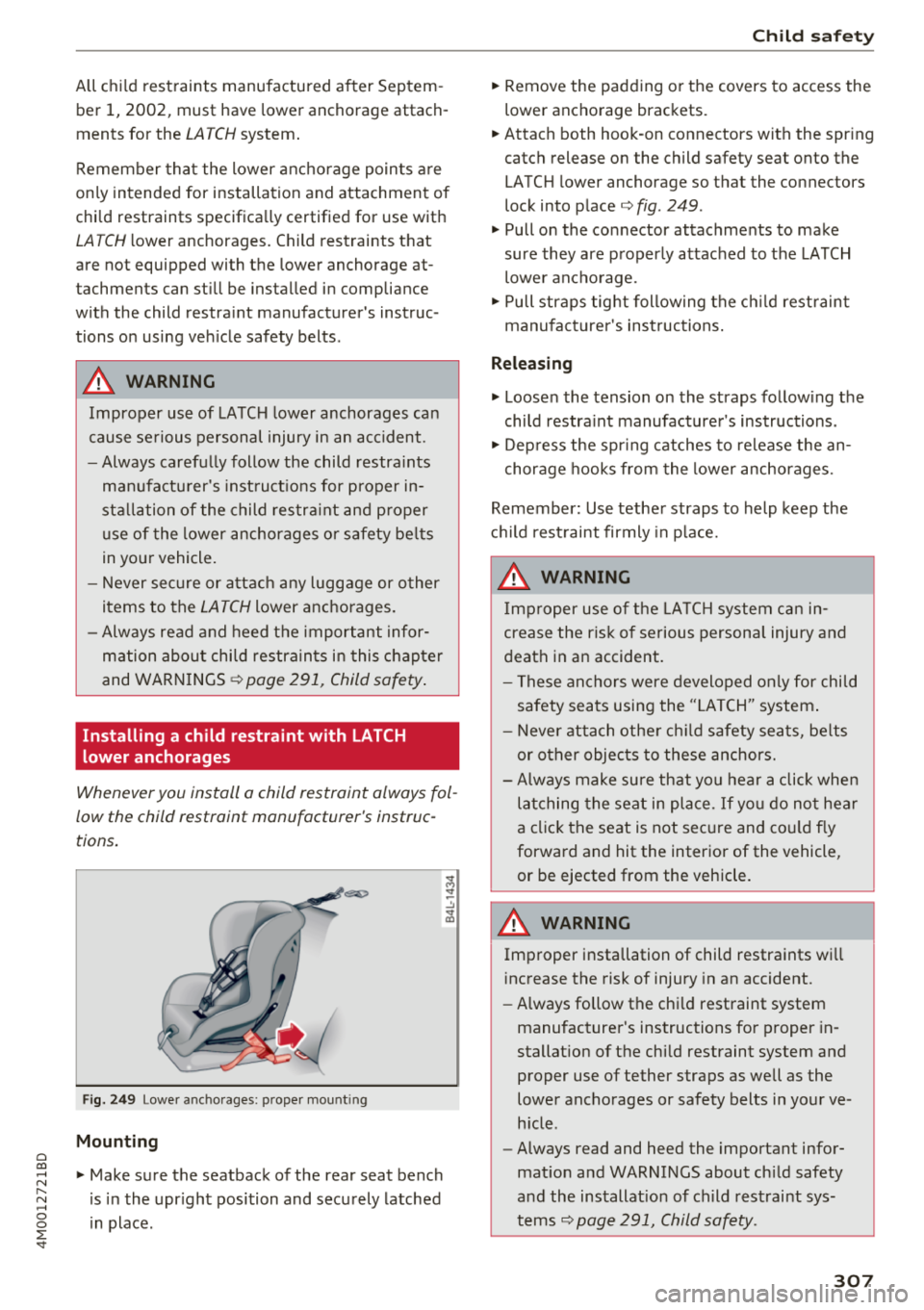
Fig . 2 49 Lower anchorage s: proper mo untin g
Mounting
"'Make sure the seatback of the rear seat bench
is in the upr ight position and secu rely latched
i n place .
Child saf ety
"' Remove the padding or t he covers to access the
lower anchorage brackets.
"' Attach both hook -on connectors with the spr ing
catch release on the child safety seat onto the
LATC H lower anchorage so that the con necta rs
lock into p lace ¢
fig. 249 .
"'Pull on the connector attachments to make
sure they are p roperly attached to the LATCH
lower ancho rage.
"' Pull straps tig ht following the ch ild rest raint
manufac turer 's ins tructions .
Releasing
"' Loose n the tension on the straps follow ing the
child restra int manufacture r's ins tructions .
"' Dep ress the spr ing catches to release the an
chor age hooks from the lower anchorages.
Remember: Use tethe r straps to help keep the
c hi ld rest raint firmly in p lace.
A WARNING
I mp roper use of t he LA TCH system ca n in
crease the ris k of se rious persona l injury a nd
death in an accident.
-
- T hese an cho rs were developed on ly for chi ld
safety sea ts using the " LAT CH" system .
- Neve r attach othe r child safety sea ts, be lts
or other objec ts to these anchors.
- Always make su re that yo u hear a click whe n
l a tc hing the seat in place. If yo u do no t hea r
a c lick the seat is not sec ure and co ul d fly
forwa rd and hit the interior of the vehicle,
or be ejected from the vehicle.
A WARNING ~ -
Improper insta llation of child restraints wi ll
i nc rease the risk of injury in an accident.
- Always fo llow the chi ld restraint system
manufacture r's instructions fo r proper in
stallat ion of the chi ld restraint system and
proper use of tether straps as well as the
lower anchorages or safety belts in yo ur ve
h icle .
- Always read and heed the important infor
mat io n and WARNINGS about ch ild safety
a nd the installat io n of ch ild rest rai nt sys
t ems¢
page 291, Child safety .
307
Page 310 of 398
Child safety
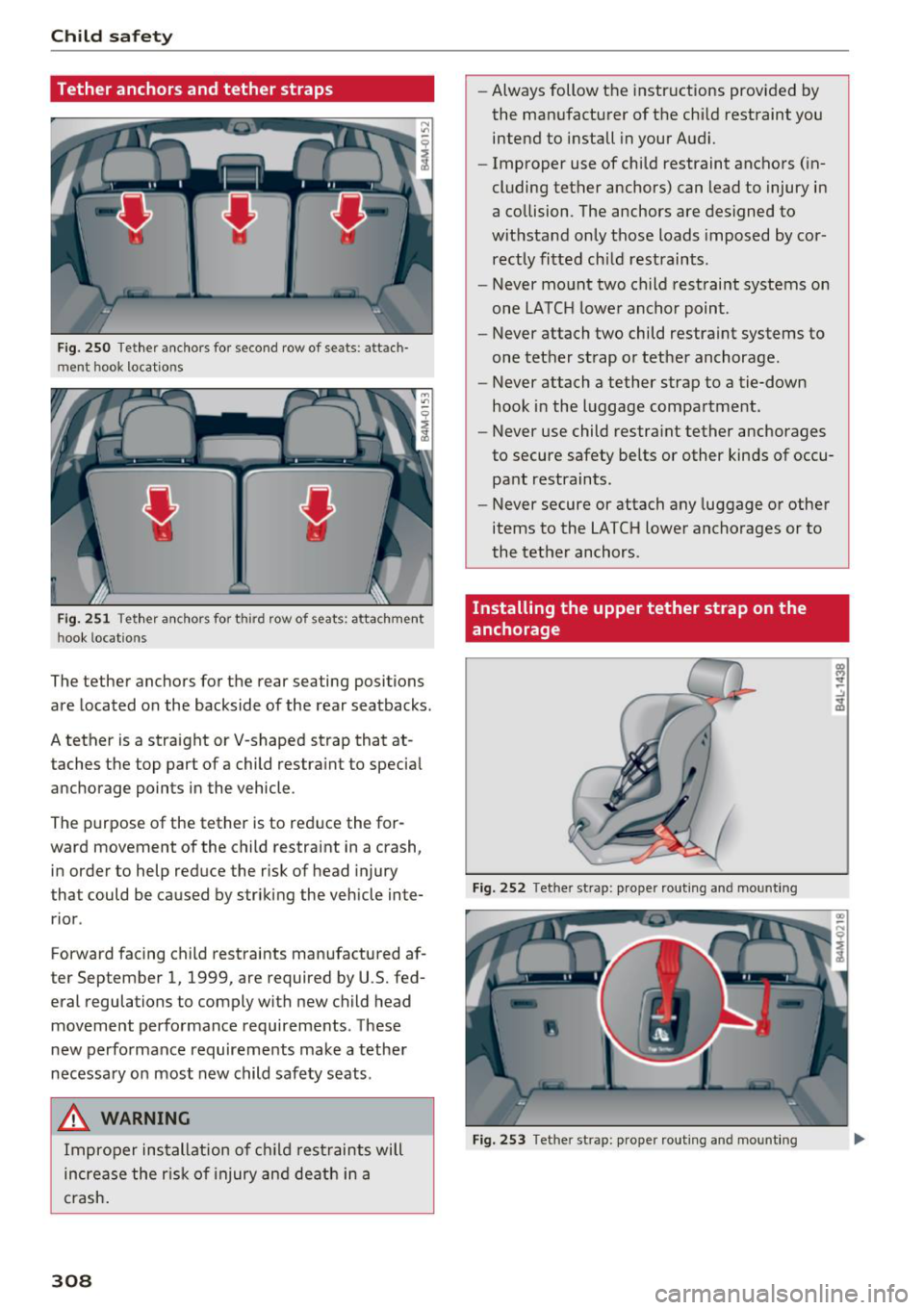
Tether anchors and tether straps
Fig. 250 Tether ancho rs for second row of seats: a tt a ch ·
m ent hook locatio ns
Fig. 251 Tether anchors for third row o f seats : atta chment
h ook locations
The tether anchors for the rear seating positions
are located on the backside of the rear seatbacks .
A tether is a straight or V-shaped strap that at
t aches the top part of a child restraint to special
anchorage points in the vehicle .
The purpose of the tether is to reduce the for
ward movement of the child restraint in a crash, in order to help reduce the risk of head injury
t ha t could be caused by striking the vehicle inte
rior .
Forward facing child restraints manufactured af
ter September 1, 1999, are required by U .S. fed
eral regulations to comply with new child head
movement performance requirements . These
new performance requirements make a tether
necessary on most new child safety seats .
_& WARNING
Improper installation of child restraints will
increase the r isk of injury and death in a
crash.
308
- Always follow the instructions provided by
the manufacturer of the child restraint you
intend to install in your Audi.
- Improper use of child restraint anchors (in
cluding tether anchors) can lead to injury in
a collision. The anchors are designed to
withstand only those loads imposed by cor rectly fitted child restraints.
- Never mount two child restraint systems on
one LATCH lower anchor point.
- Never attach two child restraint systems to
one tether strap or tether anchorage .
- Never attach a tether strap to a tie-down
hook in the luggage compartment .
- Never use child restraint tether anchorages
to secure safety belts or other kinds of occu pant restraints .
- Never secure or attach any luggage or other
items to the LATCH lower anchorages or to
the tether anchors .
Installing the upper tether strap on the
anchorage
Fig. 252 Tether st rap: p ro pe r rout ing a nd mo unting
Fig. 253 Tether st rap: pro per rout ing a nd mo unting
Page 311 of 398
Cl a:, ...... N
" N ...... 0
0
::r '
.,. Release o r deploy the tether st rap on the child
restraint according to the child restraint manu
facturer's instructions .
.,. Guide the upper tether strap
under the rear
head restraint and into the rear cargo area
(raise the head restraint if necessary). For chi ld
restra ints w ith V-tether straps, always make
sure that the head restraint guide rods do not
interfere with any part of the top tether strap.
.,. Slide the tether st rap hook over the anchor
bracket.
.,. Pull on t he tether strap hook so t hat the spr ing
catch of t he hook engages.
.,. Tighten the tether strap firmly fo llowing the
child restraint man ufacturer's instructions .
Releasing the tether strap
.,. Loosen the tens ion following the ch ild rest raint
manufacturer's instructions .
.,. Depress the spring catch on the hook and re
l ease it from the anchorage.
@ Note
If you leave the ch ild restrain t with t he tether
strap firm ly installed for severa l days, this
cou ld leave a mark on the upholstery on the
seat cush ion and backrest in the area where
the tet her strap was installed. The upholstery
wou ld also be permanently stretched around
the tether strap. This applies especially to
leather seats.
Using tether straps on rearward-facing
child restraints
Current ly, few rear -facing chi ld restraint systems
come with a tether. Please read and heed the
chi ld restraint system manufacturer's instruc
tions carefully to determine how to properly in
stall the tether.
A WARNING
A child in a rearward-faci ng chi ld safety sea t
installed o n the fro nt passenge r seat w ill be
ser ious ly injured and can be killed if the front
airbag inflates -even wi th an Advanced Air
bag System.
Ch ild saf ety
- The inflating airbag will hit the c hild safety
seat or infant carr ier with great force and
will smash the child safety seat and child
aga inst the backrest, center armrest, or
door .
- If you must install a rearward facing child
safety seat on the front passenger seat be
cause of exceptional circumstances and the
PASSENGER AIR BAG OFF~; light does not
come on and stay on, immedia tely insta ll
t he re ar-facing child safety se at in a rear
seating posi tion and have t he a irbag system
inspected by your Audi dea ler .
Additional information
Sources of information about child
restraints and their use
T he re a re a numbe r of sources of additional in
format ion abou t chi ld rest raint selection, instal
lation and use:
N HT SA advises that the best ch ild safety seat is
t h e one that fits yo ur child and fits in your veh i
cl e, and that you w ill u se cor rec tly and cons is
tent ly.
T ry befo re yo u buy!
U.S. Na tional Highw ay T raffi c Safety Admin is
tra tion
Tel.: 1-888-327-4236 ( TTY : 1-800-424-9153)
http:/ /www.nhtsa.gov
http://www. saferca r. gov
N ational SAFE KID S Camp aign
Tel.: (202) 662-0600
http:/ /www.safekids.org
Safet y Belt Saf e U.S.A .
Tel.: (800) 745-SAFE (English)
Tel.: (800) 747-SANO (Spanish)
http:/ /www.ca rseat.o rg
T ransport Canad a Information Centr e
Tel.: 1-800-333-0371 or call 1-613-998-8616 if
you are in the Ottawa area
http://www.tc.gc.ca/ eng/ roadsafety/men u. h tm
Audi Cu stom er Relations
Tel.: (800) 822-2834
309
Page 329 of 398
a co ...... N r--. N ...... 0
0
:E '
-If the vehicle will be p arked for long periods
of time, protect it against t he cold so that it
will not be destroyed by "freezing"
¢ page 327.
- There are electrical components under the
cargo floor behind a trim pane l that warm
up du ring operat ion. To reduce the r isk of
the components overheat ing, do not store
ob jects s uch as blankets u nder the ca rgo
floor. If they overheat, the components will
swi tch off tempo rar ily. Thi s wi ll be indicated
by a message in the ins trumen t clus ter, un
ti l the temperature returns to normal.
@,l For the sake of the environment
'8' B atteries cont ain poll uti ng substa nces s uch
a s s ulfu ric a cid and le ad. Contact an aut hor
ize d Au di dealer or a uthorized Aud i Service
Facility for more info rmation.
Vehicle battery
The term "vehicle battery" refers to the 12 Volt
battery in your vehicle.
Not running the vehicle for long periods of
time
If yo u do not dr ive you r vehicle for seve ral days or
weeks, e lectrical equipment is gradually sca led
back or switched off. This reduces ene rgy use and
ensu res the veh icle w ill be able to start after long
pe riods of time¢
page 147. Some convenience
functions, suc h as inter ior light ing or power seat
adjustment, may not be available under certa in
circumstances. These convenience funct ions w ill
be ava ilable again once you switc h the ign ition on
and start the engine.
Even when electrical equ ipment is switched off,
the equ ipment can still d rain the vehicle battery
if the vehicle is not drive n for long per iods of
time. Deep d rain ing results in a chemical reaction
that des troys the inside of the vehicle b attery.
The vehicle batte ry must be charged every mont h
to reduce the risk of this happening ¢
page 327.
Contact an author ized Audi dealer or authorized
Aud i Service Facility for more information.
Chec king and Filling
Winter operation
Co ld wea ther places higher dem ands on the vehi
cl e battery . This res ults in reduced s tarting ab ili
ty. Have the vehicle battery checked by an au
t h orized Audi dea le r or authorized Audi Service
Facility before the cold time of year.
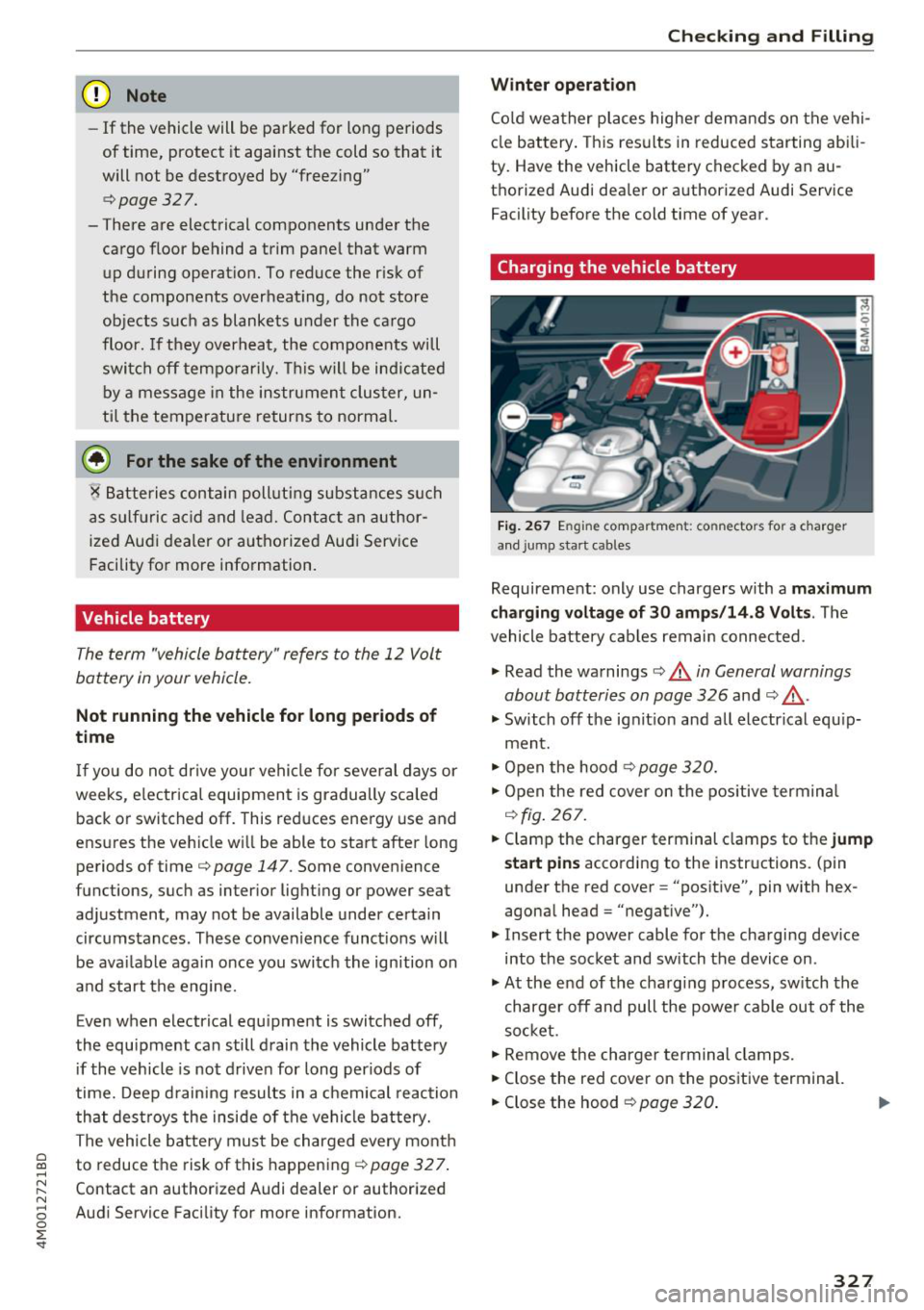
Charging the vehicle battery
Fi g. 2 67 En g in e compar tmen t: co nnecto rs fo r a c harger
and j ump start cab les
Requireme nt: only use chargers with a ma ximum
charging voltage of 30 amp s/14 .8 Volts .
The
vehicle battery cab les remain connec ted .
.,. Read the warnings ¢
A in General warnings
about batteries on page 326
and ¢ &_ .
.,. Switch off the ignit ion and all electrical equ ip
ment .
.,. Open the hood ¢
page 320.
.,. Open the red cover on the pos itive termina l
¢fig . 267.
.,. Clamp the charger terminal clamps to the jump
start pins
accord ing to the instructions. (pin
under the red cove r= "positive", pin with he x
agona l head= "negat ive").
.,. Insert t he power cable for t he charging dev ice
into the socket and switch the device on .
.,. At the end of the charg ing p rocess, sw itch the
charger off and pull the power cable out of the
so cket.
.,. Remove the ch arger termin al cl amps.
.,. Close the red cover on the positive termina l.
.,. Close the hood
¢ page 320 .
327
Page 335 of 398
0 a, .... N
" N .... 0
0
l: ..
Glossary of tire and loading
terminology
Accessory weight
means the combined weight (in
excess of those standard items
which may be replaced) of auto matic transmission, power steer
ing, power brakes, power win
dows, power seats, radio, and
heater, to the extent that these
items a re available as factory- in
stalled equipment (whether i n
stalled or not) .
Aspect ratio
means the ratio of the height to
the width of the tire in percent .
Numbers of 55 or lower indicate a
low s idewall for improved steer
ing response and better overall
handling on dry pavement.
Bead
means the part of the tire that is
made of steel wires, wrapped or
reinforced by ply cords and that is
shaped to fit the rim .
Bead separation
means a breakdown of the bond
between components in the bead .
Wheel s
Cord
means the strands forming the
plies in the tire .
Cold tire inflation pressure
means the tire pressure recom
mended by the vehicle manufac
turer for a tire of a designated
size that has not been driven for more than a couple of miles (kilo
meters) at low speeds in the
three hour period before the tire pressure is measured or adjusted .
Curb weight
means the weight of a motor ve
hicle with standard equipment in
cluding the maximum capacity of
fuel, oil , and coolant, air condi
tioning and additional weight of
optional eq uipment .
Extra load tire
means a tire designed to operate
at higher loads and at highe r in
flation pressures than the corre
sponding standard tire . Extra load
tires may be identified as "X L",
"xl", "EXTRA LOAD", or "RF" on
the sidewall. .,.
333
Page 336 of 398
Wheel s
Gross Axle Weight Rating
("GAWR ")
means the load -carrying capacity
of a single axle system, measured
at the tire -ground interfaces.
Gross Vehicle Weight Rating
(" GVWR ")
means the maximum total loaded
weight of the vehicle .
Groove
means the space between two ad
jacent tread ribs .
Load rating (code )
means the maximum load that a
tire is rated to carry for a given in
flation pressure. You may not find
this information on all tires be
cause it is not required by law .
Max imum load rating
means the load rating for a tire at
the maximum permissible infla
tion pressure for that tire.
Ma ximum loaded vehicle
weight
means the sum of:
(a) Curb weight
(b) Accessory weight
(c) Vehicle capacity weight, and
(d) Production options weight
33 4
Maximum (permissible)
inflation pressu re
means the maximum cold infla
tion pressure to which a t ire may
be inflated. A lso called "maxi
mum inflat ion pressure."
Normal occupant weight
means 150 lbs. (68 kilograms)
times the number of occupants seated in the vehicle up to the to
tal seating capacity of your vehi
cle.
Occupant distribution
means distribution of occupants
in a vehicle.
Outer diameter
means the overall diameter of an
inflated new tire.
Overall width
means the linear distance be
tween the exteriors o f the side
walls of an inflated tire , includ ing
elevations due to labeling, deco rations, or protective bands or
ribs .
Ply
means a layer of rubber-coated
parallel cords .
Page 337 of 398
0 a, .... N
" N .... 0
0
l: ..
Production options weight
means the combined weight of
those installed regular production
options weighing over 5 lbs .
(2.3 kg) in excess of those stand
ard items which they replace, not
previously considered in curb
weight or accessory we ight, in
c luding heavy duty brakes, ride
levelers, roof rack, heavy duty
battery, and special trim .
Radial ply tire
means a pneumatic tire in which
the ply cords that extend to the beads are laid at substantially
90 degrees to the centerline of
the tread .
Recommended inflation
pressure
see ¢ page 333, Cold tire infla
tion pressure .
Reinforced tire
means a tire designed to operate
at higher loads and at h igher in
flat ion pressures than the corre
sponding standard tire. Rein
forced t ires may be identified as
"XL " "xl" "EXT RA LOA D" or "RF" , , ,
on the sidewall.
Wheels
Rim
means a metal support for a tire
or a tire and tube assembly upon
which the tire beads are seated .
Rim diameter
means nominal diameter of the
bead seat. If you change your
whee l size, you will have to pur
chase new tires to match the new
rim diameter .
Rim size designation
means rim diameter and width .
Rim width
means nominal distance between
rim flanges.
Sidewall
means that portion of a ti re be
tween the tread and bead.
Speed rating (letter code)
means the speed at which a tire is
designed to be driven for extend
ed periods of time . The rat ings
range from
93 mph (150 km/h)
to
186 mph (298 km/h) ¢ table
on page 331.
You may no t find
this info rmat ion on all tires be
cause it is not required by law.
T he speed rating letter code,
where applicable, is molded on
the tire sidewall and indicates t he
11>
335
Page 339 of 398
0 a, .... N
" N .... 0
0
l: ..
by the tire manufacturer. This in
formation is used to contact con sumers if a tire defect requires a
recall.
Vehicle capacity weight
means the rated cargo and lug
gage load plus 150 lbs . (68 kilo
grams) times the vehicle's desig
nated seating capacity.
Vehicle ma ximum load on the
tire
means that load on an indiv idual
tire that is determined by distrib
uting to each axle its share of the
maximum loaded vehicle weight
and dividing by two.
Vehicle normal load on the tire
means that load on an indiv idual
tire that is determined by distrib uting to each axle its share of the
curb weight, accessory weight,
and normal occupant weight (dis
tributed in accordance with¢
ta
ble on page 342)
and dividing by
two .
Occupant loading and distr i
bution for vehicle normal load
for various designated seating
capacities
Refer to the tire inflation pres
s u re label
¢page 340, fig . 272
Wheels
for the n umber of seating posi
tions . Refer to the table ¢
table
on page 34 2
for the number of
people tha t correspond to the ve
hicle normal load.
New tires or wheels
Audi recommends having all work
on tires o r wheels performed by
an authorized Audi dealer or au
thorized Audi Service Facility.
These facilities have the proper
knowle dge and are eq uipped with
the requ ired too ls and replace
ment parts.
.,. New tires do not yet have the
optimum g ripping properties .
Drive carefully and at mode rate
speeds for the first 350 miles
(500 km) with new tires.
.,. Only use tires with the same de
s ign , size (rolling circumfer
ence), and as close to the same
tread pattern as possible on all
four whee ls .
.,. Do not replace tires indiv idually .
At least replace both tires on the
same ax le at the same time .
.,. Audi recommends that you use
A udi Original Tires . If you would
like to use different tires , please
note that the tires may perform ...
337
Page 345 of 398
0 a, .... N
" N .... 0
0
l: ..
& WARNIN G
Please note the important safe
ty precautions regarding tire
pressure
c:::> page 340 and load
limits
c:::>poge 343.
Tires and vehicle load limits
There are limits to the amount of
load or weight that any vehicle
and any tire can carry. A vehicle
that is overloaded will not handle
well and is more difficult to stop.
Overloading can not only lead to
loss of vehicle control, but can al
so damage important parts of the
vehicle and can lead to sudden
tire failure, including a blowout
and sudden deflation that can
cause the vehicle to crash .
Your safety and that of your pas sengers also depends on making
sure that load limits are not ex
ceeded . Veh icle load includes ev
erybody and everything in and on
the vehicle . These load limits are
technically referred to as the vehi
cle's
Gross Vehicle Weight Rat
ing ("GVWR").
The "GVWR" includes the weight
of the basic vehicle, all factory in
stalled accessories, a full tank of
fuel, oil, coolant and other fluids
Wheels
plus maximum load . The maxi
mum load includes the number of
passengers that the vehicle is in
tended to carry ("seating capaci
ty ") with an assumed weight of
150 lbs. (68 kg) for each passen
ger at a designated seating posi
tion and the total weight of any
luggage in the vehicle . If you tow
a trailer, the weight of the trailer
hitch and the tongue weight of
the loaded trailer must be includ ed as part of the vehicle load .
The
Gross A xle Weight Rating
(" GAWR ") is the maximum load
that can be applied at each of the
vehicle's two axles.
T he fact that there is an upper
limit to your vehicle 's Gross Vehi
cle Weight Rating means that the
total weight of whatever is being
carried in the vehicle (including
the weight of a trailer hitch and
the tongue weight of the loaded
trai ler) is lim ited. The more pas
sengers in the vehicle or passen
gers who are heavier than the
standard weights assumed mean
that less weight can be carried as luggage.
The Gross Vehicle Weight Rating and the Gross Axle Weight Rating .,.
34 3
Page 348 of 398
Wheels
tires cause less road noise, tire wear and fuel
consumption.
(D Tips
You can also use all season tires instead of
winter tires. Please note that in some coun
tries where winter tires are required, only
winter tires with the
& symbol may be per
mitted.
Snow chains
Snow chains not only improve the driving in win
ter road conditions, but also the braking .
~ Only install snow chains on the front wheels.
~ Check and correct the seating of the snow
chains after driving a few feet, if necessary . Fol
low the instructions from the manufacturer.
~ Note the maximum speed of 30 mph (SO km/
h). Note the local regulations.
Use of snow chains is only permitted with certain
rim/tire combinations due to technical reasons.
Check with an authorized Audi dealer or author
ized Audi Service Facility to see if you may use
snow chains.
Use
fine-mesh snow chains . They must not add
more than 0 .53 in (13.5 mm) in height, including
the chain lock.
You must remove the snow chains on roads with
out snow. Otherwise, you could impair driving
ability and damage the tires.
.&_ WARNING
Using incorrect snow chains or installing snow
chains incorrectly can result in loss of vehicle
control, which increases the risk of an acci
dent.
(LlJ) Note
- Snow chains can damage the rims/wheel
covers* if the chains come into direct con
tact with them. Remove the wheel covers*
first. Use coated snow chains.
- Do not install and use snow chains if there is
a malfunction in the air suspension*, be
cause the vehicle height will be
very low. If
346
you drive with snow chains anyway, the
wheel housings and other vehicle compo nents can be severely damaged.
(D Tips
When using snow chains, it may be useful to
switch the offroad mode on
r=> page 143.
Low-profile tires
Applies to: vehicles with low-profile tires
Compared to other tire/rim combinations, low
profile tires offer a wider tread surface and a
larger rim diameter with shorter tire sidewalls.
This results in an agile driving style. However, it
may reduce the level of comfort and increase
road noise when driving on roads in poor condi
tion.
Low -profile tires can become damaged more
quickly than standard tires when driving
over
large bumps, potholes, manhole covers, and
curbs . Therefore, it is particularly important to
maintain the correct tire pressure
r=.> page 340.
To reduce the risk of damage to the tires and
rims, drive
very carefully on poor roads.
Check your wheels regularly every 2,000 mi
(3,000 km) for damage . For example, check for
bulges/cracks on the tires or deformations/
cracks on the rims.
After a heavy impact or damage, have the tires
and rims inspected or replaced immediately by
an authorized Audi dealer or authorized Audi
Service Facility.
Low-profile tires can wear out faster than stand
ard tires .
Uniform tire quality grading
- Tread wear
- Traction AA ABC
- Temperature ABC
Quality grades can be found where applicable on
the tire side wall between tread shoulder and maximum section width
r=.> page 331, fig. 269.