fuel AUDI Q7 2018 Owner´s Manual
[x] Cancel search | Manufacturer: AUDI, Model Year: 2018, Model line: Q7, Model: AUDI Q7 2018Pages: 398, PDF Size: 185.58 MB
Page 6 of 398
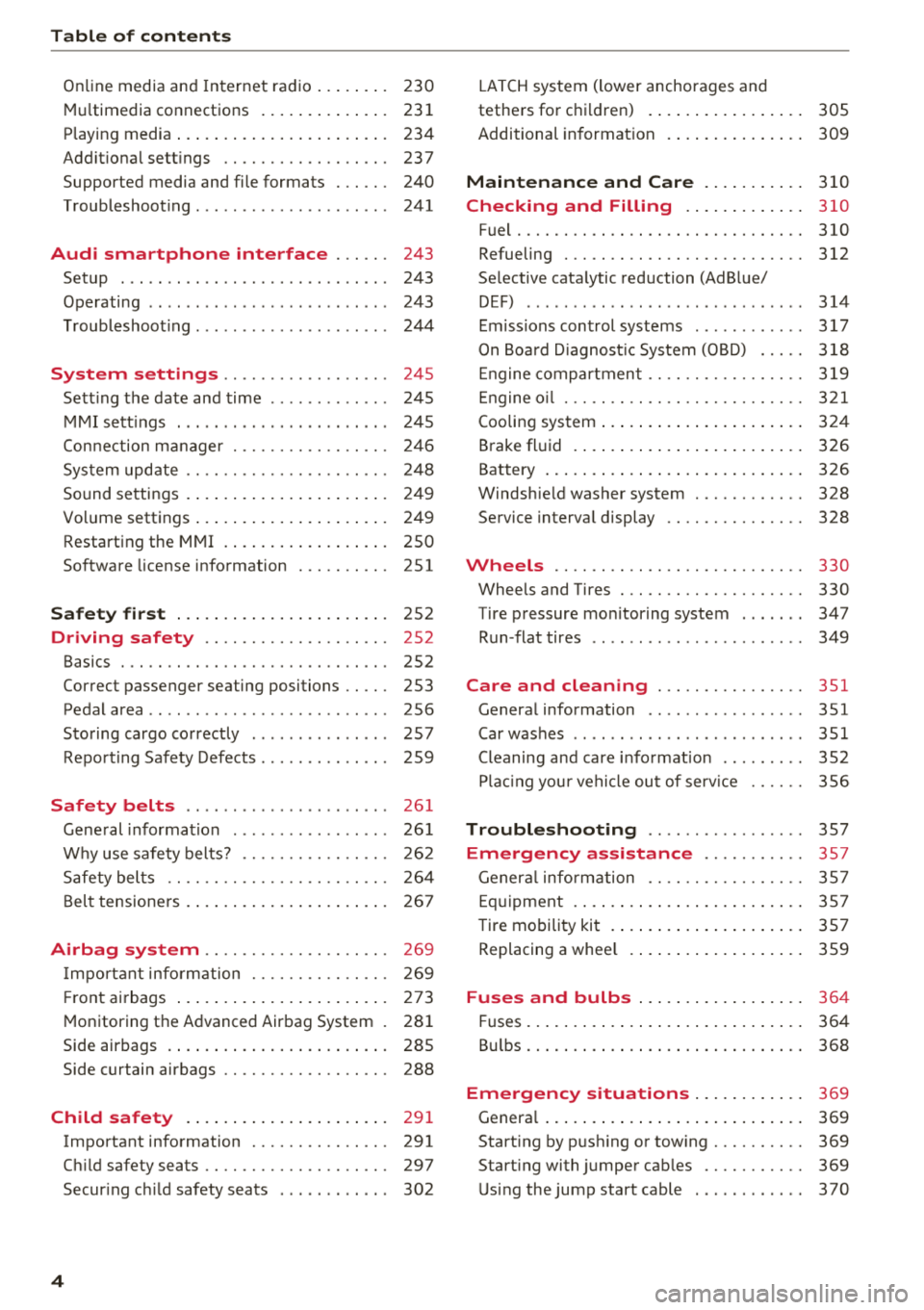
Table of contents
On line media and In ternet radio . . . . . . . . 230
Mul timedia connections .... ... .. .. ... 231
P lay ing media . . . . . . . . . . . . . . . . . . . . . . . 234
Addit ional se ttings ........... .... .. . 237
Supported media and fi le formats . . . . . . 240
Troubleshoot ing . . . . . . . . . . . . . . . . . . . . . 241
Audi smartphone interface . . . . . . 243
Setup . .. .. .. .. ... .. ..... ... .. .. .. . 243
Operating . . . . . . . . . . . . . . . . . . . . . . . . . . 243
T roubleshoot ing . . . . . . . . . . . . . . . . . . . . . 24 4
System settings . . . . . . . . . . . . . . . . . . 245
Sett ing t he date and time . . . . . . . . . . . . . 245
M MI sett ings . . . . . . . . . . . . . . . . . . . . . . . 245
Con nection ma nager . . . . . . . . . . . . . . . . . 246
Sys tem update . . . . . . . . . . . . . . . . . . . . . . 248
So und setti ngs . . . . . . . . . . . . . . . . . . . . . . 24 9
Volume settings . . . . . . . . . . . . . . . . . . . . . 249
Restarting the M MI . . . . . . . . . . . . . . . . . . 250
Software license information 251
Safety first . . . . . . . . . . . . . . . . . . . . . . . 252
Driving safety . . . . . . . . . . . . . . . . . . . . 252
Basics . . . . . . . . . . . . . . . . . . . . . . . . . . . . . 252
Correct passenger seating positions . . . . . 253
Pedal area . . . . . . . . . . . . . . . . . . . . . . . . . . 256
Storing cargo co rrectly . . . . . . . . . . . . . . . 257
Repo rt ing Safety Defects . . . . . . . . . . . . . . 259
Safety belts . . . . . . . . . . . . . . . . . . . . . . 26 1
Gene ral information . . . . . . . . . . . . . . . . . 26 1
W hy use safety belts? . . . . . . . . . . . . . . . . 262
Safety bel ts . . . . . . . . . . . . . . . . . . . . . . . . 264
B el t tensione rs . . . . . . . . . . . . . . . . . . . . . . 267
Airbag system . . . . . . . . . . . . . . . . . . . . 269
I mpo rtant info rm ation . . . . . . . . . . . . . . . 269
Fr ont airbags . . . . . . . . . . . . . . . . . . . . . . . 273
M onitoring the Advanced Airbag System . 28 1
Side airbags . . . . . . . . . . . . . . . . . . . . . . . . 285
Side curtain airbags . . . . . . . . . . . . . . . . . . 288
Child safety . . . . . . . . . . . . . . . . . . . . . . 29 1
Important information . . . . . . . . . . . . . . . 291
Ch ild safety seats . . . . . . . . . . . . . . . . . . . . 297
Secur ing ch ild safety seats . . . . . . . . . . . . 302
4
LATCH sys tem (lower anchorages and
tethers for c hild ren) . . . . . . . . . . . . . . . . . 305
Additional in format ion . . . . . . . . . . . . . . . 309
Maintenance and Care . . . . . . . . . . . 310
Checking and Filling . . . . . . . . . . . . . 310
Fuel...... .. .. .. .. .. ............. .. 310
Refueling . . . . . . . . . . . . . . . . . . . . . . . . . . 312
Se lective catalytic reduction (AdBlue/
DEF) . . . . . . . . . . . . . . . . . . . . . . . . . . . . . . 314
Emiss ions control systems . . . . . . . . . . . . 317
On Boa rd D iagnost ic System (OBD) . . . . . 318
En gine compartment .. ............. .. 319
En gine o il . . . . . . . . . . . . . . . . . . . . . . . . . . 32 1
Cooli ng system . . . . . . . . . . . . . . . . . . . . . . 3 24
Brake fluid . . . . . . . . . . . . . . . . . . . . . . . . . 326
Battery . . . . . . . . . . . . . . . . . . . . . . . . . . . . 326
Windshie ld washer system . . . . . . . . . . . . 328
Service interva l display
328
Wheels .... .. .. .. .. ............. .. 330
Wheels and Tires . . . . . . . . . . . . . . . . . . . . 330
Tire pressure mo nitor ing system . . . . . . . 347
Run -flat tires . . . . . . . . . . . . . . . . . . . . . . . 349
Care and cleaning . . . . . . . . . . . . . . . . 351
General information . . . . . . . . . . . . . . . . . 351
Car washes . . . . . . . . . . . . . . . . . . . . . . . . . 351
Cleaning and care info rmation . . . . . . . . . 352
P lac ing you r vehicle ou t of serv ice 356
Troubleshooting . . . . . . . . . . . . . . . . . 357
Emergency assistance . . . . . . . . . . . 3 57
Gener al info rmation . . . . . . . . . . . . . . . . . 357
Eq uipment . . . . . . . . . . . . . . . . . . . . . . . . . 3 57
T ire mobility kit . . . . . . . . . . . . . . . . . . . . . 3 57
Replacing a whee l . . . . . . . . . . . . . . . . . . . 359
Fuses and bulbs . . . . . . . . . . . . . . . . . . 3 64
Fuses.. ... .. .. .... .. ... .. ..... ... .. 364
Bu lbs. . . . . . . . . . . . . . . . . . . . . . . . . . . . . . 368
Emergency situations . . . . . . . . . . . . 3 69
Genera l . . . . . . . . . . . . . . . . . . . . . . . . . . . . 369
Start ing by push ing or tow ing . . . . . . . . . . 369
Start ing with jumper cables . . . . . . . . . . . 369
Usingthejumpstartcable . ...... ... .. 370
Page 12 of 398
Cockpit overview
Instrument cluster
Instrument cluster overview
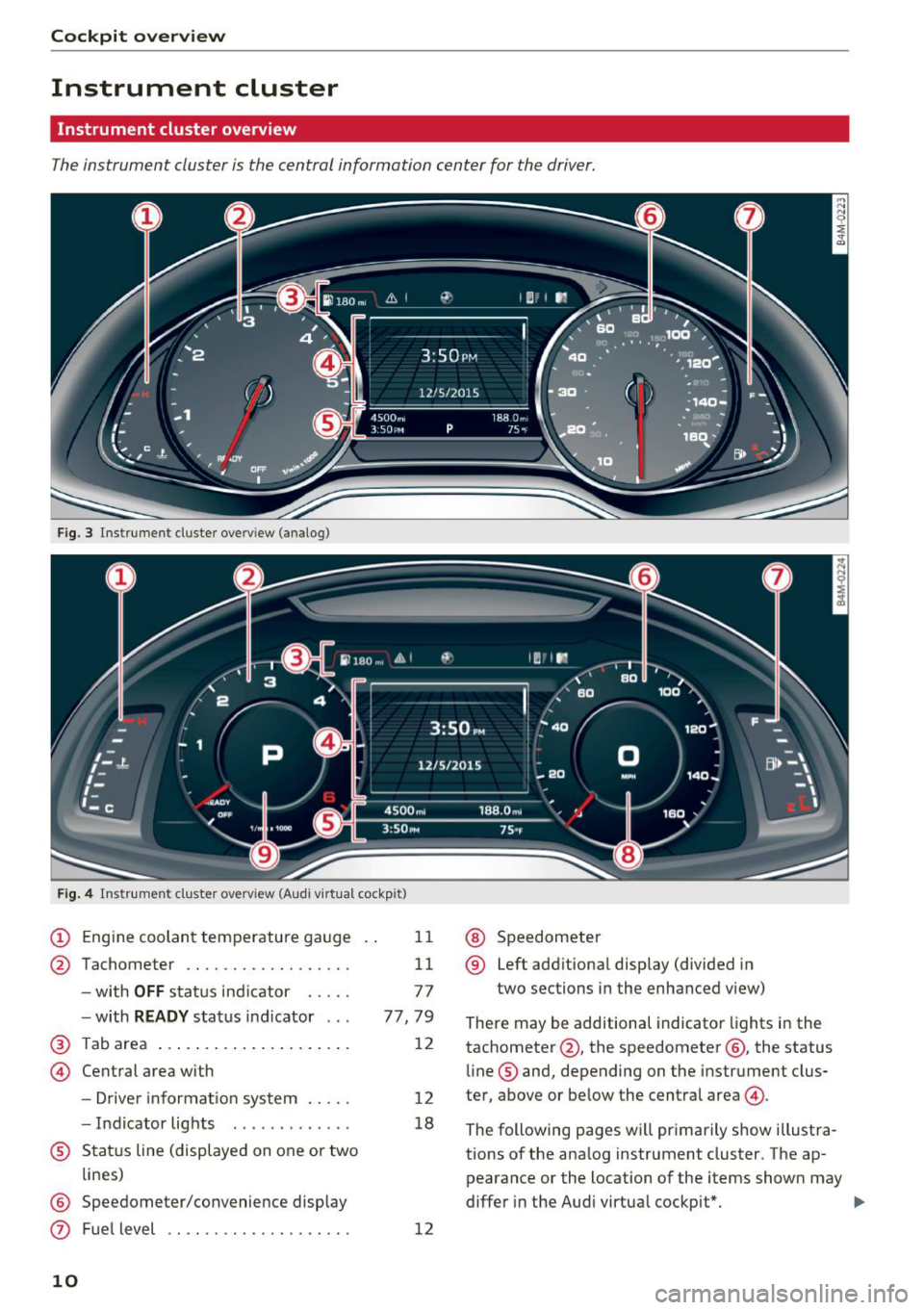
The instrument cluster is the central information center for the driver.
Fig. 3 Instrument cl uster overv iew (analog)
F ig . 4 Instrument cluster overv iew (Audi virtual cockpit )
(D Engine coolant temperature gauge
@ Tachometer ................. .
- with
OFF status indicator .... .
- with
READY status indicator .. .
@ Tab area .... ... ... ....... ... .
@ Central area with
- Driver informat ion system .. .. .
- Indicator lights ........... . .
® Status line (displayed on one or two
lines)
@ Speedometer/convenience display
0 Fuel level
10
11
11
77
77, 79
12
12
18
12
@ Speedometer
® Left additional display (divided in
two sections in the enhanced view)
There may be additional indicator lights in the
tachometer @, the speedometer @, the status
line ® and, depending on the instrument clus
ter, above or below the central area@.
The following pages will primarily show illustra
tions of the analog instrument cluster. The ap pearance or the location of the items shown may
differ in the Audi virtual cockpit*. ...,
Page 14 of 398
Cockpit overv iew
the red zone beg ins varies depending on the
engine.
@ For the sake of the environment
Upshifting early helps you to save fuel and re
duces operating noise.
© Tips
Depending on t he e ngine : the engine speed
may be lim ited when the engine is cold -the
full engine ou tput wi ll not be avai lable . When
the engine is at operating temperat ure, the
red area in the tachomete r moves to a h igher
RPM range.
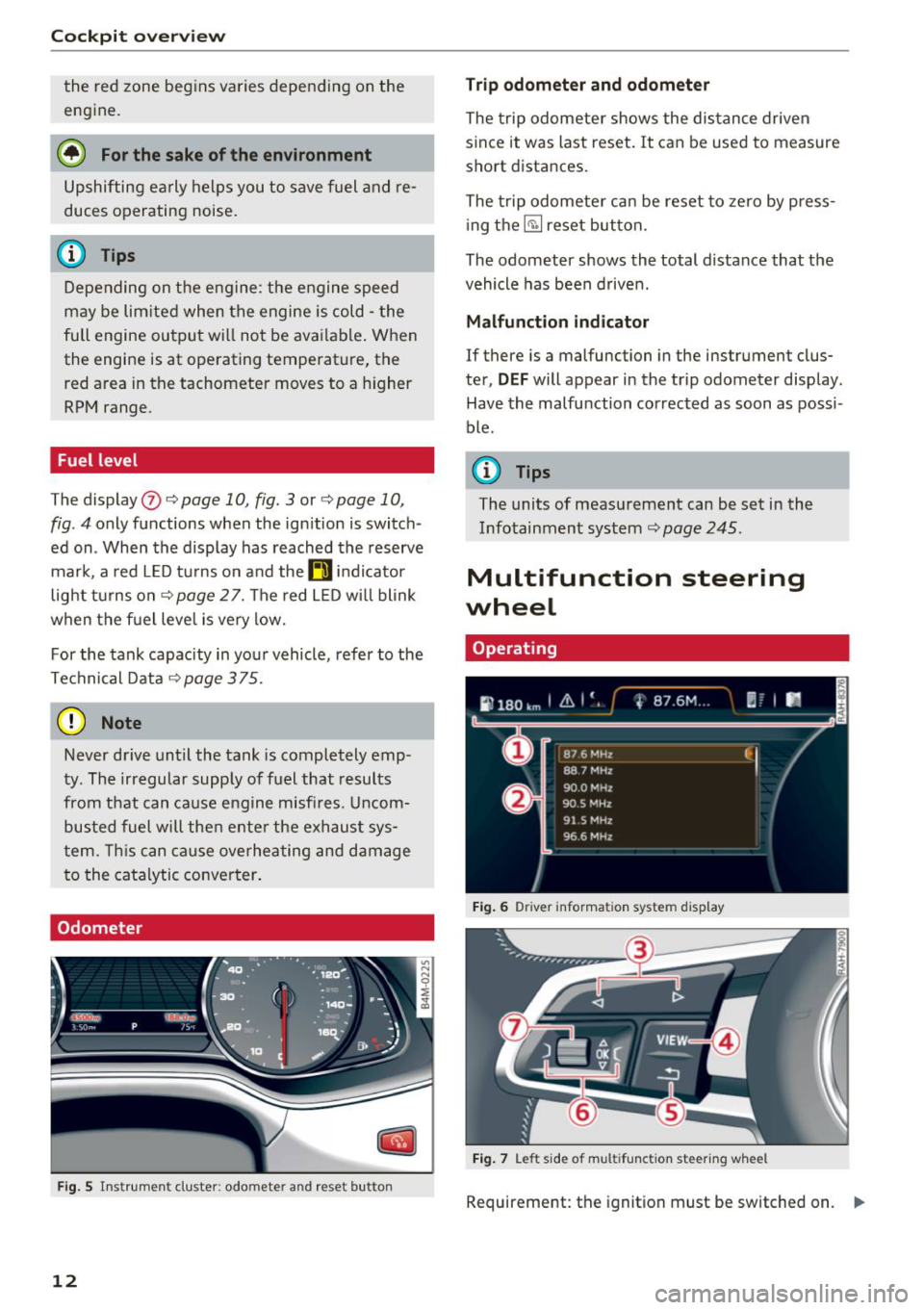
Fuel level
The display (J) ¢ page 10 , fig. 3 or ¢ page 10,
fig . 4 only functions when the ign ition is switch
ed on . When the display has reached the reserve
mark, a red L ED t urns on a nd the
tD in dicator
light turns on ¢
page 27. The red L ED w ill blink
when the f uel leve l is very low.
For the tank capac ity in you r vehicle, refer to the
Technical Data
r=v page 375.
(D Note
Never d rive until the tank is completely emp
ty . The irregular supp ly of f uel that results
from that can ca use engine misfi res . Uncom
busted fuel will the n ente r the exhaust sys
t em. This can ca use overheating and damage
t o the cata lytic conver ter.
Odometer
F ig . 5 In st ru m ent cluster: odometer a nd re se t bu tton
12
Tr ip odometer and odometer
The trip odometer shows the dis tan ce driven
s ince it was last reset. It can be used to measure
short d istances.
The trip odometer ca n be reset to zero by press
i ng th e ~ reset but ton.
The odometer shows the total distance that the
vehicle has been drive n.
Malfunction indicator
If there is a malfunction in the instrument clus
ter,
DEF will appear in the trip odometer display.
Have the malfu nction corrected as soon as possi
ble .
(D Tips
The units of measu rement can be set in the
Infotainment system~
page 245.
Multifunction steering
wheel
Operating
Fi g. 6 D river informa tion sys te m disp lay
Fi g. 7 L eft sid e of m ultifun ction steer ing wh eel
Requirement: th e ignition must be switched on. .,.
Page 18 of 398
Cockpit overview
On-board computer
F ig. 12 Instrument cluste r: fuel cons umptio n display
Resetting values to zero
Requirement: the Fuel consumption , Short-term
memory or Long-term memory
display must be
selected .
.. To reset the values in the respect ive memory to
z ero, press and hold the left thumbwheel on
the multifunction steering wheel for one sec
ond . Or
.. On the multifunction steer ing whee l, select :
the right control button
> Reset values.
In the tr ip computer, you can call up the follow
ing d isplays one after the other by turning the
left thumbwheel on the multifunction steering
wheel.
- Time and date¢
page 245
- Digital speedometer*
-Average consumption
-AdBl ue range*
¢ page 314
-Short-term memory overview
- Long-term memo ry ove rview
- Energy consumers*
¢page 16
-Driver assistance* c::> page 102
- Traffic s ign recognition* ¢ page 97
The short -term memory collects driving informa
tion from the t ime the ignition is sw itched on un
til it is switched off . If you continue driving with
in two hours after switching the ignition off, the
new values are included when calculating the cur
rent tr ip informat io n.
Unlike the short-t erm memory, the long -term
memory is not erased automat ica lly . You can se
lect the time period for evaluating trip informa
tion you rself .
16
Fuel consumption
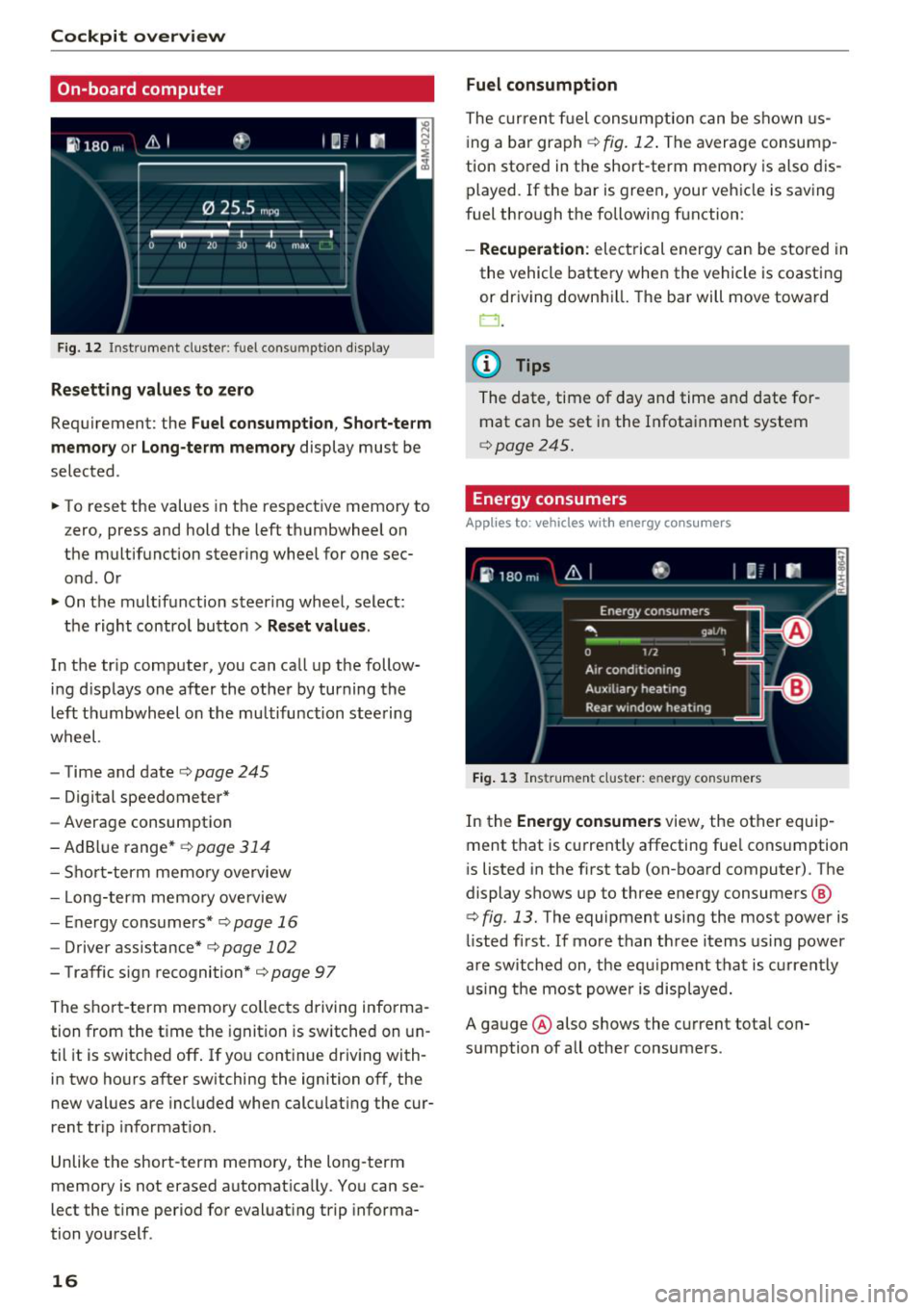
The current fuel consumption can be shown us
i ng a bar graph ¢
fig. 12. The average consump
tion stored in the short-term memory is also dis
played. If the bar is green, your vehicle is saving
fuel through the following function:
- Recuperation : electrical energy can be stored i n
the vehicle battery when the vehicle is coasting
or driving down hill. The bar will move toward
0.
@ Tips
The date, time of day and time and date for
mat can be set in the Infota inment system
¢page 245.
Energy consumers
App lies to : vehicles wit h energy co nsum ers
Fig. 13 Ins trumen t cluster: en ergy cons umers
In the Energy consumers view, the other equip
ment that is current ly affecting fue l consumption
i s listed in the first tab (on-board computer). The
display shows up to three energy consumers @
¢ fig. 13. The equipment using the most power is
li sted first . If mo re than three items using power
are switched on, the equipment that is currently
u sin g the most power is displayed.
A gauge @ also shows the current total con
sumption of all othe r consumers .
Page 28 of 398

Cockpit overview
A WARNING
Have the safety systems inspected immedi
ately. Otherwise, there is a risk that the sys
tems may not activate during a collision,
which increases the risk of serious injury or
death.
( CD ) Brake system
[I] Brakes overheating. Please shift to D
-
There was a heavy load on the brakes. Place the
selector lever in the "D/S" position in order to use
the engine braking effect and reduce the load on
the brakes.
~t~J/(O : Brake pads
II (USA models)/EiJ (Canada models) Brake
pads: wear limit reached. You can continue driv
ing. Please contact Service
The brake pads are worn .
Drive to an authorized Audi dealer or authorized
Audi Service Facility as soon as possible to have
the malfunction corrected.
~ Engine control
II Drive system: malfunction! Please contact
Service
There is an engine control malfunction.
Drive slowly to an authorized Audi dealer or au
thorized Audi Service Facility to have the engine
checked .
W Engine control (diesel engine)
Applies to: vehicles with diesel engines
The engine is preheating if the II indicator light
turns on when the ignition is switched on.
If the indicator light does not turn on or blinks
while driving, there is an engine control malfunc
tion.
Immediately drive slowly to an authorized Audi
dealer or authorized Audi Service Facility to have
the malfunction corrected.
26
!?i Engine speed limitation
(II Maximum engine speed: XXXX rpm
The engine speed is automatically limited to the
speed displayed in the instrument cluster. This
protects the engine from overheating.
The engine speed limitation deactivates once the
engine is no longer in the critical temperature
range and you have released the accelerator ped
al once .
If the engine speed limitation was activated by
an engine control malfunction, the
II indicator
light also turns on . Make sure the engine speed
does not go above the speed displayed, for exam
ple when downshifting . Drive to an authorized
Audi dealer or authorized Audi Service Facility im
mediately to have the malfunction corrected.
(D Tips
Depending on the engine: the engine speed
may be limited when the engine is cold -the
full engine output will not be available. When
the engine is at operating temperature, the
red area in the tachometer moves to a higher
RPM range.
~ ... Engine oil sensor
• Oil level system: malfunction! Please con
tact Service
The sensor to check the engine oil level has
failed . Drive to an authorized Audi dealer or au
thorized Audi Service Facility immediately to have
the malfunction corrected.
• Oil level sensor: oil change necessary. Please
contact Service
Fuel has entered the engine oil as a result of fre
quent short drives. Avoid high engine speeds, full
acceleration and heavy engine loads. Drive to an
authorized Audi dealer or authorized Audi Service
Facility immediately to have the oil changed.
• Oil pressure sensor: malfunction! Please
contact Service
There is a malfunction in the oil pressure sensor.
Drive to an authorized Audi dealer or authorized .,.
Page 29 of 398

Cl a:, ......
Audi Service Faci lity immediately to have the
malfunction corrected.
f Engine warm-up request
n Plea se drive to warm up eng in e
Fu el has en tered the eng ine oi l, ei ther from low
outside temperat ures or freq uent short drives.
Drive unti l the engine is warm so that t he fue l in
the eng ine oi l will evaporate. Avoid high engine
speeds, fu ll acce lerating and heavy eng ine loads
when doing this.
Bu Tank system
11D Plea se r efuel
If the indicator lig ht turns on for the first time
and the message appea rs, there are about 2.6
gallons (10 liters) of fue l left in the tank .
liJl Please refuel immediately
If t he in dicator lig ht tu rns on the message ap
pears, t he f ue l tank is almost empty. Re fuel t he
veh icle immediate ly.
11D Tank sy ste m : malfun ction! Please conta ct
Service
There is a malfunction in the fue l tank system .
Drive to an authori zed Aud i de aler or aut hori zed
Aud i Service Faci lity immediately to have the
malfunct ion corrected .
(D Tips
For more information on fueling, see
¢page 312.
~ Washer fluid level
1:2 Plea se add washer fluid
F ill the washer f luid for the w indshield washer
system and the headlight washer system* when
the ign ition is switched off¢
page 328 .
,s;::>, Windshield wipers
~ f·-P Windshield wipers: malfunc tion! Please con -,.....
g tact Service
::r '
The re is a ma lfunction w ith the windshield wip
ers.
Dr ive to an author ized A udi dealer or au tho riz ed
A udi Se rvice Faci lity immed iate ly to have the
malfunction corrected.
d Driver 's door
II Dri ver 's door : malfunction! Shift to P before
leaving vehicle. See owner's manual
T he re is a ma lfunction in the driver 's doo r. Se lect
the "P " selector lever pos ition to secure the vehi
cle.
Drive to an au thor ized A udi dealer or au tho riz ed
A udi Service Facility immed iate ly to have the
malfunction corrected.
· ;<;X · Bulb failure indicator
If the II ind icator light turns on, a bulb has
failed. The message indicates the location of the
bulb. Replace the bulb immediately .
Vehicle lights: malfunction! Please contact
Service
The re is a m alfu nct ion in the headlights o r the
li ght sw itch . Drive to an authorized Audi dealer or
a uthorized Audi Service Facility immediately to
have the malfunction corrected.
A WARNING "---
- Light bulbs a re under p ressure and can ex
p lode when bulbs are replaced, wh ich in
creases the risk of injury .
- W ith HID headlights (xenon headlights), the
h igh-vo ltage component must be handled
correct ly . Otherwise, there is a risk of fatal
in ju ry .
§.0 Dynamic headlight range control
II Headlight range control : malfunction! S ee
owner' s manual
There is a ma lfunction in the headlight range
contro l system, which may cause glare for other
drive rs . .,.
27
Page 67 of 398
Cl a:, ...... N
" N ...... 0
0
::r '
current conditions.
@ Note
Make sure that t he luggage compartment lid
and the panorama glass roof * do not come in
to contact with objects on the roof when they
are open.
@ For the sake of the environment
Your vehicle wi ll use more fuel due to the in
creased wind resistance . So remove the roof
rack after using it .
@ Tips
When insta lling roof rack systems on the roof
rail, the ESC uses sensors to adapt itse lf to a
different center of grav ity.
Seat s and sto rag e
65
Page 68 of 398
Warm and cold
Warm and cold
Climate control system
Description
A pp lies to: ve hicles w ith 3 -zo ne del uxe automatic c limate
co ntrol or 4-zo ne de luxe au tomatic cl imate co ntrol
The climate control system warms, cools and re
moves humidity from the air in the vehicle interi
or.
It is the most effective when the windows and
sunroof* are closed . If there is a bu ild-up of heat
inside the vehicle, ventilat ion can he lp to speed
up the cooling process.
In all heating mode functions except for
defrost,
the blower on ly switches to a h igher speed once
the engine coolant has reached a suffic ient tem
perature.
Pollut ant filt er
The pollutant filter removes pollutants such as
dust and pollen from the a ir .
K ey recognit ion
The climate control settings are automatically
stored and assigned to the remote control key
that is in use .
66
@ For the sake of the environment
- If you would like to reduce fuel consump
t ion, sw itch the air conditioning off. This
will also reduce emissions.
- In vehicles with a diesel engine, you can
switch the auxiliary heater off in the Info
tainment system.
(D Tips
- To prevent interference with the heating
and cooling output and to prevent the win
dows from fogging over, the a ir intake in
front of the windshield must be free of ice,
snow or leaves.
- Condensation from the cooling system can
dr ip and form a puddle of water under the
vehicle . This is normal and does not mean
there is a leak.
- The energy management system may tem porarily switch off certain functions, such as
the seat heating* or rear window defogger.
T hese systems are ava ilable again as soon
as the ene rgy supply has been restored.
Page 76 of 398
Drivin g
Driving
General information
Breaking in
A new vehicle must be broken in for the first 1,000 mi les (1,500 km). Do not dr ive at speeds
t hat will exceed 2/3 of the max imum pe rm itted
engine speed (RPM) for the first 600 miles
(1,000 km), and avoid fu ll acceleration during
this period . You may gradually start increasing
the RPM and the speed between 600 miles
(1,000 km) and 1,000 miles (1,500 km) .
During the first hours of use, the engine has a
higher internal friction than later on when all
moving parts have settled into place with each
other.
How the vehicle is driven d uring the first 1,000
miles (1,500 km) a lso affects the engine quality .
Drive at moderate engine speeds after the initial
break-in per iod, part icu larly when running a cold
eng ine . Th is will reduce eng ine wear and improve
the m ileage.
Do not drive at too low of an engine speed (RPM) .
Shift down if the engine stops running "smooth ly". Extremely high eng ine speeds are automati
cally reduced .
Reducing the risk of vehicle damage
@ Note
When driving on poo r roads, by cu rbs and on
s teep ramps, make su re t hat low-hang ing
compone nts such as the spo ile r and exha ust
system do not come into contact with these
or they could be damaged. This especially ap
plies to vehicles with low ground clearance
and veh icles that are heavily loaded.
Driving through water on roads
Note the following to reduce the r isk of vehicle
damage when driv ing through water, for example
on flooded roads :
- The water must not be any higher than the bot
tom of the vehicle body .
74
-Do not drive faster than walking speed .
A WARNING
After driving through water or m ud, the effec
tiveness of the brakes may be red uced due to
mo isture on the brake rotors and brake pads.
A few careful brake applications shou ld dry
off the brakes and restore the full braking ef
fect .
@ Note
- Vehicle components such as the eng ine,
transmiss ion, suspens ion or electrical sys-
tem can be severely damaged by drivi ng
throug h water .
- Always switch the Start/Stop system* off
when driv ing through water¢ page 79.
(D Tips
-Determine the depth before driving throug h
water.
- Do not stop the vehicle, drive in reverse or
switch t he engine off when driving through
water.
- Keep in mind that oncom ing vehicles may
create waves that raise the water level and
make it too deep fo r yo ur vehicle to drive
throug h safe ly.
- Avoid dr iv ing through salt water, beca use
this can cause corrosion .
Economical and environmentally-friendly
driving
The amou nt o f fuel consumption, the environ
mental impact and the wear to the engine,
brakes and tires depends mostly on your driving
sty le. With an ant icipatory and economic driving
style, fuel consumpt ion can be reduced by ap
prox imately 10-15%. The fol low ing t ips will help
you conserve the environment and your money at the same time .
Anticipatory dri ving
A vehicle uses the most fuel when accelerating.
When you drive with anticipation, you do not
need to brake as often and so you acce lerate less .
When poss ible, let your vehicle coast with a gear .,.
Page 77 of 398

Cl a:, ...... N
" N ...... 0
0
::r '
next traffic light is red . This produces an engine
b raking effect, wh ich he lps to protect the brakes
and tires and reduces the emissions and f uel con
sumpt ion to zero (fuel shut-off dur ing decelera
tion) .
Shift efficientl y
Upshifting earlier is an effective way to save fue l.
Staying in a gear too long uses fue l unnecessari
ly .
Press down on the acce lerator peda l slowly and
avoid "kick -down".
Avoid full acceleration
You sho uld rare ly t rave l at the maxim um vehicle
speed. High speeds cause a d isp roportiona tely
hi gh increase in fuel consump tion, emissions and
traffic noise . Driving more slowly saves f uel.
Reduce idling time
The Start/Stop system* he lps to reduce the id ling
time automatically. In vehicles wi thout the Sta rt/
Stop system*, it is efficient to switch the engine
off when stopped at ra ilroad crossings and long
red lights . Stopping the engine for
30 -40 sec
onds already saves more fuel than the amount of
extra fuel needed to restart the eng ine.
I t takes a very long time in idle to wa rm the en
gine up to operating temperature . Wear and
emissions are especially high in the warm -up
phase. Therefore, you should begin driving im
mediately after starting the engine. Avoid high
RPMs while do ing th is .
Have maintenance perf ormed regularly
By having maintenance performed regu larly on
your ve hicle, you can he lp to reduce fuel con
sumpt ion before you even start to drive. The
maintenance condition of your vehicle not only
affects traffic safety and long-term value but a l
so impacts fuel consumption . A poorly main
tained engine can lead to fuel consumpt ion that
i s
1 0% hi gher tha n normal.
Driving
Avoid short trips
T he eng ine and exh aust cleaning system mus t
r each their optima l operat ing temperatu re to ef
fectively reduce consumption and emissions.
A cold engine uses a d isp roportionately high
amoun t of fue l. The engine re ac h es operat ing
temperat ure and cons umption norma lizes on ly
after approximate ly 2.5 mi les (4 km) .
Check the tire pressure
To save fuel, ma ke sure the t ires are always i n
flated to t he correct pressure~
page 340. The
fuel consumpt io n can increase by
5% if the pres
s u re is on ly
0 .5 bar too low. Due to the increased
rolling resistance, low tire pressures wi ll also
l ead to greater tire wear and will affect driving
behavior.
Do not drive on winter tires year -round, as this
will consume up to
10% more fuel.
Eliminate unnecessary weight
S ince eve ry po und of ext ra weight increases f uel
co nsump tion , a quick inspect io n of the luggage
compartment may be worth it to avoid unneces
sary weight .
When not be ing used , a roof rac k sho uld be re
moved to decrease the w ind resis tance of the ve
hicle . This will save you approximately
12% fu el
at speeds from
62 -75 mph (100 -120 km/h) .
Save energy
The eng ine d rives the generator, which generates
electric ity; the fuel consumpt io n also increases
wi th the dema nd for e lec tric ity . T he refore, sw itch
electrical eq uipment off when you no longer
need it . Examples of eq uipment that uses a lot of
energy are air blowers at a high setting, the rear
window defogger and seat heating* .
@ Note
Do not leave engine idling unattended after
starting. If warning lights sho uld come on to
i ndicate improper operation, they would go
unheeded. Extended idling also produces
heat, which could resu lt in overheating or
other damage to the veh icle or other proper
ty .
75