remove seats AUDI Q7 2018 Owner´s Manual
[x] Cancel search | Manufacturer: AUDI, Model Year: 2018, Model line: Q7, Model: AUDI Q7 2018Pages: 398, PDF Size: 185.58 MB
Page 61 of 398
• Press the release point c::> fig . 61 using the me
chanical key
c::> page 30, Key set and press the
button -arrow-
c::> fig . 60 . Pull the head restraint
out of the backrest at the same time
c::> ,&. .
In stall ing th e head rest raints
• Slide the posts on the head restraint dow n into
the guides until the posts click into place.
• Press the b utton -arrow-
c::> fig. 60 and slide the
head restraint all the way down. You should not
be able to remove the head restraint from the
backrest without pressing the button .
A WARNING
-Always read and follow the applicable warn
ings
c::> page 255 , Proper adjustment of
head restraints.
- Only remove the head restraints fo r the sec
ond row seats when it is necessary for in
sta lling a child safety seat
c::> page 291,
Child safety.
Install the head restraint agai n
immediately once the child safety seat is re
moved. Driving with the head restraints re
moved or not in the upr ight position in
creases the risk of serious injury.
Memory function
Description
Applies to: vehicles with memory function
Using the memo ry function, you can qu ick ly and
eas ily store a pe rsonal seat profile for the driver
and recall the settings later. The memory func
tion is controlled by the remote control key and
the memory buttons in the driver's door.
The drive r's seat profile is stored again and as
signed to the remote contro l key each time the
vehicle is locked. When you open the door, the
seat profi le is automat ica lly reca lled . If two peo
p le use the vehicle, it is recommended that each
person always uses their "own" remote control
key.
Two seat profiles can be stored each us ing the
~ memory buttons. Once they are stored, these
...... N seat prof iles can be se lected at any time. r--. N ...... g The fo llowing settings are stored :
:E '
Remote con- Memory but-
trol key ton
Driver Drive r
Seat X X
Steering
X X wheel*
Both exterior
mirrors*
X X
Remote control key
Applies to : vehicles with memory function
The driver's seat profile con be assigned to the
remote control key when the vehicle is locked.
• Select in the Infotainment system: I MENU ! but
ton
> Vehicle > l eft control button > Vehicle
s etting s
> Seats > Driver 's seat > Store set
ting s on r emote cont rol ke y.
(D Tips
If you do not wish to have the seat profi le for
another driver assigned to the remote control key, sw itch the memory f unction off in the In
fotainment system.
Memory buttons
Applies to : vehicles with memory function
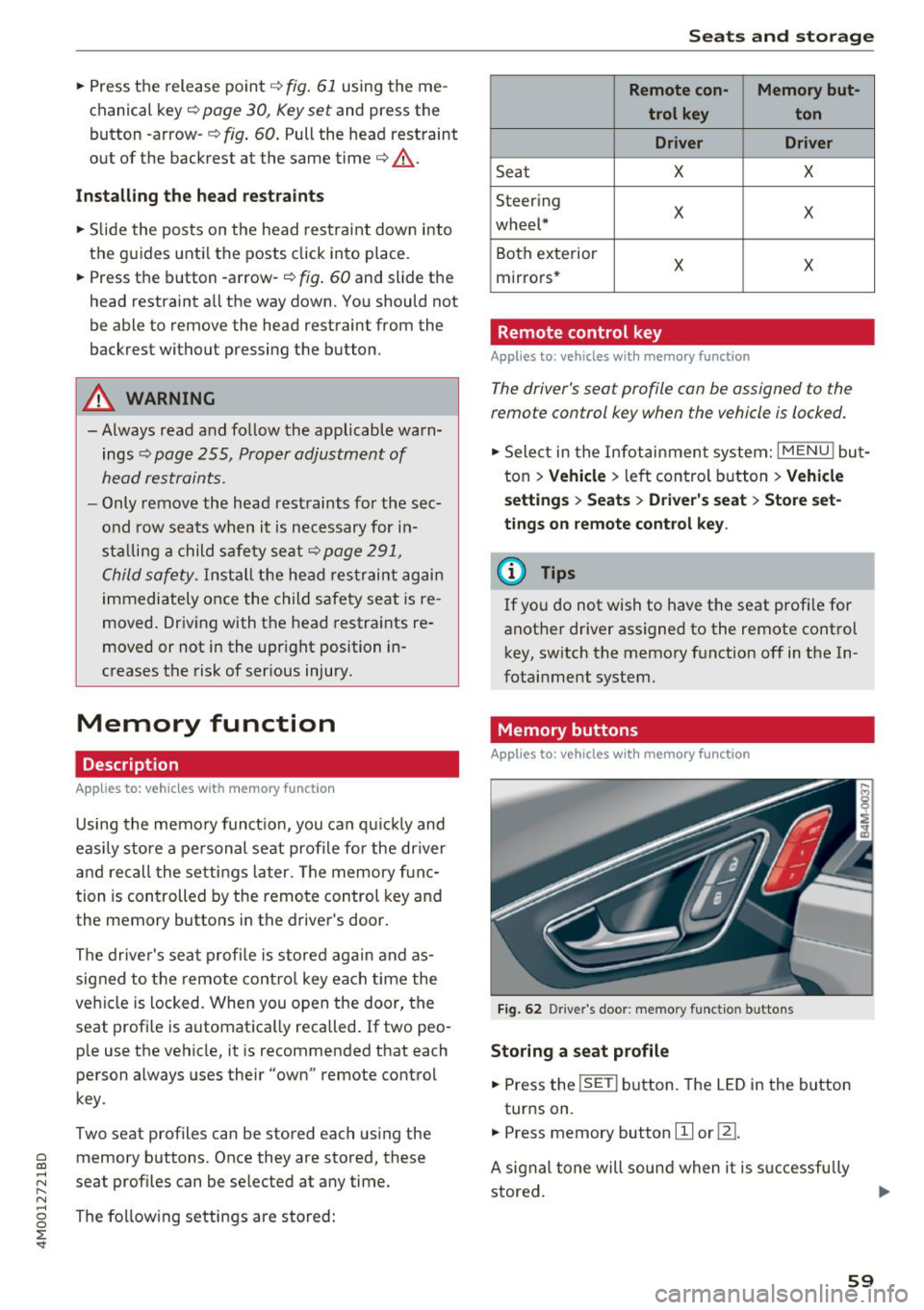
F ig . 62 Driver 's door : memo ry f unc tion buttons
Storing a seat p rofil e
• Press the !SET I button. The LED in the button
turns on.
• Press memory button
[II or ill.
A signal tone will sound when it is s uccessfu lly
stored.
59
Page 62 of 398
Seats and stor age
Acc essing a seat profile
• If the driver's door is open and the ignit ion is
switched off, press the memory button.
• If the driver's door is closed or the ignition is
switched on, press and hold the memory but
ton until the seat adjustment is complete.
A WARNING
- For safety reasons, the seat setting can only
be recalled when the vehicle is stationary to
reduce the risk of an accident.
- In an emergency, seat adjustment operation
can be stopped by pressing the
!SETI button
or the buttons @or@
c::> page 54, fig. 50 .
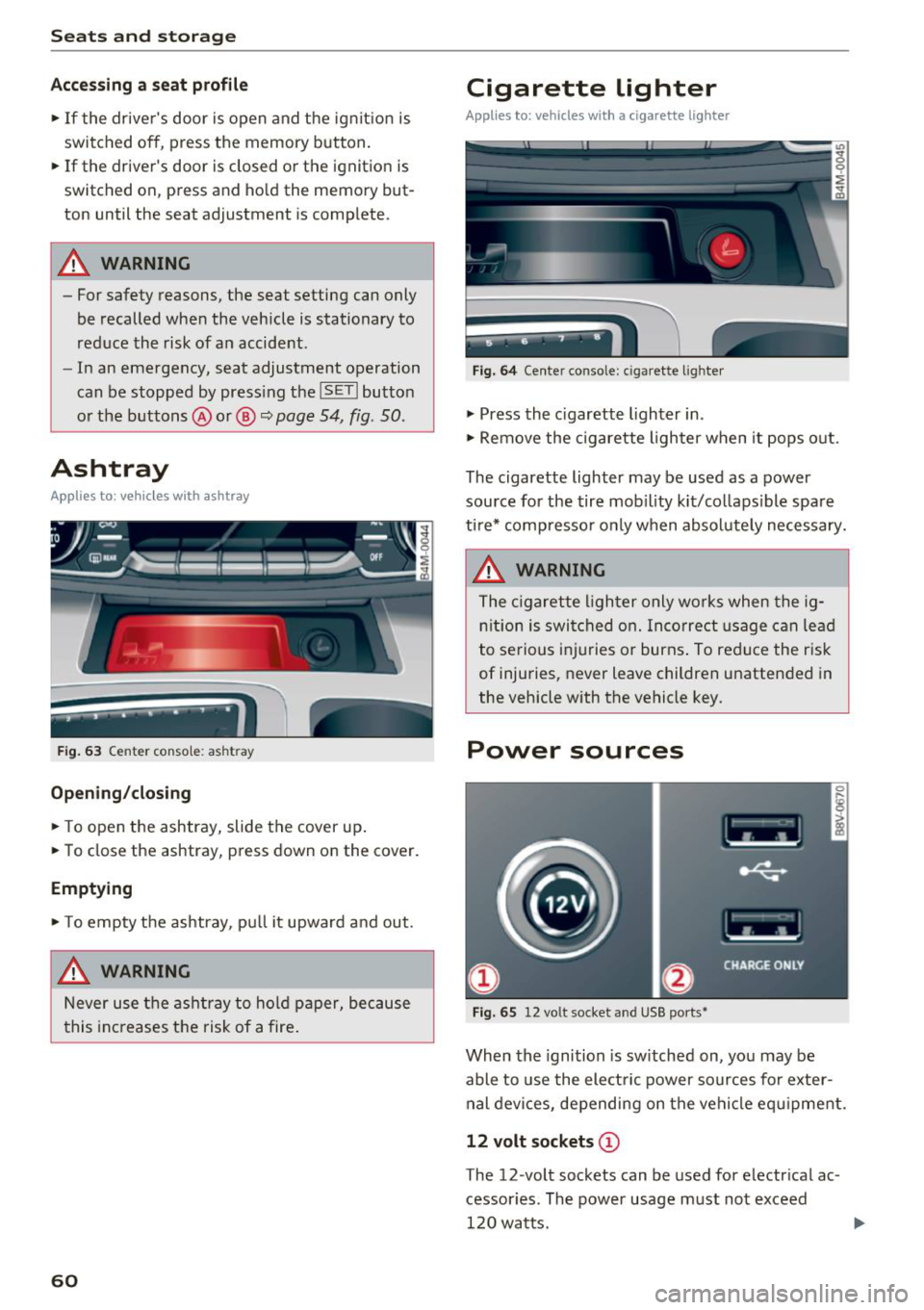
Ashtray
App lies to: ve hicles w ith ashtray
Fig. 63 Center conso le: ashtr ay
Open ing /closing
• To open the ashtray, slide the cover up .
• To close the ashtray, press down on the cover.
Empt ying
• To empty the ashtray, pu ll it upward and out.
A WARNING
Never use the asht ray to hold paper, because
t his increases the risk of a fire .
60
Cigarette lighter
Applies to: vehicles with a cigarette lighter
Fig. 64 Center conso le : cigarette ligh ter
• Press the c igarette lighter in .
• Remove the cigarette lighter when it pops o ut.
The cigarette lighter may be used as a power source for the tire mob ility kit/collaps ible spare
ti re* compresso r o nly when absolute ly necessary.
A WARNING
The c igarette lighter only works when the ig
n ition is switched on. Incorrect usage can lead
to serious i njuries or burns . To reduce the risk
of injuries, never leave children unattended in
the vehicle with the vehicle key.
Power sources
Fig. 65 12 vo lt socket and USB ports•
When the ignition is sw itched on, you may be
able to use the elect ric power sources for exter
nal devices, depending on the vehicle eq uipment.
12 volt sockets (D
The 12-volt sockets can be used for electr ical ac
cessor ies. The power usage m ust not exceed
120 watts.
Page 64 of 398
Seats and stor age
If the heat ing is sw itched on, switching the glove
compartment cooling mode off is recommended.
Additional storage compartments
You will find a variety of storage compartments
and holders at various locations in the vehicle.
- Glove compartment: the glove compartment
can be locked using the mechanical key
q page 30, Key set.
-In the door trim pane ls
- Safety vest compartment in the doo r trim pan-
els on the driver 's side and front passenger's
s ide
- Storage compartment* in the center conso le
- Storage compartment unde r the fron t center
armrest
- Ga rment hooks above the rea r doo rs
- Nets on the backrests of the front seats
- Net on the left luggage compartment trim pan-
el
.&, WARNING
-
- Always keep t he g love compartment lid
cl osed while d riving to reduce the risk of in
jury.
- Only use the storage compartments in the
doo r trim pane ls to sto re small objects that
will not st ick o ut of the compartment and
impair the range of the side airbags.
- Make s ure tha t the view to the rear is not
obstructed by hanging garments.
- Hang only lightwe ight cloth ing and be sure
that there a re no heavy or sha rp-edged ob
jects in the pockets.
- Do not use coat h angers to ha ng the cloth
ing because t his could impair the effective
ness of the s ide cu rtain airbags .
Luggage compartment
General information
.&, WARNING
-
Read and follow the important sa fety precau
tions in
q page 257, Storing cargo correctly.
62
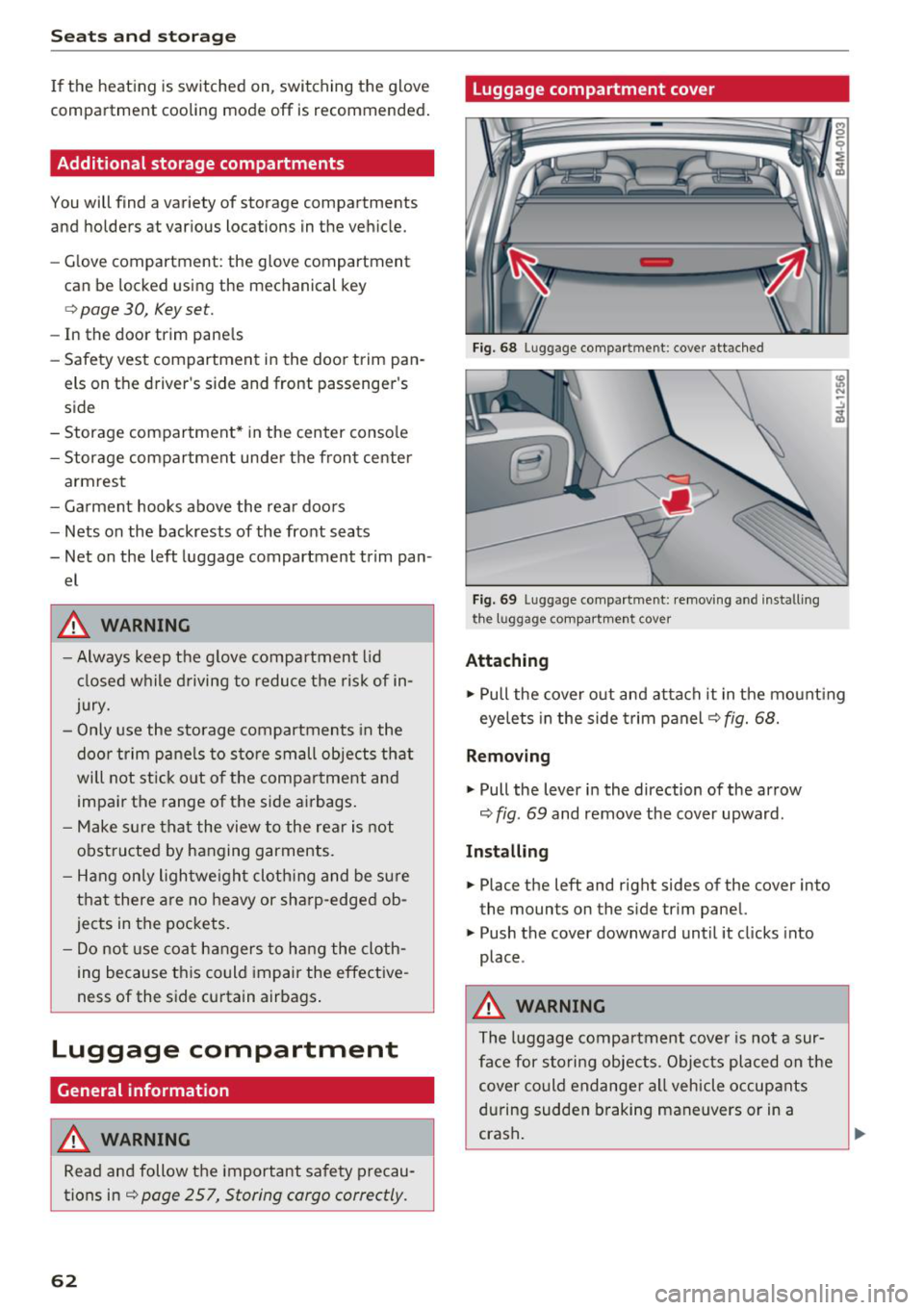
Luggage compartment cover
Fig. 68 Luggage compartment: cover attached
Fi g. 69 Luggage compa rtment: removi ng and install ing
the l1,1ggage compart ment cover
Attaching
.,. Pull the cover o ut and attach it in the mount ing
eyelets in the side t rim panel
q fig. 68.
Removing
.,. Pull the lever in the direction of the arrow
q fig. 69 and remove the cover upward.
Installing
.,. Place the left and right sides of the cover into
the mounts on the side trim panel.
.,. Push the cover downward until it clicks into
place .
.&, WARNING
The luggage compartment cove r is no t a sur
face for storing objects. Objects placed on the cover could endange r a ll vehicle occupants
during sudden braking maneuvers or in a
crash .
Page 66 of 398
Seats and stor age
Luggage compartment net
App lies to: vehicles with luggage compartment net
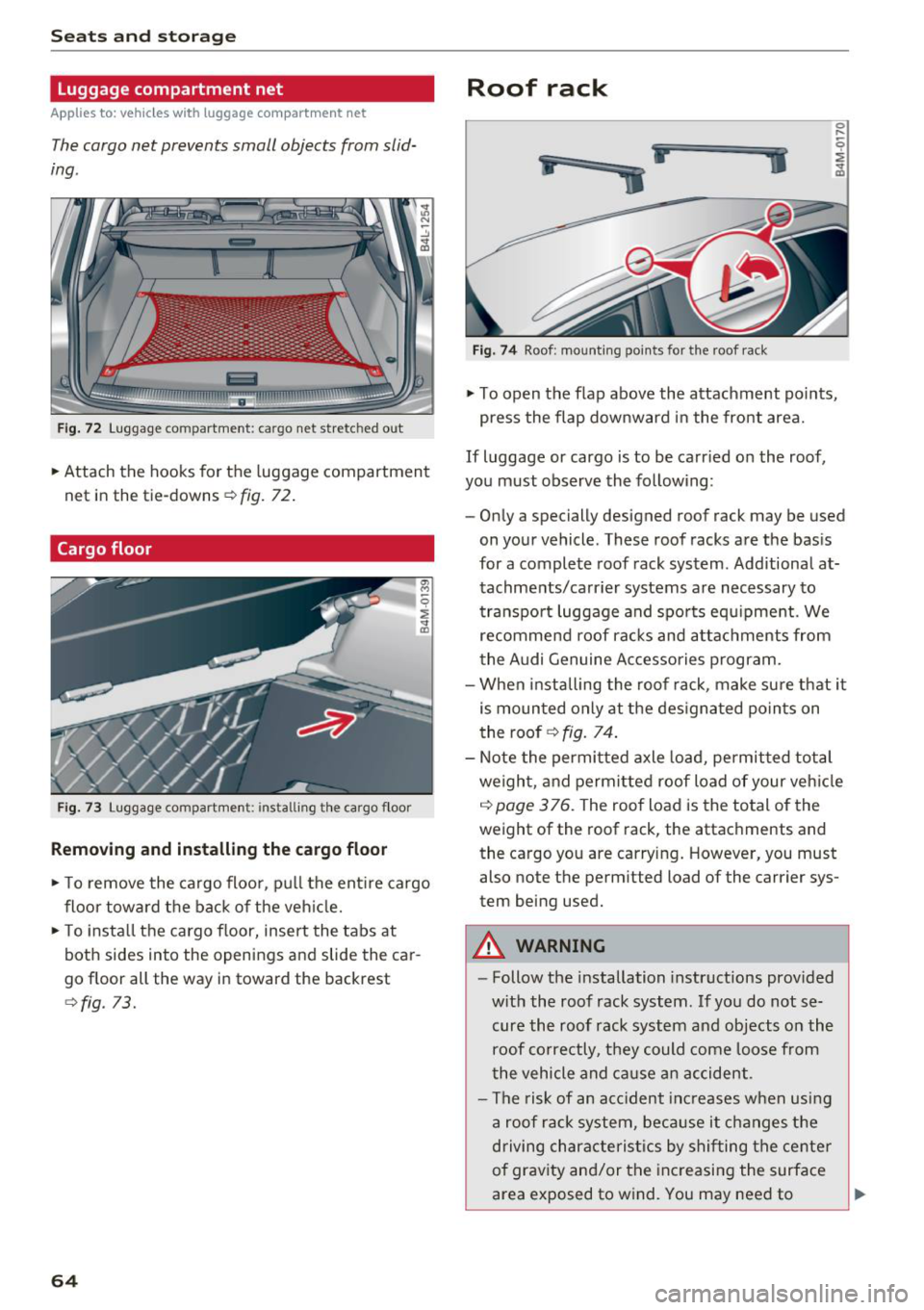
The cargo net prevents small objects from slid
ing .
Fig. 72 L uggage compartment: cargo net stretched out
.. Attach the hooks for the luggage compartmen t
net in the tie-downs
r::!> fig. 72 .
Cargo floor
Fig . 73 Luggage compartme nt: insta ll ing th e ca rgo f loor
Removing and installing the cargo floor
.. To remove the ca rgo floor, p ull the ent ire cargo
floor towa rd the back of the veh icle .
.. To insta ll the cargo floor, insert the tabs at
both sides into the openings and slide the car
go floor all the way in toward the backrest
<::!>fig. 73.
64
Roof rack
i
ii
.. j
Fig. 7 4 Roof: mount ing points for the roof rack
.. To open the flap above the attachment po ints,
press the flap downward in the front area.
If Luggage or cargo is to be carr ied on the roof,
you must observe the follow ing:
- Only a specially designed roof rack may be used
on your vehicle . These roof racks a re the bas is
for a complete roof rack system . Additional at
tachme nts/carr ier systems are necessary to
transpo rt luggage and spo rts equ ipment. We
recommend roof rac ks and a ttac hments from
the Audi Genuine Ac cessories program.
- When installing the roof rack, make su re that it
is mounted only at the des ignated po ints on
the roof
r::!> fig. 74.
- Note the permitted axle load, permitted total
weigh t, and permitted roof Load of your veh icle
c::> page 3 76. The roof Load is the total of the
weight of the roof rack, the attachments and
the cargo you are carry ing. However, you must
also note the perm itted Load of the carrier sys
tem being used.
A WARNING
- Follow the installation instructions prov ided
w ith the roof rack system . If yo u do not se
cure the roof rack system and objects on the
roof co rrectly, they could come Loose from
the vehicle and ca use a n accident.
- The risk of an acc ident inc reases w hen usi ng
a roof rack system, bec ause it changes the
driving characte ris tics by shi fting the center
of grav ity and/or the inc reasing the surface
area exposed to w ind. You may need to
~
Page 266 of 398
Safety belts
Important safety instructions about safety
belts
Safety belts must always be correctly positioned
across the strongest bones of your body.
• Always wear safety belts as illustrated and de
scribed in this chapter .
• Make sure that your safety belts are always
ready for use and are not damaged.
A WARNING
Not wearing safety belts or wearing them im
properly increases the risk of serious personal
injury and death. Safety belts can work only
when used correctly.
- Always fasten your safety belts correctly be
fore driving off and make sure all passen
gers are correctly restrained.
- For maximum protection, safety belts must
always be positioned properly on the body.
- Never strap more than one person, includ
ing small children, into any belt.
- Never place a safety belt over a child sitting
on your lap.
-Always keep feet in the footwell in front of
the seat while the vehicle is being driven .
- Never let any person ride with their feet on
the instrument panel or sticking out the
window or on the seat.
- Never remove a safety belt while the vehicle is mov ing. Doing so will increase your risk of
being injured or killed.
- Never wear belts twisted.
- Never wear belts over rigid or breakable ob-
jects in or on your clothing, such as eye glasses, pens, keys, etc., as these may cause
injury.
- Never allow safety belts to become dam
aged by being caught in door or seat hard
ware.
- Do not wear the shoulder part of the belt
under your arm or otherwise out of position.
- Several layers of heavy clothing may inter
fere with correct positioning of belts and re duce the overall effectiveness of the system.
264
- Always keep belt buckles free of anything
that may prevent the buckle from latching
securely.
- Never use comfort clips or devices that cre
ate slack in the shoulder belt. However, spe
cial clips may be required for the proper use
of some child restraint systems.
- Torn or frayed safety belts can tear, and
damaged belt hardware can break in an acci
dent. Inspect belts regularly.
If webbing,
bindings, buckles, or retractors are dam
aged, have belts replaced by an authorized
Audi dealer or qualified workshop.
- Safety belts that have been worn and loaded
in an accident must be replaced with the
correct replacement safety belt by an au
thorized Audi dealer. Replacement may be
necessary even if damage cannot be clearly
seen. Anchorages that were loaded must al
so be inspected.
- Never remove, modify, disassemble, or try
to repair the safety belts yourself.
-Always keep the belts clean. Dirty belts may
not work properly and can impair the func
tion of the inertia reel
c:> table Interior
cleaning on page 353.
Safety belts
Fastening safety belts
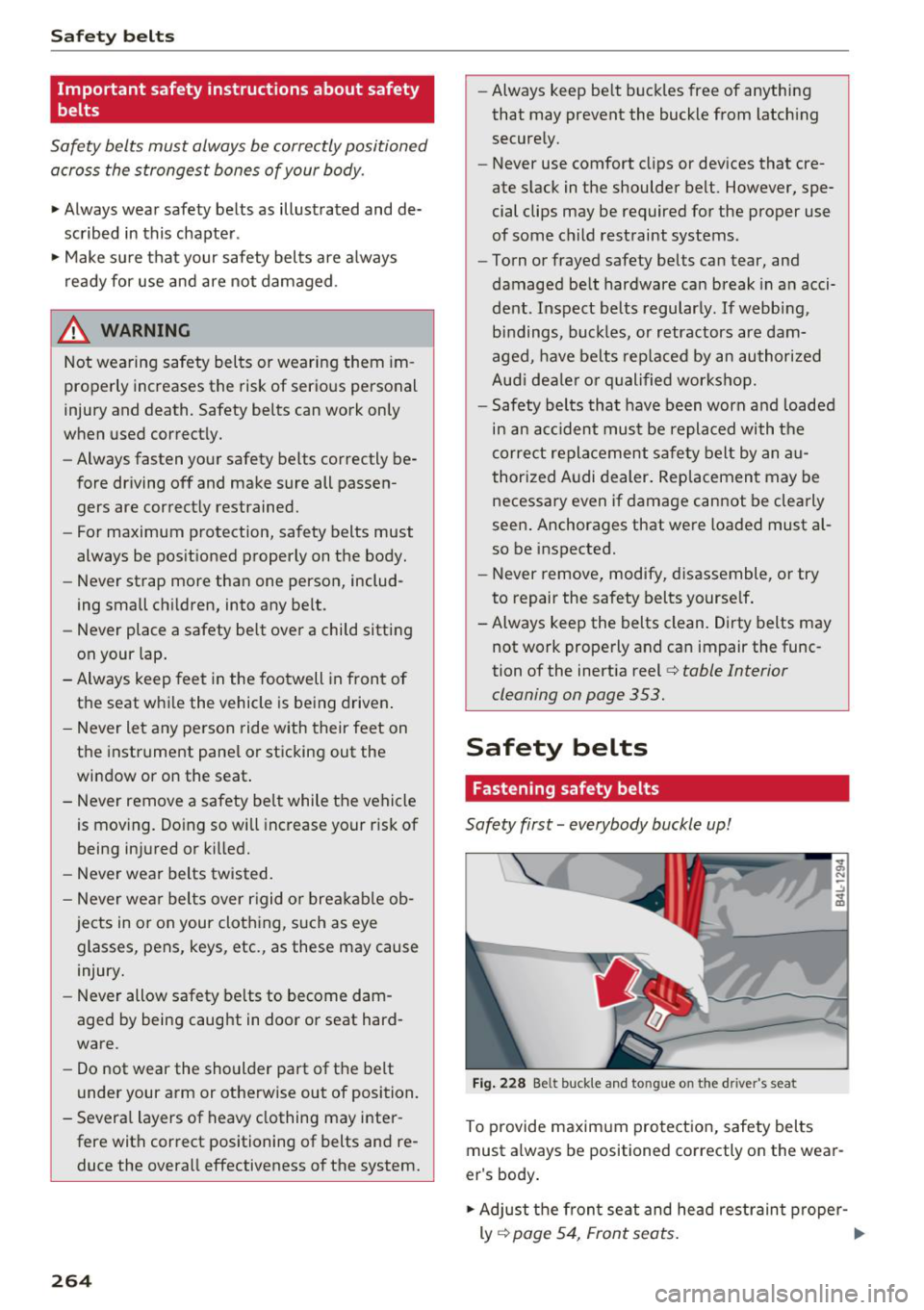
Safety first -everybody buckle up!
Fig. 228 Belt bu ckle and tongue on the driver's seat
To provide maximum protection, safety belts
must always be positioned correctly on the wear
er's body.
• Adjust the front seat and head restraint proper-
ly
c:> page 54, Front seats. ..,.
Page 267 of 398
a co ...... N r--. N ...... 0
0
:E '
is in an upright position and secure ly latched in
place before using the belt¢.&_ .
• Pull the safety belt evenly across the chest and
pelvis ¢
fig. 228, ¢ .&_ .
• Insert the tongue into the correct buckle of
your seat until you hear it latch securely.
• Pullon the belt to make sure that it is securely
latched in the buck le.
Automatic safety belt retractors
Every safety belt is equ ipped with an automatic
belt retractor on the shoulder belt. Th is feature
locks the belt when the belt is pu lled out fast,
during hard braking and in an accident . T he belt
may a lso lock when you drive up or down a steep
hill or thr ough a s harp curve. Dur ing normal dr iv
ing the bel t lets you move freely.
Safet y belt pretensioners
Safety belts wit h pretensioners he lp to tighte n
the safety belt and remove s lack when the pre
tensione rs a re activate d¢
page 267 . T he fu nc
t ion of the pretensioner is moni to red by a warn
ing light
q page 25.
Convertible locking retractor
E very safety belt except the one on the driver
seat is eq uipped w ith a co nvertible locking ret rac
tor that
must be used when the safety bel t is
used to attach a child safe ty seat. Be sure to read
the impo rtant i nfo rmat ion about this feature
¢ page 302.
.&._ WARNING
Improperly posit ioned safety be lts can cause
ser ious injury in an accident
q page 265,
Safety belt position .
- Safety belts offer optimum protection only
when the seatback is upright and belts are
properly positioned on the body.
-Always ma ke sure that the rear seat bac k
rest to wh ich the center rear safety be lt is
attached is secure ly latched whenever the
rear cente r safety belt is being used .
If the
backrest is not securely latched, the passen
ger will move forward with the backrest dur-
Safet y bel ts
ing sudden braking, in a s udden ma neuver
and espec ia lly in a crash.
- Never attach the safety belt to the buckle
for another seat. Attach ing the be lt to the
wrong buckle will reduce safety be lt effec
tiveness and can cause serio us personal i n
jury .
- A passenger who is not properly rest rai ned
can be seriously injured by the safety belt it
self when it moves from the st ronge r parts
of the body into c ritical areas like the abdo
men .
- Always loc k the convertible locking retractor
when yo u are s ecu ring a c hild safety seat in
the vehicle
q page 304.
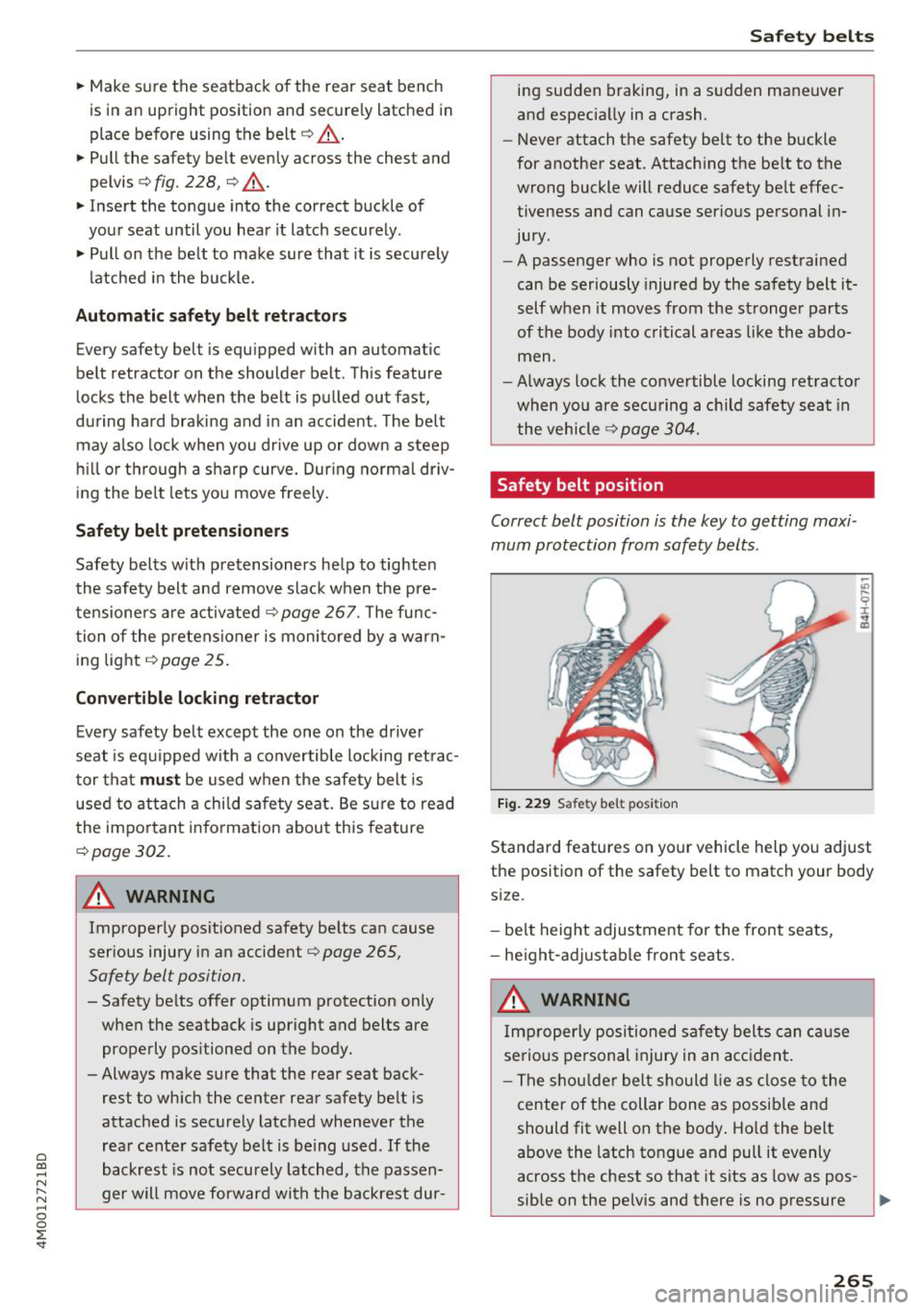
Safety belt position
Correct belt position is the key to getting maxi
mum protection from safety belts .
Fig. 22 9 Safet y belt pos it ion
Standard features on your vehicle help you adjust
the position of the safety belt to matc h your body
s ize .
- be lt height adjus tment for the front seats,
- he igh t-a djust able fro nt seat s.
.&_ WARNING
Im properly posi tioned sa fe ty belts can ca use
se rious pe rsonal injury in an acc ident .
- Th e shou lde r belt should lie as close to the
center of t he collar bone as possib le and
should fit well on the body . Ho ld the belt
above the latch tongue and pull it evenly
across the chest so that it sits as low as pos-
sible on the pe lvis and there is no pressure ..,.
265
Page 279 of 398
Cl a:, ...... N
" N ...... 0
0
::r '
doing its job in a crash.
The front Ad vanced Airbag System con sists
o f the follo wing :
-Cras h sensors in the front of the vehicle that
measure vehicle acceleration/deceleration to
provide information to the Advanced Airbag
System a bout the severity of the crash.
- An electronic control unit, with integrated
crash sensors for front and side impacts. The
contro l unit "decides" whether to fire the front
airbags based on the information received from
the crash sensors . The control unit also "de
c ides" whether the safety belt pretens ione rs
shou ld be activated .
- An Advanced Airbag with gas generator and
contro l valve for the d river ins ide the steer ing
whee l hub.
- An Advanced Airbag with gas generator and
contro l valve inside the instrument pane l for
the fron t passenger.
- A capac itive passenger detect ion system under
neath the front passenger seat cover. This sys
tem measures the elect ric al capac ita nce of the
person in the seat. The informat ion registe red
is sent contin uous ly to the e lectron ic control
unit to regulate deployment of the front Ad
vanced Airbag on the passenger side.
- An airbag monitoring system and indicator
light
m in the instrument cluster.
- A sensor in eac h front seat registers the dis
tance between the respective seat and the
stee ring wheel or instrument pane l. The infor
mation reg istered is sent continuously to the
electronic control unit to regulate deployment
of the front Adv a need A irbags .
- The
PA SSENG ER AIR BAG OFF~; ON @ light
comes on in the headliner
c:> page 281,
fig . 236 and tells you the status of the Ad
vanced Airbag o n the passenge r side .
- A sensor i n the safety belt latch for the driver
and for the front seat passenger that senses
whethe r that safety belt is latched or not and
t ransm its this info rmat io n to the elect ronic
c ontro l unit.
Airbag syste m
A WARNING ~ -
Damage to the front passenger seat can pre
vent the front airbag from working properly .
- Improper repair or disassembly of the front
passenger and driver seat will p revent the
Advanced A irbag System from f unct ion ing
p roperly .
- Repa irs to the front passenger seat must be
pe rformed by qualified a nd p roperly tra ined
wo rkshop personne l.
- Never remove the front passenger or driver
seat from the vehicle .
- Never remove the upholstery from the front
passenger sea t.
- Never d isassemble or remove parts from the
seat o r disconnect w ires from it .
- Never carry sharp objects in your pockets or
put them on the seat . The capacit ive pas
senger de tec tion mat in the front passenger
seat will not funct ion p roperly if i t is punc
tured.
- Never carry things on your lap or carry ob
jects on the front passenge r seat. S uch ob
jects ca n infl uence the capaci tance reg is
t ered by the cap aci tive passenge r detection
sys tem, so that incorrect in forma tion is pro
vided to the ai rbag control unit.
- Neve r store i tems unde r the front p assenger
seat . Parts of the Advanced Airbag System
under the passenger seat cou ld be dam
aged, p reventing them and the airbag sys
tem from wor king p roper ly.
- Never p lace seat covers or replacement up
holstery that have not been specifically ap
proved by Audi on the front seats.
- Seat covers can prevent the Advanced Air
bag System from recognizing chi ld re
stra ints or occupants on the front passenger
seat and preven t the side airbag in the seat
backrest from deploy ing properly .
- If a seat heater has bee n retrofitted or oth
erwise added to the front passe nger seat,
neve r ins tall any child restra int system on
t his seat.
- Never use cushions, p illows , blankets, or
sim ila r it ems o n the front passenge r seat .
277
Page 284 of 398
Airbag syste m
front seat p assenge r's frontal Ad vanced Airbag.
The PASSENGER AIR BAG OFF~; light:
-will come on if the front passenger seat is not
occupied;
- will come on if t he e lectr ica l capacitance meas
u red by the c apac it ive passenger detect ion sys
tem for the front passenger seat equals the
combined capacitance of an infant up to about
one year of age and one of the rearward -facing
or forward-facing chi ld rest raints listed in Fed
eral Motor Vehicle Safety Standard 208 w ith
which the Advanced Airbag System in your veh i
cle was certif ied; For a list ing of the child re
straints that were used to cert ify your vehicle 's
compliance with t he U .S. Safety Standard
¢ page 293.
-will go out if the front passenger seat is occu
pied by an adult as reg istered by the capacitive
passenger detection system .
- T he
PASSEN GER AIR BAG OFF~; light must
come on and stay on if the ignition is on and . ..
- a car bed has been insta lled on the front pas
senger seat, o r
-a rearward-fac ing ch ild restrai nt has been in
stalled on the front passenger seat , or
- a forward-facing child restra int has been instal
l ed on the front passenger seat,
- and if the electrical capacitance registered on
the front passenger seat is equal to or less than
the comb ined capac itance of a typical 1 year
o ld infant a nd one of t he rearward-fac ing o r
fo rwa rd -fa cing ch ild restrain ts lis ted in Federal
Motor Ve hicle Safety Standard 208 with w hich
the Advanced Airbag System in your vehicle was
certified .
I f t he fron t passenger sea t is no t occ upied, the
fron t ai rbag w ill not dep loy, and the
PA SSENGER
AIR BAG OFF
"1 ; lig ht wi ll stay on.
Neve r install a rearward-fac ing ch ild rest rai nt on
t he fro nt passenge r sea t, the safest p lace for a
chi ld in any k ind of chi ld restraint is at one of t he
seating positions on the rear seat
¢ page 2 70,
Child restraints on the front seat -some impor
tant things to know
and ¢ page 291, Child safe
ty .
282
If the PASSENGER AIR BAG OFF~; light
comes on . ..
If the PASSENGER AIR BAG OFF~; light comes
on when one of the condit ions listed above is
met, be sure to check the light regularly to make
certain that the
PA SSENGER AIR BAG OFF~;
light stays on cont inuously whenever the ign ition
i s on . If the
PASSENGER AIR BAG OFF~; light
does not appear on and does not stay on all the
t ime, stop as soon as it is safe to do so and
- reactivate the system by turn ing the ignit ion
off for more than 4 seconds and then tur ning it
on again;
- remove and re install the ch ild restraint . Make
sure that the child restra int is prope rly insta l
led and that the safety belt for the front pas
senge r sea t has bee n correct ly rou ted th rough
t he ch ild restraint as desc ribed in the c hild r e
straint man ufacturer's instructions;
- ma ke sure that t he convert ible loc king re tra c
tor on the safety belt for the front passenger
seat has been activated and that the safety belt has been pu lled tight .
- make sure that no e lectrica l device (s uch as a
laptop , CD p layer , e lectronic games d evice,
power inverte r or seat heater for chi ld seats) is
placed or used on the front passenger seat if
the device is connected to the 12-volt socket or
the c igarette lighter socket;
- make sure that no seat heater has been retro
fitted or otherw ise added to the front passen
ger seat;
- make sure that noth ing can interfere with the
safety belt buckles and that they are not ob
structed;
- make sure that there are no wet objects (such
as a wet towel) and no water or other liquids on
the front passenger seat cushion .
If the PASSENGER AIR BAG OFF~; light still
does not come on ...
If the PASSENGER AIR BAG OFF~; light still
does not come on and does not stay on cont in u
ous ly (when the ign ition is switched on),
- take the child restra in t off the front passenger
seat and install it properly at one of the rear ..,.
Page 298 of 398
Child sa fety
- The chi ld and the passenger can a lso in
jure each other in an accident .
- Never install rear-facing child safety seats
or infant carriers on the front passenger
seat. A child will be serious ly injured and
can be killed when the passenger airbag in
flates - even with an Advanced Airbag Sys
tem .
- The inflating a irbag w ill hit the child safety
seat or infant carrier with great force and
will smash the chi ld safety seat and child
against the bac krest, center armrest, doo r
o r roof.
- Always install rear-facing child safety seats
o r infant carr iers on the rear seat.
- Before you carry a ch ild in a rea r-facing child
sa fety seat on the rear seat, remove the
Rear Seat Entertainment (RS E)* and its
holder* from the ba ckres t of the front seat.
- Make s ure there is enough space in fron t of
the ch ild in the ch ild se at.
If necessary, ad
just the angle and posit ion of the seat in
front of the child seat .
- Forward-facing ch ild safety seats installed
on the front passenger's seat can interfere
with the airbag when it inflates and cause
serious injury to the child. A lways insta ll for
ward-facing child safety seats on the rear
seat.
- If except ional circumstances require the use
of a forward-facing child restraint on the
front passenger's seat, the child 's safety
and we ll-being require that the following
special p recautions be taken:
- Ma ke sure the forward -fac ing seat has
been designed and certified by its manu
facturer for use on a front seat with a pas
senger front and side airbag .
- Always carefully follow the manufacturer's
instructions provided with the child safety
seat or ca rrie r.
- Always move the front passenger seat to
the highest posit ion in the up and down
ad justment range and move it back to the
rearmost posit ion in the seat's fore and
aft adjustment range, as far away from
the airbag as possible, before installing
the forward-fac ing ch ild rest raint .
296
-Always make s ure that the safety belt up
per anchorage is behind the chi ld restraint
and not next to or in front of the child re
straint so that the safety belt wi ll be prop
erly pos itioned.
- Always make sure that nothing prevents
the front passenger's seat from being
moved to the rearmost position in its fore
and aft adjustment range.
- Always make s ure that the backrest is in
the up right pos ition.
- Never place or use any electrical device (such as a laptop, CD player, electronic
games device, powe r inverter or seat heat
er for child seats) on the fro nt passenger
seat if the devi ce is connec ted to the 12-
vo lt socke t or the cigarette ligh ter soc ket.
- If a seat heate r has been retrofitted o r
othe rwise added to the fron t passenger
seat, neve r install any child restraint sys
tem on this seat .
- Make sure that there a re no wet objects
(such as a wet towe l) and no water or oth
er liquids on the front passenger seat
cush ion.
- Never place objects on the seat (such as a
laptop, CD player, elect ronic games de
v ice, power inverte r or seat heater for
ch ild seats) . These may influence the elec
trical capacitance measured by the capaci
tive passenger detection sys tem and can
also fly a round in an accident and cause
se rious personal injury.
- Always buckle the child safety seat fi rmly in
place even if a ch ild is not sitt ing in it . A
loose child safety seat can fly a round dur ing
a sudden s to p or in a collision .
- Always read and heed all WARNINGS when
eve r us ing a child restrained in a vehicle is
be ing used~
page 261, Safe ty belts,
~ page 269, Airbag system and
~ page 291, Child safety.
_&. WARNING
To reduce the ris k of serious injury, make sure
that the
PASSENGER AIR BAG OFF 'I,;; light ~
Page 302 of 398
Child sa fety
restraint in place~ page 58. Install the
head restraint again immediately once the
child seat is removed. Driving without head
restra ints or w ith head restraints that are
not properly adjusted increases the risk of
serious or fatal neck injury dramatically .
- Always read and heed all WARNINGS when
ever using a child restrained in a veh icle is
being used
~ page 261, Safety belts,
~ page 269, Airbag system and
~ page 291, Important information.
A WARNING
If exceptional circumstances require the use
o f a forward- facing child restra int on the
front passenger's seat, the child's safety and
well-being require that the following special
precaut ions be taken:
- Make s ure the forward-facing seat has been
designed and cert ified by its manufact urer
for use on a front seat with a passenger
front and side airbag.
- Always follow the manufacturer's instruc tions prov ided with the ch ild safety seat or
infant carrier.
- Always move the front passenger seat to the h ighest position in the up and down ad
justment range and move it back to the
rearmost position in the seat's fore and aft
adjustment range, as fa r away from the air
bag as possib le, before insta lling the for
ward-facing child res tra int.
- Always make sure that the safety belt upper
anchorage is beh ind the child restrain t and
not next to or in front o f the child restrain t
so that the safety belt will be properly pos i
tioned.
- Always make sure that nothing prevents the
front passenger's seat from being moved to
the rearmost position in its fore and aft ad
justment range.
- Always make sure the backrest is in an up
right position .
- Never place or use any electrical device (such as a laptop, CO player, elect ronic
games dev ice, power inverte r or seat heater
for child seats) on the front passenger seat
300
if the device is connected to the 12-volt
socket or the cigarette lighte r socket.
- If a seat heater has been ret rofitted or oth
erwise added to the front passenger seat, never install any child restra int system on
this seat.
- Make sure that there are no wet objects (such as a wet towel) and no water or other
liquids on the front passenger seat cush ion .
- Never p lace objects on the seat (such as a
laptop, CO p layer, electron ic games device,
power inverte r or seat heater for ch ild
seats) . These may influence the elect rical
capacitance measu red by the capacitive pas
senger detect ion system and can also fly
around in an accident and cause se rious per
sonal injury .
- Ma ke sure th at the
PASSENGER AIR BAG
OFF
1-f; light comes on and stays on all the
time wheneve r the ign it ion is switched on .
- If the
PASSENGER AIR BAG OFF 1-f; light
does not come on and stay on, immediately
install the forward -facing child seat at a
seating position on the rear seat and have
the airbag system inspected by your author ized Audi dealer.
- Take the child restra int off the front passen
ge r seat and install it prope rly at one of the
rear seat positions if the
PASSENGER AIR
BAG OFF
1-f; light does not stay on whenever
the ignition is switched on.