check engine light AUDI R8 2007 User Guide
[x] Cancel search | Manufacturer: AUDI, Model Year: 2007, Model line: R8, Model: AUDI R8 2007Pages: 210, PDF Size: 8.1 MB
Page 51 of 210
Doors and windows49
Controls
Safety
Driving tips
General maintenance
Self-help
Technical data Turn signals
The turn signals flash briefly when the vehicle is locked to confirm
that the doors, the engine lid and the luggage lid are properly
closed and locked.
If the turn signals do not flash, check the doors, engine lid and
luggage lid to make sure they are properly closed. The turn signals
will flash briefly if one of the doors, the luggage lid or the engine lid
is closed after the system has been switched on.
Note
•
To make sure that the alarm is fully operative when leaving the
vehicle, briefly check that all the doors and windows are closed.
•
If the vehicle is unlocked at the driver's door using the key, the
central locking switch only becomes fully functional after the igni-
tion is switched on.
•
The alarm is triggered immediately if one of the battery cables is
disconnected while the alarm system is active.
Interior monitor
The interior monitor triggers an alarm if it detects move-
ment inside the vehicle.
You should deactivate the interior monitor if there is a
possibility that the alarm could be set off, for instance, by a
pet or by an object moving about inside the car ⇒. The
tow-away protection function* should be deactivated if the
car is being towed or transported (for instance by rail or
ship).
Deactivating interior monitor
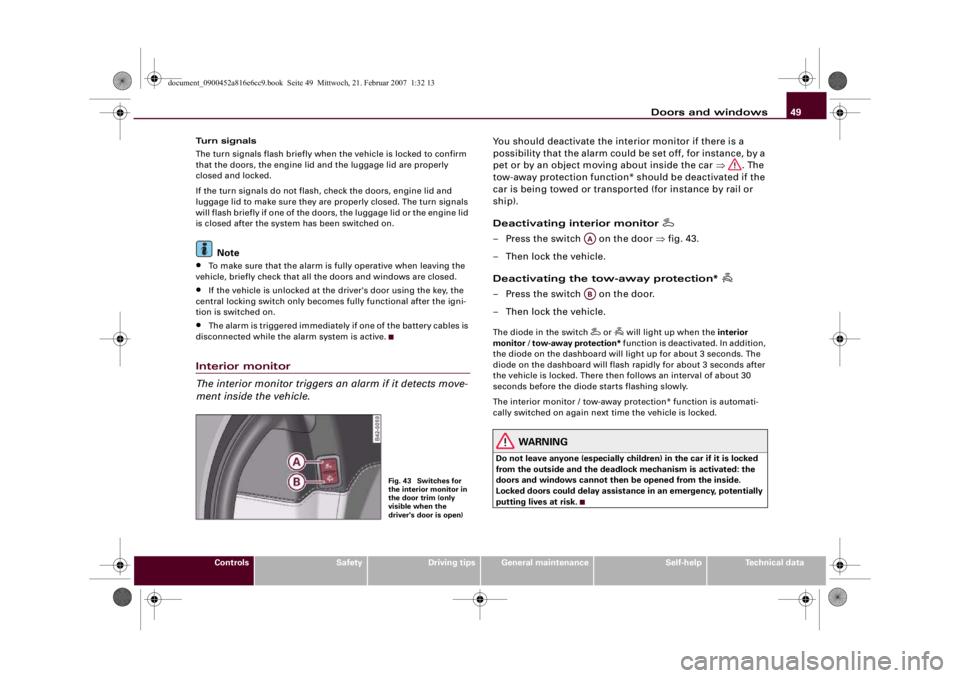
– Press the switch on the door ⇒fig. 43.
– Then lock the vehicle.
Deactivating the tow-away protection*
– Press the switch on the door.
– Then lock the vehicle.The diode in the switch
or
will light up when the interior
monitor / tow-away protection* function is deactivated. In addition,
the diode on the dashboard will light up for about 3 seconds. The
diode on the dashboard will flash rapidly for about 3 seconds after
the vehicle is locked. There then follows an interval of about 30
seconds before the diode starts flashing slowly.
The interior monitor / tow-away protection* function is automati-
cally switched on again next time the vehicle is locked.
WARNING
Do not leave anyone (especially children) in the car if it is locked
from the outside and the deadlock mechanism is activated: the
doors and windows cannot then be opened from the inside.
Locked doors could delay assistance in an emergency, potentially
putting lives at risk.
Fig. 43 Switches for
the interior monitor in
the door trim (only
visible when the
driver's door is open)
AAAB
document_0900452a816e6cc9.book Seite 49 Mittwoch, 21. Februar 2007 1:32 13
Page 78 of 210
Heating and cooling 76The compressor also switches off if the coolant temperature is
excessively high, to ensure adequate engine cooling under extreme
loads.
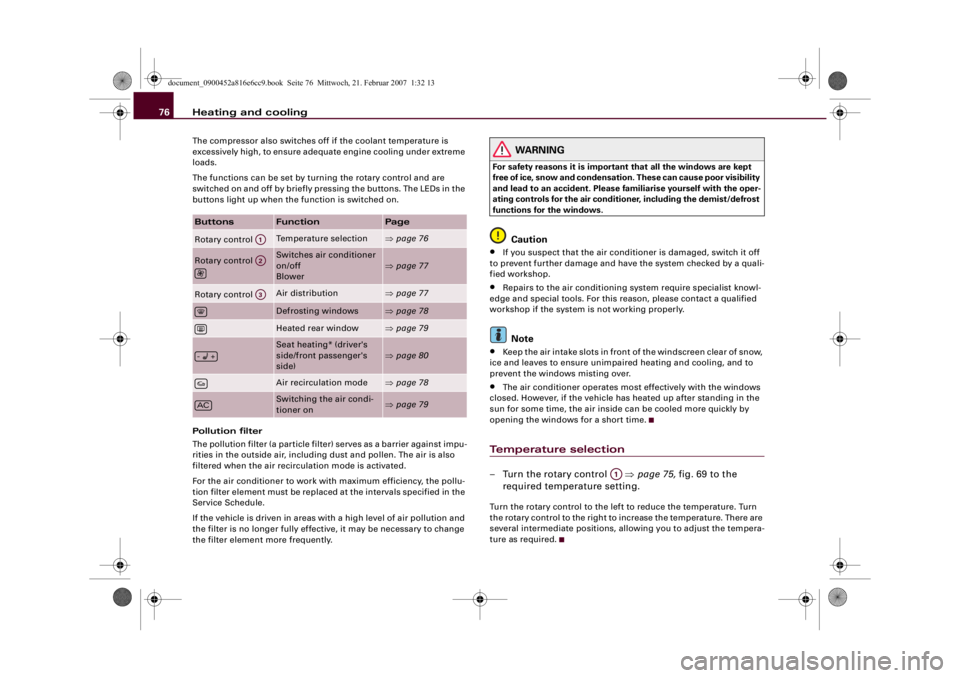
The functions can be set by turning the rotary control and are
switched on and off by briefly pressing the buttons. The LEDs in the
buttons light up when the function is switched on.
Pollution filter
The pollution filter (a particle filter) serves as a barrier against impu-
rities in the outside air, including dust and pollen. The air is also
filtered when the air recirculation mode is activated.
For the air conditioner to work with maximum efficiency, the pollu-
tion filter element must be replaced at the intervals specified in the
Service Schedule.
If the vehicle is driven in areas with a high level of air pollution and
the filter is no longer fully effective, it may be necessary to change
the filter element more frequently.
WARNING
For safety reasons it is important that all the windows are kept
free of ice, snow and condensation. These can cause poor visibility
and lead to an accident. Please familiarise yourself with the oper-
ating controls for the air conditioner, including the demist/defrost
functions for the windows.
Caution
•
If you suspect that the air conditioner is damaged, switch it off
to prevent further damage and have the system checked by a quali-
fied workshop.
•
Repairs to the air conditioning system require specialist knowl-
edge and special tools. For this reason, please contact a qualified
workshop if the system is not working properly.Note
•
Keep the air intake slots in front of the windscreen clear of snow,
ice and leaves to ensure unimpaired heating and cooling, and to
prevent the windows misting over.
•
The air conditioner operates most effectively with the windows
closed. However, if the vehicle has heated up after standing in the
sun for some time, the air inside can be cooled more quickly by
opening the windows for a short time.
Te m p e r a t u r e s e l e c t i o n– Turn the rotary control ⇒page 75, fig. 69 to the
required temperature setting.Turn the rotary control to the left to reduce the temperature. Turn
the rotary control to the right to increase the temperature. There are
several intermediate positions, allowing you to adjust the tempera-
ture as required.
Buttons
Function
Page
Rotary control
Temperature selection
⇒page 76
Rotary control
Switches air conditioner
on/off
Blower
⇒page 77
Rotary control
Air distribution
⇒page 77
Defrosting windows
⇒page 78
Heated rear window
⇒page 79
Seat heating* (driver's
side/front passenger's
side)
⇒page 80
Air recirculation mode
⇒page 78
Switching the air condi-
tioner on
⇒page 79
A1A2
A3
- +AC
A1
document_0900452a816e6cc9.book Seite 76 Mittwoch, 21. Februar 2007 1:32 13
Page 141 of 210
Your vehicle and the environment139
Controls
Safety
Driving tips
General maintenance
Self-help
Technical data
Sporty drivingLetting the engine warm up and cool downYou can reduce the amount of wear and tear on your vehicle during
a sporty driving session simply by adopting a more restrained
driving style while the engine is warming up and cooling down.
You should allow the engine to warm up by keeping the engine
speed below 7000 rpm until the engine oil reaches at least 90 °C. In
addition, the tyres will not develop their full grip potential until they
have had a chance to warm up on the road.
Even though the engine continues to be cooled after you switch it
off, it is particularly important to give it time to cool down before
parking. The engine, brakes, exhaust system and gearbox will all
reach very high temperatures when you adopt a sporty driving style.
Before you park the vehicle, allow it to cool down to normal temper-
ature by driving at moderate rpm speeds for several miles.Driving on a racing circuitBefore you take your car out on a racing circuit, please ensure that
it is in perfect condition. You should check the tyre tread and brake
pads for wear. It's also a good idea to increase the tyre pressure by
0.3 bar.
The oil consumption may be slightly higher than “normal” when
driving on a racing circuit ⇒page 157.
You should always check your vehicle after driving hard. Are the
brake pads ok? Do you notice any problems with the tyres (e.g. tread
worn, blistering, etc.)? Are the air intakes free of leaves and
deposits? Is the oil level ok?
Your Audi R8 dealer will be glad to carry out an inspection before
and after you use the car on a racing circuit.
Note
•
Some racing circuits (e.g. with banked curves) can affect the
behaviour of the ESP.
•
Driving the car on a racing circuit places a heavy load on all parts
of the vehicle. This can result in increased wear and tear.
Environmental compatibilityEnvironmental protection is a top priority in the design, choice of
materials and production of your new Audi. Particular importance
has been attached to the following aspects:
Design measures for economical recycling•
Joints and connections designed for ease of dismantling
•
Modular construction to facilitate dismantling
•
Increased use of single-grade materials
•
Plastic parts and elastomers are labelled in accordance with ISO
1043, ISO 11469 and ISO 1629
Choice of materials
•
Nearly all materials used can be recycled
•
Similar types of plastics grouped together for easy recycling
•
Recycled materials used in manufacture
•
Reduced vapour emissions from plastics
•
CFC-free refrigerant in air conditioner
Compliance with the laws prohibiting the use of:
•
Cadmium
•
Asbestos
•
Lead
•
Mercury
•
Chrome VI
document_0900452a816e6cc9.book Seite 139 Mittwoch, 21. Februar 2007 1:32 13
Page 162 of 210
Checking and topping up fluids 160Checking coolant level
Be careful when checking the coolant.– Switch off the ignition.
– Cover the cap on the expansion tank with a cloth, and
carefully unscrew the cap anti-clockwise ⇒.
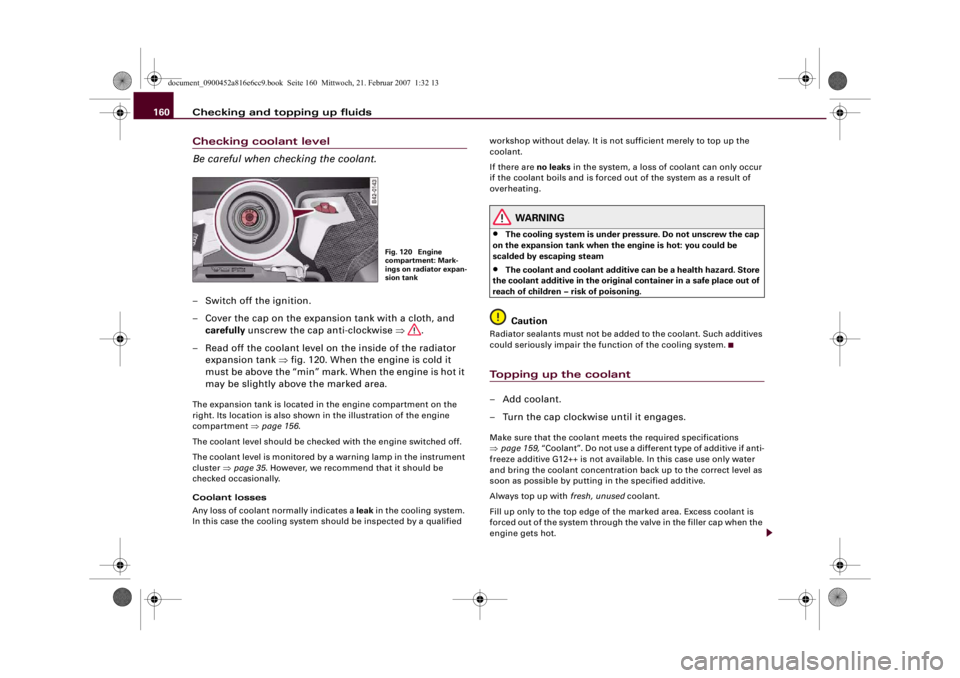
– Read off the coolant level on the inside of the radiator
expansion tank ⇒fig. 120. When the engine is cold it
must be above the “min” mark. When the engine is hot it
may be slightly above the marked area.The expansion tank is located in the engine compartment on the
right. Its location is also shown in the illustration of the engine
compartment ⇒page 156.
The coolant level should be checked with the engine switched off.
The coolant level is monitored by a warning lamp in the instrument
cluster ⇒page 35. However, we recommend that it should be
checked occasionally.
Coolant losses
Any loss of coolant normally indicates a leak in the cooling system.
In this case the cooling system should be inspected by a qualified workshop without delay. It is not sufficient merely to top up the
coolant.
If there are no leaks in the system, a loss of coolant can only occur
if the coolant boils and is forced out of the system as a result of
overheating.
WARNING
•
The cooling system is under pressure. Do not unscrew the cap
on the expansion tank when the engine is hot: you could be
scalded by escaping steam
•
The coolant and coolant additive can be a health hazard. Store
the coolant additive in the original container in a safe place out of
reach of children – risk of poisoning.Caution
Radiator sealants must not be added to the coolant. Such additives
could seriously impair the function of the cooling system.Topping up the coolant– Add coolant.
– Turn the cap clockwise until it engages.Make sure that the coolant meets the required specifications
⇒page 159, “Coolant”. Do not use a different type of additive if anti-
freeze additive G12++ is not available. In this case use only water
and bring the coolant concentration back up to the correct level as
soon as possible by putting in the specified additive.
Always top up with fresh, unused coolant.
Fill up only to the top edge of the marked area. Excess coolant is
forced out of the system through the valve in the filler cap when the
engine gets hot.
Fig. 120 Engine
compartment: Mark-
ings on radiator expan-
sion tank
document_0900452a816e6cc9.book Seite 160 Mittwoch, 21. Februar 2007 1:32 13
Page 165 of 210
Checking and topping up fluids163
Controls
Safety
Driving tips
General maintenance
Self-help
Technical data removed from the vehicle cannot tip over. Otherwise, sulphuric acid
could escape.
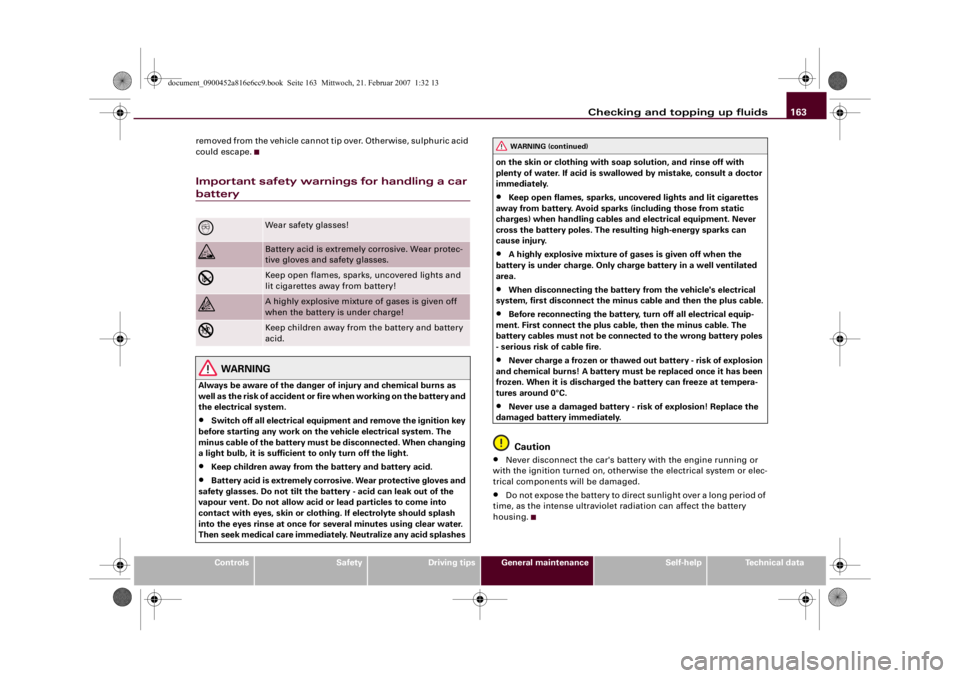
Important safety warnings for handling a car battery
WARNING
Always be aware of the danger of injury and chemical burns as
well as the risk of accident or fire when working on the battery and
the electrical system.•
Switch off all electrical equipment and remove the ignition key
before starting any work on the vehicle electrical system. The
minus cable of the battery must be disconnected. When changing
a light bulb, it is sufficient to only turn off the light.
•
Keep children away from the battery and battery acid.
•
Battery acid is extremely corrosive. Wear protective gloves and
safety glasses. Do not tilt the battery - acid can leak out of the
vapour vent. Do not allow acid or lead particles to come into
contact with eyes, skin or clothing. If electrolyte should splash
into the eyes rinse at once for several minutes using clear water.
Then seek medical care immediately. Neutralize any acid splashes on the skin or clothing with soap solution, and rinse off with
plenty of water. If acid is swallowed by mistake, consult a doctor
immediately.
•
Keep open flames, sparks, uncovered lights and lit cigarettes
away from battery. Avoid sparks (including those from static
charges) when handling cables and electrical equipment. Never
cross the battery poles. The resulting high-energy sparks can
cause injury.
•
A highly explosive mixture of gases is given off when the
battery is under charge. Only charge battery in a well ventilated
area.
•
When disconnecting the battery from the vehicle's electrical
system, first disconnect the minus cable and then the plus cable.
•
Before reconnecting the battery, turn off all electrical equip-
ment. First connect the plus cable, then the minus cable. The
battery cables must not be connected to the wrong battery poles
- serious risk of cable fire.
•
Never charge a frozen or thawed out battery - risk of explosion
and chemical burns! A battery must be replaced once it has been
frozen. When it is discharged the battery can freeze at tempera-
tures around 0°C.
•
Never use a damaged battery - risk of explosion! Replace the
damaged battery immediately.Caution
•
Never disconnect the car's battery with the engine running or
with the ignition turned on, otherwise the electrical system or elec-
trical components will be damaged.
•
Do not expose the battery to direct sunlight over a long period of
time, as the intense ultraviolet radiation can affect the battery
housing.
Wear safety glasses!
Battery acid is extremely corrosive. Wear protec-
tive gloves and safety glasses.
Keep open flames, sparks, uncovered lights and
lit cigarettes away from battery!
A highly explosive mixture of gases is given off
when the battery is under charge!
Keep children away from the battery and battery
acid.
WARNING (continued)
document_0900452a816e6cc9.book Seite 163 Mittwoch, 21. Februar 2007 1:32 13
Page 205 of 210

Index203
Controls
Safety
Driving tips
General maintenance
Self-help
Technical data Car keys . . . . . . . . . . . . . . . . . . . . . . . . . . . . 40
Carbon parts
Exterior . . . . . . . . . . . . . . . . . . . . . . . . . 146
Interior . . . . . . . . . . . . . . . . . . . . . . . . . 147
Care of vehicle . . . . . . . . . . . . . . . . . . . . . . 144
Catalytic converter . . . . . . . . . . . . . . . . . . 138
Central locking system . . . . . . . . . . . . . . . . 42
Deadlock mechanism . . . . . . . . . . . . . . 44
Locking . . . . . . . . . . . . . . . . . . . . . . . . . . 44
Locking and unlocking the vehicle from
inside . . . . . . . . . . . . . . . . . . . . . . . . . . 45
Locking doors manually . . . . . . . . . . . . 46
Luggage lid . . . . . . . . . . . . . . . . . . . . . . . 47
Opening and closing windows . . . . . . . 43
Security central locking . . . . . . . . . . . . 46
Switches . . . . . . . . . . . . . . . . . . . . . . . . . 45
Unlocking . . . . . . . . . . . . . . . . . . . . . . . . 44
Ceramic brake discs
Changing a wheel . . . . . . . . . . . . . . . . 184
Changing a wheel . . . . . . . . . . . . . . . . . . . 182
Changing bulbs . . . . . . . . . . . . . . . . . . . . . 193
Chassis number . . . . . . . . . . . . . . . . . . . . . 196
Child safety . . . . . . . . . . . . . . . . . . . . . . . . 122
Child safety seat . . . . . . . . . . . . . . . . . . . . 123
Child seat categories . . . . . . . . . . . . . . 123
Fitting . . . . . . . . . . . . . . . . . . . . . . . . . . 126
ISOFIX system . . . . . . . . . . . . . . . . . . . 128
Safety notes . . . . . . . . . . . . . . . . . . . . . 122
Cigarette lighter . . . . . . . . . . . . . . . . . . . . . 72
Cleaning . . . . . . . . . . . . . . . . . . . . . . . . . . . 144
Cleaning Alcantara . . . . . . . . . . . . . . . . . . 150Cleaning seat covers
Alcantara . . . . . . . . . . . . . . . . . . . . . . . . 150
Natural leather . . . . . . . . . . . . . . . . . . . 149
Textile covers . . . . . . . . . . . . . . . . . . . . 147
Cleaning textile covers and trim parts . . 147
Closing
Engine lid . . . . . . . . . . . . . . . . . . . . . . . 156
Clutch overheating . . . . . . . . . . . . . . . . . . . 38
Colour code . . . . . . . . . . . . . . . . . . . . . . . . 196
Coming home function . . . . . . . . . . . . . . . . 54
Compartment for (sun)glasses . . . . . . . . . 73
Compass in mirror . . . . . . . . . . . . . . . . . . . 65
Conformity certification . . . . . . . . . . . . . . . 98
Controls and displays
Overview . . . . . . . . . . . . . . . . . . . . . . . . . . 9
Convenience close . . . . . . . . . . . . . . . . . . . 43
Convenience open . . . . . . . . . . . . . . . . . . . . 43
Cooling system
Anti-freeze additive . . . . . . . . . . . . . . . 159
Checking coolant level . . . . . . . . . . . . 160
Coolant . . . . . . . . . . . . . . . . . . . . . . . . . 159
Coolant temperature gauge . . . . . . . . . 12
Malfunction . . . . . . . . . . . . . . . . . . . . . . 35
Radiator fan . . . . . . . . . . . . . . . . . . . . . 161
Topping up coolant . . . . . . . . . . . . . . . 160
Cruise control system . . . . . . . . . . . . . . . . . 86
Adjusting stored speed . . . . . . . . . . . . . 87
Indicator lamp . . . . . . . . . . . . . . . . . . . . 17
Setting speed . . . . . . . . . . . . . . . . . . . . . 87
Switching off . . . . . . . . . . . . . . . . . . . . . 88
Switching off temporarily . . . . . . . . . . . 88
Cup holders . . . . . . . . . . . . . . . . . . . . . . . . . 72
Current fuel consumption . . . . . . . . . . . . . 22
DDashboard lighting
SeeInstrument lighting . . . . . . . . . . . . . 55
Date display . . . . . . . . . . . . . . . . . . . . . . . . . 12
Daytime running lights . . . . . . . . . . . . . . . . 52
Deactivating front passenger's airbag . . 120
Deadlock mechanism . . . . . . . . . . . . . . . . . 44
Defrosting windows . . . . . . . . . . . . . . . . . . 78
Deluxe automatic air conditioner
Economical operation . . . . . . . . . . . . . . 79
Description of R tronic . . . . . . . . . . . . . . . . 90
Digital clock . . . . . . . . . . . . . . . . . . . . . . . . . 12
Digital compass . . . . . . . . . . . . . . . . . . . . . . 65
Dimensions . . . . . . . . . . . . . . . . . . . . . . . . 198
Dipped headlights . . . . . . . . . . . . . . . . . . . . 52
Defective . . . . . . . . . . . . . . . . . . . . . . . . . 37
Distance covered . . . . . . . . . . . . . . . . . . . . . 23
Door catches, engine lid and front lid
warning . . . . . . . . . . . . . . . . . . . . . . . . 20
Doors
Locking doors manually . . . . . . . . . . . . 46
Driver
SeeSitting position . . . . . . . . . . . . . . . 104
Driver information system
CD and radio display . . . . . . . . . . . . . . . 20
Door catches, engine lid and front lid
warning . . . . . . . . . . . . . . . . . . . . . . . . 20
Help . . . . . . . . . . . . . . . . . . . . . . . . . . . . . 25
Menu button . . . . . . . . . . . . . . . . . . . . . . 25
Menu display . . . . . . . . . . . . . . . . . . . . . 24
On-board computer . . . . . . . . . . . . . . . . 22
Outside temperature display . . . . . . . . 20
document_0900452a816e6cc9.book Seite 203 Mittwoch, 21. Februar 2007 1:32 13
Page 206 of 210

Index 204
Red symbols . . . . . . . . . . . . . . . . . . . . . 33
Service interval display . . . . . . . . . . . . 21
Setting . . . . . . . . . . . . . . . . . . . . . . . . . . 26
Yellow symbols . . . . . . . . . . . . . . . . . . . 33
Driver messages . . . . . . . . . . . . . . . . . . . . . 34
Driving abroad . . . . . . . . . . . . . . . . . . . . . 138
Headlights . . . . . . . . . . . . . . . . . . . . . . 138
Unleaded fuel . . . . . . . . . . . . . . . . . . . 138
Driving away on a slope
hill hold assist . . . . . . . . . . . . . . . . . . . . 84
Driving safety . . . . . . . . . . . . . . . . . . . . . . 103
Driving time . . . . . . . . . . . . . . . . . . . . . . . . . 22
Dry sump lubrication system . . . . . . . . . 137
Dust filter . . . . . . . . . . . . . . . . . . . . . . . . . . . 76
EElectric fuses . . . . . . . . . . . . . . . . . . . . . . . 190
Electric seat adjustment
SeeSeat adjustment . . . . . . . . . . . . . . . 68
Electric voltage . . . . . . . . . . . . . . . . . . . . . . 14
Electric windows . . . . . . . . . . . . . . . . . . . . 50
Central locking system . . . . . . . . . . . . . 43
Possible malfunctions . . . . . . . . . . . . . 50
Electrical socket . . . . . . . . . . . . . . . . . . . . . 72
Electrical system . . . . . . . . . . . . . . . . . . . . . 18
Electronic differential lock . . . . . . . . . . . 132
Warning lamp . . . . . . . . . . . . . . . . . . . . 19
Electronic immobiliser . . . . . . . . . . . . . . . . 42
Electronic stabilisation program . . . . . . 132
Emission control systems . . . . . . . . . . . . 138
Emissions . . . . . . . . . . . . . . . . . . . . . . . . . 196Engine compartment
Lighting . . . . . . . . . . . . . . . . . . . . . . . . . 58
Safety notes . . . . . . . . . . . . . . . . . . . . . 155
Engine compartment layout . . . . . . . . . . 156
Engine data
SeePerformance, weights and
dimensions . . . . . . . . . . . . . . . . . . . . 198
Engine hood
SeeEngine lid . . . . . . . . . . . . . . . . . . . 155
Engine lid
Closing . . . . . . . . . . . . . . . . . . . . . . . . . 156
Opening . . . . . . . . . . . . . . . . . . . . . . . . 155
Engine oil . . . . . . . . . . . . . . . . . . . . . . . . . . 157
Checking oil level . . . . . . . . . . . . . . . . 157
Consumption . . . . . . . . . . . . . . . . . . . . 157
Dry sump lubrication system . . . . . . . 137
LongLife Service . . . . . . . . . . . . . . . . . 157
Temperature gauge . . . . . . . . . . . . . . . 10
Topping up . . . . . . . . . . . . . . . . . . . . . . 158
See alsoPerformance, weights and
dimensions . . . . . . . . . . . . . . . . . . . . 198
Engine oil capacity
SeePerformance, weights and
dimensions . . . . . . . . . . . . . . . . . . . . 198
Engine oil pressure (too low) . . . . . . . . . . 36
Engine oil sensor defective . . . . . . . . . . . . 37
Environmental compatibility . . . . . . . . . . 139
Environmental tips
Filling the tank . . . . . . . . . . . . . . . . . . . 153
Leaks . . . . . . . . . . . . . . . . . . . . . . . . . . . 156
Warming up the engine . . . . . . . . . . . . 82
EPC warning lamp . . . . . . . . . . . . . . . . . . . 16ESP . . . . . . . . . . . . . . . . . . . . . . . . . . . . . . . . 16
See alsoElectronic stabilisation program
132
Ethanol fuel . . . . . . . . . . . . . . . . . . . . . . . . 152
Exterior mirrors . . . . . . . . . . . . . . . . . . . . . . 64
FFilling the tank . . . . . . . . . . . . . . . . . . . . . 152
Releasing the tank flap manually . . . 154
First-aid kit . . . . . . . . . . . . . . . . . . . . . . . . . 178
Floor mats . . . . . . . . . . . . . . . . . . . . . . . . . 107
Foreign countries
SeeDriving abroad . . . . . . . . . . . . . . . 138
Four-wheel drive . . . . . . . . . . . . . . . . . . . . 136
Front passenger
SeeSitting position . . . . . . . . . . . . . . . 105
Fuel
Capacity . . . . . . . . . . . . . . . . . . . . . . . . 199
Consumption . . . . . . . . . . . . . . . . . . . . 196
Current consumption . . . . . . . . . . . . . . 22
Ethanol . . . . . . . . . . . . . . . . . . . . . . . . . 152
Fuel gauge . . . . . . . . . . . . . . . . . . . . . . . 13
Fuel level low . . . . . . . . . . . . . . . . . . . . . 36
Petrol . . . . . . . . . . . . . . . . . . . . . . . . . . 152
Fuel consumption . . . . . . . . . . . . . . . . . . . 196
Fuel gauge . . . . . . . . . . . . . . . . . . . . . . . . . . 13
Fuel range . . . . . . . . . . . . . . . . . . . . . . . . . . 22
Fuses
Changing . . . . . . . . . . . . . . . . . . . . . . . 190
Fuse list . . . . . . . . . . . . . . . . . . . . . . . . 190
document_0900452a816e6cc9.book Seite 204 Mittwoch, 21. Februar 2007 1:32 13
Page 209 of 210
Index207
Controls
Safety
Driving tips
General maintenance
Self-help
Technical data Radio display . . . . . . . . . . . . . . . . . . . . . . . . 20
Radio transmitters
Fixed installation . . . . . . . . . . . . . . . . . 175
Mobile equipment . . . . . . . . . . . . . . . . 175
Radio-controlled clock . . . . . . . . . . . . . . . . 11
Radio-operated remote control
SeeRemote control keys . . . . . . . . . . . 41
Rain sensor . . . . . . . . . . . . . . . . . . . . . . . . . 59
Rain sensor defective . . . . . . . . . . . . . . . . . 38
Rear fog light . . . . . . . . . . . . . . . . . . . . . . . . 54
Rear lights defective . . . . . . . . . . . . . . . . . . 37
Rear spoiler . . . . . . . . . . . . . . . . . . . . . . . . 134
Rear view mirrors
SeeMirrors . . . . . . . . . . . . . . . . . . . . . . . 63
Rear window heating . . . . . . . . . . . . . . . . . 79
Remote control keys . . . . . . . . . . . . . . . . . . 40
Indicator lamp . . . . . . . . . . . . . . . . . . . . 40
Replacing the battery . . . . . . . . . . . 40, 41
Synchronisation . . . . . . . . . . . . . . . . . . . 41
Unlocking and locking . . . . . . . . . . . . . 43
Repairs . . . . . . . . . . . . . . . . . . . . . . . . . . . . 174
Replacement keys . . . . . . . . . . . . . . . . . . . . 40
Replacement parts . . . . . . . . . . . . . . . . . . 174
Rev counter . . . . . . . . . . . . . . . . . . . . . . . . . 11
Reverse gear
R tronic . . . . . . . . . . . . . . . . . . . . . . . . . . 90
Running in . . . . . . . . . . . . . . . . . . . . . . . . . 138
SSAFE . . . . . . . . . . . . . . . . . . . . . . . . . . . . . . . 42
Safe driving . . . . . . . . . . . . . . . . . . . . . . . . 102Safety . . . . . . . . . . . . . . . . . . . . . . . . . . . . . 103
Safety features . . . . . . . . . . . . . . . . . . . . . 102
Seat adjustment
Bucket seats . . . . . . . . . . . . . . . . . . . . . . 70
Electrically adjustable seat . . . . . . . . . . 68
Manually adjustable seat . . . . . . . . . . . 67
Seat belts . . . . . . . . . . . . . . . . . . . . . . . . . . 109
Adjusting seat belts . . . . . . . . . . . . . . . 112
Belt tensioners . . . . . . . . . . . . . . . . . . . 114
Cleaning . . . . . . . . . . . . . . . . . . . . . . . . 150
During pregnancy . . . . . . . . . . . . . . . . 113
Putting on . . . . . . . . . . . . . . . . . . . . . . . 112
Safety notes . . . . . . . . . . . . . . . . . . . . . 110
Taking off . . . . . . . . . . . . . . . . . . . . . . . 113
Warning lamp . . . . . . . . . . . . . . . . . . . . . 18
Seat heating . . . . . . . . . . . . . . . . . . . . . . . . . 80
Security central locking . . . . . . . . . . . . . . . 46
Selector lever defective . . . . . . . . . . . . . . . 38
Service interval display . . . . . . . . . . . . . . . . 21
Service position for windscreen wipers . . 61
Setting time . . . . . . . . . . . . . . . . . . . . . . . . . 12
Setting time format . . . . . . . . . . . . . . . . . . . 12
Side lights . . . . . . . . . . . . . . . . . . . . . . . . . . 52
Sitting position
Driver . . . . . . . . . . . . . . . . . . . . . . . . . . . 104
Front passenger . . . . . . . . . . . . . . . . . . 105
Incorrect sitting position . . . . . . . . . . 106
Snow chains . . . . . . . . . . . . . . . . . . . . . . . 171
Spare key . . . . . . . . . . . . . . . . . . . . . . . . . . . 40
Speed warning . . . . . . . . . . . . . . . . . . . 31, 37
Speedometer . . . . . . . . . . . . . . . . . . . . . . . . 13
Spoiler . . . . . . . . . . . . . . . . . . . . . . . . . . . . 134Starting the engine . . . . . . . . . . . . . . . . . . . 82
Starting with jump leads . . . . . . . . . . . . . 185
Steering
Locking the steering . . . . . . . . . . . . . . . 81
Steering wheel height adjustment
(manual) . . . . . . . . . . . . . . . . . . . . . . . . 81
Steering lock . . . . . . . . . . . . . . . . . . . . . . . . 81
Stowing luggage safely . . . . . . . . . . . . . . 108
Sun visors . . . . . . . . . . . . . . . . . . . . . . . . . . . 58
Switching off the engine . . . . . . . . . . . . . . 83
Symbols
Red symbols in central display . . . . . . 33
Yellow symbols in central display . . . . 33
TTank capacity . . . . . . . . . . . . . . . . . . . . . . . 199
Temperature . . . . . . . . . . . . . . . . . . . . . . . . 76
Tool kit . . . . . . . . . . . . . . . . . . . . . . . . . . . . 178
Tools . . . . . . . . . . . . . . . . . . . . . . . . . . . . . . 178
Tow-away protection . . . . . . . . . . . . . . . . . 49
Towing away . . . . . . . . . . . . . . . . . . . . . . . 187
Towline anchorage . . . . . . . . . . . . . . . . . . 188
Tow-starting . . . . . . . . . . . . . . . . . . . . . . . . 187
Traction control system . . . . . . . . . . . . . . 132
Tread depth . . . . . . . . . . . . . . . . . . . . . . . . 168
Trip recorder . . . . . . . . . . . . . . . . . . . . . 13, 14
Trips, checklist . . . . . . . . . . . . . . . . . . . . . . 102
Turn signals . . . . . . . . . . . . . . . . . . . . . . . . . 56
Two-way radios . . . . . . . . . . . . . . . . . . . . . 175
Type plate . . . . . . . . . . . . . . . . . . . . . . . . . . 196
Tyre Mobility System . . . . . . . . . . . . . . . . 178
document_0900452a816e6cc9.book Seite 207 Mittwoch, 21. Februar 2007 1:32 13