fuel tank capacity AUDI R8 2007 Owners Manual
[x] Cancel search | Manufacturer: AUDI, Model Year: 2007, Model line: R8, Model: AUDI R8 2007Pages: 210, PDF Size: 8.1 MB
Page 15 of 210
Instruments and warning/indicator lamps13
Controls
Safety
Driving tips
General maintenance
Self-help
Technical data Warning lamp
If the symbol
flashes in the display, this means that either the
coolant temperature is too high or the coolant level is too low
⇒page 35.
If the needle is over to the far right on the dial, this means the
coolant temperature is too high. Stop the vehicle, switch off the
engine and wait for it to cool down. If the warning lamp starts
flashing again after just a short distance, contact a qualified work-
shop.
WARNING
•
Before opening the engine lid and checking the coolant level,
please observe the warning information on ⇒page 155, “Working
on components in the engine compartment”.
•
Never open the engine lid if you can see or hear steam or
coolant escaping from the engine compartment; there is a risk of
being scalded. Wait until you can no longer see or hear escaping
steam or coolant.Caution
•
Additional lights and other accessories in front of the air inlet
reduce the cooling effect of the radiator. At high outside tempera-
tures and high engine loads, there is a risk of the engine over-
heating.
•
The front spoiler also ensures proper distribution of the cooling
air when the vehicle is moving. If the spoiler is damaged this can
reduce the cooling effect, which could cause the engine to overheat.
You should obtain professional assistance.
Fuel gaugeThe gauge only works when the ignition is switched on. When the
needle reaches the reserve zone, the symbol
lights up in the instrument cluster display ⇒page 36. At this point there are still
about 10 litres of fuel left in the tank. This is your reminder to fill up
soon.
The tank capacity of your vehicle is given in the Technical data
section ⇒page 198.
Caution
Never run the tank completely dry. If there is an irregular fuel supply,
misfiring can occur. This allows unburnt fuel to enter the exhaust
system, which could cause overheating and damage the catalytic
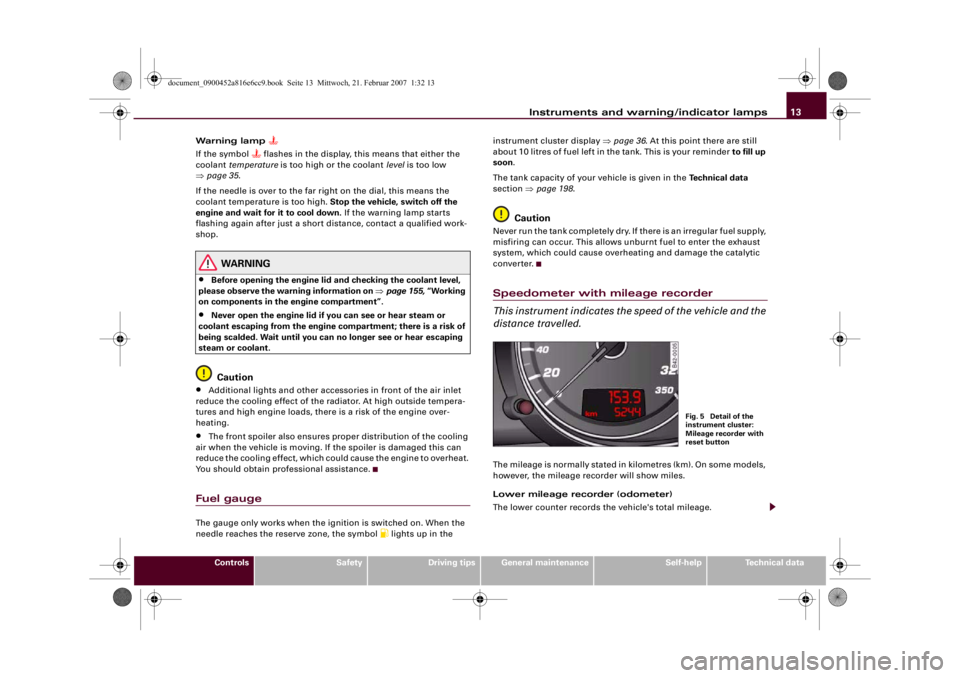
converter.Speedometer with mileage recorder
This instrument indicates the speed of the vehicle and the
distance travelled.The mileage is normally stated in kilometres (km). On some models,
however, the mileage recorder will show miles.
Lower mileage recorder (odometer)
The lower counter records the vehicle's total mileage.
Fig. 5 Detail of the
instrument cluster:
Mileage recorder with
reset button
document_0900452a816e6cc9.book Seite 13 Mittwoch, 21. Februar 2007 1:32 13
Page 155 of 210
Fuel and filling the tank153
Controls
Safety
Driving tips
General maintenance
Self-help
Technical data
Closing the tank cap
– Screw on the tank cap clockwise until it clicks audibly.
– Close the tank flap.When the automatic filler nozzle is operated correctly it will switch
itself off as soon as the tank is “full”. Do not try to put in more fuel
after the nozzle cuts out, as this will fill the expansion chamber in
the fuel tank.
The correct fuel grade for your vehicle is given on a sticker on the
inside of the tank flap. Further notes on fuel ⇒page 152.
The tank capacity of your vehicle is given in the Technical data
section ⇒page 198.
WARNING
Fuel is highly inflammable and can cause serious burns and other
injuries.•
When filling your tank or a spare fuel canister with fuel, do not
smoke and keep away from naked flames. Risk of explosion!
•
Observe all relevant statutory regulations on using, storing and
transporting spare fuel canisters.
•
For safety reasons we do not recommend carrying a spare fuel
canister in the vehicle. The canister could become damaged in an
accident and leak.
•
If, in exceptional circumstances, you have to carry a spare fuel
canister, please observe the following warnings:
−Never fill fuel into the spare fuel canister with the canister
placed in or on top of the vehicle. An electrostatic charge could
build up during filling, causing the fuel vapour to ignite. Danger
of explosion. Always place the canister on the ground to fill it.
−Insert the filler nozzle as far as possible into the spare fuel
canister.−If the spare fuel canister is made of metal, the filler nozzle
must be in contact with the canister during filling. This helps
prevent an electrostatic charge building up.
−Make sure you never spill fuel in the vehicle or in the luggage
compartment. Fuel vapour is explosive. Risk of fatal accident!
Caution
•
If any fuel is spilt onto the vehicle, it should be removed immedi-
ately as it could otherwise damage the paintwork.
•
Never run the tank completely dry. If there is an irregular fuel
supply, misfiring can occur. As a result unburnt fuel can enter the
exhaust system and cause damage to the catalytic converter(s).For the sake of the environment
Do not overfill the fuel tank – it may cause the fuel to overflow if it
becomes warm.
Note
•
Should the fuel tank flap become frozen stuck during inclimate
weather, press the middle of the flap with the palm of the hand and
try again.
•
When the fuel filler pump switches itself off, wait 5 seconds
before pulling out the fuel nozzle so that any remaining fuel flows
into the tank opening.WARNING (continued)
document_0900452a816e6cc9.book Seite 153 Mittwoch, 21. Februar 2007 1:32 13
Page 206 of 210

Index 204
Red symbols . . . . . . . . . . . . . . . . . . . . . 33
Service interval display . . . . . . . . . . . . 21
Setting . . . . . . . . . . . . . . . . . . . . . . . . . . 26
Yellow symbols . . . . . . . . . . . . . . . . . . . 33
Driver messages . . . . . . . . . . . . . . . . . . . . . 34
Driving abroad . . . . . . . . . . . . . . . . . . . . . 138
Headlights . . . . . . . . . . . . . . . . . . . . . . 138
Unleaded fuel . . . . . . . . . . . . . . . . . . . 138
Driving away on a slope
hill hold assist . . . . . . . . . . . . . . . . . . . . 84
Driving safety . . . . . . . . . . . . . . . . . . . . . . 103
Driving time . . . . . . . . . . . . . . . . . . . . . . . . . 22
Dry sump lubrication system . . . . . . . . . 137
Dust filter . . . . . . . . . . . . . . . . . . . . . . . . . . . 76
EElectric fuses . . . . . . . . . . . . . . . . . . . . . . . 190
Electric seat adjustment
SeeSeat adjustment . . . . . . . . . . . . . . . 68
Electric voltage . . . . . . . . . . . . . . . . . . . . . . 14
Electric windows . . . . . . . . . . . . . . . . . . . . 50
Central locking system . . . . . . . . . . . . . 43
Possible malfunctions . . . . . . . . . . . . . 50
Electrical socket . . . . . . . . . . . . . . . . . . . . . 72
Electrical system . . . . . . . . . . . . . . . . . . . . . 18
Electronic differential lock . . . . . . . . . . . 132
Warning lamp . . . . . . . . . . . . . . . . . . . . 19
Electronic immobiliser . . . . . . . . . . . . . . . . 42
Electronic stabilisation program . . . . . . 132
Emission control systems . . . . . . . . . . . . 138
Emissions . . . . . . . . . . . . . . . . . . . . . . . . . 196Engine compartment
Lighting . . . . . . . . . . . . . . . . . . . . . . . . . 58
Safety notes . . . . . . . . . . . . . . . . . . . . . 155
Engine compartment layout . . . . . . . . . . 156
Engine data
SeePerformance, weights and
dimensions . . . . . . . . . . . . . . . . . . . . 198
Engine hood
SeeEngine lid . . . . . . . . . . . . . . . . . . . 155
Engine lid
Closing . . . . . . . . . . . . . . . . . . . . . . . . . 156
Opening . . . . . . . . . . . . . . . . . . . . . . . . 155
Engine oil . . . . . . . . . . . . . . . . . . . . . . . . . . 157
Checking oil level . . . . . . . . . . . . . . . . 157
Consumption . . . . . . . . . . . . . . . . . . . . 157
Dry sump lubrication system . . . . . . . 137
LongLife Service . . . . . . . . . . . . . . . . . 157
Temperature gauge . . . . . . . . . . . . . . . 10
Topping up . . . . . . . . . . . . . . . . . . . . . . 158
See alsoPerformance, weights and
dimensions . . . . . . . . . . . . . . . . . . . . 198
Engine oil capacity
SeePerformance, weights and
dimensions . . . . . . . . . . . . . . . . . . . . 198
Engine oil pressure (too low) . . . . . . . . . . 36
Engine oil sensor defective . . . . . . . . . . . . 37
Environmental compatibility . . . . . . . . . . 139
Environmental tips
Filling the tank . . . . . . . . . . . . . . . . . . . 153
Leaks . . . . . . . . . . . . . . . . . . . . . . . . . . . 156
Warming up the engine . . . . . . . . . . . . 82
EPC warning lamp . . . . . . . . . . . . . . . . . . . 16ESP . . . . . . . . . . . . . . . . . . . . . . . . . . . . . . . . 16
See alsoElectronic stabilisation program
132
Ethanol fuel . . . . . . . . . . . . . . . . . . . . . . . . 152
Exterior mirrors . . . . . . . . . . . . . . . . . . . . . . 64
FFilling the tank . . . . . . . . . . . . . . . . . . . . . 152
Releasing the tank flap manually . . . 154
First-aid kit . . . . . . . . . . . . . . . . . . . . . . . . . 178
Floor mats . . . . . . . . . . . . . . . . . . . . . . . . . 107
Foreign countries
SeeDriving abroad . . . . . . . . . . . . . . . 138
Four-wheel drive . . . . . . . . . . . . . . . . . . . . 136
Front passenger
SeeSitting position . . . . . . . . . . . . . . . 105
Fuel
Capacity . . . . . . . . . . . . . . . . . . . . . . . . 199
Consumption . . . . . . . . . . . . . . . . . . . . 196
Current consumption . . . . . . . . . . . . . . 22
Ethanol . . . . . . . . . . . . . . . . . . . . . . . . . 152
Fuel gauge . . . . . . . . . . . . . . . . . . . . . . . 13
Fuel level low . . . . . . . . . . . . . . . . . . . . . 36
Petrol . . . . . . . . . . . . . . . . . . . . . . . . . . 152
Fuel consumption . . . . . . . . . . . . . . . . . . . 196
Fuel gauge . . . . . . . . . . . . . . . . . . . . . . . . . . 13
Fuel range . . . . . . . . . . . . . . . . . . . . . . . . . . 22
Fuses
Changing . . . . . . . . . . . . . . . . . . . . . . . 190
Fuse list . . . . . . . . . . . . . . . . . . . . . . . . 190
document_0900452a816e6cc9.book Seite 204 Mittwoch, 21. Februar 2007 1:32 13